
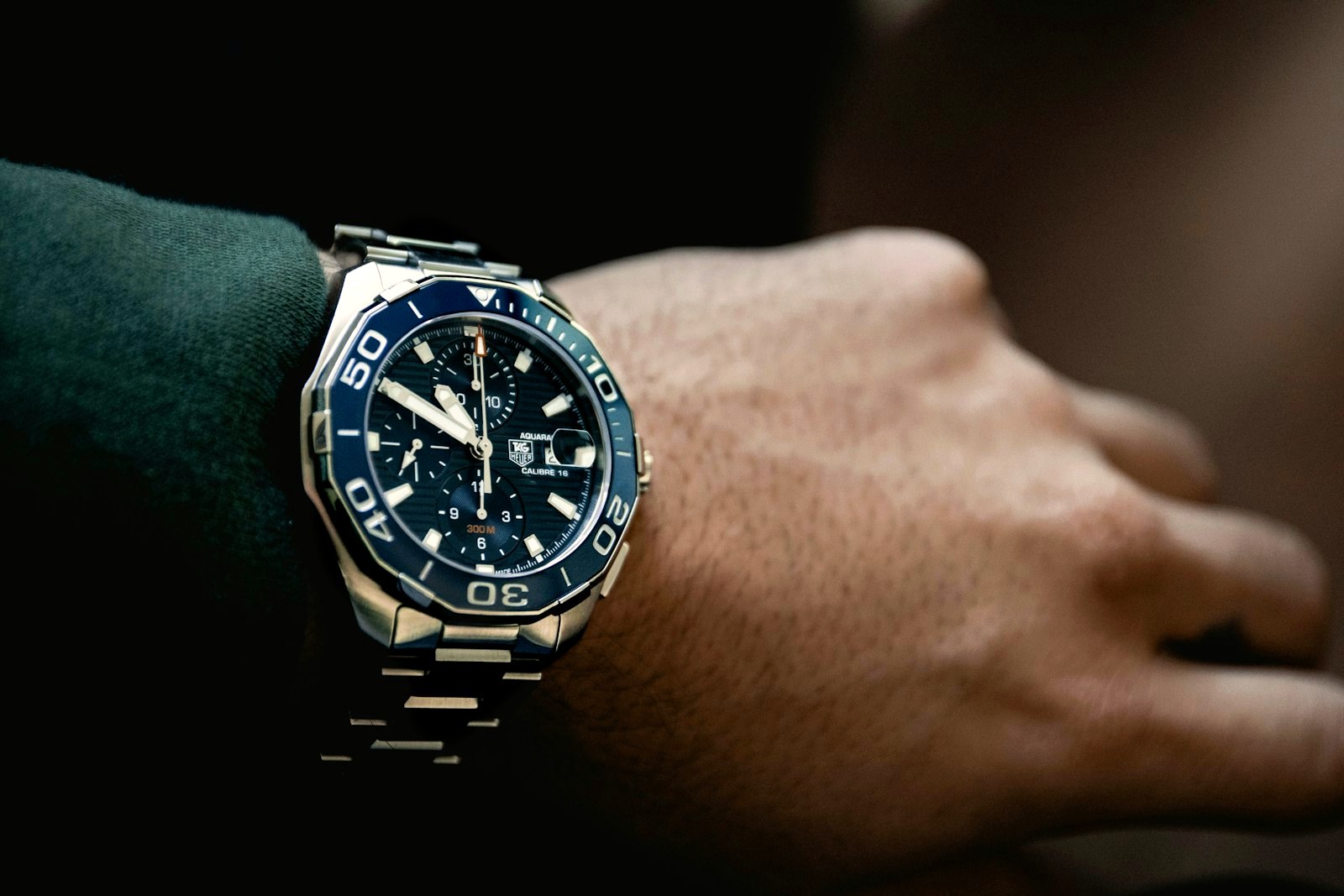
The seat this brief argues from, captioned as exactly that: a steel sports watch on its bracelet, sitting on the flat of the wrist behind the wrist bone, where our case size guide takes the measurement a watch is fitted by. The frame's watch is a sports chronograph in the casual register, used here for its seat and its bracelet, not as a ranked pick; the ranked watches live on Verdict Card No. 02, and the cuff frame our suit brief prints is cited in the text rather than repeated.
Checked and updated October 2026
The ruling, up front: a watch is sized to the wrist and seated by the suit, and it is not matched to the outfit’s colours. The case belongs on the flat of the wrist behind the wrist bone, its lugs inside the wrist’s width, its thickness passed by the cuff it has to live under; everything after that, strap material, metal, dial colour, is register, the choice of which room the watch is dressed for, and register never rescues a fit. The law underneath is already published on this site, in three places: the case size Decoder prints the fit entire, lug-to-lug against the wrist’s flat width and thickness against the cuff; Verdict Card No. 02 ranks the watches themselves, the Citizen Promaster at 81 and the fashion watch sent home at 27; and How to Wear No. 04 seats the finished assembly, the watch under the shirt cuff. This brief applies those records to the wearing, and scores nothing of its own.
This brief: the decisive rule · the seat · the fit law · the strap registers · the dress code, read as thickness · metals, as convention · the one-watch wardrobe · which wrist · the looks · the mistakes · care and our photography
The decisive rule: sized to the wrist, seated by the suit
Every brief in this family has a rule that decides its garment, and this garment arrives with more of its rule already in print than any before it, because a watch is the one thing a man wears that this site has both ranked as an object and measured as a fit. The ranking is Verdict Card No. 02: nine watches under $500 scored on movement, case and crystal, water resistance, value and serviceability, from the Citizen Promaster Diver at 81 down to the Daniel Wellington Classic sent home at 27. The measurement is the watch case size guide, the sizing Decoder’s fifth utility, and its ruling is the sentence this brief is built on: diameter is proportion, lug-to-lug is fit. Between the Card and the Decoder, the wearing is mostly arithmetic, and what remains is register.
That is this brief’s decisive rule: a watch is sized to the wrist and seated by the suit, not matched to the outfit’s colours; the case belongs on the wrist bone’s flat, the dial’s lugs inside the wrist’s width, and everything else, strap material, metal, dial colour, is register, not fit. Sized to the wrist means the footprint test of the seat and fit sections below: a case standing on the flat, lugs inside the edges, at a diameter the Decoder’s matrix assigns to the wrist that carries it. Seated by the suit means the tailoring test: the watch passes under the cuff its day requires, because the suit brief prints the finished wrist entire, jacket sleeve at the wrist bone, a sliver of shirt cuff beyond it, and the watch under the cuff rather than over it. A watch can be a superb object and fail both tests on a given wrist and a given day, and a modest watch that passes both will look better worn than the superb one does. Colour matching, the way watches are usually sold as styling, enters last and weakest: a dial that repeats a tie’s colour is a garnish on an assembly that fit and seat have already decided, and a watch bought for that garnish is bought for one outfit.
Three corrections belong to the rule itself, because this commission arrived with premises the tree corrected, and the corrections are printed here rather than absorbed. The first is about authority: the fit law is not this brief’s to state as new. The Decoder published it entire, matrix, lug ceiling, thickness ladder and mistakes list, and its first named mistake is buying diameter alone, which is what most watch styling, and the first draft of this brief’s commission, takes as its method. This page applies the Decoder; where a number is needed below, the number is the Decoder’s. The second correction is about this page’s photographs, and it runs in this brief’s favour: the bank is not empty on this garment. The watches Card built a shelf of eight frames and a banked spare shelf stands behind it, so this page opens on a worn watch at full register and owes no empty-bank admission of the kind the knit briefs print; the gap that does exist is narrower and is named in the care section, three specific frames the harvest still owes. The third correction is about metals: no belt-and-watch metal law stands anywhere in the tree. Verdict Card No. 17 sells its winning belt with its buckle in stainless steel or solid brass, the buyer’s choice, which is the market itself treating the buckle’s metal as a preference. The metals section below therefore prints the matching rule as what it is, a convention with limits, and not as house law wearing a borrowed uniform.
The seat: on the flat, behind the bone
Before size comes place, and the tree prints the place in its own measuring instructions: the Decoder takes the wrist’s circumference with the tape wrapped just behind the wrist bone, and calls that spot, in print, the spot where a watch actually sits. That is the seat. The wrist bone, the knob at the forearm’s end on the little-finger side, is the gate the case does not cross: worn behind it, on the forearm side, the case stands on the flattest ground the wrist owns, the strap holds it there against the day’s motion, and the hand bends without driving the crown into its back. Worn past the bone, down on the hand itself, the case rides the joint: it tips when the wrist flexes, the crown digs at every bend, and the watch reads as jewellery sliding off its owner rather than an instrument seated on him. It is the single most common wearing failure in the wild, and it costs nothing to fix, because it is not a size failure or a strap failure. It is a postcode failure, the right watch in the wrong place.
The strap’s part in the seat is hold, not decoration: snug enough that the case stays on the flat when the arm swings and the wrist turns, loose enough that the wrist is not clamped and the case can breathe a fraction as the wrist swells across a hot day. Here the brief retires a piece of folk law by name, because it is quoted in shops as if it were a measurement: the two-finger rule, the claim that two fingers should pass between strap and wrist. Stated plainly, it is folk law, a slack test inherited from an era of fixed strap holes, and it measures the wrong thing. Slack is not the seat. A strap loose enough to pass two fingers lets the case travel, over the bone, down the hand, around the wrist’s side, and the watch spends the day being pushed back into place by its owner, the fiddle every room notices. A strap fitted to the seat passes a different test: shake the arm, turn the wrist, make a fist, and the case has not moved. Fit the hold to the seat, in the shop, on the wrist the watch will live on, and let the fingers measure belts, where this site’s belts Card prints a sizing law of their own.
The seat has one more fact, printed because it decides purchases: the seat is personal in a way the case is not. Two wrists of the same circumference can carry different flats, one broad and level, one rounded, and the same case sits honestly on the first and perches on the second, which is why the Decoder’s second measurement exists, the ruler laid across the wrist’s top, bone to bone, read in millimetres. That width is the wearer’s own number, prior to every listing, and the fit law below is simply that number enforced.
The fit law: lug-to-lug against the wrist’s width
The governing measurement is the one almost no listing leads with. Lug-to-lug is the full length of the case from the tip of one lug to the tip of the other: the footprint the watch actually occupies standing on the wrist. Diameter measures the circle in the middle of that footprint, which is why diameter is the marketing number: it photographs as a single clean figure and it cannot tell you whether the watch fits, because two watches sold at the same diameter can differ by five millimetres of lug-to-lug, one sitting flat inside the wrist’s top, the other bridging across it with air at both ends, rocking on the bone. The Decoder prints the whole system and this brief reproduces its matrix because the matrix is the law’s working form:
| Wrist circumference | Sweet spot diameter | Hard ceiling | Max lug-to-lug |
|---|---|---|---|
| 6.0 in | 34 to 36 mm | 38 mm | 44 mm |
| 6.25 in | 34 to 38 mm | 40 mm | 46 mm |
| 6.75 in | 36 to 40 mm | 42 mm | 48 mm |
| 7.25 in | 38 to 42 mm | 44 mm | 50 mm |
| 7.75 in | 40 to 44 mm | 46 mm | 53 mm |
| 8.0 in and over | 42 to 46 mm | 48 mm | 55 mm |
Read the ranked field through it and the Card’s own sentences line up. The Promaster that wins the Card at 81 is a 44 millimetre case, and the Card itself prints the caveat, that it wears large on smaller wrists; the matrix names those wrists, any under 7.25 inches, where 44 is past the ceiling, and it seats the Card’s 38 and 40 millimetre picks, the Seiko 5 Sports at 78, the Orient Bambino at 69, the Citizen Tsuyosa at 76, inside a 6.75 inch wrist’s sweet spot entire. The Card’s size FAQ prints the same law in summary for the field: 36 to 40 millimetres the honest range for most wrists, under about 6.5 inches stay at 38 or below, 6.5 to 7.5 carries 38 to 42 comfortably, and the oversized era is over. Three refinements from the Decoder ride along, because each is a fit fact listings hide. The published diameter excludes the crown, which adds two to four millimetres of real width on the wrist’s most knocked-about side. A square case wears about one size class larger than its width, roughly two millimetres of perceived diameter, because its corners fill the footprint a round case leaves empty. And where a maker will not publish lug-to-lug at all, the Decoder’s sentence stands: an unpublished spec is data too, and the silence is rarely flattering.
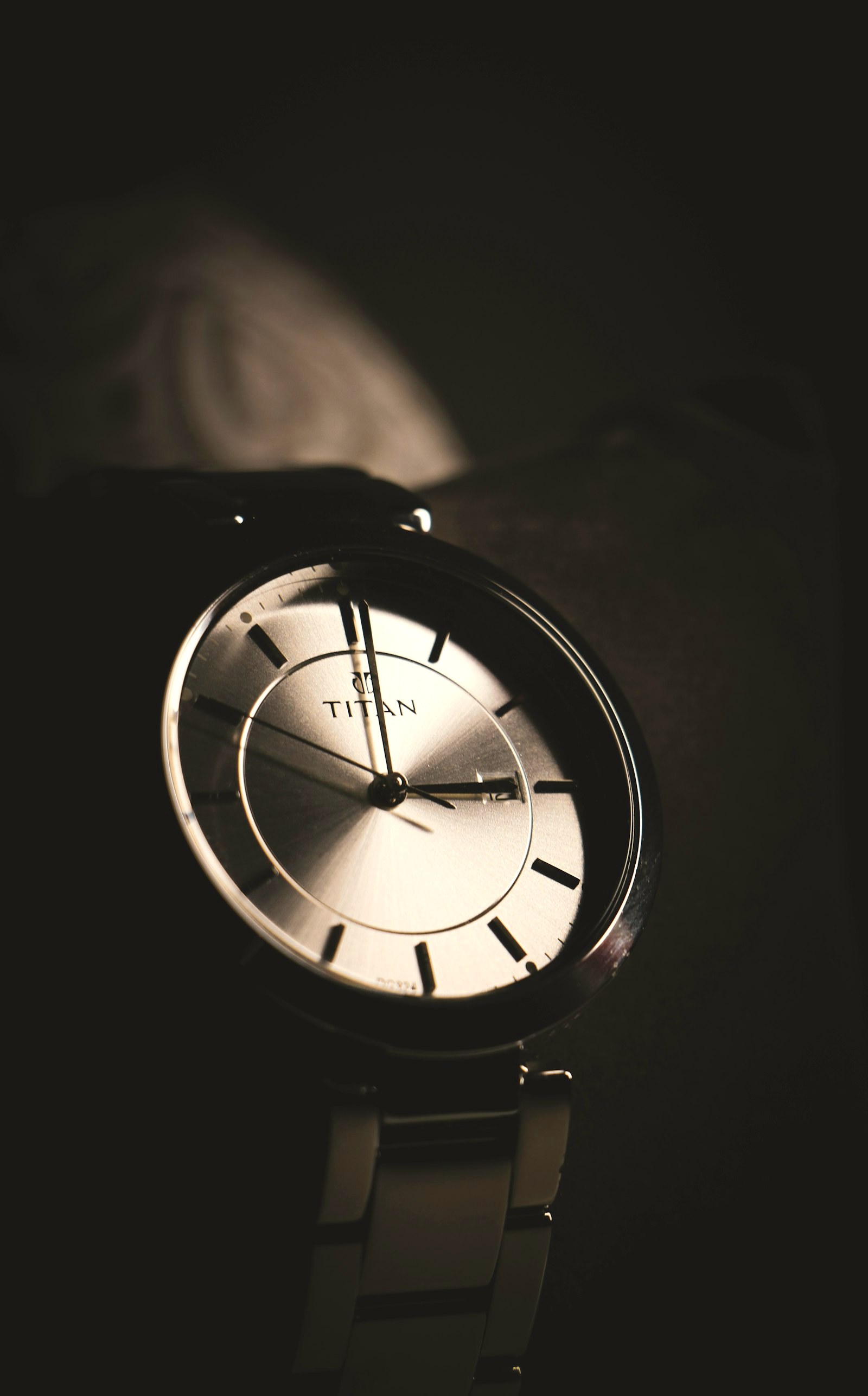
Diameter, demoted to its proper office, still has work to do: it is proportion, the read of the watch against the arm and the outfit’s scale, judged after fit has been settled by the footprint. Inside the matrix row, a man chooses his proportion the way he chooses a lapel width, moderately, aware that the moderate number outlives the cycles at both ends. What he may not do is let proportion overrule the ceiling: a 42 on a 6.25 inch wrist is not a bold proportion choice, it is an overhang, and the room reads it as the Decoder prints it, a watch that looks borrowed. Fit first, proportion inside it, colour last: the order is the whole section.
The strap registers: leather, bracelet, rubber and the field strap
Fit decided by the case, the watch’s register is decided by what it hangs from. The strap is the largest single surface of the worn watch after the dial, it is the part that touches the outfit’s other materials, and changing it moves the same case between rooms without changing the watch, which is why the Card’s Seiko note, that its price leaves money for straps, is a styling sentence as much as a value one. The registers, in descending order of formality, each stated against the tailoring law the tree already prints:
| Strap class | The build | Its seat |
|---|---|---|
| Leather | A hide strap, smooth calf at the dress end, suede and grained leather below it; the Bambino’s brown leather on the Card, the Daniel Wellington’s leather under its conviction | The tailored register: the strap a shirt cuff was designed against, thin, flexible, finished like the shoe and belt leather it sits in the family of. Under No. 04’s cuff assembly this is the default, the watch under the cuff on a strap that folds with the wrist. Its limits are water and sweat: leather is the register that stays dry |
| Steel bracelet | Linked metal, brushed at the tool end, polished accents at the dress end; the Tsuyosa and the PRX on the Card wear the integrated form, case running into bracelet with no break | The sport register made permanent: born with the dive watch, now the default metal of the working week, and in its integrated form a design register of its own, the 1970s silhouette the Card scores on the Tsuyosa at 76 and the PRX at 74. A bracelet carries more presence than leather at the same case size, wears its scratches in the open, and asks the cuff test like everything else: the links add nothing to thickness, and the clasp is the part that catches |
| Rubber | Moulded rubber or resin, the diver’s working strap; the Casio Duro’s card photograph on the Card wears it, at 200 metres and $84.95 | The tool register: water, sport and summer, the strap that makes no claim on tailoring and should not be asked to. Under a knit or a short sleeve it is the honest seat of the dive case; under a suit cuff it is the register error this brief’s matrix prints as a failure row, not because rubber is cheap but because the room and the strap are answering different questions |
| The field strap | One-piece woven straps that pass under the case, and canvas: the NATO pattern and its kin, a single band threaded through both spring bars so a failed bar cannot drop the watch | The casual register entire: the field watch’s strap, worn with the Vaer’s class of watch, at 75 on the Card, and with every unstructured layer in the wardrobe. It adds a visible band of colour and weave under the case, which is its charm at the weekend and its disqualification at the cuff: the doubled pass under the case adds height exactly where the cuff test measures |
Two laws govern the table. The first is that the register is real but it is not fit: no strap moves a watch’s lug-to-lug, and a dress strap on an overhanging case produces a formal watch that still does not fit, the garnish error of the rule section wearing leather. The second is the cuff’s indifference: No. 03 and No. 04 print the same sliver rule for the blazer and the suit, and neither brief grades the watch beneath the cuff by its strap; they grade it by whether the assembly closes. The strap decides which rooms the watch is dressed for. The seat and the thickness decide whether it is dressed correctly in them.
The dress code, read as thickness
Ask what watch a dress code allows and the honest answer is a measurement, not a style: how thick is the case, and does the cuff close over it. The Decoder prints the ladder as a table and this brief prints it as the dress code’s working text, because it is one: under 10 millimetres slides under any buttoned cuff, including a slim Oxford, and is named there the dress watch zone; 10 to 12, most cuffs cope and a fitted one feels snug; 12 to 13.5 needs a relaxed or French cuff and pushes a fitted cuff up the forearm; past 13.5 the watch lives outside the cuff entire, diver and chronograph territory, a weekend ruling and not a defect. The ranked field exhibits both ends in print. The Vaer C5 on the Card is 40 millimetres and slim at under 10, inside the dress zone by measurement whatever its field dial says; the Tissot PRX is a slim 10.4, in the snug band; and the test the Decoder prescribes takes four seconds and no instruments: button the cuff you actually wear to work and slide the watch under it, and if it passes without forcing, the watch is office-compatible at any diameter your matrix row allows.
The dress watch itself is the thin case’s purest form, and the Card’s record for it is the Orient Bambino 38 at 69: 38.4 millimetres under a domed mineral crystal, an in-house automatic movement, $295 against a $430 list, and a total held seventh only because the Card’s water row gives a dress watch 3 of 15 for a job it never does. The Card prints the re-weighting itself, that the reader whose life is offices and evenings can fairly set the water row to zero and call the Bambino his winner, and this brief adopts the sentence as the dress register’s charter: within its job, the thin watch under the cuff is untouchable, and its job is the one No. 04 describes, the continuous tailored surface whose finished edges read as chosen. Against it stands the caution the Card convicts at 27: the fashion watch is also thin, thinner than the Bambino, because there is little inside it to house. Thinness is the dress register’s entry fee, not its credential; the credential is what the case contains, a named movement and a crystal with a material, and the styling inherits whichever of those the object actually is. The evening’s far end deserves one honest sentence: the oldest formal convention holds that a watch is not worn with full evening dress at all, on the reasoning that the evening is not the wearer’s time to watch. It is printed here as a convention, not this desk’s law; modern practice wears the thin dress watch and the matrix below does, but a man who knows the convention exists is dressing with his eyes open, which is the whole of this page’s method.
Metals, as convention: the buckle, the ring and their limits
The standing advice is familiar: match the watch’s case metal to the other metal in the outfit, the belt buckle at the waist and any ring on the hand, so the outfit’s small bright points read as one family rather than a census. This brief prints it, and prints its class beside it, because the tree contains no version of it as law and one piece of evidence against its strictness: Verdict Card No. 17 ranks its winning belt, the Tanner Goods Standard at 86, with a bar buckle offered in stainless steel or solid brass, the same belt, the same score, the buyer’s choice, which is the market filing buckle metal under preference. The ring, the hand’s other metal, is sized by this site’s ring size guide, the Decoder family’s fourth utility, and no page in that family grades a ring by the watch above it either. The convention survives the audit as what it always was: a tidiness, worth observing where it costs nothing, at the dressed end of the wardrobe, where the outfit’s surfaces are few and each one is read.
Its limits are printed with it, in the order a wearer meets them. A steel sports watch is near enough neutral to sit honestly over a brass buckle: steel is the wardrobe’s grey, and the eye does not prosecute it. A watch on rubber or a woven strap has no metal in the pairing to match, and inventing one by choosing the buckle to suit a strap is the garnish error again. Gold is the one metal that argues: a gold case is a statement of register all by itself, and there the convention earns its keep, because a gold watch over a steel buckle is two statements in two metals at two heights. And the order of operations is fixed by the decisive rule: the watch is chosen by fit, seat and register, the belt by its own Card’s law of hide and buckle, and if the metals then disagree mildly, the disagreement is a footnote. No man has ever been well dressed by a buckle, and the convention’s final limit is that it may never choose the watch.
The one-watch wardrobe, argued from the Card
Most men asking how to wear a watch own, or are buying, one, and the styling question collapses into a records question: which single document survives every register the week contains. The Card’s answer is printed at its head and this brief adopts it with its reasoning: the Citizen Promaster Diver at 81, the only watch in the field with no asterisk, solar, ISO-certified to 200 metres, nothing to wind and nothing to feed, its cost per wear 11 cents across a decade of daily wear on the Card’s own table. As a styling object its case is the argument: a 44 millimetre diver is the sport register at full size, and it survives the week’s other rooms not by dressing up but by being a finished instrument, the same way a good boot survives rooms a trainer cannot enter. Two conditions ride on the adoption, both printed in the records themselves. The fit condition: 44 millimetres is a ceiling size, the Decoder’s matrix seats it on wrists of 7.25 inches and up, and the Card’s own caveat, that it wears large on smaller wrists, is the smaller wrist’s instruction to take the same logic one size down. The cuff condition: a diver is thick by trade, and the cuff test of the dress section grades it for the office honestly; the man whose week is a slim Oxford cuff five days running is the reader the Card itself re-weights toward the Bambino, and the field strap and rubber registers exist for the days the diver is dressed for.
The alternatives stand in the Card’s order. The Seiko 5 Sports at 78 is the one-watch answer for the man who wants the machine: 38 millimetres, inside nearly every wrist’s sweet spot, an automatic with a service history measured in decades, and $350 that leaves money for the straps that move it between registers. The Card’s own two-watch sentence deserves its line, because it is the cheapest complete answer in the records: the Seiko 5 for the machine and the Casio Duro for the water, $435 for the pair, and the category is covered, a 38 millimetre automatic for the tailored week and a 200 metre tool for everything the week is not. And the failure the styling inherits is printed at the field’s foot, because a one-watch wardrobe built on it fails in every register at once: the Daniel Wellington at 27 is not a dress watch that dives badly or a tool that dresses badly; it is an unnamed movement, rain-grade water resistance and a mineral crystal at $199, thin because there is little inside it, and no strap, metal or colour choice in this brief can style an object into containing more than it does. That is the one-watch lesson entire: the wardrobe is built on the document, and the document is read before the outfit is.
Which wrist: a convention of logistics
The convention is that the watch goes on the non-dominant wrist, the left for most men, and this brief prints it with its reasoning exposed, because the reasoning is the useful part. The non-dominant wrist writes less, lifts less, gestures less and knocks into less; the case seated there survives longer and is read with a turn rather than a performance. The crown, which stands on the case’s right side, is worked by the dominant hand’s fingers when the watch is worn opposite them, an arrangement so old it is built into the object’s shape. Nothing in the reasoning is etiquette. It is damage control and ergonomics, logistics wearing the clothes of a rule.
The exceptions follow from the reasoning, which is how a convention with its reasons printed behaves. The left-handed wearer reverses it entire, and wears the watch on the right, where his writing hand will not drag the case across every page and desk; makers build crown-reversed watches for exactly this wrist, and their existence in the market is the convention admitting its own logic. The wearer whose dominant side is the working side, the hand in the engine bay, on the tools, at the bench, reverses it for the first reason the convention gives: the watch goes where it survives. Desk workers meet the mildest version, the case’s underside and clasp against the desk all day, which argues for the bracelet’s brushed finish and against worrying further. What no exception produces is a styling verdict: no brief in this family fails an outfit for the wrist its watch is on, and a watch worn on the wrist where it lives longest is worn correctly by the only measure the records recognise.
The looks: the watch styled on the published records
Six assemblies from this brief’s rulings. The watches in them are the Card’s, at the Card’s scores; the tailoring is the family briefs’; nothing in the judgments is scored here.
| Setting | The assembly | With | The judgment |
|---|---|---|---|
| The suit, entire | The Orient Bambino 38 at 69 on its brown leather strap | No. 04’s assembly: sleeve at the wrist bone, the sliver of cuff showing, the watch under the cuff | The dress register’s reference row: 38.4 millimetres of thin case on leather, passing the cuff test by design, its Card total irrelevant in the one job it was bought for, exactly as the Card’s own re-weighting prints. This is the wrist the suit’s continuous surface asks for, and the row the whole brief is calibrated by |
| The blazer week | The Citizen Tsuyosa at 76 on its integrated bracelet | No. 03’s sliver of cuff, knit or Oxford beneath the jacket | The design register at working volume: the bracelet’s taper is the outfit’s one piece of jewellery, the case at 40 millimetres inside the common sweet spot, and the Card’s dry-land warning observed, 50 metres and no screw-down crown, a watch for the office’s weather and no other. The PRX at 74 takes the same seat for the man who prefers his design Swiss and his upkeep near zero |
| The mechanical default | The Seiko 5 Sports at 78, straps rotated by register | Leather for the tailored days, the field strap at the weekend, the case unchanged | The one-watch wardrobe’s transferable row: 38 millimetres that fit nearly every wrist in the matrix, an automatic that asks its year-five service and prints the price of it on the Card, and a register changed at the strap, which is the cheapest styling operation in this entire family. The assembly is the Card’s first-automatic verdict worn as a system |
| Weather and water | The Citizen Promaster Diver at 81 on its working strap | The trench’s covered cuff over it, or a knit’s cuff pushed back, never a slim Oxford | The tool register worn honestly: the Card’s winner at full size, outside the cuff by the Decoder’s thickness ladder and under the coat’s covered sleeve by the trench brief’s reverse rule, the two tailoring laws meeting at one wrist and agreeing. The Duro at 70 takes the same row at $84.95 for the man whose water is weekends only |
| The field and the road | The Vaer C5 Field Solar at 75 on the field strap | Denim, chore cloth and the unstructured rail, per the family’s casual briefs | The casual register’s reference row: a 40 millimetre case slim at under 10, solar, with two straps in the box on the Card’s record, worn where the woven strap’s colour is an asset and its added height costs nothing. It is the watch the weekend rows of every matrix in this family have been implying |
| The failure, printed as a ruling | The Daniel Wellington Classic at 27, on any strap, with a suit | Nothing can save it | The cautionary row: not a fit failure, since 40 millimetres sits inside the sweet spot, and not a thickness failure, since the case is thin to a fault. It is the document failing under the styling: an unnamed movement and rain-grade resistance dressed in the dress register’s clothes, the garnish error as a product. The row exists so the failure can be recognised at the rail: the watch that can be styled into nothing, because there is nothing in the case to style |
The wardrobe the matrix implies is sequenced like the Card’s own buying order: the document first, one watch whose record survives the week’s registers, fitted by the Decoder’s matrix before its colour is discussed; the strap rotation second, the cheapest range a watch wardrobe can buy; and the second watch, when it comes, bought as the Card directs, for the register the first one cannot enter, the water, the evening, rather than as a variation on the one already owned.
The ruling
Wear the watch the way the records build it. Seat the case on the flat behind the wrist bone and fit it by the footprint, lug-to-lug inside the wrist’s width, diameter chosen as proportion inside the Decoder’s row and never above its ceiling. Pass it under the cuff its day requires, on the strap its register asks for: leather under tailoring, the bracelet as the working week’s metal, rubber and the woven strap in the rooms that are theirs. Read the dress code as thickness, keep the metals as a convention and never let a buckle choose a watch, and build the wardrobe on the Card’s documents, the Citizen at 81 for the wrist that carries it, the Seiko at 78 for the man who wants the machine, the Bambino at 69 for the cuff’s own life, and the fashion watch at 27 left on the rail where its spec sheet put it. A watch worn this way stops being the outfit’s garnish and becomes what the ranked ones are: an instrument that fits its owner, in every sense the word carries on this site.
The mistakes
Buying diameter alone. The Decoder’s first named mistake, and the industry’s favourite, because diameter is the number that photographs. The listing’s 40 can stand on your wrist or bridge across it, and only the lug-to-lug knows which; a watch bought on the headline number is a watch fitted by an advertisement, and the returns it generates are the market’s most predictable. The cure is two measurements of your own wrist, taken once, printed in the Decoder, and carried into every shop thereafter.
The watch worn over the cuff. The seat’s public failure: the case strapped outside the shirt cuff, holding the cuff down and announcing the watch to the room. No. 04 prints the correct assembly in one line, the watch under the cuff rather than over it, and the over-cuff wearer is almost always reporting one of two facts, a watch too thick for the cuff it is worn with, which is a weekend watch at work, or a wearer who wants the watch seen, which is a garnish motive wearing a fit failure as its method. Either way the wrist is telling the truth about the assembly, loudly.
The colour-matched watch. The decisive rule’s named error as a purchase: the dial bought to repeat a suit, a tie, a pair of shoes, in a colour the wardrobe wears twice a year. The watch is the most-worn object a man owns, the Card costs its field across 365 wears a year, and an object worn daily cannot be styled to an outfit worn monthly. Buy the dial in the colours the wardrobe lives in, black, white, cream, blue, the field the ranked watches themselves are printed in, and let ties do the matching.
The register drift. The right watch in the wrong room by small degrees: the diver’s rubber under the wedding suit because it is the good watch, the field strap under a blazer because it was already on, the dress watch taken swimming on the reasoning that 30 metres sounds deep, the Card’s own trap, printed in its FAQ, that 30 metres means rain. Each garment in the assembly has a register and the drift spends them one at a time until the outfit is a committee. The strap rotation exists because the drift is cheaper to fix at the strap than at the case.
The fashion watch, styled as an instrument. The failure row’s general form: a logo-priced watch with an unnamed movement worn as if its thin case were a dress watch’s credential and its clean dial a design argument. The Card prints the audit at 27 and the arithmetic that convicts it, a five-year working life that makes it cost more per wear than a sapphire solar field watch. Styling cannot repair a document. The mistake is not owning a fashion watch, which at an honest price is a fair trade the Card itself allows; it is paying instrument money for one and wearing the receipt as the credential.
Care, and a note on our photography
A watch is kept the way the Card’s ledger prints it, in services rather than rituals. The automatic wants its service around year five, $150 to $250 at an independent watchmaker for the ranked field’s calibres, more at a brand centre, and the bill is part of the purchase whether it is budgeted or not, which is why the Card prints it inside the cost per wear. The quartz wants a battery at $10 to $20 every few years; the solar pair want nothing for a decade or more, until the rechargeable cell tires. The strap is the consumable in the system: leather is rested and rotated rather than worn daily into ruin, a bracelet is washed as the metal it is, and a strap at the end of its life is replaced for the price of a lunch, the cheapest renewal in the wardrobe. Water resistance is a rating with a service life of its own, held by seals that age; the Card’s translation stands, 100 metres swims, 30 metres is rain, and a watch whose seals have never been checked is wearing its rating as a memory. Kept on that ledger, the ranked watches are decade objects, and the ledger, not the polishing cloth, is what care means for an instrument.
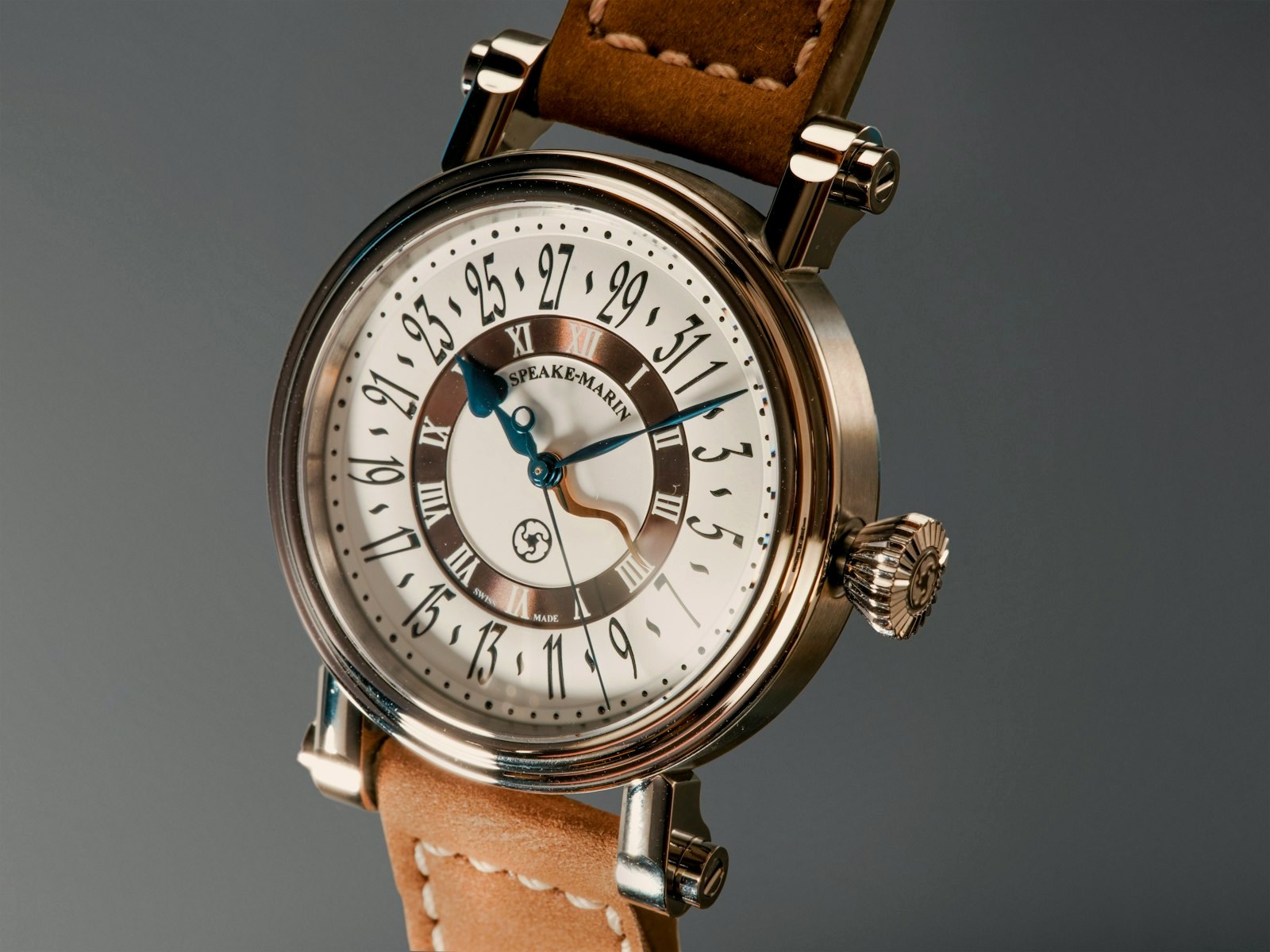
A note on our own photography, narrower than the ones the knit briefs print, because the bank’s position here is the reverse of theirs: our photo bank holds a full watch shelf. The watches Card placed eight frames and a banked spare shelf stands behind them, and this page’s three frames are spares with no prior page use, each captioned for exactly what it shows: a steel sports chronograph seated on the wrist’s flat for the hero, a slim minimal dial at macro range for the fit section, a dress watch on a suede strap, a studio still life, for the strap register. What the bank does not hold is three specific frames this brief would use the week they exist, and the harvest list names them in the order this page wants them: a watch seated under a buttoned shirt cuff in a fresh frame first, since the bank’s one cuff frame already fronts the suit and blazer briefs and the Bambino’s card and this page cites it rather than repeating it a fourth time; the same case on a leather strap and a bracelet side by side second, the register argument in one photograph; and a lug-to-lug measurement being taken, ruler across the case over a wrist, third, the Decoder’s second measurement in the wild. Until those land, every frame here is labelled for what it shows, and the ranked watches are described from their Card, where their own photographs stand. Prices and records on this page were checked against the site’s own published Card and Decoder in October 2026; the method that built them is written out on the methodology page, and where this brief’s garment sits among the site’s winners is mapped in the Body Map.
Questions, answered
How should a watch fit on the wrist?
By its footprint, not its headline number. The case sits on the flat of the wrist just behind the wrist bone, and it fits when its lug-to-lug length, the full distance from lug tip to lug tip, stays inside the flat width of your wrist, the ceiling our watch case size guide prints for every wrist size. Diameter is proportion: our Decoder's matrix puts a 6.75 inch wrist at a 36 to 40 millimetre sweet spot with a 48 millimetre lug-to-lug ceiling. A watch whose lugs overhang the wrist's edges is too big at any diameter, and it will rock on the bone, catch on cuffs and read as borrowed.
Should a watch match the outfit?
No. A watch is sized to the wrist and seated by the tailoring, and only then does register enter: the strap's material and the case's thickness decide which outfits the watch can sit in, the way our suit brief seats the watch under the shirt cuff and our case size guide grades thickness against the cuff at a 12 millimetre working line. Colour is the last and weakest variable. A watch bought to match one suit's colours is a watch that fits one outfit; a watch that fits the wrist and passes the cuff test fits the wardrobe.
Can you wear a dive watch with a suit?
The cuff decides, and the test is mechanical: button the cuff you wear to work and slide the watch under it. Our case size guide prints the ladder: under 10 millimetres thick slides under any buttoned cuff, 10 to 12 most cuffs cope with, past 12 the watch pushes the cuff up the forearm, and past 13.5 it lives outside the cuff whatever the dial says. A slim sports watch that passes is a suit watch in practice. A thick diver that fails is a weekend watch, and wearing it over the cuff announces the failure. The dress seat itself belongs to the thin case: the Orient Bambino 38, 69 on Verdict Card No. 02, built for cuffs at 38.4 millimetres.
Should the watch go under or over the shirt cuff?
Under, always, when it fits there. Our suit brief prints the assembly entire: the jacket sleeve ends at the wrist bone, the shirt cuff shows beyond it by roughly a centimetre, and the shirt cuff sits at the wrist with the watch under it rather than over it. The watch strapped over the cuff reverses the layers tailoring built, holds the cuff hostage and reads as a man showing the watch rather than wearing it. The one honest exception is a watch too thick to pass under the cuff at all, and our Decoder's ruling on that watch is that it is a weekend watch, not a cuff to be worn outside.
Which wrist should a watch go on?
The non-dominant one, by convention, and the convention is logistics rather than etiquette. The watch sits on the wrist that writes less, lifts less and knocks into less, so the case survives and the crown, which faces the hand on the right side of the case, can be worked by the dominant hand. Left-handed wearers reverse it, and wearers whose dominant wrist takes the damage at work reverse it for the same reason the convention exists. What the convention is not is a dress code: no outfit in this family is failed by the wrist a watch is worn on, and a watch worn where it survives is worn correctly.
Do the metals of a watch and a belt buckle have to match?
It is a convention, not a law, and this site prints it as one. The standing advice, match the case metal to the belt buckle and any ring, tidies the small bright points of an outfit into one family, and at the dressed end of the wardrobe it is worth the small effort. Its limits are printed with it: our belts Card sells its winner with a buckle in stainless steel or solid brass as the buyer's choice, which is the market treating buckle metal as a preference, not a specification; a steel sports watch is near enough neutral to sit over either; and a diver on a rubber strap has no metal in the pairing to match. Match the metals when the outfit is tailored. Never let a buckle choose a watch.
Has Young Cotton ranked watches?
Yes. Verdict Card No. 02 ranks nine watches under $500 out of 100 on movement, case and crystal, water resistance, value and serviceability: the Citizen Promaster Diver wins at 81, solar, ISO-certified to 200 metres and nothing to wind or feed; the Seiko 5 Sports is the best automatic at 78; the Orient Bambino 38 is the dress watch at 69, its total held down by a water row its job never uses; and the Daniel Wellington Classic is sent home at 27, an unnamed movement and rain-grade water resistance at a $199 list. This brief styles the wearing of watches from that record and from the case size Decoder, and scores nothing of its own.
Next
The records this brief is built from: the watches themselves are ranked in Verdict Card No. 02, nine watches under $500 scored out of 100, and the fit system is printed entire in the watch case size guide, the sizing Decoder’s fifth utility, beside the ring size guide for the hand’s other measurement. The tailoring the watch is seated by is briefed in How to Wear No. 04, where the cuff rule and the watch’s place under it stand in print, and in No. 03, where the same sliver governs the jacket that was born alone; the coat that reverses the rule is the trench brief. The family’s previous brief, on the garment at the opposite end of the winter wardrobe, is How to Wear No. 52; the belt the metals section argues from is ranked in Verdict Card No. 17.