
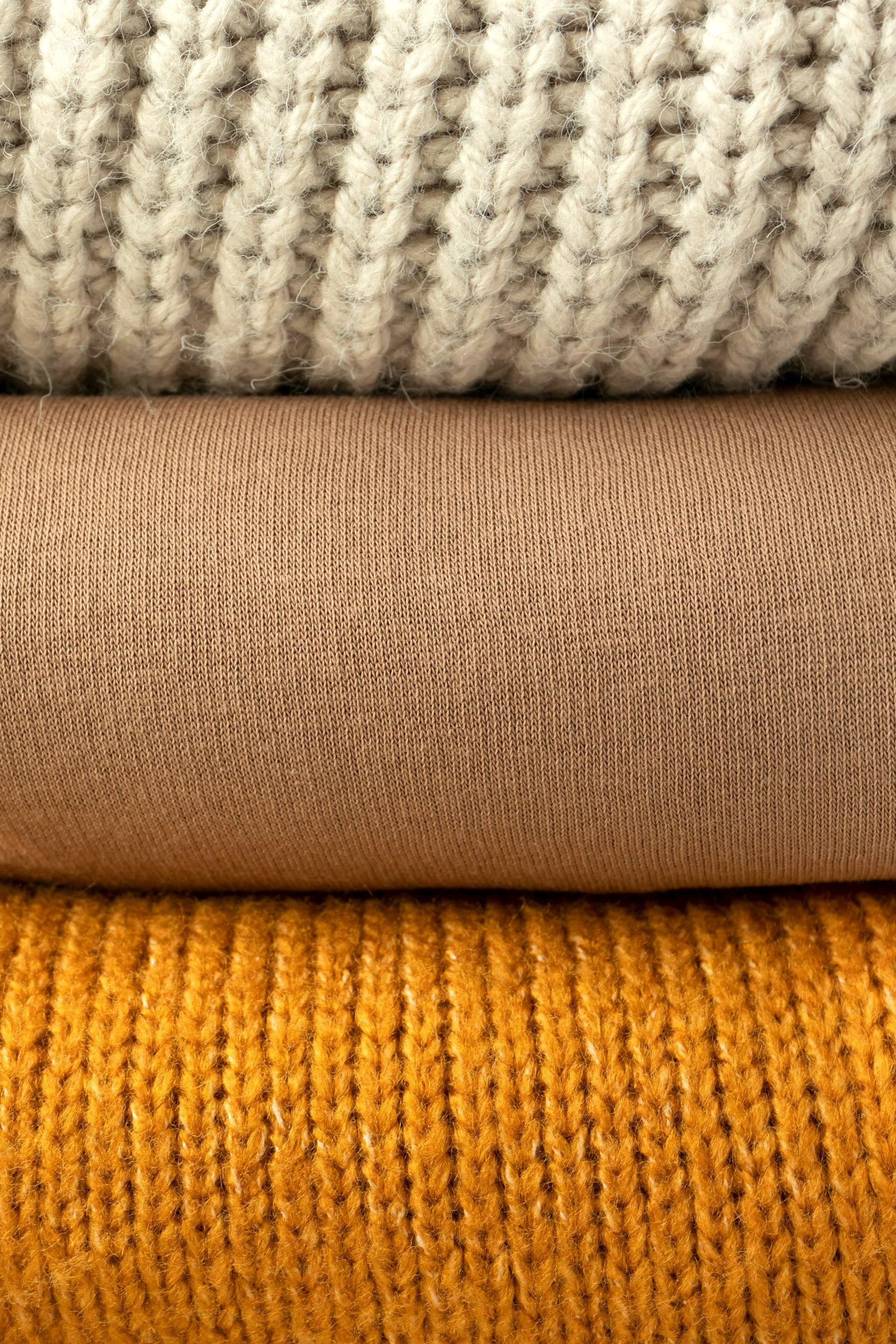
The cloth this page argues from, captioned as exactly that: plain knits at macro range, rib and stockinette in the yoke's own winter colours. Our bank holds no photograph of a Fair Isle sweater, worn, folded or at any range, so this page opens on the knit itself rather than dressing a plain sweater as its subject; the gap and the harvest list are named in the honesty section below.
Checked and updated October 2026
The ruling, up front: the Fair Isle sweater is the outfit’s one pattern and its loudest colour at the same time, carried in a single band at the top of the body. Everything else in the outfit is plain, and its colours are taken from the yoke’s own. The law underneath is already published on this site, twice: How to Wear No. 36 prints the one-pattern law for the patterned vest and applies it without exception, and No. 39 prints it for the fisherman’s cable. This brief extends the law to the yoke, styles the garment on the neighbouring ranked records, and scores nothing of its own, because no Card on this site ranks this type, and the brief says so rather than borrowing a ranking’s authority it does not hold.
This brief: the decisive rule · the garment · the species · the sweater test · the plain partners · the layers · the festive boundary · the looks · the mistakes · care and our photography
The decisive rule: one pattern, and its colours rule the outfit
Every brief in this family has a rule that decides its garment, and this garment arrives with its rule half printed, because the family has been wearing patterned knits under one law for two briefs now. The law, as No. 36 prints it for the patterned vest, is that the patterned garment is the outfit’s single pattern, worn over a plain shirt, with plain trousers, and no tie or a solid one only, because a patterned vest over a checked shirt under a striped tie is three statements shouting in a stairwell. No. 39 prints the same law for the Aran’s cable: the one-pattern law this site prints without exception retires everything else in the outfit to plain cloth. The Fair Isle yoke is the family’s third patterned knit, and it is the loudest of the three, because it is the only one whose pattern is also its colour: the cable is a texture in one yarn, the argyle a pattern in a vest’s small panel, and the yoke a band of three, four, five colours ringing the chest at the height every eye lands first.
That is this brief’s decisive rule: the yoke is the outfit’s only pattern and its loudest colour, so everything else in the outfit is plain, dark or neutral, and what colour the partners carry is taken from the yoke’s own bands. The trouser in the yoke’s rust or its navy, the shirt in its cream or its pale blue, the coat in its charcoal: the outfit is built out of the sweater’s palette, at lower volume, in plain cloth. A partner in a colour the yoke does not carry is a second decision competing with the first; a partner with a pattern of its own is the pile-up No. 36 names as the family’s standing failure. The rule is not caution. It is arithmetic: one band of pattern at the chest is a winter register, the fireside read made deliberate, and the same band over a checked shirt under a striped scarf is a costume, and the distance between the two is entirely in what the wearer put around it.
Two corrections belong to the rule itself, because this commission arrived with premises the tree corrected, and the corrections are printed here rather than absorbed. The first is a number: the Oxford this brief layers beneath the yoke is ranked on Verdict Card No. 01, the Kamakura at 93; the No. 02 sometimes cited for it is the white tee Card, and a brief that layers on the wrong Card’s record has graded nothing. The second correction is wider, and it is this page’s scope, stated once and plainly: no Verdict Card on this site ranks Fair Isle sweaters. The sweaters index files ten types and this is not one of them; the Winter Edit’s knit is the plain fisherman; the Holiday Edit carries no Fair Isle appearance at all. What the tree holds is the law, printed twice, the patterned garments graded on the vest Card, and the heavy-knit standard on the fisherman Card. This brief is built from exactly those records, extends the law from the vest and the cable to the yoke, and invents no ranking, no score and no garment to fill the space where a Card would stand. Where the record ends, the brief says the record ends.
The garment: what the yoke is, and what it settles
Fair Isle is a technique before it is a sweater, and the brief prints the technique as a table because every styling ruling below is one of its facts wearing clothes. The pattern is stranded colourwork: two colours carried in every row of the patterned band, the unused colour floating in strands across the back of the work, which is where the technique takes its name in this site’s filing, banded yoke patterns from the northern knit tradition, named for the Shetland island the knitting comes from.
| Part | The build, as the record and the technique print it | What it settles |
|---|---|---|
| The yoke | The patterned band itself: rings of small geometric motifs, crosses, diamonds, stars and peeries, worked across the chest, shoulders and upper back, decreasing as it rises so the band is also the garment’s shaping | The pattern’s placement is the styling problem entire: the loudest surface sits at the height of the face and the handshake, above every partner the outfit adds below it |
| The strands | Two yarns in every patterned row, the resting colour carried behind the work in floats; the yoke is a double layer of yarn where the body is a single one | The yoke is the warmest part of the sweater and the part with the least drape: it sits on the chest as a shallow panel, which is why the garment layers under a coat and not inside a blazer’s frame |
| The body | Plain below the yoke in the traditional build, one colour from the band’s ground or its deepest motif colour, in stockinette | The sweater carries its own plain partner inside itself: the body is the quiet the yoke is loud against, and an outfit that adds pattern below is arguing with a garment that has already settled the argument |
| The colours | Traditionally the undyed and dyed wools of the islands: natural whites, greys, browns and blacks, with madder red, indigo and lichen yellows carried in the motifs; modern builds run the same bands in whatever palette the maker chooses | The palette is the outfit’s palette by the decisive rule: the partners’ colours exist already, printed in the band, and the quieter the yoke’s colours, the wider the wardrobe it stands in |
| The fibre | Wool in the tradition entire, Shetland and lambswool; the modern rail adds every blend the knitwear Cards have graded and convicted elsewhere | The buying law is the family’s: read the split before the colours, because a stranded pattern in acrylic carries the picture and deletes the warmth the strands exist to make |
Read the table once and the brief is mostly arithmetic. A pattern placed at the chest cannot be styled quiet by anything worn beneath it; it can only be framed, by plain cloth in its own colours. A yoke built as a double layer cannot sit inside a tailored frame cut for a single one. And a technique whose whole substance is two yarns in every row is a warmth technology wearing a pattern, which is why this family grades its fibre the way the fisherman is graded: the picture is the last thing bought, after the wool and the weight of the thing.
The species: the yoke, the band and the all-over
The garment is sold at three pattern scales, and the scale is a styling class, not a taste: each scale takes a different size of room, and the brief prints them in order of volume.
| Species | The build | Its seat |
|---|---|---|
| The full yoke | The traditional build: the patterned band rings the whole upper body, chest, shoulders and back, at its fullest from the upper arm to the neck | The statement species, and the one this brief is written for: the outfit’s whole pattern and most of its colour in one garment, worn with the plain partners at full quiet, in the rooms winter gives it, the country weekend, the cold city day, the fireside it is always accused of belonging to and wears as a register when the rest of the outfit is disciplined |
| The chest band | One or two motif bands across the chest only, the shoulders and back plain; the yoke’s border without its ring | The working species: half the volume at the same placement, the first patterned knit a plain drawer should own, because it takes the yoke’s partners and the yoke’s law at a setting a office-adjacent winter day can hold, and it layers under a coat with less of the panel to arrange |
| The all-over | The motifs repeated down the body and the sleeves, pattern at every height, no plain ground anywhere on the garment | The loudest species and the narrowest seat: a ski-lodge and highland register, worn where the whole outfit is leisure and the partners are reduced to one plain trouser and boots; in a city outfit it spends the one-pattern law’s whole budget on itself and leaves nothing for the room, and this brief seats it knowingly or not at all |
Below the species stands the mechanism the family sends home wherever it meets it, and it belongs in this section because it is a species claim that fails: the printed yoke, a plain machine-knit sweater with the motifs printed or intarsia’d as a picture on a finished garment, at a fibre line that reads polyester first. Verdict Card No. 56 prints the conviction for the family: the Zara argyle, a heritage pattern over 69 percent polyester, sent home at 33, because the pattern is a promise of a knitted wool garment and the cloth underneath it is not one. Verdict Card No. 59 prints it again for the fisherman, a full cable pattern at 4 percent wool, sent home at 34. A Fair Isle bought as a picture is the same garment in a third pattern: the motifs kept, the strands, the wool and the point deleted. The species are bought by the split first and the scale second, and no scale in the table rescues a fibre line that fails.
The sweater test: three checks before the mirror
The neighbouring Cards grade patterned knits as records; the wearer meets this one as a single garment on a rail. These checks are the decisive rule and the family’s disclosure law in shopping form, run in under a minute.
The split check. Read the composition line before the colours. Wool in the majority, ideally alone; a little nylon behind it is a durability decision the knitwear Cards grade as one; acrylic or polyester at the front of the line is a cost decision wearing the tradition’s clothes. This is the whole of No. 56’s and No. 59’s convictions, applied at the rail: six of the vest Card’s eight makers published a complete fibre record and the two patterned garments failed theirs, and the fisherman’s field convicted its skip on the same line. The yoke’s colours are the last thing to judge, after the yarn that carries them.
The strand check. Turn the yoke inside out at the shoulder. A real colourwork yoke shows its working: the resting colour carried in floats across the back of the band, two yarns’ worth of cloth in the patterned rows. A printed or surface motif shows a plain reverse, one yarn, the picture on the front only. The check takes five seconds and it is the garment’s whole claim in one look: the strands are the warmth, the shaping and the tradition, and a yoke without them is a photograph of this sweater, priced as the sweater.
The palette check. Name the yoke’s colours out loud, then name the trousers and shirts already in the drawer that carry them. A yoke in natural whites, greys, navy, rust and brown stands on the whole winter rail this brief prints below; a yoke in five colours the drawer does not own is an outfit bought one garment at a time, forever, because the decisive rule takes the partners’ colours from the band. Buy the yoke whose colours are already in the wardrobe, at the scale the rooms can hold: the chest band for the first one, the full yoke when the plain partners are already hanging beside it.
The plain partners: corduroy, denim, tailoring and the pale rail
Below the yoke, the wardrobe is the plain rail, and every rung of it is ranked. The corduroy is the first seat, the yoke’s natural partner in the family’s own filing: texture answering texture, both of them winter cloths with a rural register, neither carrying a pattern. The ranked cord is the Drake’s Field Games at 79 in Verdict Card No. 38, 100 percent cotton at a published 15.4 ounces, in the deep colours, rust, tobacco, forest, that a traditional yoke’s bands already carry. The denim is the second seat, worn under the denim law: a dark, plain leg with nothing competing at any height, the Levi’s 501 at 81 in Verdict Card No. 11, rigid cotton and a button fly, its indigo deep enough to read as the yoke’s ground colour worn below. The pairing is the fireside register made urban: the jean contributes its plainness and its year-round standing, the yoke contributes all of the outfit’s decision, and the double denim brief’s one-axis discipline is respected by construction, because a knitted yoke is not a second denim and makes no claim on the axis. The tailored trouser is the dressed seat: grey flannel or charcoal wool, plain, pleated or flat, the trouser the vest brief’s own matrix seats under its fair isle row, at the formality the yoke can reach when its colours are quiet and its partners are silent. The pale rail is the far end, and it is rationed: the Drake’s ecru fatigue at 83 in Verdict Card No. 73, under a quiet yoke only, cream and natural bands over ecru being the tradition’s own tonal register; under a loud yoke the pale trouser is a second bright surface, and the law retires it.
The rail’s borders are the law’s borders. No patterned trouser of any kind, no check, no stripe, no second knit with a claim. No black jean under a natural-colour yoke unless the band carries black itself: the rule takes the partners’ colours from the yoke, and a colour the band does not print is a stranger at the outfit’s table. And no trainer-led leisure bottom: the yoke is a knitted garment with a tradition’s posture, and the jogger beneath it spends that posture on a pairing neither garment asked for. The rail is short because the rule is strict: four plain trousers, all ranked or filed, all in the band’s own colours, and the sweater is at home on every rung of it.

The layers: over the Oxford, under the coat, never under a pattern
The yoke layers in two directions, and the tree prints both. Beneath it, the plain shirt. The vest brief’s matrix seats the family’s own assembly: a fair isle in quiet colours over a plain pale Oxford, and the sleeved sweater takes the same seat with the collar law of the crew brief, No. 09: a button-down collar, because its buttons hold the points down inside the neckline, about a finger’s width of collar showing above the knit, the points contained. The shirt ranked for the seat is the Kamakura Oxford at 93 in Verdict Card No. 01, in white or pale blue, the two colours a traditional band carries in its ground. What the shirt may not be is patterned: the check and the stripe are retired by the law entire, and a tipped or club collar is a second small pattern filing its claim at the one place the outfit is looked at longest. The shirt’s cuffs are its other permitted appearance, plain, at the wrist, below a sleeve that is itself plain in every species but the all-over.
Above it, the coat, and only the coat. The heavy-knit brief prints the layering of the family’s other loud knit: the fisherman under a coat is a layer and a proud one, its pattern reading as texture at the coat’s open front. The yoke takes the same seat at higher volume: the overcoat plain and dark, worn open or loosely buttoned, the band showing across the chest as the outfit’s single pattern where a scarf’s would sit, except that this pattern is the garment and needs no arranging. The scarf itself is the layer the law rations hardest: a plain scarf in one of the band’s colours is a frame; a patterned scarf over a yoke is the pile-up at the throat, the two loudest surfaces in the outfit stacked in the same six inches. And the blazer is refused, on the garment table’s arithmetic: the yoke is a double layer of yarn crossing the chest exactly where a jacket’s opening frames it, and the knit our tailoring seats is the plain crew, the Smedley Lundy at 87 in Verdict Card No. 10, a single quiet surface the lapels were cut to hold. The yoke’s dressed seat is not the jacket. It is the coat, the fire and the cold day, worn as the top knit layer with everything above it plain and everything below it plainer.
The festive boundary: the pattern and the picture
Every winter this garment is sold beside its impersonator, and the brief prints the boundary as a ruling because the two are confused at the rail more than anywhere else in knitwear. The Fair Isle yoke is a pattern: small motifs, in bands, at knitting scale, worked into the cloth by the technique itself, in colours drawn from a wardrobe’s winter palette. It has no date on it. It is worn from the first cold week to the last, at the office’s edge, in the country, in the city, and its register is the register of every traditional garment on this site: a working pattern that earned its place and kept it. The festive jumper is a picture: one motif at chest scale, a reindeer, a tree, a slogan, a face, knitted or printed as a single image, in the colours of one holiday, bought for the parties of one month and retired, by its own design, with them. The picture is not a debased yoke and the yoke is not a tasteful jumper; they are different garments sharing a rail, and each is honest in its own seat.
The boundary’s rulings run in both directions, and neither is a sneer. The yoke worn as the festive garment, chosen loud, in the novelty colours, because it reads seasonal at the office party, spends a decade garment on a one-evening read and arrives overdressed for the joke and underdressed for everything else: No. 09 files a novelty or graphic knit among the office failures, and the yoke dragged into novelty’s seat fails with it, on the same line. The festive jumper worn as knitwear, into the winter wardrobe proper, fails the other way: a picture cannot be a partner in an outfit, because it is not a pattern to be framed but an image to be read, and it dates every garment worn with it to the same evening. Buy the yoke for the drawer, in wool, at the scale the rooms can hold, under the one-pattern law. Buy the festive jumper, if it is bought, as what it is: a ticket to a party, priced per evening, with no claim on the wardrobe’s respect and none needed. The tradition’s garment and the season’s joke are both legitimate purchases. The mistake this brief exists to retire is buying either one as the other.
The looks: the sweater styled on the published records
Six assemblies from this brief’s rulings. The trousers and shirts in them are the Cards’, at the Cards’ scores; the sweater is styled as a species, because no Card ranks it, and nothing in the judgments is scored here.
| Setting | The assembly | With | The judgment |
|---|---|---|---|
| The tradition, entire | A full yoke in natural colours over the Drake’s Field Games corduroy at 79 | Plain boots, no scarf or a plain one in the band’s rust | The reference assembly, built from the family’s two winter cloths: the band’s colours carried down into the cord’s deep shade, texture answering texture, pattern nowhere else in the outfit. This is the fireside register with its discipline showing, the pairing a stranger reads as a man dressed for winter rather than for a photograph of it, and it is the row the whole brief is calibrated by |
| The city version | A chest band in navy and grey over the Levi’s 501 at 81, dark and plain | A plain dark overcoat, worn open, above it | The yoke at working volume: the band’s navy carried into the jean, the grey into the coat, the pattern showing at the coat’s front as the outfit’s one decision. The 501’s standing does the pairing’s quiet work, a trouser with its own tradition that asks for none of the attention, and the assembly is the sweater’s answer to the city winter day |
| The layered seat | A full yoke in quiet colours over the Kamakura Oxford at 93, plain pale blue | Grey flannel trousers, the collar contained, a finger’s width showing | The vest brief’s own matrix row with sleeves: the family’s printed assembly, the yoke over the Oxford of Card No. 01 under No. 09’s collar law, the shirt contributing its collar and cuffs and nothing else. It is the yoke’s most dressed form short of tailoring, and its discipline is the whole read: pattern at the chest, plainness at every point the eye travels to next |
| The tonal register | A quiet yoke, cream and natural bands, over the Drake’s ecru fatigue at 83 | Brown suede shoes, no other colour in the outfit | The pale row the partners section rations, assembled entire: the tradition’s own tonal build, undyed colours above ecru, one family of shades at three depths. It works because the yoke is quiet; the same trouser under a loud band is a second bright surface, and the row is printed with its condition attached, as the record prints it |
| The rotation | The Smedley Lundy crew at 87, plain, under a blazer, on the yoke’s off day | Tailored trousers, the Oxford beneath the crew | The matrix’s necessary counter-row: the week’s dressed seat belongs to the plain sibling, ranked first among crews on Card No. 10, because the yoke refuses the blazer’s frame and the blazer is sometimes the room’s requirement. A drawer that owns both knits owns the whole winter week: the yoke for the coat, the country and the cold day, the crew for the jacket, each worn inside its own law and neither borrowed into the other’s seat |
| The pile-up, printed as a ruling | Any yoke over a checked flannel shirt, a striped scarf above it | Nothing can save it | The cautionary row, the family’s standing failure assembled once so it can be recognised: three patterns at three heights, each garment individually respectable, the outfit a stairwell of statements shouting over one another, in No. 36’s sentence for the same crime. The yoke is acquitted; the arrangement is convicted, and the conviction is this brief’s whole law in one row: the failure is never the sweater. It is the noise the wearer arranged around it |
The wardrobe the matrix implies is small and sequenced: the chest band first, in the drawer’s own colours, because it takes every partner the full yoke takes at half the volume; the full yoke second, when the plain rail beneath it is already hanging in the wardrobe; the all-over only knowingly, for the leisure rooms that are its seat. And the festive jumper is assembled nowhere as knitwear: it stands in this brief once, in its own section, as the boundary, because a styling brief that quietly omitted the garment this one is confused with all winter would be leaving its readers to meet the confusion unbriefed at the rail.
The ruling
Wear the Fair Isle as the outfit’s one loud surface. The yoke carries the pattern and the colour; everything else is plain, and its colours are the band’s own, taken down a volume: the corduroy at 79 in the band’s deep shades, the 501 at 81 dark beneath its navy, the flannel trouser at its dressed end, the ecru at 83 under the quiet bands only. Layer it over the plain Oxford of Card No. 01 with the collar contained, and under the plain coat with the band showing at the open front; keep the scarf plain or leave it off, and leave the blazer to the plain crew that was ranked for it. Buy it by the family’s law, the split before the colours, the strands behind the yoke, the palette already in the drawer, and keep it out of the festive jumper’s seat and the festive jumper out of its own. A Fair Isle sweater worn this way is not a costume and not a novelty: it is the northern knit tradition doing in a city winter what it was knitted to do, one band of colour carried correctly through a plain, cold, well-dressed outfit.
The mistakes
The pattern pile-up. The family’s standing failure, committed around this garment more than any other because the yoke invites company: the checked shirt beneath it, the striped tie over it, the patterned scarf above it, the fair isle over a patterned flannel that No. 36 names in its own list. The law exists because this mistake, alone among the family’s, can be committed with every individual garment fitting perfectly and costing properly. The failure is never the sweater’s cloth, which is usually the best thing in the outfit. It is the noise arranged around it, and the cure is subtraction, the one styling operation that costs nothing.
The stranger colour. The decisive rule’s second half broken: the trouser in a colour the band does not carry, the coat in a shade the palette never printed, each an individual irreproachable garment and together a second decision arguing with the first. The yoke publishes the outfit’s colours in a ring at the chest; a partner outside the ring reads as an accident, the garment the wearer grabbed rather than chose. The palette check at the rail exists because this mistake is made in the shop, in the sweater’s first minute: name its colours, then buy only what already speaks them.
The picture bought as the pattern. The species failure, convicted twice in the family’s records before this brief was written: the yoke printed on a plain knit, the motifs at full scale over a fibre line that leads with polyester, the Zara argyle’s trade in a third pattern, the picture kept and the point deleted. It fails in the hand before it fails in the mirror, because the strand check takes five seconds: no floats behind the band, no garment inside the picture. At the prices the printed yoke is sold, against the cost per wear of the real one across its decade of winters, it is also the family’s most expensive cheap sweater, and the knitwear Cards’ arithmetic for it is already in print.
The blazer forced. The yoke seated in the plain crew’s chair: the band stuffed inside a jacket’s frame, the double layer of stranded yarn bunching at the opening, the pattern crossing the chest exactly where the lapels draw the eye, two garments claiming the same panel and the photograph recording the argument. The refusal is not formality snobbery; the yoke’s dressed seats are real, the flannel trouser, the Oxford beneath, the coat above. It is carpentry: a panel does not sit in a frame cut for a plane. The wearer who needs the jacket owns its knit already, at 87 on Card No. 10, and the yoke’s week has other days.
The festive drift. The boundary crossed by degrees: the yoke bought a size louder each December, the colours chosen for the party photograph rather than the drawer, until the garment stands in the wardrobe as a seasonal costume with a tradition’s price on it. The drift’s end is printed in the festive section: a decade garment spent on a one-evening read, filed by the crew brief among the office failures in its novelty form. Buy the yoke in the colours of the winters it will actually be worn in, and let December’s parties be dressed by December’s garment, which costs less and claims less and is honest about both.
Care, and a note on our photography
A stranded yoke is cared for as the double layer it is. Wash it as wool asks to be washed on this site’s knitwear record: cool water, a wool wash, never wrung, because the floats behind the band hold water and torque like the cables of the fisherman, and dry it flat and measured, the yoke’s ring being the garment’s shaping and the first thing a hanger’s shoulders would undo. Knits are folded and stored flat entire, the crew brief’s standing sentence, and the yoke asks for one addition: fold it with the band uppermost and nothing heavy above it, because a stranded pattern pressed under weight for a summer takes the crease in two layers and returns it slowly. Moth is the long enemy of every wool on this site and the yoke is not exempt: clean before storage, cedar or lavender at the drawer, and the garment inspected at the season’s turn, because a hole in a plain body is a repair and a hole in the band is a darning pattern of its own. Worn inside its law, a wool yoke outlasts the rail beneath it; the fisherman Card costs its honest builds in decades, and this garment’s cloth is built to the same account.
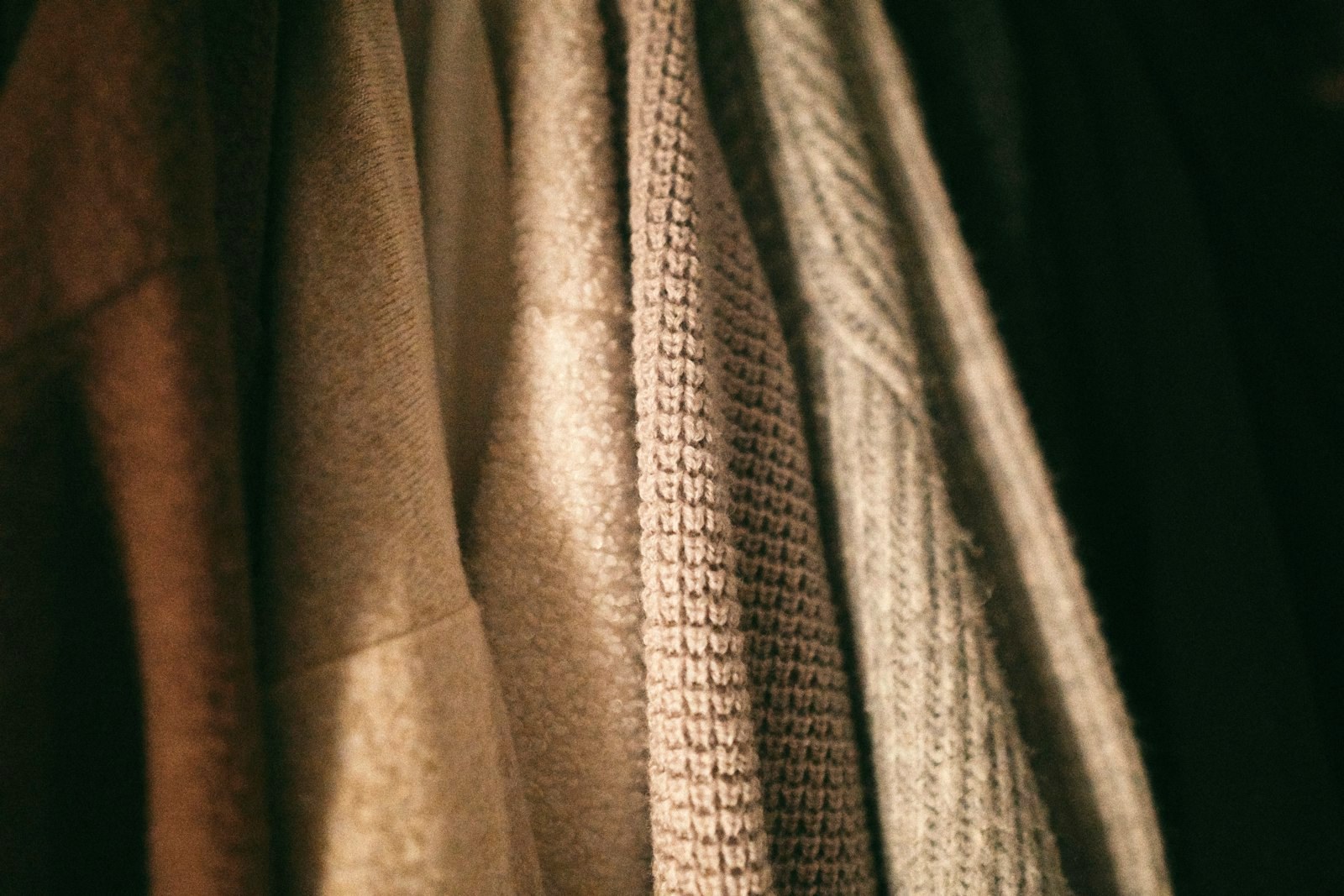
A note on our own photography: our photo bank holds no photograph of a Fair Isle sweater in any form. There is no yoke worn on a body, no band at macro range, no inside-out yoke showing the strands this brief makes its second check, no quiet yoke over a pale Oxford of the kind the vest brief’s matrix describes. The hero is a macro of folded plain knits in the yoke’s own winter colours, captioned as plain knits; the figures inside are a fine knit over a collared shirt, captioned as the layering seat’s foundation, and a rail of hanging knit textures in the band’s palette, captioned as textures. This page will not caption a plain crew, a cable or a folded stack as the Fair Isle to fill the slot, and it will take the harvest frames the week they exist, in this order: the traditional yoke worn over a plain Oxford with flannel trousers first, the yoke inside out at the shoulder second, the chest band under an open coat third. Until then, every frame here is labelled for what it shows, which is the cloth family and the palette, and the garment itself is described in words because the bank cannot yet show it. Prices and records on this page were checked against the site’s own published Cards in October 2026; the method that built them is written out on the methodology page.
Questions, answered
What is a Fair Isle sweater?
A knitted sweater whose pattern is worked in stranded colourwork: bands of small geometric motifs carried in two colours at a time, gathered at the yoke, the ring of pattern across the chest, shoulders and upper back, on a body that is usually plain below it. The technique is named for Fair Isle, the Shetland island it comes from, and our sweater vest brief files the pattern as banded yoke patterns from the northern knit tradition. The yoke is the garment's whole argument: the colour and the pattern live in one band at the top of the sweater, and everything the brief below rules follows from that placement.
Has Young Cotton ranked Fair Isle sweaters?
Not as a type, and this page does not pretend otherwise. No Verdict Card on this site ranks Fair Isle sweaters, and our sweaters index files ten types without filing this one. The records this brief styles the garment on are the neighbouring ones: the one-pattern law printed in our sweater vest brief, No. 36, and our chunky sweater brief, No. 39; the patterned garments graded on Verdict Card No. 56, where the Zara argyle vest was sent home at 33 for keeping the pattern and deleting the wool; and the heavy-knit standard of Verdict Card No. 59, where the Paul James Scapa fisherman wins at 88 on 100 percent British wool. This brief applies those published records to the yoke and scores nothing of its own.
What do you wear with a Fair Isle sweater?
Plain cloth, in colours taken from the yoke's own. The one-pattern law this site prints without exception makes the sweater the outfit's single pattern, so every partner is plain: corduroy trousers, the Drake's Field Games at 79 in Verdict Card No. 38, in a shade the yoke already carries; dark denim, the Levi's 501 at 81 in Verdict Card No. 11, washed plain and worn under the denim law; tailored wool trousers in charcoal or grey flannel; and the pale end of the rail, the Drake's ecru fatigue at 83 in Verdict Card No. 73, under a yoke in quiet colours only. What it does not take is a second pattern anywhere: no checked shirt beneath it, no striped tie over it, no patterned scarf above it.
Can you wear a Fair Isle sweater over a shirt?
Yes, over a plain one, and the assembly is this site's own: our sweater vest brief seats a fair isle vest in quiet colours over a plain pale Oxford with plain flannel trousers as a real winter register, and the sleeved sweater takes the same seat. The shirt is the Oxford of Verdict Card No. 01, the Kamakura at 93, worn under our crew brief's collar law: a button-down collar, its points contained inside the neckline, about a finger's width of collar showing above the knit. The shirt contributes its collar and its cuffs and nothing else: a checked, striped or tipped shirt under a yoke is the pattern pile-up, two statements in one outfit, and the law retires it.
Can you wear a Fair Isle sweater under a coat or a blazer?
Under a coat, yes; under a blazer, almost never, and the difference is the yoke's placement. A coat takes the sweater as its middle layer the way our chunky brief layers the heavy knit: the coat is plain and dark, the yoke shows at the open front as the outfit's one pattern, and the colourwork sits where a scarf's pattern would, except the garment carries it. A blazer is a closer room: the yoke's band crosses exactly where the jacket's lapels and opening frame the chest, the knit at yoke weight fills the frame the jacket was cut to keep flat, and the pairing reads as two garments claiming the same panel. The plain crew of Verdict Card No. 10, the Smedley Lundy at 87, is the knit our blazer law seats under tailoring. The yoke's dressed seat is the coat, worn open.
Is a Fair Isle sweater the same as a Christmas jumper?
No, and the boundary is the picture against the pattern. A Fair Isle yoke is a pattern drawn for cloth: small motifs in bands, worked in the knitting, in colours a winter wardrobe already owns, bought for the drawer and worn from the first cold week to the last. A festive jumper carries a picture: a reindeer, a tree, a slogan, one motif at chest scale, bought for a party and dated by it. Each is honest in its own seat and wrong in the other's. The yoke at the party reads as a man who dressed carefully for a joke; the picture at the office reads as a costume, which is why our crew brief files a novelty knit among the office failures. Buy the yoke for the season, in wool, and let the festive jumper be what it is: a ticket to one evening, priced as one.
What should a Fair Isle sweater be made of?
Wool, on the fibre line, in the majority and ideally alone: the knitwear law this site grades by, buy the split, not the pattern. Stranded colourwork is a warmth technology before it is a picture, two yarns carried across every row of the yoke, and it only does that work in a yarn that holds air. The records are printed on the neighbouring Cards: Verdict Card No. 59 sends a fisherman home at 34 for carrying 4 percent wool under a full cable pattern, and Verdict Card No. 56 sends an argyle home at 33 at 69 percent polyester. A yoke in acrylic keeps the motifs and deletes the garment. Read the composition before the colours, and buy the quiet yoke in lambswool or Shetland wool over the loud one in a blend, every time the choice is offered.
Next
The family this brief belongs to: the law it extends stands in How to Wear No. 36, where the one-pattern law was printed for the patterned vest, and in No. 39, where the same law governs the cable; the patterned garments themselves are graded in Verdict Card No. 56 and the heavy knit in Verdict Card No. 59. The plain sibling is briefed in No. 09 and ranked in Verdict Card No. 10; the cardigan beside it in Verdict Card No. 16. The layer beneath is ranked in Verdict Card No. 01; the rail below is ranked in Verdict Card No. 38, Verdict Card No. 11 and Verdict Card No. 73, and the drawer the garment files into is indexed in the sweaters index; where the knit sits among this site’s winners is mapped in the Body Map.