
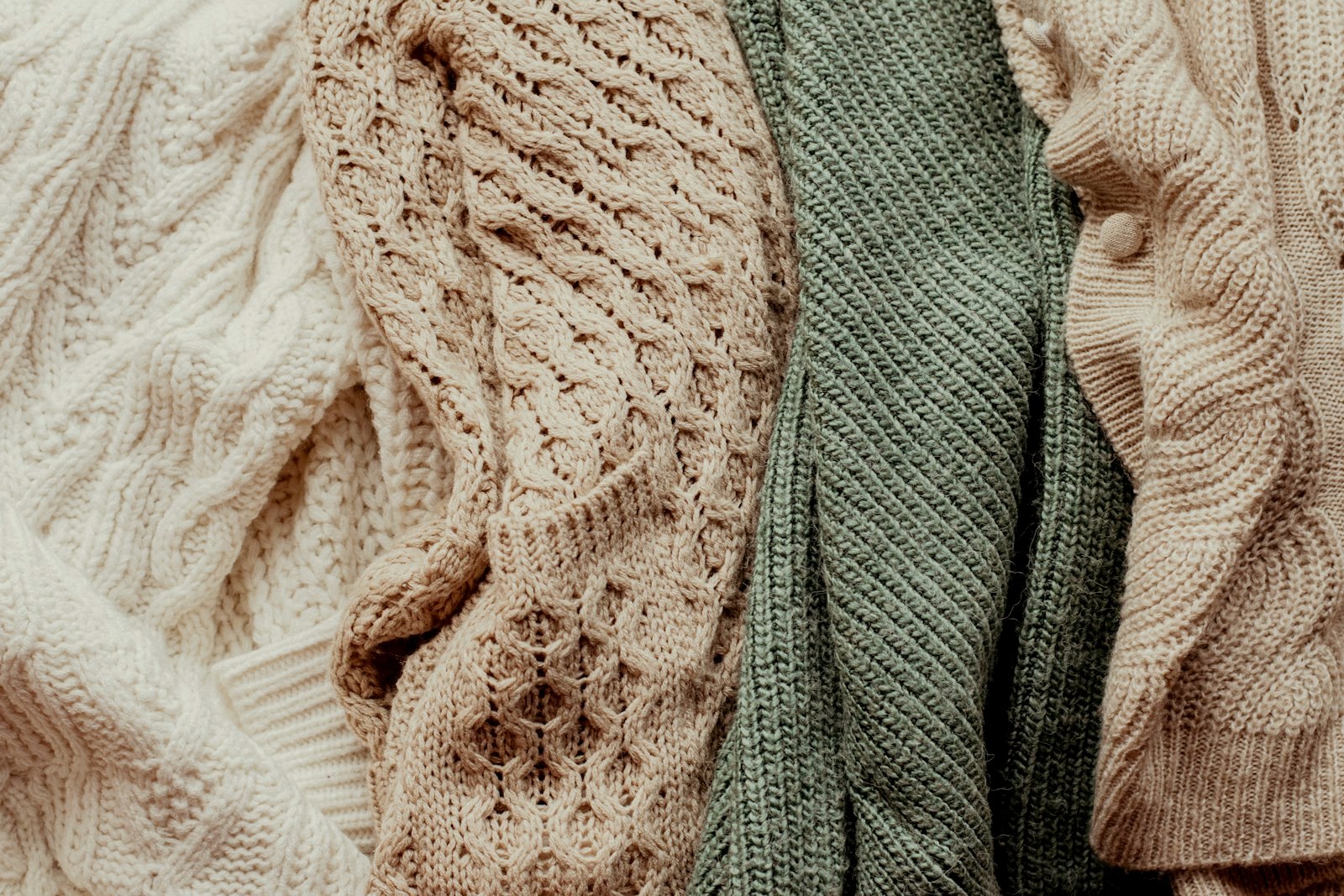
The fisherman pattern at macro range, captioned as exactly that: the cables are the page's argument, insulation knitted into the stitch itself. Our bank holds no photograph of an Aran sweater worn on a body, so this page opens on the pattern rather than dress another knit as its subject. The care section prints that gap and the harvest list.
Checked and updated October 2026
The ruling, up front: at heavy gauge the sweater stops being a layer and becomes the outfit's structure, and every other decision in the outfit is compensation for that fact. Our sweaters index files the fisherman, the Aran, at formality 1 and warmth 5, the two extreme corners of its ladders on one garment, and calls it the only type it scores on weight. Verdict Card No. 10 prints the gauge bands the whole knit family runs on: fine roughly 24 to 30, mid 12 to 20, heavy 7 and below, and this brief begins where those bands end. No. 09 owns the crew drawer and its neckline; this brief owns the heavy register whatever the neckline, the crew grown structural, the Aran in its pattern, the shawl collar ruled kin below. The problem the register poses is proportion. A heavy knit adds visual weight at the chest, the shoulder and the sleeve, all at once, and an outfit is a balance: what the top gains, everything else must answer or simplify. Hence the brief's one law, from which the rest are corollaries: one heavy thing per outfit, worn as the outermost layer or under an open coat, over almost nothing, above a leg built to stand under it.
This brief: the decisive rule · the species, separated · what goes under it · what goes over it: the coat problem · trousers and footwear: the balance below · the ceiling and the costume lines · the looks · the mistakes · care and our photography
The decisive rule: one heavy thing, and the sweater is the structure
Every brief in this family has a rule that decides the garment, and the heavy knit's is a law of load. Below heavy gauge, a sweater is a component: it frames a shirt, it fills a jacket, it answers to the outfit's other decisions. At seven gauge and below the relationship inverts. The knit is the largest single fact in the outfit, the surface the eye lands on and the volume the silhouette is built around, and the other garments stop being co-authors and become ballast and trim. That is this brief's decisive rule, printed as new: the heavy knit is the outfit's structure, so it is the one heavy thing in it, and everything worn with it is either simpler than it or built to stand under it.
The index's arithmetic is the rule's proof. Formality in knitwear is a property of gauge as much as shape, and chunky versions of any neckline fall two rungs: take the crew from its standard 3, or the roll neck from its 4, knit either at a fisherman's gauge, and the garment lands at the ladder's foot beside the Aran itself. Gauge is not a detail of this garment. Gauge is the garment, the decision that moves it between rooms, between registers, between layer and structure. Which is why the index scores the fisherman on a measure it applies to no other type: weight. A fine knit is judged by its edge and its hand. A heavy knit is judged first in the hand, by heft, because the heft is the warmth, the drape and the silhouette in one number, and the index's buying rule is the brief's first corollary: buy the wool and the weight, because a thin copy keeps the cables and deletes the warmth.
The corollaries run through the whole page. Because the knit is the structure, nothing with its own architecture competes with it: no second pattern, no second volume, no jacket with a silhouette of its own closed over it. Because it is the structure, what stands under it is chosen to bear weight, a leg and a boot with substance, and what stands over it is mostly nothing, the coat problem of the over section. And because it is the structure, its own architecture has to survive inspection: a heavy knit whose neckband has bagged or whose ribs have died is not a relaxed garment, it is a structure failing in public, and the mistakes section retires it on exactly that evidence.
The species, separated: the Aran, the plain heavy crew, and the shawl collar ruled kin
The Aran, the fisherman, is the heritage species, and its law is scale. Its pattern is not decoration applied to a warm sweater; it is the warmth, ropes and diamonds knitted heavy in lambswool or wool so the stitch itself traps air, the same insulation logic the index names, a puffer's principle in a cloth that can sit at a table. Traditional Aran patterning is scaled to the garment and the man in a way fashion copies rarely respect: the cables run at a size the hand can read across a room, the diamonds sit in proportion to the chest, and the whole reads as engineering before it reads as ornament. Shrink the pattern to a motif, cables printed shallow on a thin body, and the garment has kept the picture and deleted the point, the index's own verdict on the thin copy. Buy the species at its native scale, in its native colour first: cream is the undyed wool the garment was born in, and it carries the harbour read openly, which the ceiling section prices. Navy and charcoal are the species in the city, the pattern quieter in a dark yarn, the same weight doing the same work.
The plain chunky crew is the modern species, No. 09's heaviest garment promoted to this brief's register. It has no pattern to hide behind, so it is judged on the things No. 09 judges at every gauge and one more: the yarn's character, the rib's life, the neckband's density, and the cloth's weight in the hand. The crew ranking's own heavy reference is the class: the William Lockie Leven at 82, 100 percent Geelong lambswool in a two-ply yarn, a saddle shoulder, and a construction row that was the highest on its page, because at this gauge construction is not a refinement, it is the difference between a structure and a sack. A plain heavy crew in a good yarn is the register's most versatile garment, the one that takes the wide trouser and the boot and the open coat without a single heritage reference. It is the first buy of this brief, ahead of the Aran, for the man whose life is landlocked, which is most men: the Aran is the greater garment and the narrower one.
The shawl-collar heavy knit is ruled kin, and the ruling is this brief's own, printed with its reasoning. The index files the shawl-collar cardigan among the open knits at formality 3 and warmth 4, the cardigan's outer form, a rolling collar at a heavier gauge worn as the jacket of an evening rather than a layer inside one, the warmest of the open knits. Every term of that filing is this register's doctrine: heavy gauge, outermost posting, structure rather than layer. So the shawl knit stands inside this brief for everything that concerns weight, proportion and posting, and its evening posting is the register's one dressed seat, priced in the ceiling section. Two parts of its law stay home with its own family: it opens, so its button discipline is the cardigan's, ruled in How to Wear No. 01, and its open neckline reverses this brief's under rule, because a garment built to open over a shirt takes the shirt as its lining. Kin, then, not a fourth species and not an exile: the heavy register's open form, governed here for its weight and there for its buttons.

The gauge wall below is the register's whole range at a glance: at the smooth end the fine knits of the office briefs, at the open end the cables and textures this page governs. The register begins where texture becomes architecture.
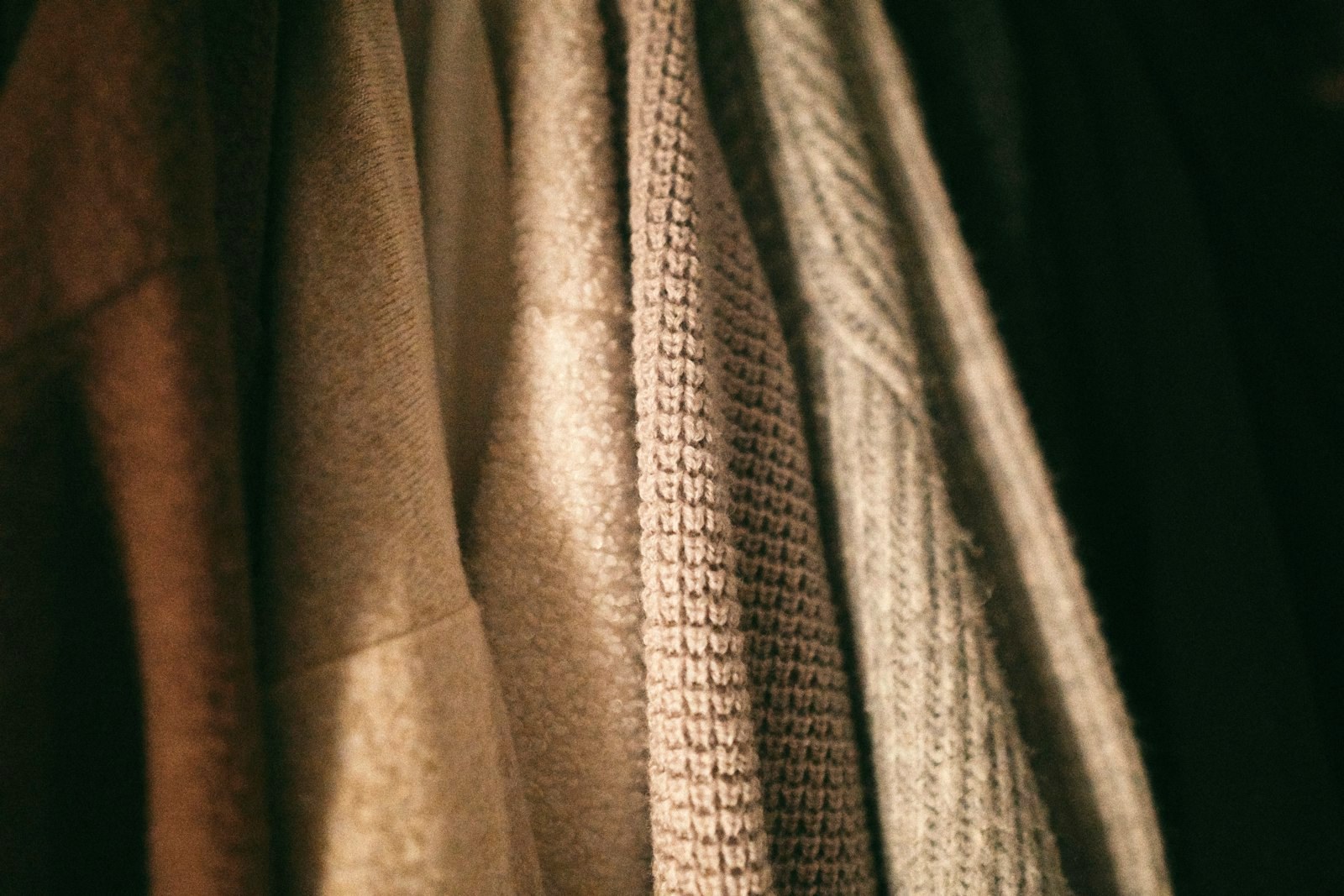
What goes under it: almost nothing, and the collar question ruled
A structure stands on a foundation nobody sees, and the heavy knit's under-layer is exactly that. The legal layer is the base layer: a fine merino crew of the class Verdict Card No. 45 ranks, its winner the Icebreaker 200 Oasis at 82, the field's only maker printing weight, fibre and micron together. Its job under a heavy knit is temperature management and the protection of the knit from the man, wool over wool, and it is cut to disappear: its neckline below the sweater's band, its hem inside the sweater's, nothing of it showing anywhere. A plain tee is the same posting in the warm end of the register's weather, worn under the plain chunky crew as No. 09 allows, on No. 09's condition, which this brief repeats as law: an under-layer's neckline sits below the sweater's neckband or it is not worn. The crescent of tee above a heavy band is not a layer. On a fine knit it is an accident; on a garment this deliberate it is a contradiction.
The collar question, ruled for this register: a collared shirt under a closed heavy knit is refused as a default. The ruling needs its reasoning printed, because it reverses the most familiar combination in knitwear. No. 09's collar law is a frame law: the band and a finger's width of collar showing, the points contained, the shirt as the picture inside the crew's low, quiet frame. That arithmetic belongs to fine and mid gauges, whose neckbands sit low and thin. A heavy band is neither: it stands higher, rolls thicker, and crowds the collar's space, so the same finger's width of collar above it does not read as a picture framed. It reads as a shirt escaping from a garment too heavy to hold it, the collar points with nowhere engineered to sit, winging over a band that was never a frame. The combination also breaks the one-heavy-thing law from below: a collared shirt is a garment with its own structure, and two structures at one throat is the register's version of two patterns in one outfit.
Two exceptions, both licensed in print. The shawl species is built over a shirt: it opens, its rolling collar is a frame by design, and the Oxford under it is its lining and its finish, the one heavy garment whose under-layer is meant to be seen. And the working register: a flannel shirt under an Aran, the class of Verdict Card No. 09's field, where the Bean Scotch Plaid took its category at 85, is harbour layering, wool on wool in the garment's own working tradition, worn open-country and unembarrassed. It is licensed as workwear, not as office dress, and the distinction is the whole licence: the flannel's collar under the Aran reads as equipment because everything in the outfit agrees it is equipment. Put the same collar under the same knit with tailored trousers and a loafer and the outfit is arguing with itself, which is the ceiling section's subject.
What goes over it: the coat problem, and the weather honesty
Begin with the tailoring fact the whole section stands on. Coats on this site are sized over a blazer: How to Wear No. 20 and the jackets index buy a coat fit-tested over a jacket, because a coat that only fits over a t-shirt is a costume. That allowance, a blazer's thickness with a fine knit inside it, is the room a tailored coat has to give. A heavy knit spends the whole allowance and then asks for more: its loft stands off the chest, its sleeves fill the coat's sleeves, its body pushes the coat's button off its line. Close a tailored coat over a fisherman and both garments lose, the coat straining into a sausage casing, the knit compressed into the one shape its pattern cannot take. This is the coat problem, and it is not a fit failure to be solved by sizing up, because a coat bought two sizes large for one sweater fits nothing else the man owns, the costume verdict by the other door.
So the register's posting is the index's sentence, which this brief adopts as its over law: chunky knits go over or alone, never under, read with one reconciliation printed in the open. No. 09 posts its own heavy crew under an open overcoat, and the two records agree once under is read as closed over. The sanctioned coat posting is the open coat: the overcoat worn unbuttoned over the heavy knit, the coat as a windbreak and a frame rather than a container, its own bulk answering the knit's across an open front. It works because nothing is asked to close. The other exception is cut, not closure: loose equipment coats with the room built into their pattern, the field and work cuts of the jackets index, take a heavy knit the way they take everything, because their allowance was never a blazer's. A tailored coat, a slim overcoat, a blazer above all: refused, on the gauge law the blazer brief and the index both print. Fine gauge under tailoring, always; heavy gauge is the tailoring's replacement for the day, not its filling.
The weather honesty, printed plainly, because the register's warmth invites the lie. Warmth 5 is a still-air number, the index's own room for the garment a cloth that can sit at a table. A knit's warmth is air held in loft and in pattern, and moving air takes it: wind passes through a heavy knit more slowly than through a fine one and just as surely, which is why the fleece brief's law, that a pile's warmth belongs to its stack, has its cousin here. Rain is the second limit. Wool is the honest fibre in wet weather, shedding light rain briefly off its surface and keeping a man warmer damp than any plant fibre does, the index's yarn passage convicting cotton as nearly useless wet or cold; but shedding is not sealing, the distinction No. 28 prints for wax and the rain ranking enforces with membranes and taped seams. A heavy knit in sustained rain drinks, weights, and keeps drinking. And the garment's own history signs the ruling: the fisherman was a working sweater, and at work, at sea, the oilskin went over it. The Aran was never the outer layer of its own system. Wear it outermost on a dry, still, cold day and it is magnificent and sufficient. In wind, it wants the open coat or the shell over it; in wet, it is a layer, and the man who treats it as a raincoat has misread a contract this page prints in full.
Trousers and footwear: the balance below the waist
The one-heavy-thing law has a second half, and it is compensation rather than simplification: the leg must carry its half of the silhouette. A heavy knit adds its visual weight at the chest, the shoulder and down the sleeve, and an outfit is read as a column. Build the top at that scale and finish it with a narrow leg and the column inverts, a heavy mass on a pin, the spinning-top read that no quality of yarn can rescue. The trousers that answer are the ones with substance in their own line: a straight or wide trouser with a leg that falls in one plane from the hip, corduroy, whose wale is the register's own texture at trouser weight, a straight jean in a dark or honestly faded wash, a heavy chino. The wool trouser is argued, not assumed: the plain chunky crew over a wide flannel trouser is the modern species at its most deliberate, two soft architectures in one register, and it holds as long as the trouser's leg is wide enough to answer; the same knit over a slim tailored trouser fails on the same arithmetic as the skinny jean, the top built for weather and the leg built for a boardroom, each accusing the other.
Footwear follows the same scale law, and the brief rules it by weight. The boot answers the knit: a work boot, a service boot, the heavier forms of the Chelsea, footwear with a sole and a shaft that can stand in the same sentence as a five-gauge sweater. The low court shoe is the argument at the other end: a clean minimal sneaker under tailored trousers is a finished outfit's punctuation, but under a fisherman it leaves the column unfinished below the knee, summer footwear under a winter structure. The sneaker's licensed form here is its own heavy register, a chunky-soled shoe whose mass is deliberate, worn with the plain species and the wide leg. The loafer belongs to the shawl species' evening and to No. 09's gauges, not to the Aran. Judge the whole column in the mirror before the door: if the eye travels down and the outfit gets lighter as it goes, the balance has failed at the last step, and the fix is at the ankle, not the shoulder.
Colour and pattern discipline close the brief's laws, and both are short because the register allows little. The cable is the pattern: on the Aran it is knitted, structural and total, and the one-pattern law this site prints without exception retires everything else in the outfit to plain cloth. The plain species carries its pattern as texture, rib and yarn character, and obeys the same law at one remove. Colour runs on the species. Cream is the Aran's native colour, undyed wool, and it is bought knowingly: it is the harbour read, the brightest thing in a winter outfit, and it asks the rest of the outfit to be quiet and dark enough to hold it. In navy, charcoal and the deep earth colours the same garment gets quieter and more urban, the pattern reading as texture rather than signal. The plain crew follows No. 09's neutrals with the register's one addition: at this gauge, colour is louder, because there is more of it, so the bright end of the drawer that a fine knit survives will shout in a chunky one. Buy the heavy knit in the colour the room can hold.
The ceiling, and the costume lines printed plainly
The register's ceiling is set by the index and is not negotiable in the mirror. The fisherman stands at formality 1, the bottom of the ladder, and the two-rung law puts the chunky version of every other neckline at the same foot of the stairs: the plain chunky crew is a 1 wearing a 3's shape. There is no tailored room in this register, no tie it can host, no blazer it can fill, and the office question is answered by the ladders before it is asked. The one dressed seat is the shawl species' evening, the jacket of an evening at formality 3, and it is an evening seat: softer, later, and judged by company rather than by a dress code. A man who needs the heavy knit's warmth in a dressed room does not promote the knit. He changes layers: the fine knit under the blazer, per the office briefs, and the heavy knit waiting at the door for the walk home, which is the honest stack the Fall Edit builds its cold evenings on.
The full fisherman kit, away from work, is a harbour costume. The Aran alone is a sweater with a birthplace. The Aran assembled with its working system, the oilskin over it, boots below, the whole Atlantic kit worn as a look in a place where no boat is being worked, is fancy dress with good yarn in it. The line is not the pieces, each of which this site ranks and respects; it is the completeness. One piece in its weather is equipment: the knit on a cold dry day, the waxed or oilskin layer when the rain actually comes, per No. 28's contract. The full set, worn as a set, to a pub nowhere near a harbour, announces that the wearer is playing a fisherman, and a costume is judged as a costume however honest its cloth. Buy the sweater. Earn the kit piece by piece, in weather, or leave it in the catalogue.
The chunky knit as a jacket substitute in real cold is the second costume, and it is a functional one. It is the over section's honesty worn as an outfit: the heavy knit sent out alone into wind and wet because it felt warm in the shop and weighs like a coat in the hand. Warmth 5 is measured in still air, at a table, and the street in February is neither. The man is not underdressed by the calendar, he is misdressed by physics, and he will spend the day with his arms crossed against his own sweater, compressing the loft he paid for. The garment is not the failure. The posting is: it is the warmest layer in the drawer and a mild day's outer garment, and it asks, on the cold days, for the open coat or the shell over it, exactly as its own working system arranged.
The oversized slouch is the third, and the line inside it is architecture. Deliberate volume exists and this brief defends it: a heavy knit cut oversized by its maker, in a yarn with the body to hold the shape, worn as a designed drape, is the register's fashion end and it can be the best-looking thing in the room. Its evidence is structural. The shoulder is placed where the pattern placed it, dropped by design and finished like it; the ribs at cuff and hem are alive, springing back, holding the volume in a shape; the neckband sits flat and dense. The sweater that simply does not fit shows the opposite evidence at the same points: a neckband bagged and wavy, a shoulder seam sliding off a shoulder it was never cut for, sleeves past the knuckle, a hem gone slack, volume with no engineering in it, which reads not as ease but as borrowing. The test is the fit answer this page's questions print: not the amount of cloth, but whether the garment's structure survives it. Volume is a decision. Slouch is an outcome, and the mirror can tell them apart at a glance if the man is honest about which one he is looking at.
The looks: the structure, standing
Four assemblies from this brief's rulings, each built on the records around the garment. No chunky or fisherman sweater is scored in this brief; the numbers in the judgments are the neighbours' records, reproduced from their own pages.
| Setting | The sweater | With | The judgment |
|---|---|---|---|
| The harbour register, landlocked | A cream Aran at traditional scale, wool on its fibre line, heft in the hand | Nothing over it on a dry, still day; a straight faded jean, work boots, a merino base layer beneath if the cold deepens | The species at its native posting and its index room, deep winter and weekends, at formality 1 by its own ladder and entirely unbothered: the pattern is the outfit's whole signal, everything else plain, the leg and the boot carrying their half of the column. Add the oilskin only when the rain is real, per the ceiling section's line between equipment and kit |
| The modern species | A plain chunky crew in charcoal, heavy gauge, clean rib and a dense band | A wide wool trouser, a chunky-soled shoe, nothing at the neck, nothing over it indoors | The register's first buy at work: No. 09's heaviest garment promoted to structure, the Leven's class at 82 on the crew ranking as the cloth's reference, the trouser's width answering the top's volume in the proportion law's clearest case. This is the landlocked man's fisherman, all of the warmth and none of the harbour |
| The shawl evening | A shawl-collar heavy knit, dark, its collar rolled and lying flat | An Oxford under it with the collar inside the roll, dark tailored trousers, suede loafers | The register's one dressed seat, the index's jacket of an evening at warmth 4: the open species over its licensed shirt, the outfit's structure worn as its jacket, legal in the evening rooms where a coat would be too much and a fine knit too little. Its buttons obey No. 01; its weight obeys this brief |
| The sanctioned stack | A navy chunky crew over a fine merino base layer | An overcoat worn open over the lot, straight corduroy trousers, service boots, a scarf if the wind rises | The coat problem's one answer demonstrated: the coat as windbreak and frame across an open front, nothing asked to close, the base layer doing its invisible work at the neck and the knit keeping its loft uncompressed. The base is the class of the base-layer ranking's winner at 82, and the assembly is the register's cold-day ceiling, the most dressed a heavy knit can stand |
The ruling
Buy the plain chunky crew first, in a yarn with a name and a fibre line that leads with it, charcoal or navy, its ribs alive and its band dense, if your winters are landlocked and your rooms are ordinary: it is the register's structure without its costume, worn over a base layer or nothing that shows, above a straight leg and a boot, as the outermost layer or under an open coat. Buy the Aran second, at traditional scale and honest weight, cream if you will wear the harbour knowingly and dark if you will not, and respect its system: it was a working layer under an oilskin before it was a photograph, and it is a layer still, the warmest in the drawer and the least sealed. Buy the shawl knit for the evening seat, over its shirt, under nothing. Refuse the collared shirt under the closed band, refuse the closed tailored coat over the loft, refuse the skinny leg under the volume, refuse the kit assembled as a look and the slouch that is only a size error with confidence. The test in the shop is the index's rule with this brief's law added: the wool and the weight in the hand, the architecture alive at the band and the rib, and the outfit around it already decided, simpler above the waist than the sweater and heavier below it. The man who can name the leg, the boot and the open coat his heavy knit will stand with has bought a structure. The man who bought the photograph of a fisherman has bought the ceiling section, and it was printed here first so he cannot say the garment surprised him.
The mistakes
The heavy knit inside the closed coat. The posting error the coat problem exists to prevent: the fisherman buttoned inside a tailored overcoat, the coat's front straining off its line, the knit's loft crushed flat at the chest where its warmth lived. Both garments are diminished in public and the knit is diminished in private too, compressed loft recovering slowly. The posting is the open coat or no coat, and a wardrobe that cannot make that posting in January needs a coat with room, bought for the purpose, not a sweater crushed into a coat bought for a blazer.
The thin copy. The buying error the index names before any other in this family: cables knitted shallow in a cloth that cannot warm, acrylic near the front of the fibre line, a fisherman with no heft in the hand. It keeps the picture and deletes the point, and it fails twice, once in the cold, where its pattern traps no air worth the name, and once in the mirror, where pattern at the wrong scale reads as a motif on a jumper rather than a garment with a trade. The defence is the index's rule and costs nothing: read the fibre line in percentages, feel the weight, and let a light Aran stay on the rail however it photographs.
The collar forced under the band. The under error: the dress shirt or spread collar worn under a chunky crew out of habit, its points winging over a band too heavy to frame them, the outfit reading as two decisions arguing at the throat. The collar's home at this gauge is the shawl's open roll or the flannel's working register, and everywhere else the throat of a heavy knit is finished by the knit alone, over a base layer that does not show. Habit is not a ruling; this page has printed the ruling.
The hanger. The care error with the heaviest consequences in the drawer, because this garment is the heaviest thing in it. A heavy knit hung by its shoulders stretches under its own considerable weight all summer, and comes back in October with a longer body, a sloping shoulder and a band beginning to wave, the architecture the fit law judges it by already failing. No. 09's storage law applies at double force here: folded flat, always, and the folded stack is not tidiness, it is the garment's skeleton being kept. A heavy knit that has hung a season does not fully recover, and its owner will read the damage as the sweater's quality rather than his closet's physics.
Care, by fibre, and the weight rule
The heavy knit's maintenance is the knit family's, printed in No. 09, with its physics scaled by weight. Fold every knit and store it flat; at this gauge the hanger is not a risk, it is a sentence, the mistakes section's longest paragraph. Lambswool, the register's standard yarn, pills lightly in its first wears and then settles into its matte warmth, the index's own service note, so judge a new Aran's surface at the tenth wear rather than the first and do not let the early pills talk you out of the yarn that will outlast the drawer. Wool wants rest between wears and air more than washing; the base layer beneath it, worn as this brief rules, is what makes that regime possible, taking the day's wear so the knit takes only the weather. When a heavy knit does get wet, dry it flat and unhurried: a wet Aran carries its weight in water, and hung wet it stretches under a load no dry garment ever puts on it. Care is not a ritual. It is how the index's warmth 5 stays a property of your sweater rather than of the one in the shop.

A note on our own photography: our photo bank holds the cable pattern at macro range, which opens this page, and one chunky shawl-collar portrait, printed in the species section as exactly that. It holds no Aran sweater worn on a body in any colour, no heavy crew under an open coat, and no frame that shows pattern scale against a smaller man, the proportion evidence this brief argues from, and this page will not caption a turtleneck, a cardigan or a fine crew as the fisherman to fill those slots. This page will take the harvest frames the week they exist: a cream Aran worn in real light with its scale honest, the sanctioned stack with the coat open over the knit, and a heavy crew beside the fine one it outweighs, the gauge law in a single frame.
Questions, answered
Can you wear a chunky sweater under a coat?
Under an open coat, yes; inside a closed one, almost never. Coats on this site are sized over a blazer, and a heavy knit spends that whole allowance and more: button a tailored coat over a fisherman and the coat strains, the knit compresses, and both garments lose. The sanctioned posting is the heavy knit as the outermost layer, or under an overcoat worn open and unbuttoned, which is where the crew brief posts its own heavy gauge. Loose equipment cuts with the room built in are the other exception. The rule is the index's: chunky knits go over or alone.
Can you wear a shirt under a chunky crew neck sweater?
Not as a default, and the reason is arithmetic. The collar ruling of the crew brief, the band and a finger's width of collar showing inside the frame, belongs to fine and mid gauges, whose neckbands are low and quiet. Against a heavy band the same finger's width reads as a collar escaping, not a picture being framed. Under a closed heavy knit wear a fine base layer, the merino class of the base-layer ranking, or nothing that shows. The exceptions are the shawl-collar species, whose open neckline is built over a shirt, and the working register, a flannel under an Aran worn as harbour layering rather than office dress.
Can you wear a chunky or Aran sweater to the office?
No. The sweaters index files the fisherman at formality 1, the bottom of the ladder, in the room it names deep winter and weekends, and the crew brief names a chunky gauge among its office failures: off-duty cloth in an on-duty room. Gauge is the mechanism: chunky versions of any neckline fall two formality rungs, so a chunky crew stands where the fisherman stands, whatever its colour. The heavy knit's dressed posting is the evening, where the shawl-collar species works as the jacket of an evening, and evening is not the office with the lights lower.
What is the difference between an Aran sweater and a chunky crew neck?
The neckline is the same and the garment is not. The Aran, the fisherman, carries its insulation in its pattern: cables, diamonds and ropes knitted heavy in lambswool or wool, trapping air in the stitch itself, which is why the index scores it on weight and files it at warmth 5. The plain chunky crew is the modern species of the same gauge, no pattern to hide behind, judged on its yarn, its rib and its neckband. The Aran is bought by the index's rule, the wool and the weight; the plain crew is bought by the crew brief's rule, a clean edge and a fit that holds its shape. A thin copy of either keeps the look and deletes the point.
How should a chunky sweater fit?
With its architecture intact inside its volume. Deliberate volume is a design: the shoulder seam placed or deliberately dropped by the maker's pattern, the ribs at cuff and hem alive and springing back, the neckband sitting flat, the body long enough to cover the belt and no longer. A sweater that simply does not fit announces itself at the same points in failure: a bagged, wavy neckband, a shoulder seam sliding off the shoulder because the size is wrong rather than the cut, sleeves past the knuckle, a hem gone slack. The line is not the amount of cloth. It is whether the garment's structure survives the cloth.
Is a chunky wool sweater warm enough to wear instead of a jacket?
In still, dry cold, at walking pace, it is the warmest sweater the index files, warmth 5, and that number is an indoor-adjacent one: a cloth that can sit at a table. Wind is its thief, because a knit's warmth is still air held in loft and pattern, and moving air takes it; rain is its limit, because wool sheds light weather briefly and keeps warming while damp but is not a sealed system, and this site ranks rain on the membrane standard. The garment's own history settles it: at sea, where it worked, the oilskin went over it. Wear it as the outermost layer on a dry, still day. In wind or wet, it is a layer, and a proud one.
What trousers go with a chunky sweater?
A leg with enough substance to answer the top. The top half of the outfit has gained visual weight at the chest, the shoulder and the sleeve, and the leg must carry its half of the silhouette: a straight or wide trouser, corduroy, a straight jean in a dark or faded wash, a heavy chino. The refused pairing is the skinny leg, which leaves a heavy top standing on a pin and reads as a spinning top. Below the trouser, weight answers weight the same way: a boot or a chunky-soled shoe completes the column, where a low court shoe leaves the outfit unfinished below the knee.
Has Young Cotton ranked chunky and fisherman sweaters?
Yes, since Verdict Card No. 59 ranked seven chunky and fisherman sweaters on their published records, the Paul James Scapa Fisherman's Crew winning at 88. This brief was written against the record that existed before the Card; what that record held is: What exists in print is the garment's record across the site: the sweaters index files the fisherman at formality 1 and warmth 5, the only type it scores on weight, with its buying rule and its thin-copy warning printed; the crew ranking costs the heavy end of its own family, the William Lockie Leven at 82 among them, on the same gauge bands this brief runs on; and this brief is the wearing system those records imply, the one heavy thing, the species, the coat problem and the proportion law, printed so any heavy knit can be judged on the wearing, with the Card now judging the buying.
Next
The garment's place in the drawer, ninth of the ten types at formality 1 and warmth 5, is printed whole in the sweaters index, whose yarn passage and ladders this brief runs on. The drawer it shares is styled in How to Wear No. 09 and ranked in Verdict Card No. 10, where the gauge bands were published and the Lockie Leven's 82 was earned. The shawl species' button laws live in No. 01; the coat that stands open over this register is briefed in No. 20; the weather contract it cannot sign is printed in No. 28 and ranked in Verdict Card No. 44. The layer beneath it is ranked in Verdict Card No. 45, and the stack the whole register belongs to is ordered in the Fall Edit. Where the shoulder and the hem land on the body is drawn in the Body Map.