
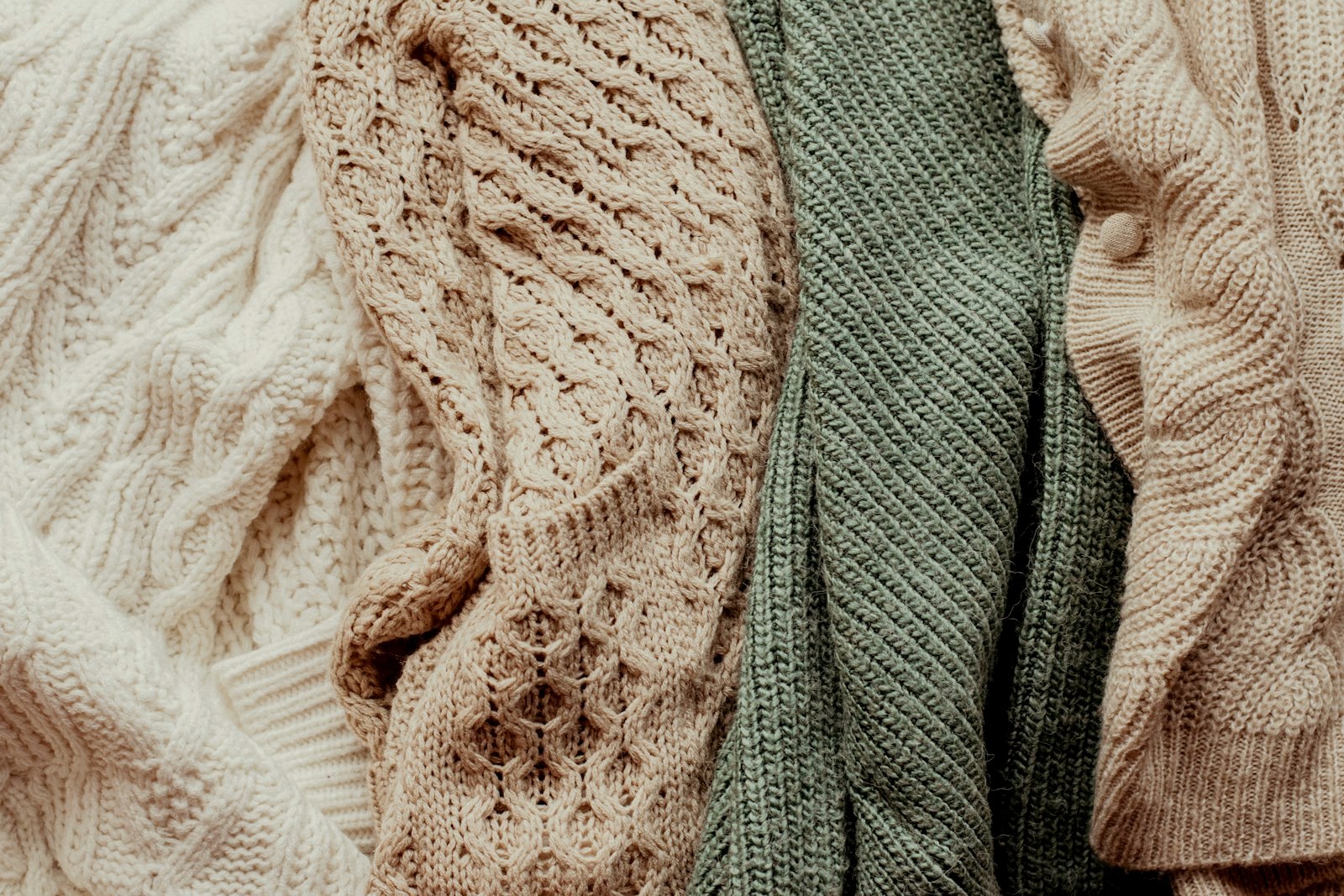
The cloth this page grades from: the fisherman's pattern read as engineering, cables knitted to trap air. The bank holds no photograph of a fisherman or Aran sweater worn, so this page's frames show the knit itself and the bank's one worn chunky portrait, captioned for exactly what it is; the gap and the harvest list are named in the honesty section below.
Checked and updated October 2026
The verdict, up front: seven chunky and fisherman sweaters scored out of 100 on fibre 30, construction 20, fit 20, value 15, longevity 15, plus the one sent home. The Paul James Scapa Fisherman's Crew Neck wins at 88, 100 percent British wool with its garment weight printed on the product page, 700 grams, in a seamless knit from the maker's own Leicestershire factory at £160. The Heimat Textil U-Boat and the Aran Woollen Mills Aran Worsted tie at 80, and the tie is broken on the fibre row, 26 to 24: the Heimat is a full kilogram of virgin wool, fully fashioned in Germany, and the Aran is the field's value answer, a published 5 gauge and a 100 percent wool claim at €59.95. And the sweater sent home, at 34, is the Topman Fisherman Rib Knit Sweater, 78 percent polyester, 18 percent viscose and 4 percent wool, a fisherman sweater with almost no wool in it. The count underneath the ranking is this Card's test, printed in full below: all eight makers publish what their sweater is made of, two of eight publish its weight, two of eight publish its gauge, one of eight publishes its measurements, and six of eight sell a story of the sea. The scope, settled before the ranking starts. This Card owns the heavy knit as one species, the Aran and fisherman cable work, the chunky crew, the heavy shawl collar, and the heavy roll neck where its record is heavy, because the sweaters index makes formality a property of gauge as much as shape and drops every chunky neckline two rungs for it. A sweater enters on its maker's own heavy filing, in its name or its class, and is graded against the published record; nothing is chunky here by photograph. The fine end of the drawer is ranked elsewhere and stays there: the roll neck that folds is Verdict Card No. 05, the crew beneath is No. 10, whose Lockie Leven crew at 82 is this Card's boundary garment, mid-heavy, graded there as a crew and cited here as evidence, never re-graded. The wearing system for everything ranked below, the one-heavy-thing law, the coat problem and the proportion law, is written in the chunky and fisherman brief, No. 39.
The finding: the fibre is published, the sea is sold, and the two heavy numbers are missing
Begin with the column that fills, because it fills completely and it did not have to. All eight makers scored here publish what their sweater is made of, five of them as a single-fibre claim totalled at 100 percent and three as a complete percentage split. That matches the V-neck Card's perfect column on No. 57 and beats the mock neck's six of eight on No. 58, and it is the heavy field's one clean habit: at every price from €59.95 to $400, the fibre line is there to be read. Read in order, the first fibre named is the sweater, and the ranking below is largely the story of that column read honestly: wool entire at the top, wool led and nylon backed in the middle, and at the foot a fisherman sweater whose first fibre is polyester.
Then count the two numbers that define the species, and the field goes quiet. A heavy knit has exactly two objective specifications, the gauge of its knit and the weight of the finished garment, and between them they decide the only thing the garment is for, which is warmth. Two of the eight makers publish a weight. One prints it on the product page itself, 700 grams, beside its fibre line and its measurements, as if weighing a sweater were the ordinary thing it is. The other, the field's heavyweight champion at a full kilogram, circulates as its maker's figure through stockists and the trade press, because the maker's own product page resisted this desk's capture. Two of the eight publish a gauge, both of them 5, the Irish factory Aran and the British expedition knit; a third maker files the gauge class in the garment's own name, Low Gauge, and prints no number behind the words. Set the counts against the family's: the sleeveless Card on No. 56 found no gauges in eight, the V found three, the mock one. The heavy field, the one family whose entire identity is a gauge, publishes its gauge at the rate the fine families publish theirs. And one maker in eight publishes full garment measurements, the same Paul James, against two of eight on the V.
What the field publishes instead is the sea. Six of the eight garments arrive wrapped in a working story: the Atlantic islands and their stitch folklore, the submariner's roll neck, the polar expedition of 1914, the Danish fishermen of Herning, the coastal traditions of Ireland and the British Isles, the old fishermen's knits of the British coast. The stories are not charged as lies; several of them are true, and the pattern they decorate is genuinely the warmth technology the index names, cables and bubbles knitted to trap air in the cloth. They are charged as substitutes. A heritage adjective cannot be compared across a shop floor; a weight can, and a gauge can, and the makers who print one of the numbers are not the ones with the least story to tell. The two heaviest-documented sweaters on this page, the 700-gram Scapa and the 5-gauge Aran, carry island and coast stories of their own, printed beside the figures. Buy the wool and the weight, in the index's own words, and where the weight is not printed, buy the gauge; where neither is printed, you are buying the story, and the ranking below prices stories accordingly. Every score is a garment score. Where a house holds a brand score elsewhere on this site, the brand number is printed on the card and kept separate, in both directions.
How the scores work
Every sweater is scored out of 100 on the same five rows. Fibre (30) reads the published fibre record, on the disclosure law this desk applies everywhere: the split as printed, percentage by percentage; a complete single-fibre claim above a blend; a blend read by its first fibre, because the first fibre is the one doing the work; provenance credited where the maker prints it, a named breed or grade, a ply, a spinner, a certification; and the species' own claims, the island, the heritage, the hand of the thing, graded as claims, credited when they are specific and checkable, charged when they are atmosphere. Construction (20) is the knit built around the fibre: the pattern's architecture as published, cables, diamonds, bubbles and ribs named where the maker names them, because on this garment the pattern is the insulation; the gauge and the garment weight where a maker publishes them; seams, fashioning and finishing as published. Fit (20) is the heavy register's test graded as published: room for the layer beneath, a body built to stand as the outfit's structure in the wearing brief's terms, sized in a range a reader can actually enter, with the maker's fit language and garment measurements credited where printed. Value (15) divides the price by the published record and by the seasons the longevity row scores, printed in the cost table below. Longevity (15) is the ownership audit: how the cloth ages, whether the house still sells the model, and whether a making culture stands behind the garment. Row scores add to the total, on every card.
The ranking
Paul James Scapa Fisherman's Crew Neck Jumper
The Winner · The Only Sweater in the Field That Weighs Itself
Maker's price: £160 at Paul James Knitwear, in stock.
Buy it as the heavy knit bought on paperwork: 700 grams of certified British wool, seamless and measured, from the maker's own factory at a factory price.
The fibre: 100 percent British wool, and the provenance printed the way provenance should be: the yarn is certified by the British Wool Board, the maker's page explains the grading system the clip passed, and the fibre's job description is printed beside it, durable, structured, dependably warm, the working virtues of a coarse British clip rather than the softness claims of a fine one. Fibre takes 27 for a total single-fibre record with a certification behind it. The deductions are the unprinted figures, no micron and no staple length, which on a wool sold for toughness rather than fineness the row prices lightly.
The build and the fit: construction 18, the field's best, carried first by the number nobody else prints on a product page: heavyweight, 700 grams, in the maker's own feature list, the garment weighed and the weight published. Behind it stands the build: knitted in the maker's own Leicestershire factory on zero-waste seamless technology, raglan shoulders, rolled edges at collar, hem and cuffs in the old fishermen's finish the garment takes its name from, the Scapa. No gauge is printed, and the row stops two points short for it, the weight doing the objective work the gauge would have shared. Fit 18, also the field's best paperwork: a relaxed fit named as such, a model's height, chest and size printed, a chest of 52.5 centimetres and a length of 69 for the medium, and a complete size table behind them. Value 12 at £160 prices the fullest heavy record in the field at the price of a high-street blend. Longevity 13 on a hard-wearing clip, an honest pilling note in the maker's own care text, and a house that owns its factory outright. Paul James holds no brand score on this site; this 88 is the garment's own, won on the strength of its paperwork alone.
Heimat Textil U-Boat Roll Neck Sweater
The Kilo · The Heaviest Record in the Field
Stockist price: £235 in Permanent Style's current guide to the class; the maker's own store sells the mariner range direct, and the door runs to it.
Buy it as the submariner's specification: a kilogram of virgin wool, fully fashioned, the heaviest sweater in the ranking by 300 grams.
The fibre: 100 percent virgin wool, five-ply and oily with its natural lanolin in the maker's telling, sourced and spun in Germany on its stockists' published record, a yarn custom-spun for density and shape retention. Fibre takes 26, and the figure it stands on is the field's headline: the sweater is made from a full kilogram of that wool, the maker's own specification for the garment, carried by its stockists and the trade press because the maker's own product page resisted this desk's capture, a capture fact printed here and in the honesty section rather than smoothed. The tie at 80 is broken on this row: the Heimat's 26 against the Aran Woollen Mills sweater's 24 below it, the desk's standing tiebreak, the kilo and the ply against the island claim.
The build and the fit: construction 17 on the stockist record: fully fashioned, not cut and sewn, with high-tension ribbing and reinforced stress points at cuffs, collar and shoulders, the roll neck built high against wind in the U-boat pattern the garment is named for. No numeric gauge is published for the sweater itself, the five-gauge figure in the house's coverage belonging to its watch cap, and the row does not borrow it. Fit 13 argues the naval cut, boxy and shorter in the body by design, and then charges the record's known fault, printed in the current stockist guide's own testing: the maker's size chart has carried an error, a medium printed at a 37-inch chest against a measured 44, so the fit is judged against a sweater you own, not against the chart. Value 10 at £235 prices a kilo of German-spun virgin wool fairly and no better. Longevity 14, the field's best, on the house's whole thesis: density, shape retention and reinforcement, a sweater built to be treated as outerwear. Heimat holds no brand score on this site; this 80 is the garment's own.
Aran Woollen Mills Aran Worsted Wool Sweater
The Value Answer · The Factory Aran at €59.95
Price: €59.95 at Skellig Gift Store, the Irish retail partner carrying the maker's own product copy, in stock from XS to XXL.
Buy it as the Aran bought the way the index rules: the wool and the weight class, a published gauge and the full stitch glossary, at a gift-shop price.
The fibre: 100 percent Irish wool, in the maker's own words on the product page its retail partner carries, and fibre takes 24 for a claim graded exactly as a claim. What is printed is total: one fibre, no blend, no garnish, in a worsted yarn the maker names Heritage Worsted. What is not printed is everything behind the word Irish: no clip, no breed, no spinner, no percentage line of the kind the blends below publish, and the provenance word is credited as the maker's assertion rather than as a verified record, which is the whole distance between this row and the certified British clip that wins the page. The tiebreak that seats this sweater third is printed on the card above: fibre 24 against the Heimat's 26.
The build and the fit: construction 16, carried by the field's joint-best objective figure after the winner's weight: a published gauge, 5, in the heavy band with room to spare, knitted at the maker's own factory in Ireland. The pattern's architecture is published panel by panel, a honeycomb central panel, a diamond inset with 2x2 moss stitch, regular rope cables, 2x2 moss sides, each with its folklore meaning attached, graded here as the claims they are and credited as construction, because the stitches named are the stitches knitted and they are the warmth. Fit 14 on the classic relaxed fit the page names and the size guide it publishes, its measurements flagged approximate in the maker's own words. Value 15, the ranking's perfect score: €59.95 for a 5-gauge, all-wool, factory-made Aran is the cheapest complete heavy record in the field, and the cost table prices it at $0.22 a wear. Longevity 11 on a worsted wool workhorse from a factory house, without the reinforcement record the two cards above it publish. Aran Woollen Mills holds no brand score on this site; this 80 is the garment's own.
Shackleton Hero Lambswool Roll-Neck Sweater
The Expedition Answer · The Gauge at $400
Maker's price: $400 at Shackleton's US store (£265 in the UK), in stock.
Buy it as the heritage roll neck with its gauge printed: 5-gauge Geelong lambswool, made in Britain, priced like the expedition it is named for.
The fibre: 100 percent Geelong lambswool, a named premium grade, the first shearing of a merino-breed lamb, printed in the maker's feature list as Super Geelong with its softness argued against cashmere. Fibre takes 26, and the deduction is a wobble in the maker's own paperwork: the same page's materials line files the garment as 100 percent merino wool, which is the same sheep by another name and no contradiction in substance, but a page that prints two labels for one fibre has not finished its own record, and the row prices the unfinished sentence rather than the wool, which is excellent.
The build and the fit: construction 17: a published gauge, 5, in the heavy band, matched only by the Irish Aran two cards above; a basket-weave panel across the chest, upper sleeves and shoulders, published as a warmth feature in the pattern of the sweater Ernest Shackleton wore through the Endurance expedition of 1914 to 1917, the garment this one reproduces; British yarn, made in the United Kingdom, crafted in London on the maker's own account. No weight is published, at $400 the field's most conspicuous missing number, and no seam or fashioning claim is filed. Fit 13 on a roll neck's relaxed expedition cut as photographed and reviewed, with no garment measurements captured on the maker's page. Value 9 is the ranking's clearest price-against-record sentence: $400 buys a gauge, a grade of lambswool and a true story, and the cost table finishes the point at $1.25 a wear, the dearest line on the page. Longevity 13 on a durable Geelong clip, recycled and certified trims, and a design now in its fourth generation. Shackleton holds no brand score on this site; this 78 is the garment's own.
S.N.S. Herning Fisherman Sweater
The Original · The Pattern That Never Changes
US retail price: $290, as listed for the Fisherman II in current US retail coverage. No buy pill: the maker's own product page resisted capture at this check, and this desk does not guess a slug.
Buy it as the pattern itself: the bubbles placed by count and position, unchanged for ninety years, in virgin wool.
The fibre: 100 percent virgin wool, the house's whole fibre sentence across its published record, total and unblended. Fibre takes 25: the claim is complete, and behind it stands the deepest provenance in the field that is not a story but a factory, the maker's own knitting works in Herning, Denmark, where the garment has been made since the house's early years. The deductions are the unprinted specifications, no breed, no micron, no ply, from a maker whose entire reputation is the cloth and who prints almost nothing about it that a buyer can compare.
The build and the fit: construction 16, earned on the most specific pattern specification in the field: the Fisherman's knitted bubbles, the air-trapping texture Søren Nielsen Skyt developed in the 1920s for Danish fishermen, are executed by strict rules the maker publishes in its own history, the number and position of the bubbles set in the dimension of each size, the pattern held, in the house's own phrase, as a forever unchangeable original, still knitted at the Herning factory to the same recipe. No gauge and no weight are printed for the garment, and the five-gauge figure in the house's coverage belongs to its Robust and Stark lines and is not borrowed here. Fit 12 on the absence of a captured fit record: no fit statement, no measurements, nothing a buyer can size from but the retail advice to consider a size up, which is third-party counsel and is graded as such. Value 10 at $290 prices the pattern's permanence fairly. Longevity 13 on the strongest evidence the row recognises, a garment in continuous production for some ninety years because it does not wear out its welcome or its cloth. S.N.S. Herning holds no brand score on this site; this 76 is the garment's own.
L.L.Bean Signature Ragg Wool Fisherman Sweater, Shawl Collar
The Shawl Species · The Merino-Blend Workhorse
Maker's price: $160 at L.L.Bean, in stock.
Buy it as the American fisherman: the heavy shawl collar over a flannel, merino-led and nylon-backed, from the house whose brand stands at 87.
The fibre: 65 percent extra-fine merino wool, 30 percent recycled nylon, 5 percent alpaca, printed in full in the maker's own answers on the garment's page, and fibre takes 21 for the field's most argued blend. Read by the law, the first fibre does the warmth work and it is a good one, extra-fine merino in a clear majority. The nylon behind it, at nearly a third of the cloth, is the durability decision the index licenses, wool with a little nylon, except that a third is not a little, and the row prices the difference; the recycled sourcing earns a point of it back. The 5 percent alpaca sits in the garnish position, second species, small share, and is graded as garnish. No micron stands behind the words extra fine, and neither gauge nor weight is published: the page files the garment as heavyweight, a word where the winner prints a number.
The build and the fit: construction 14: the cable architecture is named motif by motif in the maker's own answers, a horseshoe cable for luck, chain cables for strength, diamond and moss for prosperity, a centre braid for connection, the folklore graded as claims and the naming credited as construction, because a maker that can name its stitches has knitted them deliberately; the shawl collar is the species the index files as a jacket substitute, worn over, never under. Fit 16, the field's second-best fit row: a slightly fitted cut, relaxed through the chest and sleeve with a slimmer waist, printed in the maker's own words, with size-up guidance for layering printed beside it, the fit argued as precisely as any maker here argues it. Value 12 at $160 for a merino-led heavy knit from a catalogue house. Longevity 12 on the nylon's abrasion case and the house's service record. This sweater is an eleventh garment in the deepest file any house holds on this site, the first of them knitted for this drawer: L.L.Bean the brand stands at 87 on Brands Like L.L.Bean, fabric 23, construction 16, fit 19, value 15, longevity 14; this 75 is the garment's own.
Uniqlo Low Gauge Cable Sweater
The Honest Synthetic · The Gauge in the Name
US list price: $59.90 at Uniqlo US, in the current men's sweater range; the door runs to that range, the garment's own product code having resisted capture at this check.
Buy it knowing exactly what it is: a genuinely knitted low-gauge cable sweater at 6 percent wool, the honest end of the high street.
The fibre: 49 percent acrylic, 45 percent nylon, 6 percent wool, the maker's published composition for the garment, and fibre takes 8 for the cloth exactly as printed: a synthetic knit with a token wool share, a point above the skip's fibre row on the cloth alone, which is acrylic-led rather than polyester-led and carries three times the wool. What separates this garment from the one sent home is not the yarn, it is the filing. The name promises a low-gauge cable sweater and nothing more: the gauge class is in the garment's own name, the only high-street name in the field that files its specification where its marketing goes, no fibre is led with, and the split is published in full for any buyer to read before the box arrives.
The build and the fit: construction 12: the cables are genuinely knitted, deep rows of them in the fisherman's arrangement, with colour neps spun through the yarn for the Donegal read, at a gauge the name files as low and no number refines. This is not the printed souvenir the index warns against; the pattern is in the cloth, and only the cloth is synthetic. Fit 13 on a unisex block published from XXS to 3XL, the widest size range in the field. Value 13 at $59.90 refuses both available errors: it is not the bargain the ticket performs, because the cost table prices its short presentable life at a dollar a wear, and it is not a fraud, because nothing on its page pretends the cloth is other than it is. Longevity 7 on an acrylic and nylon knit, which will pill and bag its way down inside two winters. The garment is ranked, not sent home, for the reason the skip section states in full: on a page that grades records, an honest cheap record outranks a dishonest one at any price. Uniqlo the brand stands at 84 on Brands Like Uniqlo; this 53 is the garment's own.
Topman Fisherman Rib Knit Sweater
The Skip: Sent Home · The Fisherman at 4 Percent Wool
Sold at ASOS US under Topman, product code 158689042. No buy pill, and no price printed: the price did not survive this desk's capture of the product page, and this desk does not guess prices; the fibre line below was captured in full.
Send it home: a sweater named for the men who wore wool to sea, knitted from 78 percent polyester.
The fibre: 78 percent polyester, 18 percent viscose, 4 percent wool, the maker's complete published composition on its ASOS product page, and credit where it is due before the sentence lands: the split is published, in full, which is all that separates this garment's paperwork from silence. What the split says is the conviction. The fisherman sweater is a wool garment by the index's filing, its yarns lambswool and wool, its whole historical purpose the warmth of wool that keeps working wet. Four percent is not a blend decision; it is a trace, the fibre present in the way a garnish is present, there so the word can appear somewhere in the garment's paperwork while polyester does the knitting, the warming and the ageing. Fibre takes 5: the disclosure is real, and what it discloses is the skip.
The build and the fit: construction 8: a fisherman-rib knit, which is a genuine stitch and is credited as one, with raglan sleeves published, and nothing behind them, no gauge, no weight, no claim about the knit that a buyer could test. Fit 11 on the retailer's competent fit data, a model printed at six foot one wearing a medium with his chest given, the one part of the record kept to a standard. Value 6 refuses the cheapness defence in advance: this desk could not capture the garment's price verbatim and prints none, but the comparison that convicts it needs no price, because three cards above it stands a 5-gauge sweater claiming 100 percent wool at €59.95, and a fisherman at 4 percent wool is poor value at any ticket the high street prints. Longevity 4 on a polyester rib, a cloth that shines at the elbows and bags at the hem inside a season of wear. The full conviction is written in the skip section below. Topman holds no brand score on this site; this 34 is the garment's own.
The record table: what each maker actually publishes
| Sweater | Fibre, as published | Weight, as published | Gauge, as published | Price |
|---|---|---|---|---|
| Paul James Scapa Fisherman's Crew Neck | 100% British wool, British Wool Board certified yarn | 700 g, published on the product page | Not published | £160 |
| Heimat Textil U-Boat Roll Neck | 100% virgin wool, five-ply | 1 kg, the maker's figure as carried by its stockists | Not published for the sweater | £235 |
| Aran Woollen Mills Aran Worsted Wool Sweater | 100% Irish wool (the maker's claim) | Not published | 5 gauge, published | €59.95 |
| Shackleton Hero Lambswool Roll-Neck | 100% Geelong lambswool (materials line: merino wool) | Not published | 5 gauge, published | $400 |
| S.N.S. Herning Fisherman | 100% virgin wool | Not published | Not published | $290 |
| L.L.Bean Signature Ragg Wool Fisherman, Shawl Collar | 65% extra-fine merino wool, 30% recycled nylon, 5% alpaca | Not published (filed as heavyweight) | Not published | $160 |
| Uniqlo Low Gauge Cable Sweater | 49% acrylic, 45% nylon, 6% wool | Not published | The class filed in the name, low gauge; no number | $59.90 |
| Topman Fisherman Rib Knit Sweater (skip) | 78% polyester, 18% viscose, 4% wool | Not published | Not published | Not captured |
Read the columns in order, because together they are the finding scored. The first column fills eight times in eight, the heavy field matching the best disclosure column the knit Cards have recorded. The second column fills twice, once in figures on a product page and once as a maker's specification carried by the trade that sells it, and then closes for the remaining six, houses among them that publish the thread counts of their shirting. The third column fills twice in numbers, both of them 5, and once in words, a gauge class carried in a garment's name by the cheapest maker in the field, which is the column's sharpest sentence: the high street's synthetic files its gauge class more honestly than the heritage houses file their numbers. A buyer can compare every fibre on this page from his chair. The weight of the garment he is buying to be warm, he must mostly go to a shop and lift.
The weight audit: the specification nobody prints
The garment weight is not a shipping detail. It is this species' specification, the single number that sums the gauge, the yarn and the pattern density into the thing the sweater is bought for, and it is printable at no cost: every maker in this field owns a scale, because every one of them posts parcels. The proof that the number can be published is sitting at the top of the ranking, where a Leicestershire factory prints 700 grams in its feature list between the fibre line and the rolled edges, beside a complete set of garment measurements, and the proof that the number matters is at the ranking's other end of the evidence, where the heaviest garment in the field is specified at a full kilogram, 300 grams of wool beyond the winner, a difference a wearer feels in the first minute and no photograph shows. Between those two data points stand six makers who describe their sweaters as heavyweight, chunky, substantial, dense, thick and warm, six adjectives where two numbers would do. The distinction this desk draws, and prints because the fleece ranking on No. 54 turned on it, is between a cloth weight and a garment weight: grams per square metre describe a fabric, and they were published by seven of that field's eight makers; grams describe the sweater on the scale and on the back, and they are published here by two of eight, in a family whose index entry is, in its own words, the only type on the index scored on weight.
The heritage claims stand in the same audit and are graded the same way, as claims. The stitch folklore printed on the Aran sweaters in this field, the honeycomb for the hard-working bee, the diamond for success and wealth, the rope cable for safety at sea, is a vocabulary the makers publish and this page credits as published pattern architecture, because the stitches are real and named. The legend that grows from it, that each island family's pattern identified its drowned men, is not credited, because it is not true on any evidence this desk can find: it traces to a misreading of Synge's Riders to the Sea of 1904, in which a family recognises a drowned man by a hand-knitted stocking. A pattern is not diminished by refusing its myth; the Aran's cables were engineering before they were symbolism, air trapped in wool by women knitting for men who worked in weather, and the engineering is the better story. The first heritage maker to print its garment weights across its range takes this audit's point and, on this evidence, a ranking advantage with it. Until then, the fitting is the reader's, done with a hand under the sweater in the shop: heft is the test the makers left unpublished, and the index's rule remains the whole method. Buy the wool and the weight.

Cost per wear, printed in the open
The maths, assumptions printed. A heavy knit in rotation is worn about 40 times a year across the cold half of the year, the same assumption as our crew, V-neck and mock neck rankings. Expected life is presentable service: the winters the sweater keeps its shape, its pattern and its surface, not the winters it merely exists. The Paul James is costed at £160, read as about $210 at this check; the Heimat at £235, read as about $310; the Aran Woollen Mills sweater at €59.95, read as about $70. The Topman sent home is excluded from the table because its price could not be captured verbatim, a first for this table and a fact printed rather than estimated around. Divide price by wears.
| Sweater | Price used | Expected life | Cost per wear |
|---|---|---|---|
| Aran Woollen Mills Aran Worsted Wool Sweater | €59.95 (about $70) | 8 winters (320 wears) | $0.22 |
| L.L.Bean Signature Ragg Wool Fisherman, Shawl Collar | $160 | 8 winters (320 wears) | $0.50 |
| Paul James Scapa Fisherman's Crew Neck | £160 (about $210) | 10 winters (400 wears) | $0.53 |
| Heimat Textil U-Boat Roll Neck | £235 (about $310) | 12 winters (480 wears) | $0.65 |
| S.N.S. Herning Fisherman | $290 | 10 winters (400 wears) | $0.73 |
| Uniqlo Low Gauge Cable Sweater | $59.90 | About 60 presentable wears | $1.00 |
| Shackleton Hero Lambswool Roll-Neck | $400 | 8 winters (320 wears) | $1.25 |
Two lessons, both printed rather than implied. First, the table crowns the ranking's third sweater: the factory Aran at €59.95 is not merely the cheapest heavy sweater on the page, it is the cheapest per wear by more than half, because a 5-gauge wool knit at a gift-shop price that serves eight winters is arithmetic no flagship can answer. Second, the table's foot is occupied by the field's most expensive sweater, not its cheapest cloth: the $400 expedition knit costs $1.25 a wear, a quarter more than the honest synthetic's dollar, the identical dollar the last two Cards' skips produced at their prices. The Uniqlo lands on that dollar innocently, its life short and its record honest, and the Shackleton lands above it with its eyes open, its gauge published and its story true. Cost per wear punishes short lives and high tickets alike; what it never punishes is a printed record, and the two sweaters at the table's head are the two cheapest complete records in the field.
The skip: the Topman Fisherman Rib Knit Sweater at 34
Every Verdict Card on this site sends one garment home, and the honest ones are convicted out of their makers' own mouths. This one's maker published the conviction itself, in the composition line on its own product page, under the garment's honest name. The name is Fisherman Rib Knit Sweater. The composition is 78 percent polyester, 18 percent viscose, 4 percent wool. The fisherman sweater is not a rib pattern with a mood attached. It is a defined garment in this site's own index, filed by its yarns, lambswool and wool, at the warmth ceiling of knitwear, a working sweater whose entire historical purpose was to keep a man warm in wool that works when it is wet, and whose buying rule the index prints in six words: buy the wool and the weight. This garment keeps the rib and the name and deletes the wool, all but a trace of it, four percent, a share too small to warm, to breathe or to age like wool, present in the paperwork the way a garnish is present in the recipe. What the buyer receives is a polyester sweater wearing the silhouette of the warmest garment in the drawer, and polyester's own ageing, the shine at the elbows, the bag at the hem, the static and the pill, inside a season. What acquits the market and convicts the garment is printed above this section: the same retail floor sells a genuinely knitted low-gauge cable sweater at $59.90 whose maker leads with no fibre at all, and three cards above the skip stands a factory Aran claiming 100 percent wool at €59.95. The wool was available at one end and the honesty at the other, at prices a Topman ticket competes with. Neither was chosen, because the name was expected to sell the garment by itself, and on the evidence of its own composition line, the name is nearly all there is. Buy the split, not the silhouette. The ranking above is what that sentence buys.
Which chunky or fisherman sweater to buy
If you buy one: the Paul James Scapa, the complete heavy record at 88, a weighed, measured, seamless sweater in certified British wool at £160 and $0.53 a wear across ten winters. If you buy on weight: the Heimat U-Boat, the kilo of virgin wool, fully fashioned, at £235 and the field's best longevity row. If you buy on arithmetic: the Aran Woollen Mills Aran Worsted, the published 5 gauge and the wool claim at €59.95 and $0.22 a wear, the cheapest line in this page's cost table by more than half. If the story is the point and it must be true: the Shackleton Hero or the S.N.S. Herning Fisherman, the expedition reproduction with its gauge printed and the Danish original with its pattern unchanged, bought with their arithmetic known. If the register is American and the collar is a shawl: the Bean Signature Ragg Wool Fisherman, merino-led and honestly split, over a flannel in the working register. If the budget is the whole point: the Uniqlo Low Gauge Cable at $59.90, the honest synthetic, over every wool-named sweater whose split you have not read. The garment's wearing system, its one-heavy-thing law, its coat problem and its proportion law, is written in the chunky and fisherman brief; its place in the drawer is filed in the sweaters index; the fine end of the same drawer is ranked in Verdict Card No. 10 and the collar that folds in No. 05.
Questions, answered
What is the best chunky or fisherman sweater for men?
The Paul James Scapa Fisherman's Crew Neck, at 88 out of 100 in this ranking: 100 percent British wool from a certified clip, a published garment weight of 700 grams, a zero-waste seamless knit made in the maker's own Leicestershire factory, and full garment measurements, at £160. The weight answer is the Heimat Textil U-Boat Roll Neck at 80, a full kilogram of virgin wool, fully fashioned in Germany. The value answer is the Aran Woollen Mills Aran Worsted Wool Sweater, also at 80 and separated from the Heimat on the fibre row: a published 5 gauge, a complete stitch glossary and a 100 percent wool claim, knitted in the maker's own Irish factory at €59.95, the cheapest cost per wear on the page at $0.22. The sweater sent home, at 34, is the Topman Fisherman Rib Knit Sweater, 78 percent polyester and 4 percent wool, a fisherman in name and rib only.
What makes a sweater chunky: the gauge or the weight?
Either number proves it, and this desk admits a sweater to the heavy register on its maker's own heavy filing, then grades the filing against the two numbers. The gauge bands this site buys knitwear by, printed on Verdict Card No. 10, run fine at roughly 24 to 30, mid at roughly 12 to 20, and heavy at 7 and below. The weight is the second proof: a genuine fisherman sweater carries the better part of a kilogram of wool, and the heaviest garment in this ranking, the Heimat U-Boat, is built from a full kilo. The finding underneath the ranking is how rarely either number is printed: of the eight heavy sweaters scored here, two publish a gauge, two publish a weight, and one publishes full garment measurements, while six of the eight sell a story of the sea. A sweater that is chunky only in its photograph is graded as exactly that.
What should a fisherman or Aran sweater be made of?
Wool, on the fibre line, in the majority and ideally alone. The sweaters index files the fisherman's yarns as lambswool and wool, and prints its buying rule for the type: buy the wool and the weight, because a thin copy keeps the cables and deletes the warmth. Read the split in percentages and read it in order: the first fibre named is the sweater. Wool with a little nylon behind it is a durability decision; acrylic or polyester at the front of the line is a cost decision wearing wool's clothes, and in this ranking it is the whole distance between the Aran Woollen Mills sweater at €59.95, which claims 100 percent wool, and the Topman fisherman at 4 percent wool. The stitch stories printed on Aran sweaters, the honeycomb for the hard-working bee, the diamond for wealth, the cable for the fisherman's ropes, are graded on this page as claims and folklore: the best known of them, that each family's pattern identified its drowned men, has no evidence behind it and traces to a misreading of Synge's 1904 play Riders to the Sea, where a family recognises a drowned man by a knitted stocking, not by a sweater.
How much should a good fisherman sweater cost?
The honest range in this ranking runs from €59.95 to $400, and the cost-per-wear table matters more than the ticket. The Aran Woollen Mills Aran Worsted, at €59.95, costs $0.22 a wear across eight winters, the cheapest line on the page. The Paul James Scapa, at £160, costs $0.53 across ten winters, because a published 700 grams of certified British wool in a seamless knit is built to be worn for a decade. The Shackleton Hero, at $400, is the dearest sweater per wear in the field at $1.25, dearer even than the honest synthetic at the ranking's foot: you buy its published 5 gauge and its Geelong lambswool knowing the arithmetic, exactly as you buy a story anywhere. What the money should always buy is the record: a fibre split in full, and at least one of the two heavy numbers, a gauge or a weight, printed by the maker.
Should you buy a chunky knit or a fine knit?
They are different garments that share a drawer. The fine knit is a layer: it slides under a blazer, finishes a collar, and is ranked on this site by neckline, the crew on Verdict Card No. 10, the V on No. 57, the mock on No. 58. The chunky knit is the outfit's structure: the sweaters index drops every neckline two rungs of formality when it is knitted chunky, because formality in knitwear is a property of gauge as much as shape, and prints the wearing rule plainly, that chunky knits go over or alone, never under. Buy the fine knit for the working week and the tailored coat. Buy the chunky knit for deep winter and weekends, the index's own room for the fisherman, at formality 1 and warmth 5, and wear it as the one heavy thing in the outfit, the system written out in the chunky and fisherman wearing brief, No. 39.
How should a chunky sweater fit?
With room for the layer beneath and nothing spare anywhere else. A heavy knit is worn over a base layer or a shirt, never under a tailored jacket, and its body should stand as the outfit's structure: chest and sleeve full enough to move in, hem at the belt, no extra length pooling at the waist. Fit paperwork is where this field divides. One maker in eight, Paul James, publishes full garment measurements, a chest of 52.5 centimetres and a length of 69 for its medium, beside a complete size table. At the other end stands a caution this page prints on the Heimat card: the maker's own size chart has carried a known error, a medium printed at a 37-inch chest against a measured 44 in the current stockist guide's testing, so the heavy end is fitted in the shop or against a sweater you already own, measured flat. Buy the size your tape says, and let the maker's chart argue afterwards.
How this ranking stays honest
The rests, the capture notes and the flags, printed. The stale-FAQ flag, first, because this Card resolves it: the chunky and fisherman brief on this site was built in a parallel line ahead of this ranking, checked for this Card three times during its own build, and wrote its FAQ answer to "Has Young Cotton ranked chunky and fisherman sweaters?" in the negative, in the standing not-as-a-Card form. That was true when the brief shipped and it goes stale at this one. The amendment, citing this Card's verdict, the Paul James Scapa at 88, is owed in the wiring of this page and is flagged in this Card's state file for the parent; this page does not quietly pretend the brief says something it does not. Inis Meáin was researched for the island seat and rested on capture and species: the only knitwear factory on any of the three Aran Islands, founded on Inis Meáin in 1976, is the field's provenance flagship, and its verifiable record at this check is a 50-year Aran cable mock neck sold through Todd Snyder at $795, 70 percent wool and 30 percent cashmere, a garment whose neckline is No. 58's species and whose maker's own product page resisted capture; the desk does not grade an Aran on a retailer's paragraph, and the capture is in the November ledger. Andersen-Andersen was rested on its own published record: its Marine crew is a 12-gauge knit, the mid band, not this Card's heavy ticket, and the gauge of its heavy Navy series could not be verified on a captured page at this check. J.Crew's wool Aran fisherman cable sweater is sold this season and was rested on capture, its product page resisting this desk's standard; the house's brand score stands untouched elsewhere. William Lockie is the boundary, not a rest: its Leven crew stands at 82 on No. 10, graded there as the mid-heavy crew it is filed as, and this Card cites it as evidence and does not re-grade it. H&M was rested deliberately, as it has been rested through this run of Cards; its derived brand score stands untouched on its own page, and no garment here triggers its fourteenth derivation entry. On captures: Heimat's own product page resisted capture, and its garment is graded on the record its stockists and the trade press publish, Claymore Shop, Permanent Style and Denimhunters named on its card, with its price the current stockist-guide figure of £235 and its door running to the maker's own mariner range, the logged category exception; the S.N.S. Herning card ships without a buy pill because the maker's own product page resisted capture and this desk does not guess a slug, its record graded on the maker's own published history of the garment and its US retail price as listed; L.L.Bean's product page met this desk with its bot wall twice, and its record is taken from the page's own indexed content, including the fibre answers and price data the maker publishes there, the door being the garment's exact product page; the Uniqlo door runs to the maker's men's sweater range, the garment's own product code having resisted capture, with its composition printed from the garment's published record as carried in its launch coverage; the Aran Woollen Mills door is the retail partner page that carries the maker's own product copy in the maker's voice, the gauge, the stitch glossary and the factory claim printed there as the maker's record. The skip's price could not be captured verbatim on two attempts and none is printed, on its card or in the cost table. On photography: the bank holds no photograph of a fisherman or Aran sweater worn, the gap the mock neck, vest, fleece and quilted Cards admitted for their garments before us; this page's frames show the cable cloth in macro, knit textures hanging, folded heavy knits, and the bank's one worn chunky portrait, a shawl-collar knit captioned as the species it shows and as no ranked garment, and the cards run without images. The harvest list names what is missing, in order: a cream Aran worn in daylight with the full pattern readable, a chunky crew worn over a flannel in the working register, and a fisherman rib worn, for the skip's species. Prices and specifications were checked against the makers' own published pages in October 2026; where a figure could not be verified from the maker's page, the page says so at the figure's elbow. The full method is written out on the methodology page.