
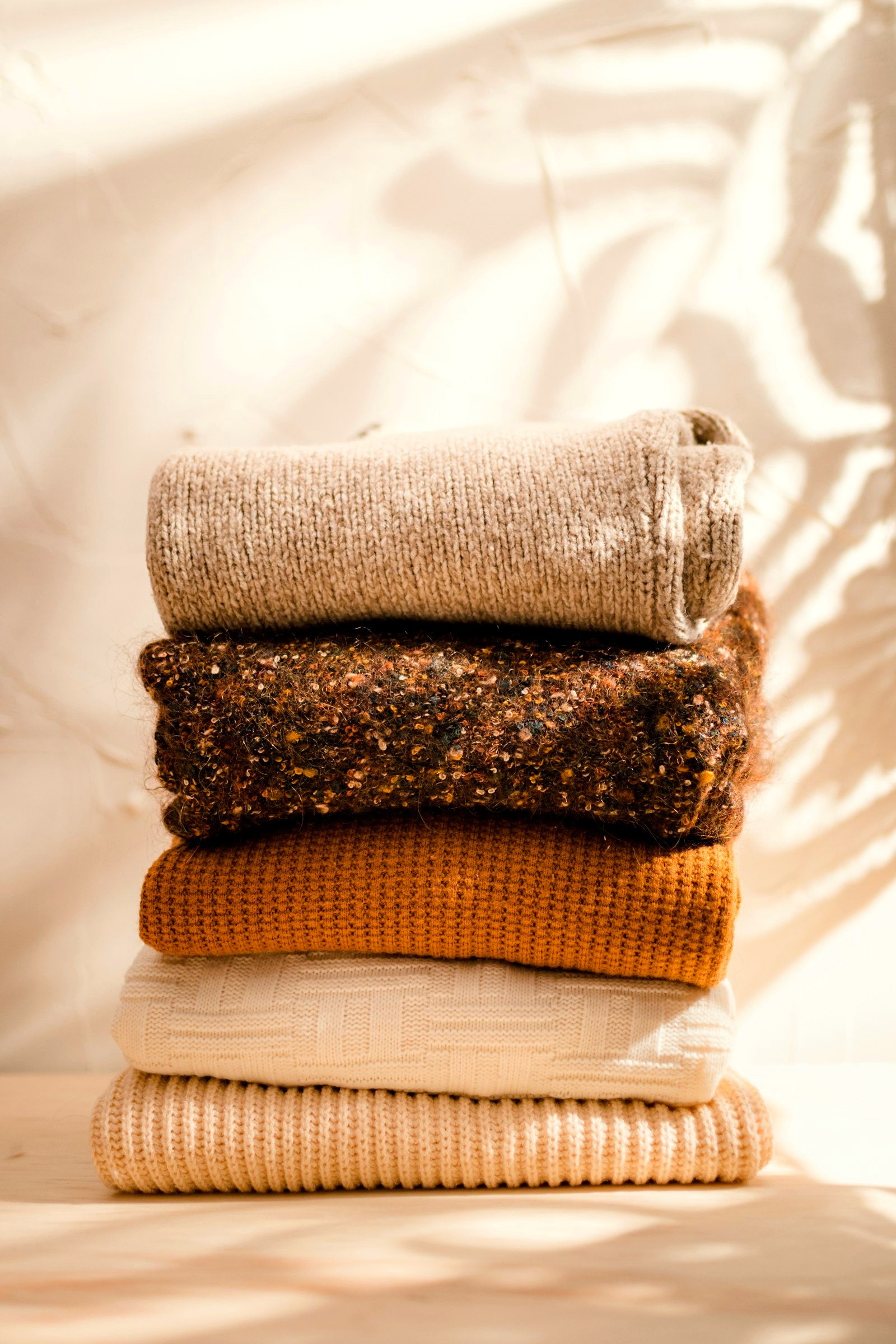
The cloth this page grades from. The bank holds no photograph of a V-neck sweater worn in any species, so this page's frames show the knit itself and one layered assembly, captioned for exactly what they are; the gap and the harvest list are named in the honesty section below.
Checked and updated October 2026
The verdict, up front: seven V-neck sweaters scored out of 100 on fibre 30, construction 20, fit 20, value 15, longevity 15, plus the one sent home. The John Smedley Blenheim wins at 87, 100 percent extra fine merino at a published 30 gauge, the second sweater from its house to land on that number after the Lundy crew. The Luca Faloni pure cashmere V-neck follows at 85, the fullest published record in the field, its own product page printing its ply, its gauge and its weight. The William Lockie Leven Vee Neck is third at 82, the third Leven garment this site has scored at the family's number, on its own rows. And the sweater sent home, at 34, is the Zara Wool V-Neck Sweater, named for a fibre its maker's own composition line puts in second place: 50 percent polyester, 30 percent wool, 20 percent acrylic. The count underneath the ranking is this Card's test, printed in full below: all eight makers publish a complete fibre split, three of eight publish a gauge, and not one of the eight publishes the depth of the V, the measurement the garment is named for. One scope ruling before the ranking starts: the sleeveless sibling is not here. The sweater vest is the same frame with the sleeves removed, graded on Verdict Card No. 56 on its fibre record; the tailored waistcoat is tailoring's garment, graded elsewhere. This Card grades the sleeved V only, the office neck the sweaters index files at formality 4 and warmth 3, bought to layer over a shirt.
The finding: the split went honest, and the blank moved to the V
The knitwear Cards on this site have spent three rankings teaching one lesson: read the composition line before the photograph. The sweater vest Card, No. 56, found the pattern end of its field hiding behind patterns, six of eight splits published, the two patterned vests failing theirs, and no gauge printed anywhere in the field. This Card graded the sleeved V on the same disclosure law, expecting the same evasions, and the field surprised the desk in the first column. Every maker scored here publishes a complete fibre split, percentage by percentage, the heritage mills and the high street alike. The split, the number this site has charged silence against for a year of knitwear, is eight for eight. Even the skip publishes its split in full. The split is what convicts it.
The gauges improved with the sleeves. Three of the eight makers print one: the winner's 30, at the top of the fine band the crew ranking published; the cashmere's 12, printed on its product page beside its weight; and the cotton knit's 12, printed beside its measurements. Against the vest field's none of eight, the sleeved V is the better documented garment, and the ranking's order is very nearly the record's order. Then the count reaches the garment's own dimension and stops dead. A V-neck is a frame: its whole design purpose, printed in the sweaters index and worked out in the wearing brief, is to hold a shirt collar and a tie knot inside an opening, at a depth that decides whether the knot sits whole, the collar stands clear, and the chest stays covered. That depth is a measurement, in inches or centimetres, as printable as a chest size. Not one maker in this field prints it. Three offer an adjective in its place: low, deep, and, from the value answer, a ruling in words, neither too deep nor too shallow. The shoulder the frame hangs from is nearly as quiet: a saddle shoulder is published by one maker in eight, and the other seven leave their shoulder construction to the photograph, which is the one place this desk does not grade from.
The lesson is narrower than the one the vest Card taught, and more useful for it. Disclosure in this family is no longer the fight: the fight is that the disclosure stops exactly where the garment's job starts. A buyer can compare every fibre in this field from his chair, and cannot compare the one dimension that decides whether the sweater does the thing it is for. So the fit rows below credit what is printed, the two makers who publish full garment measurements take the field's best fit scores at a ninth of the leaders' prices between them, and the depth each maker leaves blank is charged once, in the audit section, rather than eight times in disguise. Buy the record, and try the V over the exact shirt and tie it will frame, because on this evidence the fitting the makers declined to publish is yours to do. Every score is a garment score. Where a house holds a brand score elsewhere on this site, the brand number is printed on the card and kept separate, in both directions.
How the scores work
Every sweater is scored out of 100 on the same five rows. Fibre (30) reads the published fibre record, on the disclosure law this desk applies everywhere: the split as printed, percentage by percentage; a complete single-fibre claim above a blend; a blend read by its first fibre, because the first fibre is the one doing the work; provenance credited where the maker prints it, a named lambswool grade, a ply, a micron, a spinner, a mill; and silence charged as silence. Construction (20) is the knit built around the fibre: the gauge where a maker publishes it; the neckline's own construction, the V's rib and its shaping, as published; the shoulder as published, saddle or set-in; seams and fashioning as published. Fit (20) is the index test graded as published: close through the body over a collar, flat enough to sit under a blazer, the depth as published (in this field, as adjectivised), sized in a range a reader can actually enter, with the maker's own fit language and garment measurements credited where printed. Value (15) divides the price by the published record and by the seasons the longevity row scores, printed in the cost table below. Longevity (15) is the ownership audit: how the cloth ages, whether the house still sells the model, and whether a making culture stands behind the garment. Row scores add to the total, on every card.
The ranking
John Smedley Blenheim V-Neck Sweater
The Winner · The Fine-Gauge Answer
US price at last check: $310 at Harrods.
Buy it as the office V: the finest published gauge in the field, in the yarn the index files first for this neckline, from the house whose crew neck won No. 10 at the same number.
The fibre: 100 percent extra fine merino wool, the complete single-fibre claim, in the fine merino the sweaters index names first among this neckline's yarns. Fibre takes 27, the row the house's Lundy crew took on the crew ranking, because the yarn record is the same record: extra fine merino from the mill that has knitted it at Lea Mills since 1784. The deduction is the figure even this maker withholds on the garment's own listing: no micron is printed for the Blenheim's yarn, where the house's fibre reputation was built on printing fineness. What is printed, and what no other merino in this field prints, is the gauge, and it is graded under construction, where it belongs.
The build and the fit: construction 18: a 30-gauge knit, published in the maker's own description of the garment, the top of the fine band the crew ranking buys by, fully fashioned in the house's method, panels shaped on the machine rather than cut from cloth, with ribbed cuffs and hem. At 30 gauge the V does the index's trick in full: it slides under a blazer like a shirt with warmth, and the frame sits flat enough for the knot to be the only thing inside it. The neckline is published as low, the maker's word, an adjective where the audit below asks for a measurement, and the row stops where the record stops. Fit 16 on the standard fit the maker names, the classic English cut that assumes the shirt beneath it, a point under the Lundy crew's fit row because this garment's captured record carries no garment measurements beside the name. Value 11 at $310, thirty dollars under the cashmere and sixty-five under where this house's crew sits at US retail, the fine-gauge argument at the field's fairest heritage price. Longevity 15 on the making itself, a mill in its eighth generation refining the same garments rather than replacing them. The landing is printed because it will be noticed: 87 equals the Lundy crew's 87, a different garment on a different row split, the V winning a value point and losing a fit point against its round-necked sibling. John Smedley the brand stands at 79 on Brands Like John Smedley, rows 26, 18, 13, 8, 14; this 87 is the Blenheim's own, the sixth Smedley garment this site has scored and the fifth to win its ranking.
Luca Faloni Pure Cashmere V-Neck Sweater
The Cashmere Answer · The Fullest Record in the Field
US price checked today: $375 at the maker's own store, duties included.
Buy it as the luxury V, on paperwork nobody else in the field matches: its own product page prints the ply, the gauge and the garment's weight in one specification.
The fibre: 100 percent two-ply cashmere, A-grade in the maker's own grading, spun by Cariaggi, the yarn house named on the maker's pages and credited here the way the cashmere Card credits it, as provenance printed rather than implied. Fibre takes 27, level with the winner, because on the published evidence there is no finer raw material for this garment: the split is total, the ply is stated, the grade is stated, and the spinner is named, the four facts the cashmere law asks for on one page. This sweater is graded fresh, as its own garment; its crew-necked sibling stands at 84 on two Cards, carried there from the crew ranking, and nothing of that score is borrowed here. What the V's own record adds is printed under construction.
The build and the fit: construction 18, and the point of difference with the crew is a point about receipts. The crew's specification was assembled across its maker's cashmere pages; this garment's own product page, opened for this ranking, prints the whole of it in one list: 100 percent two-ply cashmere, a ribbed neckline, cuffs and hem, approximately 250 grams, a 12-gauge knit, knit in Italy. A published weight is the rarest figure in this field, printed by one maker in eight, and a published gauge puts the knit in the mid band, the visible layer over a button-down rather than the fine layer under a blazer, which is the cashmere V's honest posting and is graded as such. Fit 16 on the tailored silhouette the maker states, across sixteen colourways in the two-ply V, the welcome a standard run serves well. Value 9 at $375 prices the direct model fairly: no retail markup stands between the mill price and the reader, and the cost table still makes it the dearest wear on the page at $1.17, because cashmere wants rest days and the table does not pretend otherwise. Longevity 15 on two-ply yarn built to hold its shape, from a house whose whole method is the permanent wardrobe, refined year over year. Luca Faloni the house tops this site's Italian ranking at 91; this 85 is the V-neck's own, earned a point above its crew sibling on the strength of a product page that publishes more than any other in the field.
William Lockie Leven Vee Neck
The Lambswool Answer · The Leven Number, a Third Time
No consumer price at the maker's own site, a trade stock service, re-checked today; the Leven range runs $350 to $400 at US stockists.
Buy it as the country V: the warm species of the garment, two-ply Geelong with the saddle shoulder printed, from the house whose Leven garments this site has now scored three times at the same number.
The fibre: 100 percent two-ply Geelong lambswool, printed in the maker's own stock brochure, the fullest fibre sentence in the field's heritage half: the fibre, its grade and its ply in one line. Geelong is the lambswool grade the trade treats as its fine standard, the first clip of the lamb, and the two-ply states the yarn's weight class in the open. Fibre takes 26, the row this house's Leven garments took on the crew ranking and the cardigan ranking, and the deductions are the figures even this maker withholds: no micron is printed for the yarn, and no gauge is printed for the knit, the two silences the audit below counts across the field.
The build and the fit: construction 18: saddle shoulders, the heritage construction that lets a sweater move with the arm instead of against it, and the only shoulder construction any maker in this field publishes; straight cuffs; hand crafted in Hawick, where the house has knitted since 1874. The row sits a point under the Leven construction rows this site has printed before, and the card says why: the V's own brochure line is one line thinner than the file the crew was graded on, and the row grades the record in front of it. Fit 15 on the classic fit the brochure names, sized in honest chest inches, 40 to 50, across twenty-six colourways, a point above the Leven crew's fit row because the classic cut is this garment's working shape, roomed for the open button-down of its country posting. Value 8 prices the door as much as the garment: the maker's own site is a trade stock service and prints no consumer price, the opacity its brand page already charges, and the $350 to $400 stockist band is what the cost table divides, at its midpoint, printed as an estimate. Longevity 15 on two-ply lambswool built to be kept, repaired and handed down. The landing, printed in the open: this is the third Leven garment scored on this site, after the crew at 82 and the slipover at 82, and it lands on 82 on its own rows, fibre equal, construction a point lighter, fit a point kinder. Three garments, three row splits, one number: that is what a stable yarn, a stable price band and a stable making culture add up to, and the desk prints the coincidence rather than smoothing it. William Lockie the brand stands at 82, derived in the open on Brands Like John Smedley from this garment family; the Vee Neck is the family's third garment at the family's number.
Uniqlo Extra Fine Merino V-Neck Sweater
The Value Answer · The Tape Measure's Winner
US list price: $49.90.
Buy it as the field's arithmetic problem for everyone above it: a published micron, a published tape for every size, and a depth ruling in words, at a sixth of the leaders' price.
The fibre: 100 percent wool, extra fine merino at 19.5 microns, the micron count printed in the maker's own description of the garment, the same printed fact its crew sibling's score was built on. Fibre takes 19, the crew's row, because the fibre record is the crew's record: a genuinely fine natural fibre, totalled and microned, with the maker's anti-pilling processing and machine-washable finish printed beside it in plain language. The distance to the heritage rows above is the yarn's depth of provenance, a fibre specified by number rather than by mill, and the row prices exactly that distance and no more.
The build and the fit: construction 14: variable rib knitting at the sleeves and hem, printed by the maker as its answer to sagging, an efficient industrial make that files no claim about fashioning and is graded on the claim it files. The neckline carries the field's only depth ruling in words: neither too deep nor too shallow, which is an adjective doing a measurement's job, credited as the honest attempt it is and charged as the substitute it remains. Fit 18, the best fit row in the field, and it is not close: the maker's page publishes full garment measurements, length, shoulder, chest and sleeve, for every size from XXS to 3XL, so the fit can be checked against a tape before it is checked against a mirror, paperwork the heritage end of this page does not attempt at six times the price. Value 15, the ranking's perfect score: $49.90 for 100 percent merino with its micron printed is the cheapest complete record in the field, and the cost table prices it at $0.42 a wear, the lowest figure on the page. Longevity 10 prices the known deductions, a thinner knit than the heritage Vs and a three-winter honest costing before the elbows and the neckline start negotiating. The landing, printed: 76 edges this garment's crew sibling, which stands at 75 on the crew ranking, by the same single point that ranking's crew won over its own turtleneck sibling, and the point lives in the same place, the fit paperwork. Uniqlo the brand stands at 84 on its family page; this 76 is the V-neck's own.
Charles Tyrwhitt Pure Merino V-Neck Sweater
The Shirtmaker's Knit
US list price at last check: $149. No buy pill: the maker's own US product page for this knit resisted capture at this check, and this desk does not guess a slug; the record graded is the maker's own product file, carried by its review partner.
Buy it as the safe pair of hands, with the paperwork known: a certified fibre and the field's shortest promise, from the house whose shirts this site scores on published specifications, at a list price its own sale cycle keeps renegotiating.
The fibre: 100 percent merino wool, Woolmark-certified, the certification printed in the maker's own product file beside the fibre line. Fibre takes 20, and the row is the disclosure law read both ways in one card: a certification is a published, checkable fact, worth more than a bare name, and it is worth less than a number, because the file prints no micron for the yarn where the Uniqlo ranked above it prints 19.5 microns at a third of the price. Garment washed for a softer finish, a contrast trim at the back neck, machine washable: the complete fibre file, honest, certified, and thinner than the ticket suggests.
The build and the fit: construction 13: no gauge is published for the knit, no fashioning is claimed, and the garment wash is a finish rather than a construction, so the row grades a competent industrial knit on a short file. Fit 15 on the house's broad welcome, the size run its knit range carries, with no garment measurements captured for this garment and the absence charged rather than filled. Value 11 at the $149 list, graded on list the way this desk graded the house's shirts on its family page, with the theatre printed beside it: the house's own reviewers note its knits are almost always in some sort of sale, so list is an opening position, and the cost table's $0.75 a wear is the figure at list. Longevity 10 charges the promise the maker itself prints: a six-month quality guarantee, the shortest in this field by years, where the heritage end prints no guarantee because it expects a decade and the Lockie expects a generation. A house that guarantees its knit for two seasons has told the buyer its own expectation, and the row believes it. Charles Tyrwhitt the brand stands at 65, derived on Brands Like Spier and MacKay and audited on its family page; this 69 is the garment's own, four points of knit sitting above the house that made it.
J.Press Cotton-Cashmere V-Neck Sweater
The Cotton Answer · A Garnish, Printed as One
US price checked today: $245 at J.Press, in stock.
Buy it as the warm-weather V: a Pima cotton knit with its measurements published to the half inch, whose cashmere is priced here as what the split says it is.
The fibre: 92 percent Pima cotton, 8 percent cashmere, printed in full in the maker's own description, and graded exactly as the blend law reads it. The name leads with cotton, which is honest ordering, and the fibre doing the work is cotton: a long-staple Pima, named, which is worth real points against an unnamed cotton, in a knit built for the half of the year wool cannot cover. The cashmere at 8 percent is a garnish, a softening hand on a cotton cloth, and fibre takes 17 for the pair of facts together: a total split, honestly ordered, for a fibre blend whose luxury word contributes a twelfth of the cloth. Set beside the cashmere Card's law, a blend that leads with its luxury fibre on a single-digit share is convicted on its label; this one leads with its working fibre, and is graded as a good cotton knit instead of a bad cashmere one.
The build and the fit: construction 14, carried by one published number: a fine 12-gauge knit, stated in the maker's own description, one of only three gauges printed in this field, at the top of the mid band, with the country of making printed beside it, Madagascar. Fit 17, the field's second-best fit paperwork: the maker's page publishes two measurement tables, the garment's own dimensions and the body's, chest, sleeve and length for every size from XS to XXL, with the maker's own guidance printed under them, a trim fit, size up for a relaxed one. That is how a fit is sold honestly, and the row pays for it. Value 8 at $245 refuses the heritage discount the name invites: a quarter of the price of nothing on this page buys a cotton knit, however well papered, and the cost table's $1.02 a wear sits a cent under the skip's, which the card prints because the reader should see it. Longevity 10 on a cotton knit in a permanent style from a house that sells the same Ivy staples decade over decade, against cotton's own ageing, which fades and softens rather than pills. J.Press holds no brand score on this site; this 66 is the garment's own.
Zara Wool Blend Knit V-Neck Sweater
The Honest Split at the Fashion End
US price checked today: $110 at Zara's US store.
Buy it as the proof that disclosure is a choice, not a price point: a complete, wool-led split at the fashion end, with the thinnest record around it in the field.
The fibre: 95 percent wool, 5 percent cashmere, printed in the maker's own composition line on its US product page, a complete split at $110. Fibre takes 20, level with the shirtmaker's certified merino and beaten in this field only by the three heritage knits, and the row is graded exactly as the law reads it: the split is total and checkable, wool carries nineteen twentieths of the cloth, and the deductions are what the split does not say, no grade for the wool, no ply, no micron, a fibre totalled but not specified. The 5 percent cashmere is the same garnish the J.Press card prices, printed here in the honest position, second and small. Two cards from this house sit on this page, and this one's composition line is why the other one is the skip: the disclosure was available to both.
The build and the fit: construction 10: ribbed trim at the neckline, the cuffs and the hem, the complete published build, honest and thin in the same breath, with nothing filed on gauge, seams or fashioning. Fit 11 on the whole of the published fit record, which is a neckline adjective and a sleeve length: a deep V-neck and long sleeves. The deep is worth a sentence of its own, because this is the field's deepest claimed opening and it arrives, like every depth here, as a word. At the fashion end the deep V is the style, worn open over a tee or against skin, the posting the sweaters index warns reads unfinished; graded at its own posting it is a deliberate garment, and graded on its paperwork it is an unmeasured one. Value 11 at $110, the record bought per dollar beaten in this field only by the Uniqlo: 95 percent wool at this price is honest money, and the row says so against the house's own reputation. Longevity 7 prices a style built for a season's range in a house whose brand longevity row stands at 3, against a cloth that deserves a longer life than its range will give it. Zara the brand stands at 48 on Brands Like Zara; this 59 is the garment's own, and the eleven points between them are what one honest composition line is worth.
Zara Wool V-Neck Sweater
The Skip: Sent Home · The Name Is the Conviction
US price at last check: $59.90 at Zara's US store. No buy pill: this desk does not link what it sends home.
Send it home: a sweater named for wool whose maker's own composition line puts polyester first and wool second, at ten dollars above this page's 100 percent merino.
The fibre: 50 percent polyester, 30 percent wool, 20 percent acrylic, the maker's complete published composition, and credit where it is due before the sentence lands: the split is published, in full, which is more than the famous names on some of this site's Cards have managed. What the split says is the conviction. The garment is named Wool V-Neck Sweater. Wool is the second fibre in it, at 30 percent, behind a polyester majority, with acrylic making up most of the rest: 70 percent of the cloth is synthetic, and the fibre in the name is a minority partner in its own garment. That is the blend-lie in its clearest form on any knitwear Card this site has published, not a luxury garnish on a working fibre, not a performance minority, but the name fibre outvoted in its own sweater. Fibre takes 8: the disclosure is real, and what it discloses is the skip.
The build and the fit: construction 7: a V-neck, long sleeves and ribbed trims, the complete published build, a paragraph's worth of garment and nothing behind it. Fit 10 on the same record, a neckline and a sleeve, with no fit name, no measurements and no depth, the frame sold unmeasured like the rest of the field and unwoolled unlike any of it. Value 6 at $59.90 refuses the cheapness defence in advance: the sweater costs ten dollars more than the Uniqlo ranked fourth on this page, which is 100 percent merino with its micron printed, so the reader is asked to pay a premium over a real wool sweater for a majority-polyester one wearing wool's name. The cost table finishes the point in arithmetic: at about sixty presentable wears, a polyester-led knit pilling and shining its way down, it costs $1.00 a wear, more than six of the seven ranked sweaters. Longevity 3 is the house's own brand row, applied to the cloth that earns it fastest. The full conviction is written in the skip section below. Zara the brand stands at 48, printed here unmoved: this 34 is the garment's own, and its stablemate ranked seventh is the proof the sentence is about the sweater, not the house.
The record table: what each maker actually publishes
| Sweater | Fibre, as published | Gauge and weight, as published | The V's depth, as published | Price |
|---|---|---|---|---|
| John Smedley Blenheim | 100% extra fine merino wool | 30 gauge published | "Low" (the maker's word; no measurement) | $310 |
| Luca Faloni Pure Cashmere V-Neck | 100% two-ply cashmere, A-grade, Cariaggi yarn | 12 gauge and about 250 g, both published | Not described | $375 |
| William Lockie Leven Vee Neck | 100% two-ply Geelong lambswool (maker's stock brochure) | Not published (saddle shoulder published) | Not described | $350 to $400 at US stockists |
| Uniqlo Extra Fine Merino V-Neck | 100% wool, 19.5 micron published | Not published (full garment measurements published) | "Neither too deep nor too shallow" (the maker's ruling, in words) | $49.90 |
| Charles Tyrwhitt Pure Merino V-Neck | 100% merino wool, Woolmark-certified | Not published | Not described | $149 |
| J.Press Cotton-Cashmere V-Neck | 92% Pima cotton, 8% cashmere | 12 gauge published | Not described (trim fit and full measurements published) | $245 |
| Zara Wool Blend Knit V-Neck | 95% wool, 5% cashmere | Not published | "Deep" (the maker's word; no measurement) | $110 |
| Zara Wool V-Neck Sweater (skip) | 50% polyester, 30% wool, 20% acrylic | Not published | Not described | $59.90 |
Read the columns in order, because together they are the finding scored. The first column fills in completely, eight times in eight, the first knitwear field on this site where the split column has no gaps in it. The second column fills three times: two gauges at the top of the ranking and one in its lower half, one garment weight, and then silence from houses that publish their shirt specifications to the thread count. Then read the fourth column, which contains no number at all. Three adjectives stand where the measurement belongs, low, deep, and a ruling in words, and five makers do not attempt even the adjective. The V-neck is the knit most often sold as a tailoring accessory, the frame a collar and a knot sit inside, and the frame's one dimension is the one nobody in the field publishes. A buyer can compare every fibre on this page from his chair. The garment's deciding measurement he must go to a shop and make himself, over the shirt he means to wear, which is where the audit below leaves it.
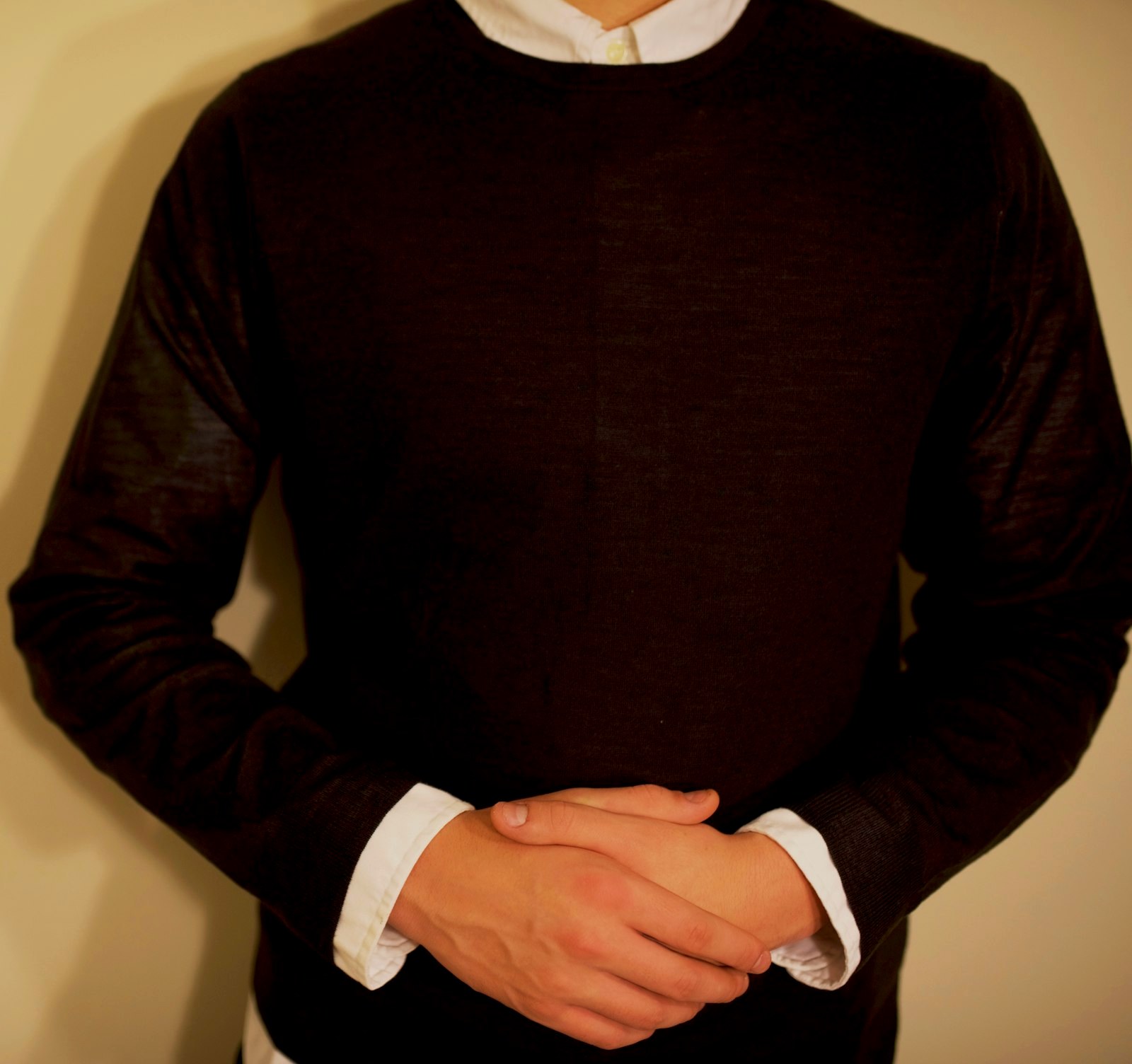
The depth audit: the measurement nobody prints
The V's depth is not a styling detail. It is the garment's specification, the number that decides all three of its jobs. It decides whether the tie knot sits whole inside the frame, the wearing brief's first law, or drops below the point and hangs out of the picture. It decides whether the collar stands clear inside the opening or is swallowed by it. And it decides the index's alone test: a shallow V over bare skin is a neckline, a deep one is an exposure, and the line between them is a measurement nobody prints. This desk buys knitwear by published bands where bands exist: the crew ranking's gauge bands, fine roughly 24 to 30 and mid roughly 12 to 20, govern the postings on every knitwear Card since. No depth bands can be published, because the input does not exist. Of the eight makers scored here, three describe their V in a word, low, deep, and neither too deep nor too shallow; five do not describe it at all. The same makers publish, between them, three gauges, one garment weight, two full sets of garment measurements and eight complete fibre splits. The paperwork culture is there. It simply stops at the neckline, on the garment named for its neckline.
The shoulder the frame hangs from is the audit's second column, and it is nearly as quiet. A saddle shoulder, the heritage construction, is published by one maker in eight, the Lockie, whose brochure line names it. A set-in shoulder is claimed in so many words by none, though several of the field's photographs plainly show one, and this desk does not grade from photographs. So the construction rows above are graded on the published remainder, gauges, ribs, trims and fit language, and the two facts a buyer most needs for the garment's one job, how deep the frame is and how it is hung, are left where their makers left them. The first maker in this family to print a V depth in inches takes the audit's point and, on this evidence, a ranking advantage with it: the number costs nothing to publish, the tape already exists in every sample room in the field, and its absence is a habit, not a necessity. Until then, the fitting is the reader's, done in a shop, over the exact shirt and tie the sweater will frame, which is the wearing brief's advice and now the audit's as well: the depth law is printed there, with the frame rule and the outfit matrix, for a garment whose makers print everything except the depth.
Cost per wear, printed in the open
The maths, assumptions printed. A V-neck in office rotation is worn about 40 times a year across the cold half of the year, the same assumption as our crew ranking. Expected life is presentable service: the winters the sweater keeps its shape, its neckline and its surface, not the winters it merely exists. The Lockie is costed at $375, the midpoint of its stockist band, printed as an estimate because the maker publishes no consumer price to divide; the Tyrwhitt is costed at its $149 list, with the sale caveat printed on its card. Divide price by wears.
| Sweater | Price used | Expected life | Cost per wear |
|---|---|---|---|
| Uniqlo Extra Fine Merino V-Neck | $49.90 | 3 winters (120 wears) | $0.42 |
| Charles Tyrwhitt Pure Merino V-Neck | $149 | 5 winters (200 wears) | $0.75 |
| John Smedley Blenheim | $310 | 10 winters (400 wears) | $0.78 |
| William Lockie Leven Vee Neck | $375 (estimate) | 12 winters (480 wears) | $0.78 |
| Zara Wool Blend Knit V-Neck | $110 | 3 winters (120 wears) | $0.92 |
| Zara Wool V-Neck Sweater (skip) | $59.90 | About 60 presentable wears | $1.00 |
| J.Press Cotton-Cashmere V-Neck | $245 | 6 winters (240 wears) | $1.02 |
| Luca Faloni Pure Cashmere V-Neck | $375 | 8 winters (320 wears) | $1.17 |
Two lessons, both printed rather than implied. First, the table does not flatter the luxury end: the Faloni's $1.17 is the page's highest figure and it sits in print beside its second-place score, because a ranking that only punishes the cheap end is an advertisement, not a verdict; you buy the cashmere for the hand of two-ply Cariaggi and a decade of evenings, knowing the arithmetic. Second, the skip's line agrees with its name conviction from the other direction: at a dollar a presentable wear, the $59.90 sweater in a wool name costs more to wear than six of the seven sweaters ranked above it, and nearly double the season of the merino that costs ten dollars less to buy. Cheap per garment and dear per wear is the fast pattern's whole arithmetic, and here it is printed in the row of a sweater whose name promised the opposite trade.
The skip: the Zara Wool V-Neck Sweater at 34
Every Verdict Card on this site sends one garment home, and the honest ones are convicted out of their makers' own mouths. This one's maker published the conviction itself, in the composition line on its own US product page, directly under the garment's name. The name is Wool V-Neck Sweater. The composition is 50 percent polyester, 30 percent wool, 20 percent acrylic. Read those two lines together and the card writes itself: the fibre the garment is named for holds less than a third of it, outvoted by the polyester in first place and the acrylic in third, in a knit sold at $59.90, ten dollars above the 100 percent merino ranked fourth on this page, whose maker prints its micron count on the same kind of page. The blend-lie has degrees, and this site has scored most of them: the cashmere garnish on a cotton knit, graded fairly on the card above because its name led with the working fibre; the argyle on the vest Card, a heritage pattern over 89 percent synthetic, sent home at 33. This one is the purest form yet, because nothing here is even patterned. There is no diamond to hide behind, no cable, no crest: a plain V-neck, a wool name, and a cloth that is 70 percent synthetic. What acquits the house and convicts the garment is printed two cards above this section: the same maker, in the same range, publishes a 95 percent wool V-neck with its complete split at $110, and that sweater is ranked seventh on this page on the strength of its own record. The fibre was available. The disclosure was available. For the sweater wearing wool's name, neither was chosen, because the name was expected to sell the garment by itself, and on the evidence of its own composition line, the name is all there is. Buy the split, not the name. The ranking above is what that sentence buys.
Which V-neck to buy
If you buy one: the Smedley Blenheim, the complete office record at 87, 30-gauge merino with the making behind it, at $0.78 a wear across a decade. If you buy the luxury: the Faloni cashmere V, the fullest record in the field, bought for the cloth with its $1.17 a wear known. If the V is the country species: the Lockie Leven, two-ply Geelong with the saddle shoulder, the warm end of the ranking and its longest life. If you buy on arithmetic: the Uniqlo, 100 percent merino with its micron and its measurements published, at $49.90 and $0.42 a wear, the field's standing embarrassment to everyone above it. If the shirtmaker's hand is the appeal: the Tyrwhitt, bought with its certification, its six-month promise and its sale cycle known. If the season is warm: the J.Press, the honest cotton, its garnish priced. If the register is fashion: the Zara 95 percent wool V, the honest split, over every famous name in its row and over its own stablemate entirely. The garment's wearing system, its depth law, its species and its outfit matrix, is written in the V-neck brief; its place in the drawer is filed in the sweaters index; and its sleeveless sibling is ranked in Verdict Card No. 56.
Questions, answered
What is the best V-neck sweater for men?
The John Smedley Blenheim, at 87 out of 100 in this ranking: 100 percent extra fine merino at a published 30 gauge, fully fashioned in Derbyshire, at $310, the second sweater from its house to land on 87 after the Lundy crew on the crew ranking. The Luca Faloni pure cashmere V-neck is second at 85, 100 percent two-ply cashmere whose own product page prints its gauge and its weight, the fullest single-page record in the field. The value answer is the Uniqlo extra fine merino V at 76, 100 percent wool with its micron count and its full garment measurements published, at $49.90 and $0.42 a wear in the cost table on this page. The sweater sent home, at 34, is the Zara Wool V-Neck Sweater, a garment named for wool whose maker's own composition line reads 50 percent polyester, 30 percent wool, 20 percent acrylic.
How deep should a V-neck sweater be?
Deep enough to hold the whole knot and no deeper, and the honest complication is that no maker in this field prints the measurement: of the eight sweaters scored here, none publishes the depth of its V, and three offer a word instead, low, deep, and neither too deep nor too shallow. The wearing brief for the garment prints the test the number would answer: the collar stands clear inside the frame, the knot sits whole inside the V, and the opening ends above the chest's midpoint for office wear. Until a maker prints the depth, the fitting its maker declined to publish happens in the shop, over the exact shirt and tie the sweater will frame.
Merino, lambswool or cashmere: which makes the best V-neck?
Each fibre owns a posting, and this ranking scores one of each at the top. Merino is the office default, fine enough at 24 to 30 gauge to sit under tailoring, and the winner is merino. Lambswool is the country species, matte and spongy at a mid gauge, worn over an open button-down, and the Lockie Leven at 82 is its record here. Cashmere is the luxury end, the softest hand in the field and the highest cost per wear at $1.17, and the Faloni at 85 is its record. Cotton is the warm-weather answer: the J.Press at 66 is a 92 percent Pima knit whose 8 percent cashmere is priced on its card as the garnish it is.
Why is one Zara sweater ranked here and another sent home?
Because the house publishes both records and this page grades records, not houses. The Zara ranked seventh, at 59, prints a complete split on its maker's own page, 95 percent wool and 5 percent cashmere, at $110, and its fibre row of 20 is beaten in this field only by the heritage knits. The Zara sent home, at 34, is named Wool V-Neck Sweater, and its maker's own composition line reads 50 percent polyester, 30 percent wool and 20 percent acrylic: wool in second place in a garment named for it, at $59.90, ten dollars above this page's 100 percent merino. Same house, two composition lines. Buy the split, not the name. Zara the brand stands at 48 on its family page; both numbers here are the garments' own.
Should you buy a V-neck sweater or a sweater vest?
They are different garments sharing an opening, and the boundary is printed on both Cards. The V-neck sweater is the office neck whole: formality 4 and warmth 3 on the sweaters index, a knitted layer with sleeves and a warmth posting of its own, bought to layer over a shirt. The sweater vest is the same frame with the sleeves removed, formality 3 and warmth 2, a storey of dress rather than a layer of weather, ranked on Verdict Card No. 56 on its fibre record, where the Lockie Leven Slipover wins at 82. Buy the sweater when the garment must warm as well as frame; buy the vest when the shirt is the outfit and the knit is its finishing storey.
How should a V-neck sweater fit?
Close through the body over a collar, with the hem at the belt and the knot whole inside the frame: the index's buying rule is to buy it to layer over a shirt, and worn alone against skin it reads unfinished. The gauge bands the crew ranking published govern the postings, fine gauge, roughly 24 to 30, under a blazer, and mid gauge, 12 to 20, as the visible layer over a button-down. Fit paperwork is where this field splits: two of the eight makers scored here, Uniqlo and J.Press, publish full garment measurements for every size, and their fit rows, 18 and 17, are the field's best; the heritage end names its fit, standard, classic, trim, and leaves the tape to the shop.
How this ranking stays honest
The rests, the capture notes and the flags, printed. The stale-FAQ flag, first, because this Card creates it: the V-neck brief on this site was written in anticipation of this ranking, its frontmatter names this Card as its sibling, and its FAQ answers the question "Has Young Cotton ranked V-neck sweaters?" in the negative, in the standing not-as-a-Card form, with a closing sentence that speaks of judging the garment "before a ranking exists". Both statements were true when the brief shipped and both go stale at this one. The amendment, citing this Card's verdict, is owed in the wiring of this page and is flagged in this Card's state file for the parent; this page does not quietly pretend the brief says something it does not. The brief's own record is otherwise respected throughout: its frame rule and depth law are this Card's audit, and its species are this Card's field. Johnstons of Elgin was researched for the Scottish cashmere seat and rested on verification: no men's cashmere V-neck could be pinned to a maker's own product page at this check, the house's V-neckline garment being a cardigan, which belongs to the cardigan Card's family, and the Lecht crew's 80 on the cashmere Card remains the house's record in this drawer. Spier and MacKay was researched and rested on the same ground: a deep-V camel merino is attested in the house's 2024 range coverage, and no current product page for it could be verified at this check; the brand stands at 76, untouched. Quince was researched and rested on a boundary this desk has printed before: only a women's cashmere V-neck could be verified on the maker's store, and a men's ranking does not grade a women's garment; Quince the brand stands at 59, untouched. The AllSaints Beton merino V-neck was researched and rested on capture: it is listed on the maker's sale pages at £119 through a permanent sale carousel, and its composition could not be captured verbatim from the maker's own page at this check; AllSaints the brand stands at 66, untouched. H&M was rested deliberately, as it has been rested through this run of Cards; its derived brand score stands untouched on its own page, and no garment here triggers its fourteenth derivation entry. On capture: the Smedley record is graded from the maker's own description of the Blenheim as carried by its retailers, with the US price read at Harrods; the house's own US product pages have resisted capture to this desk's standard across five Cards now, the backfill stays in the November ledger with the house's other product pages, and its door below runs to the maker's store, the pattern the crew ranking set. The Tyrwhitt record is the maker's own product file as carried by its review partner, and its card ships without a buy pill for the reason printed on it. The Faloni door is the garment's exact product page, captured whole for this Card, an upgrade on the collection door the cashmere Card shipped; the crew's own product-page capture, owed since No. 42, remains owed and is not discharged by its sibling's. The Lockie's door is the maker's homepage, the logged exception its brand page established, the maker's own site being a trade stock service that prints no consumer price; its cost-table price is the stockist band's midpoint, printed as an estimate. The Zara doors are the maker's exact US product pages, verified from its own listings; the skip ships without one, as skips do. On photography: the bank holds no photograph of a V-neck sweater worn in any species, the gap the vest, fleece and quilted Cards admitted for their garments before us; this page's frames show folded knits, knit textures and one knit over a collared shirt whose neckline is a crew, captioned as a crew, the cards run without images, and the harvest list names what is missing, in order: a fine V-neck worn over an Oxford shirt and tie in daylight, a lambswool V over an open button-down in country dress, and a fine V disappearing under a blazer at the jacket's opening. Prices and specifications were checked against the makers' own published pages in October 2026; where a figure could not be verified from the maker's page, the page says so at the figure's elbow. The full method is written out on the methodology page.