
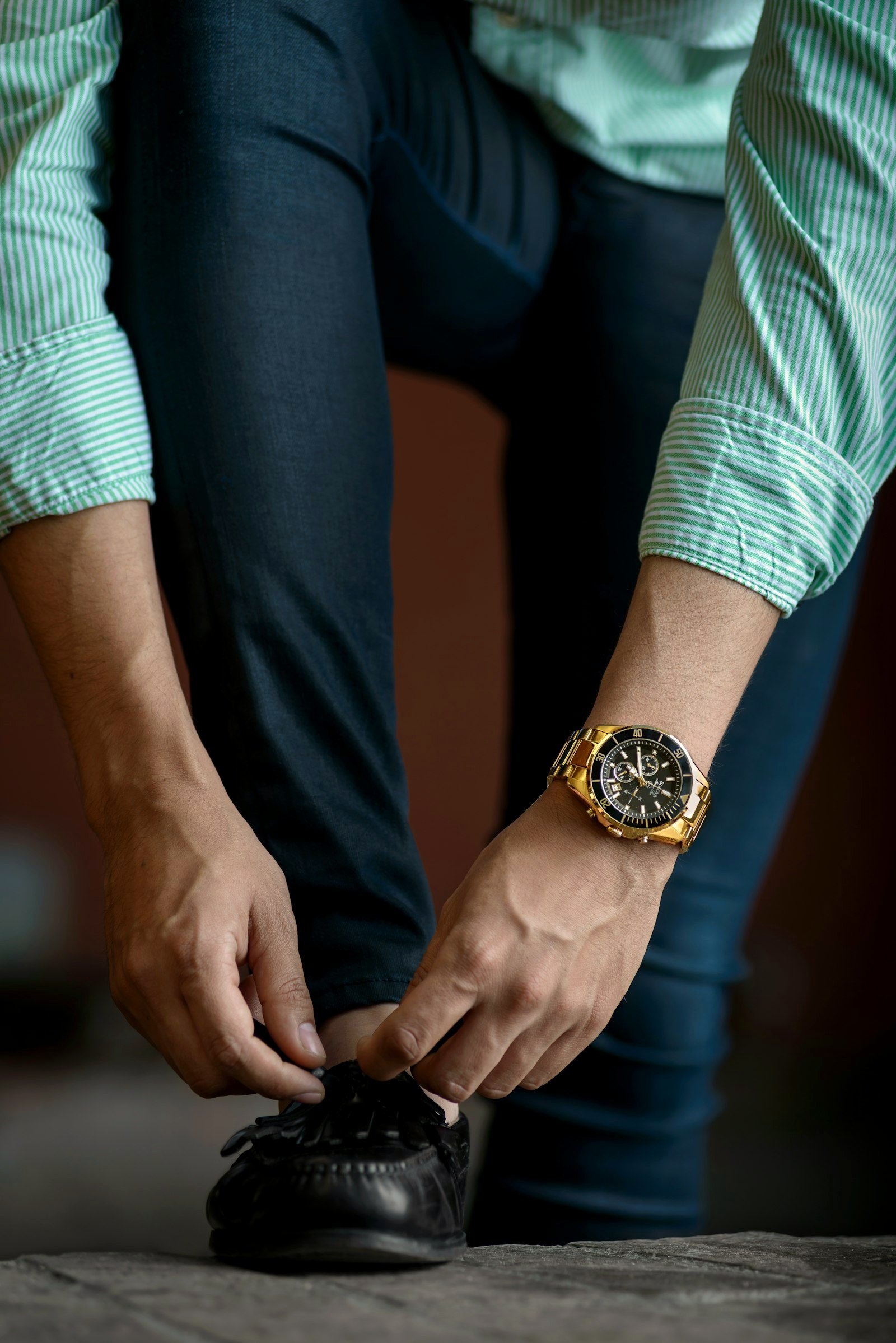
The fastening and the metal, captioned as exactly that: a laced shoe being tied, a watch in the frame, the two stations this page rules. The bank holds no monk strap frame and no buckled shoe of any kind, and this page prints that absence rather than dressing a laced shoe as its buckled subject; the care section prints the gap and the harvest list entire.
Checked and updated October 2026
The ruling, up front: the monk strap is the dress shoe that closes with jewellery: one strap of the shoe’s own leather, fastened by one buckle of metal, hardware doing the laces’ work at the throat of the shoe. It surrenders nothing the loafer surrenders, since it closes, and it claims nothing the Oxford keeps, since the ceremony rows are the lace’s. So it is worn as a decision and never as a default. One buckle before two: the single monk in calf takes the suit’s social rows and the tailored day entire, and the double monk, with twice the metal and twice the explaining, is bought later and worn only where the outfit around it is quiet enough to afford the second buckle. Its metal is answered: the buckle is the outfit’s largest piece of metal and it is counted in the metal budget the family prints for the horsebit, the belt’s buckle and the watch case in its family, the bright note spent once. And it is refused the two impersonations its hardware invites. It is not an Oxford: the boardroom, the formal evening, the funeral and black tie’s shoe station belong to laces and patent, and a buckle admitted there is hardware at a uniform’s station. It is not a loafer: worn unbuckled, sockless and loose as a pose, a fastening denied is a shoe unfinished, and the species cannot survive the reading. Between the two stands the shoe’s real register, which this brief prints in order: the record first, the shoe’s anatomy and its published history; then the pairing law, buckles, hems and metals; then the rooms and hours; and the looks, the ruling, the mistakes and the keeping after all of it. On scores: this site publishes no footwear ranking and no shoe is scored here, and the seats quoted are the family’s, cited as what they are.
This brief: the decisive rule · the shoe’s record · the pairing law · the rooms and hours · the looks · the ruling · the mistakes · care, elastic, and our photography
The decisive rule: the shoe that closes with jewellery, worn as a decision
Every dress shoe in the tailored wardrobe is decided by its fastening, and this family has printed the fastening’s census entire, in a brief about another shoe. No. 63, ruling the loafer with a suit, prints it in one sentence: every other dress shoe closes, laces tie, a buckle shuts, a boot zips or gussets, and the loafer alone slips on. The buckle in that sentence is this page’s subject, the one fastening in the census that is also an ornament. A lace is cordage, invisible when tied. A zip is machinery, hidden when shut. A buckle is a frame of worked metal standing on the shoe’s face, polished, catching the light, moving when the foot moves, and it does the lace’s whole job, holding the shoe closed against the instep, in the open, as the shoe’s one decoration. The monk strap is the dress shoe that closes with jewellery: a strap of its own leather fastened by a buckle of metal, so it is worn as a decision, one buckle before two, its metal answered by the belt and the watch, in the tailored wardrobe’s dressed rows, and never as a ceremony shoe and never as a slip-on. Nothing in its build argues with that rule. The vamp beneath the strap is plain because the buckle is the ornament and a second one would be a crowd. The shoe stands on dress lasts and leather soles because its errand is the tailored day. And the buckle cannot be taken off, dressed down or apologised for, which is why the shoe is a decision in a way the derby, its neighbour, is not: a derby under a suit is a default, and a monk under the same suit is a sentence the wearer has chosen to say.
The register is the tree’s at both ends, and this brief prints the ends rather than inventing a middle. Below the monk stands the loafer, and No. 63 seats it precisely: the loafer is the suit’s one licensed informality, the only shoe in the tailored wardrobe that arrives without its fastening, and its licence is narrow and conditional, the shoe repaying, in polish, in the hem cut for it, in the sock ruled as law, the formality its missing laces surrender. The monk is the inverse case, and the inversion is this brief’s foundation. The monk surrenders no fastening, so it owes no repayment: it closes, its closure is complete, and it walks into the suit’s rows on its own papers rather than on a licence. What it carries instead is the buckle’s cost, which is not formality but statement, and the whole of the pairing law below is the pricing of that statement. Above the monk stands the Oxford, and its seat is the family’s oldest furniture: No. 04 seats the ceremony rows once and for all, the boardroom, the formal evening and the funeral belong to black Oxford shoes, a sentence No. 56 repeats for its own family and this brief inherits for its shoe. The lace is the ceremony’s fastening, plain, standardised, the same on every foot in the room, and the buckle, one man’s chosen hardware, is exactly what a uniform’s rows are organised to exclude. Between the loafer’s licence and the Oxford’s rows stands the monk’s ground: the suit’s social rows and the tailored wardrobe’s dressed day, the same ground No. 56 gives the derby’s job to the sleek Chelsea on, and the monk does that job with a buckle where the Chelsea does it with a gusset and the derby with a lace.
The buckle’s arithmetic is the rule’s working half, and it is why the single precedes the double in everything this brief prints. A buckle is the outfit’s metal at its largest and lowest station, and the family has already priced metal worn on a shoe, in No. 63’s metals law for the horsebit: a bit is jewellery worn on a shoe, it enters the outfit’s metal budget as its largest single item, larger than the belt’s buckle, brighter than the watch case’s edge, and read first because it moves. The monk’s buckle is the horsebit’s case with the stakes raised, because the bit ornaments a shoe that has no fastening to excuse it, while the buckle is a fastening and cannot be removed from the accounting by calling it functional: the eye reads the metal first and the function second, at the ankle, at the outfit’s last station, where this family warns the eye arrives last and stays longest. One buckle spends that budget once, at a size the belt and the watch can answer. Two buckles spend it twice at the same station, and the outfit that carries a double monk has halved what every other station may say. That is not an argument against the double monk. It is its price, printed before its looks, the way this family prints every licence with its conditions: the second buckle is bought with the rest of the outfit’s quiet, and an outfit that has not got the quiet has not got the shoe.
The shoe’s record: a strap, a buckle, and a name older than the lace
The shoe first, because in this species the garment is the fastening to a degree no other subject in this family matches: change the closure and a different shoe stands in its place, a derby with a strap drawn on it, still laced in its grammar. The upper is a plain vamp crossed by one strap. The classic monk is cut with a smooth, unbroken front, no toe cap, no broguing in its formal form, because the strap and buckle are the shoe’s whole statement and the vamp is their ground. The strap is not applied decoration; it is a continuation of the upper’s own leather, rising from one side of the instep, crossing it, and fastening at the other side to the buckle, which is stitched or riveted to a short tab of the same leather. Behind the buckle, on most bench-made and ready-made monks alike, stands a short length of elastic gusset, the fastening’s one moving part, which lets the strap flex as the foot does and lets the shoe be put on without the buckle being opened at every wearing, a detail the care section prices, because the elastic is the shoe’s first wear part and its honesty depends on it. The construction under the strap is the dress shoe’s own: a slim last of the Oxford and derby family, a leather sole in the shoe’s formal register and slim rubber in its travelling one, a low stacked heel, the whole instrument built to the tailored wardrobe’s tolerances rather than the boot’s. A monk on a lug sole or a round work last is the species with its register spent, a strap on a boot’s body, and it is graded in the mistakes with the other impersonations of build.
The species divide by their buckles, and the division is a ladder of statement, printed here the way this family prints its species ladders, by register rather than by quality. The single monk is the founding and the tailored form: one strap, one buckle, the buckle usually at the strap’s middle height on the instep, the silhouette at a room’s distance a plain dress shoe with one bright point. It is the monk of the suit’s rows and the office’s day, the species a wardrobe buys first and the one this brief’s looks build on. The double monk is the later and louder species: two straps, two buckles, the second strap crossing lower toward the toes, the pair of them doubling the metal, the fastening and the explanation the shoe owes every room it enters. Its home is the dressed end of the tailored wardrobe worn as a statement, the Italian register of soft tailoring, knitwear and unlined jackets, where the shoe is the outfit’s flourish and everything above it has been quieted to pay for it. The triple monk exists in the trade’s catalogues as the ladder’s refused end, three straps in search of a fourth, and it is named here only to close the ladder: a fastening multiplied past its function has become a pattern, and a pattern at the ankle is this family’s standing definition of a shoe asking to be read instead of worn. The materials follow the family’s standing registers. Black calf is the species’ ceiling, the social rows’ shoe and the nearest the monk comes to the Oxford’s ground without entering it. Brown calf in its depths is the tailored day’s. Burgundy stands where the family stands it, a dressed register of its own. And suede, in the browns and snuff, is the soft monk, the blazer’s and the knit’s shoe, which stops below the suit’s working rows the way every suede in this family stops, its nap a register and not a defect.
The history is short in its closed form and long in its name, and it is printed here as the published record tells it, the way this family prints a cloth’s regulated name. The name is the older half: monk, from the buckled sandals worn by monks, whose footwear closed with a strap and a buckle centuries before the lace became the standard fastening of the European shoe, the strap being the closure of a shoe made to be repaired by its wearer and fastened without cordage. The telling is the trade’s standing one and this brief prints it as a telling, the name’s record rather than a dated document. The closed dress shoe that carries the name is the younger half and the documented one: a twentieth-century tailoring shoe, cut on dress lasts in the laced shoe’s own construction, standing in the bench-made makers’ catalogues as the buckled alternative to the derby through the century, and rising to its fashion height in the double-buckled form in the Italian register of the last two decades, when the double monk became the photographed shoe of soft tailoring and was copied at every price the high street keeps. Two facts in that history do this brief’s work. The first is that the buckle is not a decoration applied to a shoe but a fastening older than the one it replaces, which is why the monk reads as deliberate rather than as novelty: it is the lace’s predecessor, worn in the lace’s own rows, and a room reads it as an archaism chosen, not a gadget adopted. The second is that the species’ fashion decade belonged to the double, and the decade’s residue is the assumption that the double is the monk, the standard form of the species, which inverts the ladder this brief prints: the double is the statement species, the single is the shoe, and a wardrobe that begins with the double has begun with the flourish and will spend years discovering what the flourish was for.
The pairing law: the hem that shows the buckle, and the metal answered twice
The trousers obey the family’s hem law at the shoe’s own condition, because the monk, like the desert boot of No. 69, has a statement at the ankle that a hem can spend. The monk is a low shoe and its buckle stands at the instep’s side, in the exact territory a breaking trouser leg covers and uncovers as the wearer walks. The family’s break ladder is No. 04’s, no break, slight, medium, full, and this brief’s ruling inside it is its own: the hem ends at no break to slight over a monk, the leg slim to straight, so the buckle stands shown and still, read as the shoe’s fastening rather than glimpsed as an accident of the stride. A pooling or stacking leg over a monk is the swallowed ankle of No. 69 in a tailored cloth: the shoe’s one statement spent under a trouser puddle, the outfit’s ground floor a calf shoe with something wrong at its side. The sock is No. 63’s law transposed, ruled there for the loafer and standing here entire: the closed upper shows less ankle than the loafer’s throat does, and what it shows is dressed, a plain ribbed sock in the outfit’s own family, drawn up and quiet, the athletic and the novelty sock refused at the joint the buckle has already made the outfit’s brightest.
The suits are ruled by the line the decisive rule draws, and the pairing law’s work is to price the rows on either side of it. The monk’s suits are the social rows’ suits entire: the flannels, the soft-shouldered and unstructured tailoring, the odd jacket and trouser in their dressed registers, the summer cloths, worn where the assembly is tailored but not ceremonial, which is the wide middle of the tailored week. In those rows the single monk in calf stands at the derby’s seat and asks nothing, and the double monk is licensed under its printed price, the outfit quiet above it, the tie plain or absent, the square white or restrained, the jacket’s pattern, where one stands, at the scale the tweed law of No. 68 allows a loud garment, because the double buckle and a loud jacket are two statements in one column and the column holds one. The pressed business suit in its working rows is the monk’s border, and this brief prints the border honestly rather than pretending it is a wall: a black calf single monk under a dark suit is worn, widely, and reads as a decision, and the rooms it is read in decide whether the decision was theirs to grade. Where the room is the ceremony’s, the boardroom of No. 04’s seating, the formal client’s floor in its pressed form, the lace’s rows are the room’s, and the monk that enters them has mistaken a border for a licence. The tie rows follow No. 62 entire: the tie-less suit repays the tie’s surrendered formality at the shoe, polished a step up, and the monk is a lawful instrument of that repayment, its buckle the step made visible, provided the metals of that brief’s law are kept quiet and matched, which in the monk’s case is not a proviso but the next paragraph.
The metals are this pairing law’s second half, and they exist because this shoe carries the budget’s largest item into every outfit it enters. The law is No. 63’s, printed for the horsebit and adopted entire: the metals are matched or quiet, the belt’s buckle and the watch case in one family where the eye can compare them, and the shoe’s metal counted as the budget’s largest single item, read first because it moves. Ruled for the monk: a silver-toned buckle takes a plain steel or silver-toned belt buckle and a steel-cased watch, the three stations in one family and none of them bright beyond the shoe’s own. A brass or gold-toned buckle is the outfit’s one warm note, and it is spent the way No. 63 spends the gold bit: the belt buckle plain in its family, the watch quiet, and nothing else in the outfit bidding in the same metal, because the stack, bright buckle over gold watch over bright belt over a bracelet’s fourth claim, reads as furnished rather than dressed at exactly the stations the eye compares. The double monk doubles the floor’s holding and therefore halves the waist’s and the wrist’s allowance: under a double buckle the belt goes plainest and the watch goes quietest, and a gold-toned double monk is a whole outfit’s metal budget worn at the ankle, lawful only where everything above it has agreed to spend nothing. The belt’s leather closes the section under the family’s ordinary law, printed by No. 15 and carried by every shoe brief since: match the belt to the shoe by leather family, not by shade, calf to calf, suede to a suede or woven belt, so the waist and the ankle are not two leather decisions arguing across the outfit.
The rooms and hours: the social rows licensed, the ceremony rows refused
The monk’s rooms are the tailored day’s rooms, and they are wider than its fashion decade suggested, because the shoe beneath the decade is an ordinary closed dress shoe with an extraordinary fastening. The office’s wide middle is licensed entire: the ordinary floors of the tailored professions, the commercial and creative rows alike, where a closed polished shoe is the room’s expectation and the buckle is the wearer’s one permitted variation on it, read, at its best, the way No. 63 says rooms read a judged pairing, as a decision they can grade. The dressed evening’s social rows are licensed, the dinner, the gallery, the private room, the event that is not a ceremony, where the black calf single under a dark suit is the shoe’s standing form and the double, under its quiet conditions, is the register’s flourish. Travel licenses it on the desert boot’s grounds transposed: one closed tailored shoe that dresses a suit’s rows by day and a knitwear row by night is the one-shoe trip’s tailored answer, and the monk’s elastic-backed strap, which admits the foot without the buckle’s full undoing, makes it the airport’s fastest dress shoe that is not a slip-on, a virtue the species may print without blushing. The oversight rooms are the border’s: the formal client’s floor and the pressed boardroom in a double monk or a suede one, a licensed shoe carried one room too far, where the single in black calf might have passed as a decision and the flourish reads as a misunderstanding of the room’s papers.
The refusals are the family’s standing ones, and the buckle is refused by name at each of them. The ceremony rows are No. 04’s, seated once and inherited by every shoe brief in this family: the boardroom in its formal form, the formal evening, the funeral, where the black Oxford is the uniform’s shoe and the room’s whole grammar is that no man’s fastening differs from another’s. Above them stands the ceiling no shoe brief argues with: No. 67 prints black tie’s shoe station as a closed list, patent leather Oxfords or court shoes, or a plain black Oxford polished to the same answer, nothing on the list a suggestion, and a buckle is not on it. The refusal deserves its reason printed, because it is the decisive rule’s purest case: black tie is a uniform, its personalisation rationed to exactly one deviation at the stations the grammar licenses, and the shoe is not one of those stations; a monk at black tie is a second deviation spent at the floor, by a wearer who has mistaken a dressed shoe for a formal one, the precise confusion this brief exists to prevent. At the other end, the loafer’s home rows refuse it in mirror image: the sockless summer assembly, the short trouser, the unfastened ease of the holiday rows, where a strapped and buckled shoe is tailoring carried into the wardrobe’s off-duty rooms, and the shoe that belongs there is the one that slips on.
The looks: three assemblies the brief licenses
| Setting | The assembly | The details | The judgment |
|---|---|---|---|
| The tailored day | Single monks in black calf under a charcoal flannel suit, the hem at no break | Silver-toned buckles answered by a plain steel belt buckle and a steel watch, an Oxford shirt, a wool tie or none, a plain ribbed sock in charcoal | The species at its founding register: the derby’s job done by a buckle, one bright point at the floor, every other station quiet and matched |
| The double, spent lawfully | Double monks in brown calf under a soft navy blazer and grey flannel trousers | The outfit quiet entire above the ankle, a knit or an open Oxford, no tie or a matte one, the belt plainest, the watch quietest, the hem at slight break | The fashion species at its lawful best: two buckles bought with a whole outfit’s restraint, the flourish read as the decision it is |
| The dressed casual row | Single monks in snuff suede under dark straight denim or chinos, a roll neck or a knit polo above | A suede or woven belt in the shoe’s family, the denim hemmed or cuffed once to show the strap, a plain sock or the hidden one in the warm rows | The monk at casual’s dressed end, the desert boot’s rows answered in a closed shoe: ease above the ankle, a fastening at it |
The ruling
Wear the monk strap as the deliberate shoe it is. Buy the single first, in black calf for the social rows or brown for the tailored day, on a dress last with a plain vamp, and let the double wait until the wardrobe owns the quiet it costs; buy the suede for the soft rows and keep it below the suit’s working rows with the blazer and the knit. Hem to no break or slight so the buckle stands shown, dress the sock plainly in the outfit’s family, match the belt’s leather to the shoe’s, and answer the buckle’s metal at the waist and the wrist, one family throughout, the bright note spent once at the floor. Keep it out of the ceremony rows and off black tie’s station entire, keep it buckled, always, the strap fastened as a fastening and never worn as an effect, and keep it the way the care section prints, unbuckled to rest, the elastic watched, the leather polished around its hardware, so the shoe’s one piece of jewellery keeps its finish as long as its leather keeps its shape. Ruled so, the monk strap is what its name promises: the oldest fastening in the wardrobe, worn in the tailored day’s rows as a decision, a shoe that asks its wearer one question the laced shoe never asks, whether he meant it, and rewards the man who did.
Where the wearing goes wrong
The Oxford impersonation. The upward failure: a black monk carried into the ceremony rows, the formal boardroom, the funeral, the evening in its formal form, the wearer reasoning that a closed black dress shoe is a closed black dress shoe. It fails on the family’s printed law before it fails on taste: No. 04 seats those rows to black Oxfords, the lace being the uniform’s fastening precisely because it is the same on every foot, and the buckle is one man’s hardware standing in a row organised to exclude it. At black tie the failure completes itself, the shoe station there a closed list of patent and plain Oxfords, nothing off it admitted, and the monk is off it. The rows are not a judgement on the shoe. They are a uniform’s, and a uniform is the one document in the wardrobe that does not grade decisions.
The loafer impersonation. The downward failure, and the species’ most photographed one: the monk worn as a slip-on, the strap left unbuckled or buckled loose as a pose, the shoe flapping at the ankle over a sockless foot in the loafer’s summer rows. It fails on the shoe’s own grammar: a monk strap is a fastening, the oldest one in the wardrobe, and a fastening worn open is not ease but an unfinished act, the buckle, the shoe’s whole claim to deliberateness, converted into evidence that its wearer could not finish dressing. The loafer’s ease is lawful because the loafer has no fastening to deny. The monk’s ease is the elastic’s small flex behind a fastened buckle, and everything beyond that is a shoe being worn wrong at the one station where it is most read.
The hardware stack. The metals failure, graded under No. 63’s law in this brief’s own species: a bright double monk under a gold watch under a bright belt buckle, a bracelet bidding at a fourth station, the outfit’s metal budget spent three and four times in the same claim. It fails as the horsebit stack fails, by arithmetic rather than by taste: metal at the floor is read first because it moves, metal at the wrist is read against it because the eye compares the stations, and three bright stations in one outfit read as furnishing, the wearer decorated at every joint and dressed at none. The cure is the pairings’ law and costs nothing but restraint: one family, the shoe’s buckle the largest item, the belt plain, the watch quiet, and the second buckle, where it is worn, paid for out of the other stations’ silence.
The second buckle, unpriced. The statement failure, committed with a good shoe and a loud wardrobe: a double monk under a checked suit, a patterned tie, a bright square, a lapel’s ornament, every station of the outfit speaking at once. It fails on the pattern law transposed to hardware: the double buckle is a statement at the ankle of exactly the scale a loud garment is at the shoulder, and an outfit holds one loud statement the way No. 68’s tweed holds one loud pattern, the rest plain or finer. The wearer who cannot quiet the outfit has not bought the wrong shoe; he has bought the right shoe one species too far, the single being the same fastening at the volume his wardrobe can afford, and the exchange costs him nothing he was using.
The fashion shoe as the foundation. The wardrobe failure: the double monk in black, or the suede double, bought as a man’s only dress shoe, the statement species standing where the foundation should be. It fails over a season rather than in a room: the double cannot enter the ceremony rows, the suede cannot take the suit’s working rows, and the wardrobe built on either discovers, at the first funeral and the first formal client, that its one dress shoe is licensed for neither, the two absences this brief’s questions price. The foundation order is the register’s order and it is printed in the record: the Oxford keeps the ceilings, the single monk takes the dressed day, the loafer takes the ease, and the double is the fourth shoe of a tailored wardrobe, bought when the other three have made its flourish affordable.
The hem that hides the buckle. The pairing failure, the quietest in this list and the commonest in the street: a pooling, breaking trouser leg worn over a monk, the hem covering and uncovering the strap with every step, the buckle glimpsed as a malfunction of the shoe rather than read as its fastening. It fails on the family’s hem law, pooling refused in every register, and it fails worse here than over a laced shoe because the monk’s buckle is its sentence: a shoe whose one statement is intermittently visible under a trouser puddle has been bought and then unspoken. The cure costs a hemming, the leg slim to straight at no break to slight, and the shoe appears, fastened, bright and entire, at the station the outfit ends on.
Care, elastic, and our photography
A monk is kept the way a dress shoe is kept, with two additions that belong to its fastening, and the additions are printed first because they are the species’ own. The elastic is the first. Behind most monks’ buckles stands a short gusset of elastic that flexes as the foot does and tires as elastic does, years before the leather around it: a strap that has begun to ride loose, a buckle that no longer holds the instep at the tension it was set to, is the gusset asking to be renewed, and a cobbler renews it as a routine repair, the monk’s equivalent of the boot’s resole. The strap itself is leather and is kept as leather, conditioned with the shoe, its holes watched for the stretch that a hole used daily will show in time. The putting-on is the second. The monk admits the foot two ways, by the elastic’s flex or by the opened buckle, and the shoe’s shape is kept by the slower one: a shoehorn used, the strap unbuckled where the fit is close, and the foot never forced against a fastened strap, which spends the gusset and the strap’s holes on the one act that happens twice a day. Around its hardware the shoe is polished as a laced shoe is, cream and wax in the family’s ordinary rotation, the polish kept off the buckle’s moving parts and wiped from its frame, a bright buckle being a clean one and a wax-clogged one a dulled finish on the outfit’s brightest station. Trees and rest close the doctrine as they close every shoe brief in this family: cedar trees at the day’s end, a day’s rest between wearings, rain answered by the slow drying No. 68 prints for wool, in moving air, away from heat. A monk kept this way is not being preserved. Its fastening is being kept at the tension it was graded at, which is the whole of its claim.
The rulings this brief prints beyond the tree’s standing record are gathered here once, the way the family gathers its extensions. The seats are the family’s, cited as theirs: No. 63’s fastening census, licensed-informality rule and metals law; No. 04’s ceremony rows; No. 56’s account of the derby’s social-rows job; No. 62’s repayment at the shoe and its quiet-metals law; No. 67’s closed shoe station; No. 11’s one-notch rule behind the loafer’s seat. This brief’s own are: the monk placed between those seats as the closed shoe that owes no repayment and claims no ceremony; the buckle’s arithmetic in its stated form, one buckle before two and the second bought with the outfit’s quiet; the metals law applied to a fastening rather than an ornament, with the double’s halving of the other stations; the border printed at the pressed suit’s working rows; the unbuckled strap graded as the loafer impersonation; and the species ladder of single, double and the refused triple read as a ladder of statement. Nothing scored stands behind any of them, because nothing scored stands behind this family’s footwear at all, and the rulings are offered as the family offers its own: as the grammar of the garment, read off its fastening.
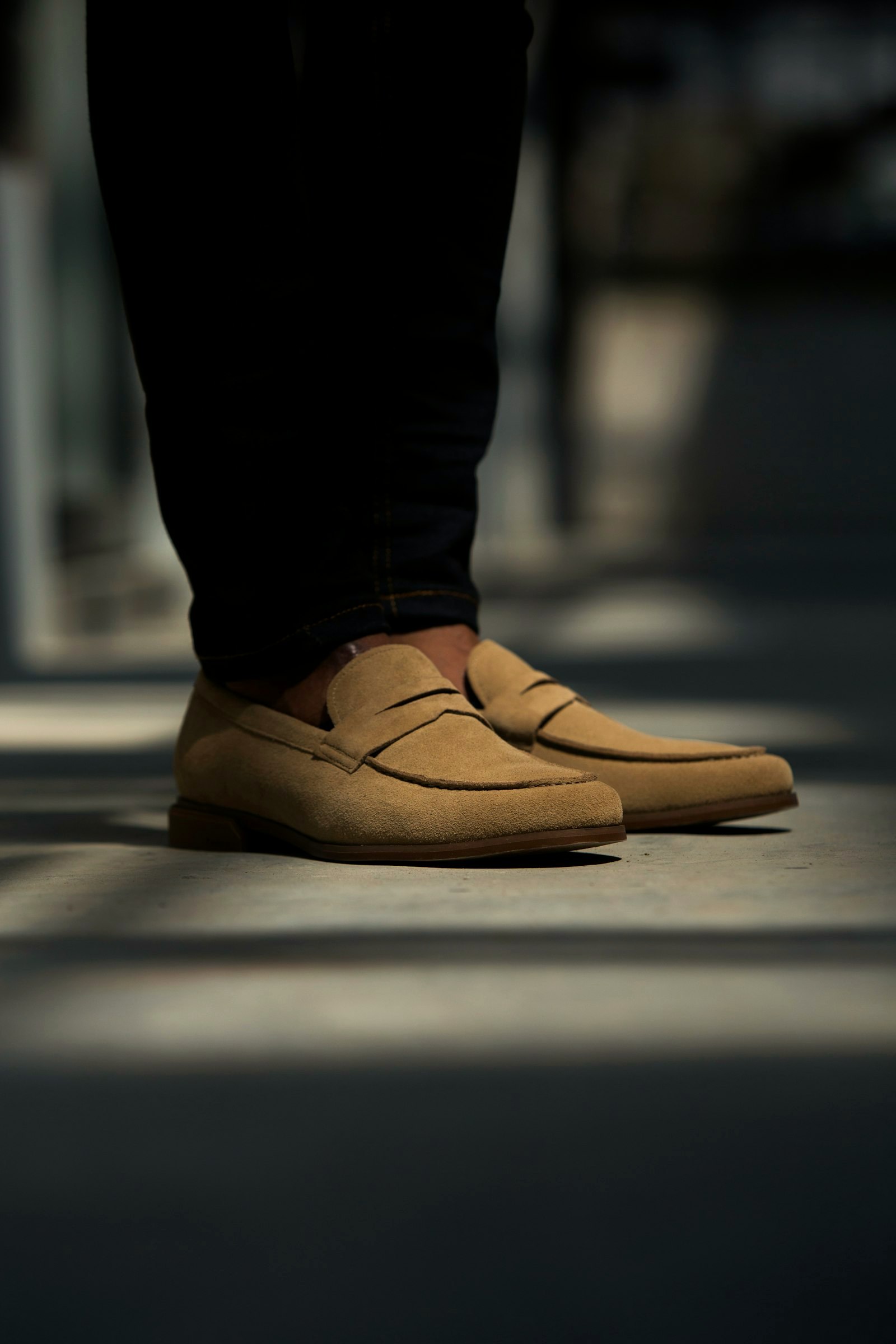
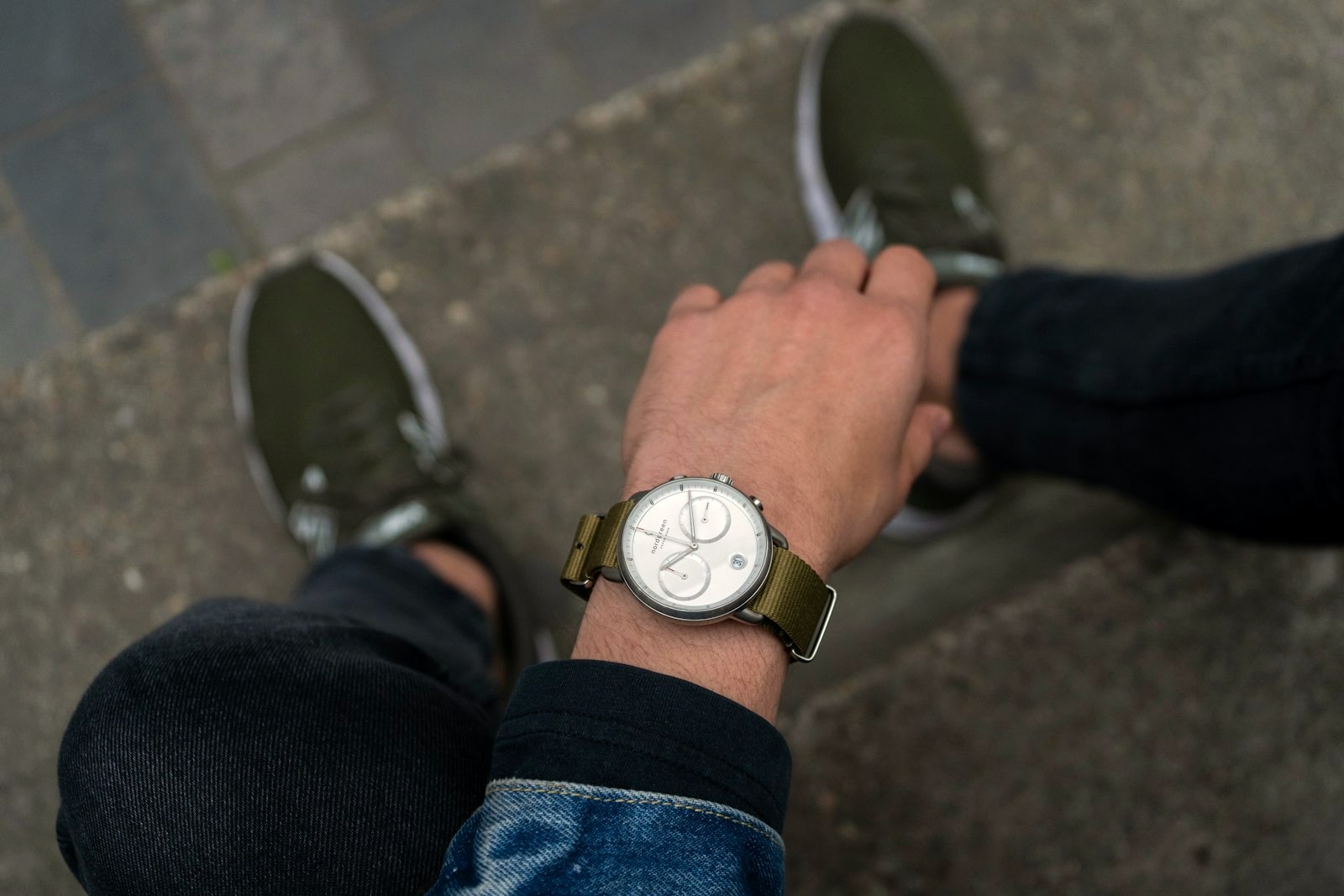
The photography, stated plainly, because this page’s subject is another of the bank’s empty shelves, the emptiest in the shoe family so far. The bank holds no frame of a monk strap and no buckled shoe in any form: no single monk in calf at a flannel hem, no double monk in the Italian register, no buckle in close view, nothing. The hero is a shoe being fastened with a gold watch in the frame, CREDITS-logged and banked as a spare, printed here for the page’s two subjects, the fastening and the metal, and captioned as the laced shoe it is. The figure in the record is suede loafers worn on a street, a banked spare, printed as the shoe this one stands above; the figure in the pairings is a watch over shoes being fastened, a banked spare, printed as the metal answered at two stations. No frame has been captioned as a monk, as a buckle or as this species, and the frames that stand in are captioned for the register they actually show. The harvest list this page is waiting for, in order: first, a black calf single monk under a flannel trouser at no break, the buckle shown and still, photographed at ankle height; second, a double monk in brown calf in close view, both buckles and the plain vamp between them; third, a suede monk under a blazer in a street, at the dressed end of a walking day.
Questions, answered
What is a monk strap shoe, exactly?
A dress shoe that closes with a strap and a buckle instead of laces: a strap cut from the shoe's own upper crosses the instep and fastens to a buckle at the side, one buckle on the single monk, two on the double. The vamp beneath it is plain, with no toe cap in the classic form, and the shoe is built on the same dress lasts and leather soles as the laced shoes it stands beside. The name is told from the buckled sandals of monks, the strap and buckle being the closure of footwear that predates the lace's dominance, and the closed dress form is a twentieth-century tailoring shoe. In this family's record it is the shoe our loafers-with-a-suit brief names without grading: every other dress shoe closes, laces tie, a buckle shuts, a boot zips or gussets, and the loafer alone slips on.
Single or double monk: which should I buy first?
The single, and it is not close. The single monk is the species in its tailored register: one strap, one buckle, a plain vamp, a shoe that takes the suit's social rows and the tailored day entire and reads, at a room's distance, as a decision rather than a statement. The double monk doubles everything the single keeps singular, two straps, two buckles, twice the metal at the floor and twice the fastening to explain, and it belongs to the dressed registers where the outfit around it is quiet enough to afford it, the odd jacket, the knitwear rows, the blazer and flannels. The wardrobe order this brief prints is the register's order: the black or brown calf single first, the suede single for the soft rows, and the double only when the wardrobe already owns the shoes the double imitates at play, the Oxford for the ceremony rows and the loafer for the ease.
Can you wear monk straps with a suit?
In the suit's social rows, yes; in its ceremony rows, no, and the line is the family's printed one. Our suit brief seats the boardroom, the formal evening and the funeral to black Oxford shoes, and no buckle changes that. Below that line the suit has its wide middle, the office's ordinary rows, the dinner, the event that is not a ceremony, and there the monk stands licensed where our boots brief seats the sleek Chelsea, doing the derby's job in the social rows: a closed, polished, tailored shoe, its fastening a buckle instead of a lace. The single monk in calf is the suit's monk; the double under a suit is licensed only in the social rows and only when the rest of the outfit is quiet, and the suede monk stops below the suit's working rows with the soft tailoring, the blazer and the knit, where its nap belongs.
Can you wear monk straps with black tie, or to a formal wedding?
No. Black tie's shoe station is printed entire in our black tie brief and the monk is not on it: patent leather Oxfords or court shoes, or a plain black Oxford polished to the same answer, and the brief prints of its list that nothing on it is a suggestion and nothing off it is admitted. A buckle is hardware, and hardware is the one thing the uniform's shoe does not carry; a black monk at black tie is a dressed shoe at a station that asks for a uniform one. The formal wedding in its evening form follows the same ceiling. The monk's wedding rows are the day wedding and the social rows, under a lounge suit, where it stands licensed like any other closed tailored shoe.
What belt and watch go with a monk strap?
Ones in the buckle's family, kept quiet. The monk's buckle is a piece of metal worn at the outfit's most-read moving point, and this family's metals law, printed for the loafer's horsebit, counts it in the outfit's metal budget: the belt's buckle and the watch case in one family where the eye can compare them, steel answering steel, and the shoe's buckle the largest item in the set. So a silver-toned buckle takes a plain steel or silver-toned belt buckle and a steel watch, and a brass or gold-toned buckle is worn as the outfit's one bright note, with the belt plain and the watch quiet. The refusal is the stack, the bright double monk under a gold watch under a bright belt buckle, three stations spending the same claim, which our loafers brief refuses for the horsebit in the same words. The belt's leather obeys the ordinary law, matched to the shoe in family and finish, calf to calf and suede to suede or a woven belt.
Can you wear monk straps casually, with jeans or without socks?
At the dressed end of casual, yes; as a slip-on, no. The suede monk and the brown calf double stand lawfully under dark straight denim, chinos and cords with knitwear above them, the monk as the dressed end of those rows the way the desert boot stands at the tailored end of its own. What is refused is the loafer impersonation: the monk worn unbuckled, or buckled loose as a pose, the strap flapping as an effect, and the sockless summer register borrowed entire from the loafer's rows. A monk strap is a fastening, and a fastening worn open is not ease, it is an unfinished shoe, the one reading the species cannot survive. The sock follows the family's sock law, plain and in the outfit's family, because the closed upper shows less ankle than the loafer and what it shows is still dressed.
Where does the monk strap sit: loafer, derby or Oxford?
Between the loafer and the Oxford, beside the derby, and the family's printed seats fix the ends. Below it stands the loafer, the suit's one licensed informality in our loafers-with-a-suit brief, the shoe that surrenders its fastening and must repay the surrendered formality elsewhere in the outfit. The monk surrenders nothing: it closes, and its closure is hardware, which is why it asks no repayment and takes rows the loafer is licensed into only narrowly. Above it stands the Oxford, which keeps the ceremony rows our suit brief prints, the boardroom, the formal evening and the funeral, where the lace is the uniform's fastening and the buckle is not admitted. Beside it stands the derby, whose job in the suit's social rows our boots brief gives to the sleek Chelsea, and the monk does the same job with a different closure. Its register in one sentence: the most deliberate of the non-ceremony shoes, and the least ceremonial of the closed ones.
Has Young Cotton ranked monk strap shoes?
No, and the absence is printed rather than papered over. This site publishes no footwear ranking, a position our boots brief states in its own ruling, and no shoe is scored anywhere on it. What stands is the family's printed record around the shoe: the loafer ruled the suit's one licensed informality in No. 63, the ceremony rows seated to black Oxfords in No. 04, the derby's social-rows job described in No. 56, and black tie's shoe station printed entire in No. 67. The monk strap is ruled inside that record as the closed shoe between the loafer and the Oxford, and is given no number of its own, because a number of its own would be an invention. When the desk grades footwear on its makers' published records, this page's rulings will be re-argued from that Card.
Next
The family this brief stands in: No. 63, loafers with a suit, whose fastening census names this page’s subject, whose licensed-informality rule seats the shoe below it, and whose metals law this brief adopts entire; No. 11, loafers, where the unfastened shoe’s doctrine and the one-notch rule were first printed; No. 04, the suit, which seats the ceremony rows this brief’s licence stops below; No. 56, boots, whose account of the derby’s social-rows job this shoe shares; No. 69, desert boots, the soft shoe of the brief before this one, whose shown ankle this page’s hem law answers in a tailored cloth; and the ceiling this brief’s licence stops below, No. 67, black tie, whose shoe station is a closed list and admits no buckle. The brief before this one stands at No. 69; the series began with the cardigan and the full run lives in the How to Wear index. How every score behind those pages is built stands on our methodology page.