

A checked wool jacket worn outdoors, the bank's nearest frame to this page's subject: the bank holds no tweed frame of any kind, no tweed jacket worn, no Donegal or herringbone cloth to photograph, and this page prints that absence rather than dressing the frame as what it is not. The check is a houndstooth in a suiting-weight wool, the pattern family this brief rules at its town end; the care section prints the gap and the harvest list entire.
Checked and updated October 2026
The ruling, up front: tweed is a working cloth before it is a texture, and every other sentence on this page is a consequence of that one. It was woven to be rained on, brushed off and worn for decades: to shed weather on a hillside, to hide the soil of the work between washings, to take thorn and scuff and keep its shape regardless. So it is worn the way equipment is worn, in working company, at working hours, its pattern carried as the cloth’s livery and not apologised for. The two failures this brief exists to refuse are mirror images. The first is costume: the full country kit assembled where none of it is working, the cloth worn as a quotation of a countryside. The second is the apology: tweed dressed in sleek pairings, the silk tie, the worsted trouser, the mirror-shined shoe, that pretend it is a city cloth and spend its honesty pretending. Between the two stands the working form, which this brief prints in order: the cloth record first, weights and weaves and the named patterns at their scales; then the pattern scale law; then the pairings; then the rooms and hours; and the looks, the ruling, the mistakes and the keeping after all of it. On scores: no garment is scored here, and no Card ranks tweed. The numbers quoted are the tree’s, cited where the cloth stands inside other rankings.
This brief: the decisive rule · the cloth record · the pattern scale law · the pairings · the rooms and hours · the looks · the ruling · the mistakes · care, moths, and our photography
The decisive rule: a working cloth before it is a texture
Most cloths in this family are ruled by what they look like. Tweed is ruled by what it was built to do, and the build comes first in its history and in this brief. Tweed is a working cloth before it is a texture: it was woven to be rained on, brushed off and worn for decades, so it is worn as equipment with a pattern in it, never as a costume of the countryside and never apologised for with sleek pairings that pretend it is a city cloth. Every famous property of the cloth is a working property before it is an aesthetic one. The yarns are spun loose and woollen, full of trapped air and tooth, because a yarn built that way sheds water off its surface, insulates wet or dry, and does not polish smooth with wear. The yarns are dyed before the weaving and flecked with other colours, because a cloth flecked in brown, moss, russet and grey does not show the dirt of a working week, and the man who wore it could brush it down and wear it again. The weave is thick, the handle dry and matte, because the garment was expected to meet thorn, heather, gate and dog, and to come home with its shape. Even its famous longevity is a work specification: a cloth whose replacement cost its first wearers real money was woven to be mended and re-mended, and the twenty-year figure this site prints for its heaviest graded tweed, on Verdict Card No. 48, is the working promise stated as a number, a 760-gram Donegal cloth graded as a twenty-year cloth by the desk that scored it 89.
The rule’s two refusals follow from the build without any taste being consulted. The costume first. A cloth built for work, worn as a complete quotation of the world it worked in, assembled entire in a place where none of it is working, has left the wardrobe and entered the dressing-up box. This family has already printed the sentence, in No. 33, and this brief adopts it as its own first law: diamond quilt over tweed over corduroy over boots, in a city where none of it is working, is fancy dress. Note what the sentence condemns and what it does not. It condemns the assembly, every working feature present and none of them working. It does not condemn any single garment, and it does not condemn the city, where tweed has worked for a century and a half as weekday dress. The apology second. The mirror failure takes the same cloth and dresses it in the smooth city’s register, the silk tie with its shine, the worsted trouser with its pressed sheen, the black Oxford polished to a mirror, as though the tweed needed forgiving. It does not, and the apology fails on the cloth’s own terms: tweed’s matte tooth against worsted’s sheen is two surfaces arguing, and the argument tells every room that the wearer bought a working cloth and is embarrassed by the work. Between costume and apology stands the working form, and it is not a compromise between them. It is the cloth worn on its own errand, in company that shares its register, which is what the rest of this brief specifies.
The standing record around the cloth, gathered rather than re-derived, is thinner than the uniform’s was in No. 67 and this brief prints the thinness. No Verdict Card grades the tweed jacket. The cloth’s scored appearance on this site is an overcoat’s: the Private White V.C. Donegal Overcoat at 89 on Verdict Card No. 48, carrying the field’s only published cloth weight, 760 grams of Donegal tweed, its yarn spun in County Donegal, woven in Lancashire and sewn in Manchester, a supply chain printed the way working things are printed. The family’s other sentence about the cloth is a pairing sentence, No. 24’s: a tweed jacket and a flannel trouser share a cloth family the way two garments share a season, related, not matched. That is the whole of the tree’s tweed law before this page, two sentences and a score, and this brief builds on exactly those foundations and marks everything beyond them as its own, gathered once in the care section, the way the family marks its extensions.
The cloth record: weights, weaves, and the named patterns at their scales
The cloth first, because in tweed the garment is the cloth to a degree no other subject in this family matches: cut it plainly, pad it lightly, and everything the wearer is saying is being said by the weave. The weave is a twill under almost everything, the diagonal structure that gives the cloth its toughness and its slight give, and the yarns are woollen-spun rather than worsted-spun, which is the cloth’s founding distinction. Worsted yarns are combed parallel and spun tight and smooth, and they make the city suiting whose sheen the apology reaches for. Woollen yarns are carded, left full of short fibres in every direction, and spun soft and hairy, and they make a cloth that is matte, warm, water-shedding and slow to look old. A tweed that drapes and shines like a suiting has crossed the founding line whatever its label prints, and the hand finds it before the eye does: tweed is dry, springy and toothed in the fingers, where a worsted is cool and slippery. The colour is in the yarn before the cloth exists. Tweed’s yarns are dyed, blended and flecked at the spinning, so the finished cloth’s colour is a population rather than a surface, hundreds of fibres in neighbouring shades standing together, which is why the cloth holds its looks at distances where a flat-dyed cloth goes dead, and why its famous earth palette, browns, moss greens, russets, greys, the heather mixtures, is not a fashion choice but the record of its errand: those are the colours of the ground it worked on, chosen so the ground would not show on it.
The weights are the cloth’s honesty column, and they are the column the trade prints least. This site has graded tweed exactly once, in an overcoat, and the maker of that coat did the thing this brief asks of every tweed maker: it published the cloth’s weight, 760 grams, beside the coat, and the desk graded the coat at the top of its field partly on the strength of being able to compute what the buyer was getting. An overcoat’s 760 grams is not a jacketing’s figure, and this brief does not transfer it; what transfers is the law the figure proves, that in this cloth weight is longevity stated in advance, grams being years. At the jacket’s end of the family the same law reads by hand. A jacketing tweed should stand with body off the shoulder, keep a shape through a day and a decade, and feel like a blanket’s disciplined relative rather than a shirt’s heavy cousin. The light, soft, draping tweeds sold for summer and for fashion are the species’ edge, and some are good cloth, but they are buying drape with the cloth’s founding capital, and a buyer should know which of the two he is paying for. The rule printed for the rail: squeeze the cloth, hang it, watch it recover. The working cloth springs back and stands. The costume cloth, in every sense, merely hangs.
The patterns are the cloth’s named forms, and each is a pattern at a scale, the scale being part of the name’s meaning and the whole subject of the next section. Herringbone is the broken twill, the diagonal reversing at intervals into a zigzag, the quietest of the family: at any ordinary distance it reads as texture rather than pattern, which makes it the town end of the cloth and the first tweed a wardrobe should own. Donegal is the fleck carried to its conclusion, a plainer twill whose yarns are loaded with coloured nepps, small knots of contrasting fibre, so the pattern is not woven across the cloth but scattered through it, random as the ground it copies; it is the most working of the forms and the easiest to pair, since a scattered fleck argues with nothing. The checks are the woven grid in its sizes: the windowpane, a single large check standing widely spaced on a quieter ground, the loudest respectable scale; the glen check, the Prince of Wales pattern, small checks built of checks, which resolves into texture at a room’s distance and rewards the close view; and houndstooth, the broken four-pointed star of the shepherd’s check, mid-scale and unmistakable, the pattern of this page’s hero frame. One name in the family carries a legal definition rather than a custom, and it is printed here because it is the cloth’s one regulated word: Harris tweed is defined in law, handwoven by the islanders of the Outer Hebrides from pure virgin wool dyed and spun in the islands, and it carries its Orb mark as the definition’s stamp. A buyer who learns nothing else from this section can hold its one sentence: in tweed, the name of the pattern is a promise about scale, and the scale is what the next section spends.
The pattern scale law: one pattern loud at a time
Tweed is the one cloth in the wardrobe that arrives already patterned, which makes its wearer the curator of a pattern before he has chosen a single other garment, and the law that governs the curation is a law of volume. One pattern loud at a time. The jacket’s weave sets the outfit’s pattern budget, and everything else in the assembly is spent under it: when the tweed is a windowpane or a bold houndstooth, it is the outfit’s only pattern above the level of texture, and shirt, tie and trouser are plain, flecked or fine enough in scale to read as texture beside it. When the tweed is a herringbone or a Donegal, whose patterns resolve to texture at conversational distance, the budget has a little left in it, and exactly one finer pattern may be spent elsewhere, a tattersall shirt’s small grid under a herringbone, a dotted or striped knit tie over a Donegal, each at a scale clearly different from the cloth’s own, because patterns at the same scale fight and patterns at different scales converse. The failure the law exists to prevent is not ugliness in the abstract; it is illegibility. Two mid-scale patterns side by side cancel each other into noise, and an outfit that reads as noise has spent a patterned cloth and received static for it.
The scale of a tweed is read at the distance the room will read it, and this is the law’s working half. A pattern has two sizes, the size it is and the size it reads. The glen check is woven small and reads smaller, a grey texture across a room, a pattern only in the handshake’s range. The windowpane reads at its full woven size from the street. The Donegal’s fleck has no size in the grid’s sense at all, which is its pairing genius: a scattered pattern cannot collide with a ruled one, so the flecked cloth is the family’s neutral, the tweed that stands aside and lets a checked shirt or a striped tie take the pattern’s chair. The practical test is printed for the mirror: stand at the distance of a conversation, then at the distance of a doorway, and ask which patterns are still speaking at each. The assembly is lawful when exactly one is speaking at the doorway’s distance and at most one more has joined it at the conversation’s, and when the wearer cannot tell which pattern is loudest, the room will not be able to either, and the law has already been broken in the only court that hears the case.
Two corollaries close the section, both about tweed worn with tweed and with pattern’s other carriers. The double-tweed ruling: two tweeds in one assembly are licensed only when one of them is the neutral, a Donegal or a plain herringbone in the cloth’s quietest register, and the other carries the pattern, and even then the two cloths must differ in ground colour as well as in weave, because two brown tweeds of neighbouring shade read as a suit that failed to match, the worst reading the cloth offers. A tweed jacket over tweed trousers bought separately is not a suit and must not approach one; the tweed suit itself, bought as one cloth, is a different and lawful garment, ruled in the looks, whose unity is its licence. The shirt and tie corollary: the shirt’s licensed patterns under tweed are the small ones, the tattersall’s fine grid, the small check, the plain Oxford above all, and the tie’s are the matte ones, the knit and the wool tie of Verdict Card No. 40’s ranking, whose textures are the cloth’s cousins; a smooth silk tie’s shine and a bold regimental stripe are both refused at this station, the stripe on the scale law and the silk on the apology, and both refusals are printed again where they belong, in the mistakes.
The pairings: the working company, and the smooth refusal
Tweed’s company is chosen by surface and by errand together, and the company has a family resemblance the wearer can learn once and use everywhere: the cloth keeps company with matte, toothed, hard-wearing things, the wardrobe’s other working materials, and it refuses the smooth, the pressed and the shined. The trousers first. Flannel is the standing partner, the pairing the tree already prints: a tweed jacket and a flannel trouser share a season, related, not matched, flannel’s brushed matte answering tweed’s tooth at the same register, and the flannels’ plainness spending none of the pattern budget the jacket has already spent. Corduroy is the second partner, No. 24’s cloth, its ribs a texture rather than a pattern and therefore lawful under the scale law at any of the jacket’s scales, in the earth registers the two cloths share. Denim is the third, straight and dark and unbroken, the weekend form’s bottom half, a work cloth of another trade whose matte indigo stands under any tweed in this brief without apology in either direction. Cavalry twill and moleskin complete the rail, hard cloths with a nap or a diagonal of their own, plain in colour and working in origin. The trouser refused, by name, is the smooth worsted: the suiting trouser with its pressed crease and its slight sheen, worn under a tweed jacket, is the apology in its commonest form, the jacket’s tooth against the trouser’s polish reading as two half-outfits, a country top looking for its trousers and a city bottom looking for its jacket, and no belt or shoe can mediate a disagreement conducted at that distance across the whole body.
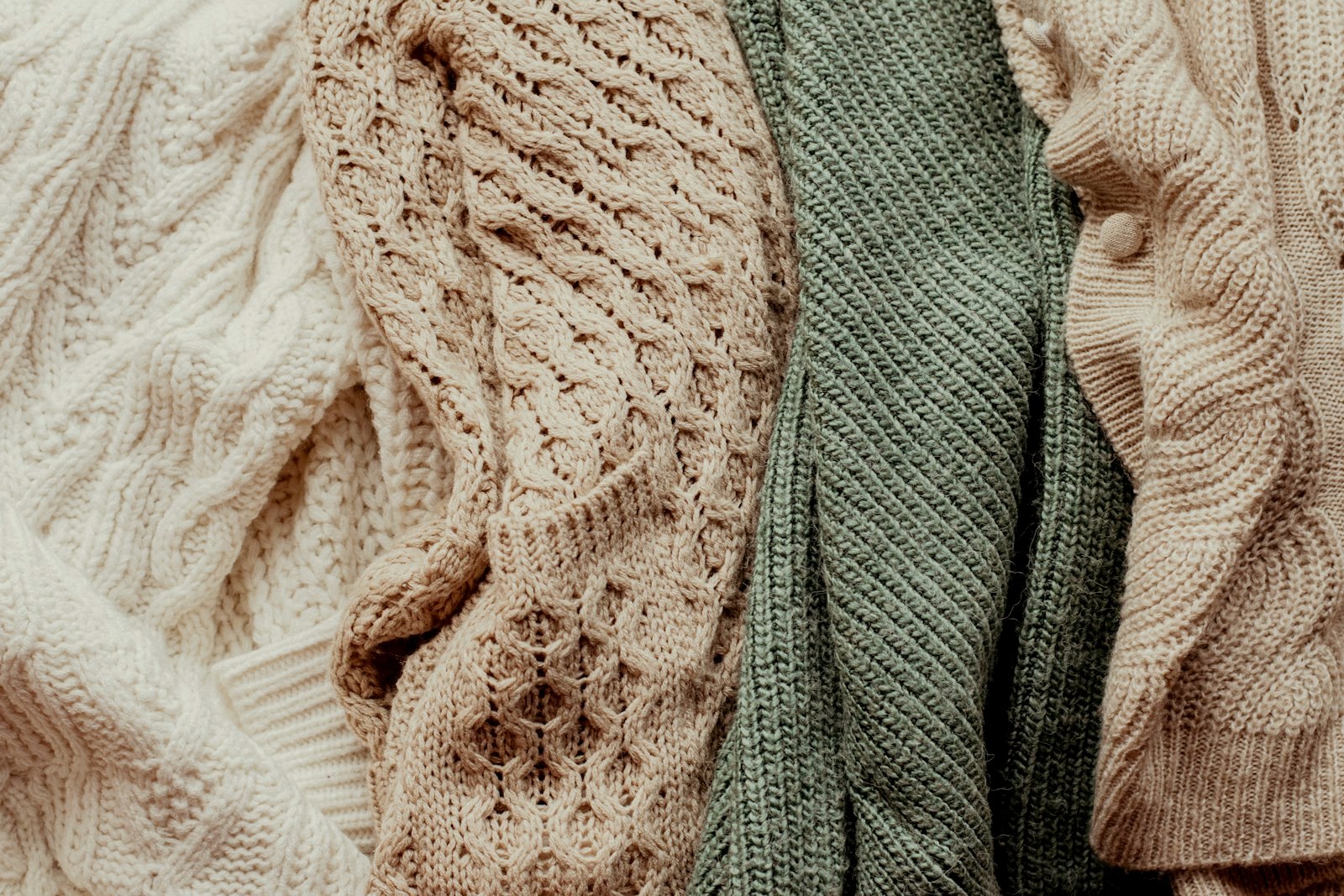
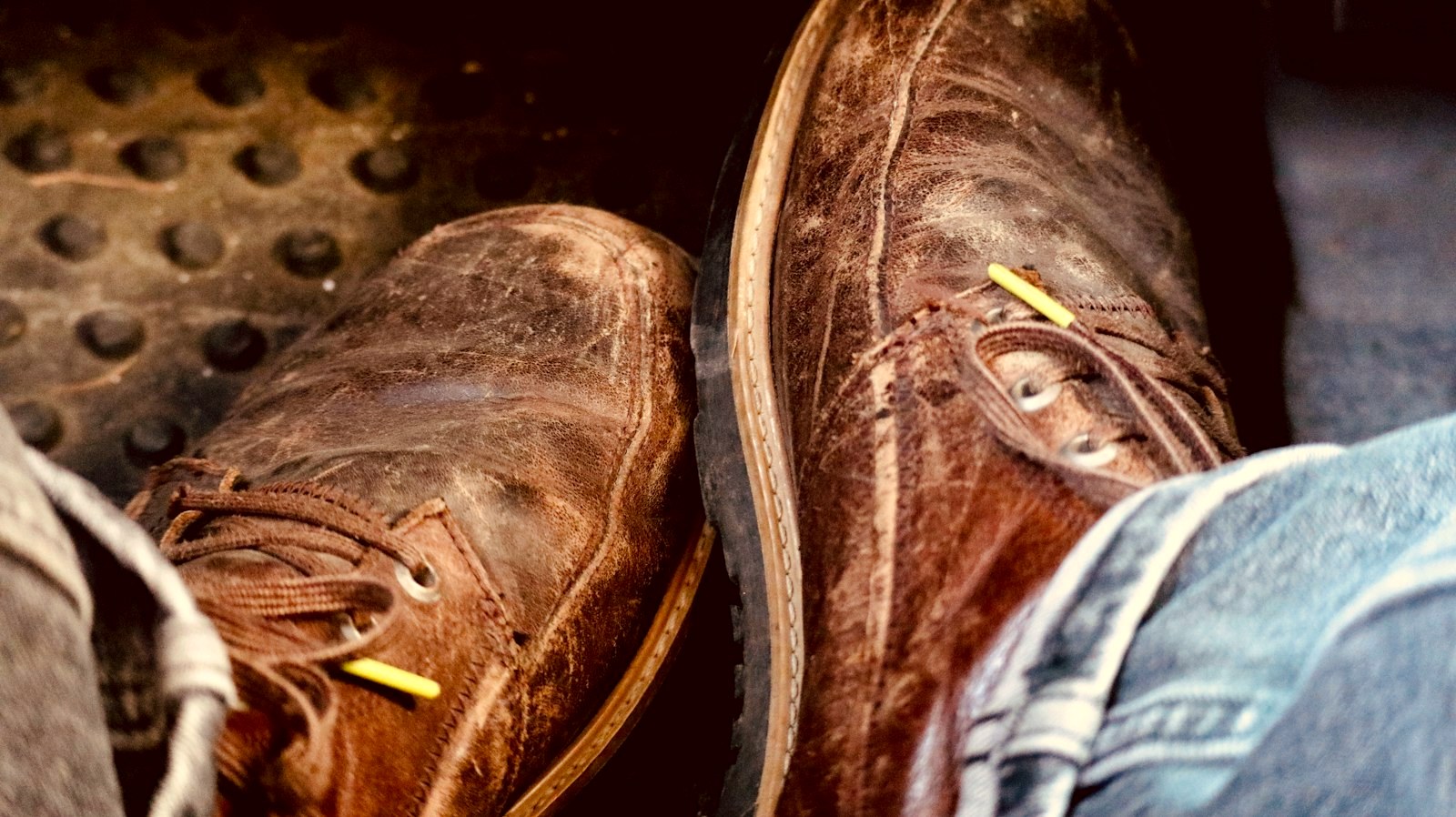
The layers and the shirt follow the same law. Knitwear is the cloth’s licensed layer, worn under the jacket as the crew neck and the roll neck, and over the shirt in place of a waistcoat, because a knit’s texture is the tweed’s own register one step finer: the Shetland’s brushed nap, the lambswool crew, the cable knit whose ropes are texture at exactly the lawful scale. A Fair Isle or a patterned yoke spends from the pattern budget and is ruled by the scale law like anything else, licensed over a Donegal or a herringbone and refused under a windowpane. The shirt is the Oxford first, its own matte weave the family’s standing shirt under texture, then the brushed cottons, the flannel shirt and the tattersall at its small scale. The tie, where a tie is worn at all, is the wool tie or the knit tie, matte, textured, in the cloth’s colour family, the instruments Verdict Card No. 40 ranks in their own right; and the shoe closes the assembly at the ankle where the apology likes to hide. The shoe is grained, suede or booted: the brogue in its country form, full broguing on a grained leather over a substantial sole, the derby boot, the suede brogue or chukka in the brown registers, each a shoe whose surface has something in it for the cloth’s tooth to answer. Under the tweed suit the shoe keeps the same rule one register up, the grained brogue rather than the boot, and under every assembly in this brief the mirror-shined plain Oxford is refused, printed again in the mistakes because it is the mistake this cloth is most often apologised with.
The rooms and hours: the city’s licence, and the evening refusal
Tweed’s hours are the working day’s and its rooms are the day’s rooms, and the licence runs wider than the costume fear supposes. The city licenses the cloth entire, on the working terms of the first section. Tweed in town is not a visitor from the country; it was the weekday dress of the professions for generations, the cloth of the office, the university, the train and the street, and it remains lawful in all of them worn as this brief specifies, one pattern, working company, no kit. The city’s own limits are two, and both are rooms rather than streets. The first is the pressed room, the boardroom and the formal client’s floor, where the assembly runs on smooth cloth and the crease is a unit of account: the family’s doctrine there is the linen brief’s boardroom doctrine in the opposite season, that a cloth is answered in the room’s own language, and tweed’s tooth, like linen’s crease map, spends authority in a room that prices smoothness. The answer there is the lounge suit, and this brief does not pretend its cloth outranks the room. The second limit is the uniform’s, and it is absolute: tweed stands below black tie’s ceiling at every station, and nothing in this brief’s licence reaches into No. 67’s rooms.
The evening refusal is the section’s hard rule, and it is a rule about light as much as about formality. After dark the assembly’s register changes: the rooms are lit lower, the cloths are smoother, the surfaces that carry the evening are silk’s, barathea’s and the polished shoe’s, and tweed’s matte tooth, which reads as substance at noon, reads as daywear left on at nine. A tweed jacket at a dinner, a reception or an evening assembly is not underdressed by a degree; it is dressed for a different part of the day, as a linen shirt would be at a winter’s noon, and it is graded the way this family grades all hour failures, as a document answered wrongly rather than a taste exercised freely. Two exceptions are printed because they are the cloth’s own. The country house’s evening, the dinner in the house the day’s work belonged to, where tweed at the table is the day’s dress continued and the room is a working room at night: licensed, because the room’s register is the cloth’s. And the pub and the inn, the evening’s working rooms everywhere, where tweed has always been the dress and the refusal would be the costume. The wedding rows follow from the rule and are printed in the questions: the country wedding in the day is the cloth’s licensed assembly, the city wedding and every evening reception are the lounge suit’s, and the guest answers the invitation that was sent.
The weather is the cloth’s home ground and its last room, and it deserves its sentence because it is where the costume and the working cloth finally separate in public. Tweed in rain is the founding image being cashed: the woollen tooth sheds the shower, the fleck hides the splashes, the cloth dries on the body’s warmth and brushes clean, and a man caught in weather in a tweed jacket and boots is dressed, where a man caught in weather in a smooth suit is merely wet. This is also the cloth’s alibi test for every other ruling on this page. An assembly that would still make sense in the rain it was built for is the working form. An assembly that the first shower would expose, the quilt and the cap and the plus-two silhouette arranged for a pavement photograph, is the costume, and it fails in sunshine exactly as it would fail in weather, because the failure was never meteorological. It was that the clothes were quoting work instead of standing ready for it.
The looks: three assemblies the brief licenses
| Setting | The assembly | The details | The judgment |
|---|---|---|---|
| The working weekday | A herringbone tweed jacket over flannel trousers, the tree’s printed pairing dressed in full | Oxford shirt, a knit or wool tie at the fine scale, a lambswool crew in the cold, grained brogues, no square beyond a plain linen one or none | The cloth’s town licence in its standing form: one pattern at texture scale, every other surface matte and plain, lawful from the office floor to the last train |
| The field-adjacent weekend | A Donegal tweed jacket over corduroy trousers, the fleck as the assembly’s neutral ground | A roll neck or a Shetland crew in place of the shirt and tie, or a tattersall at its small grid, derby boots, the brush in the hall at home | The working form nearest the cloth’s origin that the law allows: every garment in it could do its job outdoors, and none of it is assembled as the country’s portrait |
| The tweed suit in town | A tweed suit in one cloth, a quiet check or a herringbone, worn as a suit and not as separates that failed to match | Oxford or brushed-cotton shirt, wool tie, grained brogues one register up from the boot, the jacket’s unity as the pattern licence’s whole spend | The cloth at its most formal and still inside its hours: a day suit of substance for the cold half of the year, correct exactly where the lounge suit’s smoothness is not the room’s price |
The ruling
Wear tweed as the equipment it is. Buy the cloth by its founding tests, woollen tooth in the hand, body off the shoulder, weight that promises years, and choose its pattern by the scale law, herringbone or Donegal for the wardrobe’s first, the checks when the room is ready for a louder cloth. Spend the pattern budget once: one pattern loud at a time, everything beside it plain, flecked or finer, and let the flecked cloth be the neutral when another garment wants the pattern’s chair. Keep the working company, flannel, corduroy, denim and knitwear beside it, grain and suede below it, and refuse the two mirror failures entire: the country kit assembled where nothing is working, and the sleek apology that dresses a working cloth as a city one. Keep it in its hours, the day and the working evening, out of the pressed rooms and the evening’s smooth assemblies, and keep it the way the care section prints, brushed, rested and moth-proofed, so that the decades it was woven for are the decades it serves. Ruled so, tweed is what it was on the first day it was worn to work: the cloth that asks the least of its wearer and gives the most back, a pattern with a job.
Where the wearing goes wrong
The full country kit, worn as fancy dress. The assembly failure, and the family has already named it: diamond quilt over tweed over corduroy over boots, in a city where none of it is working. Each garment in the stack is lawful on this page, and the stack is a costume, because the kit’s every feature is present as a quotation, the quilt’s diamonds, the tweed’s fleck, the corduroy’s ribs, the boot’s substance, all of it signifying a countryside the wearer is standing in a pavement queue outside of. The test is the rain test of the rooms section: the kit was not assembled to be rained on, it was assembled to be read, and a wardrobe read as a portrait of work by a man doing none of it is fancy dress in its most respectable cloth. Break the kit by the pairing law’s ordinary means, one working garment carrying the register while the others dress at the day’s normal pitch, and the same tweed jacket that headed the costume heads an outfit.
The matched cap. The costume failure in miniature, and the surest single tell this cloth offers: a flat cap cut from the jacket’s own cloth, bought as a set and worn as one, the head finished in the same check as the shoulders. A cap is a lawful garment in this brief, a working hat for working weather, in a plain tweed, a herringbone or a fleck that does not repeat the jacket’s pattern, and worn when the weather asks for a hat. The matched cap fails on both of its facts. As pattern, it spends the jacket’s weave a second time at the outfit’s most-read point, two identical checks in one column of cloth, which the scale law reads as a uniform’s livery rather than a wardrobe’s choice. As register, the bought set is the costume’s signature wherever it appears, the outfit that was decided in a shop in one transaction, head included, and it converts a working jacket into the top half of a fancy-dress country gentleman. The cap that works is the cap that was bought separately, for weather, and does not match.
Tweed with tailoring’s polished shoes. The apology at the ankle: a tweed jacket or suit finished with plain black Oxfords polished to a mirror, the shoe of the smooth suit and the evening’s lower rooms, standing under the wardrobe’s most matte cloth. It fails as a surface before it fails as a form, the mirror and the tooth conducting the apology’s whole argument in one glance, the wearer has dressed the outfit’s top half for the field and its bottom inch for the boardroom, and the eye believes the inch, because it is the outfit’s last word. It fails as an errand as well: the polished plain shoe is the one shoe in the wardrobe that tweed’s weather ruins on contact, so the pairing is not only a contradiction but a impractical one, a shoe that cannot go where the cloth is going. The lawful answers are printed in the pairings and cost nothing to observe: grain, broguing, suede or a boot, in the brown registers, polished to a working shine and no further.
The silk apology. The costume’s mirror, the full sleek assembly worn to forgive the cloth: the silk tie with its shine knotted at a tweed throat, the worsted trousers pressed below it, the smooth leather everywhere, an outfit assembled as though the jacket were a blazer that had wandered in from a rougher rail and needed the city’s papers. It is graded with the kit because it is the kit’s twin error, the cloth worn as a quotation in the other direction, tweed as the texture accent in a smooth outfit, the working garment demoted to a pattern sample. The jacket in such an assembly is not being worn; it is being cited. The cure is the pairing law applied without embarrassment: give the cloth its own company, the matte tie or none, the flannel or the cord, the grained shoe, and let the outfit be one register throughout, at which point the tweed stops looking like an apology’s occasion and starts looking like what it is, the best-dressed working cloth in the wardrobe.
Tweed after dark. The hours failure, printed among the mistakes because it is committed by men whose assemblies are otherwise lawful: the good tweed jacket, correctly paired all day, carried into the evening’s rooms, the dinner, the reception, the evening wedding, where the assembly runs on smooth cloth and low light. It fails quietly, which is why it survives: nothing in it is wrong at noon, and at nine its tooth reads as the day not yet taken off, the wearer the one man in the room still dressed for the weather outside it. The rooms section prints the two exceptions, the country house’s own table and the working evening’s rooms, and outside them the rule is the family’s standing one for every hour failure in this series: the garment is correct, the hour is not its, and the answer is the lounge suit that hangs beside it, not a finer tweed worn later.
Care, the moth doctrine, and our photography
Tweed is kept the way working cloth is kept, by routine rather than by rescue, and the routine is three habits. The brush is the first. After wearing, the garment is brushed down with a clothes brush, firm strokes in the cloth’s direction, which lifts the day’s dust, rain-spots and street soil out of the tooth before they settle into it; the flecked yarns forgive what the brush misses, which is their founding arrangement, but the brush is what converts the cloth’s forgiveness from a season’s ration into a decade’s. A tweed that is brushed after every wearing is cleaned rarely, which is the second half of the cloth’s economics, since every dry cleaning costs a woollen cloth a little of its loft, and the working wardrobe’s rule is brush always, clean on evidence. Rest is the second. The garment hangs on a wide wooden hanger that fills its shoulders, in air, a day or two between wearings, because wool recovers its shape by resting as linen earns its creases by wearing, and a tweed worn daily without rest goes the way of any overworked thing, at the seat, the elbows and the fronts first. The drying is the third. The cloth is made to be rained on and is dried the slow way, on its hanger in moving air, away from radiators and direct heat, which cook the yarn’s natural oils and leave the cloth boardy where it was springy; a tweed dried patiently after weather comes back as itself, which is more than the smooth cloths can promise, and pressing, when it is needed at all, is steam and a cloth’s distance, never a hot iron flat on the tooth, which polishes the working surface into the apology’s shine one press at a time.
The moth doctrine is printed whole, because the moth is the cloth’s one true enemy and the only failure in this section that is irreversible. The clothes moth’s larvae eat wool, and they eat dirty wool first: the sweat, skin and food soil in an unbrushed, uncleaned garment is their pasture, which makes the doctrine a care doctrine before it is a storage one. Its articles are four. One: the garment goes into storage clean, brushed at minimum and cleaned where the season’s wear warrants it, because a stored dirty tweed is a stocked larder. Two: it is stored sealed through the moth months, in a closed bag, box or cedar chest, the cedar and the lavender of custom being the doctrine’s perfume rather than its mechanism; the mechanism is the seal, and the scented woods are licensed as the seal’s company and refused as its substitute. Three: it is aired and brushed when it comes out and at intervals in a long storage, sunlight and the brush being the two disturbances the larvae cannot abide. Four: a garment found holed is mended, not mourned: invisible reweaving is the cloth’s own trade, woven for exactly this repair, and a darned elbow or a rewoven moth hole in a twenty-year cloth is service recorded, the working garment’s honourable scar, where the same hole in a fashion cloth is a death certificate. That difference is the cloth’s whole promise stated in one repair: it was built to be kept, and keeping it is a skill with four articles, none of them expensive.
The photography, stated plainly, because this page’s subject is another of the bank’s empty shelves. The bank holds no frame of tweed in any form: no tweed jacket worn, no herringbone or Donegal cloth in close view, no tweed suit, no flat cap, nothing. The hero is a houndstooth-check wool blazer worn on a leafy street, CREDITS-logged and already carried on the quiet luxury capsule, printed here for the pattern family and the outdoor register and captioned as exactly what it is, a suiting-weight check and not a tweed. The figure in the pairings is a cable knit’s texture, carried on the French roundup, and the footwear figure is worn brown leather, carried on the corduroy brief and the American roundup before this one; both are captioned for the surfaces they show, and neither is dressed as the cloth it stands beside. The rulings this brief prints beyond the tree’s standing record, the scale law in its stated form, the double-tweed ruling, the city’s licence at its stated width and the moth doctrine’s four articles, are this brief’s own and are gathered here once; everything scored and every refusal inherited is the family’s, cited as theirs. The harvest list this page is waiting for: first, a tweed jacket worn in weather, rain on the cloth, in a real place; second, herringbone and Donegal cloth in macro, the twill and the fleck at the scale the cloth section rules; third, a tweed jacket with corduroy and boots in the field the kit quotes, working rather than assembled; fourth, a flat cap worn for weather over a tweed that does not match it.
Questions, answered
What is tweed, exactly?
A woollen cloth, woven most often in a twill, from yarns spun loose and dyed before weaving so that flecks of other colours stand in the finished cloth. It was woven for work in weather: the woollen yarn's tooth sheds water and scuffs, the flecked yarns hide soil between washings, and the cloth is thick and slow to wear out. Its named forms are weaves and places: herringbone, the broken zigzag twill; Donegal, the flecked cloth of the Irish county whose yarns carry the coloured nepps on their face; the checks, windowpane, glen check and houndstooth, each a pattern at a stated scale. This site's one published tweed weight stands on the overcoats ranking, Verdict Card No. 48: a Donegal overcoat at 760 grams, printed by its maker and graded there as a twenty-year cloth.
Can you wear tweed in the city?
Yes, under the licence this brief prints: the cloth works in town the way it works anywhere, as equipment, provided it is worn in working company and at working hours. One pattern loud at a time, the garments beside it plain or finer in scale, flannel, corduroy, denim and knitwear as its company, brogues or boots below it, and the full country kit left out of it. What the city refuses is not the cloth but the costume: quilt, tweed, corduroy and boots assembled entire where none of them is working, which our quilted jacket brief prints as fancy dress, and the evening, where after dark the assembly belongs to smooth cloth and the dinner jacket's rooms refuse tweed at the door.
Can you wear a tweed jacket with jeans?
Yes: denim is one of the cloth's working companies, a matte, hard-wearing cloth of the same register, and the pairing is this brief's standing weekend form. The conditions are the pairing law's. The denim is straight, dark and unbroken, the jacket's pattern is the outfit's one loud pattern, the shirt between them is plain, an Oxford or a brushed cotton, and the shoe is a brogue, a boot or a suede shoe with some grain in it. What refuses the pairing is the apology at either end: distressed or tapered denim dressing the jacket down into costume, or a silk tie and polished shoes dressing it up into a city cloth it is not.
What shoes do you wear with tweed?
Shoes with texture in them, because the pairing law is a law of surfaces: a matte, toothed cloth is answered by grain, broguing, suede or a boot's substance, and contradicted by a mirror. The standing answers are the brogue in grained leather or suede, the derby boot and the country boot for the wet end of the cloth's work, and suede in its brown registers for the town rows. The refusal is tailoring's polished shoe, the plain black Oxford shined to a mirror, whose whole grammar is the smooth cloth tweed is not: under a tweed jacket it reads as the apology this brief names, one garment pretending the outfit is a city suit, and it spends the cloth's honesty at the ankle.
How heavy should a tweed jacket be?
Heavy enough to behave like the cloth it is named for, and the check is the hand before it is a number. A tweed that drapes and shines like a suiting has left the species whatever its label says: jacketing tweed should stand with some body off the shoulder, hold a crease poorly and a shape well, and feel matte and dry in the hand. This site prints exactly one tweed weight, on the overcoats ranking: 760 grams for a Donegal overcoat cloth, graded a twenty-year cloth, and an overcoat's weight is not a jacket's. What transfers is the principle the number stands for: in tweed, weight is the longevity record, and the lightest cloth in the shop is making the shortest promise.
Can you wear tweed to a wedding?
At a country wedding, in the day, yes: the tweed suit or the tweed jacket with flannel trousers is the assembly's standing guest dress where the wedding is in a barn, a garden or a country church, worn inside the pairing law and with the costume refusals observed, no matched cap, no full kit. At a city wedding, and at any wedding that runs into the evening, no: the evening refusal governs, the rooms after dark belong to the lounge suit and, at their ceiling, to black tie, and a guest in tweed at an evening reception is wearing the day's working cloth in the night's rooms. Read the invitation as this family reads all invitations, as a document, and answer the one that was sent.
How do you look after tweed?
By brushing, resting and keeping the moths from it, in that order. Brush the garment down after wearing with a clothes brush, which lifts the day's dust and rain-spots out of the tooth before they settle; rest it a day or two between wearings on a wide wooden hanger; and dry it slowly, in moving air, away from direct heat, when it has been rained on, which it is built to be. Moths are the cloth's one true enemy and their doctrine is printed in the care section: they eat dirty wool first, so the garment is cleaned before it is stored, stored sealed through the moth months, and aired and brushed when it comes out. A tweed that is brushed, rested and stored clean is not being preserved. It is being kept in service, which is what a twenty-year cloth is for.
Has Young Cotton ranked tweed jackets?
No, and the absence is printed rather than papered over. No Verdict Card grades the tweed jacket or the tweed suit, and this brief invents no score. The cloth is graded where it stands inside other rankings: on Verdict Card No. 48, the overcoats, the Private White V.C. Donegal Overcoat stands at 89, the field's only published cloth weight at 760 grams of Donegal tweed, and our corduroy brief prints the season line this brief builds on, that a tweed jacket and a flannel trouser share a season. When the desk grades the tweed shelf on its makers' published records, weights, weaves and fibre lines, this page's rulings will be re-argued from that Card.
Next
The family this brief stands in: No. 24, corduroy, whose season line this page builds on, a tweed jacket and a flannel trouser sharing a cloth family, related, not matched; No. 33, a quilted jacket, which prints the costume refusal the decisive rule adopts, the full country kit in a city where none of it is working; the cloth’s scored record on Verdict Card No. 48, where the Donegal overcoat stands at 89 on the field’s only published tweed weight; the tie law the pairings borrow at Verdict Card No. 40; and the ceiling this brief’s licence stops below, No. 67, black tie, the uniform whose rooms refuse this cloth entire. The brief before this one stands at No. 67; the series began with the cardigan and the full run lives in the How to Wear index. How every score behind those pages is built stands on our methodology page.