
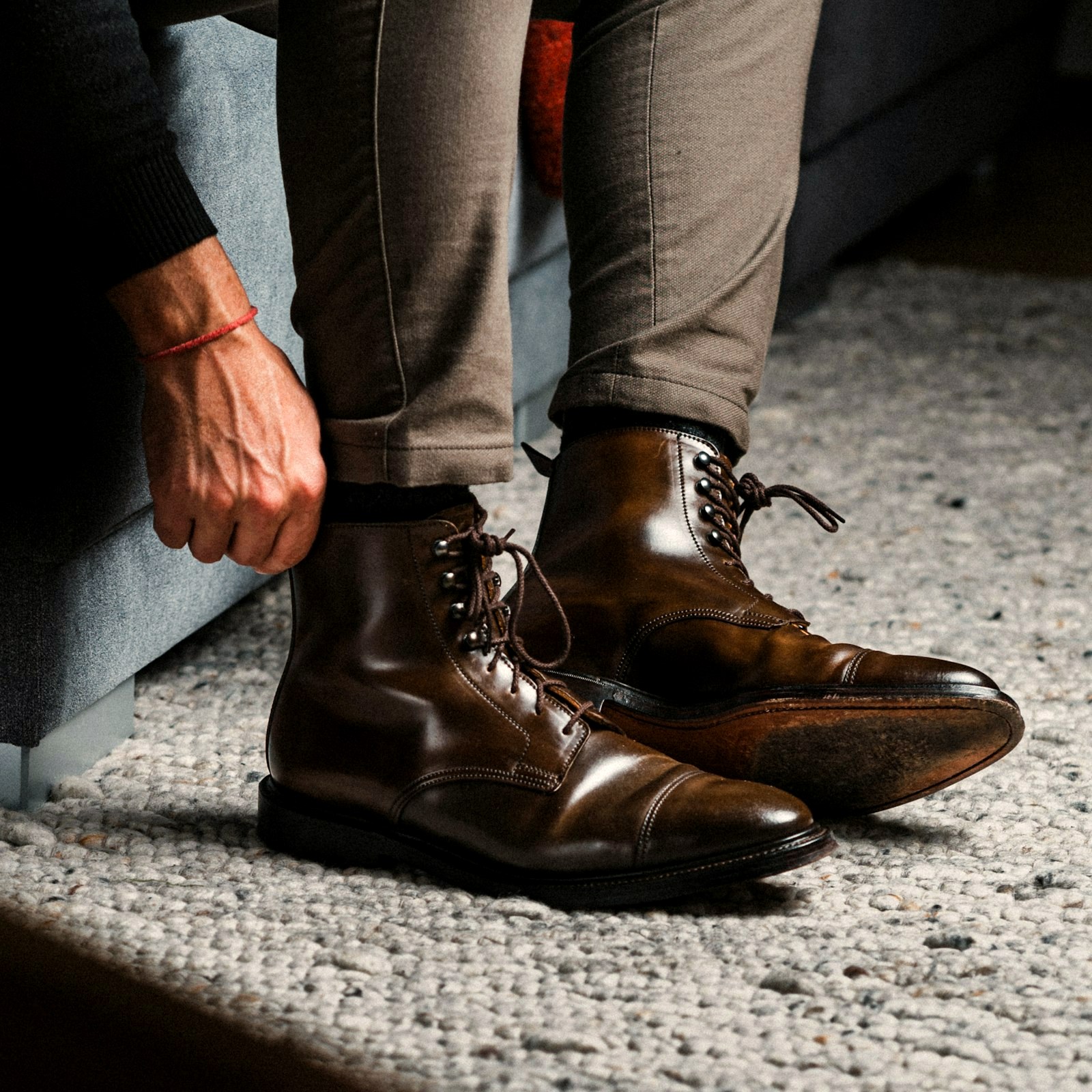
A boot at the ankle, captioned as exactly that: a leather cap-toe boot being laced over a trouser, the bank's nearest worn frame of the meeting this page exists to rule. The bank holds no desert boot frame and no suede chukka frame of any kind, and this page prints that absence rather than dressing a leather boot as its suede subject; the care section prints the gap and the harvest list entire.
Checked and updated October 2026
The ruling, up front: the desert boot is the chukka at its softest, the family’s founding species with its softness kept: an unlined suede upper, two eyelets, a crepe sole, and a shaft so low that the ankle above it is shown, and the showing is the boot’s whole statement. So it is worn at the ankle it shows, the hem ending at the shaft, the sock ruled as a garment, in the company the boot family brief prints for the chukka: soft tailoring, chinos, cords, knitwear, the tailored wardrobe’s casual end. And it is refused the two impersonations its softness invites. It is not a dress shoe: it stops below the suit, as No. 56 prints of its parent shape, and under pressed tailoring its two eyelets read as the weekend arriving early. It is not a working boot: its crepe has no grip to spend and its suede keeps its name’s condition, dry ground, and in slush and on trails it is a shoe out of its country. Between the two stands the boot’s real register, which this brief prints in order: the record first, the boot’s anatomy and its published history; then the pairing law at the low shaft; then the rooms and hours; and the looks, the ruling, the mistakes and the keeping after all of it. On scores: this site publishes no footwear ranking and no boot is scored here, and the one number quoted, the chukka’s 3.5, is No. 56’s, cited as what it is.
This brief: the decisive rule · the boot’s record · the pairing law · the rooms and hours · the looks · the ruling · the mistakes · care, crepe, and our photography
The decisive rule: the chukka at its softest, worn at the ankle it shows
Every boot in this family is decided at the hem, and the desert boot is decided there more completely than any of its relatives, because it has the least boot to decide with. No. 56 prints the chukka’s construction entire, and this brief adopts the sentence as its subject’s definition: two or three eyelets, an unlined or lightly lined upper in suede or smooth leather, a crepe or slim rubber sole, the ankle boot at its softest construction. The desert boot is that sentence at its strictest reading: two eyelets, not three; unlined, not lightly lined; suede, the softer of the two leathers; crepe, the softer of the two soles. The desert boot is the chukka at its softest: suede, crepe and two eyelets, worn as the relaxed end of tailoring and the dressed end of casual, at the ankle its low shaft shows, and never as a dress shoe and never as a working boot. Nothing in its build argues with that rule. The unlined suede gives from the first wearing because there is no structure in it to break in. The crepe yields under the foot because it is natural rubber poured thick, not a tread carved for grip. The two eyelets fasten the boot the way a loafer’s strap fastens a shoe, as a formality of closure rather than an instrument of hold. A boot built entirely of softnesses has exactly one register available to it, and the register is ease: it is the shoe a tailored wardrobe wears when it is not working, and the boot a casual wardrobe wears when it is dressing up, and it is both of those at once because the two errands meet at its rung.
The rung is the tree’s, and this brief prints it rather than inventing one. No. 56 seats the chukka at 3.5 on its five-shape scale, a half-step below the derby shoe’s rows and above every working shape, level with nothing and between everything: above the service boot and the hiking boot, which take the work rows and the ground itself, and below the suede Chelsea at 4 and the sleek calf shapes at 4.5, which take the tailored rows. The desert boot stands at the soft end of the chukka’s seat, and the distinction matters because it prices the boot’s two refusals. Downward, it has no working shape below it to borrow authority from: the service boot’s lugged, welted, storm-built register is a different instrument, and a desert boot dressed as one is a soft shoe in a hard costume. Upward, it stands a full rung below the shoes that divide the suit’s rows between them, the sleek Chelsea and the dress boot at 4.5, and the rung is not a gap to be closed by polishing. It is the boot’s address, printed by the family before this page was written, and this brief’s whole work is to furnish the address rather than to move it.
The ankle is the rule’s working half, and it is where this species differs from its parent shape in kind rather than in degree. The chukka’s shaft is low; the desert boot’s is the family’s lowest, ending at the ankle bone, and a shaft that low does not cover the ankle. It frames it. Every other boot in No. 56 makes the trouser’s meeting with the shaft a decision about coverage, the leg ending at the shaft to show the whole boot or sliding over a shaft its opening can receive. The desert boot forecloses the second half of that choice in most of its rows: a leg wide enough to slide over so low a shaft has usually swallowed the boot to a suede shoe’s worth of evidence, and the boot that remains visible is not the boot that was bought. What the low shaft shows instead is the ankle itself, and with it the sock or the skin at the joint between trouser and shoe, which makes that joint a dressed joint, ruled in the pairings the way a collar rules a tie. The family’s hem law stands entire, inherited from No. 15 through No. 56: the hem ends at the shaft or slides over it, stacking, pooling and the tuck refused in every register. Inside that law, this brief’s one addition is its own, and it is printed here so the care section can gather it with the rest: at a shaft this low, the ankle is part of the outfit, and it is dressed, socked or bare, as deliberately as anything above it.
The boot’s record: suede, crepe, and a history written in dry country
The boot first, because in this species the garment is the construction to a degree no other subject in this family matches: take away the suede, the crepe or the two eyelets and a different boot stands in its place, still a chukka, no longer this one. The upper is suede, and it is unlined. Suede is the flesh side of the hide, buffed to a nap, and in the desert boot it stands alone, one thickness of leather with no lining behind it, which is why the boot fits the way it does: it does not hold the foot, it settles around it, and the fit a buyer tries in the shop is the fit the boot keeps, there being no structure to relax into a second shape. The founding colour is the pale sand of the boot’s name, and the nap takes its marks honestly, darkening where the foot bends and where weather has touched it, a record the species has never pretended to hide. Leather versions of the boot stand in the makers’ catalogues, the beeswax browns above all, and they are lawful boots; they are also the species one register harder, the general chukka’s territory, and a buyer choosing the leather is choosing the parent shape’s errand over the species’, which the colour ruling in the questions prices. The fastening is two eyelets, three on some makers’ versions, and the count is a register before it is a fact: two eyelets cannot pretend to ceremony and do not try, and the lacing they allow is a single crossing and a knot, the least lacing a boot can carry and still be tied.
The sole is crepe, and crepe is the boot’s signature and its sentence. Crepe is natural rubber, coagulated in sheets and layered, pale when new and darkening with wear, and its properties are the boot’s properties stated in a material: it is soft underfoot to a degree no leather or moulded sole matches, it is quiet, a desert boot crosses a hard floor the way a stockinged foot does, and it grips a smooth, dry surface by contact rather than by tread, there being no tread. The same facts carry the refusal. Crepe has no edge and no lug, so on wet stone it has nothing to hold with, and in slush it fouls, its soft surface picking up the street’s grit and carrying it. The construction under the sole is the light one the species was born with, the upper stitched down to the sole in the stitchdown manner rather than welted up into a storm-proof joint: a fair-weather build, honest about it, and priced accordingly in every sense. A buyer who learns one sentence from this section can hold the boot’s whole record in it: every material in the desert boot was chosen for softness and dry ground, and the boot keeps both conditions for its whole life.
The history is short, documented, and printed here as the species’ published record, the way this family prints a cloth’s regulated name. The desert boot descends from the suede boots British officers wore off duty in the desert war, in Egypt and Burma: soft, crepe-soled boots cut by local makers, the Cairo bazaar above all, because the army’s issued boot was the wrong instrument for a hot, dry country’s evenings. Nathan Clark, of the Somerset shoemaking family, served in Burma, met the boot there, and sent the design home; Clarks launched the desert boot in 1950, on the pattern he had drawn from the officers’ boots, suede, two eyelets, crepe, and the species has been in continuous production since, the founding maker’s and then the world’s. Two facts in that history do this brief’s work. The first is that the boot was from birth an off-duty garment, the soft thing a uniformed man changed into when the uniform came off, which is its register in this family’s terms stated by its origin: the relaxed end of a dressed wardrobe, exactly where No. 56’s scale seats it. The second is that its country was dry: the boot is not named for a landscape as a compliment, it is specified for one, and the wet-weather refusal in the rooms section is not this brief’s taste. It is the boot’s own name, still in force.
The pairing law: the hem at the low shaft, and the sock as a garment
The trousers are No. 56’s, printed for the chukka and adopted entire: slim to straight, chinos, cords, straight denim and soft tailored trousers, the tailored wardrobe’s casual bottoms, in the registers the two cloths share. What this brief adds is the hem’s discipline at this shaft, because the family’s general law reads differently at its lowest address. No. 56 prints the chukka’s agreement as the easy one: the hem ends at the shaft by preference, the chukka’s low shaft making the first agreement the easy one, sliding over legal on a straight opening, at no break to slight, a small cuff on denim legal and reading as the shape’s own casualness. At the desert boot’s shaft, lower again, the preference hardens into the rule’s centre: the hem ends at the shaft. The boot’s whole design is the frame it makes around the ankle, and a hem that slides past the shaft to the shoe has framed nothing; the outfit’s ground floor reads as a suede shoe under a trouser, the species’ statement spent and its softness still to pay for. So the chino and the cord are hemmed to the shaft, the denim is worn straight at no break or cuffed once to the same address, and the wide leg that swallows the shaft is refused in the mistakes with the pooling and the tuck it travels with.
The sock is the pairing law’s second half, and it exists because this boot shows what other boots cover. Between the hem at the shaft and the boot’s top line stands a hand’s breadth of ankle, dressed or bare, and the room reads it the way it reads a cuff at a wrist: as the outfit’s finishing detail at its lowest joint. The standing form is a plain ribbed sock in the outfit’s own family, navy, charcoal, the earth registers the chinos and cords already carry, its rib the only texture at the joint and its colour a continuation of the trouser’s or the boot’s, never a third decision. In the warm rows the licensed alternative is the bare ankle, a hidden sock inside the boot, the skin at the joint, which is the species’ home register carried to its conclusion, the off-duty boot worn the way its first wearers wore it in a hot country. What the joint refuses is volume: the athletic sock, white and cushioned and logoed, built for a trainer and standing in a tailored joint like a badge from another kit, and the novelty sock, whose pattern at the one exposed joint spends the outfit’s statement at the ground, the place No. 56 warns the eye arrives last and stays longest. The boot is quiet. Everything it shows should be.
The upper half follows the register, and the family has already ruled most of it. Knitwear is the boot’s first company, the crew and the roll neck at the gauges the season sets, the soft weekend No. 56 draws as the chukka’s home: mid-gauge knitwear, cords or chinos at no break, the leg ending at the shaft, the suede chukka in sand or snuff beneath it, texture over texture and nothing polished anywhere. The blazer is its dressed company: the blazer and jeans brief seats a Chelsea or chukka in suede at the pairing’s upper rungs and names it the ladder’s evening register, the suede’s matte nap rhyming with flannel and tweed, and the desert boot stands in that seat as the chukka’s softest form, under a soft-shouldered blazer, an Oxford or a knit, the leg cut to receive the boot it stands over. Tweed licenses it by name: No. 68 prints the shoe a matte cloth is answered by, grained, suede or booted, the suede brogue or chukka in the brown registers among them, and the desert boot in snuff under a tweed jacket and cords is the two briefs’ shared ground. The belt obeys the family’s one coordination rule, borrowed by No. 56 from our leather belts Verdict Card and printed by No. 15 for its boot: match the belt to the boots by leather family, not by shade, a suede boot taking a suede or woven belt, so that the waist and the ankle are not two leather decisions arguing across the outfit. And the shirt and tie rows close where the suit ruling opens: the Oxford and the brushed cottons under the blazer, a tie, where one is worn at all, in the matte registers of wool and knit, the silk tie’s shine refused here as it is refused under tweed, an apology at the throat for a boot that needs none.
The rooms and hours: the dry licence, and the wet refusal
The desert boot’s rooms are the day’s soft rooms, and they are wider than its reputation for the weekend suggests. The office’s casual end is licensed entire: the studios, the agencies, the floors where the dress code is a rumour, the boot under chinos or soft trousers with a knit or an unstructured jacket is the standing weekday form of half the dressed professions, and it is lawful there because the room’s register and the boot’s are the same, tailored ease. The dressed evening’s lower rows are licensed, the dinner in a private room, the gallery, the theatre’s stalls in their modern dress, where the blazer pairing’s evening register is the assembly’s pitch and the suede boot is that register’s shoe. Travel is the boot’s own room, and it deserves its sentence: unlined and soft, it packs flatter than any welted boot, it crosses a hotel’s hard floors without a sound, it stands a day’s walking on a city’s pavements in a comfort its construction was designed for, and it dresses up at the evening’s end of the day it walked, which makes it the one-boot trip’s standing answer wherever the trip’s weather is dry. The refusals are the family’s standing ones, printed for the chukka and inherited: the pressed rooms, the boardroom and the formal client’s floor, where the assembly runs on smooth cloth and a crease is a unit of account; the ceremony rows, the wedding in its formal form, the funeral, where No. 56 gives the day to the black Oxford and no boot in the family changes that; and the uniform’s rooms entire, No. 67 refusing a boot at its shoe station without argument.
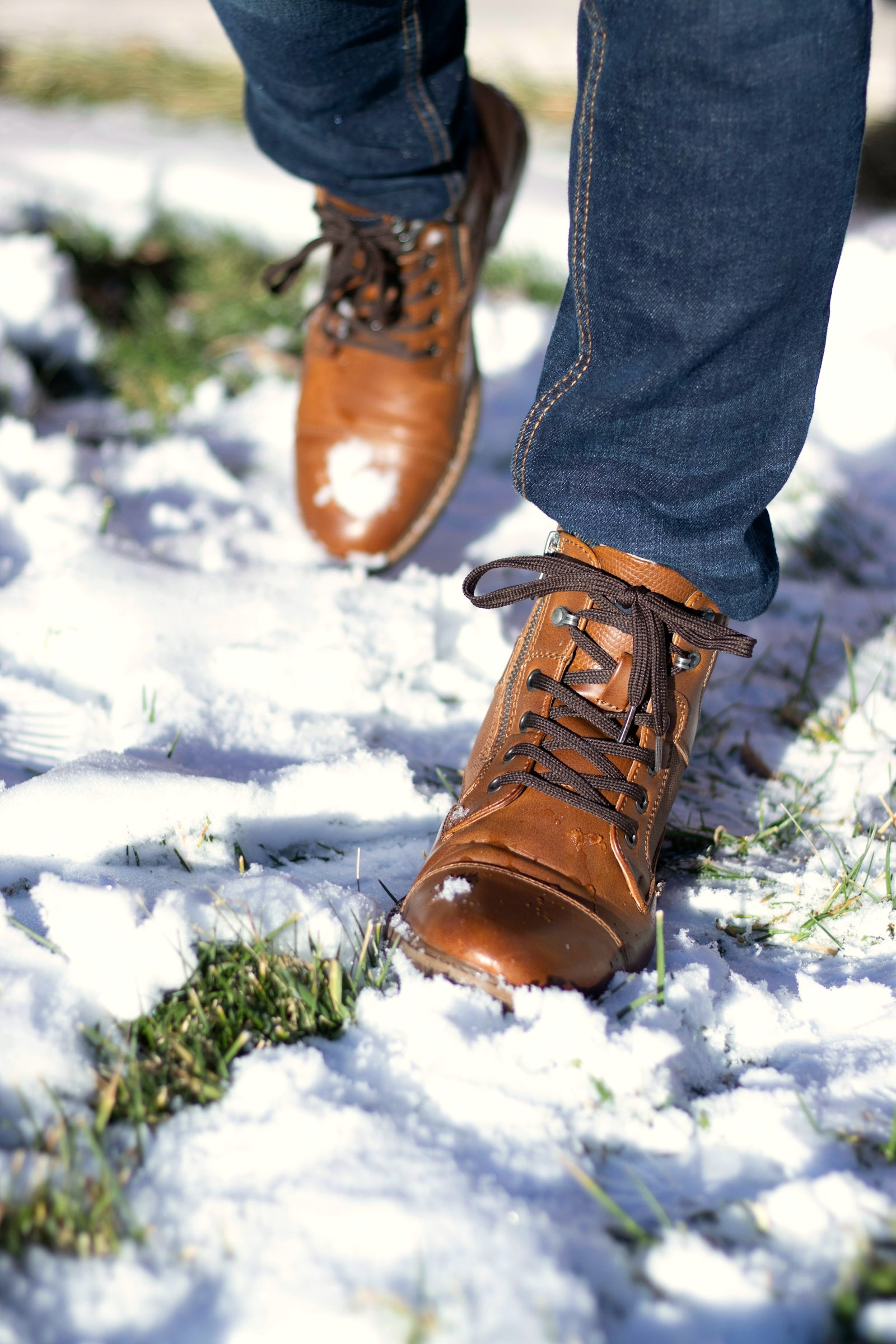
The weather is the section’s hard rule, and the boot’s name states it. The desert boot’s licence is dry ground, and its season is the dry days of the year rather than a term of months: the shoulder seasons entire, when the suede’s nap and the crepe’s give are the day’s own register; the cool, dry weeks of winter, where the boot under cords and a coat is a standing form; and the summer’s evenings and dry days, where the unlined upper is the coolest boot construction a wardrobe owns. The refusal is water in its working forms. Rain spots the suede and tides it at the welt line, and while the species survives a shower better than its reputation, a boot chosen for a wet day is a boot chosen against its specification; slush is worse, the crepe fouling and skating at once; and snow, the frame beside this section notwithstanding, belongs to the leather boot on a sole with something to hold with. The test is the family’s standing one, the rain test of No. 68 applied at the ground: an assembly that still makes sense in the weather it was built for is the working form, and the desert boot in the rain is the opposite case, a garment quoting a dry country from inside a wet one. The boot is not fragile. It is specified, and the specification is printed on its name.
The looks: three assemblies the brief licenses
| Setting | The assembly | The details | The judgment |
|---|---|---|---|
| The soft weekday | Desert boots in sand suede under chinos at no break, the hem ending at the shaft | An Oxford shirt, a lambswool crew in the cool rows, a plain ribbed sock in the trouser’s family, a suede or woven belt | The boot’s home form at the office’s casual end: every surface matte, the ankle dressed, the whole assembly one register throughout |
| The tweed weekend | Desert boots in snuff suede under corduroy trousers, a tweed jacket above them | A roll neck or a Shetland crew in place of the shirt and tie, the jacket’s pattern the outfit’s one loud pattern, the brush in the hall at home | The two briefs’ shared ground, No. 68’s suede chukka under No. 24’s cloth: working company at every station, and no part of the country kit assembled |
| The one-boot trip | Desert boots in a darker suede under straight dark denim, a soft blazer for the evening | The denim cuffed once to the shaft or hemmed to it, a knit polo or an Oxford, the boot the day’s walking shoe and the evening’s shoe in one | The travel licence in its standing form: the boot packs soft, walks quietly and dresses up at the day’s end, lawful wherever the trip’s weather is dry |
The ruling
Wear the desert boot as the soft instrument it is. Buy it in sand or snuff suede first, the founding register, and let the darker suedes follow for the evening rows; buy it unlined and two-eyeleted, the species at its strictest, and let the leather versions stand in the catalogue as the parent shape’s business. Hem to the shaft and dress the ankle it shows, a plain ribbed sock in the outfit’s family or the bare ankle in the warm rows, and keep the boot’s company soft: chinos, cords, straight denim and soft trousers below, knitwear and the unstructured blazer above, the belt in suede’s family, the tie, where one is worn, in matte wool or knit. Keep it below the suit and out of the ceremony rows, keep it off the trail and out of the slush, and keep it the way the care section prints, brushed, rested and dried slowly, so the nap that records its wear records years of it. Ruled so, the desert boot is what it was in the first year it was worn off duty: the dressed wardrobe’s ease, made permanent, a boot that asks the least of its wearer at every station except one, the ankle, where it asks for a decision and rewards it.
Where the wearing goes wrong
The dress-shoe impersonation. The upward failure: desert boots under a pressed business suit, in the rows where the assembly runs on smooth cloth, the wearer reasoning that a boot is a boot and this one is neat. It fails on the family’s printed law before it fails on taste: No. 56 stops the chukka below the suit, and the desert boot is the chukka’s softest form, further from the suit’s rows than its parent, not nearer. The two eyelets and the crepe read at the ankle as the weekend arriving early, and no quality of suede closes a rung and a half of formality. The suit’s winter answers stand in the family already, the sleek Chelsea and the dress boot at 4.5 dividing the social rows, the black Oxford keeping the ceremony rows, and the desert boot’s absence from that list is the ruling, not an oversight.
The working-boot impersonation. The downward failure, and the crueller one, because the boot pays for it: desert boots taken onto trails, building sites and slushy streets, as though a boot-shaped thing were a boot in the working sense. The construction refuses the errand at every station: an unlined suede upper with no storm welt, a crepe sole with no lug and no edge, a fastening of two eyelets that holds nothing against a climb. On rough ground the boot is a shoe out of its country, and in a wet month it is a ruined shoe, the nap tidied with tide marks and the crepe carrying the street in its surface. The family owns the instruments for the ground, the service boot and the hiking boot of No. 56’s scale, bought on fit and last and never styled at all, and the desert boot’s dignity is that it never applied for their job.
The swallowed ankle. The pairing failure, committed with good boots and ordinary trousers: a wide or pooling leg worn over the low shaft, the hem breaking and stacking above a boot it has entirely covered, so the outfit’s ground floor is a suede toe under a trouser puddle. It fails on the family’s hem law, stacking and pooling refused in every register, and it fails worse here than anywhere in the family because the shaft it swallows is the lowest: the boot’s one statement, the framed ankle, is spent, and what remains is neither boot nor shoe but the evidence of an agreement nobody made. The cure costs a hemming: the leg slim to straight, ending at the shaft, or cuffed once to it on denim, and the boot appears.
The safari quotation. The costume failure, and this family grades costume the way No. 68 grades it, as a working kit assembled where none of it is working: desert boots with shorts and the full khaki register, the boot’s colonial origin quoted entire on a city pavement. The boot’s history is real, and that is what makes the quotation a quotation rather than a coincidence: the assembly reads as a portrait of the desert war’s off-duty dress, worn as fancy dress in the tweed brief’s exact sense. The boot with shorts in genuine heat, on genuine ground, is a working answer and outside this brief’s quarrel. The boot with shorts as a look, in a temperate city, is the species’ biography worn as a costume, and the biography deserves better than to be a look.
The dressed-up suede. The apology, in this species’ form: a desert boot darkened with dye, loaded with protector until the nap lies flat, or polished at the toe toward a calf shine, the wearer forgiving the boot its softness by treating the softness as dirt. It fails as the tweed apology fails, two surfaces arguing: suede’s whole register is its matte nap, and a nap suppressed reads as leather that has gone wrong, a boot pretending to a formality its construction cannot cash. The lawful care is printed below and it is all maintenance: brush the nap up, never down into a shine; lift marks with an eraser; let the boot’s wear show as wear. A desert boot that looks new after a year has been worn nowhere, and one that has been polished looks like nothing in this family at all.
The sock that shouts. The small failure at the shown joint: an athletic sock, white, cushioned and branded, or a novelty sock in a loud pattern, standing in the hand’s breadth of ankle the low shaft exposes. It is graded here because the boot makes it visible as no other shoe in the wardrobe does: the desert boot is the one tailored shoe that frames the sock, and a sock from the trainer’s kit or the gift drawer turns the frame into a billboard. The joint’s law is printed in the pairings and costs nothing to observe: a plain ribbed sock in the outfit’s family, or the bare ankle in the warm rows, and the boot’s quiet register reaches the ground undisturbed.
Care, crepe, and our photography
Suede is kept by routine rather than by rescue, and the routine is three habits, the family’s tweed doctrine translated to a nap. The brush is the first. A suede brush, used dry after wearing, lifts the day’s dust out of the nap and stands the nap back up, which is the boot’s whole finish: suede has no shine to restore, only a direction to keep, and brushing is what keeps a worn boot looking worn-in rather than worn-out. Marks and shiny patches answer to the suede eraser, the gum block rubbed over the spot before the brush, and salt lines and tide marks fade under the same two instruments with patience. Rest is the second. The boot is unlined and gives around the foot, and it keeps its shape the way wool keeps its, by resting: a day between wearings, on trees or stuffed to its shape, in air. A desert boot worn daily goes first where any unlined thing goes, at the heel’s seat and the crepe’s edge. The drying is the third. The boot will be rained on despite this brief, and it is dried the slow way, stuffed with paper, in moving air, away from radiators and direct heat, then brushed when it is dry: dried so, a shower costs it nothing, and the tide mark the rooms section refuses is a mark of saturation and hurry, not of water itself. Protector sprays stand in the trade’s standing care and are licensed as what they are, a shower’s insurance bought at the price of a slightly darkened nap, never a licence to wear the boot as a storm shoe. The crepe wants almost nothing: grit brushes out of its surface, its darkening from pale to tobacco is wear recorded and not damage, and a cobbler can resole a crepe sole when its edge is spent, which at a city’s mileage is years in. A desert boot kept this way is not being preserved. It is being kept in service, which is what an off-duty boot is for.
The rulings this brief prints beyond the tree’s standing record are gathered here once, the way the family gathers its extensions. The shaft law, the hem’s agreements, the chukka’s rows and rung, the suit refusal and the belt law are the family’s, cited as theirs: No. 56’s scale and pairings, No. 15’s shaft law and belt rule, No. 68’s suede answer to a matte cloth, the blazer brief’s evening register for a suede chukka. This brief’s own are: the ankle rule in its stated form, that at this shaft the ankle is part of the outfit and is dressed as deliberately as anything above it, with its sock law; the travel licence stated as a room of the boot’s own; the safari quotation graded as costume; and the weather licence stated as dry days rather than months. Nothing scored stands behind any of them, because nothing scored stands behind this family’s footwear at all, and the rulings are offered as the family offers its own: as the grammar of the garment, read off its construction.
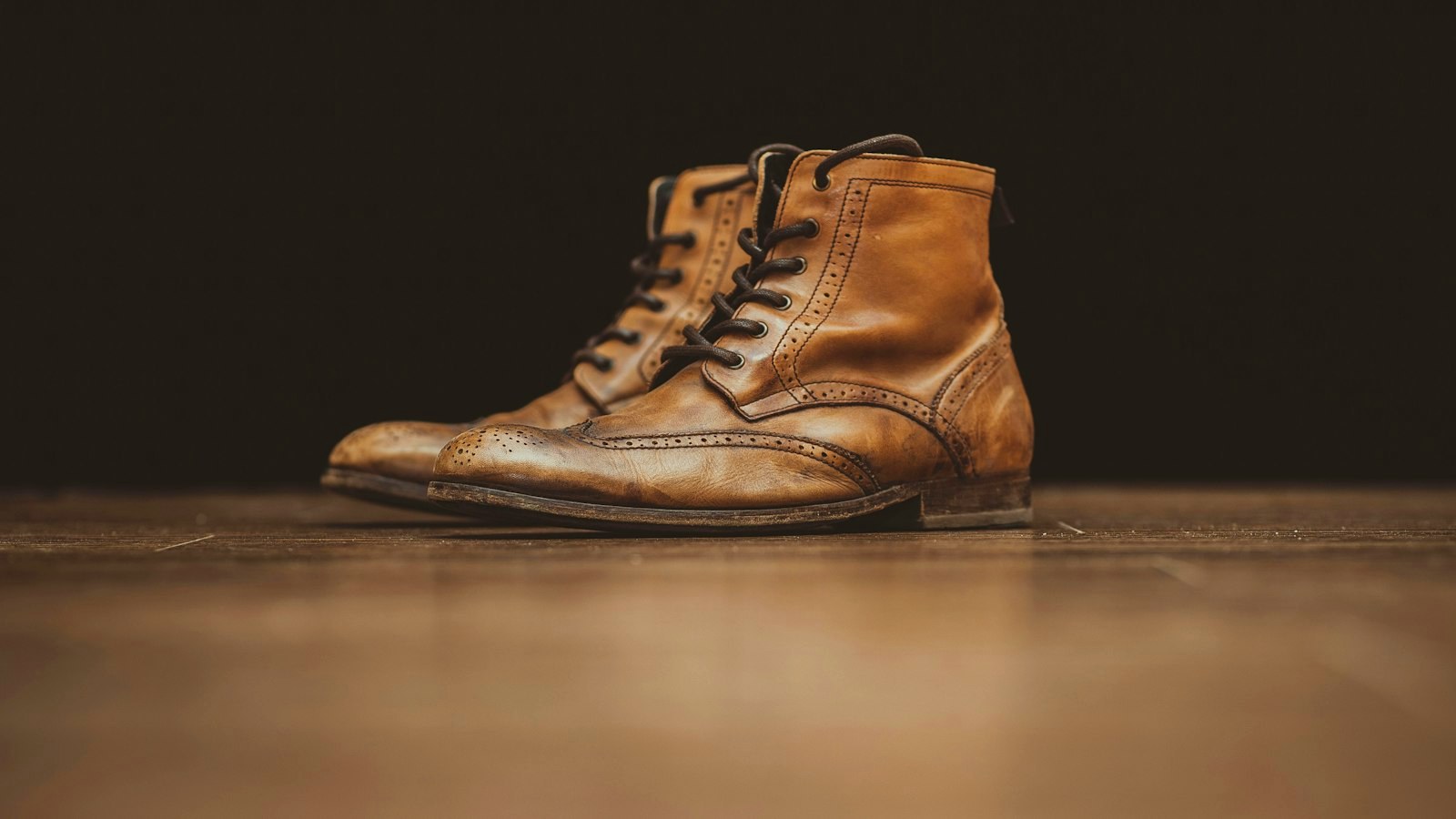
The photography, stated plainly, because this page’s subject is another of the bank’s empty shelves, one No. 56 already named. The bank holds no frame of a desert boot and no suede chukka in any form: no sand suede at a hem, no crepe sole in profile, no desert boot worn in a street. The hero is a leather cap-toe boot being laced over a creased trouser, CREDITS-logged and carried on the quiet luxury capsule, printed here for the meeting of trouser and boot at the ankle and captioned as the leather boot it is. The figure in the record is a still life of brown leather brogue boots, a banked spare, captioned for the construction it shows; the figure in the rooms is brown leather in snow under denim, carried on the boots brief and the Chelsea brief, printed as the weather agreement this boot does not sign. No frame has been captioned as suede, as crepe or as this species, and the frames that stand in are captioned for the register they actually show. The harvest list this page is waiting for, in order: first, a sand suede desert boot worn under chinos at the shown ankle, the joint this brief exists to rule, photographed at ankle height; second, a crepe sole in profile, pale and unworn beside a worn one darkened to tobacco; third, desert boots in a dry street in the shoulder season, under a blazer, at the evening end of a walking day.
Questions, answered
What is a desert boot, exactly?
The chukka's founding species: an ankle boot of two eyelets, an unlined suede upper and a crepe rubber sole, built soft on purpose. It was designed by Nathan Clark in 1949 from the crepe-soled suede boots British officers wore off duty in Egypt and Burma, cut by Cairo bazaar makers for hot, dry ground, and launched by Clarks in 1950. Every element of the founding form is a softness: the suede is unlined so it gives from the first wearing, the two eyelets make no pretence of holding a foot the way a boot's lacing does, and the crepe sole is natural rubber, pale and yielding, quiet on hard floors and useless as a grip in slush. Our boot family brief seats its parent shape, the chukka, at 3.5 on a formality scale of five shapes, and the desert boot stands at the soft end of that seat.
Is a desert boot the same as a chukka?
A desert boot is a chukka; a chukka is not necessarily a desert boot. The chukka is the family: an ankle boot of two or three eyelets and an unlined or lightly lined upper, which our boots brief prints at 3.5 on its five-shape scale, in suede or smooth leather, on a crepe or slim rubber sole. The desert boot is the family's founding species and its strictest form, suede almost always, crepe almost always, unlined, and named for the ground it was built on. A leather chukka on a slim rubber sole is the same shape one register harder, and it takes rows the desert boot does not: the desert boot is the chukka with its softness kept, and the softness is the point of the species and the limit of it.
Can you wear desert boots with a suit?
Not with the suit in its working rows, and our boots brief prints the sentence this page inherits: the chukka is a soft-tailoring boot and stops below the suit. What the desert boot is licensed under is tailoring at its soft end, the unstructured blazer, the knit under a jacket, the soft trouser in chino, cord or flannel cloth, where the whole assembly is already one register down and the boot's softness matches it. Under a pressed business suit its two eyelets, its unlined suede and its crepe sole read as the weekend arriving early, the same failure our tweed brief grades when a working cloth is dressed in the city's papers. The ceremony rows belong to the black Oxford, and no boot in this family enters them.
What trousers go with desert boots?
The trousers our boots brief prints for the chukka, worn at the hem that brief's law sets: slim to straight, chinos, cords, straight denim and soft tailored trousers, with the hem ending at the shaft by preference at no break to slight, because the desert boot's shaft is the lowest in the family and the shown ankle under it is the boot's whole statement. A small cuff on denim is legal and reads as the shape's own casualness. What refuses the boot is the wide or pooling leg that swallows the low shaft entire, which spends the boot and leaves a suede shoe's worth of evidence, and the leg tucked into the boot, which the family's hem law refuses for every ankle boot on the site.
Do you wear socks with desert boots?
Yes, and the sock is a garment in this outfit rather than an afterthought, because the desert boot's low shaft shows the ankle and whatever stands on it. The standing form is a plain ribbed sock in the outfit's own family, the earth registers, navy, charcoal, the colours the trousers already carry, drawn up and quiet. In the warm rows a hidden sock inside the boot is the licensed alternative, the ankle shown bare against the suede. What is refused is the athletic sock and the novelty sock at the shown ankle: the boot spends the outfit's softness at the ground, and a loud sock at the one joint the boot exposes is a second statement competing with it, at the point the eye arrives last and stays longest.
Can you wear desert boots in the rain or in winter?
In dry cold, yes; in wet weather, no, and the boot's name is the ruling. It was built for the driest ground on earth and it keeps the condition: the unlined suede spots and tides under rain even when it survives it, and the crepe sole, natural rubber with no lug and no edge, slips on wet stone and fouls in slush, carrying the street's grit home in its surface. Our boots brief prints the winter answer for the family, the hem at the shaft over dark denim in the weather the boot exists for, and that boot is a leather boot on a sole with something to hold with. The desert boot's season is the dry days: the shoulder seasons entire, the cool dry half of the year, and summer's evenings. In the wet months it waits, which is not a defect in the species. It is the species keeping its name.
What colour desert boots should I buy first?
Sand or snuff suede, the colours our boots brief names for the suede chukka in its home rows, the soft weekend of knitwear and cords and chinos. The pale suedes are the species' founding register, they stand under denim in every wash the wash law allows, under chinos and cords and the earth registers of flannel, and they show their wear as the boot intends to show it, the nap marking where the foot bends. The darker suedes, chocolate and the deep browns, are the second purchase and the evening register's, standing nearer the blazer's rows. Black suede is the hinge our Chelsea brief rules for its own boot, evening's colour in the weekend's material, and it behaves the same way here: licensed, moodier, and never an office boot. A polished leather desert boot is the species with its softness spent, and it is bought, if at all, as a chukka instead.
Has Young Cotton ranked desert boots?
No, and the absence is printed rather than papered over. This site publishes no footwear ranking, a position our boots brief states in its own ruling, and no boot is scored anywhere on it. What stands is the family's formality scale, printed in How to Wear No. 56: the dress boot and the sleek calf Chelsea at 4.5, the suede Chelsea at 4, the chukka at 3.5, the lug-soled Chelsea at 2.5 and out of the dress family. The desert boot is ruled inside that scale as the chukka's softest species and is given no number of its own, because a number of its own would be an invention. When the desk grades footwear on its makers' published records, this page's rulings will be re-argued from that Card.
Next
The family this brief stands in: No. 56, boots, the parent brief, whose five-shape scale seats this page’s subject at 3.5 and whose hem law this page inherits entire; No. 15, Chelsea boots, where the shaft law and the suede register were first ruled; No. 68, tweed, which names the suede chukka among the shoes a matte cloth is answered by; No. 24, corduroy, the cloth of this boot’s home rows; and the ceiling this brief’s licence stops below, No. 67, black tie, whose shoe station refuses a boot entire. The brief before this one stands at No. 68; the series began with the cardigan and the full run lives in the How to Wear index. How every score behind those pages is built stands on our methodology page.