
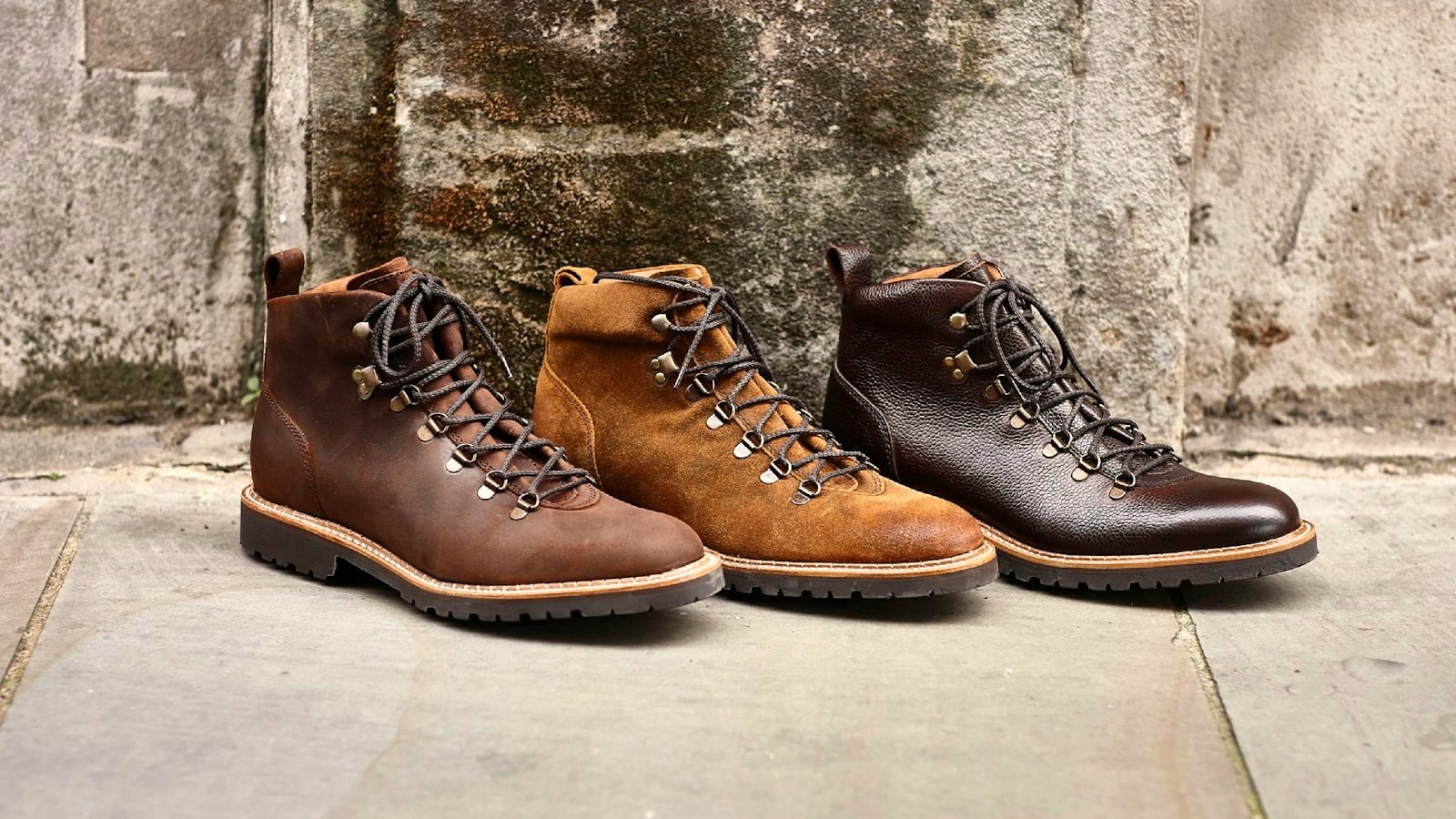
The family at rest, captioned as exactly that: a trio of leather boots against a stone wall, banked and logged in our credits. The bank holds honest boot frames, work boots, snow boots, a worn boot on wet rock, and no chukka, no dress boot and no boot worn under tailoring; those gaps are named in the honesty section rather than filled with another shoe dressed as this page's subject.
Checked and updated October 2026
The ruling, up front: a boot is decided at the hem. Every other shoe on this site is met by the trouser somewhere below the ankle, in private; a boot is met partway up it, in public, and the meeting is the outfit's most legible join. So the family obeys one law, inherited from the Chelsea brief and generalised here to every ankle boot: the hem and the shaft must agree, the leg ending at the shaft to show the whole boot, or sliding over a shaft its opening can receive, with stacking, pooling and the tuck all refused. Inside that law the five shapes, Chelsea, dress boot, chukka, derby or service boot and hiking boot, are five different instruments with five different trousers, colours and weathers, and this brief separates them, scales them and rules the pairings one by one. On scores: this site publishes no footwear ranking and no boot is scored here. The numbers quoted are formality rungs and garment and brand scores from elsewhere, cited as what they are.
This brief: the decisive rule · the five shapes · the trouser agreements · the colour law · the weather register · the suit question · the looks · the mistakes · care and our photography
The decisive rule: the boot is decided at the hem
Every brief in this family has a rule that decides its garment, and the boot family’s rule is a place: the ankle. A loafer is a low shoe and the trouser falls past it, so the only styling question the loafer asks is how much cloth breaks above it. A sneaker is lower still. A boot rises to meet the trouser halfway, and at the meeting it creates a surface neither garment owns alone: the join, where a hem ends against a shaft, or fails to. That join is read at twenty paces, before the boot’s leather, before its sole, before the trouser’s cloth, because it is the one point in the outfit where two decisions collide in plain sight. That is this brief’s decisive rule: a boot is decided at the hem. The hem and the shaft must agree, and every failure in this brief is a refusal to sign one of the two agreements available. How to Wear No. 15 prints the law for the Chelsea, whose unbroken line makes the failure impossible to hide. This brief generalises it, because laces do not repeal it: a derby boot with a puddled hem over its shaft is the same failure as a Chelsea with one, drawn in a busier hand.
The two agreements are the family’s whole constitution, and they are stated here once, for all five shapes. The first agreement: the hem ends at the shaft. The leg is slim or straight, hemmed to no break or the slightest break on our suit brief’s ladder, and it stops at or just above the top of the shaft, showing the whole boot below it. The second agreement: the hem slides over the shaft. The leg’s opening is wide enough to pass over the shaft and rest on the shoe below, again at no break to a slight break for the tailored shapes, or cuffed once to the same end for the working ones. Everything else is a refusal, and the refusals have names because each is common enough to have earned one. Stacking, extra length concertinaed above the shaft, is a denim-over-sneakers habit that reads over a boot as trousers that do not fit. Pooling, the full break collapsing around the shaft, hides the one line the boot exists to draw and drags through wet streets doing it. The tuck, the leg pushed inside the shaft, blouses the cloth above a shaft too short to hold it and reads as a bandage. And the swallow, the wide leg that drops over the whole boot, deletes the boot at the price of owning it. The shapes differ in which agreement each prefers and in how much failure each forgives. The law does not differ.
Three corrections belong to the rule itself, because this commission arrived with premises the tree corrected, and the corrections are printed rather than absorbed. The first is the ranking that does not exist: this brief was commissioned as the boot brief, and a reader could reasonably expect it to style from a boot ranking the way the coat briefs style from their Cards. There is none. Footwear rankings are excluded on this site by ruling, printed on the Chelsea brief and the loafer brief alike, and no boot carries a score here. What this brief styles from is the footwear ladder the three shoe briefs built, rungs and rules, plus the weather record of the winter briefs. The second correction is scope: the Chelsea is already ruled entire by No. 15, its scale, its office ruling, its colour hinge, and this brief cites that record as the record. It does not re-rule the Chelsea to fill a table; it rules the four shapes No. 15 did not separate, and seats the Chelsea among them at its printed rungs. The third is the tuck, which arrived in the commission as a mistake to be discussed, as if it had conditions. It has none. No. 15 rules it out for the Chelsea outright, on the shaft’s own geometry, and this brief extends the refusal to the family in the trouser section, as law rather than as taste.
The five shapes, separated and scaled
Boot is a height, not a garment, and the family separates into five shapes by last, fastening and sole. The desk prints the scale here as its own ruling, built on No. 15’s anchors by the loafer brief’s mechanism: the sleek tailored boot starts level with the calf horsebit at the top of the laceless scale, coverage adds formality, work lasts and lug soles subtract it. The Chelsea’s three rungs are No. 15’s, reproduced exactly; the other four shapes are priced here, as new, against them.
| The shape | Formality, of 5 | The build | The job |
|---|---|---|---|
| The dress boot | 4.5 | A laced boot on a slim last, plain or cap toe, leather or slim rubber sole: an Oxford or derby shoe carried up the ankle, nothing on the upper but its lacing | Tailoring in cold weather, the evening rows, the office: the suit’s winter shoe, at the sleek Chelsea’s rung |
| The Chelsea | 4.5 sleek calf, 4 suede, 2.5 lug-soled | No fastening at all: two pieces of leather, an elastic gusset at each side, a pull loop, a low heel, per No. 15 entire | The laceless system ruled by its own brief: tailoring, evening, denim, the office, at its three printed species rungs |
| The chukka | 3.5 | Two or three eyelets, an unlined or lightly lined upper in suede or smooth leather, a crepe or slim rubber sole, the ankle boot at its softest construction | Soft tailoring, chinos, cords, knitwear: the tailored wardrobe’s casual boot, a half-step below the derby shoe’s rows and above every working shape |
| The derby or service boot | 3 | A plain-toe lace-up on a rounder, roomier last, five eyelets and up, a rubber or lugged sole, work and military patterns softened for the street | Denim, fatigue trousers, cords, the waxed and field jackets: the working boot of the tailored wardrobe, honest at work register and never dressed past it |
| The hiking boot | 2 | A padded collar, speed hooks, a deep lug sole, a last built for load and distance: technical equipment in boot form | The trail, the worst weather, the country rows entire: a tool, worn as a tool, and seated in this brief only to be refused the tailored rows |
The dress boot, 4.5, is the shape the other briefs imply and none has separated: the shoe a man already owns, lengthened. Its line is the Oxford’s line, its sole is the Oxford’s sole or a slim rubber copy of it, and its one addition is coverage, the ankle closed against the weather that retires the shoe it extends. It stands level with the sleek Chelsea because it does the same job at the same register with a fastening the Chelsea refuses, and the choice between them is the choice between a laced and a laceless silhouette, nothing more. Under a suit in its social rows it is the winter answer that asks the least explanation in the room. The Chelsea is seated here at its own brief’s numbers and not re-argued: sleek calf 4.5, suede 4, the lug-soled animal 2.5 and out of the dress family, its whole system at No. 15. The chukka, 3.5, is the family’s softest construction and its most forgiving shape: two eyelets do not pretend to ceremony, the crepe sole does not pretend to grip, and the boot’s whole claim is comfort at the tailored wardrobe’s casual end, the blazer’s weekend rows, the chino and cord rows, the knit rows. It is the boot a man wears when the outfit is soft everywhere and a harder boot would argue with it.
The derby or service boot, 3, is the working lace-up: the plain toe, the open lacing, the roomier last, the sole with something to say to the ground. Its patterns descend from issued boots, and the descent is its register: it reads as equipment that has been cleaned up, not as tailoring that has been ruggedised, and the distinction is the rung. It is the natural boot of the denim rows, of fatigue trousers, of the waxed jacket and the field jacket, the shapes whose own registers are work. Dressed one row up, under chinos and a knit, it holds. Dressed two rows up, under a blazer, it starts to read as a commute compromise, and under a suit it is refused outright in the suit section. The hiking boot, 2, closes the scale, and it is priced as equipment because that is what it is: the padded collar and the speed hooks are load-bearing furniture, the lug is deeper than any street sole in this brief, and the silhouette announces distance, not register. In its own rows, the trailhead, the wet country weekend, the deep-weather errands, it is not a low score. It is the correct tool, and this brief’s only ruling on it is a border: it does not cross into the tailored rows, where its every signal argues with the cloth above it. A man who hikes owns one. A man who does not has no use for its rung at all, and the service boot covers his working rows in a shape the wardrobe can also dress.
The trouser agreements: what each shape asks of the leg
The shaft law signs one of its two agreements per shape, and this section prints the paperwork shape by shape, because the agreement that flatters one boot is the failure of another. The four variables are the ones the commission named and the family has always used: the crop, whether the leg ends above the shaft by design; the cuff, whether the leg is turned up to clear it; the stack, how much cloth, if any, rests on the shaft; and the break, where the leg sits on No. 04’s ladder of no break, slight, medium and full.
| The shape | The leg | The agreement | Break and finish |
|---|---|---|---|
| The dress boot | Slim, tailored, the suit’s and the dress trouser’s leg entire | Either: the hem ends at the shaft and shows the boot’s whole line, or slides over it on an opening cut for a shoe, which the slim last accepts | No break to slight; no cuff on a dress trouser, ever; stack none |
| The Chelsea | Slim, hemmed short, per No. 15 entire | Either, on No. 15’s terms: ends at the shaft, or slides over a shaft it can receive | No break to slight; stack none, pooling none; bootcut the one licensed wide opening |
| The chukka | Slim to straight: chinos, cords, straight denim, soft tailored trousers | The hem ends at the shaft by preference, the chukka’s low shaft making the first agreement the easy one; sliding over is legal on a straight opening | No break to slight; a small cuff on denim is legal and reads as the shape’s own casualness; stack none |
| The derby or service boot | Straight: denim, fatigue trousers, cords, heavy chinos | The hem slides over the shaft, the working agreement; or rests at it on a cuffed leg | Slight break, or one cuff turned to clear the shaft and show the boot; a short stack on raw denim is the shape’s one tolerated untidiness, kept to a fold or two and never a concertina |
| The hiking boot | Straight or relaxed, in work and outdoor cloth | The hem rests over the collar or is cuffed above it; the boot is met as equipment | Slight to medium break is forgiven here and nowhere else in the brief, because the rows are ground rows; the tuck remains refused even here on the street, the field’s own habit staying in the field |
Read down the break column and the family’s arithmetic shows itself: the higher the rung, the shorter the hem. The tailored shapes are worn at no break to slight because their line is the product, and cloth resting on the shaft spends it. The working shapes forgive a slight break and a cuff because their rows price the ground over the line. And the crop deserves its own sentence, because it is the first agreement with the decision made at the tailor’s rather than at the mirror: a cropped trouser ends above every shaft in this brief by construction, which makes it the boot family’s natural partner in the tailored rows, the one leg that cannot fail the law. Its price is the sock, and the boot family pays it more cheaply than any shoe on this site: the shaft covers the join, so a plain dark crew in merino or cotton, the sock of Verdict Card No. 36, Darn Tough at 88, disappears under the boot entire, and the novelty sock stays refused on No. 15’s logic, a flash of cartoon at the gusset when the leg crosses being a louder failure for being rare.
The tuck is refused for the whole family, and the refusal is argued once, here. The Chelsea’s shaft is too short to hold a tuck at all; the cloth blouses above it within a dozen steps. The laced shapes hold it no better in spirit: a service boot’s shaft is a working collar, not a trouser’s destination, and a leg stuffed into it reads as a uniform misremembered, field dress worn as street style. What the tuck’s defenders are usually reaching for is the boot shown whole, and the law already gives them that, legally, by the first agreement: hem the leg to the shaft and the boot stands entire, line unbroken, nothing bandaged. The tuck is the first agreement performed by force instead of by the tailor, and the difference is visible from across the street, which is where this family’s failures are always visible.
The colour law: black, brown, and suede against the palette
The boot family’s colours are the wardrobe’s colours read at the ground, and the ruling is that colour follows the trouser rail first and the occasion second. The wardrobe this magazine builds runs on a standing palette, charcoal and navy tailoring, dark indigo denim, grey flannel, ecru and stone chinos, cords in the brown family, and the boot is bought to close those rails, not to open new ones. Black calf is the boot at maximum formality, per No. 15’s record entire: the tailoring colour, the evening colour, the monochrome close to the black denim system our denim brief builds, and the only colour the office’s upper rows accept without discussion. A wardrobe whose week is led by charcoal and navy and black denim buys black first, in the sleekest shape its rows need. Brown calf, dark chocolate through mid-brown, is the tailored day boot: a notch warmer and a notch softer than black, at home under navy and grey, under dark indigo, under the flannel rail, and the first buy for the wardrobe that runs on denim, chinos and knitwear rather than on suits. The two are not rivals. They are the same purchase made by two different weeks, and the mistake is buying the second week’s boot for the first week’s trousers.
Suede is the third colour and the second purchase. In sand, snuff and taupe it is the weekend and soft-tailoring family, per No. 15: denim in every wash the wash-break law allows, chinos, cords, the knit rows, the trench worn open. Its rung is the chukka’s home and the suede Chelsea’s, 4 on No. 15’s scale, and it never enters the office’s formal end or goes under a suit at any shade. Black suede is the hinge, ruled by No. 15 and adopted here for the family: evening’s colour in the weekend’s material, the black denim row’s second option, softer than the calf and moodier for it, and never an office boot; the hinge swings one way only. The working shapes take their colours from their register rather than from the ladder: the service boot in a mid-brown or a waxed leather is the honest build, black reserving it for the uniform rows it descends from, and the hiking boot’s colours are the maker’s, bought on fit and last and never styled at all, the one shape in this brief whose colour is not a decision this page rules.
One coordination rule governs the whole family, borrowed from our leather belts Verdict Card and printed by No. 15 for its boot: match the belt to the boots by leather family, not by shade. Black calf boot, black calf belt; suede boot, suede or woven belt family; waxed service boot, the work leathers. A polished black calf belt over suede chukkas is two leather decisions arguing at the waist and the ankle, and the argument, as ever, is the only thing anyone notices. And one restraint closes the section: a boot is the largest leather surface in most outfits, and a loud colour spends the outfit’s statement at the ground, where the eye arrives last and stays longest. The family’s colours are black, brown and the suede neutrals because the trousers above them carry the wardrobe’s colour decisions already. The boot closes the column. It does not headline it.
The weather register: the shifts the boot is hired for
The boot is the only footwear family on this site that is bought against the weather rather than despite it, and its register is printed by the winter briefs as a rota. How to Wear No. 54 draws the cold-floor line: slush and standing meltwater, snow and the downpour belong to the boot, because the loafer’s low cut admits water at the ankle and its thin sole has no storm welt, and No. 12 retires the sneaker from wet streets outright. The shifts those two shoes surrender, the rainy evening, the cold commute, the wet weekend, are the boot’s hired shifts, and this brief’s weather law is the allocation of them by sole. Leather soles are the dress sole and a dry-day sole across the family: correct on the dress boot and the sleek Chelsea in dry cold, and a grip failure on wet stone before they are a style one, per No. 54’s arithmetic. Slim rubber is the winter default: it costs the tailored shapes nothing in formality, on No. 15’s printed trade, and buys the wet pavement the leather sole skates on. The lug is the only sole built for snow and slush, per No. 19’s ruling adopted by No. 54, and it is priced as No. 15 prices it: the sole moves the boot out of the dress family into the work register, so the lugged boot is worn as a working boot, in the working rows, and its grip is never spent as an argument under tailoring.
Suede takes its weather law from No. 15 entire, and the brief repeats it because October is when the mistake is made: protected suede survives drizzle, nothing suede survives a downpour, and unprotected suede should not be tried in either. Spray before the first wear and after every clean, brush after wears, and keep the pair out of standing water. Suede’s winter enemy is not the water falling but the salted melt lying on the ground, No. 54’s distinction, and the salt line retires suede to dry days for the salt months in northern cities. The weather coats seat the boot from the other side: the waxed jacket brief, No. 28, and the field jacket brief, No. 32, build their registers on the service boot’s ground, waxed cotton and field cloth over a lugged or rubber sole being the wet-country system entire, the boot under those jackets read as part of the weather equipment rather than as footwear styling. And the season’s shape of the year is the rotation itself: the loafer takes the dry mild days on rubber, the boot takes everything the ground makes hostile, and the man who owns both systems, per No. 54 and this brief read together, has no day between October and March on which his footwear is a compromise he can name.
The suit question: two shapes licensed, three refused
The question arrives with the season, because the boot is the winter shoe and the suit is worn all winter, and this brief answers it by shape, on the family’s printed record. Our suit brief, No. 04, seats the ceremony rows once and for all: the boardroom, the formal evening and the funeral belong to black Oxford shoes, and no boot in this brief enters them, at any price, in any leather. Below that line the suit has its social rows, and two shapes are licensed in them. The sleek black calf Chelsea does the derby’s job under a dark suit and lowers the outfit one deliberate notch, per No. 15’s ruling entire, sometimes the point of the exercise. The dress boot stands beside it at the same rung on this brief’s scale: it is the derby’s own silhouette carried up the ankle, it asks no notch at all in the rows where a derby is licensed, and in the cold months it is arguably the more honest of the two licenses, since the trouser’s hem meeting a shaft in January reads as weather answered rather than as formality spent. What both licenses require is the trouser section’s first agreement in its strictest form: slim leg, no break to slight, no cuff, the boot’s line unbroken from toe to shaft top.
The refusals are the section’s other half. The chukka stops below the suit: it is a soft-tailoring boot, licensed for the blazer’s casual rows, the knit rows and the chino rows, and under a suit its two eyelets and crepe sole read as the weekend arriving early. The service boot under a suit is the commute compromise in its purest form, two registers arguing at the ankle for the length of a working day, and it is refused at every price, the shape of the error being register, not quality. The hiking boot under tailoring is not a pairing but a change of clothes unfinished. And the lug-soled Chelsea, No. 15’s third species at 2.5, is refused with its family: a work sole under a suit is the lug’s register spent where the ladder says it cannot be spent. The suit in winter is therefore a solved problem with a short answer: the black Oxford keeps the ceremony rows, the sleek Chelsea and the dress boot divide the social rows between the laceless and the laced, and everything rougher waits at the door with the weather it was built for.
The looks: six assemblies the family carries
| Setting | The assembly | The boot | The judgment |
|---|---|---|---|
| The winter office | Charcoal or navy tailoring at no break to slight, a fine crew or a shirt and tie below the boardroom’s line | The dress boot in black calf, or the sleek black Chelsea of No. 15 | The suit section’s license spent as a rota: coverage against the weather, the line unbroken, the ceremony rows still surrendered to the Oxford without argument |
| The black denim evening | Black slim or straight denim, a roll neck or dark knit, the monochrome system of No. 05 | Black calf Chelsea; black suede as the hinge’s second option | The denim brief’s evening row as printed: the boot supplies the formality the jean cannot, and the hem at the shaft is the row’s whole discipline |
| The soft weekend | Mid-gauge knitwear, cords or chinos at no break, the leg ending at the shaft | The suede chukka, sand or snuff | The family’s softest construction under its softest cloth: texture over texture, nothing polished anywhere to argue with either, the chukka at its home rung |
| The waxed country day | The waxed jacket of No. 28, fatigue trousers of No. 44 cuffed once, heavy denim as the alternative leg | The service boot in waxed or mid-brown leather on rubber or a lug | The weather register as an outfit: every part of the assembly priced for the same ground, the cuff signing the working agreement at the shaft |
| The wet commute | The trench worn tied, dark trousers hemmed clear of the ground, per No. 02’s rain row | Calf on a slim rubber sole; the lug boot for the worst of it | The trench brief asks for boots with a real sole and these are the two that answer: the tailored shape on rubber for the ordinary wet day, the work sole reserved for the day the pavement is the story |
| The deep-weather errand | Heavy knit, straight work trousers, the field jacket of No. 32 | The hiking boot, worn as the equipment it is | The border respected from the correct side: the technical boot in the rows where its signals are the point, and no tailored cloth anywhere in the column to argue with them |
The ruling
Wear boots as a family with one law and five instruments. The law is the shaft’s: the hem ends at it or slides over it, at the break the shape’s rung prices, and stacking, pooling, swallowing and the tuck are refused in every register. The instruments divide the year between them: the dress boot and the sleek Chelsea take the tailored rows and the office’s winter, the chukka takes the soft wardrobe, the service boot takes the work rows and the weather coats, and the hiking boot takes the ground itself, each bought welted where the money is dress money, each matched to its belt by leather family, and each retired from the rows its rung refuses. Buy black calf first if tailoring leads the week and brown if denim does, suede second, and let the loafer keep the dry days it owns. A wardrobe whose boots are agreed with its trousers, shape by shape, has solved the join the whole street reads first, and solved it for the whole cold half of the year.
Where boots go wrong
The boot-tuck. The leg pushed inside the shaft, on any shape in this brief: the cloth blouses, the ankle reads as bandaged, and the boot’s line is deleted at the point it should read. The tuck is the first agreement performed by force instead of by the tailor. Hem to the shaft and the boot stands entire, legally, which is what the tuck was reaching for.
The wrong break. The medium or full break over a tailored boot, cloth pooling on the shaft and puddling at the heel, dragging through the wet streets the boot was bought for. The break is priced by the rung: no break to slight for the tailored shapes, slight or a cuff for the working ones, and a hem that collapses has not chosen a register, it has declined to.
Suede in the wet. Unprotected suede in rain, or any suede in the downpour and the salt: the nap drinks the water and keeps the receipt, tide marks at the wet line that do not brush out. No. 15’s law is the family’s: spray before the first wear, drizzle is the limit, standing water and salted melt retire the pair to a dry day.
The hiking boot under tailoring. The padded collar and speed hooks under a blazer or a suit: equipment signals arguing with tailored cloth at the ankle, the outfit reading as a change of clothes unfinished. The hiking boot’s rows are ground rows. Its border is this brief’s one absolute, and it is a border of register, not of quality.
The leather sole on ice. The dress boot or sleek Chelsea on its leather sole, on wet stone and ice: a grip failure before it is a style one, and the winter’s most avoidable fall. The slim rubber sole costs the tailored shapes nothing on the family’s own arithmetic. Buy the sole for the ground the week actually holds.
The boot bought on the label, not the last. A chunky heel block, a contrast lug and a round work toe sold as a dress boot is the work animal in a costume, and it dresses at its own rung however it was marketed, on No. 15’s warning generalised. The shapes are read at a glance, by silhouette. Buy the line, check the construction, and let the product name say what it likes.
Care, honestly, and our photography
The family’s care is one regime at five heights, and its spine is construction. Whether a boot can be resoled is decided on the day it is made: a Goodyear-welted boot is stitched, so a cobbler can strip the worn sole and stitch on a new one for decades; a cemented boot is glued, and when its sole goes the boot goes with it, on No. 15’s rule and its Myrqvist evidence. Below that decision, the leather takes the belts Card’s ladder and the loafer brief’s regime: full-grain over top-grain over split, cream and a brush for calf, rest between wears, rotation as the system that makes leather outlast its price. The shaft adds one instruction of its own, inherited from the Chelsea brief: stand the pair upright on boot trees or rolled cloth, because a shaft left folded in a cupboard creases at the ankle and the crease becomes a crack on a schedule. Suede takes No. 15’s care entire, spray before the first wear and after every clean, the eraser at scuffs before they set, a full day’s slow drying away from heat after any soaking. The working shapes ask the least and give the most warning: waxed leathers are re-waxed rather than creamed, lugs are cleared of the ground they carried home, and salt is wiped off every shape the day it is worn, because salt eats leather on a schedule the salt months make daily. A boot bought welted and kept on this regime is the cost-per-wear arithmetic the footwear briefs assume, a decade purchase; a boot bought cemented is a season’s costume at whatever price, and the care section cannot rescue a construction decision.
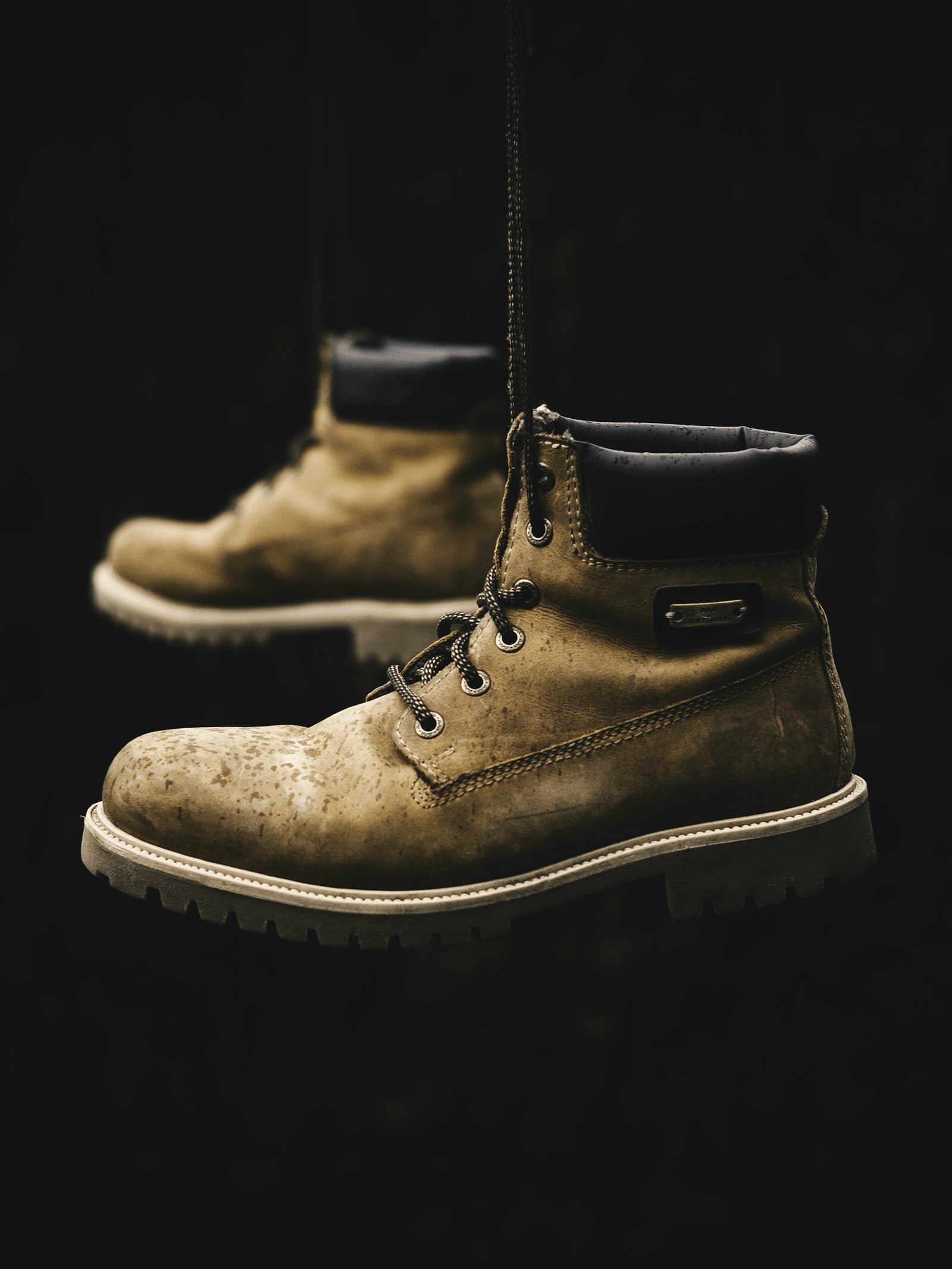
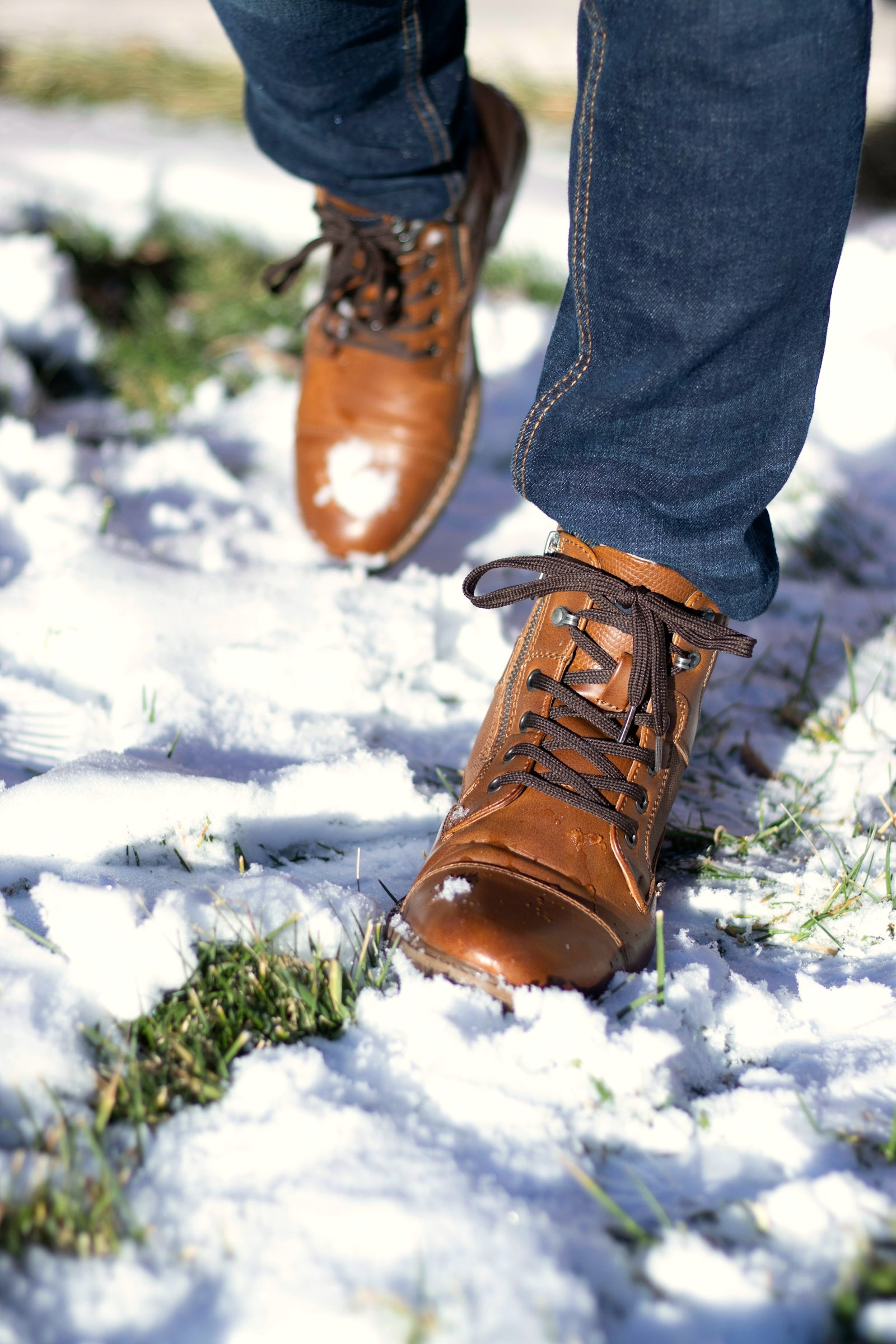
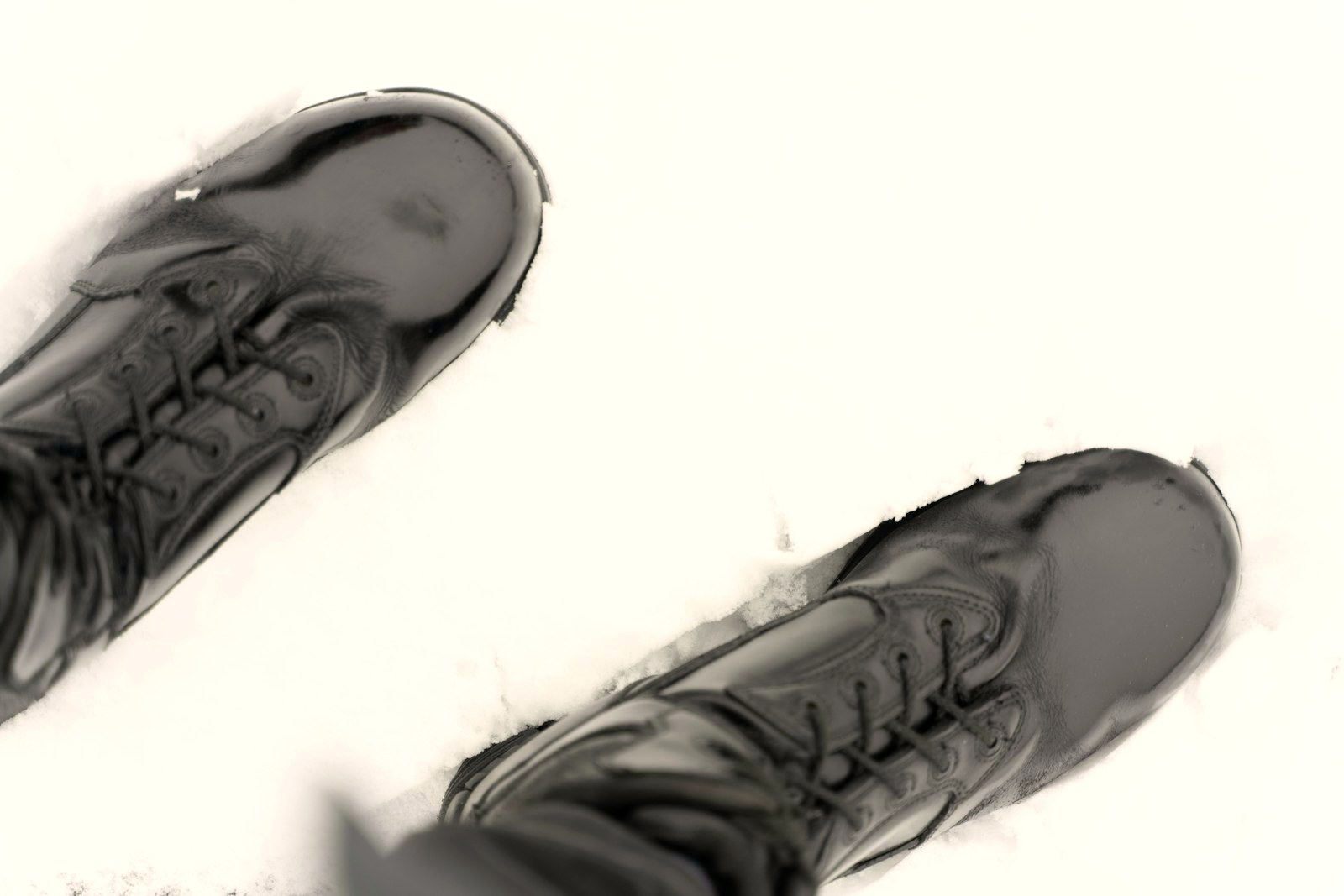
The photography, stated plainly, because this page’s family is wider than our bank. The bank holds honest boot frames and this page uses them: the leather trio against the wall, worn work boots by their laces, a hem at a shaft in snow, black boots in snow from the wearer’s own angle, the worn boot on wet rocks in the Chelsea brief beside this one. What it does not hold is named rather than disguised: no chukka in any form, no dress boot, no hiking boot on a trail, no boot worn under tailoring, and no lug sole in slush at street level. No frame of another shoe has been captioned as any of those, and the frames that stand in are captioned for the register they actually show, the work, the weather, the join. The harvest list this page is waiting for, in order: first, a suede chukka on a body under cords, the family’s softest shape in its home rows; second, a dress boot under a tailored trouser at the first agreement, the join this brief exists to rule, photographed at ankle height; third, a lug sole in slush at street level, the weather register’s missing evidence. Until those frames land, the bank’s boots stand for the family, and the page says so.
Questions, answered
Has Young Cotton ranked boots?
No. This site publishes no footwear ranking and no boot carries a score here; footwear is covered by styling briefs, the loafer brief, the white sneaker brief, the Chelsea brief, the winter loafer brief and this one. The numbers cited on this page are formality rungs from the footwear briefs' ladders, and garment and brand scores published elsewhere, a capsule loafer at 88, the Fall Edit's sneaker at 84, a boot-making brand at 82 in the Scandinavian ranking, cited as what they are. What this page gives the boot family is the wearing system the five shapes share.
How do you wear boots?
By the shaft law: a boot is decided at the hem. Every ankle boot makes the trouser meeting its shaft a visible decision, so the leg either ends at the shaft and shows the whole boot, or slides over a shaft its opening can receive, at no break to a slight break for the tailored shapes and a cuffed straight leg for the working ones. Stacking folds above the shaft are out, pooling is out, and the leg is never tucked into an ankle boot. Inside that law, each of the five shapes, Chelsea, dress boot, chukka, derby or service boot and hiking boot, takes its own trousers, its own colours and its own weather, and this brief rules them one by one.
What trousers go with boots?
The trousers follow the shape. The Chelsea and the dress boot take the slim leg hemmed short, at the shaft or sliding over it, per How to Wear No. 15's agreement. The chukka takes the same slim leg a half-step softer, chinos and cords and straight denim at no break to slight. The derby or service boot takes the straight leg, denim and fatigue trousers and cords, hemmed to a slight break or cuffed once to clear the shaft. The hiking boot takes the straight or relaxed leg, cuffed or resting at the shaft, in work and outdoor cloth only. Wide legs that swallow the shaft are out for the tailored shapes, and bootcut is the one licensed wide opening, because it was cut to clear a boot.
Can you wear boots with a suit?
Two shapes can, in the suit's social rows. The sleek black calf Chelsea does the derby's job under a dark suit and lowers the outfit one notch, per How to Wear No. 15, and the sleek dress boot stands beside it at the same rung, a laced Oxford carried up the ankle. Neither enters the ceremony rows: our suit brief gives the boardroom, the formal evening and the funeral to black Oxford shoes, and no boot changes that. The chukka is a soft-tailoring boot and stops below the suit. The service boot and the hiking boot never go under tailoring at any price.
Should you tuck your trousers into your boots?
No, not into an ankle boot. A Chelsea's shaft is too short to hold a tuck and a lace-up's is not much taller: the cloth blouses above the boot, the ankle reads as bandaged, and the boot's line, the whole reason the leg was cut slim, is deleted at the exact point it should read. Our Chelsea brief rules the tuck out for its boot, and this brief generalises the refusal to the family. The leg goes over the shaft or ends at it. The tuck belongs to tall field boots worn as field equipment, in the field, and no shape in this brief is one of those.
What colour boots should you buy first?
The colour follows the wardrobe's trousers. Black calf if tailoring and dark denim lead the week: it is the boot at maximum formality, the evening colour, and the only colour the office's upper rows accept without discussion. Dark brown calf if denim, chinos and cords lead it: a notch warmer and softer than black, the tailored day boot, at home under navy and grey. Suede in sand, snuff or taupe is the second purchase, the weekend and soft-tailoring family, never the office's formal end. Match the belt to the boot by leather family, not by shade, per our leather belts Verdict Card.
When do boots take over from loafers and sneakers?
At the cold-floor line our winter loafer brief prints: slush and standing meltwater, snow, and the downpour belong to the boot. The loafer's low cut admits water at the ankle and the sneaker is a dry-street shoe outright, so the rainy evening, the cold commute and the wet weekend are the boot's shifts, the winter third of the rotation the loafer and sneaker briefs build. In dry cold the loafer on a rubber sole and the boot divide the week by register rather than by temperature. The boot also takes any day the ground, not the sky, is the problem: salt, melt and ice are read at the pavement, not the forecast.
Can boots be resoled?
A welted pair can, a cemented pair cannot, and the difference decides whether the boot is a decade purchase or a disposable one. A Goodyear welt is stitched, so a cobbler can strip the worn sole and stitch on a new one, repeatedly; glue offers nothing to restitch. Our Chelsea brief prints the rule and its evidence: Myrqvist, 82 in our Scandinavian ranking, builds its boots Goodyear-welted in Portugal so they can be resoled. Ask which construction you are paying for before dress-boot or service-boot money moves, because the answer never appears in the product name.
Next
The family this brief generalises stands in the three shoe briefs: How to Wear No. 15, the Chelsea boot, the shaft law in its original form, the species scale and the office ruling this page seats its first shape on; How to Wear No. 11, the loafer, the one-notch rule in its first form and the summer half of the rotation; and How to Wear No. 12, the white sneaker, the solvent rule and the dry-street standard. The winter allocation is completed by How to Wear No. 54, loafers in winter, the cold-floor line that hands this brief its shifts, and the weather coats that seat the working shapes stand at No. 28 and No. 32, with the garments graded behind them on Verdict Card No. 74 and Verdict Card No. 76. The rows this brief honours live in How to Wear a Suit (No. 04), whose ceremony rows stay with the black Oxford, and How to Wear Denim (No. 05), whose evening row named the black Chelsea before any boot brief existed. The full series lives in the How to Wear index, and how every score behind those pages is built stands on our methodology page.