
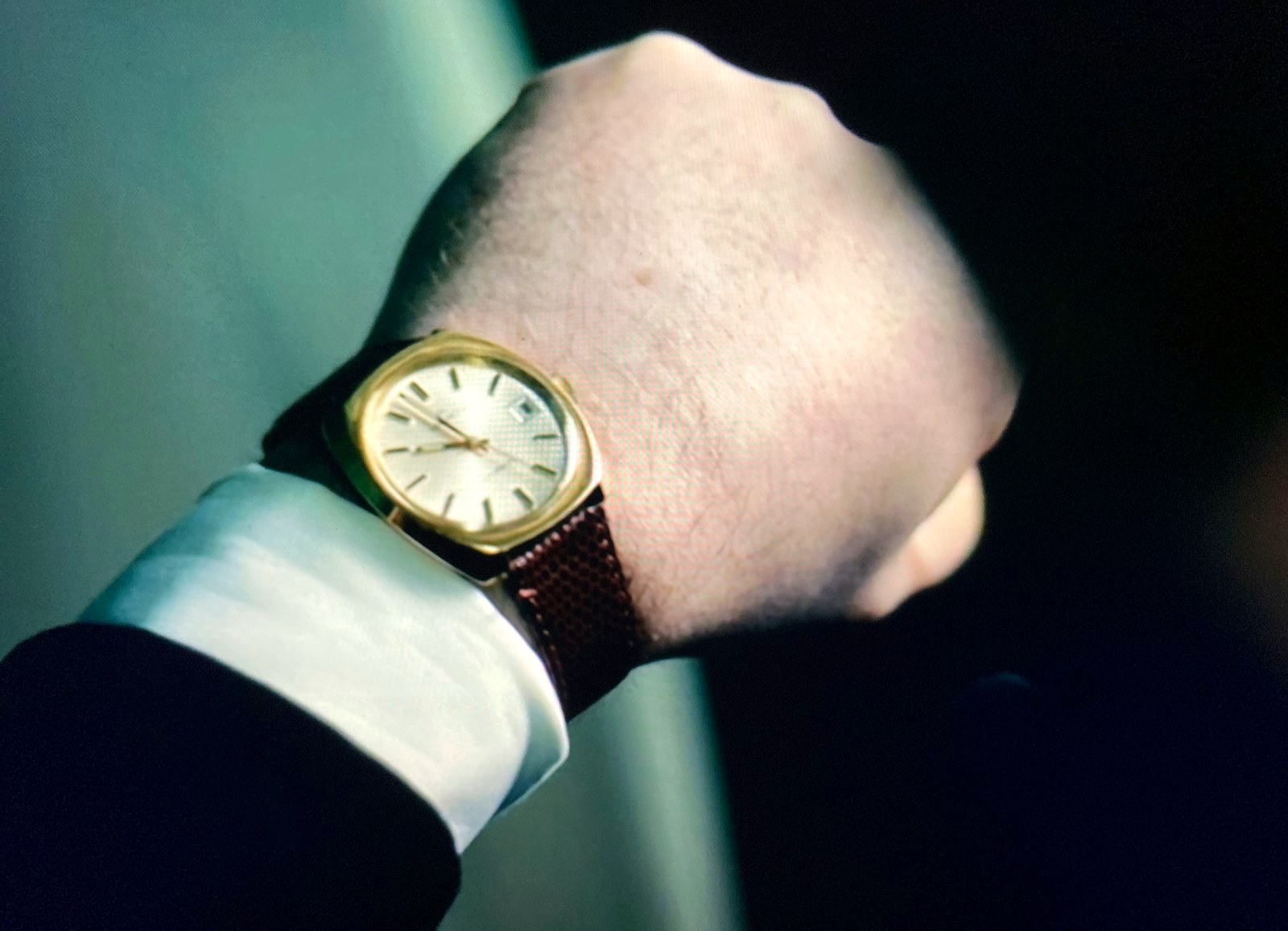
The link's station, photographed without the link: a white shirt cuff at the wrist, the dress watch above it, the small field where a face is read at handshake range. The bank holds no cufflink frame and no French cuff frame in any species, and this frame is captioned as exactly what it shows. The gap and the harvest list are named in the care section below.
Checked and updated October 2026
The ruling, up front: the cufflink is a closure before it is a jewel. It exists because the French cuff, the double cuff, folds back on itself and presents two pairs of holes with no fastening of its own, and the link is the fastening supplied from outside. The shirt is therefore the presupposition: no double cuff, no link, and the barrel cuff's conversion button is an imitation of a fastening by a cuff that already has one. The closures are registers: the toggle the working default, the chain the dressed end, the silk knot the soft end, the snap the firm vintage form. The metals are kept quiet and matched, the family law No. 62 prints; the face is sized small against the wrist, by No. 53's sizing law transposed and marked; and at black tie the link is not an accessory but a component, No. 67's grammar fixing the dress shirt closed by studs and cufflinks. On scores: no Card grades links, and this page invents none.
This brief: the decisive rule · the garment’s record · the pairing law · the rooms and hours · the looks · the ruling · the mistakes · care, the keeping, and our photography
The decisive rule: a closure before a jewel, and the shirt before the link
Begin with the cuff, because the link is unintelligible without it. A shirt cuff closes one of two ways. The barrel cuff, the single cuff of the ordinary shirt, is cut with a button sewn to its cloth: it wraps the wrist once and fastens itself, complete, a garment with its fastening built in. The French cuff, the double cuff, is twice the cloth and none of the fastening: it folds back on itself, doubles at the wrist, and presents, at each side of the fold, two buttonholes in line, four holes to a cuff and no button anywhere. It is an unfinished garment by design, a cuff that arrives open and waits to be closed by something that is not part of the shirt. That something is the cufflink, and the decisive rule follows from the vacancy: the link is a closure before it is a jewel, a fastening supplied from outside to a cuff built without one, and everything about its wearing, its host, its species, its size and its face, is the vacancy's terms. A jewel is chosen. A closure is required, and required in a specification: it must pass four holes, bear against cloth under the small constant tension of a moving wrist, sit flat enough not to fight the jacket's sleeve above it, and come out again at night without a tool. The link that meets the specification disappears into its work, the way every honest fastening in the tailored wardrobe disappears. The link that is chosen as a jewel first meets it by accident.
The rule's first clause is the presupposition, and it is absolute: the shirt comes before the link. No double cuff, no link. This is not a formality preference dressed as mechanics; it is the geometry of the holes. A link through a barrel cuff has nothing to close, the cuff beneath it being already closed by its own button, and the devices sold to simulate the arrangement, the conversion buttons on their shanks and elastic loops, are ruled in the questions below for what they are, a second fastening laid over a working first one, proud of the cloth and weak at the bearing. The practical consequence runs the other way from the way links are usually bought: the link is not the purchase that upgrades a shirt. The shirt is the purchase that licenses the link, and a wardrobe that wants links buys double-cuff shirts, which every dress-shirt maker cuts at no mystery premium, in the same cloths and collars as its barrel-cuff line. The man with one double-cuff shirt and one plain pair of toggle links is fully equipped by this brief's standard. The man with a drawer of links and no double cuff owns jewellery for a garment he does not have.
The rule's remaining clauses govern the closing's manner, and each is argued in its section below. The species is a register: the toggle's hinged bar is the working default, the chain's two faces the dressed end, the silk knot's woven softness the casual end, the snap's pressed discs the firm vintage form, and the species is chosen by the room as the room chooses every register in this family. The metal is a family matter: the links stand at the wrist beside the watch and in the eye's travel from the belt buckle, and the family's law, printed at No. 62, keeps those metals in one family, matched or deliberately quiet. The face is a proportion matter: it is read inside the sliver of cuff that shows past the jacket's sleeve, the smallest display field in the tailored outfit, and its size and its subject are both ruled by that field's dimensions, small, and silent unless the wearer can say what it is doing there. What the discipline buys is the thing the double cuff itself buys, the dressed wrist: a fold of cloth closed with the same deliberateness as everything else in the outfit, the one station where tailoring ends in metal, kept as quiet as the metal at every other station.
The garment’s record: the fold, the four closures, and the cuff’s two forms
The instrument first, in its parts, because each closure species is an engineering answer to the same four holes. The toggle, also sold as the bullet back or whale back, is a face fixed to a short post with a narrow bar hinged at the post's foot: the bar aligns with the post to pass the holes, then turns across them to bear against the cloth's inside. It is the only closure that fastens truly one-handed, which is why it owns the working default. The chain link joins two finished faces with three or four links of fine chain: it passes either face through, hangs the cuff a fraction looser than any rigid closure, and shows an ornament at both sides of the fold, the outer face and the inner, which no other species does at full size. The silk knot is two knots of woven silk cord joined by an elastic core: it stretches to pass and contracts to hold, is nearly weightless, cannot scratch a desk or a watch case, and is the only closure with nothing hard in it. The snap, the dumbbell's sprung cousin, presses two ornamented discs together through the holes on a sprung fitting: the hold is the firmest of the four, the profile the flattest, and the form is a vintage one, its modern supply thin and mostly second-hand, which this brief prints as a fact about buying rather than about wearing.
The record of the garment, printed as the published record tells it. The double cuff is the older form: through the centuries when a shirt was a made garment rather than a sized one, its cuff was finished by a link, a ribbon or a sleeve button passing through worked holes, the detachable fastening being the natural answer to a cuff meant to outlast laundering fashions and to be closed at a wrist the tailor might never see. The sewn button's victory on the single cuff is a factory's victory, the barrel cuff closing itself at no extra part and no extra step, which is why it owns the ordinary shirt entire. The double cuff survived where the shirt remained a dressed garment, in the dress shirt and the evening shirt, and the link survived with it, industrialised in the nineteenth century into the forms above, the toggle's hinge being the period's characteristic solution: a fastening miniaturised until it works like the cuff buttons of a coat, by a man dressing alone, in a mirror, with the other wrist already closed. The link's record on this site is two rulings inside other garments' briefs, and they are this page's foundation rather than its competition. No. 67 fixes the evening grammar entire, the white dress shirt with its turndown collar and double cuffs closed by studs and cufflinks, one element of a uniform whose whole virtue is that the decisions were made before the invitation arrived. No. 62, ruling the tie's removal, counts the cufflinks where the shirt carries them among the outfit's remaining metal and puts them under its law of quiet matching. Between those two stations, the grammar's evening component and the day outfit's managed metal, the link has been governed on this site only as a part of other systems. This brief is the instrument's own ruling.

The pairing law: the shirt it presupposes, the metal family, and the face’s field
The pairing law's first principle is that the link pairs with a shirt species, not with an outfit, and the species is the double cuff entire. Within that host, the pairing runs by register in the ordinary way. The double-cuff shirt under a suit is the link's home ground, the dressed day: toggle links in plain metal, the face small, the metal in the watch's family. The double cuff under a blazer and odd trousers stands one register down and takes the same links without strain, the closure being quieter than the outfit around it at every point. The double cuff in the evening, the dress shirt under the dinner jacket, is No. 67's station and is ruled there. What the pairing refuses is the host's counterfeits and the register's crossings: the conversion button on a barrel cuff, ruled in the questions; the double cuff worn with its sleeves pushed or rolled, the fold undone and the links carrying an open cuff like earrings, a wearing that spends the garment's whole formality on a gesture; and the link at a short sleeve, which has no cuff to close and stands as the novelty refusal's limiting case, jewellery pinned to a hem.
The metal family is the pairing's centre, and the law is borrowed standing. A tailored outfit carries its metal at stations the eye connects in one travel: the belt buckle at the waist, the watch at one wrist, the links at both. No. 62 prints the law for the tieless suit and it holds tied or not: the metals are kept quiet and matched, in one family where the eye can compare them, and nothing is added elsewhere to compensate or to shine. Silver-toned links answer a steel watch; gold answers gold; the dark faces, onyx and dark enamel, stand inside either family as its dressed end. The failure the law names is not vulgarity but arithmetic: two bright metals at compared stations read as two decisions where the outfit made one, and the links, being the smallest metal on the body, are where the mismatch is cheapest to fix and most often left standing. The stud set at black tie is the same law at its strictest: studs and links bought and worn as one set, in one metal and one face material, the white front carrying a single instrument in four places.
The face’s pairing is with the cuff’s sliver, and it closes the section. The tailored sleeve is cut to show a sliver of shirt cuff past its edge, and the link's face lives in that sliver, a field a centimetre and a half tall at its most generous, read at the distance of a handshake or a table's width. The face is sized and chosen for that field by No. 53's law for the wrist's other instrument, transposed once and marked: as the watch's case is sized to the wrist, neither drowning it nor perching on it, so the link's face is sized to the cuff it closes, present to a viewer looking for it and invisible to a viewer looking at the man. Subjects that survive the field are the ones that read at thumbnail scale without explanation: plain metal, a stone, a woven knot, an engraved initial the wearer can account for, a small enamel ground in the outfit's own colours. Subjects that need a caption, a joke, an emblem explained, a miniature of an object, have already failed in the field before taste is consulted, which is the mistakes section's first entry and the questions' standing refusal: the face is a closure's head, and it is decorated as a head is decorated, not as a placard is printed.
The rooms and hours: the dressed day, the evening grammar, and the rooms that never licensed a fold
The link's rooms are the double cuff's rooms, which are the dressed rooms of the day and the whole of the evening. The working day in a suit is the default room: the toggle's room, where the closure is fastened in the morning's two minutes, borne all day under the jacket's sleeve, and read, when it is read at all, at the desk and the handshake, at the range the face's field was sized for. The occasion day, the wedding's rows, the ceremony, the formal photograph, is the chain's room, the dressed end licensed entire, both faces finished and the cuff hanging as it was cut to hang. The evening is No. 67's room and is entered on its grammar's terms or not at all: the dress shirt's double cuffs closed by studs and links, the set in the evening materials, the silk knot and the novelty face both refused at the door, the first as too soft for the uniform's metal register and the second as an argument in a room whose virtue is that nothing argues.
The refusals are the rooms the host never enters. The casual room entire, the shirt worn open over a tee, the knitwear day, the summer's short sleeves, has no double cuff in it and therefore no link, and a link imported into those rooms arrives as pure ornament, the one condition this brief never licenses. The working room of the hands, the workshop, the kitchen, the site and the surgery, refuses the double cuff itself before it refuses the link: the fold is a cuff doubled at exactly the station where sleeves are pushed up, cloth catches, and metal meets machinery, and the family's working garments close at the wrist with a button or not at all, which is a ruling about the host and is printed here so the link is not blamed for it. And the desk's long hour is the link's one friction in its licensed rooms, printed fairly: a rigid face under a wrist that rests on a desk all day is felt by evening, which is the silk knot's honest case in the day register and the low-profile toggle's, and is a comfort fact to be managed by species and profile, not a defect in the closure's idea.
The looks: four assemblies the brief licenses
| Setting | The assembly | The details | The judgment |
|---|---|---|---|
| The working default | Toggle links in plain silver-toned metal, in a double-cuff white or pale blue shirt, under a suit | The face a plain oval or bar at a centimetre and a half, the metal in the watch's family, fastened one-handed at the mirror in the morning | The closure at its job entire: present at the handshake, invisible across the room, the dressed wrist at its standard |
| The dressed end | Chain links in precious metal or dark stone, in a double-cuff shirt, under the day’s best suit or at an occasion | Both faces finished, the cuff hanging a fraction loose as the chain allows, the set kept for the rooms that read both sides of the fold | The oldest form in its own register: the link as a small piece of jewellery that is still, first, a fastening, and read as both |
| The soft end | Silk knots in a colour from the outfit’s own family, in a double-cuff shirt under a blazer, or with the shirt alone in summer | Nothing hard at the wrist, no metal to match, the knot’s colour the assembly’s one quiet accent | The casual register done honestly: the closure softened entire rather than dressed down, and refused only where the grammar fixes metal, at black tie |
| The evening | A stud and link set in onyx or mother of pearl, in the white dress shirt, under the dinner jacket | Studs and links as one instrument in four places, per No. 67’s grammar, the faces dark or pearl on the white front, sized small | The component in the uniform: chosen before the invitation arrived, like everything else the code wears, and arguing with nothing |
The ruling
Buy the shirt first. A double cuff is the link's only host, and a wardrobe with double-cuff shirts and one plain pair of toggle links is equipped entire. Fasten with the toggle on working days, the chain when the room dresses, the silk knot when it softens, and keep the snap for the pleasure of a firm vintage hold. Keep the metals in the watch's family and the face small enough to be found rather than met; let the face's subject be plain metal, a stone, a knot or an initial, and let nothing at either wrist make an argument. At black tie, wear the set the grammar fixes and choose nothing. The link is the smallest machine in the tailored wardrobe, and it is worn well exactly when it is noticed least: a fold of cloth, closed, at the end of the sleeve. The cuff is the garment. The link is its closing, and the closing is not the place for the outfit's opinions.
Where the wearing goes wrong
The novelty face. The station failure, and this brief's standing refusal: a face carrying a joke, a logo or a miniature, at the one field on the body read at handshake range by everyone the wearer meets. It fails on mechanism first, as the questions print: the novelty link is made to its joke's standard, its toggle thin and its post short, so the fastening is the worst-made part of an object whose only job is fastening; and it fails on arithmetic second, the outfit's smallest instrument carrying its loudest statement, an argument the wearer must stand behind at every introduction of the day. The repair costs one plain pair, and it is total.
The conversion button. The host failure: a button on a shank or an elastic loop, worn through a barrel cuff to imitate the double cuff's arrangement. It fails mechanically, a second closure laid over a working first one, bearing on cloth that was cut for a sewn button and sitting proud where the button sits in the cloth; and it fails as the flat brim's sticker fails at No. 78, as signage of a form the garment is not in. The repair is the shirt: double cuffs are cut by every dress-shirt maker at the ordinary price, and the barrel cuff worn as itself has never needed the apology.
The face that outweighs the wrist. The proportion failure, No. 53's law transposed and broken: a face sized like a coin collection's first prize, covering the fold, dragging it out of line by its own weight, and out-shouting the watch that shares its wrist. It is graded as a proportion error before a taste error because it is one: the field is a centimetre and a half of cuff sliver, and the face that cannot be read inside it was bought for a different station than the one it occupies. Small, flat and close to the cloth is the whole of the repair.
The mixed metals. The family failure: gold links under a steel watch, a bright buckle travelling to both, three decisions where the outfit made one. It is the cheapest failure on this page to repair and the one most often left standing, because each piece is defensible alone and the law that convicts them is a law about the set, No. 62's quiet matching, which no single purchase can obey by accident. Buy the second pair in the other metal before buying a third pair in either.
The link with nothing to close. The presupposition failure, in its two forms: links worn at a barrel cuff by conversion, ruled above; and links kept in a cuff whose sleeves are then rolled or pushed, the fold undone, the closure carrying open cloth like a charm. Both spend the same coin, the double cuff's deliberateness, on its opposite. The double cuff is a commitment to the dressed wrist for the whole of the wearing; the man who will push his sleeves by ten should wear the barrel cuff at nine, buttoned, and lose nothing this page grades.
Care, the keeping, and our photography
A small machine is kept as small machines are. The toggle's hinge is the keeping's first object: it is worked dry, never oiled, and a hinge that has loosened until the bar swings free under the cloth's tension is a closure at the end of its service, retired before it retires itself into a cuff at a dinner. The faces are kept from the desk and the wash alike: links come out before the shirt is laundered, without exception, because the wash is a machine for bending posts and chipping enamel, and the pair left in a cuff through one cycle is the commonest casualty in this garment's domestic record. Enamel and stone are wiped, never soaked; silver is polished with the cloth, not the dip, which strips the engraved face's shading with its tarnish; silk knots are kept dry and replaced when the elastic tires, at a price that makes replacement the honest maintenance. Storage is a box with divisions, pairs kept together and faces apart, the chain's two faces being each other's commonest scratch. The stud set is stored with its links entire, one instrument in one place, because the evening's dressing is no hour to discover that the set is three.
The rulings this brief prints beyond the tree's standing record are gathered here once, the way the family gathers its extensions. The family's are cited as theirs: No. 67's black tie grammar, which fixes the dress shirt's double cuffs closed by studs and cufflinks as an element of the uniform, adopted entire; No. 62's metals law, the buckle, the watch and the links kept quiet and matched in one family, adopted entire; No. 53's sizing law for the wrist's instrument, transposed once for the face's size and marked as a transposition; No. 78's signage arithmetic, by which a label worn at a read station is graded as a statement, standing behind the novelty refusal. This brief's own are: the decisive rule itself, the closure before the jewel; the presupposition, no double cuff, no link, with the conversion button refused on mechanism; the species read as registers, toggle, chain, silk knot and snap; the silk knot's refusal at black tie, by the grammar's metal register; the face's field, the cuff's sliver past the jacket sleeve, as the measure of the face's size and subject; and the rolled-sleeve refusal, the fold as a commitment for the whole wearing. Nothing scored stands behind any of them: no Card grades this garment, and the link carries no number of its own because none has been graded.
The photography, stated plainly, because this page's subject is the smallest garment this family has ruled and the bank cannot picture it at all. The bank holds no cufflink in any species, no French cuff folded or fastened, no stud set on a dress shirt: the search of the bank and of CREDITS.md for cuff, wrist and French cuff frames was made before this page was written, and its result is a wrist without the instrument. The hero is the station instead, a dress watch at a white shirt cuff in close view, captioned as the station and not as the subject; the figure in the record is the barrel cuff being adjusted in the street, the host's other form, captioned as what it closes itself with. What the page needs, and has not got, is named in the harvest list, in order: first, a double cuff fastened by a toggle link at macro range, the fold, the four holes and the bar's bearing all readable; second, a chain link's two faces, the cuff hanging at its licensed looseness; third, silk knots laid beside a toggle pair, the soft end and the default in one frame; fourth, a stud and link set on a white Marcella front, No. 67's grammar at the wrist and the chest together. Until that pass runs, the brief about the wardrobe's smallest closure is illustrated by the wrist it closes at, which is, by this page's own ruling, the station the face must never outweigh in any case.
Questions, answered
What is the one rule of cufflinks?
That the link is a closure before it is a jewel. A cufflink exists because the French cuff, the double cuff, folds back on itself and presents two pairs of holes with no fastening of its own: the link is the fastening supplied from outside, a small machine for holding two thicknesses of cloth together at the wrist. Every law in this brief is that origin applied. The host is the double cuff and nothing else; the species, toggle, chain, silk knot and snap, are registers of the closing, from the working default to the dressed end; the metal answers the outfit's other metals, kept quiet and matched; the face is sized small against the wrist and the cuff it closes; and the face's subject is restrained, because a fastening that argues has stopped being a fastening. A link worn against those laws is not a bolder link. It is a jewel looking for a job at the one station of the tailored wardrobe where the object already has one.
Can cufflinks be worn with a barrel cuff?
No, and the refusal is mechanical rather than snobbish. The barrel cuff closes itself: it is cut with a button sewn to the cuff and a buttonhole to receive it, and it presents one pair of holes, not two. A link needs the double cuff's two pairs, one through the fold's outer layer and one through the inner, to pass through and bear against. The conversion button, the small button on a short shank or elastic loop sold to imitate the arrangement on a barrel cuff, is ruled here as an imitation of a fastening by a cuff that already has one: it adds a second, weaker closure on top of a working first one, sits proud of the cloth where a button sits in it, and reads at conversational range as exactly what it is, the costume of a double cuff worn over the fact of a single one. The honest routes are the garment routes: a shirt made with double cuffs, which every dress-shirt maker offers at no mystery premium, or the barrel cuff worn as itself, buttoned, which no ruling in this family has ever graded as a failure. Buy the shirt the link presupposes, or leave the link in its box.
Toggle, chain, silk knot or snap: which closure should I wear?
The toggle for the working default, the chain for the dressed end, the silk knot for the soft end, and the snap as the firm vintage form, because the four closures are four registers of one closing. The toggle, a face on a post with a hinged bar that turns to pass the holes and turns back to bear, is the engineer's answer: it fastens one-handed, holds its tension, shows one face, and is the default wherever a double cuff is worn to work. The chain link joins two faces with a short chain: both ends are finished, the cuff hangs a fraction looser and moves as the wrist moves, and it is the oldest and dressiest form, the evening and occasion register, costlier to make and slower to fasten. The silk knot is two woven knots on an elastic core, the soft end entire: quiet, cheap, unbreakable in any way that matters, the summer and casual register, and refused at black tie, where No. 67's grammar fixes the dress shirt closed by studs and cufflinks in the uniform's metal register. The snap, two ornamented discs pressed together on a sprung fitting, is the vintage form, the firmest hold of the four and the only one that shows two equal faces pressed flat to the cloth. Choose by the room the cuff is entering, and let one species be the wardrobe's default rather than a drawer of experiments.
How large should a cufflink face be?
Small against the wrist and subordinate to the cuff, by the proportion law this family prints for the wrist's other instrument, transposed here and marked as a transposition. No. 53 rules the watch sized to the wrist: the case answers the wrist's width, neither drowning it nor perching on it. The link's face answers the same wrist at a smaller station: it is read at the cuff's edge, in the sliver of shirt that shows past the jacket's sleeve, and its field is that sliver. In practice the classic faces run at the size of a shirt button's larger cousins, a centimetre to a centimetre and a half across, and the check is the mirror's: the face should be found by a viewer looking for it, not met by a viewer looking at the man. A face that covers the cuff's fold, shouts its subject across a room or outweighs the watch on the same wrist has inverted the station's arithmetic, the smallest instrument on the body carrying its largest statement, and it fails the way an oversized watch fails at No. 53, as a proportion error before it is a taste error.
Should cufflinks match the watch and belt buckle?
The metals are kept quiet and matched, which is this family's standing law for the tailored wrist and is cited here rather than reinvented. No. 62, the suit without a tie, rules the open collar's remaining metal entire: the belt buckle, the watch case and the cufflinks where the shirt carries them are kept in one family where the eye can compare them, matched or deliberately quiet, with nothing added to compensate elsewhere. The same law in its ordinary form covers the tied suit: silver-toned links with a steel watch and a silver buckle, gold-toned with gold, and the mixing of bright metals at stations the eye travels between in one glance is the failure the law exists to prevent. Within the matched family, the link's own finish follows the register: plain polished metal and dark stones, onyx and mother of pearl at the still end, at the dressed end; enamel and coloured stones in the day registers where the outfit carries colour elsewhere. At black tie the grammar narrows the choice to the uniform's own, ruled at No. 67: the dress shirt's studs and links in the evening register, dark or pearl faces on the white front, the set read as one instrument.
What cufflinks does black tie require?
Black tie's grammar is cited entire, because it is this site's standing ruling and this brief does not amend it. No. 67 prints the uniform as a fixed grammar of evening dress: among its elements, a white dress shirt with a Marcella or pleated front, a turndown collar and double cuffs, closed by studs and cufflinks. The link at black tie is therefore not an accessory chosen for the evening; it is a component of the uniform, as fixed as the bow tied by hand and the waist covering worn without exception, and the decisions were made before the invitation arrived. What remains to the wearer is the set's register inside the grammar: the studs and the links as one set, their faces in the evening materials, onyx, mother of pearl, dark enamel or plain precious metal, sized small on the white front where they are read at their closest range of the day. The silk knot is refused at this station, its softness belonging to the day registers, and the novelty face is refused at every station and doubly here, where the uniform's whole virtue is that nothing on it argues.
Are novelty cufflinks ever acceptable?
No, and the refusal is argued on mechanism rather than on taste, so that it holds at every register and not only at the formal ones. A cufflink's face is the size of a thumbnail and stands at the wrist, a station read at handshake range and at the table, in the small field of vision a conversation actually inspects. A face that carries a joke, a logo, a tiny football, a miniature of anything, converts the wardrobe's smallest fastening into its smallest billboard: the object has stopped closing a cuff and started making an argument the wearer must then spend the evening standing behind. The mechanism failure compounds the taste failure. Novelty links are made to the standard of the joke rather than of the fastening, their toggles thin, their posts short, their faces heavy enough to drag the cuff's fold out of line, so the one job the object exists for is the job it does worst. The licensed humour in a tailored outfit stands at the stations built for it, the tie's motif at a ruled width, the square's colour, the sock below the trouser's hem. The link's face is not one of those stations. It is a closure, and it is kept one.
Has Young Cotton ranked cufflinks?
No, and the absence is printed rather than papered over, as it is at No. 75 for the waistcoat, No. 77 for braces and No. 78 for the cap. No Verdict Card grades cufflinks, no shirt index on the tree scores the link, and this brief invents no score and names no maker as a pick. What stands behind the rulings here is the garment's own mechanics, the double cuff's two pairs of holes and the four closures that answer them, and the family's standing doctrines where they genuinely bear: No. 67's black tie grammar, which fixes the dress shirt closed by studs and cufflinks as an element of the uniform; No. 62's metals law, which keeps the buckle, the watch and the links in one quiet family; and No. 53's sizing law for the wrist, transposed once for the face and marked as a transposition. When the desk grades the link shelf on its makers' published records, metals, mechanisms, dimensions and terms, this page's rulings will be re-argued from that Card.
Next
The family this brief stands in: No. 67, black tie, whose grammar fixes this page's host at its strictest, the dress shirt's double cuffs closed by studs and cufflinks; No. 62, the suit without a tie, whose metals law this brief adopts entire for the buckle, the watch and the links; No. 53, the watch, the wrist's senior instrument, whose sizing law is transposed once here for the face; No. 78, the baseball cap, the brief before this one, whose signage arithmetic grades this page's novelty refusal; and No. 77, braces, the family's other hidden fastening, whose plain strap the plain face answers. The brief before this one stands at No. 78; the series began with the cardigan and the full run lives in the How to Wear index. How every score behind those pages is built stands on our methodology page.