
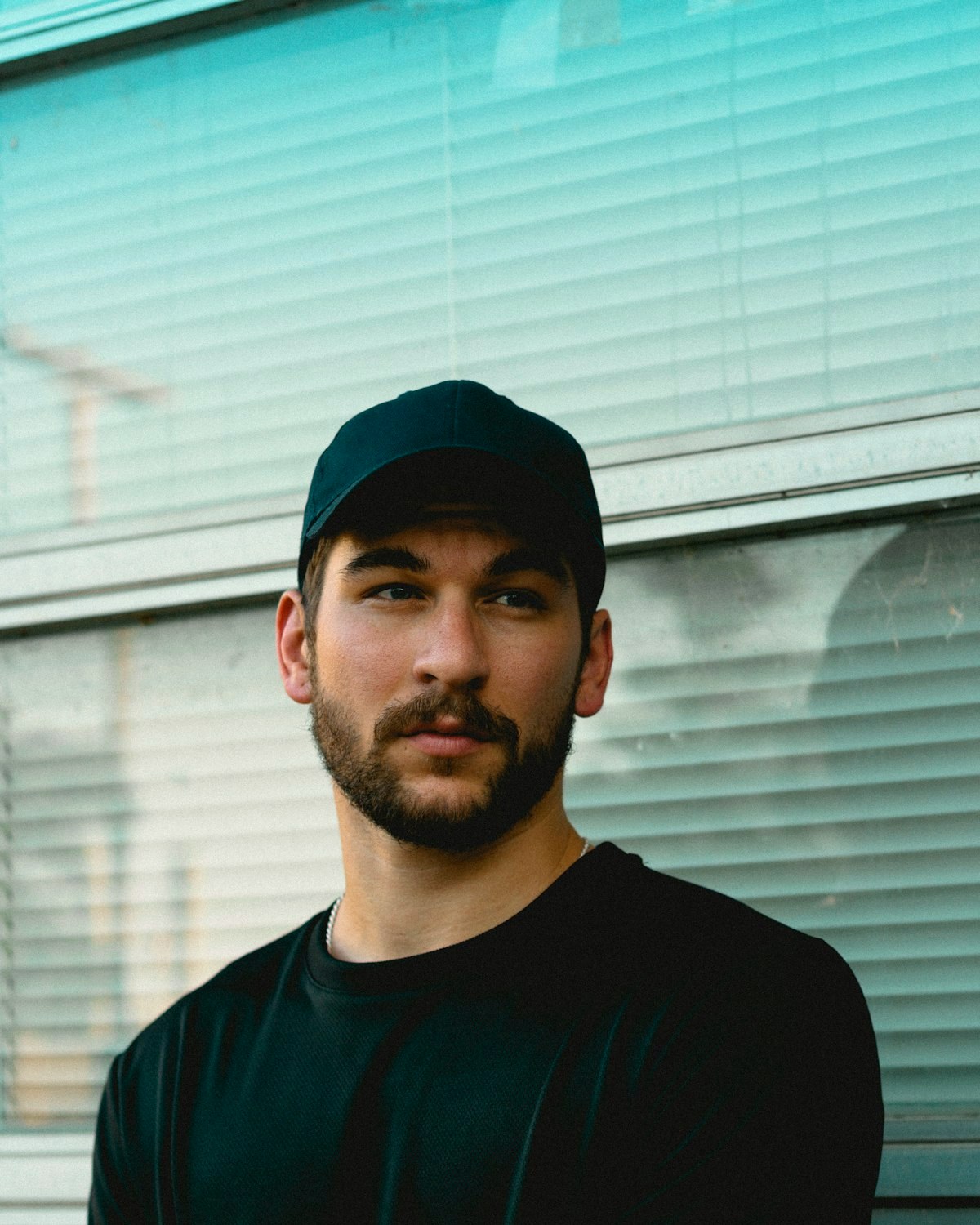
The default assembly in one frame: a plain cap, no logo on the panel, worn forward with the crown sitting low and the brim doing its work over the eyes. The bank, for once, holds the garment itself, and this frame is captioned as exactly what it shows. The cap's other forms, the mesh trucker, the flat brim, the reversed brim, are not in the bank, and the care section prints the gap and the harvest list entire.
Checked and updated October 2026
The ruling, up front: the baseball cap is a shade instrument before it is a style. It was built to put a brim between a man’s eyes and the sun, and its laws are the instrument’s: the register is set by its cloth and construction, the unstructured crown at the soft default, the structured crown in the sport register, wool and flannel at the dressed end, mesh at the working one; the brim is worn forward, because its work is in front of the eyes, and curved, because the curve is the working shape; the front panel is plain, because it stands at the eye level of everyone the wearer talks to and a logo rents it as signage; the size is the head’s own, not the haircut’s; and the cap comes off where its work ends, at the table and at ceremony. The family’s nearest brief is No. 26, the beanie, and the boundary is this page’s foundation: the beanie is warmth, a knit with no brim and no direction; the cap is shade, panels and a brim, and everything ruled below follows from the brim. On scores: no Card grades caps, and this page invents none.
This brief: the decisive rule · the garment’s record · the pairing law · the rooms and hours · the looks · the ruling · the mistakes · care, the instrument’s keeping, and our photography
The decisive rule: a shade instrument, whose register is its cloth and construction
The baseball cap is the wardrobe’s simplest machine: six panels, or five, a crown to cover the skull and a brim to shade the eyes, the whole garment a tool for seeing in bright weather. The decisive rule follows from the machine: the cap is a shade instrument before it is a style, and its register is set by its cloth and its construction, not by its colour, its label or its wearer’s intentions. The construction speaks first. The unstructured crown, no stiffening in the front panels, collapses to the head’s own shape and sits low: it is the soft default, the cap as garment, read at conversational range as equipment a man is using. The structured crown stands on buckram and holds its dome with no head in it: it is the sport register, the team uniform’s cap, built to keep its front panel upright as a display surface, and it carries that posture into every room it enters. The cloth completes the sentence. Cotton twill is the working middle; wool and flannel are the dressed end, the cap in the wardrobe’s own fabrics, quiet enough to stand beside knitwear and tailored trousers; mesh is the working end, the trucker’s ventilated back, honest wherever the heat is the day’s fact and a quotation everywhere it is not. A man choosing a cap is choosing where on that scale his head will be read, and he is choosing it in cloth and cardboard before he chooses it in colour.
The rule’s working clauses are a direction, a panel, a size and a removal, each checkable in the two minutes this family allows a man at a mirror. The direction is forward: the brim’s work is in front of the eyes, and a cap worn forward is an instrument in use, the only wearing in which the garment is entirely itself. The panel is plain: the cap’s front stands at the exact eye level of everyone the wearer talks to, centred above his face, the first surface read in any conversation, and a logo there is not decoration but signage, a billboard worn at eye level, argued entire in the pairings. The size is the head’s own measurement, the band level just above the ears, the crown clearing the skull without standing off it, bought to the head and not to the haircut it happens to be worn over this month. The removal is the rooms law in one clause: the cap comes off where its work ends, at the table and at ceremony, because indoors the shade has nothing to shade and the brim only obstructs. A cap obeying all four is not a lesser statement for being quiet. It is the instrument at its job, which is the only condition in which this family has ever found a garment well worn.
What the instrument buys, at that discipline, is the one thing no other garment in the casual wardrobe sells: unobstructed sight in bright weather, and a covered head that reads as equipment rather than as an opinion. The plain unstructured cap over a tee and an overshirt is the summer day’s working dress entire, the glare gone, the hair irrelevant, the face open. The wool cap beside flannel and knitwear is the cold bright day’s answer at the dressed end, shade and a measure of warmth in the wardrobe’s own cloth. Those purchases are forfeited, entire, by the wearings this brief will not bless: the panel rented to a brand, where the instrument has become a medium; the brim reversed as a default, where it has been switched off; the dome worn into a dressed room, where its display posture argues with everything under it. The cap’s whole dignity is that it works. The rulings below are the working’s terms.
The garment’s record: the fielder’s shade, the giveaway’s mesh, and the crown’s two forms
The garment first, because the cap’s construction is its argument in cloth and buckram. The crown is panels, five or six, sewn to a button, and it divides the species by what stands inside its front: nothing, in the unstructured form, the cloth taking the head’s shape; or buckram, in the structured form, the front held in a manufactured dome. The brim is the instrument’s working part, a stiffened visor sewn to the crown’s front, sold curved or flat and taking the curve it is taught. The closure divides the price and the fit: the fitted cap, sized like a hat and bought to the tape’s number; the adjustable, strap or snap, set to the same number by hand. The back divides the seasons: cloth entire in the standard form, mesh in the trucker’s, the ventilated half that gives that form its name and its register. Every element is functional in origin, and the record below is the account of where each came from, printed as the published record tells it.
The history is a uniform’s tool becoming a century’s default, printed as the record tells it. Brimmed soft caps were working and sporting dress through the nineteenth century, and the baseball diamond gave the form its modern specification: the record the trade repeats credits the Brooklyn Excelsiors, around 1860, with the short-brimmed cap of recognisably the modern shape, cut for the fielder’s problem, which is this garment’s founding problem entire, to see a ball against the sun. Through the game’s first professional century the cap was uniform, its structured crown and its team mark part of the kit, and one maker’s fitted form, the 59FIFTY of 1954 in the record’s usual telling, fixed the structured species’ proportions. The cap’s second career began when the uniform came off the field: the mesh trucker arrived in the 1970s as a giveaway, feed and supply companies printing their names on foam fronts and handing them to the men who worked in the heat, the billboard born as an advertisement before it was ever a fashion, which this brief’s logo law remembers. The fitted cap’s migration into the street registers of the eighties and nineties made the structured dome a uniform of its own, and the unstructured dad cap followed as the soft answer, the crown collapsing back to the head. The garment’s record on this site is, until this page, a silence with one neighbour: the beanie brief at No. 26 rules the knit headwear entire, its fold, its ear line and its indoor law, and states no law for the woven cap, the two garments sharing only the head. The cap has been pictured on this site, in portraits and rankings, and ruled nowhere. This brief is the garment’s own ruling.

The pairing law: the wardrobe it stands over, the panel’s law, and the registers it refuses
The pairing law’s first principle is that the cap pairs down the wardrobe’s formality scale and never up it, and the line is drawn by the instrument’s origin: a working shade tool stands over working and casual dress, and stops where tailoring begins. Over the tee, the overshirt, the chore coat, the denim jacket and the sweatshirt it is native, an element of the assembly rather than a comment on it. Over knitwear it stands at its dressed end and in its dressed cloth only, the wool or flannel cap beside the crew neck and the flannel shirt, cloth answering cloth. Over shorts and the camp collar shirt it is the summer register entire. The refusal is the suit, and it is a systems refusal of the family’s standing kind: a cap over a tailored jacket imports the field’s uniform into the tailoring’s system, the two garments’ registers arguing at the exact station, the head, where the argument is most read. The street quotation, cap over blazer worn as a deliberate quotation in the rooms where quotation is the register, stands licensed the way quotation stands licensed at Nos. 71 and 76, entire and knowing; worn unknowing, as a default over a suit, it is two systems bolted together and graded as such.
The panel’s law is the pairings’ centre, and it is argued plainly. Consider where the cap’s front stands: above the wearer’s face, facing outward, at the eye level of every person he speaks to. It is the most-read surface on the dressed body, read before the face beneath it has finished being read, and anything printed on it is read as the wearer’s first sentence. A team’s mark in the team’s rooms is a sentence the wearer can stand behind, allegiance, plainly owned. A club’s, a college’s, his own business’s mark is the same form, a statement with an author. The fashion brand’s logo is a different object: a sentence authored by a corporation, rented to the wearer at his expense, the wearer paying to stand under another party’s name at his own eye level. This brief refuses it on the instrument’s logic, not on taste: a tool’s front is for its work, and the cap’s work is shade, not carriage. The plain panel is the cap’s tailored form, the way the plain strap is the brace’s at No. 77: the structure unadvertised, the garment read as itself. Where a mark stands, let it be the wearer’s, sized small and worn in its own rooms, and let the dressed registers, wool and flannel, be plain entire.
The brim’s pairing closes the section, and it pairs with the face it shades. The curved brim is the working form and the default: its arc wraps the shade around the eyes’ field and follows the head’s roundness, and it pairs with every register this brief licenses. The flat brim pairs with one register only, the street quotation that owns it, and reads as an import everywhere else, a shop shape worn into the weather. The reversed brim pairs with the states the rooms section licenses and with nothing else. And the brim’s length and the crown’s depth pair with the face by the proportion logic No. 66 prints for frames, borrowed here by analogy and marked as such: there, the lens is sized against the face it covers, neither drowning it nor perching on it; here, the crown is sized against the head it covers, the low crown for the smaller head and shorter face, the deeper crown for the longer face, the brim’s edge falling where the shade is wanted and the face’s frame not doubled by the hat above it.
The rooms and hours: the weather’s rooms, the table’s refusal, and the working interiors
The cap’s rooms are the weather’s rooms, which is the rooms law’s whole shape: the garment is licensed wherever its work is being done and refused where the work has ended. The bright outdoors is its home entire: the street, the field, the water, the road, the garden, the terraces and the stands, every room under the sky the brim was cut for, and in those rooms its register is set only by its cloth and construction, the rooms section of No. 26’s beanie brief applying here in reverse, the cap rising toward its dressed end as the assembly under it dresses, wool beside knitwear, the soft crown beside the overshirt, the dome left to the sport it came from. Transit is its second home: the concourse, the carriage, the deck and the queue, a man still travelling through the weather, where the cap stands as the coat stands, worn between weathers and read as such by everyone travelling with him.
The refusals are the rooms where the work ends. The first is the table: a meal is the family’s oldest dressed room, the company seated face to face at the distance conversation happens, and the cap’s brim stands in that conversation as a wall and its panel as an announcement nobody at the table placed. The cap comes off at a table indoors and out, the terrace’s lunch being a table before it is a terrace. The second is ceremony: the service, the wedding’s rows and the funeral entire, rooms that license no signage and no shade, where headwear’s only licensed forms are the ceremony’s own. The third is the shared sightline: the theatre, the cinema, the lecture’s raked rows, where the brim and crown are built into other people’s view, a refusal priced in the room’s geometry rather than in manners. The fourth is the dressed interior general, the room a man enters to be received, where the cap kept on announces that he has not finished arriving. Each refusal is the instrument’s logic, not etiquette’s decoration: a tool worn past the end of its work is read as the wearer’s inattention to the room he is in, and it is read at the face, where inattention costs most.
The exceptions are working ones, and they are stated as plainly as No. 26 states the beanie’s. The interior where the work continues, the warehouse, the market hall, the workshop, the site and the boat in harbour, is the outdoors continued by other means: the cap there is equipment, its brim working against glare, dust and drip, and it stays on as equipment stays on. The backwards state is this section’s second licence, and it is No. 75’s licensed state transposed, the transposition marked here as it was marked there: as the waistcoat brief licenses the jacket off at a man’s own desk, a posture inside an outfit, so the reversed brim is licensed while the work that reverses it lasts, the catcher’s plate work in the garment’s own record, the mechanic under the car, the photographer at the viewfinder, the player between drills, and the street register worn entire as that register’s uniform. The licence ends with the work. A brim reversed in a room where nothing is being caught, fixed or photographed is an instrument stood down in public with no reason standing beside it, and the room will invent one, which is the reading the wearer least controls.
The looks: four assemblies the brief licenses
| Setting | The assembly | The details | The judgment |
|---|---|---|---|
| The dressed end | A plain wool or flannel cap, curved brim, over a crew neck knit or a flannel overshirt, with tailored trousers | Cloth answering cloth, no mark on the panel, the crown low and unstructured, the cap read as the wardrobe’s own fabric at the head | The cap’s quiet ceiling: shade and a measure of warmth, dressed as far as the instrument dresses, which is honestly and not far |
| The working default | An unstructured cotton cap, plain, over a tee or an overshirt, with denim or chinos | The band level just above the ears, the brim forward and curved, the size the head’s own, the assembly the summer and shoulder seasons’ working dress | The garment at its job entire: the glare gone, the panel silent, the cap noticed by nobody, which is the notice it was built for |
| The summer register | A mesh trucker or a lightweight cloth cap over a camp collar shirt, with shorts | Ventilation as the form’s honesty, the mesh working in the heat it was cut for; the panel plain or the wearer’s own mark, never a rented one | The working end in its own weather: equipment in the open, graded in its register and never imported into the dressed rooms |
| The state | The cap reversed, over workwear or a playing kit, while the work that reverses it lasts | The brim stood down for the plate, the bonnet, the viewfinder or the drill, and turned forward again when the work turns | A posture inside an outfit, licensed by its reason and read as information; the same cap reversed at a table is the mistakes section’s fourth entry |
The ruling
Wear the cap as the instrument it is. Choose it by its construction before its colour: the unstructured crown for the default, the structured dome for the sport register it belongs to, wool and flannel at the dressed end, mesh where the heat is real. Keep the panel plain, or let the mark on it be your own and small; curve the brim and wear it forward; size it to your head’s measurement and let the haircut fend for itself; and take it off at the table, at ceremony, and where other people’s sightlines begin. Ruled so, the cap is what its record promises, the fielder’s shade carried into the ordinary day, a covered head and an open face, equipment that asks nothing of the room. The brim is the garment. Everything else is the brim’s terms.
Where the wearing goes wrong
The rented billboard. The panel failure: a fashion brand’s logo worn as the outfit’s loudest element, at the eye level of everyone the wearer speaks to. It fails on the instrument’s logic before it fails on taste: the wearer has paid to carry another party’s sentence as his own first one, and the cap has stopped being a tool with a front and become a medium with a wearer. The repair is the plain panel, or a mark that is genuinely the wearer’s, and the repair costs nothing but the decision.
The flat brim, sticker on, in a dressed room. The quotation worn unknowing: the shop’s shape, with the shop’s label still on it, carried into rooms whose register is not the street’s. It fails twice, once as an import, a form that belongs to one register standing in another, and once as signage, the retail sticker being the one logo even the logo law’s exceptions cannot defend, another party’s label at the panel. Curve the brim or own the quotation entire, in its own rooms, with the sticker in the bin where shop furniture belongs.
Backwards as the default. The direction failure: the brim reversed in ordinary rooms with no work reversing it, the shade worn over the neck, the instrument switched off and the switch presented as the style. It fails the way the daily bow fails at No. 76, a state hardened into a costume, and it fails mechanically besides: a reversed cap shades nothing, sheds nothing and announces only itself. The states that license it are real and they are printed in the rooms. Outside them, forward is the wearing.
The wrong size. The fit failure, in both its directions: the adjustable perched at its last notch on the crown’s top, riding high and visibly borrowed; and the crown drowned past the ears, the head swimming in a dome bought a size up for a look. Both are usually the haircut’s fault in the precise sense the fit law names: the cap sized to the hair of the month of purchase, slack after the cut or strangling by winter. The tape is the repair, a thirty-second measurement the garment’s fitted form has always asked for, and the band level above the ears is its check in the mirror.
The cap at the table. The rooms failure, and the one the most rooms agree on: the brim kept on through a meal, a service or a ceremony, the shade working at nothing and the panel announcing through occasions that license neither. It is rarely defiance; it is the arrival never completed, the outdoors carried one room too far. Its repair is the oldest in the wardrobe: the cap comes off with the arrival, in the hand or under the chair, and the face the room was built for is the one it gets.
Care, the instrument’s keeping, and our photography
A cloth instrument is kept as its materials ask. The crown’s shape is the keeping’s first object: a cap dried or stored crushed takes the crush as its form, the unstructured crown forgivingly and the structured dome not at all, so the cap is dried on a head, a form or a balled cloth, never flattened under a stack, and packed for travel with its crown filled, the brim never folded, a folded brim keeping its fold the way the bow’s silk keeps a crease at No. 76. The sweatband is the garment’s clock: it takes the wear the face never sees, and its state is the honest record of the cap’s life; it is sponged and aired between wearings, and a cap in rotation rests a day as the family’s rotation law rests every garment that touches skin. Washing answers the cloth: cotton by hand in cool water and dried on the form, wool brushed and sponged rather than soaked, the mesh trucker rinsed and left to the air; the machine’s heat and tumble are the crown’s and the brim’s commonest cause of death, a dome returned as a dish. The fitted cap’s size is re-checked against the tape when the band’s line changes, the head’s measurement being steadier than the hair’s, which is the fit law restated as a chore.
The rulings this brief prints beyond the tree’s standing record are gathered here once, the way the family gathers its extensions. The family’s are cited as theirs: No. 26’s indoor law for headwear and its working-interior exception, the shape this brief’s rooms law follows; No. 66’s proportion logic for what covers a face, borrowed once for the crown’s depth; No. 75’s licensed state, transposed once for the reversed brim; No. 77’s plain strap, whose discipline the plain panel answers; No. 76’s costume arithmetic, by which the daily reversed brim is graded. This brief’s own are: the decisive rule itself, the shade instrument and its register in cloth and construction; the logo law, the panel as signage at eye level and the rented billboard refused; the flat brim seated as a quotation and the retail sticker refused entire; the fit law, sized to the head and not the haircut; the systems refusal of the cap over tailoring, with the knowing quotation licensed; and the table and ceremony refusals stated as the instrument’s logic rather than as etiquette. Nothing scored stands behind any of them: no Card grades this garment, and the cap carries no number of its own because none has been graded.
The photography, stated plainly, because this page’s subject is the rare recent brief the bank can actually picture. The bank holds the garment: the hero is a plain black cap worn forward over a black crewneck, no logo on the panel, the crown low, viewed at full size before placement and captioned as the default assembly it is; the figure in the record is the white cap over a boxy white tee in a garden, the summer register in the open. What the bank does not hold is the garment’s other forms, and they are admitted rather than argued around: no reversed brim in any state, no mesh trucker, no flat brim, no fitted cap in side profile, which is the frame the fit law wants. The harvest list this page is waiting for, in order: first, a cap in side profile at the mirror’s distance, the band’s line above the ear and the brim’s curve both readable; second, a mesh trucker in working light, the ventilated back visible; third, the reversed brim at its licensed work, a photographer at a viewfinder or hands under a bonnet; fourth, a wool flannel cap laid beside a cotton one, the dressed end and the default in one frame. Until that pass runs, the page’s pictures show the garment forward and plain, which is, by this brief’s own ruling, the cap’s first position in any case.
Questions, answered
What is the one rule of the baseball cap?
That it is a shade instrument before it is a style. The cap was built to put a brim between a man's eyes and the sun, and every law in this brief is that origin applied: the register is set by the cloth and the construction, an unstructured crown in cotton at the soft default, a structured crown standing in the sport register, wool and flannel at the dressed end, mesh at the working one; the brim is worn forward, because its work is in front of the eyes; the front panel is plain, because it stands at the eye level of everyone the wearer talks to and a logo rents it as signage; the size is the head's own, not the haircut's; and the cap comes off where its work ends, indoors at a table and at any ceremony. A cap worn against those laws is not a worse cap. It is the instrument switched off and worn as a picture of itself, which is the failure this family grades in garment after garment.
Structured or unstructured crown?
Unstructured for the default, structured for the sport register, and the choice is the cap's register dial. The unstructured crown, the dad cap's form, has no stiffening in its front panels: it collapses to the head's own shape, sits low, and reads soft and private, a garment rather than a statement, which is why it is the only crown this brief licenses across the whole casual wardrobe. The structured crown stands on buckram in its front panels: it holds a manufactured dome whether a head is in it or not, keeps the front panel upright as a display surface, and reads as the team and sport register it was built for, the uniform's cap carried into the street. Neither is better made than the other. They are two registers of one instrument, and the failure is the crossing: the structured dome worn as though it were the quiet default, its billboard posture imported into rooms the soft cap would have passed through unnoticed. Fit the crown's depth to the head while you are choosing, low crowns for smaller heads and shorter faces, deeper crowns for longer faces, by the proportion logic No. 66 prints for frames, cited here by analogy.
Should a baseball cap have a logo?
Plain by default, and the reasoning is the panel's address. The cap is the only garment a man wears whose front faces everyone he speaks to at exactly their eye level, centred above his own face, the first surface read in any conversation. A logo on that panel is therefore not decoration in the ordinary sense: it is signage, a billboard rented at the most-read address on the body. What may stand there is what the wearer can defend as his own statement: his team's mark in the team's rooms, his club's, his own business's, worn as allegiance and read as such. What this brief refuses is the rented billboard, the fashion brand's logo worn as the outfit's loudest element, where the wearer has paid for the privilege of advertising and the panel's message is a corporation's rather than his. The plain cap is not the timid answer to the question. It is the cap read as an instrument rather than a medium, and in the dressed registers, the wool and flannel caps at this page's quiet end, plain is the whole of the law.
Flat brim or curved brim?
Curved for the instrument, flat for the quotation, and the wearer should know which he is wearing. The brim is curved by the work it does: a curve wraps the shade around the eyes' field, sheds weather at its edges, and follows the head's own roundness, which is why every working and sporting cap in the garment's record is curved, the fielder's, the trucker's and the fisherman's alike. The flat brim is a later fashion form, the street register's quotation of the new cap as it leaves the shop, and it is licensed exactly as this family licenses quotation elsewhere, worn entire and knowingly in the rooms where that register is the room's own. It is refused where it pretends to be the working form, and it is refused outright with its shop furniture still on it: the retail sticker left on a flat brim is signage twice over, the shop's label worn as the wearer's, and no register in this brief licenses another party's label at the eye-level panel. Curve a brim by hand over days if it comes flat and the working form is what you want; the cloth takes the curve the head teaches it.
Can you wear a cap backwards?
As a state, yes; as a default, no, and the distinction is this family's own, transposed from No. 75 and marked as a transposition. The waistcoat brief licenses the jacket off at a man's own desk as a state inside an outfit, a posture rather than a costume, and the backwards cap is the same form: the brim's work deliberately suspended for a reason the moment supplies, the catcher behind the plate in the garment's own record, the man working under a bonnet or a shelf, the photographer, the player between drills, anyone for whom the shade has become the obstruction, or the street register worn entire and knowingly as that register's uniform. In those states the reversed brim reads as information: the instrument is stood down because the work changed. As a default in ordinary rooms it reads the opposite way, an instrument switched off for no reason the room can see, the shade worn over the neck it was never cut to shade, and it spends the cap's credibility exactly as the daily bow spends the bow tie's at No. 76: a decision repeated until it is a costume. Turn it round when the work turns. Turn it back when it has not.
How should a baseball cap fit?
To the head, not to the haircut, and the sentence is the whole law. The cap is sized at the head's own measurement: a fitted cap at the size the tape gives, an adjustable set to the notch that matches it, worn neither perched on the crown's top nor drowned past the ears. It is bought over the head it will be worn on for the year, which means the haircut is not a sizing input: a cap fitted over long hair stands slack after the cut, and a cap bought at the barber's shortest stands tight by winter, and both failures are charged to the purchase, not the head. The sitting line is the check: the band level, just above the ears, the crown clearing the skull without standing off it, the brim's edge above the brow so the eyes sit in the shade the brim was cut to make. Crown depth answers the face by the proportion logic No. 66 prints for frames, applied here by analogy and marked as such: the frame of a face is not to be doubled by the hat above it, a low crown on a shorter face and smaller head, a deeper crown where the face is longer, the same arithmetic the sunglasses brief runs between lens and cheek, run here between crown and brow.
When does a cap come off indoors?
At the table and at ceremony, without exception, and the reasoning is the instrument's: indoors the shade has no work, and what remains is a brim, which obstructs, and a panel, which announces, in rooms built for faces. At a meal the cap comes off because the table is the family's oldest dressed room and the brim stands between the wearer and everyone across it. At ceremony, the service, the funeral entire, the wedding's rows, it comes off because those rooms license no signage and no shade. In the rooms of other people's sightlines, the theatre and the cinema, it comes off because the brim is a wall built in a shared view. The exceptions are honest and they are the working ones, the same shape No. 26 prints for the beanie's indoor law: the interior where the work continues, the warehouse, the market, the site, the boat, where the cap is equipment; and the transit interior, the concourse and the carriage, where a man is still travelling through the weather the cap answers. A cap kept on at a table is not a style being brave. It is the instrument worn past the end of its work, and the room reads it before the wearer says a word.
Has Young Cotton ranked baseball caps?
No, and the absence is printed rather than papered over, as it is at No. 75 for the waistcoat and No. 77 for braces. No Verdict Card grades caps, no types-of-caps index stands on the tree, and this brief invents no score and names no maker as a pick. The family's headwear record beside this page is a different garment's: the Beanie Index scores eight knit types for formality and warmth, and the beanie brief, No. 26, styles that index, ruling a knit tube and its fold. The two garments share only the head they sit on: the beanie is warmth, with no brim and no direction; the cap is shade, panels and a brim, and this brief's laws follow from the brim entire. What stands behind the rulings here is the garment's own record, its construction forms and the family's standing doctrines where they genuinely bear: No. 26's indoor law for headwear, No. 66's proportion logic borrowed once for crown depth and marked as an analogy, and No. 75's licensed state transposed once for the backwards wearing and marked as a transposition. When the desk grades the cap shelf on its makers' published records, cloth, construction, sizing and terms, this page's rulings will be re-argued from that Card.
Next
The family this brief stands in: No. 26, the beanie, the headwear brief before this one in the family’s life, whose knit garment shares this page’s head and none of its laws, its indoor ruling the shape this brief’s rooms law follows; No. 66, sunglasses, the face’s other instrument, whose proportion logic this brief borrows once, by analogy, for the crown; No. 75, the waistcoat, whose licensed state is transposed once here for the reversed brim; No. 77, braces, the brief before this one, whose plain strap the plain panel answers; and No. 76, the bow tie, whose costume arithmetic grades the daily reversed brim. The brief before this one stands at No. 77; the series began with the cardigan and the full run lives in the How to Wear index. How every score behind those pages is built stands on our methodology page.