
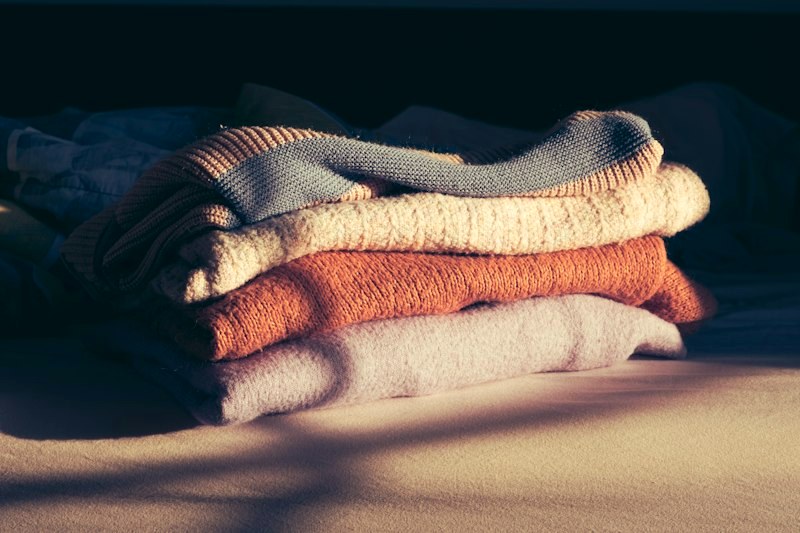
The subject, folded: a bank frame of folded knits in window light, captioned as exactly that. Our bank holds no photograph of a beanie being worn, on any head, in any fold, a gap the Beanie Index prints about its own page as well, so no beanie is pictured worn anywhere on this page and no frame here is captioned as one. The fold rulings below are argued from the Index's published crown depths and the site's knitwear record instead, which is the evidence this brief actually runs on. The care section prints the gap and the harvest list, as the Index prints it too.
Checked and updated October 2026
The ruling, up front: the beanie is the smallest garment in the wardrobe with the largest failure rate, and the failure rate is a location: it is worn at the face, the one place every other garment is judged from. A trouser can be forgiven at a distance. A beanie is read at conversational range, in the same glance as the eyes, and it frames, lengthens, shortens or cheapens the head it sits on before its wearer has said a word. This brief rules the wearing of it, and it begins with an honesty the category usually skips: Young Cotton has not ranked beanies. There is no Verdict Card for this garment, no product below is scored or recommended by name, and nothing here borrows a ranking's authority. What the desk publishes is the Beanie Index, eight types scored for formality and warmth, and this brief styles that index without touching a number: the watch cap its default at formality 2, warmth 4, the fine-gauge merino its formality ceiling at 3, the chunky knit its warmth ceiling at 5, the fisherman its shallow specialist at 2 and 3, and the fibre law printed over all of it, wool, and it is not close. Over that record, four laws of this brief's own. The fold is the fit: the cuff is the garment's adjustable hem, and where it is folded to is the tailoring. The ear line is set by weather, then by coat: covered in real cold, a decision in mild cold, and cleaner as the coat gets more formal. Gauge is the formality dial, the same law the corduroy brief prints for wale: fine is dressed, chunky is a statement, and the dial tops out low, because nothing in this category is formal. And the beanie is outerwear entire: it comes off at the door with the coat, and the hair it flattened is managed by physics and two minutes, not by keeping the hat on. It is late October, the first beanie weeks of the year. The hat comes out of the drawer now, and how it is folded is the whole of how it looks.
This brief: the fold · three garments, one name · fibre at the head · the gauge dial · the coat pairings · the hair problem · the indoor ruling · the looks · the mistakes · care and the cuff
The decisive rule: the fold is the fit
Every other knitted garment is fitted at the factory: the size is bought, the gauge is knitted, the shape is what the maker made. The beanie is fitted at the mirror. A beanie is a tube of ribbed knit with one adjustable part, the cuff, and the cuff is a hem the wearer sets every morning by choosing where to fold it. That choice is the garment's tailoring, and it decides three things at once: how much ear the hat covers, how much crown stands above the band, and how wide the band reads against the face. A beanie cannot be worn neutrally. It can only be folded well or folded carelessly, and the street can tell the difference at the same range it reads a face.
The single fold: the clean line. One fold, the maker's own depth, the band sitting where the garment was measured to sit. On the classic cuffed beanie of the Index, deep cuff, full ear cover, formality 2 and warmth 4, the single fold is the working default: the band is wide enough to soften a square face's outline, which is the Index's printed face work for the type, the crown clears the skull by the margin that keeps the hat a hat rather than a cap, and the ear is covered to the line the weather ordered. The single fold is also the honest fold: it wears the garment at its published depth, and every ruling in this brief is calibrated to it first.
The double fold: the fisherman, manufactured. Fold the cuff a second time and the arithmetic is the same arithmetic the Index prints between its first two types: about an inch of crown is the difference between a watch cap and a fisherman, and the second fold spends roughly that inch. The deep band doubles, the crown shallows, the hemline rises above the ears, and the classic beanie becomes its shallow descendant at the mirror, no purchase required. This is a legitimate manufacture with two conditions. The cold must be the mild cold the fisherman is built for, because the conversion spends ear cover to buy the read. And the intent must be the read itself: the harbour register, the proportion answer the Index gives oblong and long faces, for whom depth is length they do not need. Folded twice as a habit on a beanie bought too deep, it is neither: the doubled band works twice as hard, prints its groove in the forehead twice as fast, and the crown above it never sits at either garment's proportion. The fold is a decision, not a correction.
The unfolded slouch: refused, with one honest use. Worn unfolded and pooled, extra crown slumped behind the head, the slouch is the Index's relaxed type, formality 1, warmth 3, its volume placed behind the cheekbones where diamond faces can use it. As a mild-weather fashion pool this brief refuses it: pooled cloth in October reads as a hat that does not fit, worn by a man who has not decided what it is for, and the pool collapses through the day into a point, which is the one silhouette in the category with no defender anywhere. Its one honest use is real and it is printed as the exception: in genuine cold, pulled down. The slouch's extra length is a reserve, and spent downward it covers the ears, the back of the neck and the gap above a coat collar that shorter crowns leave open, the warmth the type's ladder number understates because the ladder scores it as worn pooled. The slouch is two garments: a fashion pool this brief refuses, and a deep-cold reserve this brief respects. The temperature decides which one is on your head.
The ear line: ruled by temperature, then by coat. The Index's law is the foundation and it is not negotiable: in real cold, the ears are covered. The ears are where the wind takes its fee, and every type on the ladder except the fisherman and the skull cap is built to cover them. Above-ear in January is not a style, it is the Index's named error, a mild-weather garment worn as an insult to the month. In the mild weeks the line is the wearer's: the watch cap rolled above the ears is its naval original's own mild setting, worn on watch, and the fisherman's whole existence is the above-ear line as a decision. Over the temperature law sits the coat law, and it runs one way: the more formal the coat, the cleaner and higher the fold sits. Under an overcoat the band narrows and the crown quiets, because bulk at the head argues with tailoring's line at the collar. Over a pea coat or a chore coat the full working cover is the register itself, and a beanie worn high and neat above a work coat reads as a man afraid of his own hat. Temperature sets the line. The coat sets the neatness. The fold obeys both.
| The fold | The build | The ear line | Its register |
|---|---|---|---|
| The single fold | The cuff at the maker's depth, band as measured | Full cover, the working line | The default: the classic cuffed and the watch cap, at their published depths |
| The double fold | The cuff folded twice, about an inch of crown spent | Above the ears, by manufacture | The fisherman conversion: mild cold, deliberate, the long face's proportion |
| Unfolded, pooled | No fold, crown slumped behind the head | Settled wherever the pool leaves it | Refused as a fashion read at any mild temperature |
| Unfolded, pulled down | No fold, the reserve length spent downward | Ears, neck and collar gap covered | The slouch's honest use: genuine cold, the reserve deployed |
Three garments sharing a name
Beanie is a category word doing the work of a wardrobe, and most of its failures are type failures: the right hat in the wrong register, judged as though all three of these were one garment. They are not. The Index separates them by crown, cuff and ladder number, and this brief separates them by the rooms and coats they belong to. The numbers below are the Index's, reproduced: this brief styles types, it does not re-score them.
The watch cap: the default, and the coat garment. Shallow, cuffed, ribbed, the naval original, formality 2 and warmth 4, the Index's safe default for most faces and the first beanie to buy. Its register is the working winter entire: it is the pea coat's own garment, argued in the coat section, the overcoat's acceptable wool option, and the one beanie whose cuff movement is a published feature rather than a fit problem, down over the ears in cold, rolled above them on watch. Worn at the single fold it is the category's citizen, and the reader who owns one beanie owns this one, in navy or charcoal, on the Index's printed set.
The fisherman: the shallow decision. Very shallow, ending above the ears entirely, formality 2 and warmth 3, the watch cap's descendant cut by about an inch of crown and a century of docks. Its job in the system is double and both halves are conditions. As proportion, it is the correct beanie for oblong and long faces, the Index's printed match, because every deeper type adds apparent length to a face already long. As register, it is a harbour and workwear read, deliberate in the mild weeks and a decision the wearer is visibly making. Its limit is printed on its ladder number and this brief will not soften it: warmth 3 is a mild-weather promise. The fisherman in hard cold is not a style being brave; it is the wrong garment, and the fold section's conversion runs the other way in January, the fisherman folded down being a hat that does not exist. Buy it for the weeks and the face it serves.
The slouch: the relaxed end, on the fold's terms. Long crown, loose knit, formality 1 and warmth 3, the volume behind the cheekbones that diamond faces use. The slouch is the only one of the three whose styling is governed entirely by the previous section: pooled, it is refused; pulled down in real cold, it is respected. Between those two states it has no third register, which is why it is the hardest beanie to wear well and the easiest to wear as an accident. It belongs to no coat in the tailored half of the wardrobe at all, and to the working coats only in the weather that deploys its reserve.
| The garment | Crown and cuff | Formality | Warmth | Its coat, its weeks |
|---|---|---|---|---|
| Watch cap | Shallow, cuffed, ribbed | 2 | 4 | The pea coat's garment; the whole working winter |
| Fisherman | Very shallow, ends above the ears | 2 | 3 | Work coats and open coats; the mild weeks, on long faces |
| Slouch | Long crown, loose knit | 1 | 3 | No tailored coat; deep cold only, pulled down |
The ladders are the Beanie Index's, printed there with all eight types, the fine-gauge merino's formality 3 and the chunky knit's warmth 5 included. This brief argues over three of the eight because they are the three that share the cuffed silhouette and get confused for one another; the merino and the chunky knit enter below, where the gauge dial puts them.
Fibre behaviour at the head
A beanie is worn against skin, hair and weather for hours a day, handled more than any garment in the wardrobe, and stored in pockets and bags between wearings. Fibre behaviour is therefore not a specification on this garment; it is the garment's whole service life, and the Index prints its law before its ladders for a reason: buy the fibre first and the type second.
Wool: the ruling, graded honestly. The Index's verdict is that wool wins and it is not close, on three published properties: it insulates dry or damp, it resists odour across days of wear, and it holds its rib and recovery for years. At the head each property is worth more than it is at the torso. Damp insulation is the commute in rain. Odour resistance is a garment worn against the scalp daily, where a fibre that holds smell is a garment on a washing schedule no hat survives gracefully. And rib recovery is the fold itself: the cuff is reset a dozen times a day, pulled over ears and rolled off them, and a fibre that forgets its shape turns the tailoring of the fold section into a daily negotiation with a bagging band. Wool's tax is printed with its virtues: the itch is real, and it is graded by fibre fineness rather than wished away. A coarse wool against a bare forehead is an honest discomfort some skin will not sign for, and the answer is the finer end of the same family, the merino below, not a surrender to synthetics.
Cashmere: softness against fragility, at the worst address. The softness is not in dispute. What the head does to cashmere is, and the evidence is the desk's own: Verdict Card No. 42 prints the fibre's physics, a staple from about 28 millimetres at the short end to 36 and beyond at the long, with short fibres working free under friction and balling into pills. Now place that fibre in the wardrobe's friction maximum: pulled on and off over hair a dozen times a day, crushed into a coat pocket at every door, dragged across a forehead at every removal. A cashmere sweater meets friction at its elbows and fold lines. A cashmere beanie meets it everywhere, every day, and hat makers publish no staple length to grade the risk against, a silence the cashmere ranking prices as information. Add the Index's price band, honest wool at typically $25 to $60, with cashmere starting where the band ends, and the ruling writes itself: cashmere at the head is a luxury taxed twice. The softness worth buying at this address is the fine merino, which is where the next fibre and the gauge section meet.
Acrylic: convicted on the Index's evidence. This brief does not need to build the case, because the desk has already published it. A fully acrylic beanie at $12 is, in the Index's printed words, a hat-shaped object: it will pill, stretch and stop warming within the season. The mechanisms are worth printing because they are all visible at the head. The pilling arrives first at the fold line and the band, where the handling is, a fuzz the wearer reads in every mirror. The stretch is the recovery wool has and acrylic borrows for a month: the cuff that held its line in October slides by December, and a beanie whose band has gone is a beanie worn pushed back, which is the silhouette of a garment giving up. The shine is the tell across a room: acrylic's surface takes light with a synthetic gloss that matte wool never has, and at the face, in the glance that reads the eyes, a shiny hat reads cheap before its fibre is ever known. And the static is the winter behaviour nobody prints on the label: a dry synthetic fibre, dragged over dry hair in dry heated air, lifts the hair into a halo at every removal, the hat hair problem of the later section with an electrical accomplice. Against all four counts the Index allows exactly one acquittal, and this brief repeats it as printed: a minority of acrylic or nylon inside a wool blend, for structure, is acceptable engineering. The fully acrylic hat is not a cheaper beanie. It is a season's rental of a hat-shaped object, at a price the Index has already done the arithmetic on.
Rib gauge: the formality dial
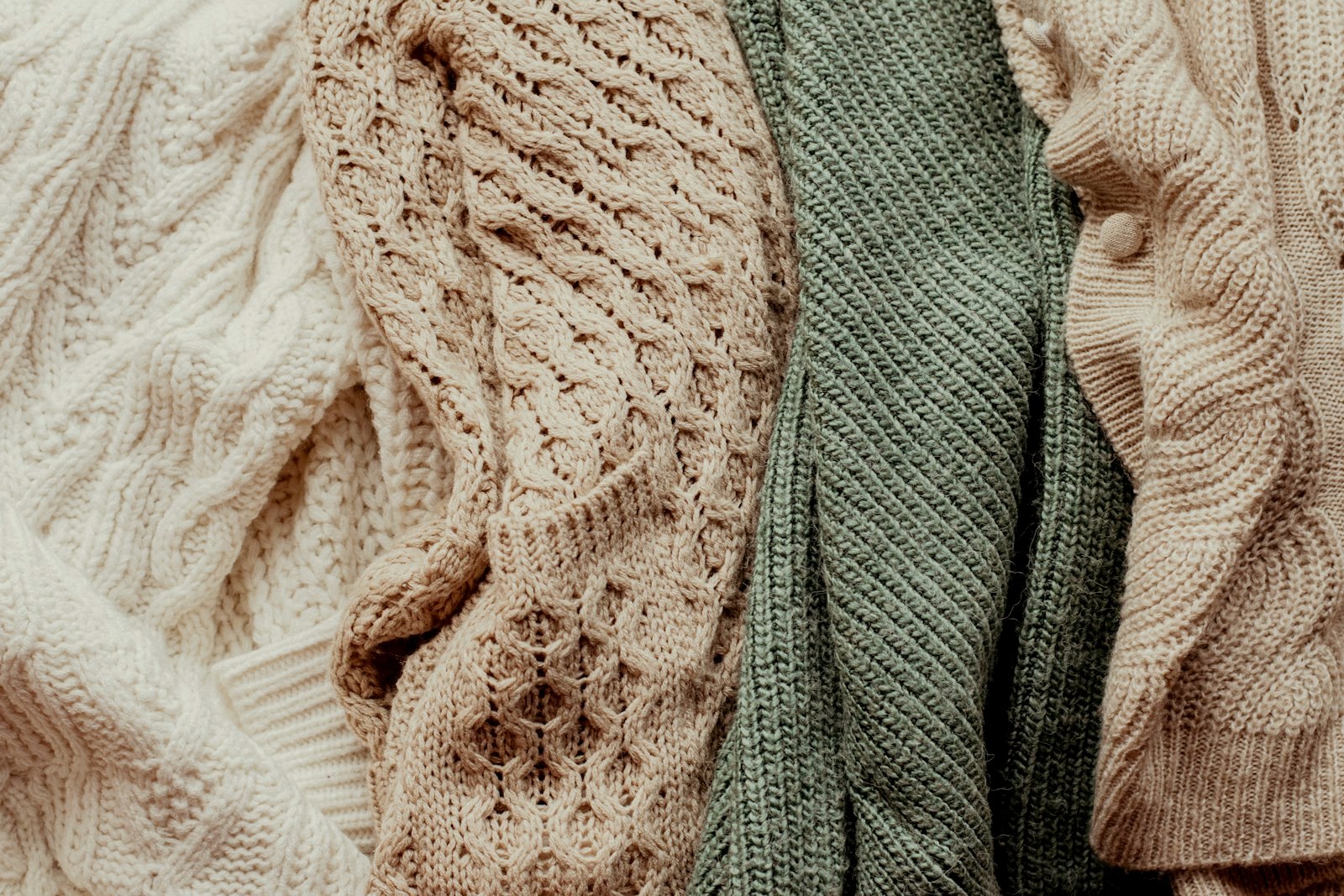
Corduroy prints its gauge on its face as wale, and How to Wear No. 24 rules that cloth by the number: needle dresses up, standard bridges, wide is a statement that dates. The beanie's rib is the same instrument in knit. Gauge decides how the hat's surface reads at the face, how much air the cloth traps, and which coats it may sit over, and the dial's bands are the knitwear record's own, the ones How to Wear No. 09 prints from the crew ranking: fine roughly 24 to 30, mid 12 to 20, heavy 7 and below. Read the hat by its band before its colour.
Fine gauge: the dressed end, with a low ceiling. At 24 to 30 the rib all but disappears at conversational range and the beanie becomes a smooth close cap: the fine-gauge merino, the Index's formality ceiling at 3 and the commuter's version, thin cuff or none, native to oval faces that need nothing corrected. Fine gauge is also the only gauge admitted to the blazer answer in the coat section, on the same evidence the knitwear briefs use below the neck: Verdict Card No. 33's winner is a 100 percent extra-fine merino knit at 24 gauge, and the fine band is the one that slides under and over tailoring without bunching or arguing. But the ceiling is printed on the ladder and this brief keeps it in view: 3 of 5 is the best-dressed beanie ever made. Fine gauge buys neatness, not formality, and a reader who needs formality needs a different answer entirely, which the pairing section gives him.
Mid rib: the working middle. The 12 to 20 band is where the watch cap and the classic cuffed live, a rib you can read across a platform, thick enough to trap the air the Index names as the insulation, fine enough to sit under a coat collar without a fight. This is the winter's default surface: warm by construction, honest in register, and the gauge of the two beanies the Index tells a man to own. Nothing in the mid band dates, because nothing in it is a statement; it is the standard wale of the category, the all-rounder setting.
Chunky: the warmth ceiling and the statement. At heavy gauge the knit is all loft: the chunky knit tops the Index's warmth ladder at 5, formality 1, bulk that balances a heavy jaw on triangle faces and reads as weather equipment at any distance. And like wide wale, it dates. The chunky beanie is the silhouette of particular winters, bought deliberately as the outfit's one loud texture, worn with the working coats, and retired on the fashion's schedule rather than the cloth's, because a good chunky wool will outlast the seasons that justified it. It is never the first beanie a wardrobe buys, and it never sits over tailoring: at formality 1 it is not arguing with the blazer, it is ignoring it, and the room can tell.
| The setting | The gauge | The Index's garment | Its register |
|---|---|---|---|
| Fine | Roughly 24 to 30 | Fine-gauge merino, formality 3, warmth 3 | The dressed end: the commuter, the blazer's one admitted hat, in transit only |
| Mid rib | Roughly 12 to 20 | Watch cap and classic cuffed, formality 2, warmth 4 | The working default: the whole winter, under any working coat |
| Chunky | Heavy, 7 and below | Chunky knit, formality 1, warmth 5 | The statement and the deep-cold tool: bought on the silhouette's schedule |
The coat pairings: the hat is finished by what it sits over
No beanie is worn alone either. It is worn at the top of a coat, and the pairing is a negotiation between the hat's register and the coat's, with the ear line and the fold set by the previous sections' laws. The pairings are ruled coat by coat, and they end with the colour order, because the finest fold in the brief fails in the wrong colour against the wrong collar.
The pea coat, No. 19: the watch cap's home. Begin where the garment began. The pea coat of How to Wear No. 19 is a naval coat, hip length, closed front, a collar built to work up, and the watch cap is a naval hat: the pairing is not a combination but a reunion, two pieces of the same service winter. The ruling inside it is the fold law at full working specification: cuff down over the ears in weather, the coat's collar standing over the whole arrangement when the wind earns it, rolled above the ears in the mild settings exactly as the type was worn on watch. Nothing needs deciding here, which is the point: when coat and hat share an origin, the register questions answer themselves, and this is the assembly the Index's default was described wearing.
The overcoat, No. 20: wool, neat, and quiet. The long tailored coat of How to Wear No. 20 sets the beanie's strictest conditions short of the blazer. The hat over an overcoat is the watch cap at its neatest or the fine-gauge merino at its plainest: single fold, band narrowed, crown quiet, the ear line run by temperature and nothing else. What the overcoat refuses is the category's casual half: no chunky statement over tailoring's longest line, no slouch in any state, no fisherman in the months the coat is out, because a coat that formalises everything beneath it exposes a casual hat as the outfit's one unconsidered inch, at the height of the face, where the exposure costs most. In the cold that justifies the overcoat the watch cap is not a compromise; it is the correct wool answer to the same weather, worn at its tidiest fold.
The blazer, No. 03: the question, answered. It is the pairing readers actually ask about, so it gets a verdict instead of a shrug: yes, in transit, in fine gauge, and it comes off at the door. The fine-gauge merino, formality 3, thin cuff or none, over a blazer and a collared shirt, on the street between the coat check and the train, is a finished transit silhouette, the commuter's version doing the job its name describes. Every widening of that licence is refused by name. Not the cuffed wool beanie, whose band and bulk belong to the coat class the blazer is not in. Not the fisherman, whose harbour register borrows against tailoring it cannot repay. And never in the room: the beanie is outerwear, the blazer is the indoor layer, and a hat kept on over it is an arrival that never finished, the exact failure How to Wear No. 25 rules for the knotted scarf over tailoring. The reader who wants a dressed head in winter has an honest answer and it is not a softer beanie: it is the haircut, the scarf's drape at the neck, and the hat carried in the hand it came off with.
The working coats: the fisherman's and the chunky's ground. Over the chore coat class, the denim jacket of No. 16's short register, the overshirt worn as a coat in the first cold weeks, the beanie drops to its loosest laws: the fisherman above the ears while the weather is still a rumour, the watch cap at working cover when it stops being one, the chunky knit when the coat is the only other layer against real cold. This is the register where the category's colour and texture are allowed their volume, because nothing at the neck is pretending to be tailored and the hat is free to be equipment. The one law that survives the drop is the ear line: casual is a register, not an exemption, and January's rule is January's at every coat in the wardrobe.
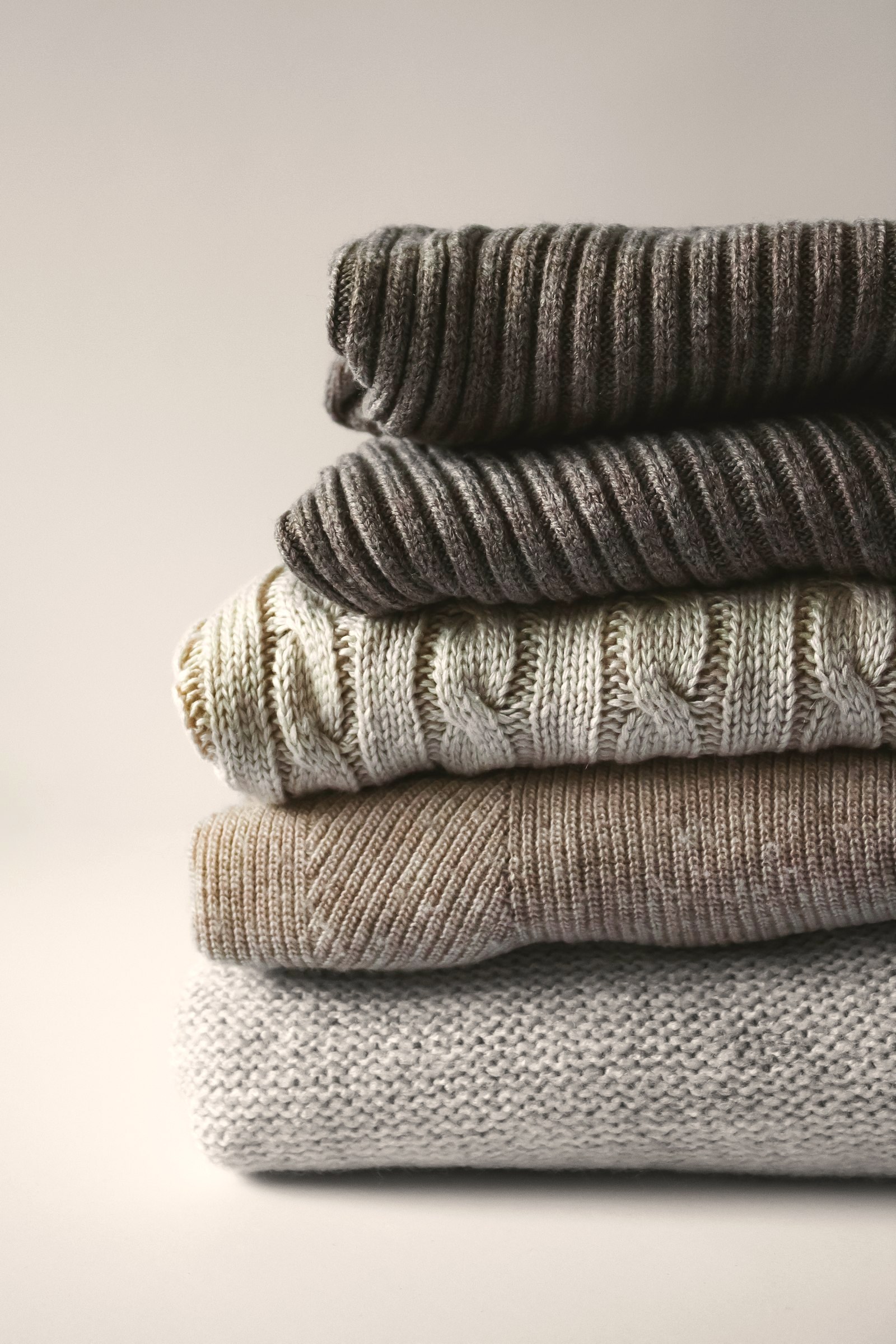
The colour order, printed coat by coat. The beanie is bought to the coat, because the coat is what it is seen against, and the Index's set starts the drawer correctly: a watch cap in navy or charcoal. Against a navy coat: charcoal first, the contrast that reads across a street without warming the picture; mid grey second; camel and tan after, the warm answer; never navy on navy, where the hat disappears into the collar and only its lint shows. Against charcoal: navy comes forward, then burgundy, then cream, the scarf law's logic at hat height, the darkest coat needing the hat to supply the temperature. Against black: charcoal or mid grey, and never black on black, which vanishes and glares by turns and shows every collected fibre. Against camel and tan: navy first, the deepest contrast the drawer owns, then charcoal, then deep green. And over every coat, the pattern law in its hat form: the beanie is plain, full stop. A patterned hat over a winter coat spends the outfit's one allowed loud texture at its smallest and most-read address; the marls and the flecks inside a plain colour are the category's decoration enough, and colour with intent belongs, as the Index's set has it, to the second beanie, bought to a face and a coat already owned.
The hair problem, answered plainly
Hat hair is the beanie's standing tax and the reason half the category's wearers keep the hat on indoors, which the next section refuses. So the tax gets its own accounting here: what it actually is, what genuinely reduces it, what is sold as reducing it, and the days the honest answer is not to pay it at all.
The physics. Hair holds the shape it dries and cools in. Under a beanie the hair is held warm, carrying the scalp's moisture, and pressed in the hat's two directions at once: flat against the crown by the cap, and bent at the band line by the cuff. Hours later the hat comes off and the set remains, a groove across the forehead where the band sat and a crown ironed in the direction the knit chose. Nothing about this is a product defect; it is the garment working as a mould, and a tighter, warmer, longer wear casts a deeper mould. Every management rule below is that sentence applied: less time in the mould, a shallower mould, or a reset after it.
The management, in the order of the day. Dry hair only: a beanie over damp hair sets the deepest line the day can produce, the mould at maximum strength; the hat goes on finished hair or it does not go on. On last, off first: the beanie is the final layer at the door and the first removed at arrival, so the mould's hours are the commute's hours and no more. The band at the hairline: a cuff worn low across the forehead prints its groove on skin as well as hair, a red line that outlasts the hat by an hour; the band belongs at the hairline and the ears, the two addresses it was built for. Direction: hair pushed back under the hat flattens back and recovers forward badly; hair left in its natural fall flattens and recovers to the same fall, the smaller argument. The recovery: water on the fingertips, worked into the roots along the band line and through the crown, the hair lifted against the direction it was pressed, then left alone for two minutes while the moisture releases the set and the hair re-dries in its own shape. Heat from a dryer does it faster where a dryer exists. What does not belong in the routine is product layered over the set, which glues the mould's shape in place and calls it styled.
The silk and lining question, ruled honestly. A lined beanie, silk or satin inside the band or through the crown, is offered as the hat-hair cure, and this brief prints what it actually does. Lining cuts friction: hair slides against silk instead of catching on knit, so the surface chaos, the frizz and the flyaway halo at the band line, is genuinely reduced, and for hair worn long or textured that reduction is worth money. Lining does nothing for pressure: the mould is cast by warmth, moisture and weight, and a lined hat presses exactly as an unlined one does, so the groove and the flattened crown survive the upgrade intact. Buy the lining as a friction answer if friction is your failure. The reader whose failure is the groove should spend the same money on the Index's second beanie and rotate, because the cure for the mould is time out of it.
When to refuse the beanie. Some days the hair is the outfit: the photographed day, the formal day, the day the evening matters more than the commute. On those days the desk's ruling is to refuse the hat and take the warmth at the neck instead, the scarf's drape and knot system of How to Wear No. 25, with the overcoat's collar up over it in real cold. The scarf seals the throat, the coat carries the register, and the head pays nothing. It is the same trade the scarf brief prints in reverse, its drape ruling sending mild cold to the neck and hard cold to a knot; here the beanie is the hard-cold instrument and the drape is the hair's exemption, and a wardrobe that owns both garments owns the choice. Refusing the beanie is not a failure of the category. It is the category knowing its price, which is more than most of its wearers ask of it.
The indoor ruling
It comes off at the door, with the coat, in the same motion. The ruling is short because the garment leaves nothing to argue with. A scarf has an indoor survivor, the ascot tuck, a form that stops being outerwear and becomes dress. A beanie has no such form: every type on the Index's ladder is weather equipment, and a hat kept on in a heated room is a coat kept on, read at hat size, at face height, in the first glance. The office is not an exception and neither is the restaurant, the house, or the meeting that runs long. Off at the door; the recovery routine in the hair section is the two-minute price, printed and budgeted there, and paying it is the whole cost of wearing the category correctly.
The exceptions are working ones, and they are the garment's own history. The watch cap was born in interiors that were not heated: the ship's deck and the dockside warehouse, the workshop, the market, the boat in harbour. Where the indoor temperature is the outdoors continued and the work is physical, the beanie is equipment and stays on as equipment, with the same standing as the coat it matches. The ruling is about heated rooms and social ones, and it draws the line where the garment's origin draws it: warmth as a tool, yes; warmth as a furnishing, no.
The named refusal: the fisherman, indoors, as a style. The shallow hat kept on in a warm room, above the ears by design and above suspicion by habit, is the ruling's standing exhibit. It warms nothing, it covers nothing, and it announces that the wearer is keeping a harbour garment on as a personality, the one register the Index's ladder cannot support: formality 2 is a working score, and a working hat worn as jewellery in a heated room fools exactly the people it was not aimed at. The fisherman's dignity is that it is a real garment for real weeks. Indoors in October it is a hat looking for weather, and the weather is not coming to it.
The looks: the index, worn
Four assemblies, each built from the Beanie Index's published types and this brief's rulings. No garment below is a product: the desk has ranked no beanie, so the looks are built from types, fibres and folds, the way the Index says a man should buy. The frames are the bank's honest knit frames, captioned for what they show; the bank holds no worn beanie at any fold, and the care section prints that gap rather than let a folded stack stand in for a head.
Look one: the naval standard. The watch cap in navy or charcoal, single fold, cuff down over the ears, over the pea coat with its collar standing in weather. The Index's default in its home assembly: wool rib against the double-breasted front, both garments at working register, the ear line at the temperature's order and the fold at the maker's depth. This is the winter's commute for most drawers, and its correctness is the correctness of matching origins: nothing in it is styled, because everything in it is worn as issued. When the weather drops its other shoe the same assembly takes the rolled cuff back down without a mirror, which is the type's published party trick and the reason it outranks every convertible rival in the drawer.
Look two: the tailored transit. The fine-gauge merino, close, thin cuff or none, in charcoal or black, over the overcoat in the morning's real cold: worn from the door to the destination and off with the coat on arrival, the two-minute recovery run in the hair section's order. The hat in this look is deliberately the least visible garment in the outfit, smooth at the crown, quiet at the band, chosen at the gauge the knitwear record admits to tailoring's company. On the days the head cannot pay even this look's small tax, it converts to the hair section's refusal: the merino stays in the drawer, the scarf of No. 25 takes the neck, and the overcoat's collar does the rest.
Look three: the mild-week fisherman. The fisherman in a ribbed wool, above the ears on purpose, over an open chore coat or an overshirt in the first cold weeks, the assembly the type was cut for. Its proportion work is the Index's: on a long face the shallow crown is the one beanie that adds nothing the face did not order, and its register is the harbour read worn knowingly, in the weeks when warmth 3 is a promise the weather is keeping. The look's discipline is its calendar: it is retired downward as the month turns, folded into no January, and replaced by look one without nostalgia when the ear line's law changes with the temperature.
Look four: the deep-cold deployment. The chunky knit, heavy gauge, over the working coat of the drawer's coldest days, or the slouch pulled down to its reserve, ears and neck and collar gap covered, in the weather that converts both garments from statements into equipment. This is the warmth ladder's top end worn as the Index scores it: the chunky at 5, formality surrendered openly and warmth taken in exchange, at the temperatures where that is the only honest trade on the table. It is also the look that dates fastest and knows it: the chunky is bought on the silhouette's schedule, and when its winter passes, the watch cap that shared the drawer is still on look one's duty, undated, which is the whole argument for owning the default first.
The ruling
Fold it like you mean it. The cuff is the tailoring: a single fold at the maker's depth for the working winter, a second fold only as the deliberate manufacture of a fisherman in mild cold, and no pooled slouch anywhere but pulled down against genuine weather. Let the temperature set the ear line and the coat set the neatness, covered in real cold at every register, higher and cleaner as the coat formalises, until at the blazer only the fine-gauge merino remains, in transit, coming off at the door with everything else the weather issued. Buy fibre before type and wool before everything: the Index's law is that it is not close, acrylic is a season's rental of a hat-shaped object, cashmere is taxed twice at the head, and the softness worth owning is fine merino at the top of a low formality ladder that tops out at 3 and pretends to nothing higher. Colour it to the coat, navy or charcoal first, plain always, and manage the hair with the physics the hat imposes: dry hair, on last, off first, two minutes of water and fingers at the door, or the scarf's drape on the days the hair is the outfit. The index is published and this brief has not touched a number: the watch cap at 2 and 4 is the default, the merino at 3 is the ceiling, the chunky at 5 is the deep-cold tool, the fisherman is the mild weeks' decision, and no beanie anywhere in it has been ranked, because the desk ranks what it has graded and styles what it has indexed, and says which is which. A beanie is a tube of knit that becomes a garment at the mirror. Fold it well.
The mistakes
The January fisherman. The Index names it and this brief repeats the name because it is the category's commonest own goal: a mild-weather garment, warmth 3, ears uncovered by design, worn into the hardest month and then blamed, the category called impractical by a man holding the wrong type. The repair is not a warmer opinion of the fisherman; it is the ladder, read honestly: January is watch cap and chunky weather, full cover, and the fisherman's season returns when the temperature does.
The five acrylic beanies. The Index's wardrobe error, printed there and inherited here: five colours of a fibre that pills at the fold, stretches at the band, shines at the face and stops warming within the season, bought for less in total than one honest wool hat that does none of those things for years. The mistake compounds because each failure looks like a colour problem, so the drawer buys a sixth. It was always a fibre problem, and the Index's band, typically $25 to $60 for a wool beanie from a maker who names the fibre, is the exit price from the whole cycle.
The indoor beanie, kept on to hide the hair. The groove and the flattened crown are real, and keeping the hat on all day to conceal them trades two minutes of recovery for a full day of the wrong register: outerwear worn as a furnishing, at face height, announcing the concealment it is performing. The recovery routine exists precisely so this mistake has no excuse: water, fingertips, two minutes, and the hat in the hand or the drawer where the coat's companions live.
The rescue fold. The beanie bought too deep, or stretched past its line, folded twice every morning to make it the hat it is not. The doubled band prints its groove twice as fast, the proportions sit at neither garment's depth, and the daily fold becomes a daily admission. A beanie is the cheapest tailored thing in the wardrobe to replace and the fold is a decision, not a repair service: buy the depth you mean to wear, in the type your face and your winter ordered from the Index.
Care, and the cuff
A beanie has one working part and care is its maintenance: the cuff, reset at every wearing, folded and unfolded, pulled over ears and rolled off them, gripping hair and foreheads and coat pockets in between. The knitwear record's band law applies at the head with the names changed. How to Wear No. 09 prints it for the crew neck: the band is the hardest-working part of the garment, a sprung band recovers, a cheap one bags, and a bagged band retires the garment from presentable service. The beanie's cuff is that band with a harder job, because it is also the fit: when the cuff's recovery goes, the fold will not hold its line, the ear line wanders, and the hat begins the slide that ends worn pushed back. Care is the defence of the recovery.
The routine, in the order of the wears. Rest the beanie between wears where the rotation allows it, the Index's two-hat set being the rotation the desk already prescribes: wool's odour resistance is a property of a fibre allowed to air, not a licence to wear one hat for a month. Store it folded flat or loosely rolled in a drawer, never balled in the coat pocket it travels in, because the pocket ball is a mould too, casting the cuff in a crushed set the morning's fold has to argue with. Keep it off hangers and hooks, on the knitwear rule the scarf brief prints for its own cloth: a knit suspended under its own weight stretches at the point of suspension, and a beanie's small weight is quite enough across a winter. Wash it as the maker directs and rarely, wool asking for water the way it asks for everything, less often than its wearer expects; and dry it flat, reshaped to its crown, never wrung, because the rib's recovery survives washing and does not survive twisting.
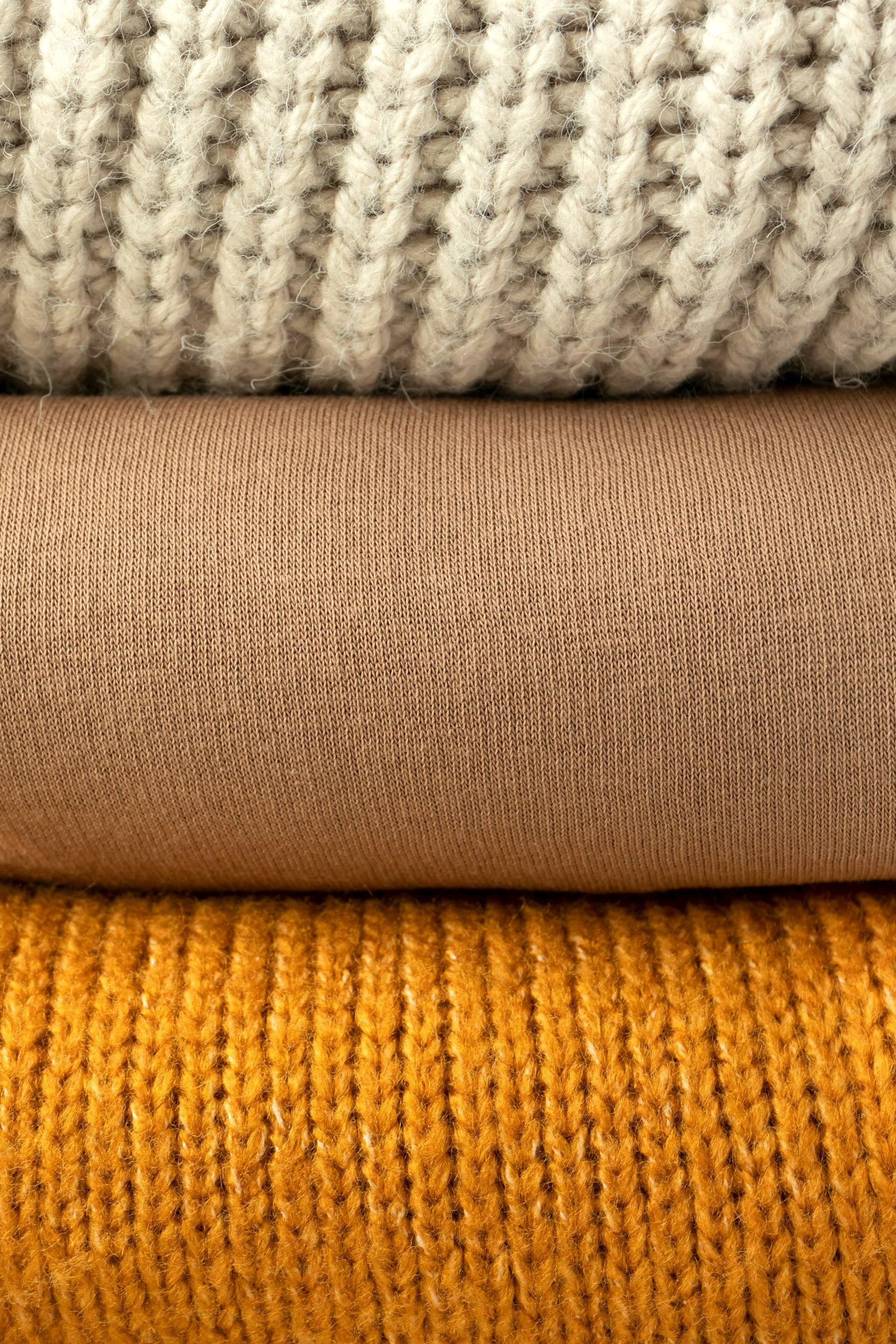
A note on our own photography, printed in the same place the Index prints it: our photo bank holds no beanie on a head. No watch cap worn down over ears, no fisherman at its shallow line, no fold at either depth exists in the bank, a gap the Beanie Index records about its own page and CREDITS.md carries as a named harvest target. The hero is a folded knit stack in window light; the frames inside are the knit surfaces the gauge and fibre arguments run on and a grey stack standing for the colour order, each captioned for exactly what it shows and none dressed as the subject. The harvest list names what is missing, a watch cap and a fisherman worn in real environments at Gate J+ register, the single fold and the double on real heads, and this page will take those frames the week they exist.
Questions, answered
How far down should a beanie sit?
To the ear line the weather sets, and the ear line is this brief's whole fit law. In real cold the cuff covers the ears fully, the Beanie Index's printed law: the ears are where the wind takes its fee, and every type except the fisherman and the skull cap is built to cover them. In the mild weeks the cuff may sit at the top of the ear or above it, worn as a decision, the watch cap rolled the way its naval original was rolled on watch. What never varies is the band's work: snug enough to hold its line in wind, never so tight it prints a groove in the forehead that outlasts the hat, and the crown clear of the skull rather than shrink-wrapped to it, because a beanie worn as a second skin reads as a swimming cap at any gauge.
Can you wear a beanie with a blazer?
In transit, in one cloth, and never in the room. The one cloth is the fine-gauge merino, the Beanie Index's formality ceiling at 3 of 5, a close thin knit with a thin cuff or none: it is the only beanie that can sit above tailoring without arguing with it, the same fine-gauge logic the knitwear briefs apply under a blazer. The conditions are the ruling. It is worn between the door and the destination, as outerwear, and it comes off with the coat, in the same motion, because a beanie announces weather the way a knot on a scarf does, and weather is not an indoor register. The cuffed wool beanie over a blazer in a room reads as an arrival that never finished. The fisherman worn as a fashion piece with tailoring is refused for the same reason at the other end of the ladder: it is a harbour garment, formality 2, and the pairing borrows a register neither garment owns.
What is the difference between a single fold and a double fold?
About an inch of crown, spent or saved, and the inch is the fit. The cuff is not a fixed part of the hat; it is the hat's adjustable hem, and folding is how a beanie is tailored at the mirror. A single fold on a classic cuffed beanie sets the clean working line, full ear cover in cold, the band sitting where the maker measured it. A second fold spends the crown's depth a second time and manufactures a different garment: the classic becomes a fisherman, ending above the ears, the shallow harbour read the Beanie Index files as its own type. That conversion is the double fold's honest use, in mild cold, on purpose. Its dishonest use is rescuing a beanie bought too deep, folded twice every day to make it a hat it is not: the doubled band prints its groove twice as fast and the crown's proportions never recover. Buy the depth you mean to wear; fold once to set it.
Is a cashmere beanie worth it?
Rarely, and the evidence is this site's own cashmere record. Verdict Card No. 42 prints the fibre's physics: cashmere runs from about 28 millimetres at the short end to 36 and beyond at the long end, and short fibres work free under friction and ball into pills. A beanie is the most-handled garment in the wardrobe: pulled on and off a dozen times a day, stuffed into coat pockets, crushed in bags. That is friction at its maximum, applied to the fibre least built to survive it, and hat makers almost never publish a staple length to grade against, which the cashmere ranking treats as the maker telling you something. The softness is real and so is the bill: the Beanie Index prices an honest wool beanie at typically $25 to $60, and cashmere starts where that band ends. The rational soft option is the fine-gauge merino, the Index's own formality ceiling, which gives most of the hand at a fraction of the fragility. Cashmere at the head is a luxury taxed twice, once at the till and once at the fold line.
How do you stop hat hair?
You manage it; you do not prevent it, and any product that promises otherwise is selling the promise. The physics are plain. Hair takes the shape it is held in while it is warm and slightly damp, and a beanie holds it warm, slightly damp and pressed flat at the band line for hours: the groove across the forehead and the flattened crown are the hat's shape, set into the hair. The management is four habits. Put the beanie on dry hair only, because damp hair sets the deepest line. Put it on last and take it off first, so the hours under pressure are the fewest the day allows. Set the cuff at the hairline rather than across the forehead's skin where the groove prints on skin as well as hair. And run the recovery on arrival: water on the fingertips worked into the roots at the band line, the hair pushed back up against the direction it was flattened, two minutes while the kettle or the meeting does its own warming up. A silk or satin lining reduces the friction half of the problem and is worth having; it does nothing for the pressure half, and this brief prints that limit rather than selling the lining as a cure.
When should a beanie come off indoors?
With the coat, in the same motion, at the door. The beanie is outerwear entire: unlike a scarf, which has one indoor survivor in the ascot tuck, a beanie has no dress form, no register in which it is part of the outfit rather than the weather's equipment. The office answer is the same as the restaurant answer and the house answer: off at the door, and the hat-hair recovery from this brief's hair section is the two-minute price of the commute, printed there rather than paid in a hat worn all day to hide it. The exceptions are working ones, and they are the garment's own history: the cold warehouse, the workshop, the market stall, the boat, interiors where the temperature is the outdoors continued and the hat is equipment. A heated room is not one of them. The fisherman worn indoors as a style is the ruling's named refusal: a shallow hat kept on in a warm room is not a look, it is a coat kept on, read at hat size.
What colour beanie should you buy first?
Navy or charcoal, in a watch cap, on the Beanie Index's printed set: the winter needs two beanies, the working watch cap in navy or charcoal and one type matched to your face. The colour logic is the coat logic of this brief's pairing section. The beanie is bought to the coat, not to the outfit under it, because the coat is what it is seen against. Navy is the default against charcoal, camel and black coats; charcoal is the default against a navy coat, where a navy hat disappears into the collar and only its lint shows. Black is bought last if at all, for the scarf law's reason: against dark coats it vanishes, against light ones it glares, and it shows every fibre it collects. Colour with intent, deep green, burgundy, a marl, is the second beanie's job, bought to a face and a coat the drawer already owns.
Has Young Cotton ranked beanies?
No, and this page says so in the open rather than letting a styling brief borrow a ranking's authority. There is no beanie Verdict Card: no beanie product on this site has been scored out of 100, and none is recommended here by name. What the desk publishes is the Beanie Index, which scores the eight types for formality and warmth from one to five, the watch cap the default at formality 2 and warmth 4, the fine-gauge merino the formality ceiling at 3, the chunky knit the warmth ceiling at 5, and prints its fibre law beside the ladders: wool, and it is not close. This brief styles that index. Its fold rulings, coat pairings, hair physics and indoor ruling are styling law argued from the index's published record and the site's knitwear evidence, and they carry no scores of their own.
Next
The index this brief styles is the Beanie Index, all eight types with their ladders and face matches printed. The no-hat winter answer is How to Wear No. 25, whose knots and drape carry the days the hair refuses the hat. The coats in the pairings are briefed in How to Wear No. 20 and No. 19, and the blazer whose question this brief answers is No. 03. The gauge bands come from the knitwear system in How to Wear No. 09, the fine-merino evidence from Verdict Card No. 33, and the cashmere physics from Verdict Card No. 42. Your face, measured before any of it, is the Face-Shape Decoder.