
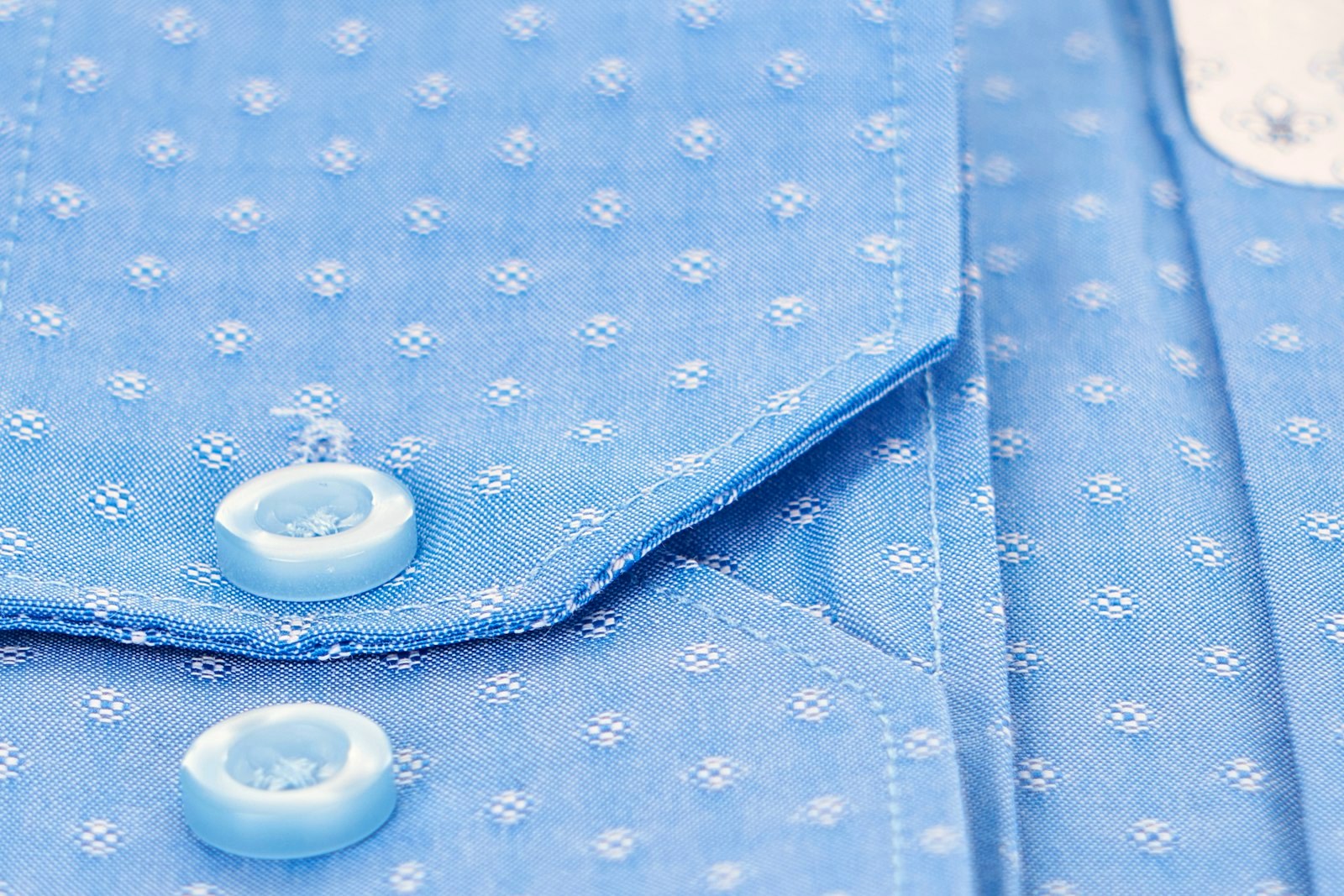
The collar in close view: the station this brief is about, since the bow is sized to the collar it sits in and its knot stands in the opening the collar's leaves make. The bank holds no bow tie frame in any form, admitted at this page's foot with the harvest list.
Checked and updated October 2026
The ruling, up front: a bow tie is tied by its wearer or it is not worn. The self-tied knot’s slight asymmetry is the garment’s signature, the proof a hand made it this morning; the pre-tied bow’s moulded perfection is its confession, and No. 67 refuses it as furniture at black tie, a refusal this brief carries into daylight entire. Outside the uniform, the bow’s register is narrow and daylight, a decision rather than a default, and its size is governed by the wearer’s face and collar as No. 64’s law governs the long tie’s width: the bow sized to the collar it sits in, its wings within the collar’s span, its band set to the neck.
The rule · the garment’s record · what it pairs with · the rooms it is for · the looks · the mistakes · keeping it
The rule: tied by its wearer, or not worn
A bow tie is tied by its wearer or it is not worn at all. Every other article in the dressed wardrobe can be bought finished: the jacket is tailored by another hand, the shoe is lasted in a factory, the long tie arrives as a made object whose only remaining act is the knot, and even that knot the wearer ties himself each morning. The bow tie is the extreme case of the same principle. The garment is nothing but its knot. A length of silk with two shaped ends has no form, no register and no meaning until a pair of hands folds it at a throat, and the bow that arrives with that work already done, sewn or moulded into a permanent symmetry, has had the garment itself removed from it. What remains is a picture of a bow tie fastened where a bow tie would go. The self-tied knot’s slight asymmetry is therefore not a flaw the wearer apologises for. It is the garment’s signature, one wing a fraction fuller than its fellow, the two ends never quite level, the whole thing legible at conversational distance as an object made by a hand, this morning, for this wearing. The bow that sits too perfectly is the one that gives itself away.
The family has already ruled the formal half of this law, and this brief adopts the ruling rather than re-arguing it. At black tie, No. 67 prints the bow as an element of the uniform’s grammar: a black silk bow tie, tied by hand, in the same silk family as the jacket’s facings, and it refuses the pre-tied bow in terms this page quotes because they settle the matter: the pre-tied bow is refused as furniture, a representation of the article rather than the article, its perfection its confession, its loops identical, its knot a moulded symmetry no hand produces. Nothing about that reasoning is specific to the evening. A knot that was never tied confesses as plainly at a noon wedding as at a midnight one, and the reader who has tied a bow once can read the difference across a room. The daylight bow therefore stands under the same law as the uniform’s: tied by its wearer, every time, or left in the drawer.
The rule’s second half governs where the honestly tied bow may go, because a garment this legible spends its meaning quickly. Outside black tie, the bow tie is a decision, not a default. The long tie, ruled at No. 64, is the dressed throat’s default instrument: it carries the working week and the suit’s ordinary ceremonies without asking to be noticed, its three measurements, width answering the lapel, length answering the waistband, knot answering the collar, doing quiet work. The bow cannot do quiet work. It concentrates the whole dressed statement at the throat and it announces that its wearer chose it, this morning, against the available default. That announcement is its value in the rooms that license it and its cost everywhere else. Worn daily, the decision curdles: the bow stops being read as a choice made today and starts being read as the wearer’s costume, the thing he is known by, and a signature that appears on every document signs nothing. The register law follows from the rule itself: keep the bow occasional, keep it daylight, and let the long tie carry the rest.
The measurements close the rule, and they are inherited, not invented. No. 64 governs the long tie as a measurement before an ornament, and No. 67 prints the bow’s version entire: the bow is sized to the collar it sits in. Its band is set to the wearer’s own neck size, the collar’s size, neither strung loose so the knot sags below the collar’s opening nor drawn tight so the collar is pulled out of its stand. The knot stands in the opening the collar’s leaves make, filling it the way No. 64’s knot fills the collar’s V, and the bow’s two wings stand within the collar’s span: a bow whose ends travel past the jaw’s width has left the measurement and entered costume, the clown’s proportion, instantly legible and impossible to unsee. The face is the second measure: the shapes divide by it, the butterfly’s fuller wing for the standard collar and the average face, the batwing’s narrower band for the smaller collar and the narrower face, and the choice is made against the mirror with the collar fastened, which is the only honest place any of this family’s measurements are finally read.
The garment’s record: a cravat that became a knot
The bow tie descends from the cravat, the neckcloth that entered European dress in the seventeenth century and spent two hundred years as the dressed throat’s main event: linen and lace tied, folded and pinned at the neck in arrangements whose complexity was itself a social signal. The nineteenth century simplified the cravat into the stock and then into the two modern heirs that divide its estate to this day, the long tie, which kept the hanging blade, and the bow, which kept the knot and discarded everything below it. The bow’s modern shape settled late in that century alongside the dinner jacket, when the shortened evening coat wanted a shortened neckwear to answer it, and the black bow with the black jacket hardened into the uniform whose grammar No. 67 prints: the bow’s formal state, fixed, licensed and not open to negotiation. That settlement is the reason the bow still reads as formal at any hour. It was codified as evening dress first, and its daylight career is a later loan against that capital.
The daylight career is a matter of published record rather than this page’s invention. Through the first half of the twentieth century the self-tied bow became the working dress of certain professions, the architect at his drawing board, the professor in the lecture hall, the physician on his rounds, men whose trades kept them leaning over work a hanging tie would trail in, and whose rooms licensed a signature the boardroom did not. The practical root matters to the register law: the bow leaves the front clear. It cannot fall into the soup, the machinery or the experiment, and it does not interrupt a waistcoat’s row of buttons or a closed double-breasted front, which is the same property that made it the uniform’s knot. Its decline as ordinary dress after mid-century tracked the long tie’s rise as the universal default, and what survived the decline is exactly the garment this brief rules on: no longer a standard option, the bow is now always a marked choice, read as deliberateness wherever it appears. The record is the register law’s evidence. A garment with an unmarked past could be a default; this one’s past is marked at every point, and the page rules accordingly.

The garment itself divides into three shapes, and the division is by the measurement law, not by fashion. The butterfly, its wings full and its outline the shape the word bow tie first summons, is the standard: it serves the standard collar and the average face, and in black silk it is the uniform’s bow at No. 67. The batwing, a straight narrow band whose ends flare only slightly, serves the smaller collar and the narrower face, and reads the most restrained of the three at any register. The diamond point ends its wings in points rather than curves and splits the other two in fullness. In silk the bow answers the same texture law the family prints for the long tie at No. 64, woven over printed, matte over shiny in daylight: satin is the evening’s finish, the uniform’s silk family, and a satin bow at noon carries the evening into a room that did not invite it, while the woven textures, grenadine’s family among them, and small woven figures hold the daylight register. Colour follows the same restraint: the daylight bow is a deep colour or a small pattern on a deep ground, and the bright bow, like the oversized one, has left the measurement and entered costume.
Tying the bow is a learnable skill, and its steps are printed here because the page that refuses the pre-tied bow owes the reader the alternative. Work at a mirror, in the shirt, with the collar turned up and the band already set to your neck size. One: hang the tie around the neck under the raised collar, one end, say the right, hanging a hand’s breadth lower than the other. Two: cross the longer end over the shorter, bring it up through the loop at the neck, and pull it to a plain, loose knot; this is the foundation, and it should sit snug, not tight. Three: fold the shorter end across the front of that knot into the bow’s first wing, a loop standing sideways at the throat with its fold pointing left, and hold it in place. Four: let the longer end hang straight down over the centre of the folded wing, covering the foundation knot. Five: fold the hanging end into the second wing, fold pointing right, and push that fold through the small loop that stands open behind the first wing. Six: tighten by pulling the two folded wings apart, never by tugging the loose ends, then settle the knot level in the collar’s opening and turn the collar down over the band. The full printing stands at No. 67, where the same steps dress the uniform. Expect the first attempts to fail and the first month’s knots to sit slightly uneven; that unevenness, within the measurement, is the signature the rule protects.
What it pairs with: the collar first, the front second
The collar is the bow’s first pairing, and it is a fit before it is a style. The knot must fill the opening the collar’s leaves make, so the collar’s spread chooses the shape: a moderate spread takes the butterfly, a narrower point takes the batwing, and the wide cutaway, cut to spread around a Windsor knot’s bulk, leaves a bow stranded in a space wider than its wings, the mismatch legible before the wearer speaks. The collar is a turndown collar with a proper stand, the system No. 67 rules for the modern uniform as for this brief; the wing collar belongs to the stiffer system that page prints, and importing it into daylight bolts a quotation from the evening onto a morning shirt. The button-down collar stands as the bow’s licensed American vernacular, long paired in the professions’ rooms, its buttoned leaves holding the knot’s station honestly; this brief licenses it in daylight only, and it does not travel up to the evening rooms. The shirt’s front is the second pairing, and it is argued from the bow’s one structural property: the bow leaves the front clear. A plain front shows that clearance to advantage; a placket buried under a long tie’s blade was never the bow’s problem to solve, and busyness at the chest, logos, chest pockets with flaps, contrast plackets, competes with a statement that has been deliberately concentrated at the throat.
The jacket pairing is governed by the same clearance, read from the front outward. Under No. 75’s law the waistcoat’s V is a frame the shirt front stands in, and the bow is the neckwear that frame was built for: the long tie’s blade crosses the waistcoat’s buttons and interrupts its row, where the bow sits above the V’s point and leaves the whole front, waistcoat, watch chain and all, unobstructed. The double-breasted jacket of No. 71 makes the same argument from the opposite direction: its fronts close high and overlap, the shirt shows as a narrow triangle at the throat, and the bow fills exactly that triangle where a long tie’s knot and first inches of blade crowd it. The single-breasted suit of No. 04 takes the bow on the register law’s terms, licensed rooms only, the jacket’s V left open or closed by a waistcoat beneath it. The pocket square, ruled at No. 65, obeys its own restraint law doubled: with the statement already made at the throat, the square stays plain, white linen in the evening’s direction or a quiet fold in daylight, and a square that competes with the bow in colour or figure puts two exclamation marks in one outfit, which is one too many by the arithmetic of every brief in this family.
The rooms and the hours: narrow, daylight, deliberate
The bow’s licensed rooms follow from its record: rooms where a signature is welcome and a default is not required. The ceremonial day is its surest ground: the wedding by day, where the guest’s bow in a deep woven silk reads as honour paid to the occasion; the christening, the summer ceremony, the race meeting and the garden party, rooms dressed above the everyday and below the uniform, which is the bow’s exact altitude. The professional room is its historical ground: the lecture hall, the studio, the laboratory and the reading room, where the bow’s clear front is a working property and its deliberateness reads as a trade’s habit rather than a performance. The dressed evening below black tie is its border ground: the dinner where the invitation prints no instruction, the theatre, the concert hall, where a dark suit, a white shirt and a black or midnight bow nod toward the uniform without claiming it, and the wearer must be certain of the room, because the same assembly one room up the scale is an underdressed guest at a black tie evening that No. 67 governs entire.
The refused rooms are the rule’s other half. The boardroom’s default business refuses it, not because the bow is informal but because it is legible: in rooms where the dress code’s whole purpose is the removal of personality from the negotiation, a garment that announces a decision spends the room’s currency on the wearer. The funeral refuses it on the same ground inverted: the mourner’s dress is the long tie’s most protected station, black and unpatterned under No. 64’s law, and a bow at a graveside reads as a signature where the day licenses none. The everyday default refuses it by the register law itself, the bow worn to the office, the errand and the ordinary Tuesday until the decision has dissolved into a costume. And the hours police the border the rooms draw: the daylight bow is a morning-to-dusk garment in its licensed rooms, and after dark its register narrows toward the uniform it descends from, satin and black silk taking over from the woven daylight textures as the light goes, until at full evening the only bow left standing is No. 67’s.
The looks: four assemblies
| Setting | The assembly | The details | The judgment |
|---|---|---|---|
| The daylight wedding | A mid-grey or navy suit under No. 68’s law, a white or pale blue shirt with a moderate spread collar, a butterfly bow in deep woven silk, a small woven figure on a deep ground | The band set to the neck, the wings within the collar’s span, a plain white linen square under No. 65’s restraint, the knot’s slight asymmetry left exactly as the hand made it | The bow’s surest daylight room, ceremony enough to license the decision and daylight enough to keep it below the uniform |
| The summer ceremony | A linen or seersucker suit, a white shirt, a batwing or butterfly in matte silk or a silk-and-linen weave, deep navy or burgundy against the pale cloth | No satin anywhere in the assembly, the evening’s finish refused at noon; the bow’s texture answers the suit’s slubbed cloth, texture against texture | The christening, the garden party and the races: the bow at its ease, the clear front doing its old working work in the heat |
| The professional room | A blazer and grey flannels, or the suit of the working week, a button-down or moderate spread collar, a batwing in a woven stripe or small figure | The assembly of the lecture hall and the studio, where the bow is a trade’s habit; kept occasional even here, rotated against the long tie’s days, so the habit never hardens into the costume | Licensed by the garment’s own record, and the room where its deliberateness costs least and reads most honestly |
| The evening below black tie | A dark suit, a white shirt with an unbuttoned turndown collar of proper stand, a butterfly in black or midnight silk, the square plain white linen | The nod toward the uniform without the claim: no dinner jacket, no dress shirt’s studs, none of No. 67’s grammar borrowed piecemeal, the systems kept whole or not at all | The border assembly, correct only where the invitation prints nothing; one degree of doubt about the room and the wearer owes the evening the full uniform instead |
Read down the table and the pattern is the family’s: each assembly is the rule’s arithmetic at a different station. The shape answers the collar, the texture answers the hour, the room licenses the decision, and the knot, tied that morning by the man wearing it, signs the whole. Change the room and the same bow changes its meaning, which is why this brief spends as much of its length on rooms as on the garment: the bow tie is the most context-dependent article in the wardrobe, a knot whose correctness is decided less by its silk than by its address.
The ruling, restated
The bow tie’s whole law fits in the space its knot occupies. Tie it yourself or do not wear it: the self-tied knot’s slight asymmetry is the signature, the pre-tied bow’s perfection the confession, and No. 67’s refusal of the moulded article as furniture stands at every register this page rules. Size it to the collar and the face: the band at the neck’s own size, the knot filling the collar’s opening, the wings within the collar’s span and the jaw’s width, the butterfly for the standard collar and average face, the batwing for the smaller measure. Spend it narrowly: daylight and ceremony, the professions’ rooms and the border evening, never the default and never the costume. A garment that survives all three rulings is one of the wardrobe’s oldest instruments, a knot with two centuries of record behind it; a garment that fails the first is not a bow tie at all, whatever its label says, and the man who has learned to tie one owns a skill the pre-tied rail exists to excuse him from learning, at the price of wearing the excuse at his throat.
The mistakes this brief exists to prevent
The pre-tied bow. The founding mistake, refused at No. 67 as furniture and refused here at every register: a representation of the article rather than the article, its loops identical, its knot a moulded symmetry no hand produces, its perfection its confession at conversational distance. The clip-on stands beneath it in the same refusal, the representation with even the band’s pretence removed. Neither is a beginner’s stage on the way to the real garment; both are substitutes for it, and the remedy is not a better substitute but an evening at a mirror with the steps printed above.
The bow past the jaw. The proportion mistake: wings travelling past the collar’s span and the jaw’s width, the clown’s proportion in No. 67’s sentence, instantly legible and impossible to unsee. It is usually bought rather than tied into being, sold as a statement size by rails that grade bows by their shelf presence. The measurement law is the whole remedy: the bow is sized to the collar it sits in and the face it sits under, and a bow that reads across the room has been sized to the room instead, which no garment survives.
The novelty bow. The printed joke, the seasonal figure, the bow as fancy dress: flags, fruit, instruments of the wearer’s hobby rendered in silk. It fails on the register law before it fails on taste, because it converts a decision into a performance, and a performance is the one reading every room in this brief refuses. The daylight bow’s licensed figures are the woven small pattern on a deep ground; anything that asks to be read as a picture has left neckwear for signage.
The bow as a daily costume. The register mistake, and the subtlest, because every element can be correct: the knot hand-tied, the size measured, the rooms licensed, and the garment still wrong by accumulation. The bow worn every day stops being a decision and becomes the wearer’s known costume, and its deliberateness, spent daily, buys nothing. The family’s rotation law applies with double force to a garment whose meaning is its occasionalness: the long tie carries the ordinary week under No. 64, and the bow is kept in reserve for the rooms that license it, which is what keeps it worth wearing there.
The borrowed grammar. The mixture mistake, imported from No. 67’s ruling on systems: the wing collar over a soft daylight shirt, the dress studs in a daytime front, the cummerbund under a lounge suit, black tie’s elements quoted piecemeal outside the uniform they belong to. Each system is chosen whole or not at all. The daylight bow’s system is the ordinary dressed wardrobe, turndown collar, plain front, jacket and square ruled by their own briefs; the evening’s system is No. 67’s entire, and the bow is the one article licensed to stand in both, which is precisely why it must not smuggle either system’s furniture into the other.
Keeping it: untied at night, rested between wearings
The keeping begins with the garment’s premise restated as a chore: untie the bow at night. A self-tied bow is untied after every wearing, never left knotted on its hook, because silk left compressed in the knot takes a permanent crease at exactly the fold the next tying needs supple, and because the untying is the nightly proof that the knot was the wearer’s work and not the garment’s moulding. Hang the untied bow or lay it flat, let it rest a day between wearings as a shoe rests under the family’s rotation law, and steam a wrinkled wing back to fullness rather than pressing it, since the wing’s shape is its loft and a hard crease flattens the very curve the butterfly is cut for. Keep the band’s setting at your neck size and move it only when the neck itself changes; the setting is a measurement, made once and kept, not an adjustment to be loosened for convenience. The rail itself is small by the register law’s design: the black silk butterfly that lives with the dress kit under No. 67, and a short daylight rail, a deep woven butterfly, a batwing in a stripe or small figure, a matte summer bow, which is wardrobe enough for a garment worn by decision. Silk bows keep away from light and from the wool ties’ rail; a faded bow confesses its storage as plainly as a pre-tied one confesses its making.
Three rulings beyond the tree’s record are extended here by analogy and marked as extensions. First, the bow under a sweater or knit, where no brief in the family has seated it: by analogy with No. 75’s V-frame doctrine, the knit’s neckline is the frame and the bow stands or falls by whether the frame leaves the collar’s opening visible; a crew neck that swallows the collar swallows the bow’s station with it, and the pairing is refused. Second, the bow with the open collar worn without a jacket, refused by extension of the clearance doctrine: the bow’s clear front is a property of an assembled front, waistcoat, closed jacket or dressed shirt under a jacket, and a bow on a bare open collar has the signature without the document it signs. Third, the bow’s measure for a collar worn with a beard or a heavier jaw: No. 67’s span is the collar’s and the jaw’s as printed, and the extension is only that the mirror reading the doctrine prescribes is taken with the face as it is worn, not as it was at the first fitting.
The photography is admitted. The bank holds no bow tie frame in any form: no self-tied bow at a throat, no knot in close view, no tying sequence, no black silk bow against a dress front, and this page will not pretend otherwise. The hero is the collar in close view, the station the bow is sized to fill, and the figure is No. 64’s own hero, the long tie at its daylight station, carried here as the garment this brief is measured against and captioned as exactly that. The harvest list, for the next camera pass over the throat’s wardrobe: (1) a self-tied butterfly at a turndown collar in daylight, close enough that the knot’s slight asymmetry reads; (2) hands mid-tying at a mirror, the second wing being pushed through the loop behind the first; (3) a butterfly and a batwing laid flat side by side on a shirt front, the shapes’ difference in one frame; (4) a black silk bow against a Marcella dress front, the uniform’s station, for this page and No. 67 to share. Until that pass runs, the page’s pictures show the bow’s station and its rival, and say so.
Questions, answered
What is the one rule of the bow tie?
Tie it yourself, or do not wear it. A bow tie is tied by its wearer or it is not worn, and the self-tied knot's slight asymmetry, one wing a fraction fuller than the other, the ends never quite level, is the garment's signature: the visible proof that a hand made it at a mirror this morning. The pre-tied bow inverts the evidence. Its loops are identical and its knot is a moulded symmetry no hand produces, and that perfection is its confession, legible at conversational distance to anyone who has ever tied one. No. 67 refuses the pre-tied bow at black tie as furniture, a representation of the article rather than the article, and this brief adopts the refusal entire and carries it into daylight: at every register the bow is a knot before it is a shape, and a knot that was never tied is not the garment.
How do you tie a bow tie?
At a mirror, in the shirt, with the collar turned up and the band set to your neck size. One: hang the tie around the neck, one end, say the right, hanging a hand's breadth lower than the other. Two: cross the longer end over the shorter, bring it up through the loop at the neck and pull it to a plain loose knot, the foundation the bow is built on. Three: fold the shorter end across the front of the knot into the bow's first wing, a loop standing sideways at the throat, and hold it there. Four: let the longer end hang down over the centre of that folded wing, covering the first knot. Five: fold the hanging end into the second wing and push its fold through the small loop that stands open behind the first wing. Six: tighten by pulling the two folded wings, never the loose ends, and settle the knot in the collar's opening, level, its wings within the collar's span. The full printing stands at No. 67, where the same steps dress the uniform; the skill is an evening's practice, and the knot it produces is meant to be read as handmade.
How big should a bow tie be?
Sized to the collar it sits in, which is No. 67's doctrine and this brief's measurement law. The band is set to the wearer's own neck size, neither strung loose so the knot sags below the collar's opening nor drawn tight so the collar is pulled out of its stand. The knot stands in the opening the collar's leaves make, filling it as No. 64's knot fills the long tie collar's V, and the bow's two wings stand within the collar's span: a bow whose ends travel past the jaw's width has left the measurement and entered costume, the clown's proportion, instantly legible and impossible to unsee. The shapes divide by the same measure. The butterfly's fuller wing serves the standard collar and the average face; the batwing's narrower band serves the smaller collar and the narrower face; the diamond point splits the difference and narrows to its points. Judge the size against the mirror with the collar fastened, which is the only honest place the measurement is finally read.
When can a bow tie be worn outside black tie?
In a narrow band of daylight rooms, worn as a decision rather than a default. The bow's home by right is black tie, and that state is No. 67's page entire. Outside it the bow reads correctly where the day is ceremonial or the wearer's trade licenses a signature: a wedding by day, a summer ceremony, a christening, the races, a garden party, the lecture hall and the studio, an evening's dinner where the invitation prints no instruction and the room is dressed but not uniformed. It reads incorrectly as an everyday default, because a garment whose whole meaning is that it was chosen cannot survive being chosen every morning: worn daily it stops being a decision and becomes a costume the wearer is known by, which is the one reading this brief refuses. The long tie remains the dressed throat's default instrument, ruled at No. 64; the bow is its deliberate alternative, kept credible by being kept occasional.
Bow tie or long tie?
The long tie by default, the bow by decision, and the two are not rivals for the same mornings. The long tie, ruled at No. 64, is the general instrument: its width answers the lapel at a standard of 8 centimetres, its length answers the waistband, its knot answers the collar, and it carries the working week, the suit's ordinary ceremonies and every room where the dressed throat should not be the subject. The bow does one job the long tie cannot: it leaves the shirt's front and the waistcoat's V or the jacket's closed front unobstructed, and it concentrates the whole dressed statement at the throat, which is why it is the uniform's knot at black tie and why it reads as an event in daylight. Choose the bow when the front of the outfit is doing work worth leaving clear, a waistcoat's row of buttons under No. 75's law, a double-breasted front closed under No. 71's, or when the room is one of the bow's licensed rooms; choose the long tie everywhere else, and never treat the bow as the long tie's novelty substitute.
Which collar takes a bow tie?
A turndown collar with a proper stand, cut to carry a bow in its opening, the same collar No. 67 rules for the uniform's current system. The governing fact is the opening the collar's leaves make, because the knot must fill it: a moderate spread takes the butterfly, a narrower point takes the batwing, and a wide cutaway leaves a small bow stranded in a space cut for a Windsor's spread, the mismatch legible before the wearer speaks. The wing collar belongs to the stiffer system No. 67 prints, the dress shirt of an earlier settlement, and worn over a soft front it bolts two formalities from two systems together; this brief leaves it to that system entire. The button-down collar is the bow's American vernacular pairing, licensed by long use with the daytime bow in the professions' rooms, and it is ruled here a daylight answer only: its buttoned leaves hold the knot's station honestly, but it does not travel up to the evening rooms, where the collar stands unbuttoned or the bow does not stand at all.
Is a pre-tied bow tie ever acceptable?
Not on this tree, at any register, and the clip-on stands below the pre-tied in the same refusal. The pre-tied bow is refused at No. 67 as furniture, a representation of the article rather than the article, and the reasoning does not weaken in daylight: the bow's entire claim on the throat is that it is a knot a man tied, the one neckwear whose making cannot be delegated to the garment itself, and the pre-tied article's moulded perfection confesses the delegation at conversational distance. The adjustable band is not the offence: a self-tied bow's band is set to the neck size once and adjusted as the neck changes, and the setting is a measurement, not a shortcut. The offence is the knot arriving pre-made. A wearer who cannot yet tie one is not excused but equipped: the steps stand printed at No. 67 and in the record below, the skill is an evening's practice at a mirror, and the first month's slight unevenness is not a defect of the result. It is the result.
How do you keep a bow tie?
Untie it at night, which is the first rule of its keeping and the nightly proof of the garment's premise: a self-tied bow is untied after wearing and left to rest untied, hung or laid flat, so the silk recovers from the knot's compression instead of taking a permanent crease at the fold. Keep the band's setting at your neck size and change it only when the neck changes; a bow restrung loose to save effort sags in the collar the next morning and confesses a different shortcut. Steam a wrinkled wing rather than pressing it, since a hard crease across the wing flattens the very fullness the shape is cut for, and store the silk bows away from the wool and cotton ones, the daylight rail apart from the black tie uniform's single black bow, which lives with the dress kit under No. 67's law. Rotate the daylight bows as any small rail rotates: the bow worn twice in a week to the same room has begun the slide from decision to costume that the mistakes name.
Next in How to Wear
The neckwear run this brief completes stands at How to Wear No. 64, the long tie ruled as a measurement before an ornament, and at How to Wear No. 67, the uniform entire, where the bow’s formal state and the tying’s full printing live. The frames the bow leaves clear are ruled at How to Wear No. 75, the waistcoat, and How to Wear No. 71, the double-breasted suit; the suit beneath stands at How to Wear No. 04, the square at How to Wear No. 65, the shirt’s other road at How to Wear No. 62, and the long tie shelf itself, graded as documents and objects with the Sam Hober grenadine at its head, at Verdict Card No. 40. The desk’s method stands at the methodology page.