

The tailored register, captioned as exactly that: a checked single-breasted suit on a street, the wardrobe this page's subject belongs to. The bank holds no double-breasted frame of any kind, no crossed front, no buttoned wrap, and this page prints that absence rather than dressing another front as its subject; the care section prints the gap and the harvest list entire.
Checked and updated October 2026
The ruling, up front: a double-breasted suit is a closed system, and it is worn buttoned. Its front is not two halves that meet but two fronts that overlap, an inner wrap held flat by an internal button, the jigger, and an outer front closed over it at one pair of buttons, the pair the pattern was drawn to close. The silhouette the garment exists to make, the continuous crossed field across the chest, stands only while both closures are done up, which is why the single-breasted suit’s freedoms are not available to it: it is not unbuttoned to sit, not worn open over a knit, not relaxed by opening, because opened it is not a relaxed version of itself but two panels of cloth hanging from the shoulders with the wrap undone. Its collar is the peak lapel, the lapel that continues the wrap’s diagonal, and our suit brief already prints what the peak does, it lifts the suit toward ceremony. It takes no waistcoat, an invisible layer under a front that never opens. And it is bought after the single-breasted foundation, as the dressed register of a tailored wardrobe, in the configuration its wearer’s frame prices: the 6x2 standing, the 6x1 lengthening, the 4x2 lightening. This brief prints the record first, the garment’s anatomy and its published history; then the pairing law; then the rooms and hours; and the looks, the ruling, the mistakes and the keeping after all of it. On scores: the suit shelf is graded at Verdict Card No. 64, the Core Suit at 85, and no score for the configuration stands anywhere on this site, because none has been graded.
This brief: the decisive rule · the garment’s record · the pairing law · the rooms and hours · the looks · the ruling · the mistakes · care, the wrap’s keeping, and our photography
The decisive rule: the closed system, worn buttoned at both its closures
Every other suit in this family is governed by a decision its wearer makes each morning, and No. 04 prints the matrix of those decisions entire: the cloth, the shirt, the tie, the break, the shoe. The double-breasted suit removes the largest of them before the wearer reaches the mirror. Its front is a wrap. One front crosses the body and is fastened inside, against the opposite hip; the second front crosses over it and is fastened outside, at the waist. The two fastenings are the garment’s whole mechanism, and both are load-bearing. The internal one, the jigger button, holds the inner wrap flat and still against the body. The external one, the closing pair, holds the outer front over it at the pair the pattern was drawn to close. While both are done, the chest reads as one continuous crossed field of cloth, the configuration’s silhouette and its entire argument. The moment either is undone, the field breaks: the inner wrap sags and wanders if the jigger is open, and if the closing pair is open the two fronts fall apart from the shoulders and the garment is two panels of suiting hanging open over a shirt. A double-breasted suit is therefore a closed system: it is worn buttoned, at both closures, for the whole of its wearing, standing, walking and sitting, and it is never worn open, because open is not one of its states. That sentence is this brief’s spine, and everything below is its working.
The comparison that prices the rule is the single-breasted suit’s freedom, which is real and which this configuration does not share. The single-breasted jacket is a front with an opening in it, designed around the opening: its fronts are cut to fall open gracefully, its silhouette is drawn for both states, buttoned for the room’s formal minute and open for the desk, the chair and the walk, and a whole doctrine of furnishing, the waistcoat, the knit under the jacket, the tie’s display, exists to furnish what the opening shows. The double-breasted jacket is designed around the opposite condition. Its fronts are cut to overlap and to be read overlapped; nothing beneath the wrap is furnished for display, because nothing beneath the wrap is displayed; and its ease, the room a man sits and breathes in, is built into the wrap’s cut, the depth of the overlap and the waist’s suppression graded to a closed front, which is why a double-breasted suit that fits standing and strains sitting has not been cut generously but cut wrong. The family has printed the condition once already, for the wardrobe’s other double-breasted front, and this brief inherits the sentence as law: the pea coat brief rules of its coat that the double-breasted front is worn closed, on the buttoning the pattern was drawn for, and No. 67 prints the dinner jacket’s double-breasted form as the uniform’s licensed variation, worn buttoned. The lounge suit’s version is the same architecture in a daytime cloth, and it keeps the same law.
What the closed system buys, at that price, is the strongest chest in the tailored wardrobe, and the rule’s second half is that the strength is a statement with a price attached, the way every licence in this family is printed with its conditions. The crossed front adds a layer of cloth across the torso, draws the eye along the wrap’s diagonal to the closing pair at the waist, and stands under the peak lapel, the lapel whose line continues the wrap’s diagonal up to the collar and whose register No. 04 has already priced: the peak lapel lifts the suit toward ceremony and belongs to the evening row of the matrix. A double-breasted suit is therefore never the quiet suit in a room of single-breasted ones. It is the dressed register of the lounge suit, one deliberate step up in formality and in notice from the foundation garment, and the wearer who buys it as a default has misread a statement as a uniform. The configuration’s discipline and its effect are the same fact read twice: because it cannot be opened, softened or dressed down in the wearing, it arrives everywhere at its full register, and the rooms and hours below are simply the list of places where that register is the right one.
The garment’s record: two fronts, three configurations, and a borrowed navy front
The garment first, because in this species the architecture is the style to a degree no other suit matches: change the closing pair and a different silhouette stands in its place, the same cloth re-argued. The front is two fronts. The inner front wraps across the body from one side and is anchored inside, at the opposite side’s hip, by the jigger button, a button sewn to the jacket’s interior facing its buttonhole on the inner front’s edge, hidden in wear and working in constant sideways tension. The outer front wraps over it from the other side and closes at the waist on the configuration’s closing pair. The overlap between them is the garment’s substance: two layers of suiting and their canvassing across the chest, which is why a double-breasted jacket carries more architecture in its front than any single-breasted, and why its front, properly made, holds its crossed line through a day of sitting and standing in a way no opened jacket is asked to. The buttons stand in two columns down the front, and the columns are the configuration’s notation and its face: the count before the cross is the buttons shown, the count after it is the rows that close, and the species divide by it, printed here as this family prints its species ladders, by register and by the body each serves.
The 6x2 is the standing form. Six buttons, three to a column, and of its rows the middle pair, the two at the natural waist, is the closing pair; the top pair and the bottom pair stand as the columns’ furniture, unbuttoned, framing the closure. It is the configuration of the garment’s ascendancy and of its modern revival alike, the form a wardrobe buys when it buys the species, with the wrap at its fullest depth and the chest at its most architectural. The 6x1 is the lengthening form. Six buttons again, but only the lowest pair closes, so the lapel rolls in one long unbroken line from the collar down to the waist’s lowest station, the roll the trade attaches to the Kent name, and the chest reads longer and softer, the wrap shallower at its top, the whole front a single diagonal instead of a crossed field with a centre. It is the configuration for the frame the 6x2 shortens and for the wearer who wants the species at its most relaxed while keeping its closure entire. The 4x2 is the lightening form. Four buttons, two to a column, both pairs made to close and the upper pair the conventional closure, the wrap at its least deep, the front nearest the single-breasted in its quantities of cloth and statement while remaining, in its architecture, a wrap that is worn closed. Beyond the three stands the ladder’s refused end, the 8x3 and the dropped-button showpieces of the configuration’s fashion decade, buttons multiplied past the front’s need and the closing pair sunk toward the hem until the wrap reads as a costume of itself; they are named here to close the ladder, the way the triple monk closes its own, a fastening multiplied past its function having become a pattern.
The lapel is the architecture’s collar, and its form is not a choice among equals. The peak lapel is native to the wrap: its points turn upward and outward, continuing the diagonal energy of the crossed front up to the collar, widening the chest’s read at its top to match the wrap’s work below, and No. 04’s sentence stands over the whole configuration, the peak lifting the suit toward ceremony. The notch lapel on a double-breasted front is the single-breasted suit’s lapel carried over by a maker cutting one block for both species, and it reads as exactly that, a default standing where a decision belongs, the notch’s downward step arguing with the wrap’s upward diagonal at the garment’s most-read station. The shawl collar belongs to the dinner jacket, No. 67’s licensed form, and does not transfer to the lounge suit’s version. The rest of the build follows the closed front’s logic. The pockets are jetted or flapped as on any suit, the flaps worn in or out under the ordinary law. The vents are side vents or none: a centre vent is the single-breasted jacket’s inheritance, splitting a back that was drawn as two fronts meeting, and under the wrap’s crossed geometry it reads as a part ordered from the other species’ list, the build’s version of the notch lapel. The trousers are the suit’s own and are governed entire by No. 04: its break ladder, no break, slight, medium, full, with the slight break this family’s default, and its waistband held by braces or adjusters or a belt under the ordinary law, the waistcoat alone refused, for the reason the questions at this page’s foot print: under a front that never opens, a waistcoat is a layer no eye reaches.
The history is a borrowed front, and it is printed here as the published record tells it, the way this family prints a shoe’s name. The wrap begins as weatherproofing: the double-breasted front is the navy’s, the reefer jacket’s and the service coat’s, a front that overlaps so that wind and spray meet two layers and a closure that can be re-fastened to the other side as a garment wears, the pea coat in this family’s own index being the same front in a shorter coat, filed as double-breasted and hip length in melton heavy enough to block a harbour wind. The lounge suit took the front from the service wardrobe in the early twentieth century and made it its dressed register, and its ascendancy is the 1930s: the decade of the configuration’s classical form, the 6x2 at its fullest wrap, worn across the Atlantic world by the generation the photographs remember, the Prince of Wales’s circle and the film tailors’ leading men, the silhouette this page’s standing form still quotes. The postwar decades belonged to the single-breasted suit’s narrower American line, and the wrap survived as the formal and the European choice until its loud second life, the 1980s power decade, which widened the shoulder, dropped the closing pair and sold the configuration as boardroom armour at a scale its classical form never asked for; the decade’s residue, like the double monk’s, is an assumption to be corrected, that the dropped, padded, oversized double-breasted is the species, where it is the species’ parody. The modern revival is the correction: a softer construction, the shoulder nearer the body’s own, the wrap at its classical depth, the configuration standing again as what it was in its first ascendancy, the lounge suit’s deliberate register, one step dressed above the foundation, worn by a man who has chosen it.
The pairing law: the chest already dressed, and the stations that answer it
The pairing law’s first principle is that the double-breasted chest arrives dressed. A single-breasted jacket worn closed shows a V of shirt and tie above its button, and the outfit’s furnishing is arranged inside that V. The wrap replaces the V with a field: cloth crosses the whole chest, the lapels stand wide at its top, and what remains to furnish is a narrower triangle of shirt at the throat and the breast pocket’s one square. The pairings are priced from that fact. The tie is the standing form. Its knot stands in the collar’s opening above the wrap’s crossing point, the one vertical line on a chest of diagonals, and the configuration’s formal rows take it as a matter of course; the tie’s own law is No. 64’s entire, the width answering the lapel at the standard the tie ranking prints, its winner the Sam Hober grenadine at 91 on Verdict Card No. 40, and the peak lapel’s width argues for the standard’s full measure rather than its narrow end. The collar answers the lapel: a spread or cutaway collar, whose leaves open at the angle the peak lapel sets, stands correctly over the wrap; a narrow point collar is lost between the lapels’ width, a small collar in a wide architecture, read as the shirt of the other species worn by mistake.
The tieless double-breasted is licensed, and its licence is No. 62’s, at a better rate than the single-breasted pays. No. 62 rules the open collar by repayment: the formality the tie carried is repaid at the shoe polished a step up, the square disciplined, the belt and the metals quiet. The wrap repays part of the sum itself, because the chest the tie would have dressed is already dressed by the crossing cloth, and the open collar above a buttoned wrap shows a fraction of the shirt the open single-breasted shows. The remaining repayments stand entire and are not waived by the wrap’s contribution: the shoe polished, the square disciplined, the collar a proper shirt collar with a stand, never a knit in the suit’s working rows. Below the tieless licence stand the soft rows where the configuration relaxes its company rather than its closure: the roll neck and the knit worn under a buttoned wrap in the Italian register, the jacket still closed, the front still crossed, the register changed by what the wrap crosses over. What is refused at every register is the hybrid the decisive rule exists to prevent: the wrap worn open over any of them, the undone front converting a dressed chest into two hanging panels over a dressed torso, both garments spent.
The square obeys No. 65’s law entire and is, on this chest, more visible than on any other: the breast pocket stands on the wrap’s field with no tie’s length beside it to share the eye, and the square is read as the chest’s one furnishing. White linen in its disciplined folds is the standing answer; the coloured silk square at its loosest is a second statement on a chest whose cloth is already making the first, and the pattern law applies in its transposed form, one loud element to the chest. The shoe rows are inherited, not re-argued. The configuration changes the jacket’s formality, not the shoe’s law: the ceremony rows stay the Oxford’s under No. 04’s seating, and the social rows admit the closed tailored shoes as the family seats them, the single monk of No. 70 licensed there as the decision shoe beside the derby, its buckle answered at belt and wrist under that brief’s metals law. The double-breasted suit’s one addition to the shoe law is emphasis: a chest this deliberate over a careless shoe is a sentence that stops before its last word, and the polished step No. 62 prices for the tieless suit is well spent under the wrap in every register. The trousers close the section under No. 04’s law, the hem at the slight break that is this family’s default, the leg slim to straight under a jacket whose own width is at the chest: the wrap widens the top of the silhouette, and a wide legged trouser under it doubles a width the configuration placed deliberately at one station.
The rooms and hours: the dressed register of the working wardrobe
The double-breasted suit’s rooms are the lounge suit’s rooms read at its dressed register, and the configuration stands everywhere the suit stands, one step up in notice. The boardroom is licensed entire. The wrap is a lounge suit, not a uniform and not a costume, and in the room No. 04 seats to black Oxfords the dark double-breasted, navy or charcoal, worn closed over a white shirt and a sober tie, is the room’s own dress at its most deliberate; the man in it has not overdressed the meeting, he has dressed at the register the configuration exists for. The wedding’s guest rows are its natural home, the assembly where the dressed register is the occasion’s own request, and the evening rows of No. 04’s matrix are the configuration’s best hour: the darkest suit you own short of black tie, printed there in the single-breasted’s terms, stands one register stronger in a midnight or black double-breasted, which is the optional invitation’s finest answer among lounge suits, the guest who does not wear the uniform wearing the wrap at its fullest formality instead. The funeral admits it in black or the darkest cloth, the closed front’s sobriety answering the room, under the sombre rows’ ordinary discipline at the pocket and the throat.
The refusals are two, and both are confusions of register rather than of taste. The first is upward: the double-breasted lounge suit is not black tie, and its wearer owns no shortcut into the uniform’s rooms by resemblance. The dinner jacket’s double-breasted form is No. 67’s garment, silk faced, braided at the trouser, worn inside a fixed grammar whose every other station differs from the lounge suit’s; a navy wrap with a bow tie is the ladder’s half-sentence in a new cloth, and No. 67’s sentence covers it, an attempt to personalise what is fixed being a spelling error however good the spelling at the other stations. The second refusal is downward: the configuration has no off-duty state. Worn in the rows where a jacket is already the dressed end, the summer’s short-sleeved assemblies, the knitwear’s home ground, the rooms where the single-breasted jacket survives by opening and softening, the closed wrap is a formality that cannot stand down, tailoring at full register in the wardrobe’s rest hours. The suit that belongs there is the foundation garment, which can open. This one’s whole virtue is that it cannot, and the rooms are priced accordingly: the double-breasted is worn where a man is content to arrive at one register and stay at it for the length of the occasion.
The looks: three assemblies the brief licenses
| Setting | The assembly | The details | The judgment |
|---|---|---|---|
| The standing form | A navy 6x2 with peak lapels, worn closed at the middle pair, over a white shirt with a spread collar | A dark grenadine tie at the standard width, black Oxfords, a white linen square in a straight fold, the hem at a slight break | The configuration at its founding register: the wrap’s crossed field, the tie’s one vertical, every other station at the family’s standing law |
| The boardroom in winter | A charcoal flannel 6x2, worn closed, over a pale blue shirt | A wool tie in a sober figure, single monks in black calf in the social reading of the room or Oxfords in its formal one, the buckle answered at belt and wrist, no square beyond white linen | The dressed register at work: flannel’s softness against the wrap’s architecture, the suit a decision the room can grade |
| The soft wrap | A stone or brown 6x1 in a lighter cloth, its long roll closed at the lowest pair, worn tieless under No. 62’s terms | An open collar with a stand, the shoe polished a step up in suede or calf, the square disciplined, the hem at a slight break over loafers’ neighbouring rows | The configuration at its most relaxed while remaining itself: the register changed by the company, the closure entire, the wrap still crossed |
The ruling
Wear the double-breasted suit as the closed system it is. Buy it after the single-breasted foundation, in the configuration your frame prices, the 6x2 for the standing form, the 6x1 for the longer line, the 4x2 for the lighter wrap, with a peak lapel, side vents or none, and no waistcoat beneath it. Fasten the jigger when you put it on and the closing pair over it, the middle pair of the 6x2, the lowest of the 6x1, the upper of the 4x2, and keep both fastened for the whole of the wearing, at the desk and in the chair as on your feet. Dress the chest it gives you: a tie at its standing form, a spread collar to answer the lapel, a square at white linen’s discipline, the shoe polished to the chest’s deliberateness. Keep it out of black tie’s rooms, where its resemblance to the uniform’s variation is a trap, and out of the wardrobe’s rest hours, where a front that cannot open has no business. Ruled so, the double-breasted suit is what its borrowed architecture promises: the naval front made civilian, the strongest chest in the tailored wardrobe, a suit that has made its largest decision before its wearer wakes and asks of him only that he keep it closed.
Where the wearing goes wrong
The front worn open. The cardinal failure, and the one this brief exists to grade: the double-breasted worn unbuttoned, over a shirt, over a knit, walking, sitting at a desk with the fronts fallen apart. It fails on the garment’s architecture before it fails on taste: the wrap’s silhouette is the crossed field, the crossed field exists only while the jigger and the closing pair are both done, and an open double-breasted is not the configuration relaxed but the configuration dismantled, two panels of suiting hanging from the shoulders over a torso dressed for a closed front. The single-breasted suit licenses its opening because its fronts were cut to fall open; these were cut to overlap. A wearer who wants the open state owns the wrong species, and the remedy is the other suit, not the undone button.
The wrong pair closed. The buttoning failure: a 6x2 fastened at its lowest pair, or at every pair that will close, the wearer reasoning that more fastening is more correctness. It fails geometrically. Each configuration’s fronts are cut so the wrap lies flat under one closing pair’s tension, the middle pair of the 6x2, and a closure moved down the column or doubled along it drags the wrap out of its plane: the chest pulls diagonally, the lapel’s roll breaks at a station it was not rolled to, and the front announces at the waist that its pattern is being worn against its drawing. The pea coat brief’s sentence is the whole law: the front is worn closed, on the buttoning the pattern was drawn for, and the pattern draws one pair.
The jigger left undone. The invisible failure with visible consequences: the wearer fastens the closing pair and skips the internal button, because nobody sees it. The inner wrap, unanchored, does what unanchored cloth does under a day of movement: it sags, it creeps, it gathers at the waist, and the outer front, closing over a surface that will not hold still, takes a slow diagonal strain that reads by evening as a suit subtly wrong at its centre, the crossed line wandering off the drawing. It is graded with the machinery failures of the black tie brief for company: a fastening that exists to be used being admired instead, and its repair is five seconds at the mirror, which is what makes its neglect a failure of execution rather than of knowledge.
The waistcoat under the wrap. The furnishing failure: a three-piece double-breasted bought and worn as a system, the waistcoat buttoned beneath a front that never opens. It fails on visibility’s arithmetic: every other element of the tailored wardrobe is worn where an eye can reach it, and the waistcoat under the wrap is carried at the one station the garment guarantees no eye reaches, its cloth adding a third layer across a torso the wrap already double-covers, its cost the price of a second suit’s deposit spent on an invisible. The period form exists and is graded as a period form in the questions; the working wardrobe’s ruling is the record’s: the double-breasted suit is a two-piece garment, and the waistcoat’s station in the wardrobe is under the single-breasted front that opens to show it.
The build argued with. The specification failure, committed at the tailor’s or the rail’s rather than the mirror’s: a double-breasted cut with a notch lapel, a centre vent, a dropped closing pair in the power decade’s manner, the architecture’s own parts replaced with the other species’ or the parody’s. It fails as the monk’s lug sole fails, the register spent at the level of construction: the notch argues with the wrap’s diagonal at the throat, the centre vent splits a back drawn for crossed fronts, the dropped pair sinks the closure until the front reads as the 1980s’ costume of the configuration rather than the configuration. A wearer cannot button his way out of a build failure, which is why this family prints the build’s law before the wearing’s: the peak lapel, the side vents, the classical closing pair are the species, and a front without them is a single-breasted suit’s parts wearing the wrap’s name.
The double-breasted as the only suit. The wardrobe failure, the foundation argument of the questions made a mistake: the configuration bought first and worn everywhere, its owner discovering its limits in sequence, the jacket that will not open at a summer desk, the front that will not separate over odd trousers without reading as an orphan, the dressed register arriving at full volume in rooms that asked for the foundation’s quieter one. It fails over a season rather than in a room, the way the double monk bought first fails: not in the rows it was bought for but in all the others. The configuration is the tailored wardrobe’s second or third suit, the variation a standing foundation affords, and bought in that order it has no failure mode left that this page has not priced.
Care, the wrap’s keeping, and our photography
A wrapped front is kept the way it is worn, closed. The jacket is hung buttoned: on a wide wooden hanger that fills its shoulders, with the jigger fastened and the closing pair done, so the wrap dries and rests in the geometry it was cut in and the crossed front keeps its set between wearings. Hung open, the fronts learn the open state the decisive rule refuses, and the overlap’s memory is the first thing a wrapped jacket loses. The jigger is inspected like a fastening under load, because it is one: it works in constant sideways tension against the inner front, harder than any button on the garment, and its thread is checked when the suit comes back from wear the way a boot’s stitching is checked, a loose jigger taken to the tailor for a five-minute re-sewing before it tears the inner front it anchors, the tear being the repair’s expensive form. The lapel’s roll is kept the way all rolls are kept in this family, pressed from behind and never creased flat by an iron laid on its face, the roll being a curve the tailor built and the press can kill in one pass. The cloth is brushed after wear, rested a day between wearings on the wardrobe’s rotation, and cleaned on the suit’s ordinary economy, the press preferred to the bath. The wrap adds one sitting doctrine to the suit’s standing care: the ease for the chair is in the cut, and a double-breasted that must be opened to sit in was fitted to the wrong tolerance; its waist is graded at the tailor’s with the wearer seated, both closures done, which is the fitting’s honest test and the one this configuration’s buyers should insist on.
The rulings this brief prints beyond the tree’s standing record are gathered here once, the way the family gathers its extensions. The seats and laws are the family’s, cited as theirs: No. 04’s fit rules, outfit matrix, ceremony rows, evening row and break ladder, and its sentence on the peak lapel; No. 62’s repayment law; No. 67’s worn-buttoned dinner jacket and its spelling doctrine; the pea coat brief’s sentence on a double-breasted front, worn closed on the pattern’s buttoning; No. 70’s shoe seats; No. 65’s square law; the tie ranking’s standard and winner, from No. 64 and Verdict Card No. 40. This brief’s own are: the closed system stated as the configuration’s decisive rule, with the two closures named and both made load-bearing; the buttoning table of the species, 6x2 at the middle pair, 6x1 at the lowest, 4x2 at the upper; the jigger button’s doctrine entire, its function, its failure and its keeping; the waistcoat’s refusal under a wrap; the silhouette’s arithmetic priced by frame; the notch lapel and the centre vent graded as build failures; the tieless licence at No. 62’s rate with the wrap’s own contribution counted; and the configuration’s place in the wardrobe’s order, after the single-breasted foundation. Nothing scored stands behind any of them: the suit shelf’s one number quoted here, the Core Suit’s 85, is Verdict Card No. 64’s, cited as what it is, and the configuration carries no number of its own because none has been graded.
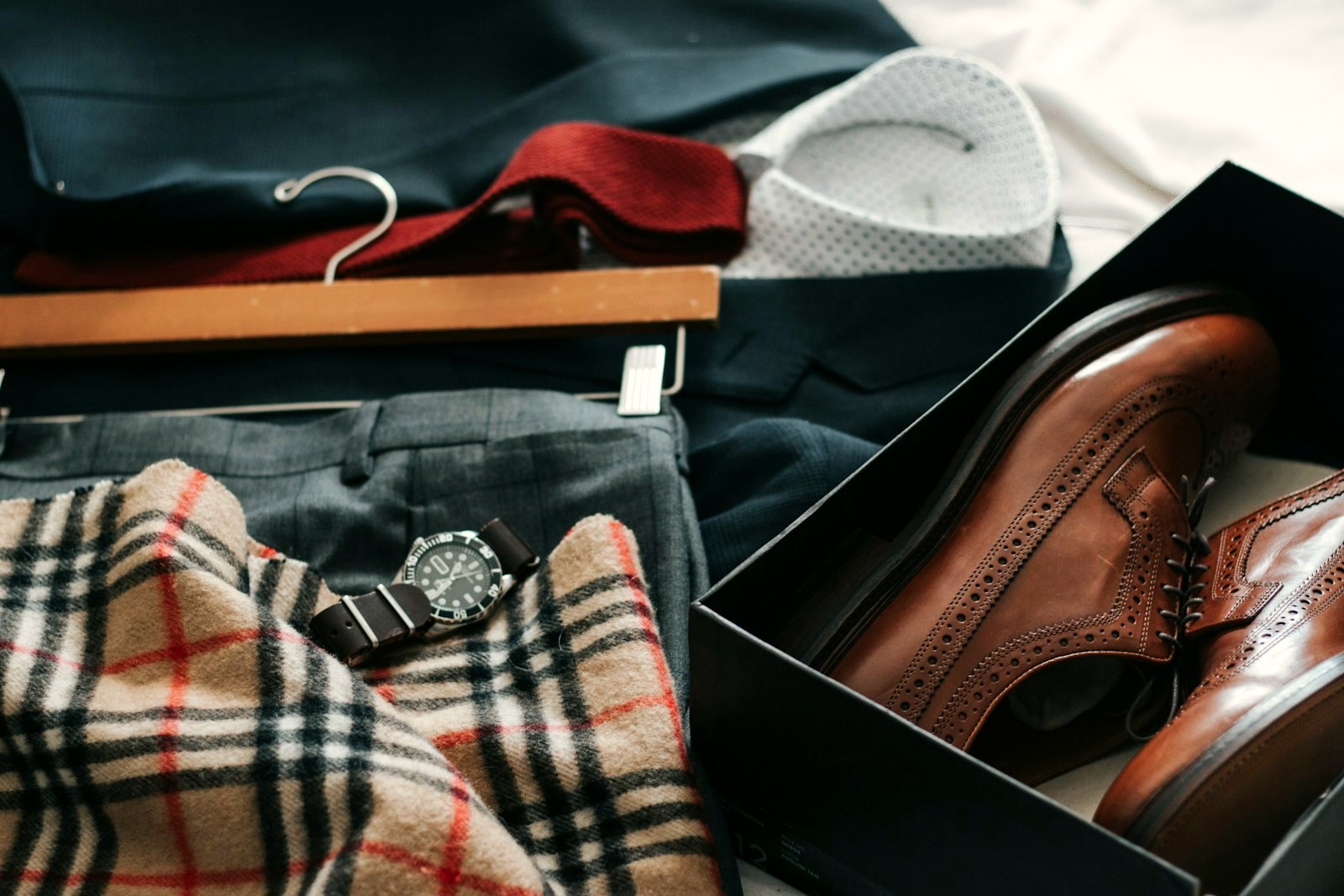
The photography, stated plainly, because this page’s subject is another of the bank’s empty shelves, and the emptiest in the suit family. The bank holds no frame of a double-breasted garment in any form: no 6x2 worn closed on a street, no crossed front in close view, no jigger’s side of a jacket, nothing. The hero is a checked single-breasted suit worn on a leafy street, CREDITS-logged and carried on other tailoring pages, printed here for the tailored register and captioned as the single-breasted suit it is. The figure in the record is a flat lay of the tailoring wardrobe’s furniture, grey trousers, a navy blazer that is likewise single-breasted, brogues and a watch, a banked spare, captioned as a flat lay and not as this page’s subject. No frame has been captioned as a double-breasted suit, as a wrap or as a closing pair, and the frames that stand in are captioned for the register they actually show. The harvest list this page is waiting for, in order: first, a navy 6x2 worn closed on a street at the middle pair, photographed at chest height with the wrap’s line unbroken; second, a double-breasted front in close view, the overlap, the two columns and the closing pair readable in one frame; third, a 6x1 in profile, its long lapel roll running unbroken to the lowest pair.
Questions, answered
What is a double-breasted suit, exactly?
A suit whose jacket front wraps: instead of two fronts that meet at a single column of buttons, the double-breasted jacket carries two fronts that overlap, one crossing over the other across the chest, held by an internal button, the jigger, on the inner wrap and by one closing pair of the buttons that stand in two columns on the outside. The configuration is named by its button count and its closing rows: a 6x2 shows six buttons and closes at the middle pair, a 6x1 closes only at the lowest pair, a 4x2 shows four and closes at the upper pair. Its lapel is a peak lapel, the form that continues the wrap's diagonal line up to the collar; the notch lapel on a double-breasted front is the single-breasted suit's lapel carried over. It is a lounge suit, ruled by the same family law as the single-breasted suit in our suit brief, with one architectural difference that governs everything else about it: its front is a closed system, and it is worn buttoned.
Which buttons do you fasten on a double-breasted suit?
The pair the pattern was drawn to close, and the internal jigger button always. On a 6x2, the standing form, the closing pair is the middle pair, the two buttons at the natural waist; the top pair and the bottom pair are the front's furniture, standing in their columns unbuttoned. On a 6x1 only the lowest pair closes, which is what gives that configuration its long lapel roll. On a 4x2 the upper pair closes. Behind whichever pair closes stands the jigger, a button sewn inside the jacket that fastens the inner wrap to the front it crosses, holding the underlayer flat so the outer front can close over a level surface. Fastening the wrong pair, the bottom pair of a 6x2 worn alone, or every closable pair at once, pulls the wrap out of the geometry it was cut in and shows at the waist as a diagonal strain. The rule is the pea coat brief's sentence, printed for the family's other double-breasted front: the front is worn closed, on the buttoning the pattern was drawn for.
Can you wear a double-breasted suit unbuttoned?
No, and the refusal is architectural rather than prim. A single-breasted jacket is a front with an opening in it: it is cut to be opened, to be sat in unbuttoned, to stand open over a waistcoat or a knit, and its silhouette survives its opening. A double-breasted jacket is a wrap: its silhouette, the continuous crossed field across the chest, exists only while the wrap is held, by the jigger inside and the closing pair outside. Unbuttoned, the two fronts fall away from each other and hang from the shoulders as panels, the overlap that made the garment's argument is undone, and what remains reads not as a relaxed suit but as an unfinished one. The rule includes the chair: the double-breasted suit is sat in buttoned, its ease built into the cut of the wrap rather than borrowed by opening it, which is why its fit at the waist is graded more strictly than the single-breasted suit's. Our black tie brief prints the same condition for the dinner jacket's double-breasted form, the licensed variation, which is worn buttoned; the lounge suit's version is the same architecture in a daytime cloth.
What is the jigger button, and why does it matter?
The jigger is the internal button of a double-breasted front: a button sewn to the inside of the jacket, with its buttonhole on the inner front, which fastens the wrap's underlayer in place before the outer front is closed over it. It does the front's invisible work. Without it the inner wrap is held only by the outer front's pressure, and it sags and shifts as the wearer moves, so the crossed line of the chest wanders and the closing pair takes a diagonal strain it was not sewn to take. With it fastened, the inner front lies flat and still, the outer front closes over a level surface, and the wrap reads as one continuous field. It is the hardest-working button on the garment, under constant sideways tension, and its doctrine is printed in this page's care section: it is fastened at every wearing, it is checked like a fastening under load, and a loose jigger is a tailor's five-minute repair that becomes a torn inner front if it is left to tear out.
Can you wear a waistcoat with a double-breasted suit?
It can be bought, and this brief rules against wearing it, on the wrap's own arithmetic. A waistcoat is a garment for a front that opens: it furnishes the chest a single-breasted jacket shows when it stands open, and it covers the waist that jacket leaves visible. The double-breasted front never opens and never shows the waist; worn closed, it presents its own crossed field from collar to hem, and a waistcoat beneath it is a layer purchased, buttoned and carried at a station no eye reaches, adding its cloth under a wrap that already carries two layers across the torso. The three-piece double-breasted suit exists in the trade's catalogues as a period form, and as a period form it is graded: a quotation of the configuration's 1930s ascendancy, worn where quotation is the register. For the working wardrobe the ruling stands: the double-breasted suit is a two-piece garment, its waistcoat money spent on the second suit instead.
Double-breasted or single-breasted: which should a man buy first?
The single-breasted, and the order is the foundation's, the same order this family prints for the double monk in our monk strap brief. The single-breasted suit is the wardrobe's general instrument: it opens, it sits at a desk unbuttoned, it takes a waistcoat and a knit, it separates into a jacket and trousers that each work alone, and it stands in every row the suit stands in. The double-breasted suit is the dressed register of the same wardrobe, a closed front that is worn one way, in the rows where its statement is the occasion's register, and it separates poorly, its crossed front reading as an orphaned suit jacket over odd trousers where the single-breasted jacket passes as a blazer. A wardrobe that begins with the double-breasted discovers its limits at the same stations the double monk's buyer discovers his: not in the rooms it was bought for, but in all the others. The suit ranking that grades this shelf stands at Verdict Card No. 64, where the Spier & MacKay Core Suit stands at 85; the double-breasted is the second or third suit of a tailored wardrobe, bought when the foundation it varies is already standing.
Who does a double-breasted suit flatter, and who should be careful?
The wrap's arithmetic is printed rather than mystical: the double-breasted front adds a second layer of cloth across the torso and draws two vertical button columns down it, so it widens the chest's read and firms the torso's. On the slim and the average frame that is the configuration's standing gift, a chest with architecture on a body that supplies little of its own, and the tall frame wears any configuration, the 6x1's long roll included. The care belongs to the broad and the short. On a broad torso the wrap adds its layer to a chest that needs no widening, and the gift reads as girth. On a short torso the horizontal emphasis of the button rows and the wrap's crossed lines shorten the body's read further; the shorter wearer's configuration is the 4x2, less cloth across and fewer rows, or the 6x1, whose closing pair sits low and whose lapel rolls long, lengthening the chest's line instead of dividing it. None of this is a prohibition. It is the silhouette's pricing, printed before the looks the way this family prints every licence with its conditions.
Has Young Cotton ranked double-breasted suits?
Not as a configuration, and the absence is printed rather than papered over. The suit shelf is graded at Verdict Card No. 64, best suits for men, where the Spier & MacKay Core Suit stands at 85, and that ranking grades suits as records, cloth, construction and documents, not front configurations as species. No Card separates the double-breasted from the single-breasted for grading, and this brief invents no score: it rules the configuration inside the family's standing record, our suit brief's fit rules and outfit matrix, the repayment law of No. 62, the ceremony seats of No. 04, and the closed-front sentence the pea coat brief prints for the family's other double-breasted garment. When the desk grades the double-breasted shelf on its makers' published records, this page's rulings will be re-argued from that Card.
Next
The family this brief stands in: No. 04, the suit, whose fit rules and outfit matrix this brief’s configuration inherits entire, whose peak lapel sentence it adopts, and whose ceremony rows it stops below; No. 62, a suit without a tie, whose repayment law prices this page’s tieless licence and whose wrap the open collar is repaid across; No. 70, monk straps, the brief before this one, whose shoe seats this page’s pairings inherit and whose foundation order, the statement species bought after the instrument it varies, this page’s wardrobe order repeats; the pea coat brief, the family’s other double-breasted front, whose worn-closed sentence this brief takes as law; and the ceiling this licence stops below, No. 67, black tie, where the double-breasted form stands as a uniform’s licensed variation, worn buttoned, inside a grammar this suit does not enter. The brief before this one stands at No. 70; the series began with the cardigan and the full run lives in the How to Wear index. How every score behind those pages is built stands on our methodology page.