
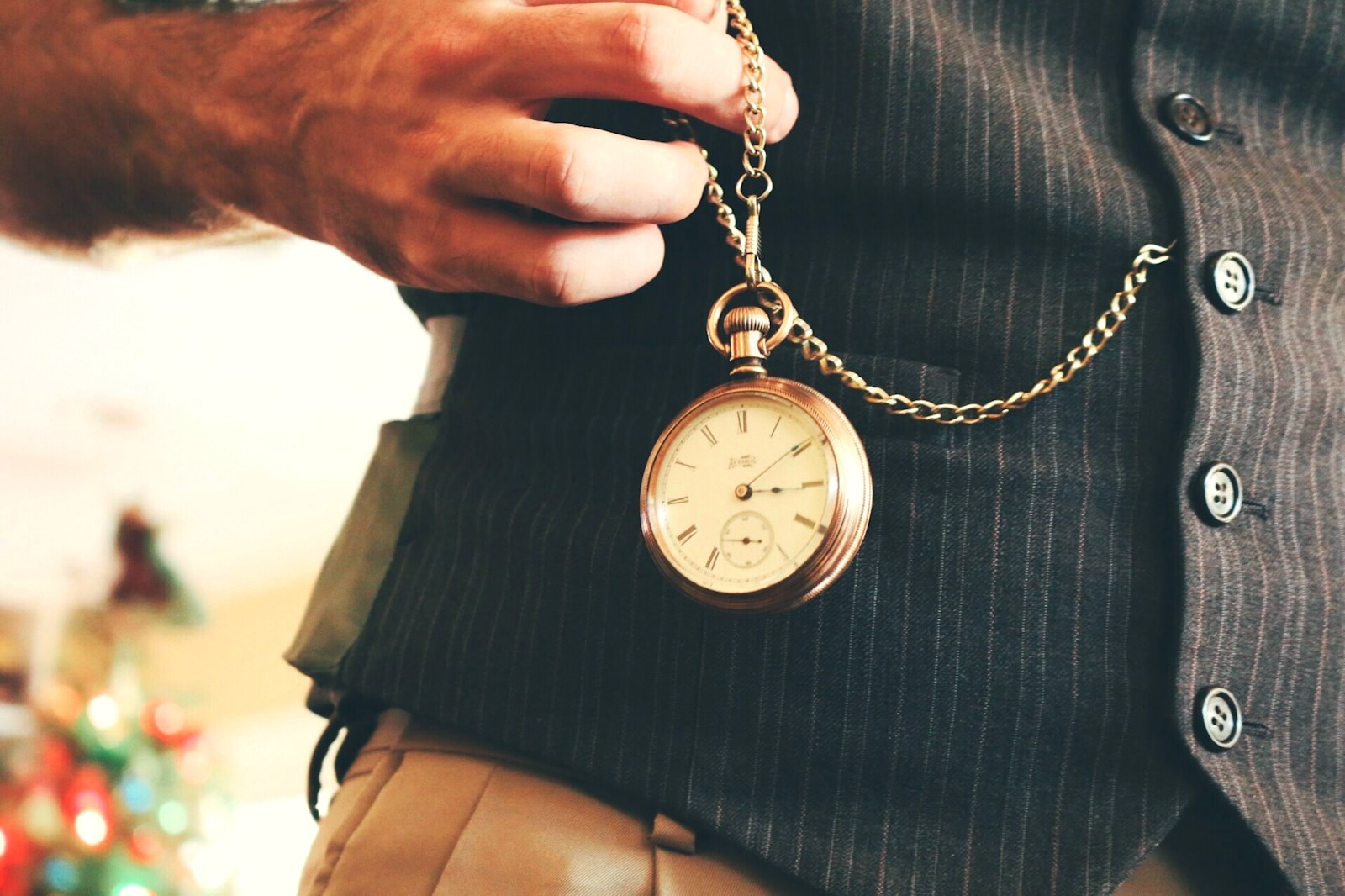
The garment in close view, the bank's one true waistcoat frame: a pinstripe waistcoat worn with its watch chain at the buttonhole station this brief's pairing law rules, the hem meeting the trouser as the decisive rule requires. The frame is carried on the wallets ranking and captioned for what it shows; the bank holds no three-piece suit worn full length, and the care section prints the gap and the harvest list entire.
Checked and updated October 2026
The ruling, up front: the waistcoat is the suit’s middle layer, the furnishing of the single-breasted front that opens, and it is worn as part of a closed system of three: jacket, waistcoat and trouser cut and worn as one assembly, in which the waistcoat’s column is buttoned to the last button but one, the lowest button left undone as the garment’s one licensed informality, and its hem meets the trouser’s waistband with no shirt showing between. It exists to cover machinery, the waistband, the brace buttons, the shirt’s lowest button, and to furnish the chest the opened jacket displays, and every failure this page grades is one of those two jobs left undone. It inherits two refusals entire and argues with neither: under the double-breasted wrap it is refused by No. 71 as a layer no eye reaches, and at black tie it appears only in the low evening cut No. 67 prints as the uniform’s senior waist covering, which is a different garment at the same name. Between those refusals stands its own ground, the three-piece suit and the odd waistcoat, and its own open question, the waistcoat worn without the jacket, which this brief rules on honestly rather than blessing: as a state, yes; as an outfit, no. This brief prints the record first; then the pairing law; then the rooms and hours; and the looks, the ruling, the mistakes and the keeping after all of it. On scores: no Card grades the tailored waistcoat, and the one number quoted here, the Core Suit’s 85 at Verdict Card No. 64, is the suit shelf’s, cited as what it is.
This brief: the decisive rule · the garment’s record · the pairing law · the rooms and hours · the looks · the ruling · the mistakes · care, the middle layer’s keeping, and our photography
The decisive rule: the middle layer of a closed system, buttoned to one button short, its hem on the waistband
Every garment in the suit family is governed by the front it belongs to, and the waistcoat’s front is the single-breasted jacket’s opening. That jacket is cut to be opened: it stands open over the torso at the desk, in the chair, in the warm room, and everything it shows when it opens is furnished, the shirt, the tie, and, at the waist, the waistcoat. The waistcoat is the suit’s middle layer: a sleeveless garment in the suit’s cloth, buttoned down a single column, whose two jobs are to furnish the chest the opened jacket displays and to cover the waist the opened jacket exposes. The covering is not decoration. Below the jacket’s button the tailored assembly is machinery: the trouser’s waistband and its fastenings, the brace buttons, the shirt’s lowest button and the shirt’s tail where it meets the trouser. Black tie’s grammar prints the doctrine for the whole wardrobe at No. 67: the waist is a joint, and machinery is not shown. In the lounge suit the waistcoat is the covering the doctrine assigns, the layer that keeps the joint dressed while the jacket does its opening and closing above it. The decisive rule follows entire: the waistcoat is worn as the middle of a closed system of three pieces, its column buttoned down to the last button but one, the lowest button left undone, and its hem meeting the trouser’s waistband all the way round, with no shirt showing between hem and trouser at any point of the wearing, standing or sitting. That sentence is this brief’s spine, and everything below is its working.
The rule’s two clauses are both measurements, and both can be checked in a mirror in the two minutes No. 67 allows the uniform’s wearer. The first is the column’s foot. The lowest button stands at the body’s hinge, the point where the torso folds, and a column fastened to its last button pulls across that hinge when a man sits, drags the hem off the waistband when he stands, and spends the day announcing the strain at the assembly’s centre. The open lowest button is the garment’s ease, and it is licensed the way the family licenses every ease, by convention with a story attached: the trade assigns it to Edward VII’s waist and his court’s courtesy, a story printed in the garment’s record below with its attribution, because the convention is the law whatever the story’s truth. The second clause is the hem’s address. The waistcoat is cut to end where the trouser begins, its hem overlapping the waistband by the small margin the tailor leaves, and the system holds only while the trouser is worn at the height it was cut for, the natural waist. Worn there, the join closes: cloth meets cloth, and the machinery stays covered standing, walking and seated. Worn at the hip, no waistcoat made can reach the trouser, and the white triangle that opens between hem and waistband is the system’s failure made visible, the lounge suit’s version of the measurement No. 67 prints for the uniform. A waistcoat is therefore not bought by the chest alone. It is fitted as a join, hem to waistband, with the wearer seated, both the column’s ease and the covering’s overlap tested in the posture that breaks them.
What the closed system buys, at that discipline, is the lounge suit at its fullest register, and the rule’s second half prices it the way this family prices every licence. The three-piece suit is the single-breasted suit with its opening furnished entire: where the two-piece shows shirt and tie in a V, the three-piece shows a column of the suit’s own cloth with the tie standing in it, and the assembly reads one register more dressed at every station, the boardroom’s formal end, the wedding’s guest rows, the rooms where the suit is asked to be an occasion’s dress rather than a day’s uniform. The waistcoat also buys the suit’s one licensed undressing: the jacket taken off at a desk or a long lunch leaves a dressed man rather than a man in his shirtsleeves, because the middle layer was built to be the surface the room sees in the jacket’s absence. Both purchases are priced in the rooms below, and both are forfeited by the wearing this brief will not bless, the waistcoat promoted from middle layer to outer one, where its unfinished back and its borrowed register spend the garment’s whole credit in a single assembly. The waistcoat’s dignity is positional. It is the most dressed thing in the wardrobe that is never the outside of anything, and the rulings that follow are the keeping of that position.
The garment’s record: the king’s vest, the ornamental century, and the third piece of the lounge suit
The garment first, because the waistcoat’s construction is its argument in cloth: a front of the suit’s cloth, a back of light sateen, and a strap between them. The front is the display: a single column of buttons, five or six in the standing form, closing a front cut from the same cloth as the jacket and trousers it stands between, with two or four pockets at its waist, the lower pair being the watch’s station in the garment’s instrumented century. The back is the economy: a plain sateen or silk back, unlined in its show, crossed low by a cinch strap with a small buckle, by which the garment’s fit at the waist is adjusted once and then left. The back is built cheaply because it was built to be covered, the jacket standing over it for the whole of the garment’s public life, and that economy, honest in its place, is the construction fact the jacketless ruling in the rooms is built on: a waistcoat’s reverse is a working side, and a working side is not a display surface. The species divide by their columns and their cuts, printed here as this family prints its ladders. The single-breasted waistcoat is the standing form, one column, the lounge suit’s third piece and the odd waistcoat’s shape. The double-breasted waistcoat is the dressed form, two columns on a wrapped front in miniature, the country and ceremony register, asking the plainest company the pairing law allows. The low-cut evening waistcoat is No. 67’s garment, its opening deep so the dress front stands, ruled by the uniform and not by this page. And the name’s other tenants are excluded by species, as the gilet brief excludes them in the other direction: the knitted sweater vest and the insulated gilet share the silhouette and none of the construction, the law or the rooms.
The history is a court garment’s long descent into the working wardrobe, and it is printed as the published record tells it. The waistcoat arrives in English dress as a deliberate act of state: in October 1666 Charles II declared a new fashion at court, a long vest in the eastern manner worn under the coat, and Samuel Pepys recorded the declaration in his diary as the king’s break with French dress, the garment entering the record as a uniform before it was a style. The eighteenth century was its ornamental age: the waistcoat was the one place in a man’s dress where silk, embroidery and figure were licensed at full strength, worn long and skirted, the assembly’s display surface in an age when the coat stood open by design. Through the nineteenth century it shortened as the coat closed and the lounge suit assembled itself, disciplined into the suit’s own cloth, until by the Edwardian years the three-piece suit stood as the complete form of tailored dress, the waistcoat its middle term, carrying the watch on its chain as the dress’s working instrument. The lowest button’s story belongs to that court’s end: the trade’s standing attribution gives the open button to Edward VII, whose fuller waist is said to have left it undone, the court copying the king’s ease until the copying hardened into the cutting room’s rule. This page prints the story as the trade tells it and the convention as law, the two standings kept separate the way this family keeps every inherited claim: the button is left undone because the garment is cut and worn so, and the king is the story the custom tells about itself.
The twentieth century is the garment’s demotion and its survival, and both halves are the record’s. Central heating, the car, the two-piece suit’s economy and the century’s general undressing demoted the waistcoat from the suit’s default third piece to its optional one, and the watch chain went first, its instrument replaced at the wrist, which is why the chain has become the garment’s quotation mark, graded in the pairings. What survived is a register rather than a default: the three-piece as the lounge suit’s dressed form, the wedding guest’s standing upgrade, the country suit’s warmth and the odd waistcoat’s furnished contrast under tweed. The garment’s record on this site is a refusal, a grammar and a shelf, printed entire because this brief rules inside all three. No. 71 refuses the waistcoat under the wrap in terms this brief adopts as law: it furnishes a front that opens, the double-breasted front never opens, and beneath it the waistcoat is a layer no eye reaches. No. 67 seats its evening form as the uniform’s senior waist covering, mandatory where the cummerbund is not worn, low-cut, in the jacket’s cloth or white Marcella, and prints the measurement this brief transposes, no triangle of white shirt below the waistcoat’s points. And the suit shelf at Verdict Card No. 64, the Spier & MacKay Core Suit at 85, grades the assemblies the waistcoat completes without grading the layer itself. The garment has been ruled at both its borders and never at its centre. This brief is the centre’s ruling.
The pairing law: the furnished opening, the odd waistcoat’s terms, and the chain’s station
The pairing law’s first principle is that the waistcoat is read through an opening, and everything it pairs with is priced by what the opening shows. The jacket stands open or closed over it by the hour, and in both states the waistcoat is the torso’s centre: closed, it fills the jacket’s V with the suit’s own cloth and the tie’s length; open, it is the dressed surface entire. The shirt under it is the suit’s shirt, governed by No. 04’s matrix entire, with one addition of this brief’s: the shirt’s front below the waistcoat’s hem is covered machinery, so the shirt is tucked and stays tucked, its lowest button done, the waistcoat’s covering being only as good as the layer it covers is orderly. The tie is the standing form and its law is inherited: No. 64’s width answering the lapel, the tie shelf’s winner the Sam Hober grenadine at 91 on Verdict Card No. 40, its knot standing in the collar above the waistcoat’s column, its blade falling to the column’s top buttons and no further into the furnishing. The tieless three-piece is refused at the standing register: an open collar over a garment whose whole work is dressed completeness reads as the system with its top station left undone, the waistcoat having raised the assembly’s formality past the point where No. 62’s repayment law can be spent on it; a man who wants the open collar owns the two-piece, where the law was written for it. The square obeys No. 65’s law entire, white linen at its discipline, the chest already furnished by the column below it having no need of a second statement beside the tie.
The matched waistcoat and the odd waistcoat are the pairing law’s two forms, and their terms are printed separately because they fail separately. The matched form is a cloth question with one answer: the waistcoat is cut from the suit’s cloth, from the same length where the tailor can manage it, so that the three pieces age, fade and clean as one garment across the wardrobe’s years; a matched waistcoat bought later, in the same cloth from a different dye lot, is the near-match the questions refuse, an assembly that reads as two suits introduced. The odd form is a contrast with rules. Its cloths are the furnishing cloths: doeskin and moleskin in their plain depths, tweed in its checks under a plain jacket, linen in summer under a plain suit, each standing as the outfit’s one furnished statement under the pattern law transposed from the chest: one loud element to the torso, a figured waistcoat under a plain jacket, a plain waistcoat under any jacket, and never a figured waistcoat under a figured jacket, where the opening becomes an argument between two patterns with the tie caught in it. Its season is its cloth’s season, as every cloth’s is in this family: the linen waistcoat under tweed is a summer instrument in a winter assembly, and the pairing fails on the calendar before it fails on the eye. Below the waist the pairings are geometry: the trouser at the natural waist on braces or adjusters under the belt refusal the questions print, its break at No. 04’s slight default, and the shoe rows inherited entire, the ceremony rows the Oxford’s under No. 04’s seating and the social rows admitting the single monk of No. 70 as the decision shoe beside the derby.
The chain is the waistcoat’s own furniture and the last of the pairings, priced here because it is the garment’s most misread station. The watch chain was an instrument’s mounting before it was an ornament: the watch lived in the waistcoat’s pocket because the wrist was not yet its home, and the chain, anchored through a buttonhole of the column, was the instrument’s security, the means by which a dropped watch fell six inches instead of to the floor. The forms are two: the single Albert, one chain from the buttonhole to the pocket, the standing form; and the double Albert, the chain’s dressed form, anchored at its centre with a drop piece and a watch at one end. The ruling is register’s. With a working watch at its end the chain is furniture, the metals law of No. 70 applying to it as to every metal the assembly wears, the chain answered by the buckle, the links and the watch at the wrist where one is also worn. Without a watch, a chain worn as a quotation of the instrument is costume jewellery at the torso’s most-read station, and this page grades it with the period forms: lawful where quotation is the register, a vintage room, a deliberate archaism worn entire, and a failure in the working wardrobe, where the assembly’s every other element is in earnest. The hero frame at this page’s head shows the station furnished in earnest, the chain anchored at the buttonhole and run to the pocket over the pinstripe, which is the only way this brief licenses it printed.
The rooms and hours: the suit’s dressed rows, the country register, and the summer’s pricing
The three-piece’s rooms are the lounge suit’s rooms read at its dressed register, the waistcoat adding its step of formality to every row of No. 04’s matrix it enters. The boardroom is licensed entire, at its formal end: the matched three-piece in navy or charcoal is the working wardrobe’s most complete dress short of ceremony, the assembly that asks nothing of the room’s forgiveness, and in the rooms where the two-piece is the uniform the third piece reads as deliberateness rather than excess, the wearer having finished the garment. The wedding’s guest rows are its natural home, the standing answer to the invitation that asks the day suit to dress: the three-piece is the guest’s upgrade that costs no rule, ceremony’s register approached from the lounge suit’s side and stopped, correctly, below the uniform. The funeral admits it in the darkest cloth under the sombre rows’ ordinary discipline, the covered waist answering the room’s wish to see machinery nowhere. The odd waistcoat’s rooms are the country and the dressed day: under tweed in the season No. 68 and No. 74 share, the races, the long lunch, the rooms where a furnished contrast is the occasion’s own register, the waistcoat there doing the work a tie’s figure does in town, at the torso’s centre, in cloth.
The refusals are three, and each is a confusion of layer rather than of taste. The first is the wrap’s, inherited from No. 71 entire: the waistcoat under a double-breasted front is a layer at a station no eye reaches, refused in the questions with its reasoning. The second is the uniform’s: the lounge waistcoat at black tie, high-cut over a dress front the grammar exists to display, is the wrong garment at the right station, and No. 67’s low evening waistcoat, bought for the uniform, is the covering the room requires; resemblance is not transfer, in this family’s standing sentence on the two garments that share the double-breasted name, and it is not transfer here. The third is the season’s: the waistcoat is a layer, and a layer is warmth, and its licence thins as the heat rises exactly as its cloth-cousins’ licences do in this family, the flannel’s summer refusal in No. 74 being the same law in another finish. The summer forms exist and are priced: the odd linen waistcoat under an open plain suit in the day’s rooms, the matched three-piece rested until the cold returns. A waistcoat worn through August at full column is a man heating himself to keep a register, and the register is not worth the temperature, the wardrobe’s summer completeness standing in the two-piece and its own briefs.
The jacketless question is answered here, in the rooms, because it is a question about where the garment may be seen. The state is licensed and its rooms are private and working: a man’s own desk, his own rooms, the long lunch’s late hour in company that knows the assembly entire, the jacket on the chair’s back and the waistcoat keeping the torso dressed, its front the suit’s cloth, its column buttoned to the licensed button, the covering intact. In those rooms the wearing is the three-piece suit at rest, and it is graded as a posture, not an assembly. The outfit is refused, and its rooms are all the others: the street, the restaurant floor, the room a man enters dressed. There the waistcoat as the top layer shows the room its sateen back and its strap at every turn, the working side of a middle layer promoted to a display surface, and it collects the service reading the record names, a century of staff waistcoats standing between the wearer and his intention. The honest garment for the sleeveless dressed top is not this one. It is the knit worn as a top layer in its own right, or the gilet in the outdoor register, each built to be an outside. The waistcoat was built to be a middle, and middles are judged by the systems they complete.
The looks: four assemblies the brief licenses
| Setting | The assembly | The details | The judgment |
|---|---|---|---|
| The standing three-piece | A navy single-breasted suit with its matched waistcoat, the column buttoned to the last button but one | A white shirt, a dark grenadine tie at the standard width, black Oxfords, a white linen square, the trousers on braces at the natural waist, the hem on the waistband | The system closed entire: the opening furnished in the suit’s own cloth, the tie standing in the column, the lounge suit at its most dressed short of ceremony |
| The wedding guest | A charcoal three-piece, matched waistcoat, worn through a long day | A pale shirt and a matte sober tie, Oxfords, the jacket taken off at the reception’s late hour and the waistcoat keeping the assembly dressed | The garment’s founding purchase spent lawfully: the upgrade the invitation asked for, and the licensed undressing when the day lengthens |
| The odd waistcoat | A plain tweed jacket over a doeskin waistcoat, single column, against flannel trousers | A checked shirt of the working register or a plain one, a wool tie, suede or grained shoes under No. 68’s law, no second pattern anywhere | The furnishing cloth as the outfit’s one statement: contrast in the middle layer, the season’s two matte cloths related around it, not matched |
| The instrumented form | A pinstripe three-piece with the watch on a single Albert, anchored at the column’s buttonhole | The watch in the waistcoat’s lower pocket, the chain’s metal answered at the links and the buckle, the square at white linen’s discipline | The hero frame’s assembly entire: the chain as furniture with its instrument at its end, the waistcoat carrying the dress’s one working instrument as it was built to |
The ruling
Wear the waistcoat as the middle layer it is. Buy it with the suit where the matched form is wanted, in the suit’s own cloth, or singly in a furnishing cloth under the odd form’s terms, and fit it as a join: the column closing without strain, the hem meeting the trouser’s waistband all the way round with the wearer seated, the trousers at the natural waist on braces or adjusters. Button it to the last button but one and leave the lowest undone, at every wearing, in every room. Keep its refusals: never under the double-breasted wrap, never the lounge cut at black tie, never as the assembly’s outer layer in a room you enter dressed. Spend its purchases where they are legal tender: the boardroom’s formal end, the wedding’s rows, the country register of the odd form, and the long day’s licensed hour with the jacket on the chair. Ruled so, the waistcoat is what its construction promises: the suit’s completeness made visible, a middle layer that furnishes the opening, covers the machinery and carries the instrument, the most dressed garment in the wardrobe that is never the outside of anything.
Where the wearing goes wrong
The triangle of shirt. The geometry failure, and the one this brief’s rule is built to catch: the waistcoat’s hem riding clear of the trouser’s waistband, a wedge of white shirt standing between them at the assembly’s centre. It fails on the covering’s own terms, the machinery the garment exists to hide displayed in a frame of the suit’s cloth, and it is almost never the waistcoat’s fault: the trousers are worn at the hip, a waistband’s width below the height the system was cut for, and no hem made can reach them. No. 67 prints the same measurement for the uniform, no triangle below the waistcoat’s points, and the lounge suit’s version differs only in its stakes. Its repair is the trouser’s address, not the mirror’s adjustment: the waist worn where the waist is, on braces, and the join closed at the tailor’s with the wearer seated.
The column closed to its foot. The ease refused: the lowest button fastened with the rest, the wearer reasoning that a buttonhole unbuttoned is a fastening unfinished. It fails mechanically before it fails ceremonially. The button stands at the torso’s hinge, and fastened, it makes the hem a strap across the fold: the column strains when the wearer sits, the front pulls at its lowest station, and the strain reads at the exact point the eye finishes the garment. The convention it breaks is the garment’s one licensed informality, the single ease a formal layer is permitted, descended in the trade’s story from a king’s comfort and kept because the geometry agrees with the story. A waistcoat buttoned to its foot is not more correct than its licence. It is the licence declined, at the price of the strain that advertises the declining.
The waistcoat under the wrap. The furnishing failure, inherited from No. 71 and reprinted because it is still bought: the three-piece double-breasted, the waistcoat buttoned beneath a front that never opens. It fails on visibility’s arithmetic, as the double-breasted brief grades it: every element of the tailored wardrobe is worn where an eye can reach it, and the waistcoat under the wrap is carried at the one station the garment guarantees no eye reaches, a third layer across a torso already double-covered, its price the deposit on the second suit No. 71 says the money belonged to. The period form exists, and the questions grade it as a period form. The working wardrobe’s ruling is the record’s: the waistcoat’s front is the single-breasted one, which opens.
The waistcoat as the outfit. The layer failure: the waistcoat worn without the jacket as a dressed claim, in rooms the wearer enters dressed, the street, the restaurant, the evening. It fails on construction’s terms, which the rooms print: the garment’s back is sateen and strap, a working side built to be covered, and as the assembly’s outside it shows that side at every turn of the body, while its front, however handsome, is a middle without its system, a furnished chest over an unfinished back. The reading the room gives it is the record’s, a century of staff waistcoats standing in the form, and no wearer’s intention outvotes the room’s archive. The licensed state, jacket off at his own desk among his own, is not this failure, and the distance between them is the whole ruling: a posture inside an outfit against an outfit missing its top half.
The near-match and the pattern argument. The pairing failures, printed together because both are contrast misjudged. The near-match is the odd waistcoat’s cowardly form: a cloth close to the suit’s but not of it, reading at conversational distance as a three-piece assembled from two suits and a tailor’s apology, neither the matched form’s unity nor the odd form’s decision. The pattern argument is its loud twin: a checked or figured waistcoat under a figured jacket, two patterns disputing the torso’s centre with the tie as their battlefield, the one-loud-element law broken at the station where the eye rests longest. Both fail the same way, by declining to choose which form is being worn. The matched form is a unity and the odd form is a decision, and a waistcoat that will not commit to either is upholstery.
Care, the middle layer’s keeping, and our photography
A middle layer is kept as part of its system or it ages out of it. The three pieces are cleaned together, always, the waistcoat travelling with its jacket and trousers to the cleaner and the press, because cloth fades and wears at the rate of its cleanings and a waistcoat cleaned on its own schedule becomes, inside a few years, the near-match the mistakes refuse, its cloth a shade off the suit it was cut from. The hanging is its own: on a hanger that fills its shoulders as a jacket’s does, buttoned to the licensed button, so the front keeps its line and the hem its set; folded in a drawer it creases across the column, and the crease is across the garment’s display. The strap and its buckle are inspected like fastenings under load, in the doctrine No. 71 prints for the jigger: the cinch strap sets the garment’s waist and holds it against a day of sitting, its stitching and its slider checked when the suit comes back from wear, a slipping strap being the waistcoat’s version of the wandering wrap, the fit going quietly out of true at a station the wearer cannot see. The chain’s buttonhole is the second working fastening: it carries the chain’s anchor under a small constant tension, and its stitching is checked with the strap’s. The front is brushed after wear, pressed from behind and never creased by an iron laid on its face, and the whole rests a day between wearings on the wardrobe’s rotation, the three pieces resting together so the rotation is the system’s and not the pieces’.
The rulings this brief prints beyond the tree’s standing record are gathered here once, the way the family gathers its extensions. The refusals and laws are the family’s, cited as theirs: No. 71’s refusal of the waistcoat under the wrap, with its period grading of the three-piece double-breasted; No. 67’s waist-covering grammar, its seniority of the waistcoat, its low evening cut and its no-triangle measurement; No. 04’s fit rules, outfit matrix, ceremony seats and break ladder, as No. 71 cites them; No. 62’s repayment law; No. 70’s shoe seats and metals law; No. 65’s square law; No. 64’s tie law and Verdict Card No. 40’s winner; the gilet brief’s species line, the waistcoat travelling under the jacket on the tailoring briefs’ laws; the suit shelf’s standing at Verdict Card No. 64. This brief’s own are: the closed system of three stated as the garment’s decisive rule, with the column’s foot and the hem’s address as its two measurements; No. 67’s no-triangle measurement transposed from the uniform to the lounge suit and marked as a transposition; the jacketless wearing ruled as a licensed state and a refused outfit, on the back’s construction; the odd waistcoat’s terms entire, its cloths, its one-loud-element law and its seasons; the belt refused under the hem and braces or adjusters seated in its place; the tieless three-piece refused, No. 62’s law held unspendable at this register; the chain’s doctrine, furniture with a watch, quotation without one; and the keeping’s system rule, the three pieces cleaned, rested and rotated together. Nothing scored stands behind any of them: the one number quoted here, the Core Suit’s 85, is Verdict Card No. 64’s, cited as what it is, and the garment carries no number of its own because none has been graded.
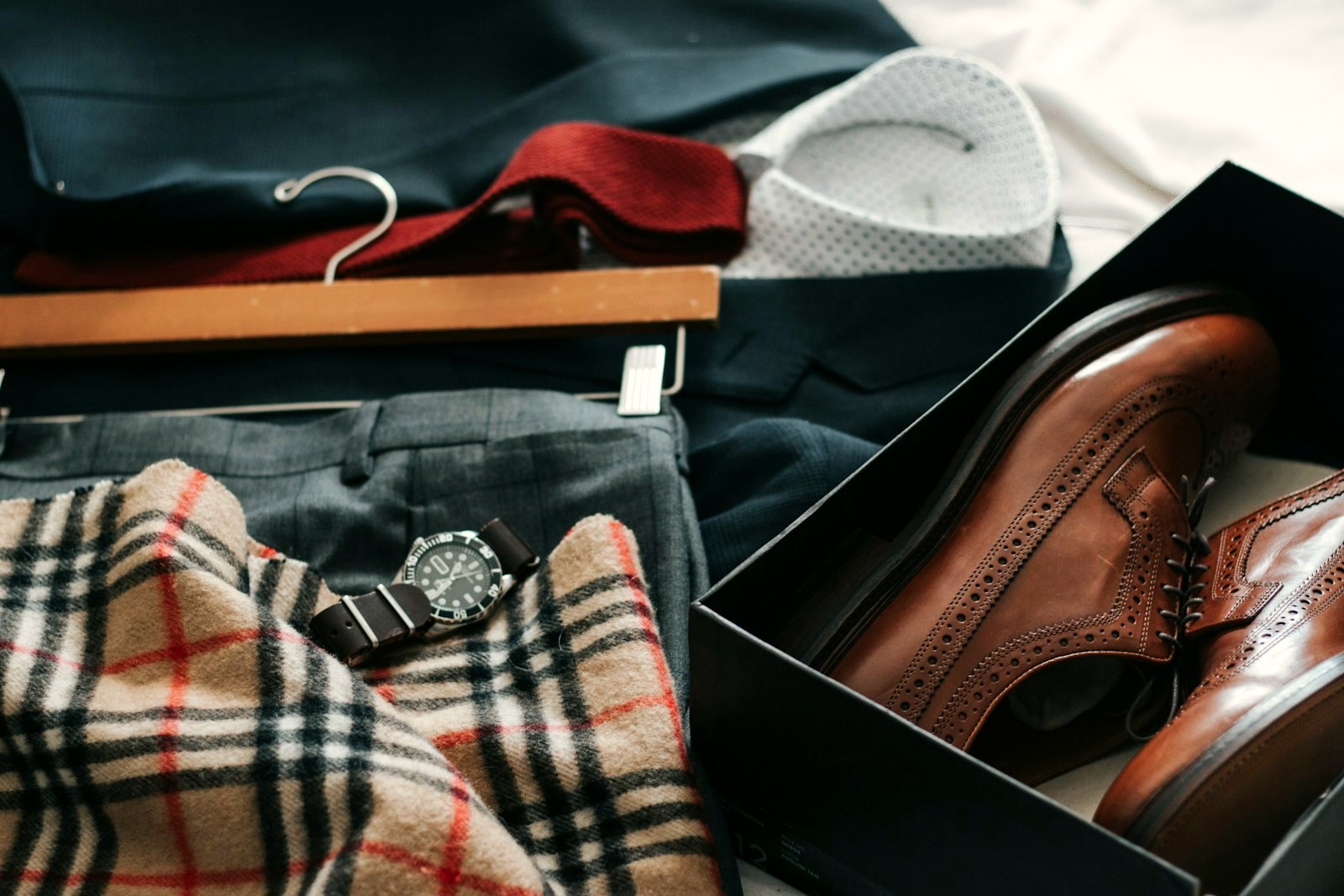
The photography, stated plainly, because this page’s subject is another of the bank’s thin shelves, though not an empty one. The bank holds exactly one true waistcoat frame: the hero, a pinstriped waistcoat in close view with its watch chain anchored at the buttonhole and run to the pocket, the hem meeting tan trousers, CREDITS-logged and already carried on the wallets ranking and the aesthetics page, printed here for the garment itself and captioned for exactly the stations it shows. The figure in the record is a flat lay of the tailoring wardrobe’s furniture, shared with No. 71 and captioned as a flat lay. The bank holds no three-piece suit worn full length, no matched waistcoat under an opened jacket, no odd waistcoat in any cloth, no waistcoat’s back and cinch strap, and no column in close view with its lowest button undone. The harvest list this page is waiting for, in order: first, a three-piece suit worn full length on a street, the jacket open over the matched waistcoat, the column and the hem’s join readable in one frame; second, an odd waistcoat under a tweed jacket, the furnishing cloth against the plain one; third, the waistcoat’s back, the sateen and the cinch strap, the working side this page’s jacketless ruling is built on; fourth, a column in close view at its foot, the lowest button undone over the waistband it meets.
Questions, answered
What is a waistcoat, exactly?
The tailored suit's middle layer: a sleeveless, close-fitting garment of the suit's cloth at its front and a light sateen at its back, buttoned down a single column, cut to end where the trousers begin. It is the furnishing of the single-breasted front that opens. Where the jacket stands open or is taken off at a desk, the waistcoat is the dressed surface that remains: it covers the shirt's front and the waist's machinery, the trouser's waistband, the brace buttons and the shirt's lowest button, and it carries the suit's one instrument, the watch on its chain, anchored at a buttonhole with the watch in the waistcoat's own pocket. It is not the gilet of the outdoor trade and not the sweater vest of the knit rail, which are different garments that share its silhouette and none of its law. Our gilet brief rules it out of that species in one sentence: the sleeveless garment tailoring owns is the waistcoat, and it travels under the jacket, on the tailoring briefs' laws. This page is those laws.
Why is the lowest button of a waistcoat left undone?
By convention, and the convention is the garment's one licensed informality, printed here with its standing attribution rather than as certain history. The story the trade tells assigns it to Edward VII, whose waist, in the fuller years, is said to have made the lowest button a courtesy, first his own and then his court's, until the open lowest button descended from the court into the trade's cutting rooms and stayed there as custom. Whether the story is true in its details is beyond the documents this desk can grade. What is gradeable is the convention's function, which is mechanical as much as ceremonial: the waistcoat's hem is cut to sit at the trouser's waistband, and the lowest button stands at the body's hinge, so a column fastened to its foot pulls across the waist when a man sits and rides up when he stands. The open button is the garment's ease, built into its wearing the way the double-breasted suit's ease is built into its wrap. Fastening it is not a style error of the loud kind. It is the refusal of the one ease the garment licenses, and the hem's strain announces it.
Should a waistcoat match the suit, or contrast with it?
Both forms are lawful, and they are different registers with different rooms. The matched waistcoat, cut from the suit's own cloth, makes the three-piece suit: the lounge suit at its most dressed short of ceremony, the assembly our looks print for the boardroom at its most formal and the wedding's guest rows. The odd waistcoat contrasts in cloth: a doeskin, a tweed check, a plain linen in summer, worn under a plainer suit or a tweed jacket, and it is the country and dressed-lunch form, the waistcoat as the outfit's one furnished statement. The law that governs both is the pattern law this family prints at the chest: one loud element to the torso. A checked or figured waistcoat stands under a plain jacket; under a patterned jacket the waistcoat is plain or it is not worn. What is refused is the near-match, a waistcoat in a cloth close to the suit's but not of it, which reads at every distance as a three-piece suit assembled from two, the mismatch neither decision nor accident but the appearance of one.
Can you wear a waistcoat without the jacket?
As a state, yes; as an outfit, this brief rules against it, and the ruling is construction's before it is taste's. The waistcoat is a middle layer and it is built as one: its front is the suit's cloth and its back is a light sateen with a cinch strap, an unfinished side made to be covered by the jacket, the same economy that lines a jacket's interior. Worn as the assembly's outer layer, the garment shows the room its working side, the strap and the sateen, and reads as a suit with its argument removed, a dressed torso waiting for its top half; the service echo the form carries, the waistcoat as staff uniform from a century of bars and dining rooms, is the room's reading and not this page's invention. The licensed state is the working one: the jacket off at a man's own desk, on the chair, in his own rooms, the waistcoat keeping the assembly dressed while the jacket rests. That is a posture inside an outfit, not an outfit. The man who wants the sleeveless dressed layer as his top half is asking for a different garment, and the wardrobe's honest answers are the knit and the gilet in their own registers, ruled in their own briefs.
Can you wear a waistcoat with a double-breasted suit?
No, and the refusal is not this page's to soften, because it is printed entire in the double-breasted brief, No. 71, whose jurisdiction the configuration is. Its reasoning is the wrap's arithmetic: a waistcoat furnishes a front that opens, and the double-breasted front never opens, worn closed at both its closures for the whole of its wearing, so a waistcoat beneath it is a layer purchased, buttoned and carried at a station no eye reaches, its cloth adding a third layer across a torso the wrap already covers twice. No. 71 grades the three-piece double-breasted as what it is in the trade's catalogues, a period form, a quotation of the configuration's 1930s ascendancy, worn where quotation is the register. For the working wardrobe its sentence stands as this family's law and this brief repeats it without amendment: the double-breasted suit is a two-piece garment, its waistcoat money spent on the second suit instead. The waistcoat's home is the single-breasted front, which opens to show it.
Is the lounge waistcoat the same garment as the black tie waistcoat?
The same species at a different cut, and the difference is the shirt front. Black tie's grammar, ruled entire in No. 67, requires a waist covering without exception, a waistcoat or a cummerbund, because the waist is the uniform's joint and its machinery is not shown. The waistcoat is the senior of the two forms, and it is cut low, its opening deep, so that the dress shirt's Marcella front and its studs stand above it and are the assembly's display. The lounge waistcoat is cut high, its column rising to furnish the chest a single-breasted jacket shows, and worn under a dinner jacket it covers exactly what the uniform exists to display, leaving the grammar with its front furnished in the lounge suit's manner. So the evening waistcoat is a waist covering that happens to share the lounge garment's name and construction, bought for the uniform and worn inside it, in the jacket's cloth or in white Marcella in the oldest form. A wardrobe that owns black tie owns its waistcoat separately, the way it owns its dress shirt separately, and the three-piece's middle layer does not transfer.
Belt or braces with a waistcoat?
Braces or side adjusters, and the reason is the waistcoat's own geometry. The waistcoat's hem is cut to meet the trouser's waistband and cover it, the join this brief's decisive rule is built on. A belt's buckle stands exactly at that join, under the hem, and it does three kinds of damage at once: it prints its outline through the waistcoat's front, it pushes the hem off the waistband so the shirt shows in the gap the rule refuses, and it shows machinery at the one station the garment exists to cover. The trouser under a waistcoat is therefore held the way the uniform's trouser is held in No. 67, by braces or by side adjusters, and it is worn at the natural waist, which is the height the whole system was cut for. A waistcoat worn over trousers that sit at the hip cannot meet their waistband, and the triangle of shirt that appears between hem and trouser is not the waistcoat's failure. It is the trouser's address, printed in the mistakes.
Has Young Cotton ranked waistcoats?
Not the tailored waistcoat as a shelf, and the absence is printed rather than papered over. The sleeveless garments this site has graded are the waistcoat's namesakes, not the garment: the vests and gilets ranking grades the outdoor layer, and the sweater vests ranking grades the knit, each a different species sharing a silhouette. The suit shelf the waistcoat belongs to is graded at Verdict Card No. 64, best suits for men, where the Spier & MacKay Core Suit stands at 85, and that ranking grades suits as records, cloth, construction and documents, not their middle layers as a species. This brief invents no score: it rules the garment inside the family's standing record, No. 71's refusal, No. 67's grammar, No. 04's matrix and seats, and the tie and square laws of Nos. 64 and 65. When the desk grades the three-piece shelf on its makers' published records, this page's rulings will be re-argued from that Card.
Next
The family this brief stands in: No. 71, the double-breasted suit, whose refusal of this garment under its wrap this brief adopts as law and answers from the other front, the single-breasted one that opens; No. 67, black tie, where the waistcoat stands in its low evening cut as the uniform’s senior waist covering, inside a grammar the lounge garment does not enter; No. 04, the suit, whose matrix, seats and break ladder the three-piece inherits entire; No. 74, flannel, the brief before this one, whose cloth the country three-piece wears and whose season line the odd waistcoat’s rooms share; the vest or gilet brief, the silhouette’s other species, whose species line assigns this garment to the tailoring laws this page prints; and No. 73, pleated trousers, the stored cloth the waistcoat’s hem meets at the natural waist both garments insist on. The brief before this one stands at No. 74; the series began with the cardigan and the full run lives in the How to Wear index. How every score behind those pages is built stands on our methodology page.