

Trousers in motion, captioned as exactly that: a suited cyclist, the leg working the way a pleat is built to work. The bank holds no pleated trouser on a body in any cloth, a gap our pleated trouser ranking prints on its own page, and no frame here is captioned as showing a pleat the frame's distance cannot prove; the care section prints the gap and the harvest list entire.
Checked and updated October 2026
The ruling, up front: a pleat is stored cloth. It is a fold at the trouser’s front that lies flat and closed while the wearer stands and opens only in motion, sitting, striding, climbing, spending the cloth it stored across the front of the thigh and taking it back when he stands again. Everything about the garment is priced from that mechanism. It is worn at the natural waist, because the fold hangs shut from its anchor or not at all; it is cut full through the thigh and tapered below, because the fold must be the only thing that opens; and its front, worn with the shirt tucked and the waistband’s furniture showing, is the outfit’s worked surface, the tailored wardrobe’s ease made visible. The species stands in the record: our trouser index files it at formality 4 and prints its system entire, and Verdict Card No. 85 grades its shelf, the Natalino at 88 the standing winner, on a record that counts the pleats on six of eight makers’ pages, their direction on three, and their depth on none. This brief prints the garment’s record first; then the pairing law; then the rooms and hours; and the looks, the ruling, the mistakes and the keeping after all of it.
This brief: the decisive rule · the garment’s record · the pairing law · the rooms and hours · the looks · the ruling · the mistakes · care, the fold’s keeping, and our photography
The decisive rule: the pleat is stored cloth, and it is spent in motion or not at all
Every trouser in this family is governed by a question about its leg: the chino by its register, the wide leg by its volume, the flat-front by its line. The pleated trouser is governed by a question about its front, and the answer is mechanical before it is anything else. A pleat is a fold of cloth stored at the front of the trouser, at the waistband, to be spent when the wearer moves. Standing still, in a trouser that fits, the fold does nothing: it lies flat against the front, its edge reading as a crease, the stored cloth invisible behind it. The moment the wearer sits, the geometry of the seated body asks the front of the trouser for length and width it does not have lying flat, and the fold opens and pays the cloth out, across the thigh, exactly where the demand is. Standing again, the fold takes the cloth back. The pleat is therefore not fullness and not decoration. It is the tailored garment’s answer to a problem the flat-front trouser solves by fitting closer and forgiving less: a seated man needs more trouser than a standing one, and the pleat is where the difference is kept. The decisive rule follows entire: the pleat is read flat and closed standing, and open only in motion; a pleat that gapes at rest has been defeated before the wearer takes a step, and a pleat that never opens is a crease with pretensions. That sentence is this brief’s spine, and everything below is its working.
The rule’s first condition is the anchor, and it is a condition of height. A fold hangs by gravity from the point it is stitched to, and the pleat is stitched to the waistband. Worn at the natural waist, the band sits level above the hips, the fold falls plumb from it, and its own weight keeps it closed at rest. Worn low, dropped to the hips the way the slim decades taught a generation to wear every trouser, the same fold is dragged sideways by the band’s tilt, the cloth at the front is pulled across a body it is no longer aligned with, and the pleats stand open in the mirror, the stored cloth displayed as slack. Nothing about the garment has changed; its anchor has moved, and a mechanism moved off its anchor reads as a defect. This is why our trouser index prints the rule as a system rather than a preference: pleats are a system, high rise, full thigh, taper below, and a pleat on a low-rise slim leg is a contradiction, because a pleat is a fold of cloth that needs somewhere to live. The index’s bands give the system its numbers: low under 10 inches, mid 10 to 11.5, high 11.5 and above, and pleats require the high band. The mid-rise pleated trouser is sold, and our ranking graded the ones it met, charging the Cavour’s medium-rise model and the mid-rise Bonobos for the compromise on their cards; a shortened anchor is a shortened licence, and the wearing cannot refund what the cutting spent.
What the mechanism buys, at that price, is the most comfortable tailored trouser in the wardrobe and the one whose comfort is legible, and the legibility is the register. A pleated front announces itself: the fold’s line from the band, the cloth’s depth at the front, the silhouette of a garment built for a body that sits and stands in it all day. It is not the quiet trouser in a room of flat fronts. It is the tailored wardrobe’s ease worn openly, formality 4 on the index’s scale, and its failures are all failures of the mechanism read as failures of taste: the pleats worn open, the fold pressed out, the storage spent on a leg too tight to need it. The wearer who understands the storage owns a trouser that fits standing and forgives sitting, which is the whole of a working day; the wearer who buys the fold as a silhouette owns a pair of creases that gape, and the difference between the two is not the trouser. It is whether the system the fold belongs to came with it.
The garment’s record: the fold, its directions, and the shelf as graded
The garment first, because its anatomy is shorter than its mythology and more useful. The pleat is a fold stitched down from the waistband. The cloth at the front is folded under or over itself for the first inches below the band, the fold held by its stitching, and released where the stitching ends, somewhere over the upper thigh, from which point the fold’s cloth falls as the leg’s front. The stitching’s length is the garment’s tuning: a long stitched section holds the front trim over the stomach and releases the cloth where the thigh takes over; a short one opens sooner and fuller. Behind the fold stands the rest of the system our index prints: the waistband built to hold a height, in its fullest published form curtained, split at the rear and reinforced with internal canvas, so the band can sit at the natural waist all day without rolling; the full thigh, cut with the room the fold’s spending assumes; and the taper below the knee, bringing the leg back to a clean landing. The species divide by the fold’s count and its direction, and the divisions are printed here as this family prints its ladders, by register.
The single pleat is the standing form: one fold to a side, the storage a working day spends, the front at its cleanest, a crease with a mechanism behind it. The double pleat is the fuller form: a second, smaller fold set outboard of the first, toward the pocket, storing more cloth and reading with more depth, the front of the drape tradition the garment descends from, asking for a cloth with body and a thigh with room to carry it. Beyond the two stands the ladder’s refused end, the triple pleat of the garment’s fashion decades, storage multiplied past any body’s spending, a fold kept for the silhouette it makes standing still, which is the one thing a pleat is not for; it is named here to close the ladder. The direction divides orthogonally to the count. A forward pleat folds toward the fly, the fold’s opening facing the centre front: the English form, the fold of the traditional drape cut, releasing its cloth across the front. A reverse pleat folds toward the side pocket, its opening facing the hip: the continental form, whose crease line runs uninterrupted from the band in most modern cutting, and the form the contemporary trade has settled on. Neither direction is a correctness; each is a tradition with a cutting logic behind it, and a buyer is entitled to know which he is buying. The record’s finding, printed below, is that the market largely declines to tell him.
The garment’s published history is a history of the waist’s height, and it is printed as the record tells it. The fold is old in workwear and uniform, where ease at the front was a working requirement before it was a style, and it enters the tailored wardrobe with the high-waisted drape trouser of the interwar decades: the full thigh, the band at the natural waist, the pleats spending their cloth across a generation of men who sat at desks and stood at lecterns in the same garment. The slim decades that followed deleted the system entire, the low rise and the narrow leg ruling the fold a contradiction by making it one, and the pleat survived as the older generation’s trouser, which is the reputation its revival still spends against. The return came in two waves, the 1980s’ fuller cut, which restored the fold and exaggerated its company, and the current one, which restored the system at its classical proportions: the high band, the full thigh, the taper, the fold as engineering rather than as period quotation. The modern garment is the interwar system with the record’s lesson learned, that the pleat is not a silhouette. It is a mechanism that happens to have one.
The garment’s record on this site is a graded shelf, and it is printed entire because this brief rules inside it. Verdict Card No. 85 grades eight pleated trousers on cloth and weight honesty, the pleat and waistband construction record, fit and range, value, and longevity and service. The Natalino Classic Pleated Trouser won at 88: a Vitale Barberis Canonico woollen flannel at a published 340 grams, single reverse pleats, a curtained and split waistband with internal canvas, horn buttons and side adjusters, at £215, the only record in the field that publishes its mill, its weight, its pleat direction and its waistband’s whole construction. The Berg & Berg August Flannel followed at 80, double reverse pleats in the field’s heaviest published cloth at 430 grams, and the Cavour Summer Hightwist at 78, a single reverse pleat in a 240 gram VBC high-twist, its buttonholes handmade. Below them the field thins in the Card’s order: the Bonobos Italian Pleated Wool at 71, its double pleat published and its direction not, at a mid rise the Card charges; the COS wide leg at 58, its pleats uncounted; the Beams Plus 2 Pleats at 56, its count carried in its name and nothing else published; the Rota single-pleat at 52, the field’s highest price on its thinnest record; and the pair sent home, the Zara suit pant at 37, front pleats uncounted over an interior drawstring, in a cloth that is 6 percent wool. The Card’s counts are this brief’s evidence base, and they describe the species’ documentation exactly: the pleat count stated by six of eight, the direction by three, every one of them reverse, the pleat’s depth by none, in any unit, anywhere in the field, and a curtained waistband published by exactly one maker. The fold that defines the garment is counted by most, directed by a few, and measured by none. Neighbouring garments stand graded on their own Cards and are cited, not re-graded: the Spier & MacKay tropical wool trouser at 87 on Verdict Card No. 15, with its pleat option standing in its copy; the Brooks Brothers double-pleated wool flannel at 76 on the same Card; and the Drake’s single-pleat corduroy at 79 on Verdict Card No. 38.
The pairing law: the front is the worked surface, and the waistband is furniture
The pairing law’s first principle is that the pleated trouser’s front arrives worked. A flat-front trouser presents a plain field and the outfit’s interest is arranged elsewhere; the pleated front carries its fold lines, its waistband’s construction and its stored depth at the body’s centre, and the pairings are priced from that fact. The shirt is tucked, always. The tuck is not formality’s fussiness here; it is the mechanism’s display condition. The pleat’s whole argument happens between the waistband and the upper thigh, and an untucked shirt covers exactly that span, leaving the garment’s system hidden and its silhouette unexplained, a full front with no visible reason. A knit worn over the band commits the same covering with better intentions. The shirt itself is the tailored wardrobe’s ordinary shirt for the cloth and the room, and its collar and the tie above it are governed by the family’s standing law, No. 64’s entire where a tie is worn. The waistband’s furniture is worn as furniture. The system prefers side adjusters or braces, which hold the band level at its height by its own construction, over the belt, which holds it by cinching and can drag the pleats’ anchor down at the front and sideways at the hips over a day’s sitting. The fullest published waistband in the record, the Natalino’s, curtained, split and canvas-reinforced, is built for exactly this station. Where a belt is worn, it is worn at the natural waist as part of the tailored assembly, not dropped to the hips the trouser was cut against.
The jacket is furnished plainly, because the chest is not the only worked surface in the room. The tailored jacket over pleated trousers follows No. 04’s law entire, its fit rules and its matrix, with one transposition: the outfit carries two deliberate surfaces, the jacket’s front and the trouser’s front, and the stations between them, the shirt, the tie, the square, are kept at the plain end of their own laws so the two worked fronts are not competing with a third. The suit form of the garment, pleated trousers under their own jacket, is the system at its most complete and stands in the looks below; the trouser worn as a separate takes the odd jacket under the ordinary law, with the cloth contrast doing the work the fold’s register does not need to. The shoe is the cloth’s shoe under the suit matrix, and the hem is the system’s signature at the floor: the taper lands at the slight break, No. 04’s default, the cloth’s stored depth above resolving into a clean line at the shoe. A hem pooled over the shoe spends the taper the system bought; a hem cropped short of it shows the taper’s machinery unfinished. The crease is part of the pairing: the leg’s front crease is the pleat’s own line continued down the leg, and a pleated trouser worn uncreased has surrendered the fold’s visible half, the half that reads standing still.
The rooms and hours: the working trouser of the tailored wardrobe
The pleated trouser’s rooms are the tailored wardrobe’s working rooms, everywhere the suit trouser stands, read at the system’s register. The desk is its founding room: the garment was engineered for the man who sits for a living, and the office day, the sitting, the standing, the stairs, the car at both ends of it, is the exact cycle the fold is built to spend and recover across. No other trouser in the wardrobe is as specifically designed for its wearer’s actual day. The boardroom admits it entire, in its cloths of record, the flannels and high-twists of the ranking’s podium, worn as a suit or as a separate under a tailored jacket: formality 4 is a working formality, and the pleat’s depth at the front reads, in a room that wears tailoring, as a decision rather than a relaxation. The social day rooms stand beside them: the wedding guest’s rows, the long lunch, the races, the whole calendar where a tailored trouser is asked for and a full day is spent in it, the garment’s comfort compounding across exactly the hours the flat front taxes. The cloth sets the season, as cloth always does in this family: the flannel in the cold months, the high-twist and the tropical weights in the heat, under No. 07’s law where the pleated trouser is cut in linen, the fold’s storage doing in summer cloth what it does in wool.
The refusals are two, and both are confusions the rule predicts. The first is upward, and it is a refusal of degree rather than of kind: the ceremony rows of No. 04’s matrix, the formal evening and the funeral at their strictest, belong to the plainest front the wardrobe owns, the flat-front dress trouser in the darkest cloth, because those rooms price any worked surface as notice, and the pleat’s depth is a worked surface. The pleated trouser is not refused at a wedding; it is refused where the room’s discipline is invisibility. The second refusal is downward, and it is the system’s own: the pleated trouser has no untucked state. In the wardrobe’s rest hours, the knit over the band, the shirt out, the trainer at the foot, the garment’s mechanism is covered, its anchor is dragged and its register is spent arguing with company it was not cut for; the trousers that belong in those hours are the chino of No. 29 and the flat fronts of the rotation, which have no system to betray. The pleated trouser is worn where a man is content to be dressed at the waist for the length of the day, which is the compliment its engineering pays him back.
The looks: four assemblies the brief licenses
| Setting | The assembly | The details | The judgment |
|---|---|---|---|
| The standing form, as a suit | A single-pleat flannel trouser with its own jacket, the shirt tucked, the band held by side adjusters | A plain shirt, a matte tie under No. 64’s law, tailored shoes under No. 04’s matrix, the hem at a slight break, the crease pressed | The system at its founding register: the record’s winning specification worn as it was published, the fold closed standing and spent across the working day |
| The double pleat, at the fuller register | A double-pleat trouser in a cloth with body, worn as a separate under a plain odd jacket | Braces or adjusters at the band, nothing patterned at the waist, the leg full through the thigh and tapered to the slight break | The drape tradition’s dose: the second fold bought knowingly, its depth the outfit’s one depth, every station around it kept plain |
| The summer weight | A single-pleat high-twist or tropical trouser, worn with a tucked shirt and no jacket in the heat’s working rooms | The waistband’s furniture showing and meant to, sleeves at the forearm, the shoe the summer row’s tailored shoe, the crease kept | The system in its lightest cloth: the garment the ranking’s summer seat models, ease at the front doing the work a jacket’s absence asks of the trouser |
| The pleat in corduroy | A single-pleat corduroy trouser, the cloth of Verdict Card No. 38’s Drake’s at 79, under a knit or a soft jacket | The wale’s texture at the leg, the fold reading through it, the band at the natural waist, boots or suede at the foot | The system in the wardrobe’s informal cloth: the mechanism entire at a lower register, proof the fold is engineering and not a formality |
The ruling
Wear pleated trousers as the system they are. Buy the single pleat first, in a cloth with a published record, the mill and the weight and the direction in print where the record’s winner prints them; buy the double when the wardrobe stands and the fuller front is chosen rather than inherited. Have the band sit at the natural waist and keep it there, on adjusters or braces where the maker offers them, with the thigh full enough that the fold is the only thing that opens and the leg tapered to the slight break. Wear the shirt tucked, the jacket plain, the crease pressed and the fold left alone. Keep the garment in its rooms, the working day and the social day, and out of the ceremony’s strictest rows and the rest hours’ untucked ones. Ruled so, the pleated trouser is what its record says it has always been: the tailored wardrobe’s ease, engineered into a fold, worn by a man whose trouser fits him standing and forgives him sitting, which is the whole of the day he bought it for.
Where the wearing goes wrong
The pleats worn low. The anchor failure, and the one this brief exists to grade: the pleated trouser dropped to the hips, the band worn where the slim decades put every band, the folds standing open in the mirror. It fails on the mechanism before it fails on taste. The fold hangs shut from a level band at the natural waist; tilted and lowered, the anchor drags the stored cloth sideways and the pleats display their storage at rest, reading as slack at the front of a trouser that does not fit, which, at that height, it does not. The wearer concludes the species is unflattering. The species concludes nothing; it was never worn. The repair is the fitting’s, not the mirror’s: the band at the natural waist, held there by the garment’s own furniture, and the fold falls closed on its own.
The leg too tight to store anything. The fit failure: the pleated trouser bought slim, the thigh taken in to the flat-front’s line, the pleats pulled open by the leg itself before the wearer sits. It fails on the system’s second term. The fold is storage for a thigh with room to move inside the garment; a thigh that fills the trouser standing spends the storage standing, and the garment delivers neither the flat front’s line, which its folds interrupt, nor the pleat’s ease, which its fit has already consumed. It is the index’s contradiction worn rather than cut, the pleat on the slim leg, and its repair is the size’s: the full thigh is not a style option on this garment, it is the fold’s housing.
The shirt worn out. The covering failure: the untucked shirt or the knit over the band, worn from a habit formed on trousers with nothing at the waist to show. It fails on visibility’s arithmetic, the way the waistcoat failed under the double-breasted wrap: the span between the waistband and the upper thigh is the garment’s whole mechanism, and the covering spends it, leaving a full front unexplained and a waistband’s construction, adjusters, curtain and all, carried invisibly. The pleated trouser is the one trouser in the wardrobe whose top six inches are its argument, and the untucked shirt is an argument for a different garment. A wearer who will not tuck owns the wrong species, and the chino will forgive him what this trouser will not.
The pleat as styling. The specification failure, the record’s own skip worn knowingly or not: the fold sewn onto a trouser that deletes the system, the low or mid band, the token cloth, the drawstring inside the waistband where the construction should be. Our ranking graded its exemplar at 37 and the card’s sentence stands as this brief’s: a cloth that is 6 percent wool under a suit department’s signage, its pleats uncounted, its waist adjusted by a cord. It fails because it keeps the fold’s silhouette and removes everything the fold is for, storage, anchor and system entire, so the wearer gets the pleat’s one cost, its notice, with none of its return. The repair is the record’s: count the pleats, name the direction, publish the waistband, or do not sew the fold.
The fold pressed out. The keeping failure, committed by an iron rather than a wearer: the trouser returned from a flat press with its pleats ironed open at the front, the stored cloth flattened, the crease surviving and the mechanism gone. It fails structurally, as seersucker’s flat press fails in No. 72: the fold is the garment’s working part, and a press that treats the front as a flat-front’s field has unmade the garment in the act of maintaining it. The crease down the leg is pressed and should be; the fold at the band is set at its stitched head and left alone everywhere else. The repair is instruction, printed in the care section: steam the leg, press the line, and tell the cleaner the garment’s construction before he tells you his price.
Care, the fold’s keeping, and our photography
A pleated trouser is kept the way it is worn, at its height and with its fold intact. The band is the keeping’s first station: the trouser is hung from the waistband or folded over a wide hanger at the knee’s crease, never crushed at the front, and the band’s furniture, adjusters, buttons and the curtain’s canvas, is checked the way the double-breasted brief checks its jigger, as construction under daily load; a split rear waistband exists to be let out and taken in across a garment’s life, and the alteration is the system’s maintenance, not its failure. The crease is pressed and the fold is not. The leg’s front crease, the pleat’s line continued, takes the iron in the ordinary way, pressed sharp from the knee down and set through the thigh along the fold’s own release. The pleat’s stitched head, from the band to the stitching’s end, is pressed flat along its stitching, which is its set position. Below that, the fold is refreshed with steam, the distinction the garment-care shelf grades at Verdict Card No. 126, where the Jiffy J-2000 stands at 88: hang the trouser, steam the day’s sitting out of the front, and let the stored cloth fall back into its fold. A full flat press across the pleats is the one service to refuse by name. The cloth is rested a day between wearings on the rotation the wardrobe keeps, brushed after wear, and cleaned on the tailored trouser’s ordinary economy, the flannels and high-twists of the record being cloths that reward the press over the bath.
The rulings this brief prints beyond the tree’s standing record are gathered here once, the way the family gathers its extensions. The seats and laws are the family’s, cited as theirs: the trouser index’s formality 4 filing, its system sentence and its rise bands; Verdict Card No. 85’s ranking entire and its counts, count six of eight, direction three of eight and all reverse, depth none of eight, curtained waistband one of eight; No. 15’s Spier & MacKay at 87 and Brooks Brothers at 76, cross-referenced by No. 85 itself; No. 38’s Drake’s corduroy at 79; No. 04’s fit rules, outfit matrix and break ladder with the slight break its default; No. 64’s tie law; No. 72’s flat-press doctrine, transposed from cloth to fold. This brief’s own are: stored cloth stated as the garment’s decisive rule, with the fold read flat standing and open only in motion; the anchor priced as a condition of height, the natural waist or nothing; the chair test as the fitting’s verdict; the waistband’s furniture worn as furniture, adjusters and braces over the cinching belt; the untucked shirt graded as the covering failure; the double pleat seated as the fuller register of one system rather than a second species; and the ceremony refusal stated as a refusal of degree. Nothing scored stands behind any of them: the numbers quoted here are other pages’, cited as what they are, and the wearing carries no number of its own.
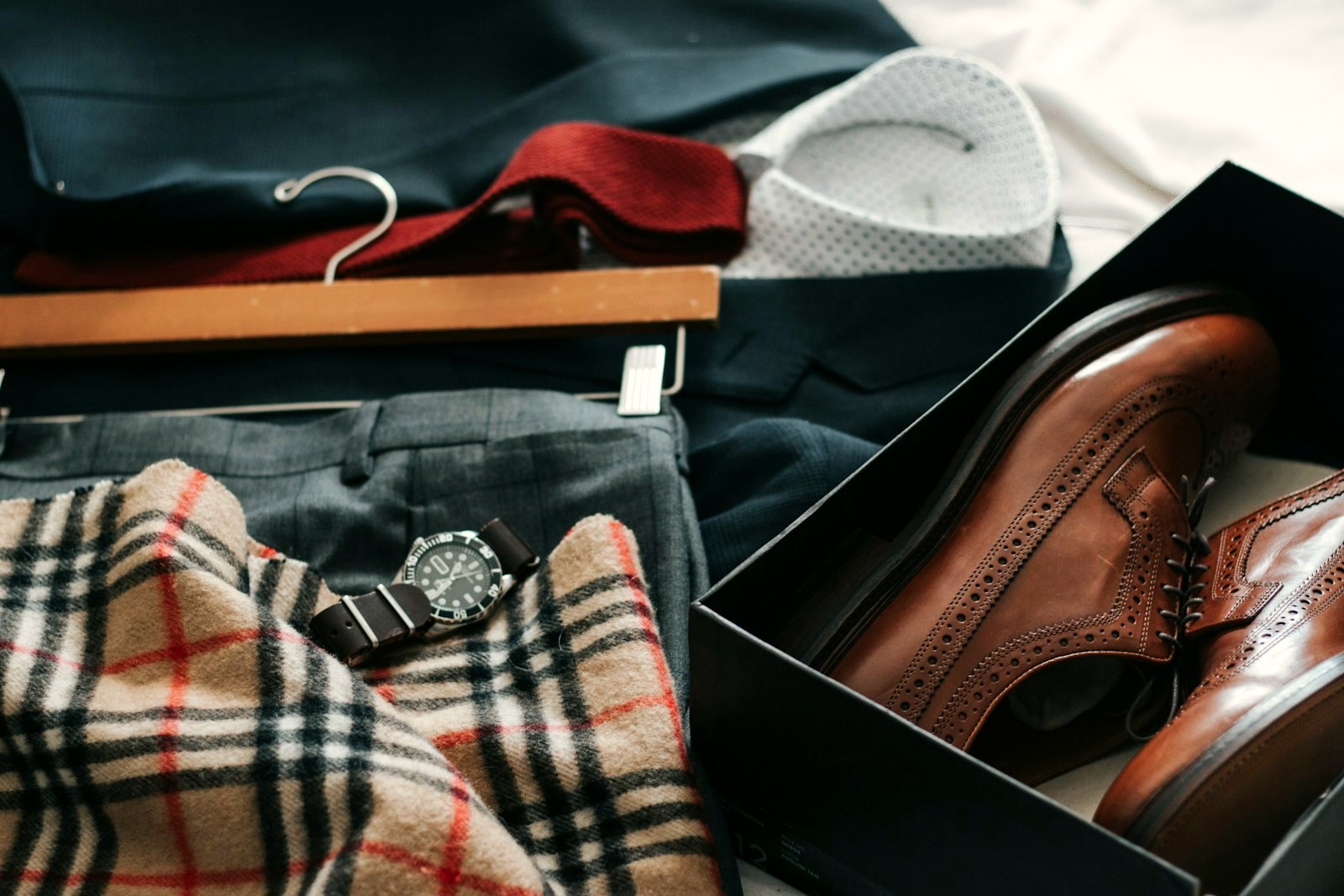
The photography, stated plainly, because this page’s subject is another of the bank’s empty shelves, and our own ranking said so first. The bank holds no frame of a pleated trouser on a body in any cloth: no fold at a waistband in close view, no pleated leg in motion, no curtained waistband in macro, nothing, the gap Verdict Card No. 85 prints on its own page and repeats in its harvest list. The hero is the bank’s suited cyclist on a Tokyo street, CREDITS-logged, tailored trousers on a body and in motion, printed for the register and the motion and captioned as neither pleated nor provable at the frame’s distance. The figure in the record is the tailored flat lay that fronts the ranking itself, grey trousers, a blazer, brogues and a watch, the trousers in it the flat-front form, captioned as a flat lay of the wardrobe and not as this page’s subject. No frame has been captioned as a pleat, as a fold or as a waistband’s construction, and the frames that stand in are captioned for what they show. The harvest list this page is waiting for, in order, is the ranking’s own, adopted: first, a pleated flannel worn, full length, the fold closed standing as this page rules it should read; second, a reverse pleat in close-up, the fold, its stitching and its release in one frame; third, a curtained waistband in macro, the construction the record’s winner alone publishes, photographed as it is described.
Questions, answered
What is a pleat, exactly?
A fold of cloth at the front of a trouser, stitched down from the waistband and released into the leg, whose work is storage. Standing still, a correct pleat lies flat and closed, a crease with cloth folded behind it. When the wearer sits, strides or climbs, the fold opens and spends the stored cloth across the front of the thigh, then closes again when he stands. It is ease engineered into the front of the garment rather than looseness cut into the whole of it: the trouser fits at the waist and through the leg, and carries its spare room in two folds at the front, where the body bends. Our trouser index files the species at formality 4 and prints the system the fold belongs to: pleats are a system, high rise, full thigh, taper below, because a fold of cloth needs somewhere to live.
Why must pleated trousers sit at the natural waist?
Because the pleat is anchored at the waistband, and it only hangs closed from the height it was cut for. A pleat is a vertical fold: gravity keeps it shut when the trouser sits at the natural waist, the fold falling straight from the band over a full thigh. Drop the same trouser to the hips, on a low rise or a band worn low, and the geometry turns: the cloth above the fold is pulled sideways, the pleats gape open standing still, and the stored cloth reads as spare fabric at the front rather than as a crease. Our trouser index prints the bands, low under 10 inches, mid 10 to 11.5, high 11.5 and above, and rules that pleats require the high band. The mid-rise pleated trouser exists in the trade, and our pleated trouser ranking charges the ones it graded for the compromise, the Bonobos at 71 and the Cavour's medium-rise model among them. The garment is worn at the natural waist or it is not worn at all, which is a fitting rule before it is a style rule.
Single or double pleats: which should a man buy?
The single pleat is the standing form, and the double is the fuller register of the same system. One pleat to a side stores the cloth a working day spends: sitting, striding, the car, the stairs. The second pleat, set outboard of the first, stores more and reads more, a front with a deliberate fullness that belongs to the drape tradition the garment descends from, and it asks for the cloth and the thigh to carry it. Our pleated trouser ranking graded both without preferring either in the abstract: its winner, the Natalino at 88, is a single pleat; the Berg & Berg August Flannel at 80 is a double; the pair sent home at 37 was convicted of other things entirely, an uncounted fold over a drawstring waist in a cloth that is 6 percent wool. Buy the single first, in a cloth with a published record. Buy the double when the wardrobe already stands and the fuller front is a decision rather than an accident.
Forward pleats or reverse pleats: what is the difference?
The direction the fold turns. A forward pleat folds toward the fly, toward the centre front, the form of the English tailoring tradition. A reverse pleat folds away from the fly, toward the side pocket, the continental form. The forward pleat's fold opening faces the centre, so its stored cloth releases across the front; the reverse pleat's opening faces the hip, and its crease line runs cleaner from the band in most modern cutting, which is part of why the contemporary trade has settled on it. Our pleated trouser ranking counted the published record: of eight graded pleated trousers, three state their direction at all, the Natalino, the Berg & Berg and the Cavour, and every one of the three is a reverse pleat. No maker in that field publishes a forward pleat's direction, and no maker anywhere in it publishes a pleat's depth in any unit. The direction is a real distinction with a real tradition behind each form; it is not a distinction the current market will let a buyer shop by, because most makers decline to state which one they are selling.
How should pleated trousers fit through the thigh and leg?
Full through the thigh and tapered below the knee, which is the system's second and third term. The thigh must carry enough cloth that the pleat is the only thing that opens in motion: a pleated trouser worn tight through the thigh spends its folds standing still, the creases pulled open by the leg itself, and reads as a flat-front trouser straining at its seams. Below the knee the leg tapers to a clean landing on the shoe, at the break our suit brief's ladder defaults to, the slight break. The failure in the other direction is the undated wide leg worn without the system: the fullness of the thigh carried untapered to the hem is a different garment, ruled in our wide-leg trousers brief, No. 47, and it does not borrow this species' licence. The fit test is the chair: sit, and the pleats open and the waistband stays where it was put; stand, and the pleats close and the crease falls straight. A trouser that passes standing and fails seated has been fitted to the photograph rather than to the wearer.
What goes with pleated trousers: shoes, jackets, shirts?
The tailored wardrobe's ordinary furniture, at the formality the index files the species at, which is 4, between the dress trouser and the chino. The jacket is a tailored jacket whose own front is furnished plainly, since the trouser's front is already the outfit's worked surface; the shirt is tucked, always, because an untucked shirt over a pleated waistband covers the garment's whole mechanism and reads as an apology for it. The waistband's furniture is part of the wearing: side adjusters or braces carry the trouser at its height better than a belt, which cinches the band and can drag the pleats' anchor down and sideways; where a belt is worn it is a tailored belt, worn at the natural waist and not through loops the maker added as a concession. The shoe is the suit wardrobe's shoe for the cloth in question, loafers and tailored shoes under our suit brief's matrix, with the hem at the slight break that is this family's default, so the taper lands where the system draws it.
How do you iron pleated trousers without pressing the pleats out?
The pleat is pressed along its crease, never across its fold. The trouser's front crease, the line the pleat releases into, is pressed sharp down the leg in the ordinary way; the pleat itself, the fold at the waistband, is set by pressing the stitched-down section at the top of the leg, from the band to where the stitching releases, and by steam elsewhere. What ruins the garment is the flat press laid across the pleats at the front, which irons the stored cloth open and leaves the front flat and the fold's memory gone: a pleated trouser pressed as a flat-front comes back as one, its system ironed out of it. It is the same error, in the tailor's register, as wearing the garment low: both spend the fold at rest. The garment steamer shelf's distinction, graded at Verdict Card No. 126, steam over pressure, is the home version of the rule: hang the trouser, steam the leg, press the crease line and the pleat's stitched head, and leave the fold itself alone.
Has Young Cotton ranked pleated trousers?
Yes, and this brief rules inside that record rather than beside it. Verdict Card No. 85, best pleated trousers for men, grades eight pleated trousers on cloth and weight honesty, the pleat and waistband construction record, fit and range, value, and longevity and service. The Natalino Classic Pleated Trouser won at 88, the only record in the field that publishes its mill, Vitale Barberis Canonico, its cloth weight, 340 grams, its pleat direction, single reverse, and its waistband's whole construction, a curtained and split waistband, at £215. The Berg & Berg August Flannel followed at 80 and the Cavour Summer Hightwist at 78. The Card's counts stand as this page's evidence: the pleat count stated by six of eight makers, the direction by three, every one reverse, the pleat's depth by none, and a curtained waistband by one. Neighbouring garments stand graded on their own Cards and are not re-graded here: the Spier & MacKay tropical wool trouser at 87 on Verdict Card No. 15, its pleat option in its copy, and the Drake's single-pleat corduroy at 79 on Verdict Card No. 38.
Next
The family this brief stands in: Verdict Card No. 85, the pleated trousers ranking, the record this brief rules inside, whose counts are its evidence and whose winner’s specification is its standing form; the trouser index, which files the species at formality 4, prints the system this brief’s rule restates, and bands the rises the anchor is priced by; No. 47, wide-leg trousers, the neighbouring fullness, whose untapered leg this system’s taper distinguishes it from; No. 40, ecru and white trousers, the rotation’s pale end, where the pleated form stands among the cloth’s own rulings; No. 04, the suit, whose break ladder and matrix this brief’s pairings inherit entire; and No. 29, chinos, the cotton middle the pleated trouser’s working rooms border on. The brief before this one stands at No. 72; the series began with the cardigan and the full run lives in the How to Wear index. How every score behind those pages is built stands on our methodology page.