
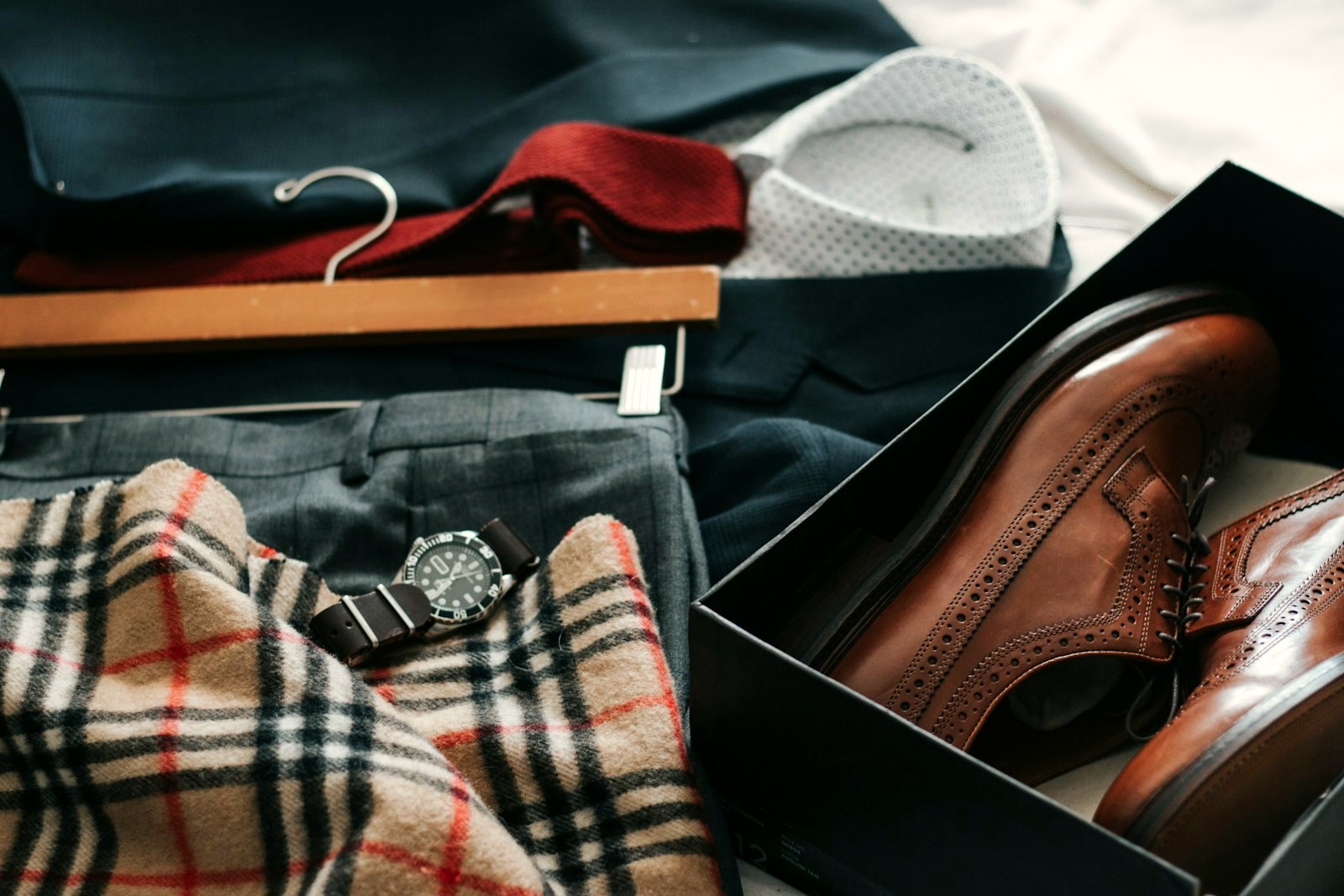
The tailored end, laid flat, captioned as exactly that: grey trousers on a hanger with a blazer, brogues and a watch. No garment in this frame is a wide-leg trouser on a body, and our bank holds no wide leg on a body in any cloth, the gap Verdict Card No. 85 admits for the pleated species entire; this page repeats the admission rather than covering it with a borrowed shot.
Checked and updated October 2026
The ruling, up front: a wide-leg trouser is not a size, a mood or a photograph of a runway. It is a proportion system with four dials, and our trouser index prints the numbers every dial is set by: a high rise of 11.5 inches and above, a leg opening of nine to ten and a half inches read against the shoe, a hem finished to end at the shoe, and a top half fitted or tucked that returns the waist the width spends. The index prints the whole brief in one line: width is worn with discipline, hem at the shoe, top half fitted or tucked, and pooling cloth is a mistake, not a silhouette. The records this brief styles are the trouser Cards': the pleated ranking, where the Natalino wins at 88 on the only complete construction record in its field and the one garment actually sold as a wide-leg pant stands at 58; the ecru ranking's Drake's fatigue at 83; the corduroy ranking's Field Games at 79; the linen ranking's Spier & MacKay Sondrio at 85; and the chino ranking the silhouette replaces, won at 84. This page prints the proportion test that shops for the garment, the break line that finishes it, the counterweight rule that dresses its top half, the shoe rows, the outfit matrix that assembles the whole thing, and the five ways the silhouette is ruined.
This brief: the decisive rule · know which wide leg you are holding · the proportion test · the break line · the counterweight rule · under tailoring · the shoe rows · the season line · the looks · the mistakes · care and our photography
The decisive rule: width is a proportion system, not a size
Every brief in this family has a rule that decides the garment, and the wide leg's is a law of proportion. The slim trouser this silhouette replaces could be worn on instinct, because a narrow leg forgives: its hem lands where it lands, its top half can hang loose, and the outfit reads as one continuous tube either way. The wide leg forgives nothing, because it spends the outfit's two fixed quantities at once: the leg's apparent length, which pooling cloth and a low rise both shorten, and the waist, which an untucked relaxed top half deletes. What is left when either is spent is not a relaxed outfit. It is a shorter man in a larger trouser. That is this brief's decisive rule, printed as new: a wide-leg trouser is bought on the trouser index's numbers and worn as a system of four agreements, a high rise that gives the leg its length, an opening in the wide band read against the shoe it covers, a hem tailored to end at the shoe, and a top half fitted or tucked that returns the waist; the width is the statement of the outfit, so everything the width touches is kept exact, and a wide leg bought a size up, hemmed long, or topped with volume has not been styled loosely, it has been bought wrong, because width is a pattern, cut into the leg by its maker, and a pattern cannot be improvised from a size.
The rule's first corollary is about the season, and it resolves in print a tension the desk's peer watch has been carrying all month. The AW26 read says relaxed fits are settling in; the SS27 read says structured tailoring is returning, cleaner lines and defined shoulders. Read as a contradiction, the two cancel. Read as a proportion system, they are the two halves of this brief: the wide leg is where the relaxed half lives, and the structure returns above it, in the fitted shoulder, the tucked shirt, the buttoned knit polo, the belt line showing. Volume below, structure above is not a compromise between the two seasons. It is what each of them looks like worn by a man rather than photographed on a rail, and the trouser records below are graded on exactly that division: the Cards publish the rises, the openings and the waistbands, because those are the facts the system runs on.
The second corollary is about buying, and it is the index's own order, adopted entire: buy the rise first, the cloth second, the taper last, because the order is the order of what can be changed. A taper can be tailored, a cloth is chosen at the rail, and a rise is forever. On the wide leg the order bites harder than anywhere else in the trouser family, because the silhouette's whole effect is the leg line, and the leg line is set at the waistband before the width is even reached. The proportion test below is the buying form of the rule: four checks, two of them run with a tape, each one a number the index prints and the Cards grade.
Know which wide leg you are holding: the species and their seats
The rail sells several garments under the wide leg's name, and the trouser Cards separate them by the cloth and the construction that carry the width, because the wearing rules differ by seat. The seats come first.
| Form | Build | Its seat on the Cards |
|---|---|---|
| The tailored pleat | The pleat system entire: high rise, full thigh, taper below, the width engineered to open and close | The Natalino Classic at 88 and the Berg & Berg August Flannel at 80 in Verdict Card No. 85 |
| The summer tailored leg | The same system in a light high-twist cloth, the width carried at a warm-weather weight | The Cavour Summer Hightwist at 78 in No. 85, 240 grams published |
| The work leg | Width in canvas and twill, the silhouette as a work cut, formality falling toward the work family | The Drake's Ecru Fatigue and the Carhartt WIP Single Knee, tied at 83 in No. 73 |
| The corduroy leg | Width in a ribbed winter cloth, the wale setting its formality | The Drake's Field Games at 79 and the J.Crew Relaxed-Fit Double-Pleated at 68 in No. 38 |
| The linen leg | Width in the heat's cloth, the crease accepted as the texture | The Spier & MacKay Sondrio High Rise at 85 and the Uniqlo Linen Blend Relaxed at 67 in No. 41 |
| The named wide leg | The silhouette sold under its own name at high-street, the system partial or unpublished | The COS Relaxed-Fit Wide-Leg at 58 in No. 85, its cloth split unpublished on its maker's US page |
| The name-only form | The tailored name over a drawstring waist and an uncounted pleat | The skip at 37 in No. 85, a suit pant at 6 percent wool |
One distinction causes most of the confusion in this family, and No. 85 prints it as the species line this brief adopts whole: the pleat is not the wide leg's decoration, it is its structure. The pleated trouser's width is room engineered at the waist, a fold that opens when the wearer sits or strides and closes when he stands, which is why the Card's system insists on the high rise and the full thigh: the fold needs somewhere to live. The plain wide leg's width is the pattern's alone, the same cloth at the hip as at the hem, and it is carried honestly by the cloths that were always cut wide, the work canvas, the corduroy, the linen. Neither is the other's substitute. The pleat is the tailored form of the silhouette, the one that climbs toward formality 4 on a crease; the plain wide leg in tailored wool without the system is the seat the named-wide-leg row grades, and its 58 is the price of the width without the engineering. A buyer choosing between them is choosing whether his width is built or merely cut.
The proportion test: four checks at the rail
The Cards grade the trouser as a record; the wearer meets it as a garment on a rail, in a family where the decisive numbers are the ones least often printed on a swing ticket. These checks are the index's compiled classes in shopping form, and the counts behind the record check are No. 85's, run across its eight graded records.
The rise check. Sit the waistband where it will be worn, at the natural waist, and read the rise against the index's bands: low under 10 inches, mid 10 to 11.5, high 11.5 and above. The wide leg requires the high band for the same reason the pleat does: the silhouette is a leg line, and the leg line is measured from the waist. A wide leg on a low rise drops the fork, shortens the leg it was bought to lengthen, and works a tucked shirt loose by noon, which is why the index calls the low rise a fashion cut with a date on it. No. 85 charges the point in money: its fourth-placed trouser, at $149 on sale, is charged on its card for the rise it short-changes the system with. Measure the rise before the width is admired; the index's buying order starts there because nothing downstream can repay it.
The opening check. Fold the hem flat and measure across it, then double it in your head against the index's classes: tapered at six to seven inches, straight at seven to eight, wide at nine to ten and a half. This is the check that separates the garment from its name. Below nine inches the trouser is a straight leg in a wide leg's listing copy, a fine garment and a different brief. Inside the band, the number is also the shoe instruction, because the index reads the opening against the shoe and not against the thigh: at nine inches a loafer still ends the leg, at ten and a half the shoe needs presence of its own, and the shoe section below is written from this measurement. A maker who publishes no opening is graded the way the Cards grade every silence, as unpublished, and the tape in the shop is the buyer's answer to it.
The break check. In the longest mirror available, with the shoes the trouser will actually be worn with, look at where the hem lands. The tailored answer is the kiss, the cloth resting on the shoe's top in a single slight fold; anything stacked below that is the pooling the index names a mistake, and on wide cloth it arrives faster, because the same spare inch folds twice. This check is run standing still and walking both, since a hem that kisses at rest and stacks in motion is hemmed for the photograph. The full doctrine is the break line below; the check here is simpler: if the hem is not at the shoe, the trouser is not finished, whatever the ticket says.
The waistband check. Read the waistband the way No. 85's second row reads it, as construction. What holds this trouser at the natural waist for a full day: a belt in filled loops, side adjusters, an extended tab? Side adjusters are published by three of the Card's eight records, a curtained waistband by one, and the check matters more on this silhouette than on any slim leg, because the high rise is the system's foundation and a waistband that migrates down the hip spends the rise it was bought for. The convicted failure is printed at the bottom of the field: a drawstring inside a tailored waistband, the pleat's name over an elasticated fact, sent home at 37. A waistband that needs no holding has usually given up holding anything.
The record check. What the hand and the tape cannot settle, the maker's page sometimes can. A full composition stands on five of No. 85's eight records, a cloth weight on three, a named mill on two, the pleat count on six and its direction on three, and the pleat's depth on none, not one maker in the field measuring the fold that defines the tailored species. None of it proves a silhouette, and the brief does not pretend otherwise. What it proves is the maker's habit, the pattern the trouser Cards print across every field they grade: the garments that publish are the garments that place, and the dearest thin record in No. 85's field, a $520 trouser sold from a collection page with no composition, no weight and no waistband facts at all, places seventh of the ranked seven. The silence is information, and on a silhouette purchase it is priced exactly where it belongs, before the width is admired.
The break line: the hem is the silhouette's full stop
The chino brief prints the family's hem doctrine, that the hem decides where a trouser lands on the formality span, and the wide leg is where the doctrine collects its largest fees, because this silhouette carries more cloth to the ankle than any other in the rotation. The line is three lengths, and only three. The kiss is the tailored default: the hem resting on the top of the shoe, one slight fold, the leg's line running unbroken from the waistband to the leather. The short break ends the hem at or just above the shoe, the opening clearing the upper entire: the summer length, the sneaker length, and the length the linen and ecru rows below are built on, because a broad opening that clears the shoe reads deliberate where the same opening stacked on it reads abandoned. Pooling is the third length and it is not a length at all: cloth folded on the shoe and brushing the ground, the index's printed mistake, a silhouette only in the sense that a debt is a kind of money. The wide leg reaches it sooner than any narrow leg, because width multiplies the fold: the inch of spare length that a tapered hem hides in one crease, a ten-inch opening displays in two, and frayed at the ground within a season.
The break line has a buying consequence the field prints in the open: on this silhouette, the tailor is part of the purchase. The winner of No. 85 ships with unfinished hems at 37.5 inches, which is not an omission but the tailored trade's standing instruction, that a trouser whose whole effect is a leg line is finished on the leg that will wear it. The price of the garment is therefore its ticket plus its hemming, and the brief prices it that way in the matrix below: a wide leg bought at the edge of a budget with nothing reserved for the tailor is a pooling hem bought in instalments. The reverse discipline holds at the other end of the market: a trouser sold hemmed to a standard length in this silhouette is a trouser whose break was decided by a size chart, and the rail check above is how the buyer finds out whether the chart's leg and his are the same.
One adjustment belongs to the cloth, and the season section spends it in full: the heavier the cloth, the more honestly it holds a kiss, because flannel at 430 grams falls in one fold where a 240 gram high-twist wants watching, and a featherweight linen wants the short break and the shoe cleared, its crease surrendered by design rather than by neglect. Read the cloth first, the way the index's buying order reads it, second only to the rise. The lengths follow from it.
The counterweight rule: the top half returns the waist
The index prints the rule as the type's own buying line, and this brief adopts it as the wearing law of the whole silhouette: the top half is fitted or tucked. The reasoning is arithmetic rather than taste. An outfit has one waist, one horizontal line where the eye divides top from bottom and reads the leg's length from it. The wide leg spends visual weight below that line on purpose; that is the silhouette. An untucked relaxed top spends it a second time above the line, and with the line itself hidden under hanging cloth, the eye has nothing left to measure with: the leg reads short, the torso reads long, and the wearer reads as a size too big, the index's sentence for exactly this failure. The counterweight rule is the discipline that prevents it: something at the top half is exact, a fit, a tuck, a buttoned placket, a belt line showing, so that the width below reads as a decision taken against a standard rather than as the absence of one.
The rule's first seat is the knit polo, and the pairing is this family's dressed standard: the polo of How to Wear No. 45, buttoned to the top on that brief's ruling, its collar standing the way a shirt's sits, over a pleated wide leg with the hem kissing a loafer. The field's seat is the Faloni Amalfi at 88 in Verdict Card No. 86, with the Sunspel merino at 84 behind it; the knit's own discipline, bought at its true size because the give is already in the cloth, is the counterweight in its purest form, nothing loose anywhere above the waist and all the room in the outfit below it. The second seat is the tucked tee: a plain tee of real cloth, the white tee ranking's Asket at 88 the standing example, tucked with the belt line showing, the outfit's hinge made visible. The tee untucked over a wide leg is the single most common way this silhouette is ruined in the wild, because each half is defensible alone and the two together delete the waist. The third seat is the fine crew knit worn close, the sweater as the tailored layer of the cold half, under the overcoat row below.
The belt belongs to this section because the counterweight is where it lives. On a high rise the belt, or the side adjusters the tailored records publish, is not an accessory added to the outfit; it is the visible proof of the system, the line the whole proportion is hung from. A wide leg worn with an untucked top and no belt line showing has deleted its own hinge, which is why the forgotten belt stands among the mistakes below rather than among the accessories. Where the waistband carries adjusters, the Natalino's published pair the tailored example, they do the belt's work invisibly and the line reads cleaner still; where it carries loops, the loops are filled. A high waistband sliding under an untucked hem is neither, and the silhouette spends its foundation on a detail nobody decided.
Under tailoring: the overcoat row, the blazer conditions and the office ruling
The wide leg's tailored life is wider than the slim trouser's ever was, because the silhouette is tailoring's own history: the full leg is the older pattern, and the tailored pieces recognise it. The first row is the overcoat, and it is the silhouette's best tailored assembly. How to Wear No. 20 builds the coat on a straight, built line from shoulder to knee, and a wide leg under it is two straight lines in agreement, the coat's width at the shoulder answered by the trouser's width at the hem, the fitted or tucked top half between them keeping the waist the system runs on. No negotiation is required of either garment, which no other casual leg can claim under a coat: the slim trouser under a full coat reads as a stem, and the wide leg reads as the coat's own foundation continued. The flannel seats of No. 85, the winner at 340 grams and the Berg & Berg at 430, are the row's ranked cloth, worn with the kiss break over a boot or a substantial shoe.
Under a blazer the conditions are the blazer brief's, carried across from How to Wear No. 03 entire: the jacket unstructured and textured, hopsack, flannel or cotton twill, born alone, never a smooth suit jacket; the layer beneath it disciplined, here the trouser itself; and nothing else in the outfit ambiguous. The wide leg meets them more easily than most, because a pleated wide leg in a tailored cloth is already most of a tailored outfit, and the blazer completes a system rather than arguing with one. The suit line is drawn where the index draws it: the wide leg is not a suit trouser's substitute in a room that measures formality, because the suit's trouser is cut to its jacket and the silhouette's width is a separate purchase with its own top halves. What the wide leg owns is the wide tailored middle, the blazer rows, the coat rows and the office below, owned in the specification this brief prints.
The office ruling follows from the index's formality arithmetic: the wide leg stands at 3 in a tailored cloth, and formality in trousers is set by cloth and crease more than by cut, so a wide leg in a smooth wool with a pressed crease climbs toward the pleated trouser's 4, while the same width in a work canvas falls toward the work family and takes the ruling with it. The office specification is therefore the system entire, not the width alone: tailored cloth, the pleat system or a clean flat front, the hem at the kiss, the top half fitted or tucked, leather shoes below. Every office failure attributed to this silhouette on sight is one of the other four facts missing, the pooling hem, the untucked volume, the canvas cloth, the trainer under the broad opening, each a separate abdication wearing the width as its excuse. Worn in its specification, the wide leg is the office's most comfortable tailored trouser, which is the pleat system's original promise: room that opens when the wearer sits, in a room that sits all day.
The shoe rows: the opening is read against the shoe
The index prints the law this section executes: the opening is read against the shoe, not against the thigh, and the wider the opening, the more substantial the shoe it wants under it. The thigh is where the width is cut; the shoe is where it lands, and a silhouette is judged at its landing. Three rows divide the shoe wardrobe, and the break line above assigns each its length.
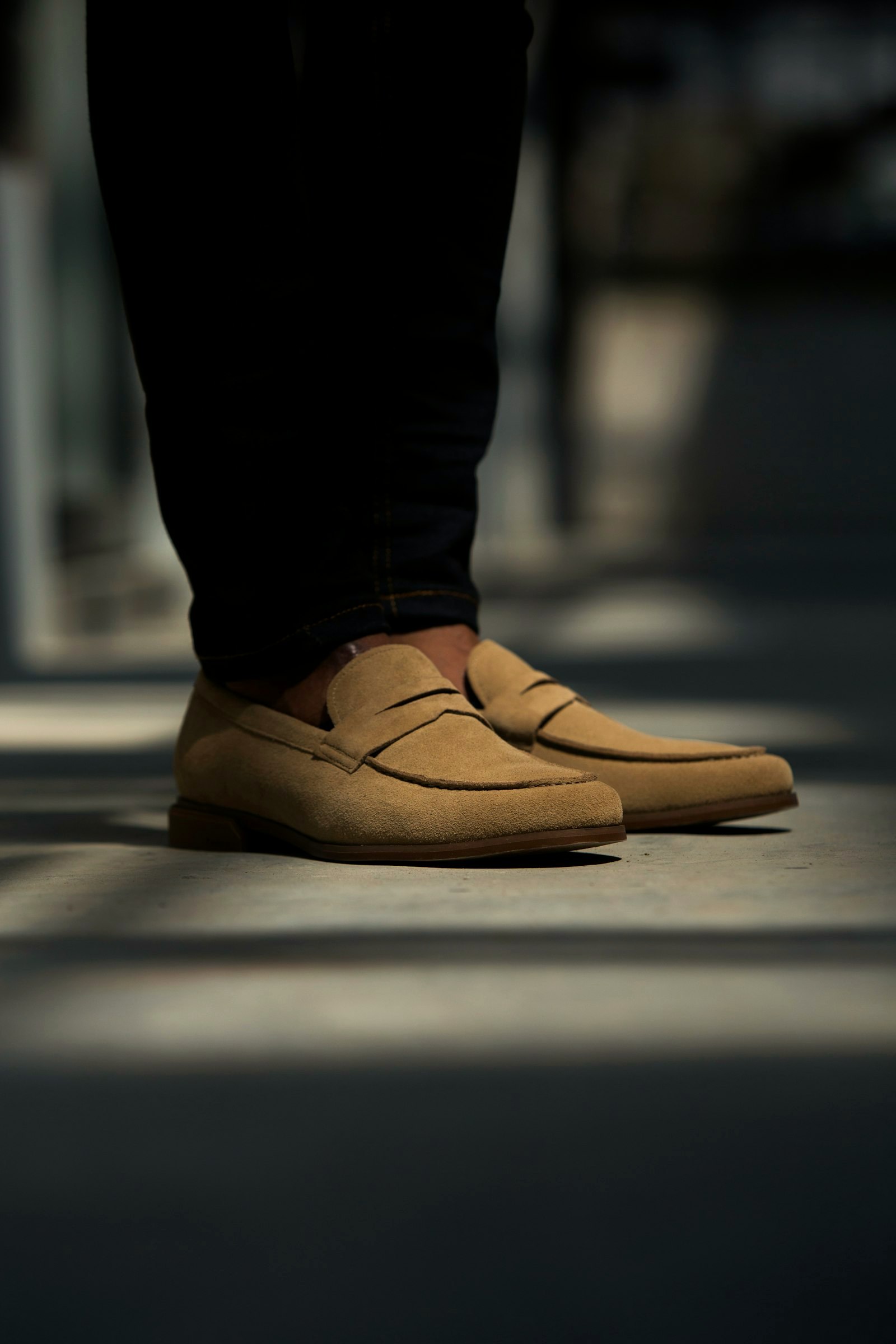
The loafer row is the dressed row, and the loafer is the brief's chosen instrument for the same reason the loafer brief prints: it is the shoe that moves an outfit one notch, and under a wide leg the notch lands exactly where the silhouette is decided, at the hem. A suede loafer under a nine to ten inch opening, the hem kissing its top, is the tailored wide leg's complete sentence: width above, structure at the waist, a deliberate shoe at the foot. The condition is presence: at the top of the opening band the shoe must hold its own against the cloth's width, a loafer with a real sole and a shaped upper, not a slipper of a shoe that the hem swallows. The row's cloths are the tailored ones, the flannel and the high-twist, and its break is the kiss.
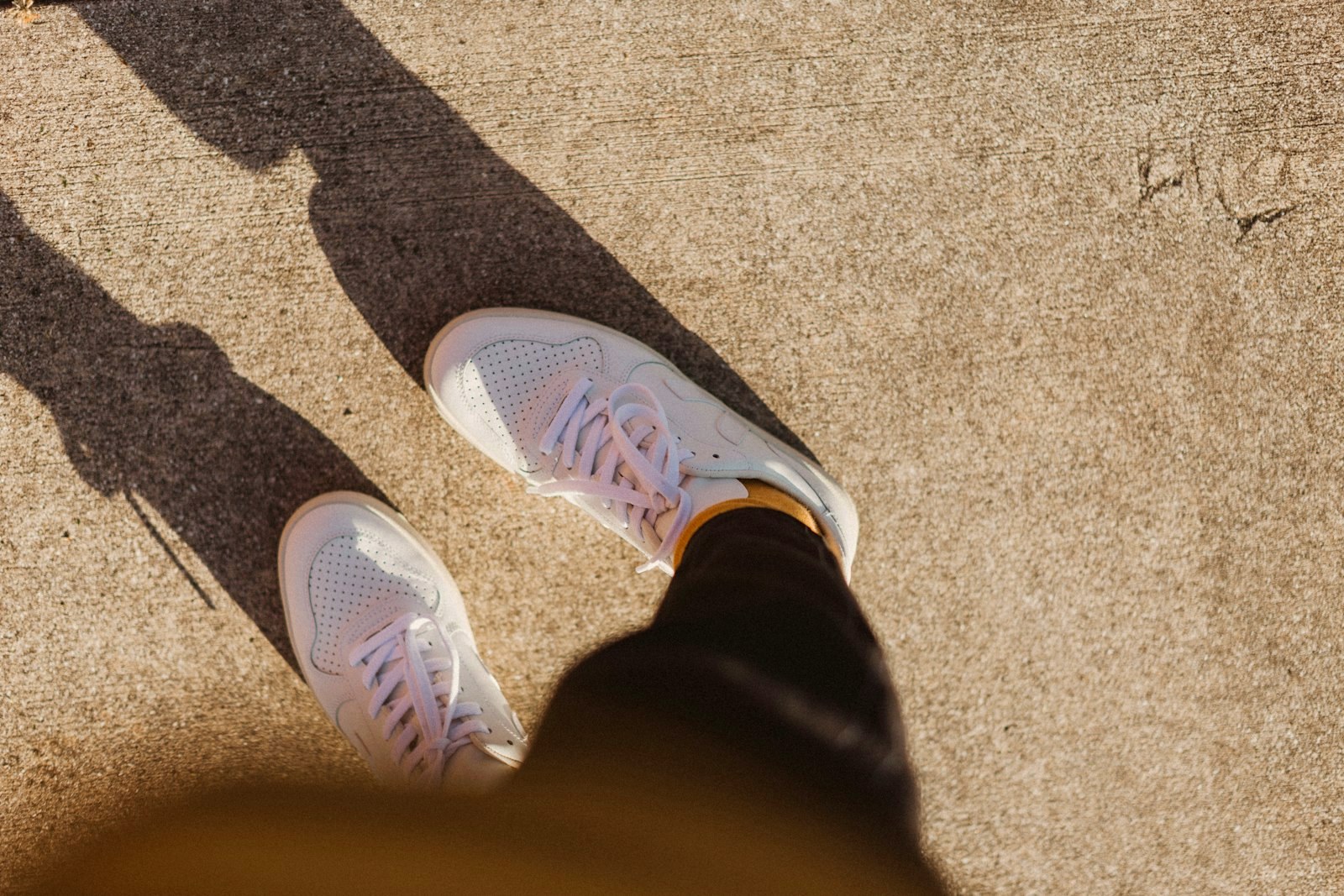
The sneaker row is the casual row, and its conditions are two: the shoe is clean and minimal, a plain leather upper without apparatus, and the break is the short one, the hem ending at or above the shoe so the opening clears the upper and the shoe reads whole. The index's warning is the row's boundary: a broad opening over a slim trainer is the two halves of the outfit arguing, and the argument is lost by the half that pooled. A hemmed-short wide leg over a clean sneaker is not that failure; it is the summer register of the silhouette, the ecru and linen rows below worn exactly that way. What the row refuses is the running shoe's bulk and branding under a tailored cloth, and any sneaker at all under a pooling hem, where the cloth, not the shoe, is the abdication.
The boot row is the oldest row of the three and the one the slim decade forgot: a wide hem is the one leg opening that falls over a boot shaft without a fight, no stacking at the ankle, no cloth caught on the pull loop, the leg continuing its line over the boot the way it was cut to when boots were the default footwear. The work leg of No. 73 and the corduroy leg of No. 38 are the row's ranked seats, and the winter flannel takes it under the overcoat. Between the three rows the discipline is constant: the shoe is chosen for the opening's width and the break is hemmed for the shoe, in that order, and a silhouette that arrives at the shoe as an afterthought has spent its last dial on the one the eye reads first at street level.
The season line: the cloth decides the calendar
The wide leg files at formality 3 and keeps the filing in every month; what changes by season is the cloth, and the trouser Cards have already ranked the silhouette in each of its cloths. The cold half belongs to the heavy tailored cloths and the ribbed one: the Berg & Berg's 430 gram flannel is the field's winter weight, the winner's 340 gram flannel its three-season standard, and the corduroy of No. 38, its wale the formality dial, needlecord toward tailoring and wide wale toward the weekend, is the cold half's textured leg, the Drake's Field Games at 79 its ranked head. The warm half belongs to the high-twist and the linen: the Cavour's 240 gram high-twist is the tailored system's summer weight, built to hold a crease in heat, and the linen of No. 41, the Spier & MacKay Sondrio at 85 its ranked head, wears its crease as texture and takes the short break as its length. The ecru and canvas leg of No. 73 runs the whole year, the colour family's ruling in How to Wear No. 40 being to buy ecru first precisely because its records are year-round cloths, the 9.2 ounce twill and the 12 ounce canvas indifferent to the calendar. In high summer the tailored rows yield to the linen leg and the short break; in deep winter the flannel and the boot row take the whole matrix. The rotation is the point: one silhouette, four cloths, no season in which the system is out of work.
The looks: the Cards' fields, worn in their order
Six assemblies from this brief's rulings, each built on the published records around the garment. The trousers are the trouser Cards', at the Cards' scores; the garments around them are the rankings named in the sections above; nothing in the judgments is scored here.
| Setting | The trouser | With | The judgment |
|---|---|---|---|
| The tailored wide leg | The Natalino Classic Pleated Trouser, 88, hemmed to the kiss | The Faloni Amalfi knit polo buttoned to the top, or a fine crew knit; suede loafers; a belt or its own side adjusters working | The complete system at £215: the only record in its field publishing its mill, its 340 grams, its pleat direction and its waistband entire, worn the way the record deserves, volume below and structure above in one outfit. The judgment carries the purchase's full price with it: the hemming is part of it, the hems ship unfinished at 37.5 inches, and at about £0.67 a wear across eight years the tailored row is also the field's honest arithmetic |
| The winter leg | The Berg & Berg August Flannel, 80 | A crew knit worn close, a tailored overcoat over the outfit, boots or a substantial loafer | The weight line's heavy end at work: the field's heaviest published cloth at 430 grams with double reverse pleats, the wide leg as the cold half's foundation under the coat row. At €380 and about €1.06 a wear across nine it is the dearest honest row in the matrix, bought for the cloth knowingly, its mill unnamed on its card and charged there |
| The summer tailored leg | The Cavour Summer Hightwist, 78, at the short break | A tucked plain tee or the knit polo, loafers, nothing over it | The system in its warm-weather cloth: 240 grams of named-mill high-twist, its single reverse pleat stated and its buttonholes handmade, the width held at summer weight with the break shortened for the heat. The attainable summer version of the same row is the linen leg below; this is the tailored one, at $325 |
| The ecru work leg | The Drake's Ecru Cotton Twill Fatigue, 83 in No. 73 | A fitted crew or a tucked tee, clean minimal sneakers at the short break, boots in the cold months | The silhouette in its work cloth, formality falling toward the work family exactly as the index prices it: 100 percent cotton at a published 9.2 ounces, button fly, side adjusters doing the belt's work in the open. The judgment carries its field's arithmetic, that at £295 the winner is the dearest honest wear in No. 73's field, bought for the record entire |
| The corduroy leg | The Drake's Field Games Corduroy, 79 in No. 38 | A crew knit or an overshirt above it, boots below | The cold half's textured leg: the wale dial turned toward the weekend, the width carried by a ribbed cloth whose pile does the visual work a crease does in wool. The relaxed seat in the same field is the J.Crew double-pleated at 68, the pleat system at a high-street record, bought with its card read |
| The attainable wide leg | The Asket Loose Twill Chino, 82 in No. 04, hemmed short | A tucked tee, clean minimal sneakers, the belt line showing | The silhouette's attainable door, and the matrix prints it ahead of the garment actually sold under the wide-leg name: the loose chino at 82 is a published record with room cut in, while the COS wide-leg pant stands at 58 in No. 85 on a cloth split its maker's US page does not publish, at $159. The row is the brief's buying advice in one line: the width with a record behind it beats the width with a name on it |
The linen leg stands behind the summer row as its own assembly, the Spier & MacKay Sondrio at 85 in No. 41, high-rise and cotton-linen, worn at the short break over loafers with its crease accepted as the cloth's texture; and the Uniqlo Linen Blend Relaxed at 67 is its attainable seat. And the skip is worn nowhere: a pleated suit pant at 6 percent wool, its pleats uncounted over a drawstring, is not the cheap seat in any row of this matrix, because at about $1.00 a wear across two years it is dearer per wear than the £215 winner it imitates. It is not the inexpensive option it poses as. It is the expensive one, for the field's emptiest record.
The ruling
Buy the silhouette on the proportion test: a rise in the high band measured at the rail, an opening inside the wide band measured across the hem, from a maker whose page prints a composition, a weight or a waistband, which in the Cards' fields means the Natalino at £215 for the complete tailored record, the Cavour at $325 for the summer cloth, the Drake's fatigue at £295 for the work leg, the Spier & MacKay Sondrio at 85 for the linen, and the Asket loose chino at 82 for the attainable start. Hem it before it is worn, to the kiss in the tailored rows and the short break in the summer ones, the tailor priced into the purchase. Wear it under the counterweight rule: fitted or tucked above it, the knit polo buttoned to the top at its dressed end, the belt line showing or the adjusters working, and let the structure the season is returning live in the top half while the width lives below. Choose the shoe for the opening and the break for the shoe, loafers at the dressed end, clean sneakers at the short break, boots under the winter cloth. The wide leg is the tailored wardrobe's oldest leg returned with its numbers printed, and worn as the system it is, high, broad, exact at the hem and answered above, it is the hardest-working silhouette in the rotation: room that reads as intention, at every hour of the day.
The mistakes
The pooling hem. The finishing error, and the one this silhouette is photographed committing most: the wide leg worn at the length it left the shop, cloth stacked on the shoe and brushing the ground, read by every eye that meets it as a trouser too long rather than a silhouette chosen. The index prints the verdict in the type's own rule, pooling cloth is a mistake, not a silhouette, and the field prints the mechanism: the tailored winner ships its hems unfinished because the break is a fitting, not a size. A wide leg that has not been to a tailor has not been bought yet, whatever has been paid for it. The hem is the silhouette's full stop; pooling is the sentence trailing off.
Volume on volume. The proportion error: the relaxed, untucked top half over the wide leg, each piece defensible alone and the two together deleting the waist the whole system hangs from. The outfit loses its one horizontal line, the leg reads short, the torso reads long, and the wearer reads as the index's sentence for the failure, a size too big. The counterweight rule is the correction and it is cheap: a tuck, a fitted knit, a buttoned placket, any one exact fact above the waist. Width is a statement made against a standard; with nothing exact above it, there is no standard and the statement is not made.
The belt forgotten. The hinge error: a high-rise wide leg worn with the waistband left to migrate, no belt in the loops, the adjusters unworked, an untucked top hiding the slide. The high rise is the system's foundation, the fact the leg's length is measured from, and a foundation that moves an inch down the hip spends the silhouette's whole geometry on a detail nobody decided. The tailored records print the furniture for a reason: side adjusters published, tabs extended, loops cut to be filled. Fill them, or work the adjusters, and let the line the outfit is hung from be visible doing its work.
The low-rise wide leg. The contradiction error, the index's pleat ruling read at full width: a fold of cloth needs somewhere to live, and a leg line needs a waist to be measured from, and the low rise provides neither. The wide leg cut low drops its fork, shortens the leg it was bought to lengthen, works a tucked shirt loose by noon, and turns the silhouette into the skate pant it is actually patterned as, wearing a tailored name. It is sold every time the silhouette cycles back, because it photographs as ease; it wears as a date, the index's phrase for the low rise entire, a fashion cut with a date on it. The rise check takes ten seconds at the rail and there is no styling rule downstream that can repay a rise bought wrong.
Width bought by the size. The buying error the Cards exist to catch: the room believed from the size label, a slim or straight trouser bought two sizes up and worn as a wide leg, the waist gathered by a belt, the rise dropped by the same inches the hem gained, the seat and fork wrong in every direction at once. Width is a pattern, cut from the thigh to the opening by a maker who graded the whole leg for it; a size is a different garment's proportions enlarged. The convicted evidence stands across the trouser fields: the name-only pleat at 37, the wide-leg name at 58 on an unpublished split, against the system's 88. Buy the leg that was cut wide, in your size, and let the tape at the rail, not the label in the waistband, say which garment it is.
Care, and a note on our photography
A wide leg's care is aimed at the two places the silhouette is judged: the hem and the crease. The hem is the watch point first, because it works nearest the ground of any garment in the rotation: a break hemmed right keeps it off the pavement, and a hem that brushes is a hem being sanded, so the break check is rerun whenever the shoes change, the boot row and the loafer row asking measurably different lengths of the same leg. The crease is the tailored cloths' second watch point, re-pressed rather than ironed into a rail track, and surrendered by design in the linen, whose crease is its texture and whose record this desk grades as honesty rather than failure. The cloths are otherwise washed and kept by their own records where the makers publish them, the Faloni discipline of the knit rows applying to the top halves: where a maker publishes nothing, the care label on the garment is the only record and it governs, read before the first wash rather than after it. And the rise is checked the way the rail test checks it, the waistband sitting where it was bought to sit after a season of wear: a waistband that has stretched into migration is the silhouette's quietest retirement, announced at the mirror before it is announced anywhere else.
A note on our own photography: our photo bank holds no frame of a wide-leg trouser on a body, no pleated trouser on a body in any cloth, no hem kissing a loafer at street level and no rise measured against a tape on a rail, the gap Verdict Card No. 85 admits in its hero caption for the tailored species entire. This page repeats the admission rather than covering it with a mislabelled picture. There is no photograph of a ranked trouser here, and no frame of the coat row this brief exists to rule on. This page will take those frames the week they exist, in the trouser Cards' own harvest order: a pleated wide leg worn full-length in street light, a hem at the kiss over a suede loafer, a leg opening measured across a folded hem. Until then the bank's tailored flat-lay, its tailor's tape, the loafer row and the sneaker row carry the page, captioned for exactly what they show.
Questions, answered
How do you wear wide-leg trousers?
As a proportion system, not as a bigger size. Our trouser index files the wide leg at formality 3 and prints its numbers: a high rise, a leg that falls straight and broad to an opening of nine to ten and a half inches, and its rule entire, that width is worn with discipline, the hem at the shoe and the top half fitted or tucked. Worn, that means four facts agreeing: the waistband at the natural waist so the leg reads its full length, the opening read against the shoe it covers, the hem finished to end at the shoe rather than pooling past it, and a top half that returns the waist the width spends, fitted, tucked or buttoned to the top. The pleated trouser ranking, Verdict Card No. 85, grades the silhouette's tailored form, and this brief is the wearing system those records imply.
How wide is a wide-leg trouser?
By the leg opening, on the compiled classes our trouser index prints: a tapered trouser lands around six to seven inches across, a straight leg at seven to eight, and a wide leg at nine to ten and a half. The opening is the honest measure because it is read where the silhouette lands, against the shoe, not against the thigh: the same thigh can taper to a tailored landing or fall straight to a broad one, and only the opening tells you which garment you are holding. Below nine inches the trouser is a straight leg wearing the wide name; the width in a true wide leg is a pattern fact, cut into the leg from the thigh down, and it is never bought by sizing up, which buys length and a dropped rise along with the room.
What break should wide-leg trousers have?
The shortest break the row allows, because wide cloth pools worse than narrow cloth: the same spare inch that folds once on a tapered leg stacks twice on a broad one. The tailored default is the kiss, the hem resting on the top of the shoe with a single slight fold, the leg's line unbroken from waist to shoe. The sneaker and summer rows take the short break, the hem ending at or just above the shoe, the opening clearing the upper entirely. Pooling, cloth stacked on the shoe and brushing the ground, is the index's printed mistake, not a silhouette: it is a tailor bill left unpaid, and on a trouser sold with unfinished hems, as the pleated ranking's winner is at 37.5 inches, the hemming is part of the purchase, priced in before the garment is worn once.
What do you wear on top with wide-leg trousers?
A counterweight: the top half fitted or tucked, so the outfit keeps a waist. The index prints it as the type's own rule, top half fitted or tucked, because width below the waist spends the outfit's one horizontal line, and an untucked, relaxed top spends it a second time: volume on volume is not a silhouette, it is a size too big, the index's sentence entire. The ranked seats are the knit polo, buttoned to the top on its brief's ruling, the Faloni Amalfi at 88 in Verdict Card No. 86; the plain tee, tucked with the belt line showing, the Asket at 88 in the white tee ranking; and a fine crew knit worn close. The top half is also where the season's structure lives: the wide leg is the relaxed half of the outfit, and the fitted, tucked, buttoned top half is the tailored half, and the outfit needs both halves.
Can you wear wide-leg trousers to the office or under a blazer?
Yes, in the tailored cloth, and the index prices the permission: the wide leg stands at formality 3, and formality in trousers is set by cloth and crease more than by cut, so a wide leg in a smooth wool with a pressed crease climbs toward the pleated trouser's 4, while the same width in a work canvas falls toward the work family. The office specification is the whole system at once: tailored cloth, the pleat system or a clean flat front, the hem kissing the shoe, the top half fitted or tucked, leather shoes. Under a blazer the conditions are the blazer brief's: unstructured and textured, never a smooth suit jacket, and nothing else ambiguous. Under an overcoat the wide leg is the coat's natural partner, two straight lines in agreement. What the office refuses is not the width; it is the pooling hem, the untucked volume above it, and the canvas cloth, each a separate failure wearing the silhouette as its excuse.
What shoes go with wide-leg trousers?
Shoes with enough presence to end a broad opening, on the index's rule: the opening is read against the shoe, not against the thigh, the wider the opening the more substantial the shoe it wants under it, and a broad opening over a slim trainer is the two halves of the outfit arguing. The loafer is the dressed row's instrument, a suede loafer under a ten-inch opening, spending the one notch the loafer brief prints at the point where the eye finishes. The clean minimal sneaker takes the casual and summer rows, on the short break, the hem clearing the upper so the shoe reads whole rather than swallowed. Boots are the leg's oldest partners: the wide hem is the one opening that falls over a boot shaft without a fight, which is why the work and winter rows are built on them. What fails is proportion, not taste: a slight shoe under a pooling broad hem, where both halves have abdicated.
Wide-leg trousers or pleated trousers: which should you buy?
The pleated one first, because on this site's records the pleat is the wide leg's structure rather than its decoration. Verdict Card No. 85 prints the system: pleats are a system, high rise, full thigh, taper below, and a pleat on a low-rise slim leg is a contradiction, because a pleat is a fold of cloth that needs somewhere to live. The width that opens from a pleat is engineered room, released when the wearer sits or strides and closed when he stands; the width in a flat wide leg is the pattern's alone. The evidence stands in the Card's own field: the one garment there sold under the wide-leg name, the COS relaxed-fit wide-leg pant, stands at 58, its cloth split unpublished on its maker's US page, while the system's complete record, the Natalino, wins at 88 publishing its mill, its weight, its pleat direction and its waistband entire. Buy the pleat system for the tailored rows; buy the plain wide leg in the cloths that carry it honestly, the ecru canvas of No. 73, the corduroy of No. 38, the linen of No. 41.
Has Young Cotton ranked these trousers?
Yes, across the trouser Cards this brief styles, the pleated ranking first. Verdict Card No. 85 ranked seven pleated trousers and sent one home: the Natalino Classic Pleated Trouser winning at 88 on a published 340 grams of named-mill flannel and the field's only curtained waistband at £215, the Berg & Berg August Flannel at 80 on the field's heaviest cloth, the Cavour Summer Hightwist at 78, and the one sent home at 37, a suit pant at 6 percent wool with its pleats uncounted over a drawstring. The wide leg's other cloths are ranked where they live: the ecru and canvas legs in No. 73, won by the Drake's fatigue at 83; the corduroy in No. 38, won by the Drake's Field Games at 79; the linen in No. 41, won by the Spier & MacKay Sondrio at 85; and the slim baseline the silhouette replaces in No. 4, won by the Spier & MacKay high-rise chino at 84. The trouser index files the type itself, at formality 3, with the measurements this brief is built on.
Next
The family this brief belongs to: the ranking it styles first is Verdict Card No. 85, and the type itself is filed in the trouser index, whose measurements this page is built on. The silhouette's other cloths are ranked in the ecru Card, No. 73, styled in How to Wear No. 40; the corduroy Card, No. 38, styled in No. 24; the linen Card, No. 41, styled in No. 07; and the slim baseline it replaces in the chinos Card, No. 04, styled in No. 29. The top half's dressed layer is styled in How to Wear No. 45; the coat row stands in No. 20; the notch the loafer spends is printed in No. 11; the work leg's own brief is No. 44; and where the leg lands on the body is drawn in the Body Map.