

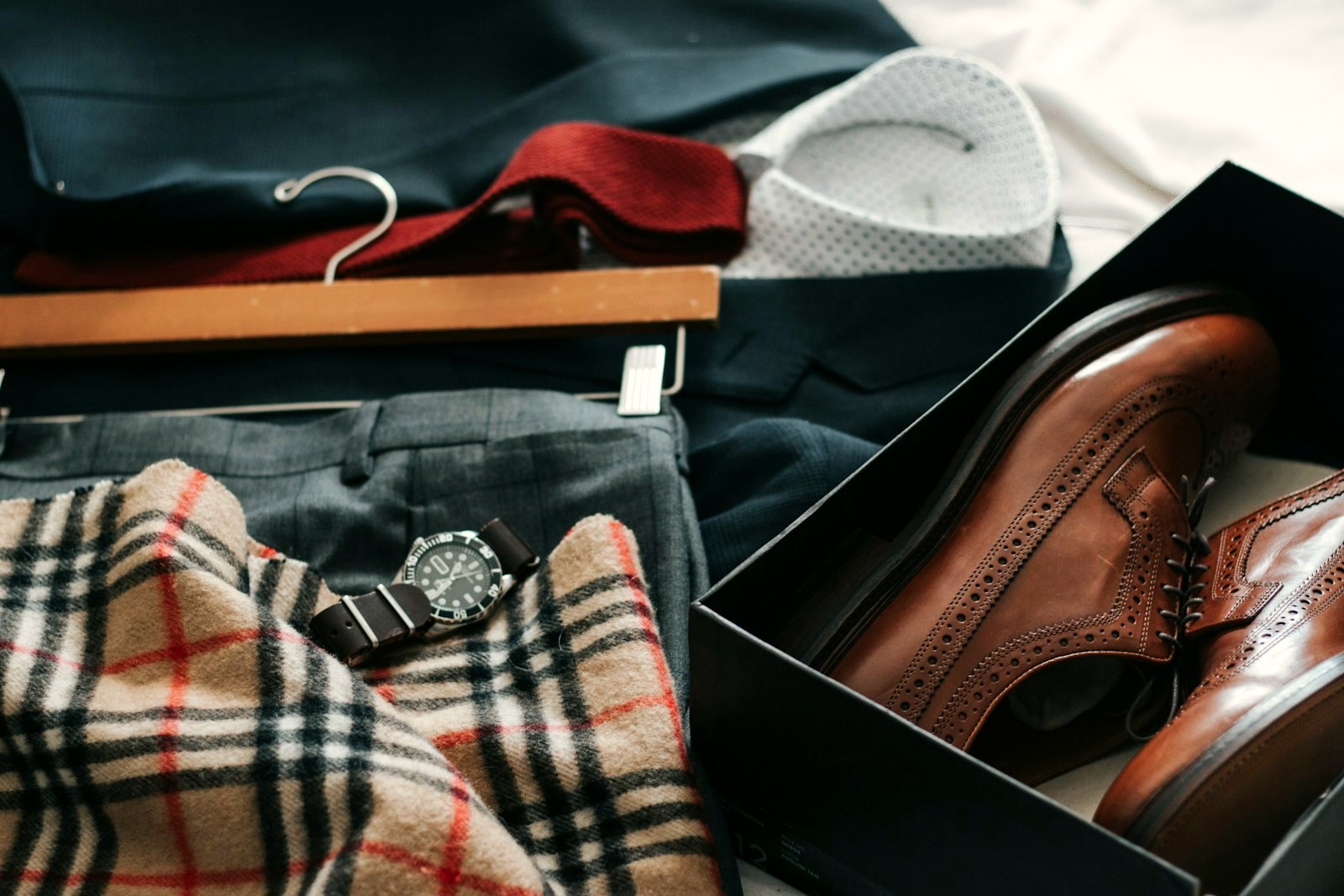
The assembly the garment serves: a checked single-breasted suit with its jacket open, the trousers at the natural waist, carried from No. 71 where the frame already stands as the single-breasted counterweight. No brace strap shows in it, which is the tailored brace's ordinary condition and this page's admitted gap: the bank holds no braces frame in any form, and the care section prints the gap and the harvest list entire.
Checked and updated October 2026
The ruling, up front: braces are structure before ornament. They hang the trouser from the shoulder, the waistband carried level at the natural waist on two straps, where the belt cinches the same trouser at the waist and holds it by grip. Everything this page rules is priced by that mechanism: button-on in tailoring, the tabs fastened to buttons sewn inside the waistband, and clip-on in workwear, where the jaw's bite is the uniform's honesty; the tailored strap in its width band and its Y-back form, the wide X-back reserved to the working register; and the showing licensed by register, covered machinery under No. 75’s waistcoat and No. 67’s uniform, a working glimpse under a jacket, a state at a man’s own desk, a uniform in workwear, and refused as presented ornament in any room a man enters dressed. The family has seated this garment before, always as another garment’s support: No. 75 holds the waistcoat’s trouser up by braces or side adjusters and covers the brace buttons as machinery; No. 67 refuses the uniform’s belt in their favour; No. 73 prefers their carrying to the belt’s cinching. Those rulings stand entire below. What has never been ruled is the garment itself, its attachments, its widths, its backs and its showing, and that is this brief’s ground. On scores: no Card grades braces, and this page invents none.
This brief: the decisive rule · the garment’s record · the pairing law · the rooms and hours · the looks · the ruling · the mistakes · care, the structure’s keeping, and our photography
The decisive rule: structure before ornament, the trouser hung from the shoulder
A trouser has to be held up by something, and the wardrobe owns exactly two mechanisms for the job, which are not two styles of one idea but two different ideas. The belt is a cinch: a strap around the waistband, tightened until friction and pressure hold the trouser against the body, its height the height the cinching settles at, its grip relaxing and tightening with the body’s day, the meal, the chair, the hour. Braces are a suspension: two straps over the shoulders, attached to the waistband front and back, carrying the trouser’s weight at the body’s carrying station and holding its band level at the height it was cut for, independent of the waist’s own measurement, the band standing a fraction free of the body it hangs beside. The decisive rule follows from the mechanism: braces are structure before ornament, a load-bearing garment whose every other question, its attachments, its width, its back, its colour, whether it may be seen at all, is answered by asking whether the answer serves the suspension or advertises it. A brace bought for its pattern, clipped to a trouser cut for a belt and worn displayed over a shirt in a dressed room has inverted the rule at every station: the structure is not working, because the trouser is not built to be hung, and the ornament is all that remains. A brace buttoned to a trouser cut for it, under a jacket or a waistcoat, doing its carrying unseen, is the rule obeyed entire, and it is not a lesser wearing for being invisible. It is the garment at its job.
The rule’s working clauses are three measurements and a refusal, each checkable in the two minutes this family allows a man at a mirror. The first measurement is the trouser’s height: braces presuppose the natural waist, the trouser cut to ride there, because a suspension system can only hold a garment at the height its geometry reaches, and hung correctly the waistband stands level all the way round, front and back at one height, through sitting and standing, which no cinch maintains. The second is the straps’ plumb line: from the shoulder’s point the front straps fall straight to their buttons, neither splayed outward toward the arm nor drawn inward toward the neck, their tension even and light, adjusted once at the fittings and then left, a strap that needs re-adjusting by noon is a strap set wrong or a trouser cut wrong. The third is the band’s freedom: the waistband under braces stands fractionally off the waist, the shirt moving under it, where the belted band is pressed to the body in a ring; that small freedom is the suspension’s signature and the source of its comfort across a long day, the trouser carried rather than worn tight. The refusal is the belt, at every station where the braces stand: the two systems worn together corrupt each other, argued entire in the questions, and the refusal is inherited, not invented, No. 67 refusing the belt inside the uniform and No. 75 refusing it at the waistcoat’s join, each for its own printed reasons that this brief adopts.
What the structure buys, at that discipline, is the tailored trouser at its full specification, and the purchases are the family’s own findings gathered. The waistcoat’s join closes, because the trouser held at its height by braces is the trouser No. 75’s hem was cut to meet, the waistband steady at the natural waist with no buckle standing at the join to print through the covering. The pleat keeps its anchor, because No. 73 prints that braces carry the trouser at its height better than a belt, which cinches the band and can drag the pleats’ anchor down and sideways: the stored cloth hangs from a level band and opens only where it was built to open. The uniform’s silhouette holds, because No. 67’s trouser, braid unbroken from waist to hem, is a trouser whose waist never migrates. And the long day is priced honestly: suspension is the support that does not need the wearer’s attention, no hand going to the waistband at the hour the cinch starts its slow surrender. Those are structural purchases, every one, and they are forfeited entire by the wearing this brief will not bless, the brace as a displayed accessory, where the straps work at nothing and signify at everything, and a garment that signifies at everything is costume by this family’s standing definition.
The garment’s record: the standard support of the classic century, the belt’s convenience, and the two registers that kept it
The garment first, because the braces’ construction is their argument in webbing and leather. The tailored form is a pair of straps, woven silk, boxcloth or webbing in the standing materials, elasticated in whole or at the back portion in most modern make, ending at the front and back in tabs, leather buttonholes or woven runners, that fasten to buttons sewn inside the trouser’s waistband, two at the front set either side of the fly and two at the back either side of the centre seam. The back divides the species: the Y-back, the front straps meeting at a junction piece between the shoulder blades and continuing as one strap to the back’s centre attachment, which is modern tailoring’s standard; and older and working forms with two separate back straps or the crossed X-back. The adjusters, small sliders of metal or leather on the front straps, set the hang once; the fittings answer the assembly’s metals wherever they show, under the law No. 70 prints for the shoe’s buckle, transposed here to the strap’s hardware and marked as a transposition. The workwear form is wider, all-elastic or heavy webbing, X-backed, ending in clips that bite the waistband of jeans or work trousers, built to carry a working trouser and its pockets’ load through a physical day. The two forms share a mechanism and nothing else: not width, not attachment, not register, and the page grades each inside its own.
The history is a default’s long tenure and a convenience’s coup, printed as the published record tells it. Braces are the older system by centuries: straps over the shoulder supported the trouser through the whole period in which the tailored wardrobe assembled itself, and by the nineteenth century the button-on brace was the standard machinery of every dressed trouser, its maker’s name, in the record the trade repeats, being Albert Thurston, founded in London in 1820, whose name the tailored trade still uses as the form’s shorthand, printed here as the record’s attribution and not as a graded recommendation. The belt was, for most of that century, a military and sporting article, worn with uniforms and plus-fours, not with the lounge suit. Its coup came with the twentieth century’s undressing: the softer, lower, readier trouser, the waistcoat’s demotion that No. 75 records, and the general preference for the fastening a man could buy off a rail and thread through loops any factory could sew, loops being cheap to add and brace buttons, and the rise they presuppose, being a specification. By the century’s second half the belt was the default and the brace the survival, kept in exactly the two registers this page rules: tailoring, where the trouser’s height is a designed fact and the waistcoat and the uniform still refuse the cinch, and workwear, where the load is real and the suspension’s advantage is a working man’s arithmetic. The garment’s record on this site is four rulings and no brief, printed entire because this page stands inside all four: the waistcoat’s trouser held by braces or side adjusters at No. 75, with the brace buttons named among the machinery its hem covers; the uniform’s trouser held the same way and never by a belt at No. 67; the pleated trouser’s carrying preferred at No. 73; and the double-breasted trouser’s ordinary law at No. 71. The support has been ruled at every station it serves. This brief is the garment’s own ruling.
The pairing law: the waistcoat’s join, the uniform’s list, the pleat’s anchor, and the strap’s own discipline
The pairing law’s first principle is that braces pair with a trouser before they pair with anything else, and the trouser’s specification is the pairing: a rise to the natural waist, a waistband that carries its buttons inside, two front and two back in the standing arrangement, and in the traditional cut the higher fishtail back, the waistband rising at the rear into the split the back attachment answers. Belt loops are the trouser’s other system made visible, and the pure braces trouser omits them; a trouser carrying both provisions is worn on its buttons in dressed rooms, the loops standing empty or removed, as the questions rule. The waistcoat pairing is the family’s most complete, and it is quoted rather than paraphrased: at No. 75, the trouser under a waistcoat is held by braces or by side adjusters and worn at the natural waist, the belt refused because its buckle prints through the waistcoat’s front, pushes its hem off the waistband and shows machinery at the station the garment exists to cover, and the waistcoat’s own account of what it covers names the brace buttons in the list: the waistband, the brace buttons, the shirt’s lowest button. Inside that system the braces are the covered machinery’s covered machinery, the one element of the assembly that is not merely unseen but unseeable, and the three-piece on braces is the closed system of No. 75 with its support built into the same logic as its covering. The uniform pairing is No. 67’s list entire: the black tie trouser is held up by braces or by side adjusters, and never by a belt, its waistband covered by the waistcoat or the cummerbund, its braid unbroken from waist to hem; the evening brace in black or white silk is the form the uniform presupposes, and this page adds nothing to that page’s grammar.
The pleated trouser pairing is a preference with a mechanism, printed at No. 73 and adopted: braces carry the trouser at its height better than a belt, which cinches the band and can drag the pleats’ anchor down and sideways. The stored cloth of No. 73’s brief is engineered to open in motion from a level anchor at the natural waist, and suspension is the support that keeps the anchor level, where the cinch makes the band itself a moving part. The plain-front tailored trouser pairs on the same terms with lower stakes. Below the waist the pairings are the trouser’s own briefs’: the break at the slight default the family prints, the shoe rows inherited from the outfit’s own page, the support adding nothing below the hem it has already steadied. The strap’s own discipline closes the pairings, and it is the discipline of a structural element: in tailoring the strap is plain, a deep solid colour answering the trouser or the jacket, silk or matte webbing, its pattern budget zero at the stations where it is covered and near zero where it is glimpsed, the figured and striped straps belonging to the licensed showing registers, the desk state and the vintage quotation, and to workwear’s uniform, where pattern is not the question. The fittings, where the register shows them, answer the assembly’s other metals under No. 70’s law transposed: a gilt adjuster against a steel watch and a silver buckle is three metals arguing at a station too small for the argument, and the transposition is this brief’s, marked as such, No. 70’s law having been written for the shoe and the wrist.
The rooms and hours: covered in the systems, glimpsed in the day, a state at the desk, a uniform at work
The braces’ rooms are the rooms of the assemblies they hold up, read through the showing law, because a structural garment’s register is the register of its visibility. Inside the closed systems the braces have no room of their own at all, which is their perfection: under the three-piece’s waistcoat and under the uniform’s waist covering they are machinery in the family’s exact sense, present, load-bearing and never presented, and the rooms are those garments’ rooms entire, the boardroom’s formal end and the wedding’s rows for the waistcoat system at No. 75, the evening entire for the uniform at No. 67. In the tailored day without a waistcoat, the two-piece’s rooms, the braces stand in the jacket’s opening as a working element, glimpsed when the jacket opens or comes off in the licensed state, and their register there is understatement: the plain strap, the buttoned attachment, the hang doing its quiet work inside No. 04’s matrix without asking the matrix to notice it. The boardroom admits them on exactly those terms, as it admits any infrastructure: completely, provided they remain infrastructure.
The state is licensed, and it is No. 75’s state transposed. The waistcoat brief licenses the jacket off at a man’s own desk, in his own rooms, as a posture inside an outfit rather than an outfit, and the braces are what that state shows: the shirt, the straps over it, the trouser hanging at its height, the assembly at rest with its structure visible to the room that knows the whole of it. In that room the showing is honest, because the structure is real and the audience is the wearer’s own. The workwear rooms license the showing entire: the wide X-back over a work shirt, on jeans or work trousers, is a uniform in the sites and yards and workshops where the load is the day’s fact, and its straps are displayed the way any working equipment is displayed, by being used in the open. The vintage quotation stands where this family always seats quotation, with No. 71’s period forms and No. 76’s licensed archaisms: braces worn displayed in a dressed room as a deliberate period register, worn entire and knowingly, are lawful where quotation is the room’s register, and are a costume everywhere the room did not ask for one.
The refusals are three, and each is the rule inverted at a different station. The first is the dressed display: braces as the outfit’s presented ornament in rooms entered dressed, the straps patterned, arranged and offered, the wearer’s torso a frame for his support system; it fails because the garment’s meaning is its work, and a support exhibited has stopped being read as support and started being read as the wearer’s wish to be seen wearing it. The second is the hip: braces fitted to a low trouser, argued in the questions, the straps straining at a geometry that cannot answer them, structure asked to hold a garment at a height the garment refuses. The third is the doubling: braces over a belt, the refusal the questions argue entire, two systems in public announcing trust in neither. A fourth refusal belongs to the hours rather than the rooms: braces are a day’s structure, and the evening’s only brace is the uniform’s, inside No. 67’s grammar; the tailored day brace promoted into a dressed evening as display has crossed both the register line and the clock’s, and the evening was not consulted.
The looks: four assemblies the brief licenses
| Setting | The assembly | The details | The judgment |
|---|---|---|---|
| The closed system | A matched three-piece suit on button-on braces, the trouser hung at the natural waist under the waistcoat’s hem | Plain deep straps, silk or matte webbing, buttons inside the waistband, no belt anywhere in the assembly, the waistband covered entire under No. 75’s law | The garment at its perfection: load-bearing, covered, and the waistcoat’s join closed by the steadiest waistband the wardrobe can build |
| The tailored day | A two-piece suit or jacket and trousers on button-on braces, the straps standing in the jacket’s opening | The Y-back form, the width in the tailored band, the fittings answering the watch’s metal, the jacket taken off at the wearer’s own desk and the state licensed there | Infrastructure doing its work in the open of the working day: glimpsed, not presented, and the trouser at its cut height from the first meeting to the last |
| The uniform | Black tie on silk evening braces, black or white, the trouser’s waistband covered by the low waistcoat or the cummerbund | No belt by No. 67’s list, the braid unbroken from waist to hem, the braid unbroken from waist to hem and the hem’s rest on the shoe checkable in the mirror’s two minutes | The evening’s machinery entire and invisible: the oldest room the garment owns, and the one where its law is least negotiable |
| The working register | Wide X-back clip-on braces over a work shirt, on jeans or work trousers, with boots | The straps at the workwear width, the clips biting cloth built to be bitten, the load of a working trouser carried at the shoulder through a physical day | The suspension’s other honesty: shown entire because the work is shown entire, a uniform graded in its own register and never imported into tailoring’s |
The ruling
Wear braces as the structure they are. Have the trouser cut or chosen for them: the rise at the natural waist, the buttons inside the waistband, the loops omitted or left empty. Button them on in tailoring and leave the clips to the workwear they belong to; keep the tailored strap in its width band and its Y-back, the fittings quiet and answered; adjust the hang once, plumb and level, and let it alone. Never wear them with a belt, and never present them as the outfit in a room you enter dressed: covered under the waistcoat and the uniform, glimpsed under the jacket, a state at your own desk, a uniform at work. Ruled so, braces are what their mechanism promises, the trouser carried at its cut height all day by the body’s strongest station, the support the family’s waistcoat, uniform and pleat rulings have been presupposing every time they refused the cinch. The belt holds a trouser against the body. Braces hang it from the man, and the difference is readable in every assembly the two systems hold up.
Where the wearing goes wrong
Braces and belt together. The doubling failure, argued in the questions and reprinted because it is still bought: two systems for one job, the cinch cancelling the suspension and the straps reduced to decoration over a support they are not providing. It reads as distrust made visible, the wearer insured against his own trouser, and it fails mechanically before it fails visually, since a waistband gripped at the waist cannot also hang from the shoulder. The repair is a decision, made at the tailor’s and kept: the trouser is hung or it is gripped, and the wardrobe’s dressed rooms can always tell which sentence was never finished.
The clips on a tailored trouser. The attachment failure: metal jaws bitten into a cloth that was woven to be worn, not gripped, marking it at the waistband with every wearing and tearing at its edge across a season, while the jaws themselves stand at the waist as hardware in a register that covers its machinery. It fails a second way as confession: the clip announces that the trouser’s own provision was never made, that the garment was clipped to rather than built for, and the room reads the announcement at the exact station where the dressed wardrobe is most judged. Buttons sewn inside a waistband cost less than the clips did. The considered wearing has no station where the jaw is the answer on tailored cloth.
The displayed strap. The ornament inversion, the rule’s opposite bought deliberately: braces chosen for their figure, worn over a shirt as the outfit’s presented centre in a dressed room. It fails the way the novelty bow fails at No. 76, by converting an instrument into a performance: the garment whose whole meaning is that it carries something is worn carrying nothing but the wearer’s wish to be read as a man who wears braces. The licensed showings are real, the desk state, the workwear uniform, the knowing quotation, and each is a register with a room attached. The displayed strap in the ordinary dressed room has the register without the room, which this family grades, in garment after garment, as costume.
The low trouser. The geometry failure, the waistcoat brief’s triangle translated to the support: braces fitted to a trouser cut to sit at the hip, straps adjusted to their shortest and still standing slack or straining by the hour, the waistband migrating under a system built to hold it somewhere it was never cut to be. It is almost never the braces’ fault. The trouser’s rise is the assembly’s foundation, and no strap made can hang a garment at a height the garment does not possess. Its repair is the trouser’s specification, not the adjuster’s travel: the natural waist, asked for when the trouser is chosen, the way No. 75’s join and No. 73’s anchor both presuppose it.
The novelty strap and the arguing metals. The discipline failures, printed together because both are small stations read closely. The novelty strap, the joke figure, the flag, the team’s colours rendered in webbing, fails as signage fails everywhere in this family: it asks to be read as a picture at the torso’s most structural station. The arguing metals fail quieter: gilt adjusters and clips set against a steel watch and a silver buckle, the fittings gathered from three registers and worn at once, at a station whose whole discipline is that nothing about it should be noticed. The plain strap and the answered fitting are not the timid choices. They are the garment’s job description, written small.
Care, the structure’s keeping, and our photography
A load-bearing garment is kept as fastenings under load are kept in this family, in the doctrine No. 75 prints for the waistcoat’s strap. The button ends are the first inspection: the tabs and their buttonholes carry the trouser’s weight at four points all day, and their stitching, the buttons’ own thread on the waistband’s inside, and the leather’s holes where they stretch are checked when the trouser comes back from wear, a button riding on two threads being the suspension’s version of the wandering wrap, a failure announced quietly and then all at once. The elastic is the garment’s clock: the back strap’s or the whole strap’s give tires across years of tension, and a brace that has to be adjusted shorter every season is a brace spending its remaining life; it is rested between wearings, hung unclipped and unstretched over a hook or a rail rather than left snapped to a waistband under tension in the wardrobe, the tension being the wear. The clips, where the workwear form owns them, are kept clean of the grit that dulls a jaw’s bite, and a jaw that slips is replaced rather than trusted, a slipped clip under load being the working register’s one unforgivable failure. The woven and silk straps are brushed and rested like the ties they share a rail with; the leather ends are fed when they dry. And the trouser’s side of the system is kept with it: the waistband’s buttons resewn at the first looseness, the fishtail’s split pressed as cut, the whole support, straps and trouser together, treated as one garment with two addresses, which is what a suspension is.
The rulings this brief prints beyond the tree’s standing record are gathered here once, the way the family gathers its extensions. The family’s are cited as theirs: No. 75’s seating of braces and side adjusters under the waistcoat, its belt refusal at the join, its naming of the brace buttons among the covered machinery and its licensed jacketless state; No. 67’s uniform list, the trouser held by braces or side adjusters and never by a belt, the waistband covered; No. 73’s preference for the braces’ carrying over the belt’s cinching, with its drag on the pleats’ anchor; No. 71’s ordinary law for the wrapped front’s trouser; No. 04’s matrix, into which the tailored day’s braces are seated; No. 65’s and No. 76’s registers, borrowed for the quotation’s licence. This brief’s own are: the decisive rule itself, structure before ornament, with the suspension against the cinch as its mechanism; the attachment law, button-on in tailoring and clip-on in workwear, with the crossing graded as damage and confession; the width band and the two backs divided by register; No. 64’s width law applied to the strap by analogy, marked as analogy where it stands; No. 70’s metals law transposed to the fittings, marked as a transposition; No. 75’s licensed state transposed to the braces’ showing, marked as a transposition; the belt-and-braces doubling refused on mechanism; the braces trouser’s specification, rise, buttons and omitted loops; and the keeping’s inspection of ends, buttons and elastic as fastenings under load. Nothing scored stands behind any of them: no Card grades this garment, the one name in the record, the London house of 1820, is printed as the trade’s attribution and not as a graded pick, and the garment carries no number of its own because none has been graded.
The photography, stated plainly, because this page’s subject is another of the bank’s empty shelves, emptier than the waistcoat’s, which held one true frame. The bank holds no braces frame in any form: no straps over a shirt, no back in either of its forms, no buttons inside a waistband, no clip on a working trouser. The hero is the checked single-breasted suit with its jacket open and its trousers at the natural waist, carried from No. 71 and captioned as the assembly the garment serves, no strap visible in it, the tailored brace’s ordinary condition being invisibility inside its own systems. The figure in the record is the tailoring flat lay shared with Nos. 71 and 75, the trouser the structure hangs, captioned as a flat lay. The harvest list this page is waiting for, in order: first, button-on braces over a white shirt from the back, the Y-back’s junction readable between the shoulder blades; second, the waistband’s inside in close view, the brace buttons sewn in their pairs with a tab fastened; third, braces under an opened jacket in the two-piece day, the straps standing in the opening as this brief’s rooms describe; fourth, the wide X-back on a working back, clips on denim, the workwear register in its own frame. Until that pass runs, the page’s pictures show the garment’s trouser and its assembly, and say so.
Questions, answered
What are braces, and are they the same garment as suspenders?
The same garment at two addresses: braces in the British and tailoring usage this family prints, suspenders in the American one, a pair of straps worn over the shoulders that carry the trouser, hanging it from the shoulder so the waistband rides level at the natural waist on the strap's tension rather than being cinched there by a belt. That one mechanical difference is the garment's whole claim. A belt holds a trouser up by friction and pressure at the waist, tightening its band against the body, and the band's height is wherever the cinching settles it. Braces hold the trouser by suspension: the straps take the trouser's weight at the shoulders, the body's strongest carrying station, and the waistband can stand a fraction free of the waist, at the height the trouser was cut for, all day, sitting and standing, without the wearer's hand going to it. The garment ruled here is that suspension system in all its forms: the tailored button-on brace, the workwear clip-on, the silk evening brace. It is not the belt's rival in the wardrobe's drawer so much as its senior: braces were the standard support of the tailored trouser for the whole of the garment's classic century, and the belt is the twentieth century's convenience that displaced them from the default without ever answering their mechanism.
Button-on or clip-on braces?
Button-on in tailoring, clip-on in workwear, and the line is drawn by what each attachment does to the trouser and what it says about the register. The button-on brace ends in tabs, leather or woven, that fasten to buttons sewn inside the trouser's waistband, two at the front and two at the back in the standing arrangement, a connection made when the trouser was cut for it, reversible, silent, and harmless to the cloth. The clip-on brace ends in metal jaws that bite the waistband from outside: the bite marks and eventually tears a tailored cloth, the jaws show at the waist as hardware on display, and the whole attachment reads as borrowed, a garment clipped to a trouser that was never built to receive it. In the workwear register the clip is the native form and carries no shame: over a work shirt, on jeans or work trousers built to take it, the clip's honesty is the uniform's. The failure this page grades is the crossing, clips on a tailored trouser in a dressed room, where the attachment both damages the cloth it grips and confesses that the trouser's own provision, its brace buttons, was never made. A tailored trouser bought without brace buttons can have them sewn in by any alterations tailor for less than the clips cost; there is no station in the dressed wardrobe where the clip is the considered answer.
How wide should braces be, and which back, Y or X?
The tailored band runs from about three and a half to four centimetres, an inch and a quarter to an inch and a half, and the width is a proportion before it is a number, by the same logic No. 64 prints for the tie, cited here by analogy because the strap, like the tie's blade, is a band read against the frame it crosses: the tie's width answers the lapel, the strap's width answers the wearer's chest and shoulder. Under three centimetres the strap is the skinny fashion register, a line rather than a structure, and it cuts at the shoulder under load besides; at five centimetres and over the strap is the workwear form, built for a working load and reading as such wherever it stands. The backs divide by register the same way. The Y-back, the two front straps meeting into a single central strap down the back, is the tailored standard: one line at the back, one point of adjustment, quiet under a jacket and under a waistcoat, its junction a small leather or metal piece at the shoulder blades. The X-back, the straps crossing and continuing to four separate attachments, spreads a load across the back and is the workwear form, logger's and tradesman's, honest on a work shirt and an industrial quotation anywhere in tailoring. Fit the length at the adjusters so the trouser hangs at the natural waist with the straps under light, even tension, the front straps falling plumb from the shoulder's point, neither splayed to the arm nor drawn to the neck.
Can you wear braces and a belt together?
No, and the refusal is mechanical before it is ceremonial. The two garments are two systems for one job, and worn together each corrupts the other's work: the belt cinches the waistband to the waist, so the trouser can no longer hang from the straps, and the braces, still attached, become decoration hung over a support they are not providing, the one arrangement in which the structure-before-ornament rule is inverted by definition. The reading follows the mechanism. A man held up by two systems announces that he trusts neither, and the tailored wardrobe's whole doctrine of machinery, printed at No. 67 for the uniform and at No. 75 for the waistcoat's join, is that support is chosen, built in and then covered or carried plainly, never doubled in public. The trouser itself usually settles the question before taste does: a trouser cut for braces is cut higher in the rise, often without belt loops at all, its waistband made to be hung rather than gripped, and a belt threaded through the loops of a trouser worn under braces is a second waistband drawn over the first. Choose the system at the tailor's. Where a trouser carries both provisions, loops and buttons, the buttons are the dressed answer and the loops stand empty, or are removed, which is the cleaner sentence.
Should braces be seen?
Braces are infrastructure, and their showing is licensed by the room and the register, never by the strap's wish to be looked at. Under a waistcoat they are not shown at all: the waistcoat's covering doctrine, No. 75's, counts the brace buttons among the machinery the garment exists to cover, and the straps stand above that covering as part of the same closed system, seen by nobody the wearer does not undress in front of. At black tie the same covering law holds under No. 67: the waistband is covered by the waistcoat or the cummerbund and the braces belong to the uniform's machinery, not its display. Under a jacket in the tailored day, braces are glimpsed rather than presented, standing in the jacket's opening as the waistcoat's column does when there is no waistcoat, a working element read in passing. The showing state is licensed in two registers. The first is the state No. 75 licenses for the waistcoat itself, transposed here: the jacket off at a man's own desk, in his own rooms, the braces over the shirt a posture inside an outfit, the tailoring at rest. The second is the workwear register, where the wide X-back over a work shirt is the uniform entire and its showing is its honesty. What is refused is the dressed display: braces worn over a shirt as the outfit's presented ornament in a room the wearer enters dressed, straps chosen for their pattern and arranged for their audience, which is structure demoted to decoration, the rule's inversion, graded with the novelty bow at No. 76: a garment whose meaning is that it works cannot survive being worn as a picture of itself.
Braces or side adjusters?
Both stand in the family's law at the two stations where the belt is refused, and they are not interchangeable so much as differently built answers to the same refusal. No. 75 seats them together under the waistcoat: the trouser there is held by braces or by side adjusters, and No. 67 prints the same pairing for the uniform's trouser. Side adjusters are the trouser's own machinery, tabs and buckles at the waistband's sides that take the band in and let it out, part of the garment, invisible, and sufficient wherever the trouser's fit at the waist is true and its wearer's waist is steady. Braces do a job adjusters cannot: they carry the trouser's height independently of the waist's measurement, so the band rides at its cut height through a long day, a long lunch and the body's ordinary variation, which is why the pleated trouser's brief, No. 73, prefers them: braces carry the trouser at its height better than a belt, and better, on a full day, than a fastening that only grips. The dressed wardrobe's working answer is braces where the trouser will be worn long and formally, under a waistcoat or the uniform, adjusters where the trouser stands alone under a jacket and its waist is honestly fitted, and the two combined, braces over an adjuster trouser, is no offence, the adjusters being part of the trouser rather than a second system worn. What neither answer licenses is the belt at those stations, for the reasons both briefs print.
Can braces be worn with any trouser?
No, and the trouser's rise is the governing fact. Braces hang a trouser from the shoulder at the height the trouser was cut for, and they presuppose the natural waist: a trouser cut to sit at the hip has no height to be hung at, its band standing where the straps' geometry does not reach, and braces on a low-rise trouser do not lift it so much as fight it, the straps pulling against a garment built to sit somewhere else. The braces trouser is therefore a specification, asked for when the trouser is made or chosen: a rise that reaches the natural waist, a waistband built to carry buttons inside it, two at the front, two at the back, and in the traditional cut a higher, fishtail back, the waistband rising at the rear into the split the back strap's attachment answers. Belt loops are the trouser's other system and are omitted in the pure form, which is also the trouser's own declaration that it will be hung and not gripped. Jeans and work trousers stand in their own register: the wide clip-on over denim is the workwear uniform entire and this page does not grade it by tailoring's law. The failure graded here is the tailored version of the hip problem, braces fitted to a fashion trouser worn low, where the straps stand visibly straining at an assembly whose every other element was cut for the belt they replaced.
Has Young Cotton ranked braces?
Not as a shelf, and the absence is printed rather than papered over, as it is at No. 75 for the waistcoat. No Verdict Card grades braces, so this brief invents no score and names no maker as a pick; the garment's standing record on this site is a set of rulings inside the garments it serves, and this page gathers them rather than re-arguing them: the waistcoat brief's seating of braces and side adjusters under its covering, with the brace buttons among the covered machinery, at No. 75; the uniform's refusal of the belt in their favour at No. 67; the pleated trouser's preference for their carrying over the belt's cinching at No. 73; and the double-breasted brief's ordinary law at No. 71. The maker's name the published record attaches to the tailored brace's classic century is printed in the record below as the trade tells it, a house founded in 1820 whose name still stands for the button-on form, and it is printed as history, not as a recommendation this desk has graded. When the desk grades the support shelf on its makers' published records, straps, fittings, ends and terms, this page's rulings will be re-argued from that Card.
Next
The family this brief stands in: No. 75, the waistcoat, whose trouser this garment holds up and whose covering names its buttons as machinery, the brief this one completes from the support’s side; No. 67, black tie, where the same support stands in the uniform’s list and the belt stands refused entire; No. 73, pleated trousers, whose anchor the suspension keeps level and whose preference for the carrying over the cinching this brief adopts; No. 71, the double-breasted suit, whose trouser stands on the ordinary law and whose hero frame stands at this page’s head; No. 04, the suit, whose matrix the tailored day’s assemblies inherit; No. 64, the tie, whose width law this brief borrows once, by analogy, for the strap; and No. 76, the bow tie, the brief before this one, whose novelty and costume rulings the displayed strap is graded by. The brief before this one stands at No. 76; the series began with the cardigan and the full run lives in the How to Wear index. How every score behind those pages is built stands on our methodology page.