
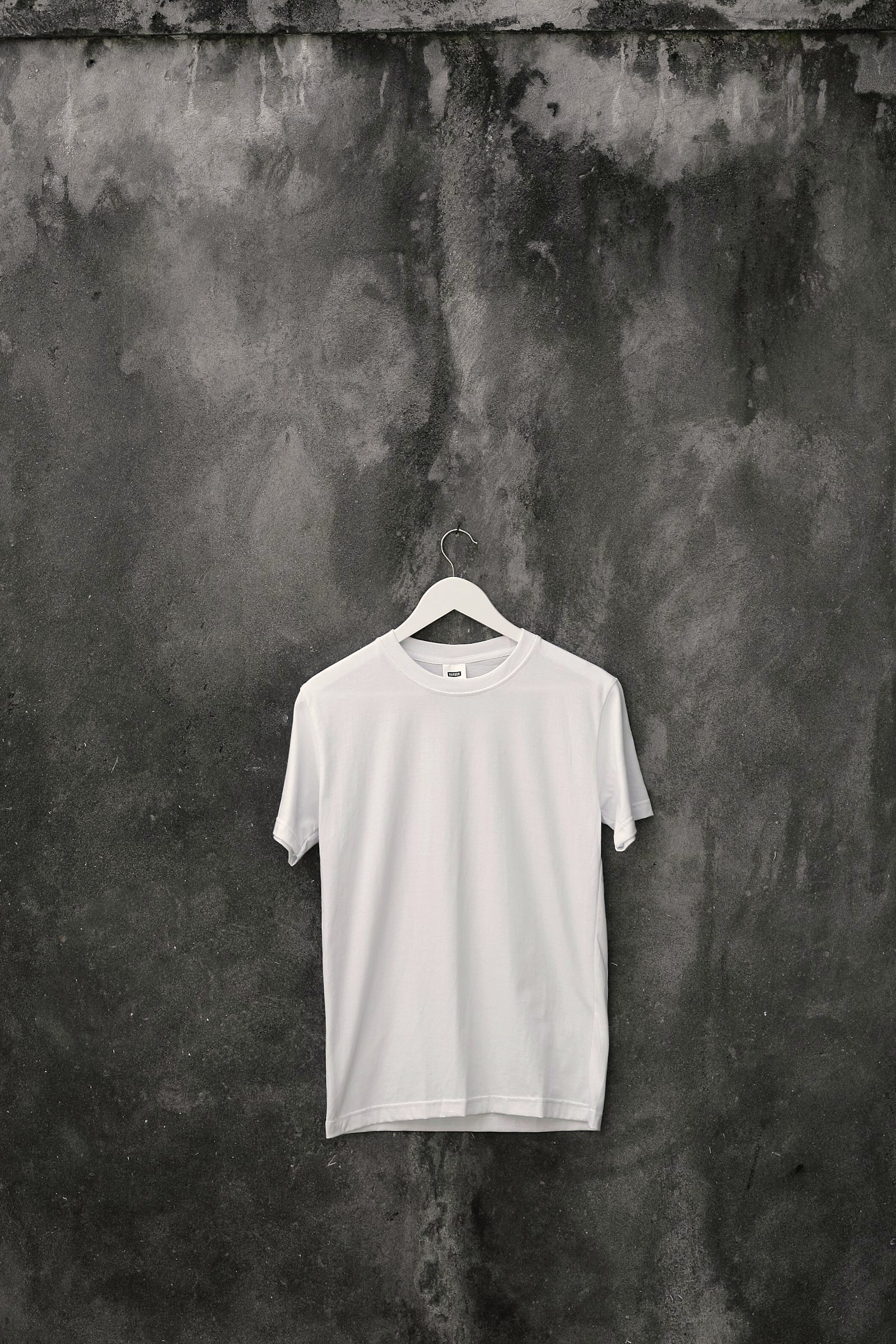
A note on photography, printed because this page believes in saying so: our photo bank holds no tank top photography, on a body or off one, so no ranked garment is pictured anywhere on this page. The hero is the white tee on a hanger, the tank's sleeved sibling and the garment every tank below is a subtraction from, captioned as what it is. The frames this page actually needs, a ribbed tank worn in heat, an armhole at working depth, a tank under an open camp shirt, head the harvest list in the honesty section.
Checked and updated October 2026
The verdict, up front: seven tank tops, scored out of 100 on the house basis for this category: cloth 30, construction 20, fit and drape 20, value 15, longevity and wash 15. The Sunspel Superfine Cotton Vest wins at 84: the finest published cloth in the field, armholes cut at the depth the ruling below asks for, $50. And the Amiri MA Tonal Tank Top, listed at $480 and already marked down to $178 by the channel selling it, is sent home at 38. A tank top is the smallest garment in the wardrobe and the easiest to grade, because there is nowhere for a maker to hide: two bound openings, one body of cloth, and a price.
First, the decision
Every tank argument is really one argument, and it is about a hole. The armhole is the whole category. Cut it too deep and the garment is a stringer, a gym cut whose opening falls past the ribcage and reads as undress in every other room. Cut it too shallow and it binds in the pit, chafes by noon, and announces itself as an undershirt that wandered out of the drawer. Between those two failures is a narrow band, the opening ending around the bottom of the shoulder blade's swing, the strap two to three fingers wide, and every score on this page is downstream of how close a maker lands to that band. If you buy one tank, buy the Sunspel. If you buy the argument, buy any of the top three and check the armhole first.
The category ruling, in one line: a tank is a base layer and a heat garment, never a shirt substitute in a room with a door policy. It has exactly two legal states. Worn alone, it is a heat garment, for the beach, the garden, the hot city afternoon, the places where sleeves are the problem. Worn under an open shirt, it is a base layer with the shirt doing the dressing: the stack that our camp collar ranking builds toward all summer, its winner at 84 being precisely the kind of open shirt a ribbed tank belongs under, and the stack our linen shirt ranking assumes in every hot-weather row. A third state gets attempted every summer, the tank as the whole outfit in a restaurant, an office, a place with a dress code and a door, and it fails there not on taste but on arithmetic: the garment covers less than the room requires. Comfort cannot look sloppy, and the tank is where that rule is cheapest to keep.
One naming debt, paid before the cards. The winner is sold as a vest, because Sunspel is English and in England the word vest means this garment, while in America it means a waistcoat. The taxonomy page for the shirt family, types of shirts, files the garment by its American name. Same cloth, same cut, two words. This page uses tank, and grades the garment, not the label.
How the scores work
Five rows, printed on every card, the same discipline this magazine applies to a $500 shoe and a $3 undershirt. Cloth judges the fibre and the knit as the maker publishes them: rib against jersey against mesh, weight where a weight is published, and a published weight beats an adjective every time. Construction judges the binding at the neck and armholes, self-fabric or rib, the stitching that holds it, and the cut of the opening itself. Fit and drape is the armhole row: depth against the ruling above, strap width, and whether the body hangs as a garment or clings as a base layer, with the intended state graded honestly. Value divides what you get by what you pay, against the whole field. Longevity and wash costs the two ways a tank dies: rib that stops recovering, and jersey that relaxes, twists or goes wavy at the hem. The rows sum to the score, and the score is printed where you can screenshot it, under our published methodology.
Seven tanks, ranked
Sunspel: Superfine Cotton Vest
Best overall
List price at last check: $50 in the US at Sunspel; the same house's cotton jersey tank lists at £40 at Mr Porter in the UK.
The call: buy it first. This is the tank the rest of the page is measured against.
The ribbed classic done properly turns out to be a jersey, and the house that does it properly is the one that has been making underlayers in Long Eaton since before the tank had a name. The cloth is a long-staple cotton jersey, fine and smooth, the same fibre discipline that took the cloth honours on our boxer ranking, where Sunspel's boxer short scored 81 on its published paperwork, cited here as brand evidence only, because this garment is scored fresh. What wins the card is not softness. It is the cut: a scoop that sits where a scoop should, armholes at the ruled depth, a strap wide enough to read as a garment. Worn alone it passes for a top. Under an open shirt it disappears into the layer it is supposed to be. At $50 it is the most expensive honest tank here, and the cost-per-wear table below still puts it at 33 cents.
The deductions are printed with the praise. Sunspel does not publish a cloth weight for the vest, and on a page that prints weights that absence costs cloth points, the same charge this site laid on its t-shirt. And fine jersey is the delicate construction in any field: the longevity row, 12, is the honest price of the hand feel, paid knowingly.
Colorful Standard: Organic Rib Tank Top
The organic pick
List price at last check: £27 at Colorful Standard.
The call: buy it when the fibre line is the point. The most published garment on this page.
The organic entrant, verified the way this desk verifies: on the maker's own numbers. Colorful Standard publishes what the rest of the field mostly will not. The cloth is a rib knit of 95 percent organic cotton and 5 percent elastane at a stated 190 gsm, garment-dyed, anti-pilling finished, made in Portugal, with a ribbed binding at the neckline and straps and a regular fit. That paragraph is why it ranks second. A published weight, a published split, a named country of make: the data is the garment's second material. The 5 percent elastane is graded as what it is, the thing that keeps a rib's recovery honest across a summer of washes, and the reason this tank's fit row trusts its armholes to stay where they were cut.
Two honest charges. The price is printed in the maker's sterling, £27, because that is the store this desk could verify end to end, and the value row grades the figure as found. And elastane ages on its own clock: heat and years take it before they take the cotton, which is why the longevity row sits at 10 despite the rib. The organic cotton standard this site keeps, set when the underwear ranking scored a certified winner at 87, is met here on published fibre evidence, and the page says plainly that the certification paperwork is the maker's own account, graded as such.
Uniqlo: DRY Color Ribbed Tank Top
Best under $10
List price at last check: $9.90 in the US.
The call: buy three. The attainable pick, and the best-fitting cheap garment on this page.
Scored fresh, as the law of this site requires: Uniqlo the brand stands at 84 in our brand rankings, and its AIRism boxer brief scored 78 as a garment on the underwear ranking, and neither number is inherited here. This tank earns its own 77. The cloth is a cotton and recycled polyester rib with the maker's DRY quick-dry finish, the exact split varying by colour on the maker's materials line, which the cloth row grades as a blend doing a job: it dries faster than anything above it and feels like it. The fit is the surprise. The cut is fitted without being a compression garment, the armholes land in the ruled band, and the size run, XXS to 3XL, is the widest in the field by a distance. At $9.90 the value row is a formality: 15.
The charges are the blend's own. Polyester in a heat garment is a trade, cooler when wet, warmer against the skin on a still day, and it holds odour across a season in a way cotton does not, which is priced in the longevity row. Buy it as the rotation tank, three in rotation for the price of one Mack Weldon, and replace without ceremony when the rib tires.
Mack Weldon: 18-Hour Rib Tank
The recovery pick
List price at last check: $32 in the US.
The call: buy it as the under-shirt tank. The rib that promises to keep its shape, priced on whether it does.
The maker's whole pitch is in its name for the cloth: the 18-Hour Jersey, a cotton and modal blend on the maker's own fabric description, cut here as a stretch rib knit that, in the maker's words, will not lose its shape under your shirt. That sentence is the garment's job description and its grading rubric. As a base layer it is the best tool on this page: the modal gives the rib a smooth face that slides under a shirt instead of gripping it, the stretch keeps the body close without compression, and the armholes are cut for the under-shirt state, slightly shallower than the solo tanks above it, which the fit row grades as correct for the state it is built for and limiting outside it. This is the tank for the man whose tank is never the outfit.
The charges: $32 is real money for a base layer, three Uniqlo rotations deep, and the value row says so. And a blend built on modal is built for feel first; against the organic rib at rank two it publishes less and promises more, which is the wrong way round on this site.
Merz B. Schwanen: Iconic Ribbed Tank Top
The cloth hobbyist's tank
List price at last check: $130 at US stockists; sold out at both stockists found at check time.
The call: buy it if cloth is the hobby and your size survives the restock. Everyone else, the podium is above.
The loopwheel house's tank is the ribbed classic at full craft tariff: a dense cotton rib from the maker's Schwanen line, the same German knit discipline that put its 215 tee second on our white t-shirt ranking at 82, cited as brand evidence only. The cloth and construction rows respect it, 24 and 17, the second-highest pair on this page. A Merz rib is a serious object, cut close, finished like the underwear of a wealthier century, and it will outlast everything ranked around it.
Then the rest of the card happens. The fit runs in the maker's own numbering, 4 to 8, and runs small in the family pattern this site has flagged on every Merz garment it has scored, which costs the fit row. The price is $130 at the stockists carrying it, when they carry it: both found at check time were sold out, and a garment you cannot buy is a rumour with a score. The value row, 5, is the sound of a $130 tank top in a field where the winner costs $50. The cloth champion of the tee page could afford its tariff because a tee is the outfit. A tank is a layer, and layers are graded on what the layer costs.
Hanes: Cotton Ribbed Tank, 6-Pack
The workhorse
List price at last check: $20 for a pack of six at Target, $3.33 a shirt.
The call: buy the pack. The floor of this ranking, and the floor holds.
The A-shirt in its natural state: a 100 percent cotton rib in the whites, sold six at a time, with banded neck and armholes and a longer body cut to stay tucked, per the maker's own listing. Nothing about it is refined and nothing about it pretends to be. The cloth is thin beside every garment above it, the cut is a box with two holes, and the material row scores it 16 without apology. Then the arithmetic answers back, the way it did when the same house's Beefy-T embarrassed shirts ten times its price on the tee ranking: $3.33 a shirt, a cost per wear of about four cents, and a pack that stocks a whole drawer for less than one Mack Weldon. As the under-everything layer in a hard summer, or the tank a garden is allowed to ruin, it is not a compromise. It is the correct tool.
What it cannot do is be seen. Worn alone, the thin rib and the undershirt armhole give it away in one look, and the longevity row knows the rib relaxes a season sooner than the podium's. The ranking is a ladder, not a fence: this rung is for volume, and it is an honest rung.
Amiri: MA Tonal Tank Top
Skip it
List price at last check: $480 at SSENSE, marked down to $178 at check time.
The call: skip it. A logo wearing a tank's shape, priced as if the logo were the garment.
Amiri the brand stands at 64 in our brand rankings, a house with real craft in its denim and leather, and none of that standing is transferable to this card, because this card is graded on this garment. The garment is a tonal logo tank: the MA mark rendered in the same colour as the cloth, so the entire proposition is a logo you can barely see, on a sleeveless knit, at a list price of $480. The listing publishes no cloth weight and no fibre line worth the name, so the cloth row grades the absence, 14, the same treatment this site gives every maker who asks to be graded on adjectives. And the market has already filed its own review: at check time the channel selling it had cut the price to $178, a 63 percent markdown, which is what a $480 tank top is worth to the people whose job is selling it. At list it costs $4.80 a wear. At the sale price it costs $1.78 a wear, still five times the winner, for less garment than the winner is.
The cloth, in numbers
| Tank | Knit and fibre, as published | Published weight | Made in |
|---|---|---|---|
| Sunspel Superfine Vest | Long-staple cotton jersey | Not published | England (the house's Long Eaton jersey tradition) |
| Colorful Standard Organic Rib | Rib, 95% organic cotton, 5% elastane | 190 gsm | Portugal |
| Uniqlo DRY Color Ribbed | Rib, cotton and recycled polyester, DRY finish | Not published | Varies by batch |
| Mack Weldon 18-Hour Rib | Stretch rib, cotton and modal jersey | Not published | Not published |
| Merz B. Schwanen Iconic Ribbed | Cotton rib | Not published for this garment | Germany (the house's knit tradition) |
| Hanes Ribbed Tank | Rib, 100% cotton (whites) | Not published | Varies by batch |
| Amiri MA Tonal | Not published in the listing | Not published | Not published in the listing |
One garment in seven publishes a cloth weight, and it is the organic one at rank two. The pattern from the tee ranking holds in miniature: weight is published when it flatters, and the two most expensive tanks here publish nothing at all.
What each tank costs per wear
The maths, assumptions printed. A tank in a warm-season rotation is worn about 50 times a year, twice a week through the warm months and under shirts at the edges of them. Expected life is estimated from construction class, not from the price tag: dense rib and long-staple jersey at the top, thin multipack rib at the bottom. These are the data team's estimates, published so you can argue with them.
| Tank | Price | Expected life | Cost per wear |
|---|---|---|---|
| Hanes Ribbed Tank (per shirt) | $3.33 | 1.5 years | $0.04 |
| Uniqlo DRY Color Ribbed | $9.90 | 2 years | $0.10 |
| Colorful Standard Organic Rib | £27 | 2.5 years | £0.22 |
| Mack Weldon 18-Hour Rib | $32 | 2 years | $0.32 |
| Sunspel Superfine Vest | $50 | 3 years | $0.33 |
| Merz B. Schwanen Iconic Ribbed | $130 | 4 years | $0.65 |
| Amiri MA Tonal | $480 | 2 years | $4.80 |
Argue with the Amiri line first. Even at the $178 its own channel cut it to, it costs $1.78 a wear, more than five times the winner, for a garment whose logo is dyed to match itself so nobody can see it. The price is not buying cloth, years or even display. It is buying the receipt.
The Skip · 38/100
The Amiri MA Tonal Tank Top, listed at $480 and already marked down to $178 by the channel selling it at check time, is this ranking's named loser. A tank top is two bound openings and a body of cloth; there is no construction programme, no hand-finishing story, no cloth weight even published, that closes a $430 gap between it and the winner. What the $480 buys is a tonal logo, a mark dyed to be invisible, which makes this the purest logo tax in the category: you pay for the name and then pay again in camouflage. Buy the Sunspel, buy the Colorful Standard for the days the fibre line matters, and put the change toward the open shirt both of them belong under.
The first wash, read from the specs
An honesty note, because this page prints its methods: the checks below are how to judge any tank after its first wash, together with what each construction on this page predicts. This is a reading of published specifications, not a laboratory result, and we label it that way because the difference matters.
Armhole creep. Hang the washed tank and compare the openings. A rib binding with elastane in the knit, the Colorful Standard, snaps back to its cut line. A pure cotton rib, the Hanes and the Merz, recovers by knit structure alone and creeps a little more each season. A self-fabric binding on a fine jersey, the Sunspel's family construction, is the one to watch: when it goes, the scoop deepens and the garment slides from top to undershirt in a single summer.
Body twist. Lay the tank flat and sight down the side seams. Single jersey twists toward the direction of its knit torque; compacted and garment-dyed cloth, the Colorful Standard is garment-dyed after cutting, arrives pre-shrunk and moves least. The Uniqlo's synthetic content holds the body square at the price the cloth row already charged it.
The white test. Hold a white tank against the light. In this category thin is not a flaw by itself, a base layer should be thin, but a tank sold to be worn alone owes you opacity, and the maker's own listing for the Uniqlo says its white is slightly sheer, printed here because the maker printed it first. That sentence is worth more than a photograph: grade makers on whether they tell you.
Which one to buy
If you buy one: the Sunspel, in white, and wear it both legal ways. If you buy for the heat: the Uniqlo, three in rotation, replaced without grief. If the fibre line is the point: the Colorful Standard, the only published weight and the only organic cloth in the field. If your tank is never the outfit: the Mack Weldon, built for under a shirt and graded for exactly that. If you are stocking a drawer: the Hanes six-pack, and spend the savings on the shorts the tank will actually be seen with. If cloth is your hobby: the Merz, sized up, bought at restock, kept for years. The ranking is a ladder, not a fence.
Questions, answered
What is the best tank top for men?
The Sunspel Superfine Cotton Vest, scored 84 out of 100. It wins the way Sunspel keeps winning on this site: the finest published cloth in the field, a long-staple cotton jersey, cut with armholes at the depth this page rules correct, at $50, which works out to about 33 cents a wear across a three-year life. The Colorful Standard organic rib tank is second at 80 and is the pick when the fibre line matters most: 95 percent organic cotton at a published 190 gsm.
How deep should a tank top's armholes be?
Deep enough to move and shallow enough to cover. The working test: raise your arm; if the opening falls past the bottom of the ribcage, the garment has stopped being a tank and become a stringer, a gym cut that reads as undress everywhere else. If the binding sits tight in the armpit and chafes by noon, it is cut as an undershirt only. Every tank ranked highly on this page sits between those two failures, with the shoulder strap wide enough, roughly two to three fingers, to read as a deliberate garment rather than a tee that lost its sleeves.
Can you wear a tank top under an open shirt?
Yes, and it is the tank's most dressed state. The rule is contrast and cloth: a ribbed tank under an open camp collar or linen shirt, in a colour that differs from the shirt by a clear step, reads as a planned layer. A smooth jersey tank the same colour as the shirt reads as underwear that escaped. The open shirt supplies the coverage the door policies ask for; the tank supplies the heat management. What the stack never survives is a blazer or a restaurant with a dress code: in rooms with a door policy, the tank is a base layer, not the outfit.
Is a vest the same thing as a tank top?
In British English, yes: what Sunspel and the English makers call a vest is the sleeveless cotton underlayer Americans call a tank top or an A-shirt, and the winner of this ranking is sold under the word vest. The words carry different baggage by country, undershirt in London, gym or beach in Los Angeles, but the garment graded here is one garment: a sleeveless knit top with bound neck and armholes, worn alone in heat or under an open shirt.
How much should a tank top cost?
The honest range on this page runs from $3.33 a shirt in the Hanes six-pack to $50 for the winner. Under $10 buys a real garment at Uniqlo. Between $25 and $50 buys published cloth, organic fibre or heritage construction. Past $100 you are paying for a name, and the most expensive tank here, a tonal logo tank listed at $480 and already marked down to $178 by its own channel, is the one sent home. The cost-per-wear table is the proof: the $480 tank costs $4.80 a wear against the winner's 33 cents.
Do ribbed tank tops last longer than jersey ones?
They fail differently, and the rib fails later. A rib knit stretches and recovers, so its armholes and neck keep their shape across washes; its weakness is twist, the body slowly spiralling if the knit was not finished against it. A fine jersey holds its line beautifully and then relaxes all at once, the scoop deepening and the hem going wavy. On the published constructions here, recovery is what the longevity row rewards most, and the fine jerseys are graded on staple length and ply, the things that delay the relax.
How this ranking stays honest
Scores follow our published methodology and are re-checked on the cadence in the byline; when a maker changes cloth, construction or price materially, the score moves and the move is noted here. Three disclosures belong on the record. First, photography: this page pictures none of its garments, because the bank holds no tank photography and this site does not borrow product shots it has not licensed; the frames needed, a ribbed tank worn in real heat, an armhole at working depth, the tank under an open camp shirt, are on the harvest list, and the page will rather run plain than run wrong. Second, two prices are printed in the form the evidence took: the Colorful Standard in the maker's sterling, and the Merz at retailer list with its sold-out status stated on the card, because a price you cannot currently pay is a different kind of fact and is labelled as one. Third, every garment here was scored fresh: brand standings and sibling garments are cited as evidence where they appear, the Sunspel boxer at 81, the Merz tee at 82, and never inherited as scores. The sleeveless drawer, like the rest of the wardrobe, is graded garment by garment.