
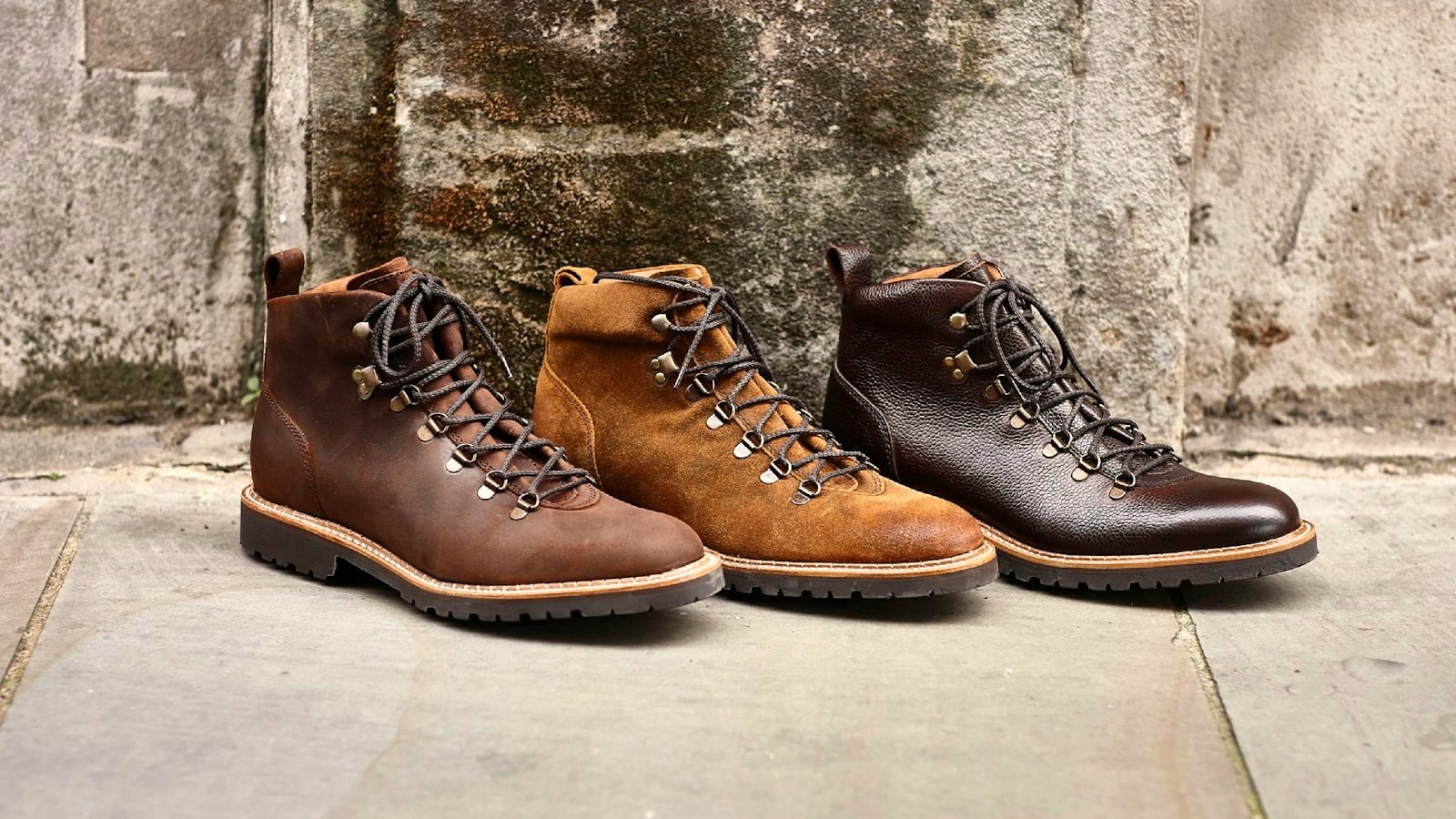
Worn boots, close up: the sporting register every house on this page sells into. Our bank holds no photograph of an Orvis garment and no fly-fishing frame, so no frame on this page is captioned as one.
The short answer: Orvis is the elder of American sporting retail, a fly-fishing house founded in 1856 that still prints the oldest covenant in the business, and its 70 was derived on our L.L.Bean page from its flagship shirt and its guarantee. This page audits the anchor against the house’s current published record and the number moves to 69: one row moves, longevity, from 12 to 11, because the derivation docked that row for a retrenchment that has since roughly doubled, 31 stores and 5 outlets announced closed, the headquarters campus listed for sale, while the covenant itself verifies entire and the rescale winds down the very lines the derivation docked. The flagship’s price verifies at $98 and the other four rows stand. Above it: L.L.Bean at 87, Filson at 85, Barbour at 81 and Tom Beckbe at 75. Level with it: Belstaff at 69, the tie ruled on the fabric row, against the anchor. Zara, at 48, standing from its own page, is the skip: the waxed jacket sold as an effect, the word printed in its own product names.
What people actually want from Orvis
The want under this search is the sporting house that answers: fishing shirts and country cloth with a specification printed on them, sold by the oldest name in American sporting retail, and standing behind all of it a sentence the house has printed since before the Civil War, that any purchase that is not 100 percent satisfactory will be refunded, anytime, for any reason. Orvis began in Manchester, Vermont in 1856 as a fly-fishing house, became the oldest mail-order company in America, and grew into a catalogue that sold the whole sporting life, dogs, home furnishings and travel included. The derivation this page audits was set on another house’s brief, the L.L.Bean page, and it graded the anchor the way that page graded everything, through its flagship shirt, its guarantee and its drift: a Tech Chambray at $98 with its rating and its fibre printed, a covenant intact, and a clothing range that had wandered a long way from the river. The audit owed the record a reading on its own terms: what does the house publish now, about the cloth, the price, the promise and the estate standing behind all three, and which of the derivation’s five reasons survive?
The answer is a house whose cloth record is exactly as published as the derivation said, whose price has not moved, whose promise has not moved, and whose estate has halved since the derivation graded it, in a rescale the house itself describes as a return to its roots. The audit treats those facts in the rows they belong to.
How the scores work
Same ruler as every page in this series: fabric and specification record out of 30, construction 20, fit and size range 20, value 15, longevity and repair 15. One row on this page moves, the anchor’s longevity, and the move is argued below; every other number already stands in this series, and each card names its home. The skip’s 48 was set as the anchor of its own page and is restated here, not re-derived.
The standing record, in full. The L.L.Bean page of this series derived the anchor’s score in the open, from the published record: fabric 20, construction 15, fit 13, value 10, longevity 12. Add them: the brand score was 70, and the Filson, Patagonia and Arc’teryx pages rested it in prose, while our field jacket and barn jacket rankings cited it as evidence. This page audits each row against the maker’s current record.
Fabric, 20, stands. The derivation rested on a sporting core that publishes real cloth, and the flagship’s record is unchanged and entire at this check, read on the maker’s own product page: the men’s Tech Chambray work shirt at $98, its UPF 40 rating printed, its fabric built to breathe, wick and dry, and its fibre named with its recipe, MarinoWul+, in the maker’s words an eco-friendly performance fiber made from recycled plastic bottles and oyster shells reclaimed from the restaurant industry. Against that stands what stood before, and it is the row’s ceiling: the general apparel rail around the core runs to unremarkable cloth at sporting prices, and the row was docked for exactly that. The house has announced an assortment tightening that winds down the home and lifestyle lines and returns the range to the sporting core, and the audit prints that announcement here as a credit and does not cash it, because the rail still stands in the store at this check and the row grades the published record, not the plan. The 20 stands on the derivation’s evidence, verified.
Construction, 15, stands. The derivation graded construction published on the work shirts, and it is published at this check in the maker’s own words on the flagship’s page: Tech Chambray incorporates triple-stitched critical seams to stand up to heavy packs, long hikes, fishing missions and seasons of travel, with pockets carrying reinforced stress points beside them. The rod and wader benches behind the clothing remain genuine benches, and the clothing still sits a step below them, which is where the derivation put it. Nothing published moves the grade in either direction. The 15 stands.
Fit, 13, stands. The derivation credited classic cuts honestly described and a narrower library than the catalogue houses offer, and both halves verify at this check: the flagship is published in an Active Fit, its sizes run small to XXL on the maker’s pages, and the house describes its fits in plain language rather than in vanity. In this field the welcome is honest rather than wide, a step narrower than the anchor’s great rival above it, whose library runs to big and tall without apology, and a step more useful than a chest number alone. The evidence is the derivation’s evidence, verified in the current listings, and the 13 stands on it.
Value, 10, stands. The row was argued on a price and a distance: the flagship shirt at $98 against the catalogue flannel class at $59.95, the sporting premium charged on the clothing as well as the tackle. The price verifies at this check to the dollar: the Tech Chambray stands at $98 at the maker’s store, the figure on its own product page. Where the audits before this one moved a value row, they moved it on the maker’s own new price, a rise printed at the till; this maker has not moved its price, and the row records a held price the way it records a risen one, by standing. What $98 buys is unchanged and printed on the card below: a rated, fibre-named, seam-published fishing shirt from the house that invented the category. The 10 stands.
Longevity, 12 to 11, moves. The derivation priced the afterlife as the strongest sentence in American retail standing behind a shrinking house: continuous since 1856 with the covenant intact, docked for the drift, dog beds and home furnishings sharing the catalogue’s front ranks with the clothing, and for the 2024 retrenchment, stores closed and the catalogue ended after 167 years. The covenant half of that sentence verifies entire at this check, and the audit prints it before the charge: the maker’s returns page still opens with the words that 100 percent customer satisfaction has been our commitment since 1856, no expiry is printed anywhere on it, and its international section still carries the old formula, that if for any reason you are not satisfied with your purchase, you should return it. The Perkins family, owners since 1965, still own the house. What has changed is the size of the institution standing behind the sentence, and it has changed in the open. In October 2024 the house cut 112 jobs, about 8 percent of its staff, and ended the catalogue. In June 2025 it cut some 50 more under tariff pressure. In October 2025 it announced the closure of 31 stores and 5 outlets by early 2026, more than half of an estate of about 70 stores, and listed its 351-acre Vermont headquarters campus for sale at $5.85 million. The caps are printed at the same size as the credit, because they are the row’s ceiling: a guarantee is only ever as strong as the institution that must honour it, and the institution has halved its physical estate since the derivation graded it. Against the charge stands one fact the audit credits at full size, because it answers the derivation’s other dock directly: the rescale is a return to the sporting core, the home furnishings and lifestyle lines wound down, the assortment tightened to fishing, wingshooting, gear and the sporting clothing this page grades, the Manchester flagship kept open and the gear carried by more than 550 independent dealers beside the maker’s own store. The drift the row was docked for is being reversed by the same programme that shrinks the estate, and that is why the move is one point and not three: the row falls to 11, level with the Manchester house’s rewaxing ritual on the Tom Beckbe ladder, below the audited 13s whose terms print a guarantee beside a staffed service, and the total with it to 69, derived on the L.L.Bean page, rested on the Filson, Patagonia and Arc’teryx pages, audited here.
The bookkeeping, printed: L.L.Bean’s 87, Filson’s 85, Barbour’s 81, Tom Beckbe’s 75 and Belstaff’s 69 are standing scores from their pages in this series, reproduced with their rows; nothing here re-derives them. One consequence of the audit is printed rather than left to arithmetic: the anchor’s move lands it level with Belstaff at 69, and the tie is ruled the way this series rules ties, on the fabric row, 20 to 22, against the anchor: the moto house’s cloth record, a named mill and a published weight, stands above a core shirt with a named fibre, and the anchor’s fabric row carries the dock for the rail around that core. Belstaff also takes longevity, 13 to 11; the anchor takes value outright, 10 to 6; construction stands level at 15 and fit level at 13, and both cards below print those rows at their full size. The ladder orders the tie; it does not hide it. Two garment-level facts are cited on this page as evidence, the Heritage Field Coat’s 80 and the Classic Barn Coat’s 75 on our jacket rankings, where the garments were graded on their own rows; they belong to their garments and move no brand number by themselves. One correction to the derivation’s record is printed in the open in the audit above rather than carried silently: the estate, corrected from the 2024 retrenchment the derivation docked to the halved estate of 2026, with the covenant verified entire beside it. The audit has one consequence the page prints rather than leaves to implication: the L.L.Bean, Filson, Patagonia and Arc’teryx pages and our two jacket rankings carry the derivation’s number, and the audited rows are the ones recorded here, 20, 15, 13, 10, 11, on this page, which is the ruling’s home. The total they reconcile to is 69.
Rested, with their standing numbers: Patagonia at 83, the modern covenant graded on its own page; it stands in a different register, the technical branch of the heritage family, and this page grades the sporting and country field the anchor actually trades in. Lands’ End at 75, the other covenant keeper, whose unretreated sentence stands in the Bean page’s ledger beside the anchor’s own; its register is the catalogue household, and its argument is made where its score was derived. Duluth Trading at 68 and Eddie Bauer at 56 rest with that page’s field, the workwear spec and the expired trademark, neither of them a sporting house a reader cross-shops against this anchor.
One more house belongs in prose. H&M sells the field silhouette at prices that undercut every card on this page, and this series derives its brand score from its ranked garments on its own page rather than borrowing one; nothing here restates or re-derives that number, and no H&M garment is scored on this page. The Tom Beckbe page answered that house the same way, and the reader cross-shopping the anchor against the high street should read those pages. The derivations there are untouched by this one.
The disclosure ledger
What each house publishes, in its own words where words exist. The audit reads this table before it reads any marketing.
| House | The fabric record, as published | The afterlife, as published |
|---|---|---|
| L.L.Bean | The deepest garment record on this site: the boot sewn in Maine, the tote’s 24-ounce canvas and 500-pound handle test printed by the maker | One year for a refund since February 2018, defective items considered after that: the famous retreat, printed by the house that made it |
| Filson | The heaviest cloth in the field, tin cloth and wool published across the line, the cloth the ceiling is named for | The lifetime guarantee the category is measured against, printed as a promise to repair or replace, from the house that has stood behind it the longest |
| Barbour | 6-ounce Sylkoil published to the ounce on the classics, a range whose centre publishes what its edges do not | The repair and re-waxing department itself, with a United States repair address and published turnaround targets; re-waxing recommended annually depending on wear |
| Tom Beckbe | 8-ounce waxed shelter cloth with its mill, Halley Stevensons, named on the product page itself | A lifetime guarantee against manufacturing defects, repair first and free, replacement behind it; damage and wear repaired at cost; a garment sendable to be rewaxed |
| Belstaff | The lighter Ultracore wax cotton at 8 ounces over a Miporex membrane, the cloth still British Millerain, printed on the maker’s own product pages | A repairs service arrangeable online, a 24-month guarantee in the maker’s terms with paid repair beyond it, and the annual rewax interval printed on its care pages |
| Orvis | The flagship’s fibre named with its recipe, MarinoWul+ from recycled bottles and oyster shells, its UPF 40 printed and its seams published; the rail around it unremarkable at sporting prices | 100 percent satisfaction, the commitment since 1856, refunded anytime, for any reason, with no expiry printed; a prepaid mail label at $6.95 and a gift card without a receipt |
| Zara | “Cotton fabric with a waxed-effect finish,” under product names that sell the effect: the whole cloth story, printed by the maker | A longevity row of 3: nothing is published behind the returns window, and an effect has no renewal mechanism |
Seven brands like Orvis, ranked

L.L.Bean
US prices at last check: Bean Boots from $140 at the maker's store, the 8 inch at $150; the Scotch Plaid flannel $59.95; the Boat and Tote $59.95.
Keeps its standing 87 and its rows, set in the American ranking and audited on its own page of this series: ten ranked garments, three category winners, and a guarantee whose retreat is charged on its own card.
Bean wins this page the way it wins its own: on the file. No house on this site has been graded garment by garment as often, and the grades hold up under the accumulation: the Scotch Plaid flannel a winner at 85, the Chamois overshirt at 83, the Wicked Good slippers at 88, a tote whose 24-ounce canvas and 500-pound handle test are printed by the maker, and a boot still sewn in Maine 113 years after Leon Leonwood Bean refunded the first hundred buyers out of his own pocket and fixed the design. Set that file beside the anchor’s and the eighteen points between them stop looking like an insult and start looking like a measurement: the anchor’s clothing record on this site is two honest jackets, a field coat at 80 and a barn coat at 75, graded as garments and cited on this page as evidence, where Bean’s is a shelf of ranked garments across five categories. Fabric 23, construction 16, fit 19, value 15, longevity 14: 87, set in the American ranking and audited on its own page of this series, the page that derived the anchor below.
The anchor beats it in exactly one room of the house, and the room matters: the document. Bean cut its covenant in February 2018 to one year and a consideration, and the anchor still prints its own in the old words, which is why the anchor’s card below argues the guarantee at full size. Buy Bean for the garments, at prices that charge almost nothing for the story; its value row is a perfect 15 against the anchor’s 10, and that gap, not the founding dates, is what a buyer feels at the till.
Filson
US price at last check: the Wool Jac-Shirt $349 at the maker's store; the Mackinaw Wool Cruiser about $550.
Keeps its standing 85 and its rows, set on the Carhartt page and audited on its own page of this series: the heaviest cloth in the field and a lifetime guarantee, at two to four times the anchor's prices.
Filson is the ceiling this whole cluster is measured against, and the anchor’s page is no exception. The Seattle house has sold cloth to people who work outside since 1897: tin cloth finished until it sheds water like a roof, Mackinaw wool woven to a density modern mills rarely attempt, and behind the garments a lifetime guarantee printed as a plain promise to repair or replace, kept across a century and a quarter. The anchor grew up in the same weather, a sporting house selling country cloth to people who use it, and the sixteen points between them are the honest distance between a good sporting catalogue and the field’s reference standard: a range of heavy cloths against one flagship shirt’s published fibre, and a guarantee with a repair department and a fleet behind it against a guarantee whose institution has just halved its estate. Fabric 27, construction 19, fit 15, value 9, longevity 15: 85, set on the Carhartt page and audited on its own page of this series.
Buy the Filson if the garment is bought once in a generation. Nothing on this page out-publishes it, and the houses below it are arguments about price, pattern and place, not about whether the ceiling is real.
Barbour
US prices at last check: the Bedale $425 and the Beaufort $450 at the maker's store.
Derived in the open at 81 on its own page of this series: the founding arrangement entire, a 6-ounce cloth published to the ounce and the bench the whole category copied.
Barbour is the anchor’s British counterpart and its quiet rebuke: the country house whose centre publishes what the anchor’s centre publishes and whose edges are forgiven the same lapses, because behind the garment stands the thing no other house here can sell, a repair and re-waxing department with its prices and turnaround targets printed, re-dressing the same jackets for decades. The South Shields house has made the waxed jacket since before the jacket had a category: the Bedale and the Beaufort, a 6-ounce Sylkoil cloth published to the ounce, corduroy at the collar, brass at the front. The anchor beats it on covenant, a refund promise with no expiry against a price list, however staffed, and loses to it on the cloth range, the bench and the years. Fabric 24, construction 16, fit 15, value 12, longevity 14: 81, derived on its own page of this series.
Buy the Bedale if the jacket is a thirty-year arrangement and the service department is the argument. Its twelve points over the anchor are the institution measured, and unlike the anchor’s institution, this one publishes its turnaround targets.

Tom Beckbe
US price at last check: the Tensaw $495 at the maker's store.
Audited at 75 on its own page in this series: the afterlife corrected from no repair service published to a lifetime guarantee with repairs at cost behind it, one reason replaced and the number moving three points.
The young sporting house stands six points above the elder on this page, and the comparison is the audit’s own lesson read from the other side. Tom Beckbe, of Birmingham, Alabama, has made its waxed jackets in the United States since 2015, and its Tensaw’s page is the fullest single product page in this field, as our waxed ranking found when it graded the garment at 78 there: an 8-ounce waxed shelter cloth with Halley Stevensons of Scotland named in the description, a movement pattern of set-in sleeves, gusseted underarms and a bi-swing back, and the full care ritual printed beside the price. Its own audit found the same shape of error this page finds, in the same row, and corrected it upward: a lifetime guarantee against manufacturing defects, repairs at cost behind it and a send-in rewaxing service, where its derivation had read a tin of wax and stopped. Fabric 22, construction 16, fit 15, value 10, longevity 12: 75, derived on the Barbour page and audited on its own page.
Read the six points plainly. The young house publishes one cloth more deeply than the elder publishes its whole range, cuts its jacket for shoulders that work, and prints a guarantee with a repair desk behind it. The elder prints the older and wider promise, anytime, for any reason, on a clothing range the young house would not recognise as competition. A reader choosing between them is choosing which document to trust, the specification or the covenant, and this page’s rows price both.

Belstaff
US price at last check: the Trialmaster $795 at the maker's US store; £595 in the UK, cut from £650.
Audited at 69 on its own page in this series: the maker's own store printing $795 plainly where the derivation had to guess, and a change of ownership printed beside the guarantee.
The level rival, and the comparison this page’s audit quietly created. Belstaff is the other founding house of the waxed jacket: the Trialmaster of 1948 carried the pattern into the motorcycle trials world, and the current jacket’s cloth is still British Millerain waxed cotton, the lighter Ultracore at 8 ounces, its waterproofing done by a Miporex membrane behind the wax with armour rated in the maker’s own copy. Its own audit moved it one point on the maker’s own price, $795 printed plainly in its United States store, near double the Bedale, and printed a completed change of ownership beside its service record: a repairs service arrangeable online, a 24-month guarantee in its terms with paid repair beyond it, and the annual rewax interval on its care pages. Fabric 22, construction 15, fit 13, value 6, longevity 13: 69, derived on the Barbour page and audited on its own page.
Read the tie, because it is the page’s neatest measurement. The anchor’s audit lands it level with the moto house, and the ladder rules the tie on the fabric row, 20 to 22: a named mill and a published weight against a flagship fibre named with its recipe, the anchor’s row carrying the dock for the unremarkable rail around its core. Belstaff also takes longevity, 13 to 11, its service paperwork printed beside its promise where the anchor’s promise stands behind a halved estate; the anchor takes value outright, 10 to 6, a $98 flagship shirt against a $795 jacket; construction stands level at 15 and fit level at 13. Three rows to the anchor’s one, level at 69, and the ladder orders the tie on the first row because this cluster grades cloth before everything. Buy the Trialmaster if you ride. Buy the anchor’s core if you fish. The rows say why each stands where it stands.

Orvis
US price at last check: the Tech Chambray work shirt $98 at the maker's store.
Audited at 69 on this page: the estate corrected from the 2024 retrenchment its derivation docked to the halved estate of 2026, the covenant verified entire beside it, one reason replaced and the number moving one point.
The house first, stated plainly. Orvis was founded in Manchester, Vermont in 1856 by Charles F. Orvis, a fly-fishing house before it was anything else and the oldest mail-order company in America; the Perkins family has owned it since 1965, and its flagship store still stands in Manchester. Its garment evidence on this site is honest and narrow, cited here as evidence and never blended into this number: the Heritage Field Coat at 80 on our field jacket ranking and the Classic Barn Coat at 75 on our barn jacket ranking, both graded on their own rows and both pill-less there for want of a readable American product page. The audit’s credits are the derivation’s: the flagship’s cloth record stands entire, a UPF 40 rating printed, a fibre named with its recipe, triple-stitched seams published on the product page itself, and the price verifies to the dollar at $98. Fabric 20, construction 15, fit 13, value 10.
The correction is the audit’s, printed at the same size. The derivation priced the afterlife off a house mid-retrenchment and docked it for the drift and the closures it could see in 2024; the record since is larger in both directions. The covenant verifies entire: the returns page opens on the commitment of 1856, no expiry is printed on it, and the house kept the sentence through a retrenchment that cost it its catalogue. The estate does not verify: 112 jobs cut in 2024 and the catalogue ended after 167 years, some 50 more jobs cut in 2025, and 31 stores with 5 outlets announced closed by early 2026, more than half the estate, with the Vermont headquarters campus listed for sale. Credited against the whole charge, the rescale winds down the home and lifestyle lines the derivation docked and returns the house to the sporting core this score grades, which is the reversal of the drift, bought with half the estate. Longevity falls to 11. The brand score is 69, derived on the L.L.Bean page, rested on the Filson, Patagonia and Arc’teryx pages, audited and moved here.
Buy the core, as the derivation said, only with the audit’s arithmetic now attached. The fishing shirts, the waders, the country cloth with a specification printed on it: those are Orvis garments, made by a house that still answers for them in the oldest words in American retail, and after this audit the words are nearly all that is left at full size. On promotion, in the core categories, it remains the sporting house that answers. At list, in the clothing aisles, it is a smaller store than the one its derivation graded, with the same magnificent guarantee attached.
Zara
US prices at last check: the regular fit waxed-effect jacket $149 and the waxed-effect padded jacket $169 at the maker's store. This card ships without a buy link, and the honesty section prints why.
Standing at 48 from its own page in this series, and the skip here, its conviction restated from the Barbour page: the register copied at speed over thin cloth, with nothing behind the returns window.
The charge is read off the maker’s own record, on this cluster’s own rail, re-verified at this check rather than trusted from the file: the maker’s American store sells the regular fit waxed-effect jacket at $149, its whole description of the cloth one sentence, crafted from cotton fabric with a waxed-effect finish, with the waxed-effect padded jacket at $169 and a collaboration edition at the same figure beside it. No mill is named, because there is no mill story. No weight is published, because the cloth is not the product. And no wax is in the garment, because the finish is an effect, which is the maker’s word and the conviction in one. The rows are the house’s standing rows, reproduced exactly as this series prints them: fabric 13, construction 8, fit 15, value 9, longevity 3: 48, set as the anchor of its own page. The test this page set for a fresh conviction is printed in the questions below: a thinner waxed record than a resemblance sold under the word effect, and no candidate on the fashion rail published one.
Set it beside the anchor one place above it. The anchor has just halved its own estate and carries the audit’s correction on its card, the easiest target on this page, and it still publishes its fibre’s recipe, its seams and the oldest guarantee in American retail. The skip publishes a photograph of the field and an effect where the cloth should be. Buy the shape if the shape is what you want, eyes open, as a fashion jacket with a season in it. Do not buy it as a waxed jacket. The maker, to its credit, never quite said it was.
The pattern under the ranking
Read the ladder as one argument about what a sporting brand is. The top answers with garments and weight: a boot sewn in Maine and a tote costed by the pound, cloth at 27 with a lifetime guarantee, and the founding bench printing its prices. The middle answers with publication at two altitudes, an Alabama sporting house and a Staffordshire moto house standing six points and a tie apart, each printing its cloth in its own words. The anchor answers with a sentence, the oldest in the field, standing behind an estate half the size it was. And the bottom answers with a word, effect, printed in its own product names. The scores are that argument measured seven times: in this category the product is a cloth and a promise, and everything else is a photograph of them.
The second pattern is the audit’s own, and this page is the fourth time the series has found it. The L.L.Bean page’s derivation graded this house through its flagship shirt and its guarantee, and docked its longevity for the retrenchment it could see. The closures since were not on that page; they were in the trade papers and the maker’s own announcements, where retrenchments live, and the derivation could not have read them because most had not happened yet. The Peregrine audit corrected a mill and a making; the Tom Beckbe audit found a lifetime covenant behind a care ritual; this audit finds a halved estate behind an unretreated covenant. Read together, the four pages are the series’ method stated four times: a standing score is a claim about the record as it stood, and the record is a living thing, so the desk re-reads it. What would move the number back is printed so the maker can act on it. Publish a repair service beside the guarantee, or hold the estate the rescale leaves and let the covenant accumulate seasons at the new size, and the longevity row recovers; publish the cloth weights of the sporting core the way the flagship publishes its fibre, and the fabric row’s ceiling lifts. Until then, the house sits sixth, at an audited 69, the sporting elder with its promise intact and its estate corrected.
The ranking at a glance
| Brand | Score | The piece to buy | Price |
|---|---|---|---|
| L.L.Bean | 87 | Bean Boots, the 6 inch | $140 |
| Filson | 85 | The Mackinaw Wool Cruiser | $550 |
| Barbour | 81 | The Bedale | $425 |
| Tom Beckbe | 75 | The Tensaw | $495 |
| Belstaff | 69 | The Trialmaster | $795 |
| Orvis | 69 | The Tech Chambray work shirt | $98 |
| Zara | 48 | None | $149 not spent |
The verdict: skip Zara
Zara is this page’s named loser, and the charge is the shape of its record, set on its own page in this series, argued on the Barbour page and re-verified at this check on the waxed rail itself. It sells the founding silhouette of this category under product copy that confesses the finish is an effect; its cloth story is one sentence long; and behind the garment there is no repair, no resale and no published guarantee, only a returns window and next season’s version of the same photograph. Every house above it publishes more, and the anchor of this page, a house that has just halved its own estate, still publishes its fibre’s recipe and the oldest guarantee in American retail. Buy the register with the truth printed on it.
Which one to buy
For the institution: L.L.Bean, 87. The boot, the flannel and the tote, icons bought once and handed down.
For the ceiling: Filson, 85. The Mackinaw Cruiser, the heaviest cloth and the longest guarantee in the field.
For the bench: Barbour, 81. The Bedale at $425, and send it home for wax when the year asks.
For the field pattern: Tom Beckbe, 75. The Tensaw at $495, for the shoulders, the movement built into it, and the guarantee behind it.
If you ride: Belstaff, 69. The Trialmaster, armour and membrane, level with the anchor and ahead of it on cloth.
For the sporting core: Orvis, 69. The Tech Chambray at $98 and the fishing shirts, on promotion, under the oldest sentence in American retail.
To skip: Zara, 48. The photograph of the field, over cloth with no wax in it, with nothing behind it.
Questions, answered
What brand is most like Orvis?
On the basis this series grades, the head-to-head is L.L.Bean, at 87: the other American sporting institution, founded on a guarantee and a boot, with a deeper garment record than the anchor’s and prices that charge almost nothing for the story. Barbour, at 81, is the country-clothing answer, the founding bench with its cloth published to the ounce. Tom Beckbe, audited at 75 on its own page, is the same field pattern rebuilt in Alabama over a named Scottish cloth. Below the anchor the field thins fast: Belstaff stands level with it at 69, audited, the tie ruled on the fabric row. The honest summary: nobody here beats Orvis at being Orvis, the sporting house of 1856 that still prints the oldest covenant in American retail; the argument is about what you want more of around it, the garments, the cloth or the bench.
Why did Orvis’s score move from 70 to 69?
Because one row was priced on an estate that has since halved, and the audit corrects it. Longevity falls one point, 12 to 11: the derivation docked the row for the 2024 retrenchment, stores closed and the catalogue ended after 167 years, and since then the house has cut some 50 more jobs, announced the closure of 31 stores and 5 outlets by early 2026, more than half its estate, and listed its Vermont headquarters campus for sale. The other half of the row verifies entire and is printed at the same size: the returns page still opens on the sentence that 100 percent customer satisfaction has been the commitment since 1856, with no expiry printed on it; the Perkins family still owns the house; the Manchester flagship stays; and the rescale winds down the home and lifestyle lines the derivation docked the row for, which is why the move is one point and not three. The other four rows verify as scored, fabric on the flagship’s unchanged published record, value to the dollar, the Tech Chambray still $98 at the maker’s store. The number’s status changes with the audit: derived on the L.L.Bean page, audited here, at 69.
Orvis or L.L.Bean?
On the rows, Bean, 87 to 69, and the distance is the garments: ten ranked Bean garments with three category winners against an Orvis clothing record this site has graded twice, a field coat at 80 and a barn coat at 75, both honest and neither a winner. Bean’s prices charge almost nothing for its story, a perfect value row of 15 against the anchor’s 10, and its fit library is the widest in the field. Orvis wins the document: its covenant still reads anytime, for any reason, in substance, where Bean cut its own to one year in 2018. Buy Bean for the boot, the flannel and the tote, at the prices printed on its card. Buy Orvis for the sporting core, the fishing shirts and the country cloth with a specification printed on it, on promotion, and hold the house to the sentence it has printed since 1856.
Does Orvis still refund anytime, for any reason?
In substance, yes, and the maker’s own returns page is the evidence read at this check. It opens with the sentence: 100 percent customer satisfaction has been our commitment since 1856; it is who we are; if you are not happy with a product or service, we want to know about it, and we will make it right. No time limit is printed anywhere on the page, and the international section still carries the old formula, that if for any reason you are not satisfied with your purchase you should return it. The machinery around the sentence is ordinary retail and is printed here at the same size: a prepaid mail label costs $6.95 deducted from the refund, returns without proof of purchase come back as a gift card, and authorised dealers cannot process returns for the maker’s own stores. The sentence itself, the one the derivation graded, stands unretreated, which is more than the two most famous guarantees in this field can say: Bean cut its own to a year in 2018, and Duluth followed it in 2019.
Why is Zara the skip on a page about sporting brands?
Because the skip’s conviction is this cluster’s own charge, set on the skip’s own page in this series, restated on the Barbour page and re-verified at this check on the waxed rail itself. The test is printed on this page: a fresh conviction must publish a thinner waxed record than the standing skip’s, and none did. The maker’s American store sells the regular fit waxed-effect jacket at $149 under a description that reads, in full, crafted from cotton fabric with a waxed-effect finish, with the waxed-effect padded jacket at $169 beside it: no weight, no mill, no composition a buyer can weigh, and no wax anywhere in the garment to renew. Every house above it publishes a cloth and a covenant. The anchor, a house that has just halved its own estate, still publishes its fibre’s recipe and the oldest guarantee in American retail. The skip publishes a finish and the word effect.
The honesty section
Six scores on this page already stand in this series, and each card names its home: L.L.Bean set at 87 in our American ranking and audited on its own page; Filson set at 85 in our Carhartt ranking and audited on its own page; Barbour derived at 81 on its own page; Tom Beckbe derived at 72 on the Barbour page and audited at 75 on its own page; Belstaff derived at 70 on the Barbour page and audited at 69 on its own page; and Zara set at 48 as the anchor of its own page. The anchor’s 70 was derived in the open on the L.L.Bean page and rested in prose on the Filson, Patagonia and Arc’teryx pages, with our field jacket and barn jacket rankings citing it as evidence; this page audits it against the maker’s current published record, its flagship’s product page, its returns page and the house’s own announced rescale read at this check, and moves the total one point while moving one row, longevity down one on an estate that halved after the derivation graded it. The pages printed earlier in this series carry the derivation’s rows; the audited rows are 20, 15, 13, 10, 11, recorded here, and this page is the ruling’s home. The audit records one correction to the standing description, printed in the audit rather than carried silently: the estate, corrected from the 2024 retrenchment to the halved estate of 2026, with the covenant verified entire beside it and the refocus credited at full size. Prices and programmes were checked in October 2026 against the makers’ own published pages and current retail listings, following the method on our methodology page.
Buy links follow the deep-link rule: each card keeps the door its scoring page established, the maker’s own product page where that page used one and its established retail or category door where it did not. One door is printed as the exception it is. The anchor’s card goes to the maker’s own United States shirt category, the door the L.L.Bean page established for this house, because the flagship’s exact listing address is a session address in the maker’s store and the desk does not guess at addresses. The skip ships without a buy link because the desk does not link what it sentences. Photographs come from the bank credited in CREDITS.md; the bank holds no photograph of an Orvis garment and no fly-fishing frame, the same gap our L.L.Bean page admitted for the Bean Boot, and the cards run on the bank’s street, stack and profile frames rather than on borrowed product photography. The anchor’s card frame is the one its derivation used, a worn boot on wet rocks; no frame on this page is captioned as a garment it does not show.