

The ratio in one frame: a boxy white tee, its shoulder dropped and its body wide, worn over a slim black trouser that stays true, one volume zone spent and the other kept exact. The tee is a class frame from the bank, not a charted garment from the table below, and it is captioned as a class frame: the bank holds no measured oversized-fit photograph, and the gap and the harvest list are named in the care section below.
Checked and updated October 2026
The ruling, up front: oversized is a ratio, not a size up. An oversized garment is a pattern whose maker has redistributed the cloth among its zones, shoulder, body and length, in proportions a regular cut does not use, and the redistribution stands printed in the makers’ own size charts: at the same nominal size M, the oversized cuts the desk read stand 7 to 16.5 centimetres wider at the shoulder than the same maker’s regular block. The wearing is the cutting’s discipline. One volume zone at a time: the top wide over a true leg, the leg wide under a true top, the layer long over a true base, and every zone not spent kept at the wearer’s own measure. The garment is bought in the wearer’s own size inside the oversized cut, never sized up within it, and a regular garment sized up is refused entire, on No. 47’s standing law: width is a pattern, cut into the garment by its maker, and a pattern cannot be improvised from a size. On scores: no Card grades oversized as a class, and this page invents none; the Seoul labels the silhouette is identified with stand ranked on the Korean brands ranking, cited here and not restated.
This brief: the decisive rule · the garment’s record · the pairing law · the rooms and hours · the looks · the ruling · the mistakes · care, the keeping, and our photography
The decisive rule: the ratio, kept to one zone, in the wearer’s own size
Begin with the chart, because the word oversized is usually argued about in front of a mirror, and the mirror cannot settle it. A size is an even inflation: take a maker’s regular block up one step and every dimension grows a little, shoulder, body and length together, in the small increments the grading rules allow. A cut is a redistribution: the maker takes dimensions from where the regular block keeps them and spends them where the design wants them, unevenly and on purpose. Oversized is a cut, and the proof is printed by the makers themselves, in the drop table in this page’s record: one maker’s oversized tee stands 16.5 centimetres wider at the shoulder than its own regular tee at the same size, while its body grows by less and its length by less again, proportions no sequence of sizes can reproduce, because sizing up grows the length fastest in absolute terms and the shoulder slowest. The decisive rule follows from the pattern’s existence: oversized is a ratio among a garment’s zones, bought in the wearer’s own size inside the maker’s cut, and worn one zone at a time, so that the redistribution can be read as a decision rather than as a fit that failed. Everything this brief rules is the ratio’s keeping: which zone may spend, what the unspent zones owe, where the rooms close, and what the arithmetic forbids.
The rule’s clauses follow in order. The zone count is one. The body wears three volume zones in this brief’s accounting, the top, the leg, and the length of the layer over both, and the ratio licenses exactly one of them wide at a time. The reason is legibility, the same reason No. 47 keeps everything the wide leg touches exact: a single wide zone reads as a proportion chosen, its neighbours’ trueness supplying the scale that makes the width visible, while two wide zones remove the scale and leave only cloth. The size is the wearer’s own. The oversized cut has already spent the size’s work inside its pattern; the chart’s M is drawn for the M body, wider at the printed points, and to size up inside the cut is to stack an even inflation on an uneven redistribution, which lands in the dimensions the design did not ask for. The waist survives. Volume is spent at the shoulder, the hem or the leg, never at the body’s middle legibility: somewhere in the assembly the waistband or the body’s line must remain findable, by a true zone adjacent to the wide one, which is No. 47’s returning of the waist transposed from the leg to the whole silhouette and marked as a transposition in the care section. The drop is the maker’s figure. How far the shoulder seam falls is read off the chart, inside the printed band the table establishes, and a drop beyond that band is not a stronger ratio but a larger garment, graded in the mistakes below.
One preliminary distinction, because the trade’s own words blur it and the blur is where the mistakes start. Relaxed and oversized are not degrees of one thing in the documents the desk read; they are different documents. A relaxed cut widens the regular block modestly and evenly, a few centimetres distributed as a regular garment’s ease. An oversized cut redistributes, shoulder first or body first, at the magnitudes the table prints, plus 7 to plus 16.5 at the shoulder. The words are used loosely on rails and in marketing, which is why this brief takes its definitions from the charts rather than from the labels: where a maker publishes both blocks, the numbers say which garment is which, and where a maker publishes no garment numbers at all, as two of the six attempted here do not, the brief prints the absence and declines to grade the garment’s claim either way. The ratio is measured or it is not discussed, and the measuring is the record’s business, next.
The garment’s record: the Seoul silhouette, and the drop table that measures it
The silhouette first, in its published record. The wide top over the true leg is the standard form of the Seoul street silhouette, the shape the Korean labels ranked on this site are drawn around: thisisneverthat, which the Korean ranking calls the uniform of young Seoul, builds its line on wide blocks as a house standard rather than as a seasonal gesture, and Covernat, standing at 81 on that ranking, sells the same proportions at a student’s prices. At the ranking’s head the register is tailored upward, Wooyoungmi at 91 showing in Paris with the volume kept and the finish raised. The silhouette’s deeper roots are the ones this desk has printed before, in the ametora record: American workwear and campus cloth taken up in Japan and re-cut with an attention the originals never asked for, then re-exported, and the skate and hip-hop volumes of the 1990s, in which the wide garment was a size borrowed from an older brother before it was a pattern drawn by a designer. The modern fact is the one the table documents: what was once borrowed is now drafted. The volume has moved from the size rail to the pattern table, and the makers publish the pattern.
The drop table. The desk read six makers’ own published documents for the same nominal size, M, in a regular cut and an oversized cut, printing shoulder and body width as each maker prints them, centimetres throughout. Three makers publish complete pairs. Three are counted where their documents do not publish the numbers, and the counting is part of the table.
| Maker, size M | The regular cut, as printed | The oversized cut, as printed | The drop |
|---|---|---|---|
| Uniqlo, the maker’s own product-size charts | U Crew Neck T-Shirt: shoulder 37.5, body width 46, length 63.5 | U AIRism Cotton Oversized Crew Neck T-Shirt: shoulder 54, body width 58.5, length 72 | Shoulder +16.5, body +12.5, length +8.5 |
| thisisneverthat, the maker’s size chart, read at its retail channel | T-shirt block: shoulder 48.4, pit to pit 55.5, back 67.5 | Pocket Crewneck, the maker’s wide sweatshirt block: shoulder 57, pit to pit 67.5, back 66.5 | Shoulder +8.6, body +12, length −1 |
| Covernat, the brand’s actual-size tables at its Korean retail platform | Cooltandard C Logo T-Shirt: shoulder 51, chest width 55.5, length 69 | Multi Color Logo Graphic T-Shirt: shoulder 58, chest width 60.5, length 69 | Shoulder +7, body +5, length 0 |
| Ader Error, the maker’s own product documents | One block published entire: the tee at M, shoulder 47, chest 106 printed as a full chest, length 71. No regular counterpart stands in the documents read to print against it | Counted: numbers published, pair not published | |
| COS, the maker’s own size guide | Body measurements only: the guide gives the body the size fits, an M chest of 96, and no garment shoulder or width for either cut | Counted: garment numbers not published | |
| Matin Kim, the maker’s size information | No garment shoulder or width figures presented in a capturable document in this run | Counted: not read, and not estimated | |
Read the three complete pairs as the ratio’s three dialects, because they do not agree, and the disagreement is the finding. Uniqlo spends at the shoulder first: plus 16.5 there against plus 12.5 of body and plus 8.5 of length, a drop-led design, the seam descending furthest while the body follows, the silhouette lengthening as it widens. thisisneverthat spends at the body first: plus 12 of width against plus 8.6 of shoulder, and its length falls a centimetre, the wide block shorter than the tee it widens, volume taken in the round and refused in the vertical. Covernat spends least and at the shoulder only in effect: plus 7 and plus 5 at an unchanged length, the mildest ratio here, a wide tee that keeps the regular garment’s vertical entirely. Three makers, three answers to where oversized lives: in the drop, in the body, in a modest widening. There is no standard oversized, any more than there is a standard regular, and the buyer who wants a particular ratio chooses it by choosing a maker’s chart, the only document that states the choice in figures. The counts stand as the table prints them: six makers attempted, complete pairs at three, garment numbers published at four, body measurements only at one, and one not read.
The pairing law: the true zones are the wide zone’s evidence
The pairing law’s first principle is that the wide zone is read against its neighbours, and the neighbours’ trueness is what makes the reading possible. A dropped shoulder over a straight, true trouser reads as a proportion: the eye takes the leg’s measure, finds it exact, and credits the top’s width to design. The same top over a wide leg has no exact neighbour to be read against, and the eye’s verdict changes from proportion to quantity, more cloth, everywhere, unexplained. This is No. 47’s law at the scale of the whole body: there, everything the width touches is kept exact, the hem at the shoe, the top half fitted or tucked, because the width is the statement and a statement requires a quiet room. The oversized brief is the same law with the statement moved among three possible speakers, and the pairing discipline is identical whichever speaks: the two zones that are not speaking stay at the wearer’s measure, in garments whose own charts are regular, worn at their own sizes.
The waist is the pairing’s centre, and the law is No. 47’s, transposed once and marked. The wide-leg brief returns the waist with the fitted or tucked top, because a leg’s width that swallows the waistband has hidden the body’s one fixed point and the trouser reads as sacking. Transposed to the top, the law runs: an oversized top that falls past the waistband and past the hip’s line, over a trouser whose waist it also covers, hides the same fixed point from the other side, and the assembly reads as a tent for the same reason, a silhouette with no joint in it. The repairs are the family’s repairs: the hem kept at the lengths the oversized charts themselves print, 66.5 to 72 centimetres at M, a band that ends around the hip rather than below the seat; the front tucked or half-tucked where the cloth allows it, the waistband’s line shown at least in part; or the volume moved to the layer, worn open over a true base whose waist is visible entire. The check is the mirror’s and it is one question: can a viewer find the waist? If the waist can be found, the ratio stands. If it cannot, one zone too many has been spent, whatever the charts said.
The shoe answers the silhouette’s weight, and the rule is proportion, not a pick. A wide top lowers the outfit’s centre of visual weight; a true leg restores the line; and the shoe closes the account at the ground. The family’s standing guidance for the wide leg, at No. 47, reads the opening against the shoe it covers, and the pairing here borrows the direction without restating the ruling: the wider the assembly above the ankle, the more the shoe must be a full stop and not a whisper, a substantial sneaker or a boot’s line under the wide top’s standard assembly, the slim shoe reserved for the assemblies whose volume is smallest. No shoe is scored here and none is named as a pick; the brief’s claim is only that the shoe is part of the ratio’s evidence, the last true measurement in an assembly whose first measurement was deliberately given away.
The rooms and hours: the street’s capital, the office’s mild end, and the evening’s closed door
The ratio’s rooms divide by how fluently the room reads fit. The street is its capital, the campus, the creative floor, the weekend’s ordinary hours, where the silhouette is a native language and the full band of the drop table is licensed, one zone at a time, the Seoul standard being simply the local dress worn correctly. The tailored office is the narrow room, and it takes the ratio at its mildest, under the conditions the questions print: the relaxed end of a maker’s range rather than the oversized end, the drop at the low end of the printed band, one zone only, and the volume answered by structure somewhere in the assembly, a true shoulder in the layer above or a tailored exactness below. The mechanism is the room’s literacy: an office built on the fitted shoulder reads a descending seam by its own grammar, as a garment that does not fit its wearer, and a wearer cannot annotate his own shoulder in a meeting. The ratio that survives the office is the one that reads there as ease rather than as error, which is the band’s lower third and no further. The evening is No. 67’s room, and the door is closed by the grammar as it was closed to the bracelet at No. 80: black tie prints a fixed set whose proportions are part of the set, and an oversized element is an improvisation the set does not contain, in any zone, at any scale. The dressed evening below black tie inherits the refusal in proportion: the narrower the room’s code, the narrower the band of the ratio it admits, down to the tailored dinner’s none at all.
The working rooms of the body add one condition of their own, printed fairly because the silhouette’s defenders rarely print it: volume is cloth in motion, and a wide garment at a bench, a pass or a worktop catches, drapes and trails where a true garment clears, which is the same survival logic the wrist’s law applies at No. 53, read at the scale of the torso. The ratio is a room’s garment before it is a day’s, and the rooms that work with the hands are answered by taking the volume off, as the watch and the bracelet are taken off there, without the garment being blamed for the room. The desk’s long hour, by contrast, is the silhouette’s friend and is printed as such: no passage is fitted, nothing binds at the shoulder or the waist across eight seated hours, and the oversized top’s comfort in the untailored office is a real entry in its ledger, the one room where its ease and its legibility are paid in the same currency.
The looks: four assemblies the brief licenses
| Setting | The assembly | The details | The judgment |
|---|---|---|---|
| The Seoul standard | An oversized tee or sweatshirt in the wearer’s own size, over a true straight trouser, with a substantial sneaker | The volume in the top only, the drop read off the maker’s chart, the hem inside the printed band so the waistband’s line survives, the leg exact from waist to shoe | The silhouette’s home form: the wide block of the Korean labels worn as they draw it, one zone spent and the rest of the outfit the evidence |
| The leg answers | A fitted or tucked top over wide-leg trousers | No. 47’s assembly entire: rise first, hem at the shoe, the top returning the waist, the volume in the leg and nowhere else | The ratio with the zones exchanged, the standing proof that the discipline is the alternation and not the top |
| The long layer | A true base, fitted top and straight leg, under a long oversized coat or overshirt worn open | The volume spent vertically, in length, the base’s waist visible entire inside the open layer, the layer’s own hem kept off the ground’s business | The third zone carrying the claim: the most forgiving assembly here, because the true base does the legibility work in public |
| The tailored compromise | A relaxed knit or shirt at the drop band’s low end, under a true-shouldered blazer, over a tailored trouser | Relaxed rather than oversized, one zone at its mildest, the blazer’s shoulder supplying the room’s grammar while the knit supplies the ease | The office’s licensed form: the ratio present at the strength the room can read, and no stronger |
The ruling
Buy the cut, in your size, and spend it once. The oversized garment is drawn, not grown: read its maker’s chart, take the size the chart assigns your body, and let the printed drop, 7 to 16.5 centimetres past the regular block at the makers the desk read, be the volume you wear. Wear it in one zone, the top over a true leg, the leg under a true top, the long layer over a true base, and keep the waist findable, because the unspent zones are the evidence that the spent one was a decision. Refuse the size up in both its forms, the regular garment inflated, which the arithmetic shows cannot reach the cut’s shoulder inside eleven sizes, and the oversized garment inflated, which stacks an even growth on an uneven design. Refuse the second zone, however the rail merchandises the pair. In the tailored office, take the band’s low end or leave the ratio at the door; at black tie, leave it entire, the grammar having furnished the silhouette already. Oversized is the modern silhouette’s most democratic garment and its most counterfeited, the counterfeit being a size with a story told about it. The chart is the story’s check: a ratio, printed by its maker, worn one zone at a time.
Where the wearing goes wrong
The size up in a regular cut. The arithmetic failure, and the commonest: a regular tee or sweatshirt bought two sizes large and worn as oversized, its proportions the regular block’s own, grown evenly, the shoulder seam descending only because the whole garment descends, the length arriving at the thigh while the drop is still modest. The makers’ charts grade a size step at 1.5 centimetres of shoulder on the regular block the desk read, against the oversized cut’s 16.5 at a single size: the manoeuvre cannot reach its object, and what it reaches instead is a large garment, wrong at the neck, the cuff and the hem simultaneously. The repair is total and cheap in logic: return the size, and buy the cut, whose existence on the same rail is the whole of the modern fact.
The two zones spent together. The legibility failure: the oversized top assembled with the wide-leg trouser, each garment defensible, the pair indefensible, the volume with no true neighbour to be read against and the waist lost between them. It is the mistake the merchandising photograph teaches, the full look sold as one outfit, and it fails by this family’s oldest arithmetic for the leg, No. 47’s everything the width touches kept exact. The repair is a subtraction to one zone, the other garment returned to its true form, and the assembly’s read changes at once from quantity to proportion.
The size up inside the oversized cut. The stacking failure: the wearer who takes the L in a cut whose M was already drawn 12 centimetres wide, reasoning that oversized rewards more. The stack lands where the design did not ask, the length and the body growing evenly over a redistribution that was uneven on purpose, until the garment’s own printed ratio has been replaced by the wearer’s inflation of it. Its mirror failure, sizing down for a neater oversized, taxes the body width the cut spent its design on and produces the wide pattern worn tight, neither true nor oversized. Both are graded here as the same error in two directions: the size treated as the volume’s dial, when the cut is the dial and the size is the body’s.
Length bought as volume. The substitution failure: the long garment, tall tee, trailing sweatshirt, coat past its station, worn as the oversized claim, when length is only the ratio’s third zone and the least of it. The table prints the correction in a maker’s own figures: thisisneverthat’s wide block is a centimetre shorter than its regular tee, the volume taken in the round and refused in the vertical, so that a buyer who equates oversized with long has misread the design’s first decision. Length without width is not a ratio; it is a hem in search of a proportion, and it pools, drags and dates faster than any other form of the error.
Volume over tailoring. The room failure: the full drop worn into the tailored rooms, the seam descending the arm under a boardroom’s or a client’s eye, read by that room’s fluent grammar as a borrowed suit or a fit that failed. The garment is not blamed; the room’s literacy is the fact, and the wearer who knows the band takes the low end of it, answered by structure, or takes the true garment the room was built for. The silhouette’s capitals are the street and the untailored floor, and it is worn well exactly when its wearer knows which rooms are not among them.
Care, the keeping, and our photography
A wide garment is kept as its pattern requires. The shoulder seam is a structure, not a decoration: the dropped seam carries the garment’s weight off the shoulder’s point and onto the upper arm, and wide knits and sweatshirts are stored folded rather than hung, because a hanger’s points inside a dropped shoulder will grow the drop in the wrong places over a season, lengthening the sleeve’s hang and pulling the neck. The wide body is washed and dried flat where the cloth is heavy, for the same reason: a wet oversized garment carries more water in more cloth, and hung wet it dries longer, in every sense. The hem band and the cuff ribs are the garment’s fit furniture, the points where the wide pattern is gathered back to the body, and they are kept from the dryer’s heat, which tires elastic unevenly and leaves the body wide over a waist that no longer gathers, the ratio’s most ordinary death. Rotation is the wide wardrobe’s economy as it is every wardrobe’s: the silhouette repeats well, the same cut in the maker’s colours, and a ratio owned in three garments outranks a rack of single experiments.
The rulings this brief prints beyond the tree’s standing record are gathered here once, the way the family gathers its extensions. The family’s are cited as theirs: No. 47’s decisive rule for the wide leg, width as a pattern that cannot be improvised from a size, with its top-half discipline, adopted entire and extended from the leg to the silhouette; No. 67’s evening grammar, which furnishes the dressed body from a fixed set of proportions, adopted entire for the evening’s refusal; No. 53’s survival logic for the working rooms, transposed from the wrist to the torso and marked as a transposition. The Korean ranking’s standings are cited as printed there, Covernat at 81, Wooyoungmi at 91, thisisneverthat as the uniform of young Seoul, and no label is re-graded or scored here. This brief’s own are: the decisive rule itself, the ratio in one zone in the wearer’s own size; the three-zone accounting, top, leg and length; the waist’s survival stated for the whole silhouette; the drop band read from the table, 7 to 16.5 centimetres at the shoulder across the complete pairs; the size-up refusal in both its forms, with the eleven-step arithmetic drawn from Uniqlo’s own regular chart; the between-makers adjustment, the ratio chosen by the chart rather than inside the size run; and the office’s mild-end licence with its conditions. Nothing scored stands behind any of them: no Card grades this ratio as a class, and oversized carries no number of its own because none has been graded.
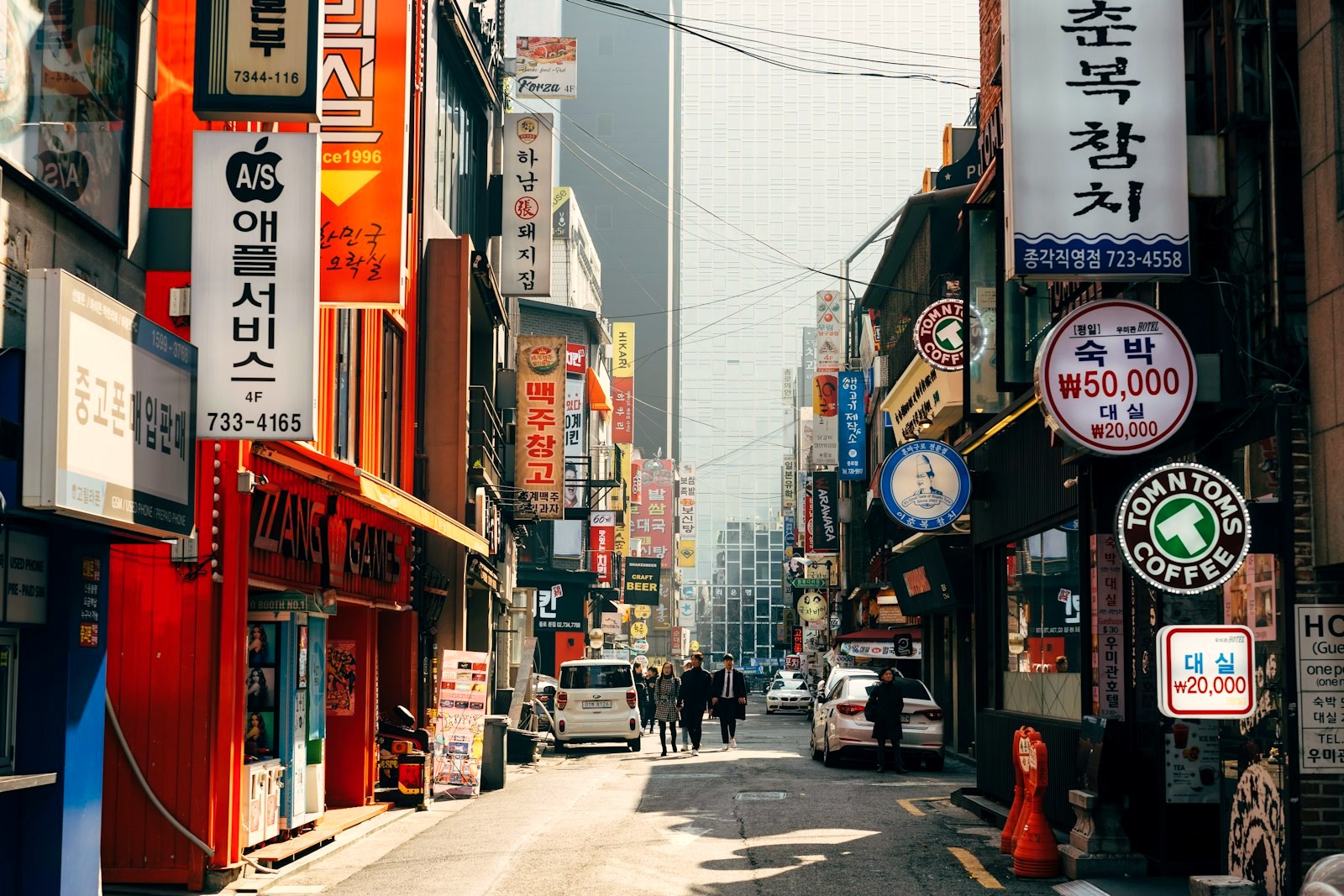
The photography, stated plainly. The bank holds no measured oversized-fit frame: no charted garment from the table worn by a model whose size is stated, no dropped shoulder seam at macro range, no two cuts of one maker’s garment laid flat with a tape, a result confirmed by the search of the bank and of CREDITS.md made before this page was written. What the bank holds is the ratio’s class evidence, and the page is illustrated from it with the captions carrying the distinction in the open: the hero is a boxy white tee worn over a slim black trouser, the volume in one zone and the leg true, a class frame for the assembly and not a picture of a charted product; the figure in the record is a Seoul shopping street in daylight, the silhouette’s home ground, a street and not a garment. What the page needs, and has not got, is named in the harvest list, in order: first, a dropped shoulder seam at macro range on a worn oversized tee, the cut’s signature in one frame; second, an oversized sweatshirt or hoodie worn over a true straight trouser with the waistband’s line visible, the standard assembly entire; third, one maker’s regular and oversized tees laid flat side by side with a tape across the shoulders, the drop table photographed; fourth, a long oversized coat worn open over a fitted base, the length zone in its licensed form. Until that pass runs, the brief about the measured ratio is illustrated by its class and its city, which is, by this page’s own ruling, the correct order of evidence in any case: the chart first, the picture second.
Questions, answered
What is the one rule of wearing oversized fits?
That oversized is a ratio, not a size up. An oversized garment is a pattern: its maker has redistributed the cloth among the garment’s zones, shoulder, body and length, in proportions a regular cut does not use, and the drop table on this page prints the redistribution from the makers’ own size charts, the same nominal size M in each maker’s regular and oversized cuts. The wearing follows from the cutting. One volume zone at a time: the top wide and the leg true, the leg wide and the top true, or the layer long over a true base, with every zone not spent kept at the wearer’s own measure. And the garment is bought in the wearer’s own size inside the oversized cut, because the cut has already done the sizing: the M in the table is an M body’s garment, drawn wider at the printed points. Two zones spent at once is not more of the look. It is the ratio collapsed, the outfit read as cloth in search of a body, and a size up is not the ratio at all, as the next answer’s arithmetic shows.
Can I get the look by buying a regular garment two sizes up?
No, and the makers’ own charts prove it in numbers rather than in taste. On Uniqlo’s product-size charts, the regular U Crew Neck T-Shirt grades from M to L by 1.5 centimetres of shoulder, 3 of body width and 2.5 of length: a size step is a small, even inflation of the whole garment. The same maker’s oversized cut at the same size M stands 16.5 centimetres wider at the shoulder than the regular M. To buy that shoulder by sizing up the regular tee would take eleven size steps, and eleven steps would add about 27 centimetres of length and 33 of body width along the way, a garment past the knees and twice the body, not a dropped shoulder on a wearable tee. The shoulder is the extreme case of a general law: a size multiplies every dimension a little, a cut redistributes dimensions a lot, unevenly, on purpose. No. 47 prints the same law for the leg entire: width is a pattern, cut into the garment by its maker, and a pattern cannot be improvised from a size. What a size up buys is a larger regular garment, with the regular garment’s proportions intact and its fit wrong at every point the oversized cut was drawn to be right.
How much shoulder drop is too much?
The table on this page is the measure, because the drop is the maker’s figure and not the wearer’s guess. Across the three complete pairs the desk read, the oversized cut’s shoulder stands 7 to 16.5 centimetres past the same maker’s regular block at the same nominal size: Covernat’s wide graphic tee at plus 7, thisisneverthat’s wide crewneck block at plus 8.6, Uniqlo’s oversized tee at plus 16.5, the widest printed drop in the run. Inside that band, the drop is the cut’s intention, and the seam sits where the maker drew it, below the natural shoulder, on the upper arm. Beyond the band, what is being worn is not a bolder cut but a bigger garment: a shoulder seam past the band’s top on a body the chart sized smaller is a size error wearing a cut’s name. The practical check is the chart itself. Buy the size the maker’s chart assigns your body, read the shoulder the chart prints for that size, and the drop you get is the drop the garment was designed to show. A drop chosen by taking a larger size from the rail is chosen blind, because the chart’s other dimensions, length and body, come up with it, and they are the dimensions that betray the manoeuvre.
Can an oversized top be worn with wide-leg trousers?
Not under this brief’s rule, because the pairing spends the volume twice. The wide leg is ruled entire on this site at No. 47: width worn with discipline, hem at the shoe, and a top half fitted or tucked that returns the waist, the width being the statement of the outfit, so that everything the width touches is kept exact. The oversized top is the same claim made by the other half of the body: the volume is the statement, and the zones around it are kept true so the statement can be read. Two statements at once do not amplify each other. They cancel into a general looseness in which neither the leg’s width nor the top’s drop can be seen as a decision, the waist disappears between them, and the silhouette reads as a size error distributed evenly over the whole body. The licensed pairings run the other way: the oversized top over a true, straight leg, where the trouser’s exactness is the foil the drop needs, and the wide leg under a fitted or tucked top, No. 47’s own assembly. One zone carries the volume. The rest of the outfit is the evidence that it was carried on purpose.
Which zone should carry the volume?
The zone the day can furnish a foil for, and the three zones have different prices, printed here in the brief’s own order. The top is the commonest and the cheapest to carry: an oversized tee, sweatshirt or knit over a true trouser, the drop at the shoulder doing the work while the leg’s exactness keeps the waist and the shoe in view, and it is the Seoul silhouette’s standard form, the one the Korean labels ranked on this site are drawn around. The leg is the second zone, and it is governed entire by No. 47, rise first, hem at the shoe, top half fitted or tucked: the most architectural of the three, and the least forgiving. The length is the third zone, volume spent vertically, a long oversized coat or layer over a true base, and it is the zone most often spent by accident, because length is what a size up adds most visibly, so it must be chosen as a cut and never inherited from a size. What the choice never licenses is the second zone joining the first mid-outfit, or the layer’s length arriving together with the top’s width and the leg’s width in one assembly: the zones are alternatives, and the discipline is the alternation.
Should I size up or down inside an oversized cut?
Neither. Buy your own size, the size the maker’s chart assigns to your body, and let the cut supply the volume it was drawn to supply. The drop table is printed at a single nominal size for a reason: the M oversized garment is the M body’s oversized garment, its shoulder already 7 to 16.5 centimetres past the same maker’s regular M, its body already widened, its length already set. Sizing up inside that cut stacks a size on a ratio, and the stack lands in the wrong places, because the size grades every dimension evenly while the cut’s design lives in the unevenness: the length and the body grow past the printed design while the drop merely continues. Sizing down performs the opposite vandalism, taxing the body width the cut spent its design on and returning a garment that is neither true nor oversized, a wide pattern worn tight. The one adjustment the family licenses is between makers, not inside one: the charts disagree about how much volume an oversized cut holds, Uniqlo’s drop being more than twice Covernat’s, so the wearer chooses his ratio by choosing his maker’s chart, and then wears the size that chart gives him.
Can oversized be worn in the office, or at black tie?
The two rooms have different answers, and both are printed plainly. The office takes the ratio at its mildest, under conditions: the relaxed end rather than the oversized end of a maker’s range, the drop at the low end of the table’s band, one zone only, and the volume carried where the room’s own structure can answer it, a true-shouldered blazer or a tailored trouser keeping the outfit’s other measurements exact. What the tailored office refuses is the full drop under tailoring’s own codes, because a shoulder seam descending the arm inside a room built on the fitted shoulder reads by that room’s grammar as a garment that does not fit, and the read is not unfair: the office is the one place where fit is a language everyone present speaks fluently. In the untailored and creative offices the ratio stands in its standard form, as it does on the street it came from. Black tie refuses the silhouette entire, on the grammar’s authority rather than this brief’s: No. 67 prints the evening uniform as a fixed set of elements whose proportions are part of the set, and an oversized element is an improvisation the uniform does not contain. The ratio’s rooms are the day’s rooms, and its capital is the street.
Has Young Cotton ranked oversized clothing?
Not as a class, and the absence is printed rather than papered over, as it is at No. 80 for bracelets and No. 79 for cufflinks. No Verdict Card grades oversized as a category, no index on the tree scores the ratio, and this brief invents no score and names no maker as a pick. What stands ranked is everything around the ratio. The garments the silhouette is built from stand in their own Cards and briefs, the hoodies, the sweatshirt, the bomber jacket, the wide-leg trousers at No. 47. The labels the silhouette is identified with stand ranked on the Korean clothing brands ranking, where Covernat stands at 81 and Wooyoungmi at 91, their standings cited here and not restated. And the drop table in this page’s record is the desk’s own measurement of the ratio itself, read from six makers’ published documents, three complete pairs and three makers counted where their charts do not publish the numbers. When the desk grades an oversized shelf on its makers’ records, cloth, construction, price and terms, this page’s rulings will be re-argued from that Card.
Next
The family this brief stands in: No. 80, the bracelet, the brief before this one, the wrist’s second instrument admitted on the first’s terms, whose evening refusal this page borrows from the same grammar; No. 47, wide-leg trousers, the leg’s volume ruled entire, whose decisive rule this brief adopts as its foundation and whose assemblies are this page’s second look; the hoodie and the sweatshirt, the silhouette’s standard garments ruled in their own briefs; the Korean brands ranking, the Asia desk’s record of the labels the silhouette is identified with, whose standings this page cites and does not restate; and No. 67, black tie, whose grammar closes the evening to this garment as it closes it to every improvisation. The brief before this one stands at No. 80; the series began with the cardigan and the full run lives in the How to Wear index. How every score behind those pages is built stands on our methodology page.