
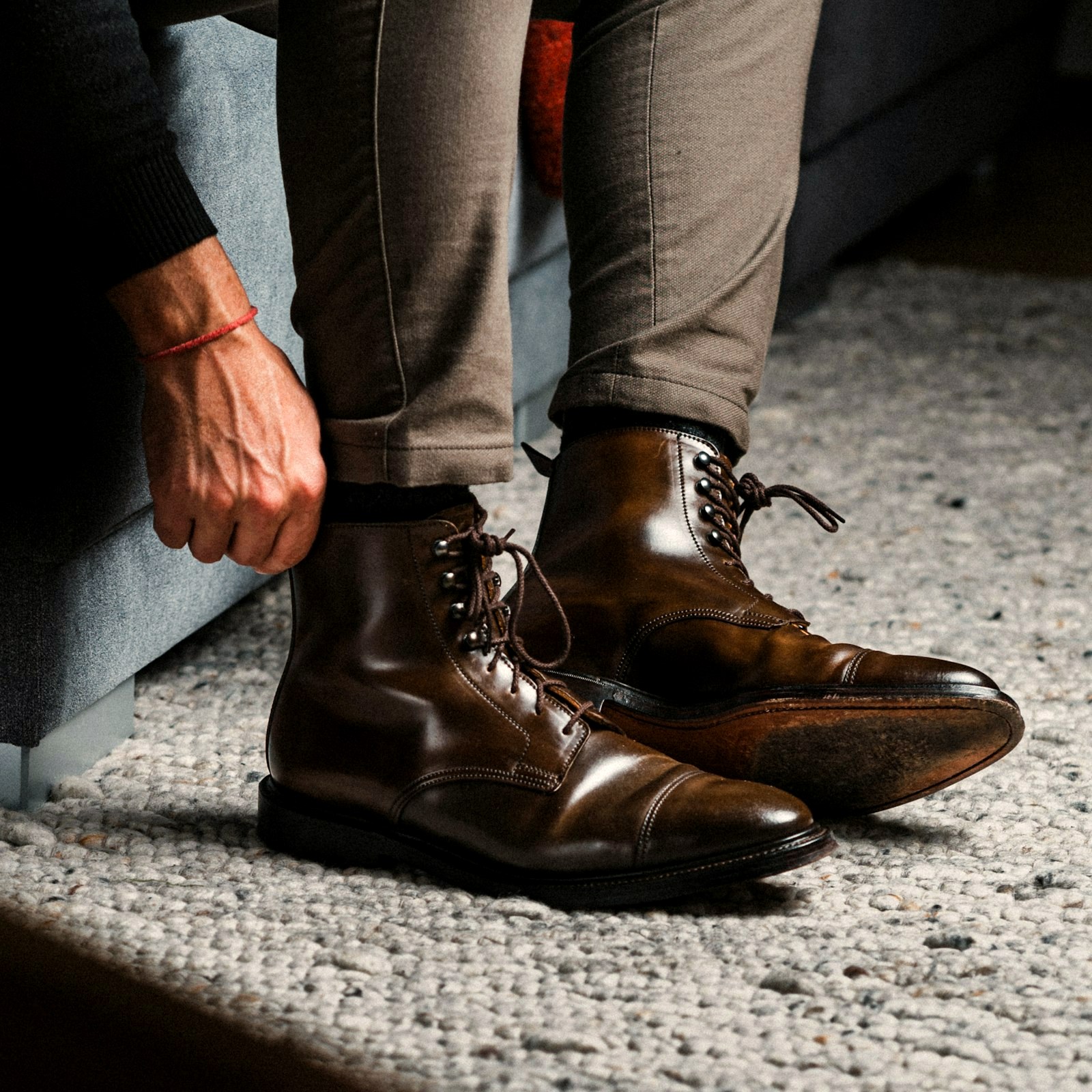
The subject, not the shelf: Verdict Card No. 117's own hero, standing at the head of a Take argued from that Card, because the percentages below are finally claims about what may be put on the feet inside boots like these. The photo bank holds no foot-cream product photography, no tube or bathroom-shelf frames, a gap the Card names on its own page and the honesty section below admits in full.
Checked and updated October 2026
The thesis, up front: a percentage on a label looks like the maker’s candour and is usually the maker’s circumstances. On Verdict Card No. 117, a headline-active percentage is printed by the maker on five of nine foot creams, and the five sort cleanly by why they stand. One is compelled: Aquaphor’s petrolatum at 41 percent, printed on a complete drug record, the shelf’s largest number on its last-place product. Two are carried in the product’s name, AmLactin’s 15 percent and Ebanel’s 40 and 2, where the number is the title and cannot be removed without renaming the goods. One stands in the maker’s retail copy, Kerasal’s 10 and 5. And one is simply stated, in the maker’s own copy, where no name carried it and no label compelled it: Flexitol’s 25 percent urea, the dose the heel band runs on, printed by the shelf’s winner. Against the five stand the shelf’s two returning houses, each printing the number exactly where a rule or a foreign market requires it and nowhere else: CeraVe numbers its drugs and not its cosmetic, and Beiersdorf numbers its American drug and its European names and not its American lotion. The printed percentage is a map of the law’s reach, of filing and of geography, before it is a portrait of honesty, and it becomes the maker’s testimony only where printing it was a choice, which is why the shelf’s one unrequired number in its plainest form belongs to the product the Card put first.
In this issue
The thesis: five numbers, four causes, and the reader told one story
Begin with the reading every buyer of a foot cream performs and no label corrects: he reads the percentages as a shelf of confessions. Here is a maker who tells you his strength, 25 percent, in plain figures; here is another who names his, 15 percent, in the product’s own title; here is a third who will not tell you at all, and the buyer draws the conclusion the documents invite, that the first two houses are candid and the third is hiding something. The conclusion is not stupid. It is the conclusion this desk’s own honesty row appears to print, scores descending from the fullest records to the emptiest, and it is wrong in a way this shelf is uniquely built to expose, because this shelf contains the control experiment. Two of its houses have been graded by this run before, on other shelves, in other categories, and their behaviour across the whole catalogue is on the record: they print percentages constantly, fluently, to the decimal, wherever the document they are writing is a drug label, and they print none, on this shelf, where the document is a cosmetic. The buyer comparing the foot creams is not comparing two makers’ candour. He is comparing two documents’ obligations and reading them as one maker’s character, and the shelf’s numbers, sorted by their causes, are this issue’s whole subject: a percentage is evidence about the paper it stands on before it is evidence about the house that printed it.
Watch the sorting happen, because the five numbers divide without a remainder. Aquaphor’s 41 percent petrolatum is the compelled number: a complete drug listing of seven items, the active ingredient and its strength printed in the form American drug law prescribes, and the Card grades the record as the most lawful on the shelf and the product last anyway, at 58, because the number certifies a protectant and the category’s job is dissolution. AmLactin’s 15 and Ebanel’s 40 and 2 are the named numbers: the percentage is the product’s title, printed at the largest size on the package, a disclosure that is also an advertisement and cannot be withdrawn without renaming the goods; both are cashed in their lists, the lactate in its salt form at the second seat, the urea first of thirty-five, and both houses deserve the credit the Card gives them, which is real. Kerasal’s 10 and 5 are the retail numbers: stated in the maker’s retail copy, both doses, in a soft white petrolatum base, a maker telling the trade what the formula holds. And Flexitol’s 25 is the stated number: no figure in the product’s name, which is a plain Heel Balm; no drug record compelling one, the product a balm whose maker’s American page prints its dose in its own copy beside the claim it carries, with the podiatric seal and the diabetes suitability standing on the same page. Four causes, five numbers, and the reader is told one story about all of them, the story of the candid maker, when three of the four causes would have produced their numbers from a maker of any character at all: the law does not ask whether a house is candid before it prescribes a drug label’s form, a product’s name does not become more honest for being printed larger, and a retail panel is written for buyers of shelf space before it is written for buyers of cream.
The title is this issue’s claim and it is defended here, in the family’s manner, because the defence is the argument. The number is not the candour states the two objects’ non-identity in the direction the shelf gets wrong. A number is a quantity: how much urea, how much acid, a fact about a formula that a chemist could state without mentioning any document. Candour is a relation: who chose to tell you, at what cost to himself, under what obligation to have stayed silent. The two share a printed figure and nothing else, and the figure’s presence is predicted, on this shelf, by everything except the relation: by the filing, drug or cosmetic, that sorts the document before its maker writes a word; by the market, whose naming customs decide whether a strength is worn as a title; by the channel, retail copy being written under different pressures than a maker’s own page. In each of this franchise’s earlier numbers the document’s hidden property was a definition, a population, a direction. Here it is a cause, the reason the figure stands where it stands, and the cause is the one property a percentage never prints about itself. The buyer does not care about candour as a virtue. He cares about it as evidence, because a dose he can verify is worth money to him and a dose he cannot is a garnish he is asked to pay for as a treatment. Which is why the misreading costs what the cost section counts, and why the one number on the shelf that does testify, the stated one, is printed at this issue’s head: it is the only figure whose cause is the maker himself.
The kinship is the number line’s, and it is read from the issues’ own Next paragraphs, as this franchise reads its descent. Take No. 18 is the parent argument, the law prints the number: there, on the scalp shelf of Card No. 100, the strength itself was sorted before the minutes were asked, printed where a statute files the bottle as a drug and withheld where the filing lets it be withheld, so that the dose column and the contact column turned out to be governed by the same authority, the category, and not by the maker’s candour at all. This issue is the parent’s doctrine carried from one filing’s shelf to the whole map: the foot shelf adds the causes the scalp shelf did not hold, the name that carries the number as its title, the foreign market that prints it as a name’s grammar, and above all the two houses whose own catalogues, graded across this run’s Cards, let the parent’s sorting be watched inside a single maker’s output rather than inferred across a shelf’s. Take No. 7 is the grandparent, the number is not the dose, which No. 18’s own Next names among its parent arguments: there a printed strength still owed its minutes and its class before it could be spent, a percentage being a strength before it is a dose. This issue stands one step further back along the same line and asks the prior question, not what the printed strength is worth, but why it is printed at all, and finds the answer in the filing the grandparent’s shelves took for granted. The descent runs unbroken: the strength is not the dose; the dose is sorted by the law; and the number, this issue’s term, is sorted by its causes before either of its elders’ questions can be asked of it.
The record, counted
Count the shelf first, because the Card’s counts and this issue’s subject are the same census read two ways. A full ingredient list published somewhere a reader can check: nine of nine, ten of ten counting the one sent home. A headline-active percentage printed by the maker: five of nine. A printed dose matching its printed claim: six of nine, with three charged for a number that never appears. Fragrance standing as one closed word: two of nine, the winner’s Perfume closing its pharmacy list and the Gold Bond’s Fragrance filed inside its thirty-nine. An ounce of the category: from $0.76 to $8.99, nearly twelve to one. Now sort the five printed percentages by the cause this issue charges, a sorting the Card’s record supports at every seat and nowhere performs itself. Compelled, one: Aquaphor’s petrolatum, 41 percent, on a drug record of seven items, the largest figure on the shelf. Carried in the name, two products and three figures: AmLactin’s lactic acid at 15 percent, cashed as ammonium lactate at the second seat of a thirteen-item list on the maker’s own page; Ebanel’s urea at 40 and salicylic acid at 2, cashed in a thirty-five-item list on the maker’s own store, urea first and the acid in the first dozen. Printed in the maker’s retail copy, one: Kerasal’s urea at 10 and salicylic acid at 5, both doses, the list itself standing on the packaging record. Stated in the maker’s own copy, with no name carrying it and no record compelling it, one: Flexitol’s urea at 25 percent, the heel band’s working figure, the list checkable on the pharmacy record that carries the product. Five numbers, four causes, and the scoreboard reads the causes in order without knowing it is doing so: the stated number wins at 83, the named numbers stand second and fifth at 81 and 72, the retail numbers third at 76, and the compelled number, the largest of all, finishes last at 58 on a record the Card calls the most lawful on the shelf. Presence is not the ranking. Presence sorted by cause is very nearly the ranking, and the difference between those two sentences is this issue.
Count the first returning house, because CeraVe is the parent argument’s doctrine with a catalogue for evidence. The foot cream’s record, as its card prints it, is genuinely rich: a full twenty-five-item list on the maker’s own regional pages, three ceramides named in full, NP, AP and EOP, niacinamide fourth, hyaluronate near the close, and the two acids the product is sold on, ammonium lactate and salicylic acid, seated in the middle of the list. Nothing about the composition is hidden. What is withheld is the only figure that would let a reader grade it, a percentage for the salicylic acid and a percentage for the lactate, on any page the maker publishes, while the claims, exfoliates and softens extremely dry, cracked feet, run at full strength. Now read the same house where the law holds the pen: its Therapeutic Hand Cream carries a drug record printing dimethicone at 1 percent, and won the hand cream ranking, Card No. 96, at 86 doing it; its SPF moisturizers print their filters to the decimal, scored 82 on Card No. 109; its Moisturizing Cream stands at 88 on Card No. 66, quoted on the foot Card as evidence of what the house prints when it chooses to, or is made to. The house’s fluency is not in question anywhere in this run’s record. What the foot shelf adds is the sorting: every numbered document in the catalogue is a drug’s, and the unnumbered one is the cosmetic’s, and the line between them is not the house’s character, which is constant, but the document’s filing, which is the whole of the difference. The Card’s own FAQ answers the buyer’s question in the buyer’s terms, because no law makes it, and prints the sentence this issue is built on: on this shelf the maker’s silence, not its formula, is what the honesty column grades. This issue adds only the corollary the Card leaves for its readers to draw: the same sentence, read backwards, acquits the shelf’s printed numbers of the meaning the buyer assigns them, until a maker prints one where the law is not holding the pen.
Count the second returning house, because Beiersdorf holds the geographic half of the map inside the same nine seats. Its Aquaphor stands on this shelf with the compelled number, petrolatum at 41 percent on a complete American drug record. Its Eucerin stands two seats above it with no American number at all: the Intensive Repair Lotion seated as the generalist species at 68, its urea seventh in a nineteen-item list carried on a national retailer’s panel, its 5 percent figure standing on that retailer’s description rather than on any page the maker publishes, the maker’s own American copy describing the formula in the language of blends and factors without a number. And the same house’s European line, as the Card prints in its dose column, sells Eucerin with the percentages in the product names themselves, a UreaRepair line at 30 percent and an intensive cream at 10, worn as titles. One house, three documents, three causes: the number compelled in America on the drug, the number worn as a name in Europe on the cosmetic, the number withheld in America on the cosmetic, left to a grocery panel to approximate. The Card’s sentence for it is the franchise’s own geography quoted back: the number is in another country, as it has been before in this run. This issue prints the overlay the two halves make together, because it is the map’s completeness that convicts the candour reading: within one house’s output on one shelf, the figure appears under compulsion and under foreign custom and vanishes under domestic choice, and a buyer who sorted Beiersdorf’s two products by their numbers would be grading the FDA’s forms and the European market’s naming grammar and calling the grade a judgment on Beiersdorf.
Count the control case, because an argument about causes owes its reader the seat where the cause is the maker. Flexitol’s record is not the shelf’s fullest: its honesty row stands at 25, one below AmLactin’s 26, charged openly for a list that stands on a pharmacy record rather than the maker’s own page and for copy that names glycolic acid and tea tree oil among the formula’s members where neither stands in the printed list. Its active row is 18, its fit 16, its value 11, its longevity 13, and it wins at 83 on a record with two named faults, which is what makes it the control rather than merely the winner: the Card’s margin for it is the dose and its printing. Twenty-five percent urea is the heel band’s working strength, the figure the category’s ladder runs on, and Flexitol is the only maker on the shelf that prints its keratolytic dose in its own copy. Not in the product’s name, which is a plain Heel Balm and would have to be renamed to stop carrying nothing; not on a drug record, there being none quoted for it anywhere on the Card; in copy, beside the claim, next to the podiatric seal. Strip the number out of that page and the page still stands, the balm still a lanolin balm with a seal, the claims intact at an ungraded strength, which is the precise definition of a voluntary act: the maker wrote a sentence he was not required to write, in the place a reader checks a claim, and the sentence is the only one of the shelf’s five numbers whose cause, interrogated, returns the maker himself. AmLactin’s number is nearly as creditable and is graded nearly as high, and the distinction this issue draws between them is one of degree, printed as such: a number in a name is disclosed at the largest size a package offers and simultaneously spent as the product’s identity, an advertisement’s asset, while a number in copy is spent on nothing but the claim it quantifies. Both are voluntary. Only one is volunteered in the grammar of evidence rather than in the grammar of branding, and the Card’s two-point margin between the shelf’s first and second seats is, on this reading, the market price of the difference.
Count the remainder, because the map has a false positive and two instructive blanks, and the issue that omits them has sorted only the convenient five. The false positive stands below the shelf, sent home at 47: the Miracle of Aloe’s copy leading with a number, 60 percent Ultra Aloe, a figure that appears nowhere in its twenty-two-item list, its directions or any label record, a percentage of a trademark, while the only numbered active on its drug record is menthol at 0.1 percent, a tingle rather than a treatment. The skip is the candour map’s necessary warning in the other direction: a number can also stand where nothing cashes it, printed by choice and worthless as evidence, so presence is not even a reliable sign of disclosure, let alone of honesty; the map sorts causes, and one of the causes is invention. The blanks instruct in their own grammar. Gold Bond prints the shelf’s fullest list, thirty-nine ingredients on the maker’s retailer panel, urea second among them, and no percentage anywhere, so the reader holds the long half of honesty and cannot grade the half that matters, second at what strength being the shelf’s only question; and its shea stands filed as an extract at seat 19, behind the fragrance the list closes into one word. O’Keeffe’s prints no keratolytic at any dose and reaches instead for concentration language, increased levels of allantoin, for an ingredient seated twelfth of sixteen, a figure-shaped claim with the figure withheld, under repair claims for a glycerin system, while publishing the shelf’s strongest service promise in its money-back guarantee. Between them the two blanks mark the map’s domestic interior: not the drug’s compulsion, not the foreign name’s grammar, not the stated figure, but the American cosmetic page as its largest houses actually write it, complete in everything except the one number the category is sold by.
What the map costs
The first cost is the buyer’s arithmetic, and it is paid at the shelf in the category’s own currency. A foot cream is bought by its dose or it is bought blind, because the category’s ladder, printed on the Card from the trade’s own bands, is a ladder of percentages: about 10 percent keeps everyday skin soft, 20 to 25 repairs a heel, 40 treats a callus, and the same tube at an unstated strength is a maintenance cream or a heel treatment depending on a figure the buyer cannot see. The map’s distortion lands exactly there. The buyer who reads presence as candour will trust the compelled number as a character reference, will read the named numbers as confessions rather than as titles, and will grade the silent records by a suspicion the catalogue refutes, CeraVe’s foot cream being an honestly composed formula whose maker numbers fluently wherever it must. And he will do the reverse sum with equal confidence, taking the three charged records’ silence as a formula’s fault, when the Card’s grades say otherwise at every seat: CeraVe finishes fourth at 74 with its silence charged and its composition praised in the same card, and the spread between the shelf’s most forthcoming record and its most silent is four honesty points in thirty, a real margin and a small one. What the map costs the buyer is the conversion he was never told he was performing: he came to compare creams and left having compared filings, markets and naming customs, and every future shelf he reads with the candour grammar inherits the error, because the grammar travels and the causes do not announce themselves anywhere he shops.
The second cost is the incentive’s, and it is the franchise’s standing cost with its address on the label’s smallest print. Sort the shelf by what the number earned its printer. The compelled number earned its maker nothing it could keep: it is the price of the drug filing, paid by every drug on every shelf, and it bought the shelf’s last place. The named numbers earned their makers their identities, which is a branding return, not a disclosure return, and would survive this column’s abolition entire. The retail numbers earned a trade’s confidence. The stated number, Flexitol’s, earned the only return that was disclosure’s own: the top of a ranked Card, bought with a sentence in the maker’s own copy. And the silences earned their keepers the thing silence always earns on a graded shelf, the benefit of an ungraded claim: CeraVe’s exfoliation claim runs at full strength beside no figure, Gold Bond’s urea sits second beside no figure, and no reader alive can convict either of underdosing, because a claim with its dose left blank is a claim that cannot lose an argument. That asymmetry is the map’s engine. Printing voluntarily exposes a maker to grading; withholding exposes him to nothing but a column like this one, and columns are cheaper than labels. Until a stated cosmetic dose is the category’s ordinary grammar, the rational maker files his strong products as drugs where he can, names his percentages where they flatter, and leaves his cosmetic doses blank where they might be graded, which is to say the map will keep being drawn by everything except the makers’ honesty, because honesty is the one cause the current grammar does not pay for.
The third cost is the standard that never gets built, the cheapest in this column’s history of asking. The correction this issue demands is one figure on one page: the headline active’s percentage, stated in the maker’s own copy for the cosmetic records that withhold it, in the grammar the same houses already write fluently on their drug records, at a cost measurable in a web edit. No formula needs changing, no label needs reprinting, no claim needs softening; CeraVe’s foot cream is what it is, and its maker’s page could carry the two figures beside the two acids’ names the way its hand cream’s record carries dimethicone’s, in an afternoon. The proof that it can be done at this shelf’s scale stands at its head, where the winner’s maker, a pharmacy house a fraction of the silent houses’ size, has been printing its figure in its own copy as a matter of course. And still the American cosmetic page stands at three charges of nine, because no standard rewards the sentence: no basis but this desk’s counts a stated dose as evidence, no buyer asks for it by the name this issue gives it, and the maker who prints it buys himself a grade he could have skipped. The standing offer of this column applies to the foot shelf in its own terms, as it applied to the banners, the panels, the dialects and the doses: the first house whose cosmetic page prints its headline dose at the claim’s own size, in its own copy, where nothing required it, will be named at the top of the re-argued column. It is the same first place the dose issues priced at a line of type. On this shelf the line already exists, in the winner’s copy, which is this issue’s whole hope stated as a fact: the standard does not need inventing, only generalising, and the generalisation costs the largest houses on the shelf less than it cost the smallest one to go first.
The other side, stated fairly
The other side comes in four limbs, and three of them are partly right. The convention limb: percentages on American cosmetics are uncommon by the category’s custom, not by any house’s design; the INCI list is the cosmetic’s document, its order is its disclosure, and a maker who prints a complete and accurate list has done what his document class asks, so that grading the absence of a figure the class does not carry mistakes a grammar for a concealment. The name limb: a percentage in a product’s name is disclosure at the largest size the package offers, impossible to miss and impossible to withdraw quietly, and to rank it below a figure in body copy is to prefer the desk’s favourite typography to the buyer’s actual reading, the name being the one part of the package every buyer reads entire. The completeness limb: CeraVe hides nothing; its twenty-five items stand named in full on its own regional pages, every acid it sells on is present to be read, and a reader is told the formula entire, which is more than the shelf’s dearest records give him, so that unquantified is not a synonym for undisclosed. And the harm limb: no reader is shown to have bought a garnish believing it a treatment on this record, the Card’s grades being documentary, so the map this issue draws is a map of paperwork, and paperwork’s distortions are a columnist’s subject rather than a buyer’s injury.
Each part is true about something, and the record answers each on its own ground. To the convention limb, the strongest of the four: agreed that the INCI list is the cosmetic’s document and that a complete list is a real disclosure, and printed in the record that this desk grades CeraVe’s composition as genuinely rich. But the shelf’s own houses refute the custom’s innocence from inside the same document class: AmLactin’s cosmetic page carries its figure in its name and its full list beneath it, Ebanel’s store prints both figures and a thirty-five-item list, and the winner’s copy states its dose beside its claim, so the grammar this limb calls the class’s limit is a grammar three of the shelf’s nine records exceed without leaving the class. A convention observed by the largest houses and exceeded by the smaller ones is not a document’s nature. It is a choice with a custom’s alibi, and the alibi expires at the shelf’s own head. To the name limb: agreed that the name is read entire and that the named numbers are honest disclosures, graded as such on the Card, and this issue’s distinction is not between disclosure and its absence but between the causes that produced the disclosure, a distinction the buyer’s spending already makes without naming it, since no buyer has ever paid a premium for a number he believed a regulation extracted. The name’s figure is spent by its house twice, once as evidence and once as identity, and an accounting that ignores the second spending is not rigour but its opposite. To the completeness limb: a list without its figures is a cast without its weights, complete in membership and silent in proportion, and on a shelf whose category ladder is printed in percentages the proportion is the one fact the purchase turns on, which is why the Card’s honesty row, the house’s own chosen instrument, charges the silence inside a list it praises. To the harm limb: the desk does not grade harms it cannot document and prints none, in the honesty section’s terms. What it prints is a mechanism and a price, the buyer’s conversion of filings into character, documented in the only place this franchise can document anything, the documents themselves and the grades they already carry. A map of paperwork is the correct description of the charge. The buyer, however, does not shop in a paperwork store. He shops the map as if it were the territory, and the labels are drawn to be read exactly as he reads them, which is the harm’s documentary form, and the only form this column has ever claimed jurisdiction over.
The Take Rule
Read a percentage by its cause before you spend it as a character. Where a drug record prints the number, grade the record as lawful and the number as the filing’s, evidence of a category obeyed and of nothing else; where a name carries the number, grade it as disclosed and as branded in one act, the figure spent twice; where a maker states the number in his own copy, beside the claim, with no label holding the pen and no title carrying it, grade that as the maker’s testimony, the only form in which a percentage testifies about its printer. On this record the count stands at lists nine of nine, percentages five of nine, their causes at one compelled, two named, one retail and one stated, the two largest houses on the shelf printing the figure exactly where a rule or a foreign name requires it and nowhere their American cosmetic pages choose to, and one skip below the shelf printing a percentage of a trademark, the map’s false positive. The first house that prints its cosmetic doses in the grammar of its drug records, at the claim’s own size, will own this shelf’s legibility at the price of the figures it already knows.
The picks, as published on the Card
| Item | The record | Price, as published |
|---|---|---|
| Flexitol Heel Balm (Verdict Card No. 117) | The winner, 83: the only maker on the shelf that prints its keratolytic dose in its own copy, 25 percent urea, the heel band’s working figure, its full 13-item list checkable on the pharmacy record, Perfume closing the list; charged for copy naming two ingredients the list does not contain | $14.50 for the 4 oz tube at Target; $3.63 an ounce |
| AmLactin Foot Repair Cream with 15% Lactic Acid (Verdict Card No. 117) | Second, 81: the honesty row’s highest score at 26, the 15 percent in the product’s name and cashed as ammonium lactate at the second seat of a full 13-item list on the maker’s own page, the fragrance-free claim cashed the same way | $11.19 for the 3 oz tube on the maker’s own store; $3.73 an ounce |
| Kerasal Intensive Foot Repair Ointment (Verdict Card No. 117) | Third, 76: both doses printed in the maker’s retail copy, urea 10 percent and salicylic acid 5 percent, in a soft white petrolatum base, the full list on the packaging record; the shelf’s dearest ounce in its smallest vessel | $8.99 for the 1 oz jar at Target; $8.99 an ounce |
| CeraVe Renewing SA Foot Cream (Verdict Card No. 117) | Fourth, 74: the shelf’s fullest ceramide record, three ceramides named in a 25-item list on the maker’s own regional page, and no percentage printed for either headline active, the salicylic acid or the ammonium lactate, by the house that numbers its drug records to the decimal | $12.99 for the 3 oz tube at Target; $4.33 an ounce |
| Ebanel Urea Cream 40% Plus 2% Salicylic Acid (Verdict Card No. 117) | Fifth, 72: the strongest printed record on the shelf, 40 percent urea and 2 percent salicylic acid in the name and cashed in the maker’s own 35-item list, charged in fit for licensing a callus-band treatment as an everyday routine and in longevity for a second, differing rendering of its list | $15.95 for the 4.6 oz jar on the maker’s own store; $3.47 an ounce |
| Eucerin Intensive Repair Lotion (Verdict Card No. 117) | Sixth, 68: the generalist species seated and disclosed as one, urea seventh in a 19-item list on a retailer’s panel, its 5 percent figure the retailer’s rather than the maker’s, whose European line wears its percentages as product names | $12.79 for the 16.9 fl oz pump at Target; $0.76 an ounce, the shelf’s cheapest |
| Gold Bond Ultimate Softening Foot Cream (Verdict Card No. 117) | Seventh, 65: the fullest list on the shelf at 39 items and no percentage anywhere, urea second at an unstated strength, the shea it is sold with filed as an extract at seat 19; no buy button, its record a retailer panel rather than a shelf door | $7.89 for the 4 oz tube on the maker’s retailer panel at Meijer; $1.97 an ounce |
| O’Keeffe’s Healthy Feet Foot Cream (Verdict Card No. 117) | Eighth, 63: the glycerin concentrate graded as itself, no keratolytic at any dose, allantoin twelfth of 16 under increased-levels language, and the shelf’s strongest service promise in its money-back guarantee; no buy button, the canonical jar’s door uncapturable | $7.29 for the 3 oz tube at Target; $2.43 an ounce |
| Aquaphor Healing Ointment (Verdict Card No. 117) | Ninth, 58: the occlusive graded as itself, a complete drug record of seven items printing petrolatum at 41 percent, the shelf’s largest number, and no keratolytic at all; recommended on the Card as the layer over a treatment, not the treatment | $16.49 for the 14 oz jar at Target; $1.18 an ounce |
| Miracle of Aloe Miracle Foot Repair Cream (Verdict Card No. 117) | Sent home, 47: a copy led by a number, 60 percent Ultra Aloe, that no document the maker publishes ever cashes, a percentage of a trademark, the only numbered active on its drug record being menthol at 0.1 percent; no buy button, this page does not link what the Card sends home | Scored and sent home on the Card; no price carried here |
The discipline for using any of them is the Card’s, extended by this issue’s one term: buy the cream on its list and its dose, the seats and the strength read as the working record, and on the dose’s cause, where one can be told, the compelled number read as the filing’s, the named number read as disclosed and branded at once, the stated number read as the maker’s own testimony and weighted as the shelf’s rarest evidence. And where the dose cannot be told at all, count the blank as the Card’s columns count it, a claim running at full strength beside the figure that would grade it, charged in the open rather than suspected in the dark. The standing offer of this column applies to the foot shelf in its own terms, and it is priced at the shelf’s own arithmetic: one figure in the maker’s own copy, the headline dose of a cosmetic printed where its drug records already print theirs, and that house will be named here, at the top of a re-argued column, the same day its American pages state the number its catalogue already knows. No formula needs changing, no claim needs softening, no price needs moving. One stated figure, and the claim on that maker’s creams will read in the shop the way it reads on its drug labels, which is all this column has ever asked a record to do.
What this page does not claim
On the evidence. This page scores nothing and tests nothing. Every score, row, price, seat, ounce and count is Verdict Card No. 117’s, reproduced exactly as that Card published it, and the Card’s own evidence discipline stands behind them: the desk grades published documents, makers’ pages and storefronts, retail panels and pharmacy, packaging and drug records, and asserts nothing about what any cream does on any heel. No cream was applied, dissolved or assayed for the Card or for this issue, and the category’s ladder this issue quotes, about 10 percent for maintenance, 20 to 25 for heel repair, 40 for callus treatment, is quoted as the Card prints it, from the trade’s bands and from the maker of the shelf’s strongest cream printing the same ladder in its own FAQ. The counts this Take adds are counts of the Card’s printed record, the five percentages sorted by their causes at one compelled, two products named, one retail and one stated, the three charges for a number that never appears, and are printed as counts so they can be recounted. The extensions beyond the Card are this Take’s own argument and are labelled as it: the sorting of the printed percentages by the cause that produced them, which the Card’s record supports at every seat and nowhere performs itself; the reading of the stated number as the manufacturer’s testimony and of the named number as spent twice, defended in the thesis as this issue’s own; and the standing offer’s terms, which are this column’s standing instrument and no maker’s obligation.
On the brief’s premises, checked against the record. This issue was briefed on the foot Card, and the brief’s spine survived the record with two precisions the record insists on, printed rather than absorbed. First, the brief’s sentence that the number appears exactly where a rule requires it is exact at the level of the house and the filing, and incomplete at the level of the shelf: four of the nine records print their percentages without an American drug record compelling them, in two names, in retail copy and in the winner’s own copy, and this issue prints the sort rather than the slogan, its charge being not that voluntary printing never happens but that the two largest houses on the shelf perform it nowhere, and that the reader’s grammar cannot tell the voluntary four from the compelled one without the sorting this issue supplies. Second, the geographic half of the brief rests on documents of two kinds, kept distinct wherever they are cited: Beiersdorf’s European percentages stand in the maker’s own product names, the UreaRepair line at 30 and 10 percent, while the American Eucerin figure of 5 percent is a retailer panel’s, attributed as one on the Card and here, so that the withholding charged is the maker’s American silence and not a figure the maker printed and this issue misread. The kinship candidates were also checked against the tree before they were printed: No. 18’s own Next names No. 7 and No. 15 as its parent arguments jointly, and this issue descends through No. 7, whose object is the percentage itself, a strength before it is a dose, while No. 15’s object, the contact the strength is given, never arises on a shelf of leave-on creams graded on printed strengths, the choice printed here rather than smoothed over; No. 14 stands as nearest sibling and not as an ancestor, its case recurring inside this shelf’s own Card in the Eucerin record while its printed descent, from No. 2 by its own Next, runs outside No. 18’s line; and No. 2, weighed as a candidate, stands cited in the record’s terms where No. 18’s Next assigns it, governing the voluntary half, the column this issue’s stated number stands in, rather than in the kinship, where the descent lines the tree prints are stronger.
On what foot creams do. Nothing on this page says any cream softens, dissolves or repairs any reader’s heel, beyond what the Card prints as the formulas’ printed systems graded against the trade’s printed bands, quoted here as the Card’s grading. The candour argument throughout is documentary, not dermatological in its consequences: a percentage’s cause is a fact about a printed document and the obligations under which it was produced, and the consequences drawn from it, the misread character, the mispriced claim, the incentive’s arithmetic, are drawn from the Card’s columns and from the houses’ own catalogues as the run has graded them, and not from any treatment the desk has performed or witnessed. Where this issue says readers misread presence as candour, it is describing the arithmetic the documents invite, documented in the form the labels and pages take, and not asserting any individual reader’s error, which the desk cannot measure and does not grade.
On the photographs, and on the record moving. There are no photographs of ranked products on this page because there are none to print: the photo bank holds no foot-cream, tube or bathroom-shelf photography of any kind, a gap the Card names on its own page, and the hero and figure here are the Card’s own frames of the subject itself, boots being laced and boots worn, captioned for what they show, which is the feet the shelf is bought for, not a cream documented. The record itself moves underneath this argument: a maker may print his cosmetic dose at any time, which would retire his seat in the map before it moved this argument, the Card’s own honesty section already promising that the Eucerin card’s row improves the day its maker’s American pages print the figure; the silent houses may extend their drug grammar to their cosmetics in a catalogue revision, collapsing this issue’s central case into the voluntary column; the skip’s maker may cash its percentage or retire it, either of which retires the false positive in one direction or the other; and any formula on the shelf may be revised in silence, as formulas on these shelves have been before, each of which moves the Card first. The scores and the rule stand as published until a cited record changes; when one does, the Card moves first and this Take is re-argued from it, in the open.
Questions, answered from the record
What does The Grooming Take No. 30 argue?
That on Verdict Card No. 117's foot cream shelf, a printed percentage is a map of the law's reach before it is a portrait of the maker's honesty. A headline-active percentage stands on five of nine records, and the five sort by why they stand: one compelled by a drug record, two carried in the product's name, one printed in the maker's retail copy, and one printed in the maker's own copy where no name carried it and no label compelled it. The same house that withholds both its foot cream's doses, CeraVe, prints percentages wherever a drug label forces one, and the same house that withholds its American lotion's dose, Beiersdorf, prints percentages in its European product names. The only number that testifies about the maker is the voluntary one, and on this shelf the voluntary number in its purest form, Flexitol's 25 percent urea, stated in copy, belongs to the winner.
Which foot creams print their doses, and why do they print them?
Five of the nine, for four different reasons. Aquaphor prints petrolatum at 41 percent because its drug record requires a number, and it is the shelf's largest percentage on its last-place product, scored 58. AmLactin prints 15 percent lactic acid and Ebanel prints 40 percent urea and 2 percent salicylic acid because the numbers are their products' names. Kerasal prints urea at 10 percent and salicylic acid at 5 percent in its maker's retail copy. Flexitol prints 25 percent urea in its maker's own copy, with no number in its name and no label requiring one, and it wins the Card at 83. CeraVe, Eucerin on its American pages and Gold Bond print no headline percentage at all, and are the three records the Card charges for a number that never appears.
Why does CeraVe print percentages on some products and not on its foot cream?
Because a rule requires it in the one case and not the other, as the Card's own FAQ answers: the same house prints a percentage whenever a drug label forces one, dimethicone at 1 percent in the drug record of its Therapeutic Hand Cream, the winner of the hand cream ranking, Card No. 96, at 86, and its sunscreen filters to the decimal in its SPF moisturizers, scored 82 on Card No. 109. The foot cream is a cosmetic, no label makes it print, and so its salicylic acid and its ammonium lactate both stand in its 25-item list with no number attached to either, and the cream scores 74 with the silence, not the formula, as the charge. The withholding is a choice the catalogue itself proves is a choice, which is this issue's whole evidence.
Does a printed percentage mean the maker is more honest?
Not by itself, and this shelf is the proof in both directions. The shelf's largest printed number, Aquaphor's 41 percent petrolatum, stands on a drug record that compelled it and finishes last at 58, because a protectant dose is not a keratolytic system. The shelf's most famous silence belongs to a house, CeraVe, whose formula record the Card calls genuinely rich. What a percentage's presence reliably reports is the document's situation: whether the product is filed as a drug, whether its market prints strengths in product names, whether its maker chose to state the figure in copy. Only the last of those is the maker's candour, and it is the rarest of the three: on this shelf, one product in nine prints its dose in its own copy with no name carrying it and no label forcing it, and that product, Flexitol at 83, is the winner.
Which foot cream won Verdict Card No. 117, and on what?
Flexitol Heel Balm, at 83 of 100, on the shelf's only maker-printed dose in its own copy: 25 percent urea, the heel band's working strength, carried in a lanolin balm, its full 13-item list checkable on the pharmacy record that carries the product, at $14.50 for the 4 oz tube at Target, $3.63 an ounce. AmLactin Foot Repair Cream is second at 81, with the shelf's fullest maker's-page record and the honesty row's highest score at 26 of 30, its 15 percent standing in its name and cashed in its list's second seat. Kerasal is third at 76 with both of its doses printed. The Card, not this column, owns those scores; this issue argues only about what the numbers' presence and absence mean.
What would change this Take?
Any house printing its cosmetic doses the way its drug labels print theirs: CeraVe stating the salicylic acid and lactate percentages of its foot cream on its own page, or Beiersdorf's American Eucerin pages stating the urea figure its European names wear as titles. Either act would move the number out of the map and into the maker's own testimony on the shelf where the withholding is currently total, and the Card reopens on the maker's republication, as its own honesty section prints. Until then the record stands as Card No. 117 printed it in October 2026: nine creams, nine checkable lists, five printed percentages sorted among a drug record, two names, a retail panel and one maker's copy, and the two largest houses on the shelf printing the number exactly where a rule or a foreign name requires it and nowhere their American cosmetic pages choose to.
Next
The record this issue argues from stands in full at Verdict Card No. 117, the foot cream ranking, where every list quoted here is printed with its provenance, every cream carries its own card, and the dose column this issue argues from stands in the Card’s own words. The shelves beside it are the foot’s own family in this run: Card No. 96, the hand cream ranking, where this shelf’s fourth-place house prints its percentage on a drug record and wins at 86, the compelled column’s standing exhibit; Card No. 66, the moisturizer ranking, where the same house’s cream stands at 88; and Card No. 109, the SPF moisturizer ranking, where its filters stand printed to the decimal at a score of 82, the decimal being the drug label’s grammar and not the house’s hobby. The kinship runs three ways: Take No. 18 is the parent argument, the law prints the number, since there the strength was sorted by the bottle’s filing before its minutes were asked, printed where a statute files the product as a drug and withheld where the filing lets it be withheld; while here the sorting is read across a whole shelf and inside two houses’ own catalogues, the causes multiply to four, and the parent’s withheld column turns out to hold the shelf’s most famous name, so the doctrine the parent proved across bottles is proved again within single makers, where no difference of character can be pleaded between one document and the next; Take No. 7 is the grandparent, the number is not the dose, which No. 18’s own Next names among its parent arguments, there a printed strength still owing its minutes and its class before it could be spent; while here the line runs one step further back, to the strength’s printing itself, sorted by its causes before the grandparent’s question can be asked, so the descent reads as a single regress, each issue asking the prior question of the one before: what the number is worth, then who sorted it, then why it stands; and Take No. 14 is the nearest sibling, the number is in another country, since there the number existed, was published, and was addressed to somebody else, the blank having moved from the maker’s files to the buyer’s label; while here the number’s address turns out to be only one of its causes, the sibling’s geography recurring inside this shelf’s own record in the Eucerin seat, a European name’s figure withheld from an American page by the same house that prints a compelled figure two seats below it, so the two issues stand as the map’s two projections, the withholding read across markets in the elder and across filings in this one, with the houses themselves indifferent to which projection catches them. The franchise so far: No. 1, grooming is sold by the step and works by the habit; No. 2, the number nobody prints; No. 3, one tube, two honesties; No. 4, the pair graded as one record; No. 5, the name is not the number; No. 6, the name is not in the list; No. 7, the number is not the dose; No. 8, the minute is the dose; No. 9, the ritual is not an ingredient; No. 10, the hold is an adjective; No. 11, the name is not an ingredient; No. 12, the burn is not the proof; No. 13, the copy is not the list; No. 14, the number is in another country; No. 15, the rinse is not the dose; No. 16, the step is not a species; No. 17, the oil stands fifth; No. 18, the law prints the number; No. 19, the technology is not dosed; No. 20, the figure is not a scale; No. 21, the clay stands third; No. 22, the panel is not on the page; No. 23, the edge has no number; No. 24, the wax is not in the tin; No. 25, the number is a ladder; No. 26, the panel is not the reader; No. 27, the banner is a definition; No. 28, the dose is not the list; No. 29, the direction is not the formula; No. 30, the number is not the candour. How every score on this site is built is set out in the methodology.
Take No. 31, the grade is not a scale, argues from Verdict Card No. 118 and stands in this line as the child of a cousin of this issue. The kinship runs three ways: Take No. 20 is its parent, the figure is not a scale, since there a denomination printed on a shelf of creams turned out to name a recipe family rather than measure anything on a public scale; while here the denomination is a word rather than a figure, the badger grades standing as each house’s private ladder, and the child’s defence is the one the parent’s case already implied, that a denomination earns trust only when its house publishes the dictionary it is read by; Take No. 10 is its grandparent, the hold is an adjective, which No. 20’s own Next names as its parent, there a styling word graded as the claim it was, and here the grade words of an older shelf graded the same way, an adjective wearing a rank’s uniform until its glossary stands in print; and Take No. 5 is its nearest sibling, the name is not the number, a fellow descendant of the denomination line, since there a name promised a measure it never cashed, while here the grade promises a rank it cashes only inside one house’s walls, the sibling’s broken promise become this issue’s private language, legible entire to the house that coined it and to no one else until the dictionary is published.
The Takes continue by number; the next one starts, as this one did, from a record that already exists or a blank that is printed as one.