
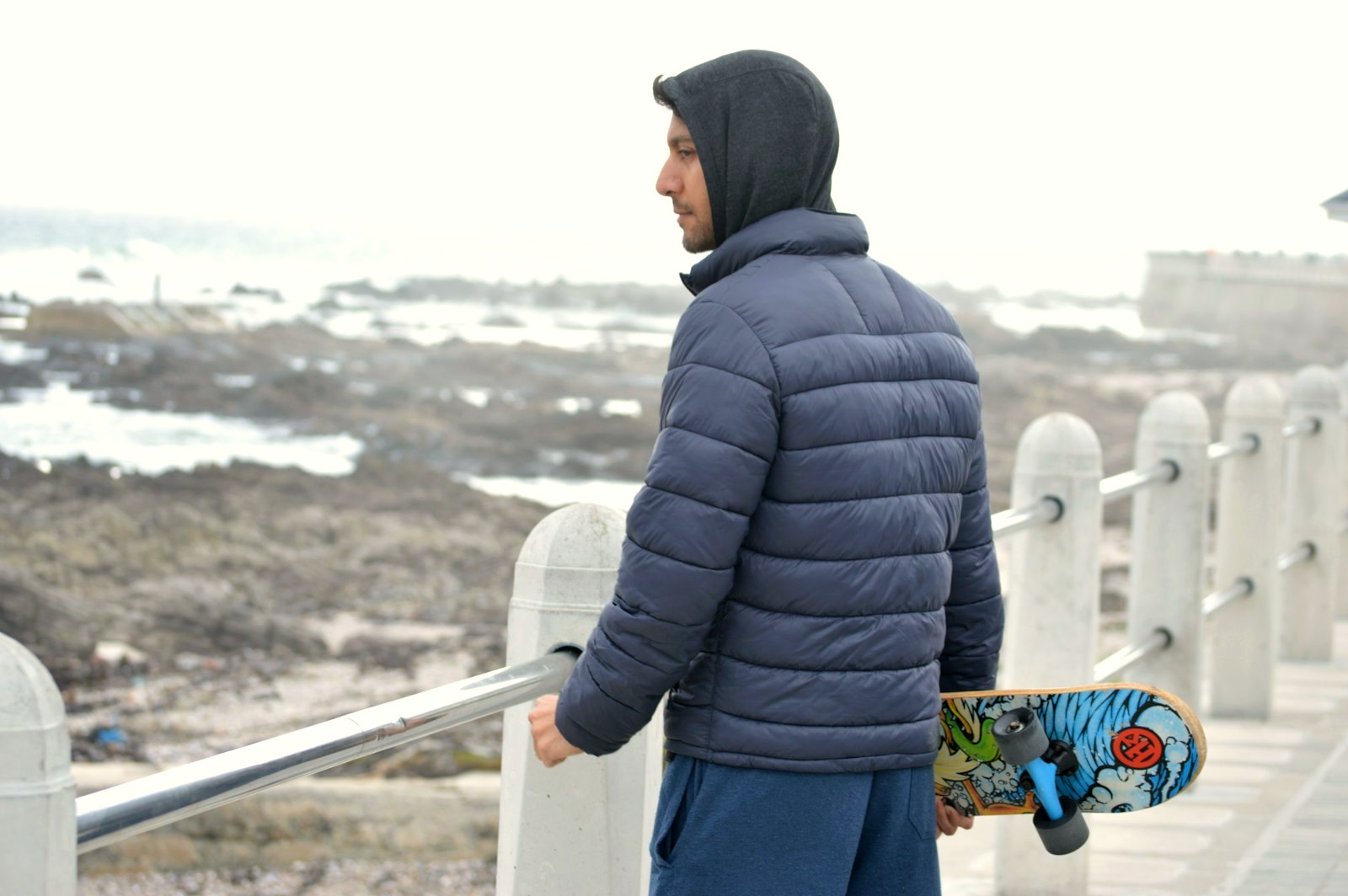
The system's most visible layer, captioned as exactly that: a navy puffer on a body, in real light, on a coast. The frame shows one layer of the stack worn as the outer garment on a moving day; the bank holds no base layer worn alone, no fleece on a body and no four-layer stack worn whole, and those gaps are named in the honesty section rather than filled with another garment dressed as this page's subject.
Checked and updated October 2026
The ruling, up front: a winter layer is a job, not a garment. The system this brief builds has three jobs and hires one layer for each: the base moves water off the skin, the mid holds still air against the body, and the shell stops the weather from stripping the other two. Every failure in this brief is a hiring failure: a garment given two jobs it cannot both do, a job left unfilled, or the order reversed, insulation against the skin, a shell buried in the middle of the stack. Inside that rule the brief prints the fabric order from the site’s graded records, the fit agreements layer by layer, the three-layer and four-layer builds for the cold bands, and the buy-once framing: the base of Verdict Card No. 45, the fleece of No. 54, the puffer of No. 46, the parka of No. 62, each cited at its published score. On scores: this brief grades nothing. The numbers quoted are the Cards’, reproduced exactly.
This brief: the decisive rule · the fabric order · the fit agreements · the builds · the looks · the mistakes · care and our photography
The decisive rule: every layer is hired for one job
Every brief in this family has a rule that decides its garment, and the layer’s rule is a hiring: a layer is a job before it is a garment, and the system fails at the first garment hired for two. The physiology is not complicated, and it is worth stating plainly because every mistake in this brief is a way of forgetting it. A body in cold air loses heat four ways at once, and the winter stack answers three of them with cloth. Sweat and the skin’s ordinary moisture chill the body where they stand, so something against the skin must move that water outward continuously: that is the first job, and it is a transport job. Heat escapes through the air the body warms around itself, so something must hold a layer of that air still, in a structure, against the body: that is the second job, and it is a stillness job. Wind and rain strip both the warmth and the held air away from outside, so something must close the stack against the weather: that is the third job, and it is a barrier job. Move, hold, stop. Three verbs, three layers, and the whole of winter dressing is the discipline of never asking one garment to conjugate two of them.
The jobs are stated here once, with the evidence each stands on in this site’s records, because the hiring rule is only as strong as the paperwork behind the posts. The base moves water. Its garment is the next-to-skin layer, and its graded standard stands on Verdict Card No. 45: the Icebreaker Merino 200 Oasis Crew wins that Card at 82, on a specification its maker publishes entire, 200 grams per square metre of 100 percent merino at an 18.9-micron fibre, and the Smartwool Classic Thermal stands second at 80, the heaviest pure merino in the field at 250 grams per square metre. The Card sent a fashion thermal home, and the vacancy it was convicted of is this job’s definition: a garment in the base’s position that moves no water is not a base layer at any softness. The mid holds still air. It is the insulation post, and it is held by two species graded on two Cards: the fleece, Verdict Card No. 54, whose winner, the Patagonia R1 Air Full-Zip Hoody at 89, publishes its weight, its recycled share and its yarn construction together; and the insulated layer, Verdict Card No. 46, whose winner, the Feathered Friends Eos at 88, publishes its fill power and its fill weight together, 900-plus fill, the grams printed in the maker’s own specification table. The shell stops weather. Its garment is the outer barrier, membrane, waxed cloth or proofed face, and its graded form at the system’s deep end is the down parka of Verdict Card No. 62, where the two leaders tie at 85 and the tie is broken on the cloth row. The shell is the job the coat briefs in this family style garment by garment; this brief hires it as a post.
Two corrections belong to the rule itself, because this commission arrived with premises the tree corrected, and the corrections are printed rather than absorbed. The first is the layer count, which arrives in the culture as a number, three layers, worn as a slogan. The count is a consequence, not a rule: there are three jobs, and the garment count follows them, three garments when each job has its own, four when the mid job splits between two garments in deep cold, and two on the mild days when one job can lawfully stand down. A stack counted instead of hired is how a man ends up wearing four garments that do two jobs. The second correction is the exception, and it is stated in the rule’s own terms so it cannot be stretched: a garment may hold two jobs only when it was built for both. The down parka is the licensed case, insulation and shell hired together by construction, sewn as one garment and specified for both posts, which is why its Card grades cloth and fill against coverage in one score. The license does not transfer to improvisation: a puffer worn as a rain shell is a mid trespassing on the shell’s post, a rain shell zipped over a parka is a second shell hired to defeat the first, and both are convicted in the mistakes section under their own names. Built together is a design. Worn together is an accident.
The fabric order: what each job is made of
Read the stack from the skin outward and the fabrics arrange themselves by physics before they arrange themselves by taste. Against the skin: merino wool or a synthetic built for transport. Merino is the graded standard because its fibre does the base’s job in both directions, pulling moisture vapour off the skin and buffering it inside the fibre, and because its best makers print the specification a buyer can grade: the weight in grams per square metre and the fibre in microns, the two numbers Card No. 45’s winner publishes and its field mostly withholds. The weights are the base layer’s own ladder: the 200-gram cloth of the winner is the midweight default, the 250 of the Smartwool second is the deep-cold weight, and the Card’s lightest entries are shoulder-season garments wearing a winter name. Synthetics hold the post on price and on drying speed, and they hold it honestly when their makers print the same paperwork; what neither fibre may be is cotton, and the exile is argued once, here, on the base Card’s record. Cotton absorbs the water the base exists to move, holds it against the skin at body temperature’s expense, and dries on a schedule measured in the rest of the day. In the stack it is a reservoir installed at the one point the system needs a pump, and the fashion thermal the Card sent home is its standing exhibit: the prettiest garment on that shelf, convicted by its fibre line.
In the middle: trapped air, in wool, fleece or down. The mid’s mechanism is not the fibre but the stillness, and the three species are three architectures for holding air. Wool knit holds it in the yarn’s own loft, the oldest form, still the mid of the tailored rows where the system runs under a coat. Fleece holds it in a brushed or gridded structure engineered for the purpose, and the grid form, Card No. 54’s winner’s construction, adds the system’s one refinement: channels that let the mid breathe while the body works, dumping heat that a sealed insulation would keep. Down holds the most air per ounce of anything the wardrobe owns, which is why Card No. 46 grades it on the pair of numbers that describe the holding, fill power for the loft of the cluster and fill weight for the amount of it, the winner publishing both and the sent-home fashion puffer publishing neither. The species divide by water as much as by warmth: fleece keeps most of its hold wet and dries in the wearing, down loses its loft wet and recovers it slowly, which is why the moving day hires the fleece and the still, dry, deep cold hires the down, and why the four-layer build in the next sections seats them in that order when it hires both.
Outside: the barrier, and its two honesties. The shell’s cloth is either a membrane laminate, a proofed or waxed face, or, at the system’s dressed end, a tailored coat cloth standing over the stack as weather protection of the social kind. The barrier’s paperwork is the shell version of the base’s: a waterproof claim with its rating printed, a finish named for what it is. What the shell must never be is a second insulation: a padded fashion coat over a puffer is two mids and no shell, the stack’s warmth real and its weather answer absent, the failure the looks table’s wet row exists to catch. And the floor of the whole system deserves its sentence, because the stack ends at the ankle: the sock is the base layer’s last metre, and it obeys the base’s law entire, merino against the skin inside the boot, the Darn Tough of Verdict Card No. 36 at 88 standing as its graded standard, with No. 56 ruling the shaft the sock disappears into. A cotton sock in a winter boot is the fabric section’s whole argument repeated at the smallest scale: the pump removed, the reservoir installed, at the body’s coldest point.

The fit agreements: close, loose, true
The hiring rule has a fitting room version, and it is printed here as three agreements, one per job, because a correctly hired stack in the wrong fits fails as completely as a wrongly hired one. The base touches. Transport is a contact sport: a base layer that hangs off the body moves the air against the skin instead of the water off it, so the base is cut close, crew or half-zip at the neck, long enough to stay tucked under the mid at the waist through a day’s reaching, its seams flat where straps and the mid’s own seams will press on them. This is the one layer in the winter wardrobe bought slim on purpose, and the base Card’s fit row, which grades a real next-to-skin cut as a specification, is the agreement’s paperwork. The mid traps. The insulation’s ease is its mechanism: loft needs room to stand, and a mid compressed by the layer above it holds exactly the air its compression leaves, so the mid is cut with working ease over the base, neither the base’s skin fit nor the shell’s drape, and its closures, the full zip of the fleece Card’s winner and of the puffer brief’s subject, are the system’s thermostat, opened on the climb and closed at the rest, the adjustment a fixed stack makes in place of a removed layer. The shell covers. The outer layer is bought for the stack it must close over, not for the body alone: a shell sized to the wearer in a shirt will strangle a four-layer build at the shoulders and split its closures at the chest, and a shell sized in hope will bellows at every opening. The agreement is a size decision made at the till, with the whole winter build on, which is why the shell is the last purchase in the system and the one tried over the most clothes in the shop.
Between the three agreements sits this brief’s bulk rule, stated in the front ruling and argued here: bulk lives in the mid, and only in the mid. The system’s visible volume, the loft that makes a layered man read as warm rather than as large, belongs to the insulation post, where volume is function. Bulk at the skin is a base that cannot touch, seams and folds standing between the fibre and the water it was hired to move. Bulk in the shell is a barrier cut like a sail, its openings pumping the stack’s held air out with every stride, the bellows failure, and reading at twenty paces as a size error even when the size is a decision. The joins are where the agreements are inspected, as the boot family’s joins were in No. 56: at the wrist, where the base’s cuff must disappear under the mid’s and the mid’s under the shell’s, three cuffs in a telescope and no skin in the gap; at the neck, where the base’s crew, the mid’s collar and the shell’s hood or stand collar stack without a draught channel; and at the waist, where hems are staggered, base longest, so no two layers end at the same line and open the same gap when the body bends. A stack whose joins are signed is warm at the temperatures the builds below name. A stack whose joins are not is a pile of good garments at a bus stop, which is the condition this brief exists to retire.

The builds: three layers, four layers, three bands
The builds are printed against this brief’s own working bands, stated as its ruling rather than as any maker’s rating: mild cold, the first cold of the season, roughly the forties Fahrenheit and the long October evenings; cold, the winter default, from freezing down through the twenties; and deep cold, below the twenties, the still days when the system is the day’s whole defence. Across the bands the jobs do not change. What changes is how many garments the mid job needs, and whether the shell stands alone or arrives with its insulation built in.
| The band | The build | The garments, at their graded records | The adjustment |
|---|---|---|---|
| Mild cold | Two jobs filled, one standing down | Base (the Icebreaker 200 class, Card No. 45, winner at 82) under a knit or a shirt and overshirt; or base and fleece (the R1 Air class, Card No. 54, winner at 89) with the shell carried or worn open | The shell is hired by the forecast, not by the temperature: in dry mild cold it is the layer that stays home, and the day it rains it is the only layer added |
| Cold | Three layers, three jobs | Base at 200 to 250 grams per square metre (the Smartwool Classic Thermal, second on Card No. 45 at 80, is the band’s weight); one mid, fleece for the moving day or puffer for the still one (the Eos, Card No. 46’s winner at 88, 900-plus fill with its fill weight published); shell over both | The mid’s zip is the thermostat: open on effort, closed at rest, and the shell comes off before the mid does when the day warms, barrier before insulation in the shedding order |
| Deep cold | Four layers, the mid split in two | Base at the heavy weight; fleece mid against it (the R1 Air at 89, or the Houdini Power Houdi at 86, its cloth printed to the gram at 246 grams per square metre); down over the fleece (the Eos at 88); shell over all, or the parka hired as the last two posts together (the Khumbu and the Fjallraven Expedition Down, tied at 85 on Card No. 62, the tie broken on the cloth row) | Nothing is shed below the waist of the day: the build is adjusted at the neck, the cuffs and the mid’s zip only, because a four-layer stack opened at the chest is a three-layer stack with luggage |
Read the builds down and the system’s economics show themselves, which is the buy-once argument made structural. Nothing is bought twice. The base bought for mild cold is the base the deep build wears under its fleece; the fleece of the cold band is the first mid of the deep band; the puffer that is the cold day’s insulation is the deep day’s second mid; and the only purchase the deepest band adds is the shell’s heaviest form or the parka that combines the last two posts. A wardrobe built by jobs extends by hiring, each new garment filling a vacancy the bands expose, where a wardrobe built by outfits buys a second and third version of the same post and calls the duplication a rotation. The graded records are the hiring standard for the same reason: a base whose maker prints its weight and micron, a fleece whose maker prints its cloth to the gram, a down layer whose maker prints both warmth numbers, are garments whose performance in the stack can be predicted from their paperwork, and a stack, unlike a single garment, is only ever as honest as the least documented layer in it.

The looks: four assemblies the system carries
| Setting | The assembly | The jobs | The judgment |
|---|---|---|---|
| The cold commute | Merino base under the shirt, the parka or a shell coat over the suit’s day clothes, per the builds’ cold band | Base filled invisibly; mid and shell combined in the coat post or carried by the parka of Card No. 62 | The tailored day’s system entire: nothing inside the tailoring, everything at its two ends, the stack invisible at the office and complete at the platform |
| The moving day | Base, grid fleece, shell in the pack until the weather turns: the fleece of No. 34 worn as the working outer | Base and mid filled; shell hired by the hour | The fleece’s home fixture: the grid breathes on the effort, the shell closes over it at the rest and the rain, and the puffer stays home because still-air insulation on a moving day is a sauna with a brand name |
| The still cold day | Base, puffer, shell: the Eos class worn as No. 27 styles it, at the cold band’s full build | All three jobs, the mid held by down | The standing-around system: queues, platforms, sidelines, the cold that arrives by duration rather than by effort, answered by the insulation that publishes both its numbers |
| The deep-weather errand | The four-layer build entire, parka over fleece over base, the boots of No. 56 at the floor | Four garments, three jobs, the mid split | The system at full strength and full length: no vacancy anywhere in the column, from the merino at the skin to the lug at the ground, and no garment in it hired for another garment’s job |
The ruling
Layer as a hiring manager, not as a dresser. State the three jobs before you open the wardrobe: something at the skin that moves water, something over it that holds still air, something outside that stops the weather. Fill each post from the graded records, merino with its weight and micron printed, fleece with its cloth to the gram, down with both its numbers published, and let the bands decide how many garments the mid post needs. Keep the fits to their agreements, close at the skin, easy at the insulation, true over the whole at the shell, with every join signed at wrist, neck and waist. Refuse the double-hirings and the vacancies on sight: no cotton at the skin, no insulation worn as a shell, no shell buried or doubled, no mid inside the tailoring. A stack built this way is not three purchases. It is one system, bought once, extended by hiring, and warm at exactly the temperatures its paperwork says it will be, which is the only promise this site has ever asked a garment to make.
Where layering goes wrong
Cotton against the skin. The tee or the fashion thermal under a serious coat: the base’s chair filled by the one fibre that cannot do its job, the day’s sweat held cold against the body from the first hill onward. The coat is then blamed for a failure installed beneath it. The base Card sent the type home; this brief refuses the fibre at the post entire.
Two shells. The rain shell zipped over the parka, or over a membrane mid: the stack’s barrier doubled and its breathing ended, the mid’s moisture condensed inside the insulation it was meant to protect. One shell closes a system. The second shell seals it, and a sealed stack wets itself from inside at a rate no membrane arithmetic survives.
The mid worn as the outer in wind. The grid fleece is air-permeable by construction, its channels the moving day’s ventilation, and the same channels are a wind tunnel at rest: the fleece without its shell on a windy day insulates at a fraction of its paperwork. Its Card grades it as a layer. Worn as a coat, it is a vacancy at the shell post wearing the mid’s clothes.
The puffer against the skin. The down layer worn over a tee as the whole system: sweat driven straight into the loft, the clusters collapsing on the moisture they cannot move, and the garment’s published warmth spent by its position. Down is hired to hold dry air. Against the skin it is given wet air, and it answers accordingly.
The insulated shell that is neither. The padded fashion coat, bought as the system in one purchase: insulation without published numbers sewn into a face without a weather rating, two jobs claimed by a garment built for neither, convicted in the puffer Card’s sent-home seat and the parka Card’s paperwork alike. The licensed combination is the parka, specified for both posts. The costume version is a coat-shaped vacancy.
Bulk at the skin. The chunky knit worn as the base under everything, on the theory that the warmest garment should sit closest: seams chafing at the straps, no transport at the skin, and the system’s one contact layer replaced by its loosest. The knit is a mid, and a good one. Hired at the base post it fails the first job while occupying its chair, the double failure this brief’s rule was written to name.
Care, honestly, and our photography
The system’s care is the care of its posts, and it is shorter than the wardrobe’s because the stack protects its own: the base is washed most, as the skin’s garment, merino on the gentle cycle its makers print and rested between wears, the fibre’s own odour record being the reason the base Card’s winner can be worn on rotation at all; the fleece asks only to be kept out of the softeners that coat its grid; the down asks for loft, stored uncompressed, dried with patience and movement until the clusters stand again, a wet-compressed puffer being a garment whose published numbers are temporarily on leave; and the shell asks for its finish renewed on the maker’s schedule, the barrier’s honesty being a maintenance fact as much as a purchase one. Rotation is the system’s real care regime: two bases alternate so neither is worn damp twice, and the rest of the stack, worn over and outside, asks for rest the way the boot family does in No. 56, a day off between hard days being the cheapest longevity in this entire family of pages.
The photography, stated plainly, because this page’s system is wider than our bank. The bank holds the stack’s outer register honestly and this page uses it: the navy puffer on a coast, the pale puffer in a city, the knit seated over a collared shirt, a knit cuff in snow. What it does not hold is named rather than disguised: no base layer worn alone on a body, the skin post of the whole system unphotographed in our bank; no fleece worn on a body, the fleece frame being a named gap in our credits’ harvest list, the mid post’s moving species missing with it; no four-layer build worn whole, the deep band’s assembly shown in this page’s tables and nowhere in its frames; and no down parka on a body, the licensed combination standing unphotographed beside its Card. No frame of another garment has been captioned as any of those, and the frames that stand in are captioned for the register they actually show. The harvest list this page is waiting for, in order: first, a grid fleece worn on a body on a moving day, the system’s hardest-working layer in its home fixture; second, a merino base worn alone at the skin post, collar and cuff readable; third, the four-layer build worn whole in deep cold, the full column from base to parka in one frame. Until those frames land, the bank’s outer layers stand for the system, and the page says so.
Questions, answered
What order should winter layers go in?
Skin outward, in job order: the base moves water off the skin, the mid holds still air against the body, and the shell stops the weather from stripping either. The order is the system, and it fails reversed at every joint: insulation against the skin drowns in the sweat it cannot move, a shell under the mid traps the mid's moisture inside the stack, and a wicking layer worn outside insulates nothing. Garments combine jobs only by construction, never by improvisation: the down parka is an insulated shell built as one garment, and it is the one licensed exception on this page.
How many layers do you need for winter?
Three jobs, and three or four garments. In mild cold the system runs base plus one mid, or base plus shell over a shirt and knit. In cold it runs the full three: a merino or synthetic base, an insulating mid, a weather shell. In deep cold the mid job splits in two and the stack runs four: base, fleece for the moving warmth, down for the still warmth, shell over both. The count follows the jobs, not a number in a headline: a layer with no job is weight, and a job with no layer is the cold finding you.
What should a winter base layer be made of?
Merino wool or a synthetic built for the post, and never cotton. The base layer's one job is moving water away from the skin, and cotton holds water against it, which is why our base layer Verdict Card sent its fashion thermal home. The graded standard is printed on that Card: the Icebreaker Merino 200 Oasis Crew wins at 82, its maker publishing 200 grams per square metre of 100 percent merino at an 18.9-micron fibre, $120, and the Smartwool Classic Thermal stands second at 80 as the field's heaviest pure merino at 250 grams per square metre. Buy the fibre with its weight and micron printed, the way the winner prints them.
Fleece or puffer: which is the better mid layer?
They hold two different posts inside the same job. The fleece is the moving mid: a grid fleece breathes while you work, dumps heat on the climb and holds its warmth under a shell, and our fleece Verdict Card's winner, the Patagonia R1 Air at 89, is built exactly for that traffic. The puffer is the still mid: down holds the most still air per ounce and does its best work when you stop, and our puffer Verdict Card's winner, the Feathered Friends Eos at 88, publishes its fill power and its fill weight together, which is the mid layer's whole paperwork. In deep cold they stack in that order, fleece against the base, down over it. In merely cold weather, choose by whether the day moves or stands.
Can a parka replace the shell layer?
Yes, because the parka is the shell and the insulation hired together, by construction. Our down parka Verdict Card ties its two leaders at 85, the Feathered Friends Khumbu taking the top seat on the cloth row and the Fjallraven Expedition Down Jacket sharing the score, both publishing the numbers the combination has to answer for. That is the licensed form of the double job: one garment designed, sewn and specified for both posts. What the license does not cover is improvisation, a fashion puffer worn as a rain shell or a rain shell zipped over a parka, two shells in a stack, each defeating the other's job.
Why is cotton the layering mistake?
Because cotton fails the first job in the system. Against the skin it absorbs the water the base layer exists to move, holds it cold against the body, and keeps holding it for the length of the day, so the stack above it insulates a wet layer at full efficiency. The failure is at its worst exactly where cotton is most often hired: the printed thermal and the everyday tee under a good coat, where the coat's price argues the system must be working. Our base layer Card sent its fashion thermal home on this record, and this brief generalises the refusal to the skin layer entire: in a winter stack, cotton is licensed above the base, in shirts and knits that have a base beneath them, and never against the skin.
Where should the bulk sit in a layered outfit?
In the middle, and only in the middle. The base fits close, because water moves off skin it touches. The shell fits true over the stack, because a shell sized to the body alone strangles the layers under it and a shell sized for weather alone bellows. Between them, the mid is where the system's volume is allowed to live: loft is the mid's mechanism, air held in a structure, so the mid is cut with the ease the air needs and everything visible about a well-layered outfit, the clean shell line over a plainly warm core, is that distribution working. Bulk at the skin chafes and wicks nothing; bulk in the shell flaps, leaks heat at every opening and reads as a size error.
How do you layer under a suit in winter?
Under it and over it, never inside it. Under: a fine merino crew or vest-weight base beneath the shirt does the skin job invisibly, the one layer tailoring admits without discussion. Over: the shell post belongs to the coat, and our overcoat and mac briefs rule those rows, the tailored shell cut to close over the suit it serves. What does not happen is the mid layer inside the tailoring: a fleece or puffer under a suit jacket breaks the jacket's line, defeats its canvassing and insulates the man at the price of the suit, three failures for one warm torso. On the coldest days the system's answer is a heavier coat over the suit and the base beneath the shirt, the two ends of the stack doing the work and the tailored middle left alone.
Next
The garments this system hires are styled one by one in their own briefs: How to Wear No. 27, the puffer jacket, the still mid’s wearing rules; How to Wear No. 34, the fleece jacket, the moving mid’s; and How to Wear No. 56, boots, the floor the stack stands on, whose cold-floor line completes the system at the ground. The records the posts are hired from stand at Verdict Card No. 45, base layers, No. 54, fleece jackets, No. 46, puffer jackets and No. 62, down parkas, with the floor’s own record at No. 36, socks. The full series lives in the How to Wear index, and how every score behind those pages is built stands on our methodology page.