
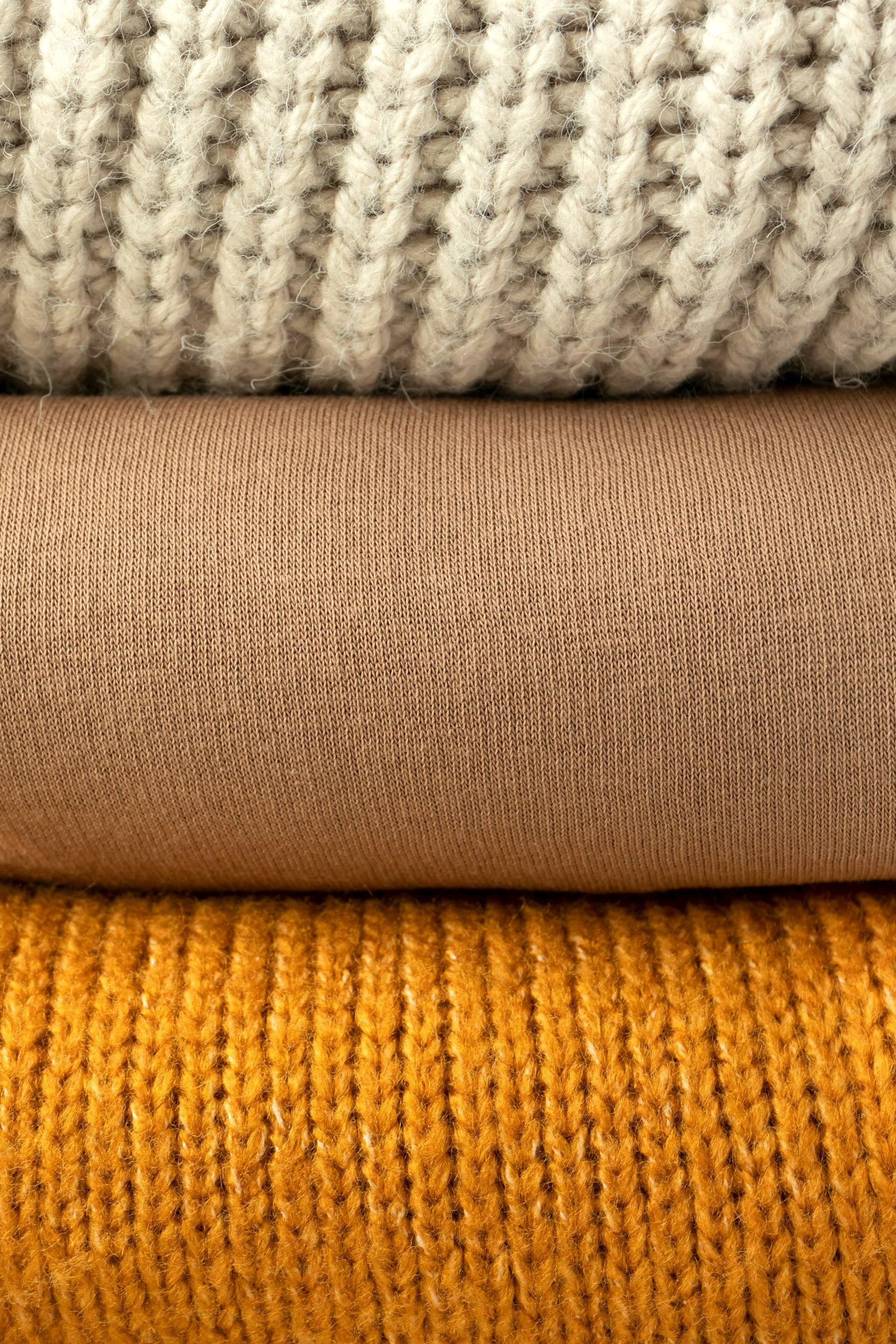
A crew sweatshirt is graded on its cloth first, because terry or fleece is the whole garment: no hood to build, no tailoring to hide behind, only the weight of the knit, the rib at the collar and cuff, and the honesty of the price. A note on photography, printed because this page believes in saying so: our photo bank holds no sweatshirt photography, on a body or off one, so no ranked crew is pictured anywhere on this page. The hero is a folded-knit macro from the bank, captioned as what it is, and the frames this page actually needs head the harvest list in the honesty section.
Checked and updated October 2026
The basis: a crew sweatshirt is graded on its cloth before its cut, because with the hood gone the cloth is the garment entire, and on its weight only where the maker publishes one: a weight in grams or ounces printed by the house is evidence, and a weight guessed from a photograph is a fiction this page does not print. The winner: the Reigning Champ Midweight Terry Standard Crewneck at 81, a 100 percent cotton loopback terry at a maker-published 390 grams per square metre, at $98. The ruling, in one line: a crew sweatshirt is judged at the collar and the cuff after fifty washes, not on the rail. The skip: the Amiri MA Quad Jacquard Crewneck Sweatshirt at 45, named in the verdict box below: an $890 crew whose price is nine winners and whose published cloth evidence would fit on its care label. In between, the hoodie winner's house is graded fresh on a lighter terry and takes second, the attainable answer holds third at $39.90, a Stockholm loopback carries the field's best sizing system and the field's steepest American price, and a 14 ounce fleece with its weight in its name closes the ranked field.
First, the decision
Every crew sweatshirt argument is really three arguments, and this page settles all three before it scores anything. The first is the only question most readers actually have: if you buy one crew sweatshirt, buy the Reigning Champ Midweight Terry Standard Crewneck. It is ranked first below on the published evidence, and it is named here, in the first screen, because a page that buries its answer under seven cards has not answered it. Its maker publishes the number most of the field hides, 390 grams per square metre of 100 percent cotton loopback terry, and builds to it: flatlock seams, semi-raglan sleeves, rib side gussets, at $98, the same money as the second-place garment and a ninth of the skip. The crew is the hoodie's hoodless sibling, and this site's hoodie ranking set the cloth law this page inherits: loopback against brushed, published weights against silence, boxy against sloppy. Nothing in that law changes because the hood came off. What changes is the failure mode, and it is the second argument.
The second argument fits in one line: a crew sweatshirt is judged at the collar and the cuff after fifty washes, not on the rail. A hoodie dies by hood collapse and pilling; a crew has no hood to collapse, so it dies at its rib. The collar that goes wavy and stops sitting flat and round, the cuff that is pushed up the forearm once and never comes back: those are the two deaths of this garment, and they are graded inside the construction and longevity rows of every card below, with the rib's fibre line printed as evidence where the maker publishes one. A crew that holds its collar for four years is a garment. A crew whose collar surrenders in a season is a disposable wearing a mid-market price, and this page grades the difference.
The third argument is a boundary, drawn before it can blur. This page ranks the fleece crew: cut and sewn from jersey, terry or fleece. The other crew neck, the one knitted from yarn stitch by stitch, has its own ranking on this site, the crew neck sweater Card, where the John Smedley Lundy stands at 87, and its own styling brief, How to Wear No. 09. The two garments share a neckline and nothing else: the knit drapes and breathes like a garment and reads as one in a room, the fleece crew layers and launders like sportswear and reads as ease. Buy the knit for the rooms in the sweater brief. Buy the crew on this page for everything the knit is too dressed to do. Neither ranking borrows the other's numbers, and no score crosses the boundary in either direction.
And the office ruling, stated plainly, because this is the garment office dressing negotiates with most. The arithmetic is the hoodie ruling with the hood removed, and the hood was never the problem: a sweatshirt is a layer, and a layer sits one rung below the garment it covers. The knitted crew passes in more rooms because a knit reads as a garment; the fleece crew reads as what it is, the soft layer, and it is legal as the commute layer everywhere and as the top layer only in rooms where a plain tee would already pass. In any room that measures formality, the answer is a jacket, and the crew waits outside it, exactly where its hooded sibling waits.
How the scores work
Every crew sweatshirt is scored out of 100 on the same five rows, and the rows are printed on every card, so the reader can disagree with the weighting and still use the evidence.
Cloth, 30 points. The terry or fleece as the maker publishes it: its weight in grams per square metre where a weight is published, in ounces per square yard where the house prints ounces, with any conversion labelled as this desk conversion and never as the maker figure. Loopback against brushed is graded as the bargain each is, under the law the hoodie ranking set: the loopback cooler, cleaner-layering and slower to pill; the brushed warmer, softer at first touch and first to tire. The fibre line is graded as printed: an all-cotton cloth earns what all-cotton earns, a blend earns its ratio, and a house that publishes neither weight nor fibre story is graded on the silence.
Construction, 20 points. The build as published: the rib first, at collar, cuff and hem, because the rib is this garment's signature the way the hood is the hoodie's; then the heritage details, graded as function or costume on the evidence. A V-stitch insert at the neck began as engineering, a gusset that let the collar give and took the sweat, and side gussets began as movement panels; where a house still builds them as working parts they earn as construction, and where they are printed or appliquéd nostalgia they earn as decoration, which is less. Then the seams where the maker prints them, flatlock against overlock, cover stitching against the standard line.
Fit and silhouette, 20 points. The cut graded against this site's published soft standard: room carried with structure, the shoulder dropped by pattern rather than by sag. The line is printed here so the cards can be audited against it. Boxy is a cut: the shoulder drops on purpose, the body has room in every direction, and the garment still ends where the pattern says, the hem at the hip, held by a rib that grips, the collar sitting flat and round. Sloppy is a failure: the same room with the structure gone, the collar wavy, the cuffs surrendered, the hem belled. The trim athletic patterns in the field are graded as what they are, a deliberate narrower welcome, with the maker's own steering printed on the card.
Value, 15 points. The price as a reader first meets it, printed on every card with its seller. A list price that the maker's own channel permanently marks down is graded at the list and convicted by the markdown, in the open, on the same card.
Longevity and wash, 15 points. How the garment ages in the machine and on the body: the care line ceremony or lack of it, the fibre known arc, and the two failure modes this category dies of, collar sag, where the neck rib loses its round, and cuff surrender, where the rib stops recovering, with pilling charged to the brushed faces where it belongs. Stated lives in the per-year table are this desk's, printed beside the figures so the reader can argue with the life rather than the arithmetic.
The rows sum to the score. Maker figures are labelled maker figures throughout, and three kinds of number appear on this page, kept separate on every card: garment scores, set fresh here on this basis; brand scores, set on the brand pages and cited for the record only; and scores from other garment rankings, cited as evidence of a house's record, never inherited by the garment in hand.
Seven crew sweatshirts, ranked
Reigning Champ Midweight Terry Standard Crewneck
$98 at Backcountry and Shopbop
The call: the winner is the crew whose maker publishes the number, and then builds like the number is a promise. The cloth is the Vancouver house's signature midweight terry, 100 percent cotton, loopback, loops uncut on the inside, and the maker's published weight for the cloth is 390 grams per square metre, the figure this site carried when the same cloth won the sweatpants ranking at 86 and stood fourth in the hoodie ranking at 74. Those are other garments' scores, cited as the cloth's record, and this crew was scored fresh: the build is the terry line's athletic tailor work, flatlock seams, semi-raglan sleeves, rib side gussets, and a rib at collar and cuff with the recovery the category is judged by. At $98, verified at two retailers on the same day, it is the cheapest published-weight terry in the field and the most honestly priced garment on this page.
The deduction is the fit, and the house's own fit ladder prints it. The Standard pattern ranked here is the regular athletic cut, trimmer than this site's soft, boxy standard, and the house now cuts the same cloth in Slim, Classic and Relaxed fits around it, which is an admission printed in its own range: broader bodies and drape-first readers should take the maker's steering toward the Relaxed, in the same cloth at the same $98. Graded on the Standard, the fit row of 14 is the narrowness priced, exactly as the house's hoodie was priced before it. The house's other numbers belong to other garments and stay there: the terry hoodie at 74 and the terry sweatpant at 86 are the cloth's evidence, and this 81 is the crew's own. Four years at $24.50 a year, $0.41 a wear, and the arithmetic is in the table further down.
American Giant Relaxed French Terry Crew
$98 at American Giant
The call: the most instructive card in the field. The house that won the hoodie ranking at 87 with a 12.2 ounce heavyweight fleece sells its crew in a different and lighter cloth, and publishes that too: a 100 percent cotton French terry at a printed 9.4 ounces per square yard, about 319 grams per square metre in this desk conversion, midweight by the map this page prints, built for the in-between moment the maker's own copy names, fleece too much and a tee not enough. This garment was scored fresh on that evidence, and the hoodie's 87 was not transferred, borrowed or averaged in: a house's record is evidence, and a garment's score is its own. What the record does earn is trust in the build, and the build is printed like a spec sheet: raglan sleeves, a rib V-notch at the front neckline, the heritage gusset still doing its original work of letting the collar give, durable 5-thread cover stitching throughout the body, a grosgrain neck tape, made in Los Angeles.
The deductions are cloth weight and finish, both printed rather than smoothed. At 9.4 ounces this is a layering terry, a class below the winner's 390 gram cloth in warmth and in outer-layer duty, and the cloth row of 22 is that class priced honestly next to it. The garment is pigment dyed and vintage washed for a lived-in look, which means the fade is a design decision taken before you arrive: the fit row of 17 credits the relaxed cut, room carried with structure and a size chart in inches from S to XXL, and the longevity row of 12 charges the pigment finish a point of ceremony, wash separately, colour transfer warned on the maker's own page. At $98 it is the same money as the winner for a lighter cloth and a better drape, which is a real choice and not a ranking error: buy the winner for weight, buy this for the silhouette. Four years at $24.50 a year, $0.41 a wear.
Uniqlo Sweatshirt
$39.90 list at Uniqlo, seen at $29.90 on sale
The call: the attainable answer, holding third the way its hooded sibling held third on the hoodie ranking: the silhouette this page grades as the standard, a modern regular fit with shoulder and body dimensions adjusted and ribbing refined, per the maker's own description, sold at $39.90 list in a size run from XXS to 3XL with chest measurements published in inches, and carrying a 4.7 from 246 buyers on the maker's page, printed as a report. The fit row of 19 is the highest awarded on this page, because this is the cut the standard is drawn from at a price every reader in the field can pay, and the value row of 15 is the maximum the row allows: forty dollars, honestly labelled, in every size a body comes in.
The rest of the card is the forty dollars' other side, and it is printed in full. The maker's page for this garment would not load for this desk's reader today, so two things are graded as the absence they are: no cloth weight could be captured, so none is graded, and the fibre line is scored on the fleece-lined description the maker's indexed pages carry, not on a specification this desk could not open. The construction is competent and unremarkable next to the spec sheets above it, and the longevity row of 9 prices the class arc the hoodie ranking priced before it: the structure is the selling point, and structure in a mass-market fleece is what the second year tests, at the collar first. Costed at a stated two years, this is $19.95 a year, $0.33 a wear, among the cheapest years in the field at a third of the winner's ticket. Uniqlo standing brand score on this site is 84, recorded here for the record from brands like Uniqlo; the garment was scored fresh, and its hooded sibling's 76 on the hoodie ranking is a coincidence of two instruments landing together, not a number carried across.
Asket The Sweatshirt
$180 at Asket's US store; €130 in its European store
The call: the best-fitting garment in the field and the page's settled argument. The cloth is the Stockholm house's premium cotton loopback, graded 23 with its weight unpublished in grams on the maker's US page, a silence that costs less here than anywhere because the house publishes everything else: origins, cost breakdowns, and a sizing system no other card in this field approaches, sizes graded in fine increments across three lengths, long, regular and short, confirmed on the maker's page today. The fit row of 19 ties the highest on this page for that system alone: this is the crew a reader between sizes, or tall, or short, buys when every other card's S to XL ladder has already failed him. The brand around it stands at 92 on brands like Asket, the highest attainable brand score this site has set, cited for the record; this garment was scored fresh, and neither number borrowed from the other.
The deduction is the price, and this card is where the desk closes its own open file. This site's records have carried three figures for this sweatshirt: $180 in one note, about $95 in another, and the $95 printed to this day in our quiet-luxury capsule. Checked today on the maker's own stores, the garment is $180 in the United States and €130 in Europe, the European figure the one this site printed when the brand was scored. The $95 traces to a 2018 review, when the sweatshirt genuinely cost roughly that; neither old American figure is current, and the capsule's price is flagged in the honesty section below for correction at the next check rather than quietly left wrong. Graded at the $180 an American reader is actually charged, the value row of 5 is what the steepest regional price in the field earns, and it is the whole distance between this card and second place: at the European figure this is a 79-point garment, and the desk prints that arithmetic because the reader deserves to see what the ocean costs. The care line is a mild ceremony, wash at 30 degrees, no tumble dry, and the house take-back programme stands behind the garment in a way no other card here matches. Five years at $36.00 a year, $0.60 a wear.
Sunspel Loopback Sweatshirt
$175 at Sunspel
The call: the refined altitude, and the field's cleanest fibre lines. The maker's US page, checked today, prints them in full: main cloth 100 percent cotton loopback, developed for warmth without bulk, and ribs at 95 percent cotton and 5 percent elastane, the elastane printed here because it is this garment's answer to the category's first death, a rib that recovers because it was built to. The V-stitch at the neck, introduced to this line by a former creative director the maker names, is graded as construction rather than costume: it is the original sweat gusset, still letting the collar give over the head and still taking the moisture where a crew works hardest. Made in Portugal, gentle wash, at $175. The house's record on this site is a row of fresh garment scores, the vest at 84, the boxer at 81 and the underwear tee at 83, with the family graded on brands like Sunspel; this crew was scored fresh like the rest, and the pattern those numbers make, a house that wins on cloth and construction and pays for it in the value row, repeats here exactly.
The deductions are fit and price. The cut is the maker's neat regular fit, graded 13 against the soft standard: it is a deliberate, trimmer welcome, the crew for a wardrobe that runs tailored, and a reader built for the drape standard will find it correct and joyless in equal measure. No cloth weight is published, so none is graded, the same silence charged to the Asket above it. And at $175 the value row of 8 records what the refinement costs next to a winner with a published weight at $98: the Sunspel is the better-finished garment by a margin the cloth rows can see, and it is not 79 dollars better finished. Buy it for the wardrobe it matches. Four years at $43.75 a year, $0.73 a wear, the dearest year among the ranked six, printed without flinching.
J.Crew Heritage 14 Oz. Fleece Sweatshirt
$58.80 at J.Crew today, under the house's standing promotion
The call: the field's heavyweight by its own name. The maker puts the weight in the product title, 14 ounces, about 475 grams per square metre in this desk conversion, heavier than the winner's terry and heavier than the hoodie ranking's champion fleece, and the cloth row of 23 grades the claim as published evidence, because a weight printed in the name is a promise the house can be held to. The build around it is the heritage pattern the name advertises, a classic fit that the maker's own review summary reports true to size with longer options taller readers praise, carrying a 4.71 from 342 buyers, printed as a report. J.Crew standing brand score on this site is 73, set on brands like J.Crew; this garment was scored fresh, and the knitted lambswool crew the same house sells, graded 62 on the sweater ranking, is a different garment on the other side of this page's boundary and lends this card nothing.
The deductions are the face and the ticket, and both are house habits this site has printed before. The interior is brushed, per the maker's own review summary, which makes this the field's one brushed entry: warmer on the first touch, softer in the first month, and the first surface here to pill, charged in the longevity row of 8 under the loopback law. And the price could only be verified as J.Crew prices can ever be verified: the page's own structured data carried $58.80 today, under the standing promotion the house runs in place of a price, with no clean list figure separable from it on the surfaces this desk could check. The desk grades the verified $58.80, which makes the value row of 11 genuinely good money for a published 14 ounces, and prints the caveat beside it, because a J.Crew price is a weather reading, not a climate. Three years at $19.60 a year, $0.33 a wear, at the promoted figure.
Amiri MA Quad Jacquard Crewneck Sweatshirt
$890 at Neiman Marcus
The call: skip it, and the conviction is arithmetic before it is taste. This is a crewneck sweatshirt listed at $890 at Neiman Marcus, nine times the winner's $98, five times the refined altitude in fifth, for a garment whose published evidence is a jacquard monogram and a name. No cloth weight is published. No fibre story beyond the category ordinary is printed on the surfaces this desk could check. Against the basis above there is almost nothing to grade, and the cloth row of 13 and the construction row of 12 are what an unremarkable fleece earns when it declines to publish its evidence at nine times the honest price.
The channel then grades the list price the way this page does. The same retail system that lists this crew at $890 carries the house's fleece programme at SSENSE cut across the rail, hoodies at $458 against $750, at $552 against $890, at $604 against $990, a pattern this site documented when the house was scored on brands like Amiri, where Amiri stands at 64 as a brand. The list is an opening bid, and the reader who pays it is funding the discount the next reader gets. Run the year and the case closes: at a generous three years this is $296.67 a year, $4.94 a wear, twelve times the winner's year, the dearest year in the field by a distance of five Sunspels. This site keeps an anti-award for exactly this transaction, the Logo Tax, and a jacquard monogram woven into a sweatshirt is the tax with the logo built into the cloth itself. The honest version of the want underneath it, a heavyweight crew with a real pattern story, is ranked sixth on this page at $58.80. Buy that. Let the $890 go unpaid.
The numbers, side by side
Maker figures, checked against the makers' and sellers' own pages this month, with the claims labelled as claims: where a maker publishes a weight, a fibre line or a size chart, it is printed as theirs, and where a maker publishes nothing, the nothing is printed too.
| Crew sweatshirt | The cloth | The build | Fit system | The fine print |
|---|---|---|---|---|
| Reigning Champ Midweight Terry Standard Crewneck | 100% cotton loopback terry, 390 GSM published by the maker for the cloth | Flatlock seams, semi-raglan sleeves, rib side gussets | Standard fit, the regular athletic pattern; Slim, Classic and Relaxed fits cut in the same cloth at the same price | $98 verified at two retailers today; the cloth's third ranked garment on this site, after the sweatpant at 86 and the hoodie at 74 |
| American Giant Relaxed French Terry Crew | 100% cotton French terry, 9.4 osy published by the maker, about 319 GSM in this desk conversion | Raglan sleeves, rib V-notch at the neckline, 5-thread cover stitching, grosgrain neck tape; made in Los Angeles | Relaxed fit; chart in inches, S to XXL; 4.9 from 26 buyers, as reported | The hoodie winner's house, scored fresh: the crew's cloth is not the hoodie's 12.2 ounce fleece, and no score crossed over |
| Uniqlo Sweatshirt | Fleece-lined, per the maker's description; no weight captured, fibre line not captured on the surfaces checked | Refined ribbing at collar, cuff and hem, per the maker | Modern regular fit, adjusted shoulder and body dimensions; XXS to 3XL; 4.7 from 246 buyers, as reported | $39.90 list; seen at $29.90 on sale on the maker's own pages; brand score 84 stands on the brand basis |
| Asket The Sweatshirt | Premium cotton loopback; no weight in grams published on the maker's US page | The permanent-collection build, with the house take-back programme behind it | Sizes in fine graded increments across three lengths: long, regular, short | $180 in the maker's US store today, €130 in its European store; the $95 in our records traces to a 2018 review; brand score 92 stands on the brand basis |
| Sunspel Loopback Sweatshirt | 100% cotton loopback; ribs 95% cotton, 5% elastane, both lines published by the maker; no weight published | V-stitch neck insert, ribbed cuffs; made in Portugal | Neat regular fit | Gentle wash at 30 degrees, no tumble dry; the house's garment record here runs 84, 81 and 83 on three other rankings |
| J.Crew Heritage 14 Oz. Fleece Sweatshirt | 14 oz fleece published in the product name, about 475 GSM in this desk conversion; brushed interior, per the maker's review summary | The heritage build; classic fit, true to size, longer options reported | Classic fit; 4.71 from 342 buyers, as reported | $58.80 verified today under the house's standing promotion; no clean list figure separable on the surfaces checked; brand score 73 stands on the brand basis |
| Amiri MA Quad Jacquard Crewneck Sweatshirt (the skip) | No weight published; no fibre story beyond the category ordinary on the surfaces checked | A jacquard monogram woven into the cloth | Relaxed logo fit | $890 list at the department-store channel; the channel marks the house's fleece programme down by a third to a half as routine; brand score 64 stands on the brand basis |
Read the cloth column and the ranking explains itself. The top of the table is the field's published terry weights and the house that prints its ounces on the product page; the middle is the loopbacks whose makers publish everything except the weight; the bottom is a fleece priced as tailoring that publishes nothing at $890. Evidence, all the way down, is the ranking.
Cost per year, in the open
The table divides each price by a stated working life for its cloth and build, printed beside the figure so the reader can argue with the life rather than the arithmetic. Wear counts assume a crew in regular rotation, worn about sixty times a year. Published-weight loopback builds are costed at four to five years, the mass-market structure at two, the brushed heavyweight at three, and the logo piece at the three years of a fashion life.
| Crew sweatshirt | Price | Stated life | Cost per year | Cost per wear |
|---|---|---|---|---|
| Reigning Champ Midweight Terry Standard Crewneck | $98 | 4 years | $24.50 | $0.41 |
| American Giant Relaxed French Terry Crew | $98 | 4 years | $24.50 | $0.41 |
| Uniqlo Sweatshirt | $39.90 | 2 years | $19.95 | $0.33 |
| Asket The Sweatshirt | $180 | 5 years | $36.00 | $0.60 |
| Sunspel Loopback Sweatshirt | $175 | 4 years | $43.75 | $0.73 |
| J.Crew Heritage 14 Oz. Fleece Sweatshirt | $58.80 at the promoted price | 3 years | $19.60 | $0.33 |
| Amiri MA Quad Jacquard Crewneck Sweatshirt (the skip) | $890 at list | 3 years | $296.67 | $4.94 |
Two headlines live in that table. The two $98 garments at the top tie their year to the cent, $24.50, which is the field telling you the choice between them is cloth and cut, not money: the winner's heavier terry against the second card's lighter terry and better drape. And the dearest year is not close: the $890 skip costs twelve winners a year, $296.67, for the field's thinnest published evidence, while the cheapest years belong to the $39.90 attainable pick and the promoted heavyweight at its verified $58.80, a tie at $0.33 a wear between the lightest promise in the field and the heaviest name.
Which one to buy
Buy one crew only: the Reigning Champ Midweight Terry Standard Crewneck at 81. The published 390 gram loopback, the athletic tailor build, $24.50 a year. Take the Relaxed fit in the same cloth if the Standard's trim is not your shape; the maker cuts it at the same $98.
The drape on the same money: the American Giant Relaxed French Terry Crew at 79. A lighter, published terry, a raglan cut and the lived-in finish, from the house whose hoodie this site ranks first, graded here on its own evidence.
The silhouette on a budget: the Uniqlo Sweatshirt at 76. The standard's cut at $39.90 list, in every size a body comes in, bought knowing its collar is a two-year proposition.
Between sizes, tall, or short: the Asket at 75. The only graded sizing system in the field, bought with open eyes at the American price, or at the European figure if your life takes you there.
The tailored wardrobe: the Sunspel at 73. The neat fit, the elastane rib and the cleanest fibre lines in the field, at the field's dearest ranked year.
The rest of the layer system: the same desk grades the hooded sibling on the hoodie ranking, the knitted crew on the crew neck sweater ranking and its styling in How to Wear No. 09, and the sweatpant cut from the winner's cloth on the sweatpants ranking. Where every layer sits is mapped on the Body Map, and the full method behind these scores is on the methodology page.
How we know: the honesty section
The scores are this desk's own, computed on the basis printed above from maker-published fibre lines, weights, construction details, size systems and care instructions, checked against the makers' and sellers' own pages this month. Prices were verified on the seller page at check time, and the exceptions are printed rather than smoothed over.
Six disclosures specific to this page. First, prices. The American Giant at $98, the Asket at $180 and the Sunspel at $175 were read off the makers' own product pages today. The Reigning Champ at $98 was verified at two stocking retailers on the same day, Backcountry and Shopbop, the maker's terry line being sold through retail at a single figure this season; the card links the retailer this site used for the same house on the hoodie ranking. The J.Crew at $58.80 is the figure in the product page's own structured data today, read under the house's standing promotion, with no clean list price separable from it on the surfaces checked, and the card says so. The Amiri at $890 is the department-store channel's list figure, read in that channel's own listings today; the card links the channel's listing page, the product's individual page address not having been captured verbatim, and the markdown pattern cited against it is the same channel system's SSENSE rail, where the house's fleece programme stands cut by a third to a half today.
Second, the Uniqlo. The maker's product page would not load for this desk's reader today, and the desk does not pretend otherwise: the $39.90 list price, the 4.7 from 246 buyers, the regular fit and the XXS to 3XL run are read from the maker's own indexed product pages, crawled within the week, and the fibre line and cloth weight that a live page would have settled are graded as uncaptured, in the open, on the card. When the page loads at the next check, the card will be corrected with whatever it prints.
Third, the Asket file, closed in the open. This site's records carried $180, about $95, and €130 for the same sweatshirt. Today's check finds $180 on the maker's US store and €130 on its European store, both read today; the €130 is the figure the brand page printed, and it stands. The $95 traces to a 2018 review of the garment's early version, our quiet-luxury capsule still prints about $95 for it, and that figure is flagged here for correction at the next check rather than silently left wrong in two places at once. The brand score of 92 is untouched by any of this: it was set on the brand basis, and a regional price correction moves a garment's value row, not a house's record.
Fourth, weights. Three makers in this field publish one. Reigning Champ prints 390 grams per square metre for its midweight terry; American Giant prints 9.4 ounces per square yard for its French terry; J.Crew prints 14 ounces in the product's name. The conversions, about 319 and about 475 grams per square metre, are this desk arithmetic and are labelled as such wherever they appear. Every other cloth on this page is graded with its weight unpublished, and no weight has been estimated from a photograph, a review or a reputation anywhere in the scoring.
Fifth, the three kinds of number, because this page is where several of them meet. The garment scores are fresh, set here on this page's basis. The brand scores cited on the cards, Uniqlo 84, Asket 92, J.Crew 73 and Amiri 64, were set on the brand pages of this site on the brand basis. The other garment scores cited, the Reigning Champ terry at 86 in sweatpants and 74 in a hoodie, the American Giant hoodie at 87, the John Smedley Lundy at 87 on the sweater ranking, were set on those pages' bases for those garments. None of them was inherited by, or lent to, any garment score here, and where the same cloth appears in three garments at three scores, the instruments are measuring three different garments that happen to share a fabric, which is precisely why the desk scores garments and not reputations.
Sixth, a rested name and the photography. H&M sells crew sweatshirts, and no H&M garment is scored on this page, deliberately: the field convicts its skip on price evidence that needs no fast-fashion exhibit, and the house's derived brand arithmetic, set on its own page from thirteen ranked garments, does not move because of this page. Photography: the bank holds no sweatshirt photography, no terry on a body in street light, no loopback-against-brushed macro and no fifty-wash collar detail, and this page does not pretend otherwise. The cards run without images rather than borrow a wrong frame, the hero is a folded-knit macro captioned as what it is, and the harvest list for this category names what is missing: a loopback crew worn on a city street, a collar-and-cuff macro that shows the rib this page grades, and the same crew photographed new and after a season of washing.
Questions the desk hears
What is the best crew neck sweatshirt for men?
The Reigning Champ Midweight Terry Standard Crewneck, 81 out of 100: a 100 percent cotton loopback terry whose weight the maker publishes at 390 grams per square metre, built with flatlock seams and rib side gussets, at $98. Second is the American Giant Relaxed French Terry Crew at 79, the hoodie winner's house graded fresh on a lighter, published 9.4 ounce terry at the same $98. Third is the attainable answer, the Uniqlo Sweatshirt at 76 and $39.90 list, in a size run from XXS to 3XL.
What is the difference between a crew neck sweatshirt and a crew neck sweater?
The cloth, not the neckline. A sweatshirt is cut and sewn from jersey, terry or fleece, a woven-loop cloth made on a different machine for a different job; a sweater is knitted from yarn, stitch by stitch, and drapes and breathes like a knit because it is one. This page ranks the fleece garment. The knitted crew has its own ranking on this site, where the John Smedley Lundy stands at 87, and its own styling brief. A wardrobe needs the distinction more than it needs either garment twice: the knit is the layer that reads as a garment in a room, the fleece crew is the layer that reads as ease, and confusing them is how a sweatshirt ends up at a dinner it was not built for.
Loopback or brushed fleece: which lasts longer?
Loopback, on the evidence of how each face ages, the ruling this site set on its hoodie ranking and applies unchanged here. A loopback or terry cloth leaves its loops uncut on the inside: it breathes better, layers without grabbing, and has no raised pile to pill. A brushed fleece has its inside raised into pile: warmer and softer on the first touch, and the first surface in the garment to pill and mat. Five of the seven crews ranked here are loopback or terry; the one brushed entry, a 14 ounce fleece with its weight in its name, is graded with the bargain priced into its longevity row. Brushed is the warmer buy and the shorter-lived face; loopback is the cooler buy and the longer one.
How heavy should a crew neck sweatshirt be?
Midweight is the default, and the field's published numbers draw the map. The winner's terry is published at 390 grams per square metre, the heavy end of midweight and the crew that works nine months a year. The American Giant terry is published at 9.4 ounces per square yard, about 319 grams per square metre in this desk conversion, a true midweight for layering. The J.Crew fleece is published at 14 ounces in its own name, about 475 grams per square metre, heavyweight, worn as the outer layer on cold days. Below roughly 300 grams a crew is a layer to be worn under things, not the purchase. And a maker who publishes no weight at all is graded as unpublished, never estimated from a photograph.
How should a crew neck sweatshirt fit: boxy or trim?
Boxy is a cut, sloppy is a failure, the standard this site set on the hoodie ranking, applied to the hoodless garment unchanged. A boxy crew drops the shoulder on purpose, carries room in every direction, and still ends where its pattern says, the hem at the hip held by a rib that grips, the collar sitting flat and round. A sloppy crew has the same room with the structure gone: the collar wavy, the cuffs surrendered, the hem belled. The trim end is graded just as honestly: an athletic cut like the winner's Standard pattern is a deliberate, narrower welcome, and broader bodies should follow the maker's own steering toward its relaxed fits. Buy the cut in your size and the failure in no size.
What fails first on a sweatshirt, and how long should one last?
The collar and the cuffs, in that order. A crew neck lives or dies at its rib: when the collar stops sitting flat and round and goes wavy, and when the cuffs stop recovering after a push up the forearm, the garment has ended, whatever the body cloth still has in it. That is why this page grades collar retention and cuff recovery inside its construction and longevity rows, and why the elastane in a rib, the winner's pure cotton against the Sunspel's 95 and 5, is printed on the cards as evidence. A well-built cotton crew in regular rotation should give four to five years; costed at those lives, the per-year table on this page runs from $19.60 a year for the promoted J.Crew to $296.67 a year for the $890 skip.
Seven crews, three published weights, one price question settled at $180, and a winner judged where this garment is always judged in the end: at the collar, after the washes. Buy the cloth, not the chest.
Checked and updated October 2026