

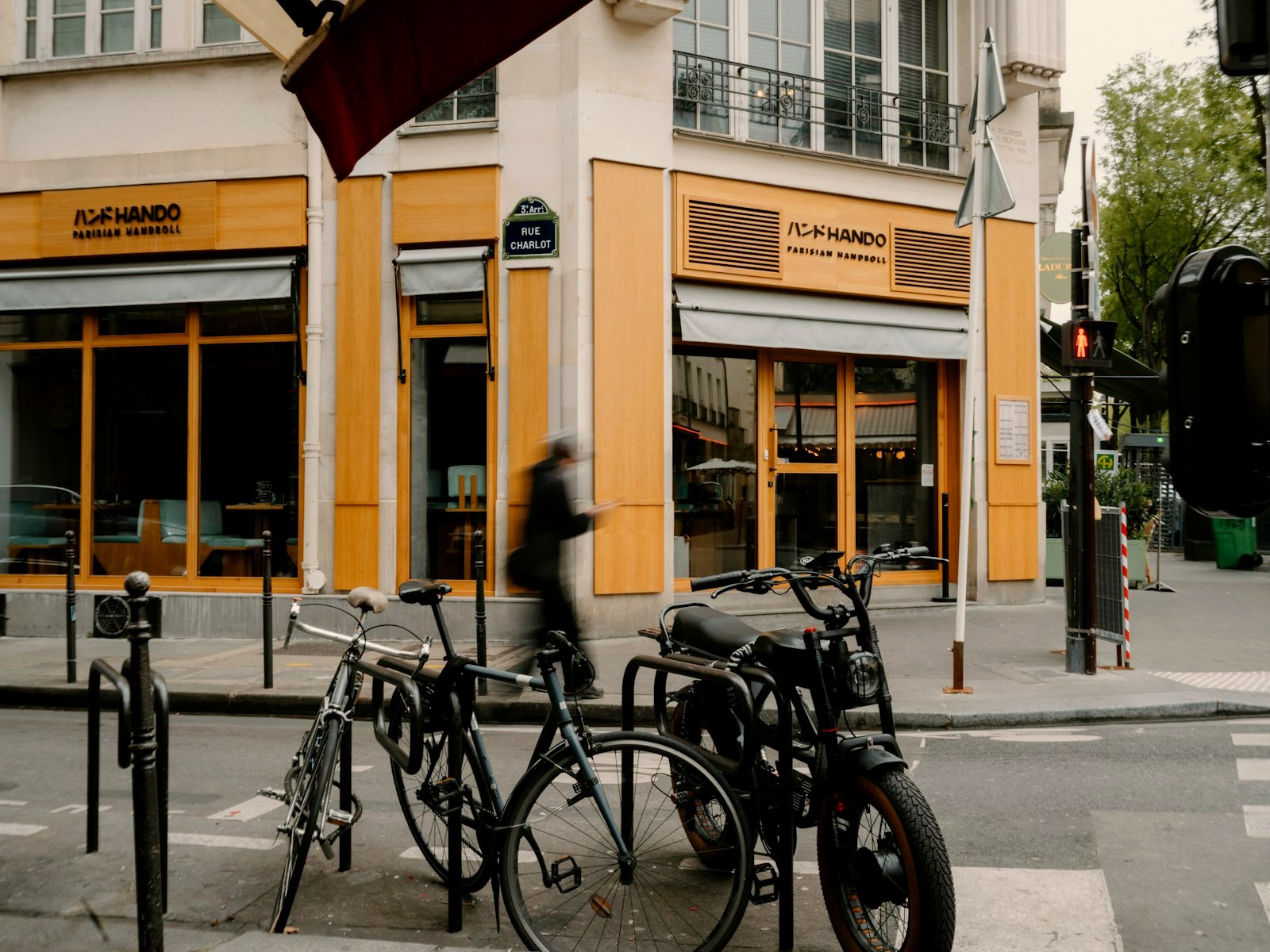
The trench coat's home register: a northern city street in the wet shoulder seasons. It is not any ranked coat; our bank holds no honest trench-on-body frame yet, the same gap How to Wear No. 02 prints on its own page, and the honesty section below prints the harvest list rather than let a stranger's coat stand in for a ranked one.
Checked and updated October 2026
The verdict, up front: seven trench coats scored out of 100 on cloth 30, construction 20, fit 20, value 15, longevity 15, plus the polyester coat sent home. The Private White V.C. Despatch Rider's Trench wins at 86, the fullest published specification in the field: Ventile cotton, copper-taped seams, horn buttons, copper D-rings, a liner weight printed to the gram, at £1,695. The Burberry Long Kensington Heritage is second at 83, its gabardine woven at the maker's own Yorkshire mill and the only published length in the field, 116 centimetres, at $2,850. The Mackintosh Fetlar is third at 81, bonded cotton sealed by hand in Scotland, at $1,450. And the coat sent home, at 24, is boohooMAN's Boxy Oversized Trench Coat, whose maker's entire cloth record reads Fabric: Polyester, at €32. How to Wear No. 02 printed that this site had not ranked trench coats. It has now.
The finding: a specification garment, sold as a silhouette
The trench coat is the one garment in the wardrobe that began life as a literal specification. It was written down, item by item, for officers in the First World War: a double-breasted front to shed driven rain, a storm flap over the chest, a throat latch to close the collar against the weather, epaulettes for rank and straps, D-rings on the belt for equipment, a vent at the back that buttons, and a cloth, cotton gabardine, woven tightly enough to shed water by its weave while it breathed. Every one of those items was a function before it was a look. How to Wear No. 02 styles the garment from our jackets index: formality 4, warmth 2, the wet shoulder seasons, its buying rule printed whole, buy the cloth and the length, not the epaulettes, gabardine first. No. 02 styles the garment and scores nothing. This page scores the coats, and it scores them on a single question: how much of the specification does the maker still publish? The count, from the eight coats below, is the finding. One maker in eight publishes the whole specification, cloth, storm system and a garment length a buyer can check: Burberry, at $2,850. Two more publish the cloth and the system and go quiet on the length. Not one maker in the field publishes the weight of its outer cloth; the only cloth weight printed anywhere in this ranking belongs to a removable liner, 600 grams per square metre, on the winner's page. And at the bottom of the market the specification is not withheld but deleted, and what is sold in its place is a double-breasted outline, a belt, and the word trench. The trench did not get worse this century. Its paperwork did, in exact proportion to its price falling, and this page grades the paperwork.
The field below was chosen to cover the ways a coat can keep the spec or lose it. There are two Manchester coats from the house that publishes the most complete file in British outerwear, the flagship and its half-price sibling. There is the heritage name itself, graded on its record and not its mythology, check lining and all. There is bonded cotton from the Scottish house that invented the rubberised tradition, the only fully waterproof construction in the field. There is the attainable American standard in honest cotton twill, the attainable direct coat whose maker prints a full organic split at $104, and the high street's one named-mill coat. And there is the skip, convicted, as the honest ones always are, out of its maker's own mouth: two words of cloth record and one word of length. The membrane law from the rain jackets Card runs underneath the whole page: waterproof is a structure, sealed at the seams, and water-repellent is a finish that fades. The trench predates membranes. Gabardine sheds by weave, and breathes while it does it, at formality four. Choose by the room at the end of the rain.
How the scores work
Every coat is scored out of 100 on the same five rows. Cloth (30) reads the published record first: a printed split scores, a weave-shed cotton (gabardine, or Ventile at the densest end) scores as the class No. 02 rules the buy, bonded cotton scores as the acceptable second, and a polyester-led cloth scores as what it is. A named mill scores again, because a named mill is a checkable claim, and a published cloth weight scores a third time; on this page, that third mark was available to everyone and taken by no one, for a shell. Construction (20) is the storm system audited as published: storm flap, throat latch, D-rings, epaulettes and a buttoned vent score as the working parts they are, real horn and metal hardware score above plastic and silence, raglan and set-in are read for the layering each allows, and a checked lining is read twice, as construction and as branding, and charged for the second when the first is thin. Fit (20) is No. 02's law applied: length by height with leg showing beneath the hem, the sleeve covering the cuff, room over a blazer; a published garment length is the strongest evidence a maker can file, and its absence is charged at the rate the law requires. Value (15) divides the price by the published record and by the seasons the coat will serve, printed in the cost table below. Longevity (15) is the care audit: how the cloth ages, whether it can be re-proofed, whether the house repairs, and whether the model will still exist when the coat needs a button. Row scores add to the total, on every card.
The ranking
Private White V.C. The Despatch Rider's Trench
The Winner
UK list price at last check: £1,695 at the maker's store (about $2,271).
Buy it as the reference trench of this field: the only maker here that publishes its coat the way the coat was originally specified, part by part, down to the weight of the liner.
The cloth: 100 percent cotton Ventile, printed on the maker's own product page. Ventile is gabardine's denser descendant, a cotton woven so tightly that the fibres swell when wet and close the weave, and this maker publishes the claim in the strongest words anyone on this page uses: 100 percent waterproof, with fully taped internal seams, the maker's journal specifying that every seam is sealed with its signature copper tape. Then the detail that convicts the rest of the field by existing: the removable liner, 90 percent extra fine merino wool and 10 percent cashmere, is published at 600 grams per square metre. A cloth weight, to the gram. It belongs to the liner and not the shell, and the cloth row charges the shell's own missing weight even here, 28 of 30; but a maker that weighs its liner is a maker that thinks in specifications, and no other page in this field prints a gram of anything.
The build and the fit: the storm system is published part by part, the way the 1910s wrote it: double-breasted front, raglan sleeves, gun flaps, a stud-adjustable throat tab, copper D-rings on a multi-stitch belt with a leather buckle, a back saddle, a button-adjustable rear vent, underarm metal eyelets, and real horn combat buttons, printed as made in Britain, on a coat made in the maker's own Manchester factory. Construction 19, the field's highest mark, docked one because perfection is not a score this desk prints. The fit row is where the winner pays its one real charge: no garment length is published, and on No. 02's law the length is half the purchase, so fit lands at 16 on the raglan's layering room, the adjustable vent and cuffs, and a size run that read partly sold out at this check, a flagship selling through its extremes. Longevity 14 is the Ventile's record plus the house's published Lifetime Repair Service, a maker offering to maintain the specification for the coat's life, and value 9 is the honest price of the fullest file: £1,695, about $114 a season across twenty seasons in the table below. This house's Donegal coat won the overcoats Card at 89 on the same habit of publishing everything. The habit is the brand. There is no brand score for it on this site, and the two garment scores are kept as separate as the garments.
Burberry Long Kensington Heritage Trench Coat
The Heritage Name, Graded
US price at last check: $2,850 at Nordstrom (£1,895 at the maker's UK store).
Buy it for the pattern, the mill and the printed length: the most complete heritage record in the field, at the field's highest price, with two silences left in it.
The cloth: cotton gabardine, 100 percent cotton on the maker's own page, and the mill is named in the only way stronger than a name: it is the maker's own, woven at the Burberry mill in Yorkshire and made into the coat in Yorkshire. That is the original arrangement, the cloth and the coat from the same house in the same county, and the cloth row scores it 27, docked for the two figures the page withholds, a cloth weight and any fibre detail beyond the cotton itself. The maker's own weather word deserves its sentence: the coat is sold as shower-resistant, which is the honest Victorian grade for gabardine, a weave that sheds showers and breathes, not a membrane that seals. On the rain Card's law, a maker that prints the modest true claim outranks a maker that prints the grand false one, and this page credits the modesty. One caution, printed because the name invites the confusion: the same house's fashion line sells a different double-breasted trench whose published composition is 65 percent polyester. The name covers two cloths. This card grades only the Heritage, and a buyer should know which rail he is standing at.
The build and the fit: the published system is complete: double-breasted closure, hook-and-eye collar, throat latch, epaulettes, a storm shield at the back, a gun flap at the shoulder, belt and cuff straps buckled in calf leather, the buckles' composition printed at 100 percent calf leather, a back vent that buttons, and the Burberry Check as lining and undercollar. The check is read the way this page reads every check: as construction, a full cotton lining is real tailoring, and as branding, the lining is the house's livery worn inside the coat, and the construction row, 18, credits the first and charges a little for the second. The set-in sleeve and structured shoulder are the tailored choice, sharper over a suit and less forgiving over knitwear than the winner's raglan. The fit row takes 18 on the field's single published length: 116 centimetres in the long version at IT 50, with a classic fit the maker states has room for layering, which is No. 02's law answered in numbers by exactly one maker in eight. What is not published is the button material, at $2,850, and the silence is charged where it sits. Longevity 13 credits a century of pattern continuity and a re-proofable cloth; value 7 is the heritage premium read plainly, about $143 a season across twenty seasons, the most expensive coat on this page to own per season as well as per ticket. Burberry holds no brand score on this site. Its check cashmere scarf was sent home by the scarves Card at 72, a different garment on its own record; nothing of that grade travels here, in either direction.
Mackintosh Fetlar Trench Coat
Bonded Cotton, Sealed by Hand
US price at last check: $1,450 in the maker's retail record (Editorialist).
Buy it as the only fully waterproof construction in the field: bonded cotton, sealed by hand in Scotland, from the house that invented the form, with its capture flagged below.
The cloth: bonded cotton, the second cloth of the jackets index's trench row and the acceptable second of No. 02's cloth table, made the way this house has published its method for two centuries: two layers of cotton sandwiching a thin layer of natural rubber. Where gabardine sheds by weave, bonded cotton seals by construction, which makes this the only coat in the field that is waterproof the way the rain Card defines the word, by structure rather than by finish. The house prints its composition as 100 percent Cotton Bonded on its own product pages and publishes its construction in a journal deconstruction this desk wishes every maker on this page would imitate: the pieces are sewn, then sealed by hand with a rubber-based solution applied by finger, and tape is pressed by hand over the exposed seams. The cloth row scores the record 26: the strongest weather cloth in the field, docked because the Fetlar's own composition line is graded from the house's published bonded-cotton record rather than captured from the coat's own page, a capture flagged here and in the honesty section.
The build and the fit: handmade in Cumbernauld, Scotland, the house's own factory town since the nineteenth century, and the construction row, 18, scores the method as published: hand-sealed seams are the storm system here, a coat whose weatherproofing is a craft process rather than a coating, worn in a belted double-breasted trench form in the maker's retail record. The house publishes full garment measurement tables on its own product pages, chest, length and sleeve in centimetres, which is the fit evidence this page asks for; the Fetlar's own table was not captured at this check, and fit lands at 15 on the house's published habit rather than the coat's own numbers. The longevity row carries the bonded tradition's care law, printed by the house itself: spot clean only, never dry clean, because the rubber core that makes the coat waterproof is the thing solvents dissolve, so the coat asks a different ownership than gabardine, gentler cleaning and no re-proofing, in exchange for a seal that does not fade the way a finish does. Twelve, on that trade, honestly stated both ways. Value 10: $1,450 for a handmade sealed coat, about $91 a season across sixteen seasons, is real money charged for a real structure, and the card says so without flinching in either direction.
Private White V.C. The DB Trench Coat
The Flagship's Sibling
UK list price at last check: £895 at the maker's store (about $1,199).
Buy it as the value seat of the heritage end: the winner's factory, the winner's cloth class and the winner's waterproof claim at roughly half the winner's price.
The cloth: the maker's own rainwear page introduces this coat in one sentence: our latest 100 percent waterproof trench coat, at £895. The cloth, on the coat's launch record in the trade press, is the house's Ventile, the same weave-shed cotton as the flagship at No. 1, and the cloth row scores it 25 on that record, docked a further point beyond its sibling's cloth charges because this coat's own product page resisted verbatim capture at this check and its fabric line is graded from the maker's published claim and its launch record rather than quoted from its own page. The capture is flagged on the card, the way this desk flags its own failures, and the November pass holds the direct re-verification. What is not in doubt is the class: a Ventile trench from the Manchester factory, in the cloth No. 02 rules the buy's family, at the price of a high-street coat and a half.
The build and the fit: the launch record publishes military-grade copper hardware and button-adjustable cuffs, the house's hardware register of copper and horn carried down the range, and construction 16 scores the double-breasted form and the hardware as published, against a storm-system list thinner in print than the flagship's part-by-part inventory. Fit 14: no length is published in the captured record, charged as the field's common silence, on a cut from a factory whose patterns are drawn for layering. The value row is the card's argument and takes 12: £895, about $1,199, about $60 a season across twenty seasons, buys the same factory, the same cloth class and the same waterproof claim as the £1,695 winner, minus the liner, the document pocket and the fullest paperwork in the field. Longevity 13 stands on the house's Manchester making and its repair culture, printed on the flagship's page as a lifetime service. Two coats from one house in the top four is not favouritism; it is what the published record does to a ranking when one factory files its paperwork and the others file their adjectives. The door on this card is the maker's rainwear collection, the garment-class door this desk uses when a product page resists capture, and it is printed as one.
J.Crew Trench Coat in Water-Resistant Cotton
The Attainable Standard
US price at last check: $498 in the retail record; the maker's own product page resisted capture to this desk's standard at this check, and this card ships without a buy link for that reason.
Buy it as the honest mid-market trench: all-cotton cloth, a raglan sleeve and a finish with no fluorocarbons, graded here from the retail record with the capture printed.
The cloth: 100 percent cotton, on the hands-on retail record this desk grades it from, and the weave is twill rather than gabardine, which is the card's first charge: twill is a sound cotton and a softer drape, and it is not the tight weave the garment was specified in, so the shedding here is done by a finish, a fluorocarbon-free, PFC-free water-repellent treatment, rather than by the cloth itself. On the rain Card's law that distinction is the whole game, a finish fades and a weave does not, and the cloth row lands at 20: full marks for an all-cotton split honestly published in the record, docked for the weave class and for the finish standing in the weave's place. The maker's own product page resisted capture to this desk's standard at this check, as its shirt pages have before, so the record is graded from the retail account of the coat, GQ's trench guide, which handled the garment, with the capture flagged here and for the November pass.
The build and the fit: raglan sleeves, the layering shoulder, a belt, a full lining, and a storm system the retail record describes as the classic details, slightly pared down, which this page reads the way it reads every euphemism: the epaulettes and the theatre are gone, the working outline remains, and construction 14 scores a pared system honestly described over a full system falsely claimed, every day of the week. Fit 14, on the classic cut the guide reports, roomed for the layering the raglan allows, with no garment length in the captured record. The brand stands at 73 on Brands Like J.Crew, scored on its whole range; this 70 is the coat's own. Value 12 is the mid-market's honest arithmetic: $498, about $42 a season across twelve seasons, for an all-cotton trench from a house that will still be selling it when the finish needs renewing, and longevity 10 prices that renewal in: a DWR coat is a maintained coat, and the maintenance is part of the specification this one actually has.
Quince Comfort Stretch Trench Coat
The Attainable, Fully Published
US list price at last check: $104 at the maker's store.
Buy it as the cheapest honest cloth record on the page: a full organic split printed at $104, in a coat that quietly drops half the specification and prints that too, if you read it.
The cloth: 98 percent organic cotton and 2 percent spandex, printed on the maker's own product page, with a PFC-free water-resistant finish and materials certified to OEKO-TEX Standard 100. Read that sentence at the price beneath it: $104. The fullest cloth disclosure in the attainable field belongs to the second-cheapest coat on this page, and the cloth row credits it at 19 before charging what the same record carries: the weave is a stretch woven cotton, not gabardine, so the shedding is finish work again; the lining is 100 percent polyester, plastic against the coat's own body; and the house's FAQ elsewhere describes this fabric as a poly-cotton blend, which contradicts its own product page, a records fault this desk has met at this house before and prints wherever it finds it. The product page is the senior document and the grade follows it. The split still stands as published, and it is more than houses at twenty times the price will print.
The build and the fit: here the specification quietly leaves. The maker's own description of the men's standard coat lists a point collar, a full button-front closure and clean welt pockets: no storm flap, no throat latch, no epaulettes, no belt, and a single-breasted front where the specification wrote a double one. Nothing is misdescribed; the omissions are simply there to be read, and construction 12 reads them. What the coat keeps, it publishes properly: a full lining, an interior pocket, reinforced pockets, and two lengths, standard and long, offered as versions even if no centimetre figure travels with them, which with the house's own layering guidance, three to four inches of room at the chest, earns fit 14. The brand stands at 59 on this site, derived on Brands Like Spier & MacKay and audited on its own page, convicted there of reference-price theatre; this 66 is the coat's own, and it outscores its house for the same reason the Spier coat outscored its house on the overcoats Card, a garment graded on its file can beat the brand graded on its habits. Value 13: about $13 a season across eight seasons, the cheapest ownership on this page. Longevity 8 prices the spandex, the polyester lining and the absence of any repair path. The desk's ruling on this house has not changed: its prices need no theatre, and neither does this coat.
Zara Manteco Origins Water-Repellent Trench Coat
The Named-Mill High-Street Coat
US list price at last check: $229 at the maker's US store.
Buy it as the high street's one serious attempt: a named Italian mill and the most honest rain sentence at this end of the market, in a coat whose fibre split its maker still will not print.
The cloth: the name on this coat is a mill's, and that alone separates it from its rail. The maker publishes the fabric as an Italian technical fabric by Manteco, a real and reputable mill, and names it in the product's own title, which is the named-mill credit this page gives, scored. What the maker does not publish, in the record this desk captured, is the split: technical fabric is a category, not a composition, and a coat whose cloth cannot be divided by its price cannot take the cloth row's top marks, so the row lands at 16, the mill's credit against the split's silence. The rain claim, though, is the most honest sentence at the high-street end of this page, quoted because it deserves quoting: the fabric helps keep you dry during brief exposure to light drizzle. Brief, light, drizzle: three qualifiers, all of them true of a repellent finish, printed by a fast-fashion house with no gun to its head. On the rain Card's law, that sentence is worth points, and it has them.
The build and the fit: the published system is partial and real: notch lapels, adjustable tab cuffs, shoulder epaulettes, welt pockets, an interior pocket, a self-fabric belt, a centre-back vent and a double-breasted closure. No storm flap and no throat latch appear in the maker's own list, and construction 13 scores the list as printed, a silhouette with working details rather than a sealed system. Fit 12: a regular fit on a 185-centimetre model in the maker's record, and no garment length, the field's common silence at its commonest address. Value 11: $229 list for a named-mill cloth is a fair rate, about $29 a season across eight seasons, shadowed by the line's own behaviour, the same coat seen in clearance in another colourway inside the season, which is the churn clock this house runs on and which longevity 6 prices in full. The brand stands at 48 on Brands Like Zara, scored on its whole range; this garment, like the Quince above it, outscores the house that sells it. The Origins line is this maker's better self, and the card grades the garment it actually is: the high street's most honest trench, which is a real title and a limited one.
boohooMAN Boxy Oversized Trench Coat
The Skip
Price at last check: €32 at the maker's store, marked down from €90.
Leave it, on its maker's own product page: the entire cloth record is the words Fabric: Polyester, and the entire length record is the word Cropped.
The cloth: two words, quoted entire from the maker's own page: Fabric: Polyester. Not a split, because there is nothing to split; not a weave, because none is claimed; not a finish, because none is mentioned. How to Wear No. 02 rules the polyester shell the skip of this garment's cloth table, in words this page now applies to an actual coat: it keeps the silhouette and deletes the function. It does not breathe, it beads water until the finish, if this one even carries a finish, tires, and it shines in daylight with the particular shine that announces the substitution across a platform. The cloth row gives the record 3 of 30: two points for the honesty of a label that at least confesses, and one for the polyester itself, which is, in fairness, a fibre that will survive things cotton will not, none of them weather.
The build, the fit and the bill: the description beneath this coat on its maker's page is the house's generic coats paragraph, the same boilerplate that serves its puffers, its parkas and its borg jackets, which means the people selling this garment never claimed a storm flap, a throat latch, a belt, a vent or a single construction detail for it, because the paragraph was never about it. Construction 5 scores a collar and long sleeves, the two facts its own specification list does publish. The fit record is one word, Cropped, which inverts the garment's first law: the trench's length is its weather coverage, leg showing beneath the hem on No. 02's rule, and a cropped trench is an umbrella with the canopy removed, worn as a waistline. Fit 7. The arithmetic finishes it: €32, marked down from €90 before it had a season to be marked down from, works out at about $19 a season across the two seasons a coat of this class serves, which is more per season than the $104 Quince at No. 6 costs across eight. The buyer is not saving money. He is renting a word. Value 6, longevity 3, and no buy link, the way this desk sends home the garments it convicts. The brand stands at 32 in this site's rankings, sentenced on its whole range elsewhere; this 24 is the coat's own, and it grades below its own house, which took some doing.
The specification table: what each maker actually publishes
Every cell below is the maker's own published position at this check. Where a maker publishes nothing, the table prints the silence rather than an estimate: read down the length column and you have read this page's finding in one column.
| Coat | Cloth, as published | Weight, as published | Storm system, as published | Buttons, as published | Length, as published |
|---|---|---|---|---|---|
| Private White V.C. Despatch Rider's Trench | 100% cotton Ventile | None for the shell; the liner is published at 600 gsm, the field's only cloth weight | Gun flaps, throat tab, copper D-rings, back saddle, buttoned rear vent, taped seams | Real horn, made in Britain | Not published |
| Burberry Kensington Heritage | Cotton gabardine, woven at the maker's own Yorkshire mill | None published | Throat latch, epaulettes, storm shield, gun flap, leather-buckled belt and cuffs, button vent | Not published | 116 cm (IT 50, long), the field's only published length |
| Mackintosh Fetlar | Bonded cotton, printed by the house as 100% Cotton Bonded | None published | Seams sealed by hand with rubber solution and hand-pressed tape (the house's published method) | Not published | Not published for this coat; the house publishes measurement tables |
| Private White V.C. DB Trench Coat | Ventile, on the maker's waterproof claim and its launch record | None published | Copper hardware, button-adjustable cuffs (launch record) | Not published | Not published |
| J.Crew Trench in Water-Resistant Cotton | 100% cotton twill, PFC-free DWR finish (retail record) | None published | Belt and raglan sleeves; the system described as pared down (retail record) | Not published | Not published |
| Quince Comfort Stretch Trench | 98% organic cotton, 2% spandex | None published | None in the maker's own description: point collar, button front, welt pockets | Not published | Two versions offered, standard and long; no measurement published |
| Zara Manteco Origins Trench | Italian technical fabric by Manteco; split not published | None published | Shoulder epaulettes, self-fabric belt, tab cuffs, centre-back vent | Not published | Not published |
| boohooMAN Boxy Oversized Trench | Polyester, the whole record | None published | None published; the description is the house's generic coats paragraph | Not published | Cropped, the maker's own word |
Read the table as the ranking does. Eight coats wear one name. One publishes a length. None publishes the weight of its own cloth, and the single gram figure in the field belongs to a liner. Five publish a cloth a buyer can divide by the price; one names a mill and withholds the split; one prints a single word of fibre. The specification did not fade evenly. It survives almost intact where the making is named and the price is high, thins to a finish and a feature list in the middle, and at the bottom it is not a specification at all. It is a silhouette with a label sewn in, counting on nobody reading the label. Somebody read the label.
The care audit: the specification includes its own maintenance
A word the longevity row keeps spending, printed once in full. A trench coat's weather record is not finished at the till, because each cloth class on this page keeps its promise a different way, and the maker's care record is part of its specification. Gabardine and Ventile shed by weave, a structure, and structures do not wash off; but most modern gabardines also carry a light finish, and finishes tire, which is why the heritage coats repay an occasional re-proofing and a brush after rain rather than a wash after every wearing. Bonded cotton seals by construction, and its law, printed by the Mackintosh house itself, is the strictest on the page: spot clean only, never dry clean, because the solvent that cleans the cotton dissolves the rubber core that makes it waterproof. The coat is the most sealed in the field and the least washable, and both halves of that sentence are the same fact. The finish coats run on a clock: the J.Crew, the Quince and the Manteco shed by a repellent treatment, and the rain Card's law applies to all three, the finish fades with wear and washing and can be renewed at home for a few dollars, which makes their real specification a maintenance schedule the buyer agrees to by purchasing. And the polyester skip has no care record worth the name, because there is no performance to maintain: nothing to re-proof, nothing to seal, nothing to brush back to life. A coat you cannot maintain is a coat whose specification was only ever a photograph. This page grades the cloth. The seasons after are a partnership between the record and the closet, and only one side of that partnership is scored here.

Cost per season, printed in the open
The assumption, printed before the numbers: the trench's working year is the two wet shoulder seasons of the jackets index, spring and autumn, and the life column is the service life our longevity row scores for, counted in those seasons in rotation before the cloth, the finish or the build retires the coat, not a promise. Sterling prices are read at about £1 to $1.34, the rate this desk used across the page, and the euro at about €1 to $1.16.
| Coat | Price | Score | Scored life | Cost per season |
|---|---|---|---|---|
| Quince Comfort Stretch Trench Coat | $104 | 66 | 8 seasons | About $13 |
| boohooMAN Boxy Oversized Trench Coat | €32 (about $37) | 24 | 2 seasons | About $19 |
| Zara Manteco Origins Trench Coat | $229 | 58 | 8 seasons | About $29 |
| J.Crew Trench in Water-Resistant Cotton | $498 | 70 | 12 seasons | About $42 |
| Private White V.C. DB Trench Coat | £895 (about $1,199) | 80 | 20 seasons | About $60 |
| Mackintosh Fetlar Trench Coat | $1,450 | 81 | 16 seasons | About $91 |
| Private White V.C. Despatch Rider's Trench | £1,695 (about $2,271) | 86 | 20 seasons | About $114 |
| Burberry Kensington Heritage Trench | $2,850 | 83 | 20 seasons | About $143 |
The table's shape is the ranking's economics in one view. The cheapest coat to own per season is the $104 Quince, whose maker published its whole cloth record; the second line is the conviction, because the €32 skip costs more per season than the Quince costs, on a quarter of the life. The DB Trench at about $60 a season is the heritage end's honest middle: the flagship's factory at a working rate. The two full-specification coats anchor the top, and the Burberry's $143 buys the printed length and the mill along with the check, which a buyer can defend. What no line in this table defends is paying silhouette money for a specification that was deleted before the coat was sewn. The discount was never in the coat. It was in the paperwork nobody filed.
The skip: boohooMAN's Boxy Oversized Trench Coat at 24
Every Verdict Card on this site sends one garment home, and the honest ones are convicted out of their makers' own mouths. This one required the least detective work in the Card's history, because the maker published the whole case on the product page: Fabric: Polyester. Length: Cropped. A description copied from the house's generic coats boilerplate, shared with its puffers and parkas, claiming no storm flap, no throat latch, no belt, no vent, no construction of any kind. How to Wear No. 02 wrote this garment's review before it was ever ranked, in its cloth table: the polyester shell is the skip; it keeps the silhouette and deletes the function. What is left when the function is deleted is a beige outline with a famous name, sold at €32 out of a €90 ticket it never honestly wore, to be worn for two seasons and landfilled with its shine intact. Buy the Quince and own the cheapest honest coat on this page. Buy the DB Trench and own the specification at its fairest price. The word trench is a promise about weather. This coat is the promise with the weather removed.
Which trench coat to buy
If you buy one: the Private White V.C. DB Trench, the flagship's factory and cloth class at £895, the specification at its fairest price in the field. If you buy the best: the Despatch Rider's Trench, the fullest published file in British outerwear, liner weight and all. If your rain is real and daily: the Mackintosh, the only sealed construction here, with its spot-clean law accepted as the price of the seal. If you wear it over tailoring: the Burberry, the set-in shoulder, the printed 116 centimetres, the mill in the same county as the making. If the money is the argument: the Quince, the fullest cloth disclosure at the attainable end and the cheapest coat on the page to own per season. If you want the high street's honest attempt: the Manteco Origins, a named mill and a rain claim with its qualifiers left in. The wearing system for whichever one you buy is How to Wear No. 02, the wet-weather equipment it works beside is ranked in the rain jackets Card, and every layer in the stack is mapped in the Body Map.
Questions, answered
What are the best trench coats for men?
The Private White V.C. Despatch Rider's Trench, scored 86 out of 100: 100 percent cotton Ventile, seams taped in copper on the maker's published record, real horn buttons, copper D-rings, a removable merino and cashmere liner whose weight the maker publishes at 600 grams per square metre, and a lifetime repair service, at £1,695. The Burberry Long Kensington Heritage Trench follows at 83, the only coat in the field that publishes its length, 116 centimetres, with its gabardine woven at the maker's own Yorkshire mill, at $2,850. The coat sent home, at 24, is boohooMAN's Boxy Oversized Trench Coat, whose maker's entire cloth record is the words Fabric: Polyester, at €32.
What should a trench coat be made of?
Cotton gabardine, the cloth invented for this coat, woven so tightly that water is shed by the weave itself and the coat breathes while it sheds: How to Wear No. 02 prints it as the buy, and the jackets index prints the buying rule whole, buy the cloth and the length, not the epaulettes, gabardine first. Ventile, the densest of the weave-shed cottons, is the same answer at higher density. Bonded cotton, two cotton layers over a rubber core in the Mackintosh tradition, is the acceptable second: stiffer, sharper, genuinely waterproof by construction. The polyester shell is the skip, in No. 02's words it keeps the silhouette and deletes the function. And read the weight line before any of it: not one maker in this field publishes the weight of its outer cloth.
How much should a good trench coat cost?
Judge it per season, not per ticket. The trench's season is the wet shoulder seasons, two a year on the jackets index, and on the lives our longevity row scores, the Private White V.C. DB Trench at £895 works out at about $60 a season across twenty seasons; the winner at £1,695 about $114; the Quince Comfort Stretch Trench at $104 about $13 across eight seasons, the cheapest coat on this page to own. The cautionary figure is the skip: boohooMAN's €32 coat, on a two-season life, costs about $19 a season, more per season than the $104 coat whose maker published its full cloth split. The cheapest ticket in the field is not the cheapest coat.
How long should a trench coat be?
By height, with leg showing beneath the hem: that is How to Wear No. 02's length law, with the coat sized over a blazer or knit and the sleeve covering the shirt cuff completely, the reverse of the tailoring rule, so rain runs off the coat rather than into it. The scandal of this field is that the law is nearly impossible to shop by, because makers will not publish the number it needs: of the eight coats on this page, exactly one prints a garment length, the Burberry Kensington at 116 centimetres in its long version. A cropped trench, and one maker on this page sells exactly that, is the silhouette with the specification's first line deleted.
Is the Burberry trench coat worth $2,850?
On its published record it scores 83 on this page, second, and the record is genuinely strong: gabardine woven at the maker's own mill in Yorkshire, the full storm system published part by part, throat latch, epaulettes, storm shield, gun flap, leather buckles, and the field's only published length. What the price buys beyond the record is the check, which is construction and branding at once, a cotton lining that is also the house's livery, and what the record withholds is the cloth weight and the button material, unpublished at $2,850. The winner on this page publishes more of its specification for about $580 less. Buy the Burberry for the pattern, the mill and the length in print, not because the file is the fullest. It is not.
Why is the boohooMAN coat the one sent home?
Because its maker's own page is the whole prosecution. The cloth record, quoted entire, is Fabric: Polyester. The length record, quoted entire, is Length: Cropped. The description under the coat is the house's generic coats paragraph, the same boilerplate that serves its puffers and its parkas, which means no storm flap, no throat latch, no belt and no construction of any kind was ever claimed for this garment by the people selling it. At €32, marked down from €90, it is the trench as a word and a waistline, and it grades at 24, below the standard of its own house, which this site has already scored at 32 on its whole range.
How this ranking stays honest
The rests, the prose answers and the capture notes, printed. Spier & MacKay is rested because its current range carries no trench coat at this check; the house filled the named-mill seat on the overcoats Card, its brand stands at 76, and this desk does not seat a maker in a ranking for a garment it does not sell. Suitsupply is rested because its trench could not be verified on the maker's own pages at this check, the searches returning aggregators and spam rather than a product record; its brand stands at 74, derived in the open on Brands Like Spier & MacKay, untouched. Brooks Brothers is rested because its gabardine trench, carried in retail roundups at $798, could not be pinned to a live product page of the maker's own at this check; the brand stands at 77 elsewhere on this site. Aquascutum, the other heritage house of this garment's history, is rested on the saddest record in the file: the name now fronts licensed nylon shell coats and packable polyester trenches at discount retailers, and its Kingsway-class trench survives as a vintage market rather than a current maker's record this desk can grade. COS is rested as a species: its current men's trenches are short technical nylon fashion pieces, a different garment wearing the name, and the brand stands at 70 untouched. Uniqlo is rested because no current US men's classic trench could be verified; its Blocktech and Chesterfield coats are different species, and the brand stands at 84. Marks & Spencer's pure cotton coat is a mac, single-breasted, and was dropped on species rather than graded as a trench. H&M was rested deliberately, as it has been rested through this run of Cards; its derived brand score stands untouched on its own page and no garment here disturbs it. On capture: the Private White V.C. DB Trench's fabric line is graded from the maker's published waterproof claim and its launch record, its own product page resisting verbatim capture; the J.Crew record is graded from the hands-on retail account in GQ's trench guide, the maker's page resisting capture to this desk's standard; the Mackintosh Fetlar is graded on the house's published bonded-cotton construction record and its retail listing, its own product page not captured at this check; the Zara Manteco split could not be captured and is scored as a silence, not a conviction; and the Burberry record is read from the maker's own UK product page, with the US price from Nordstrom's product page for the same coat. All five are flagged for direct re-verification in the November pass. On doors: the DB Trench card links the maker's rainwear collection, the garment-class door allowed when a product page resists capture; the Mackintosh card links the exact retail listing that carries the coat; the J.Crew card ships without a buy link rather than send a reader through a redirect this desk did not verify; and the boohooMAN card ships without one because this desk does not link what it sends home. On photography: the magazine's bank holds no trench coat on a body in any cloth, no gabardine shoulder in rain, no belted waist at street level, the same gap How to Wear No. 02 prints on its own page. The hero is a Paris street corner, captioned as exactly that; the frames inside are the coat's workplace and the wet ground it works over, captioned for what they show; the cards run without images; and the harvest list names what is missing, in order: a trench coat worn on a body in rain, a gabardine cloth at macro range, a belted trench at street level, and a bonded cotton coat's sealed seam in close-up. One flag for the record: How to Wear No. 02 still prints that this site has not ranked trench coats, in its honesty note and its final FAQ. That was true when it was written and this Card is the ranking it lacked; the amendment is the parent desk's to make, and it is flagged in this page's state file rather than made here. Prices and specifications were checked against the makers' own published pages in October 2026; where a figure could not be verified from the maker's page, the page says so at the figure's elbow. The full method is written out on the methodology page.