
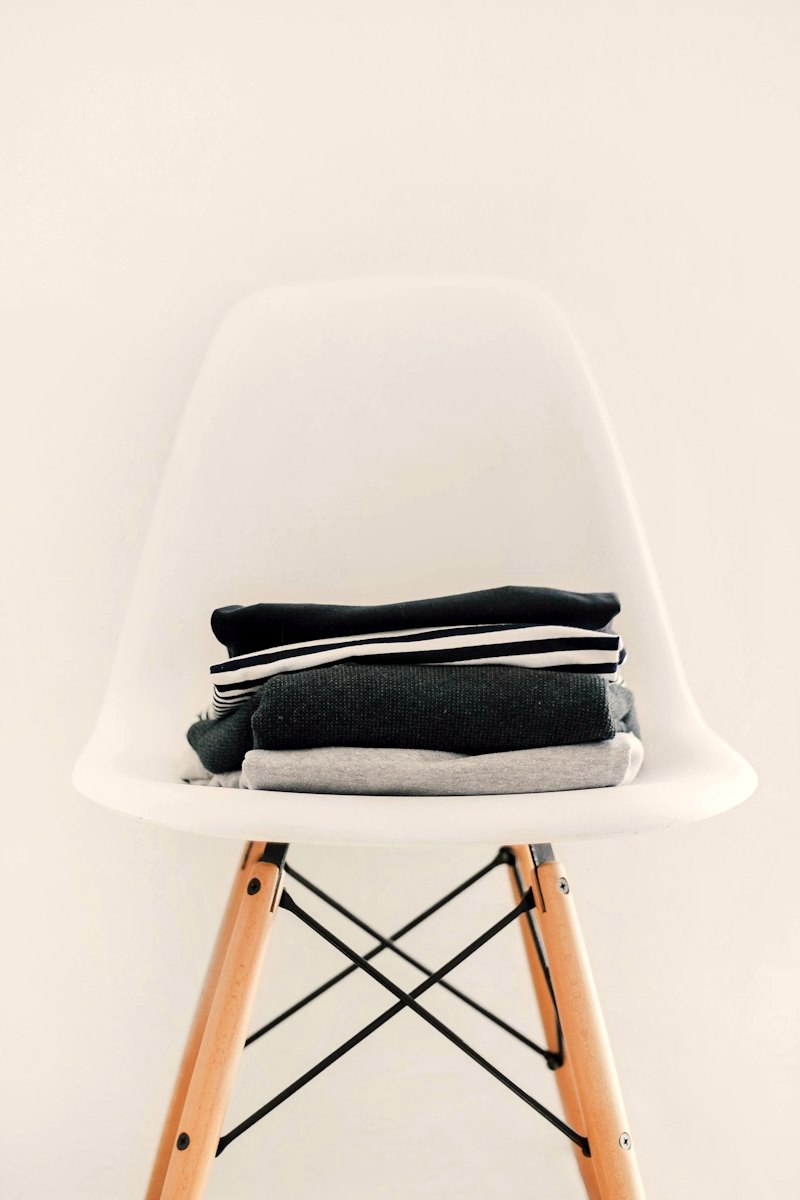
The wardrobe half of this aesthetic, folded: plain tees and unmarked knits, kept spotless. Maintenance is the whole garment argument here. A note on photography, printed because this page believes in saying so: our photo bank holds no product photography for the grooming categories this page grades, so no ranked product is pictured anywhere on it rather than borrow one. The frames are garments and rooms, captioned as such.
Checked and updated October 2026
The short version: clean boy is decode No. 4 on the Aesthetic Decoder hub, ruled survives as a routine, fails as a shopping list, and this page is that split ruling at full length. The routine half is a published method: four steps in the morning and four at night, with roughly ninety per cent of the benefit in two of them. The shopping-list half is already graded, product by product, on this site's grooming Cards, and the Cards convict it on percentages unprinted, scent systems undosed and a sunscreen shortcut under the floor. And the twist underneath the whole decode: this is the one aesthetic whose entry piece is not a purchase but a subtraction, so it is the one whose cost column runs negative. The two load-bearing steps cost $23.94 at the prices the Cards print. The shelf version of the same work costs $123.99. The difference is the decode.
In this guide
The word, and the ruling it arrives with
The hub's definition, kept whole: grooming-led minimalism. The order of operations is the definition: skin first, hair tidy, fragrance disciplined to one bottle worn properly, and behind all of it the plainest garments on the hub page, the plain tee, the clean sneaker, the unmarked knit, kept spotless and well fitted. The palette barely exists, which is the point: the aesthetic is maintained, not assembled. The hub also prints what the term is not, in the same breath: it is not a ten-step routine, and it is not a bathroom shelf photographed as a personality. The costume version buys the shelf; the real version repeats the routine. Both halves of that definition matter. The first half is a method. The second half is the failure mode, named in advance.
The hub applied the same three questions it applies to every aesthetic. Can it be stated without using its own name? Yes, and more plainly than most: it is a short list of repeated actions and the plainest wardrobe on the page. Do the garments survive their own composition lines? The garments are barely the question here, and the page deals with them last for that reason; what has to survive inspection is the routine's paperwork, and the routine's paperwork is this site's grooming record, graded Card by Card. Does the record name an entry piece? It does, and the entry piece is the strangest on the hub: not a garment at all, but the routine's two load-bearing steps, a gentle cleanse and a morning SPF, before any garment is bought. The ruling, kept exactly: survives as a routine, fails as a shopping list. Of the seven terms on the hub, it is the cheapest to do honestly and the easiest to fake expensively. Everything below is the working behind those sentences.
The term also arrives with one prior appearance in the tree, and this page prints it because it is the best single sentence anyone here has written about the aesthetic. In the Korean ranking, on Matin Kim, the soft look's poster label at 76: "This is what the clean-boy aesthetic wears when it grows up." Read it carefully. The sentence is about a wardrobe label, relaxed cardigans and easy shirts in a palette like morning light, and it locates this aesthetic's grown form in clothes that are soft, plain and kept. The grooming is the engine; the wardrobe is what the engine is for. This spoke follows that order: routine first, shelf second, wardrobe last.
The routine: four steps, two load-bearing
The routine half of the ruling rests on one document: the skincare Decoder, Grooming Decoder No. 02 on this site, and its ruling is printed there in full. The routine is four steps in the morning and four at night, matched to skin type, and roughly ninety per cent of the benefit lives in two of them: cleansing without violence, and sunscreen every morning. The morning runs cleanse, an optional treatment, moisturise, protect, with the protection specified: SPF 30 or higher, every day, two finger-lengths of product for the face and neck. The night runs cleanse, one treatment on rotation, moisturise, and then the fourth step, which is stop: sleep is a skincare step, and the routine ends so the skin can start. Retinol nights and exfoliant nights never share a night. One new product at a time, so that when a face objects, the culprit has a name.
Why does a method like this survive the Decoder's test, when so much of what surrounds it does not? Because it has the three properties this desk grades everywhere else. It is statable: eight steps, printed in two tables, no name required. It is bounded: the Decoder's own ruling box reads "Buy three things: a gentle cleanser, a moisturiser for your type, and an SPF 30. Add one treatment only after a month of the core." And it is repeatable, which is the property the whole aesthetic turns on: the Decoder judges a routine at the one-month mark by whether it is still being done, not by the mirror, and its mistakes list is a list of ways the repetition breaks, the daily scrub, the beach-only sunscreen, the verdict delivered at day nine on a skin cycle that runs a month. A practice that can be stated, bounded and repeated can be graded. That is what surviving means on this hub, and the routine survives it.
The detail work obeys the same law, and the desk's other grooming Decoder is the proof. The brow Decoder, Grooming Decoder No. 01, with its seven face-shape spokes, rules that the correct brow is the brow that was already there, with the noise removed: strays tidied, length trimmed, the natural outline surviving all of it. Five minutes, in the skincare Decoder's phrase, for the routine above the eyes. Nothing is drawn on, nothing is reshaped into a different face. Even at the level of the smallest feature this aesthetic touches, the method is subtraction and upkeep, not acquisition. Keep that sentence in mind. It is the whole decode in miniature, and the cost section below is just it, priced.
The shelf: where the shopping list fails
The hub's failure mode for this term is a bathroom shelf photographed as a personality, and the reason it fails is not taste. It is paperwork. The grooming Cards on this site grade the shelf the aesthetic is sold as, category by category, on published records, and the convictions cluster into three counts. Each one is a Card's own finding, cited to its Card.
The first count is the percentage silence. On Verdict Card No. 65, every antiperspirant in the field prints its active percentage on a Drug Facts panel, 4 of 4, the winner printing aluminium chloride at 12.0 percent; no deodorant-only product in the field prints a percentage for anything, 0 of 4, because cosmetic law requires order, not quantity. The cleanser Card runs the same test on the treatment shelf and gets the same shape: on Verdict Card No. 67, the two drug-panel salicylic cleansers print their 2 percent, while the cosmetic treatment cleanser at 78 carries its headline acid 16th of 29 on its own list with no percentage published anywhere. A shopping list is bought on claims. A claim with no number in it cannot be compared, dosed or caught drifting, and the shelf version of this aesthetic is built out of exactly those claims.
The second count is the fragrance load. The hub's definition allows this aesthetic one bottle, worn properly. On Verdict Card No. 66, the count is printed in full: a scent system appears in 4 of 4 men's-shelf products in the field and in 0 of 4 unisex products, and no maker doses any of it. The scented version of clean is therefore rarely a decision. It is an accumulation, each product on the shelf adding its own undosed layer, against the skincare Decoder's discipline for sensitive skin, which is the strictest sentence in its tables: fragrance-free everything, one new product at a time. The unisex benchmark on that Card, a fragrance-free lotion at 82 and 56 cents an ounce, and the Card's winner, a fragrance-free ceramide cream at 88, are what the routine's own shelf looks like when it is graded: short, unscented, published.
The third count is the shortcut and the scrub. The sunscreen Card sends home the field's prestige shortcut at 45: on Verdict Card No. 68, an SPF 20 face moisturizer, priced at $9.70 an ounce in its standard size on the moisturizer Card, sits under the skincare Decoder's printed floor of SPF 30 while wearing the language of the step it replaces. The morning's load-bearing step, bought as a two-in-one, quietly stops being the step. And the cleanser Card's skip is the oldest product in this whole record: the apricot scrub, sent home at 46, the same product the skincare Decoder's FAQ names in its exfoliation ruling, that the classic apricot-style scrub is how a healthy face ends up raw. The shelf's failures are not new products failing in new ways. They are the Decoder's mistakes list, bottled and priced.
Underneath all three counts stands the format conviction, which is the Decoder's own and the shortest sentence in this section: the ten-step routine is a sales format, not a skin format. Ten steps is not a stricter version of four. It is a different object, a list of purchases wearing a routine's clothes, and it fails the three properties the routine passed. It cannot be stated without the shelf. It is not bounded, since its whole commercial logic is the next step. And it is not repeatable at the rate the mirror demands, which is why the Decoder's day-nine mistake exists. The hub's split ruling is, in the end, an accounting identity: the same aesthetic, kept as a practice, survives; sold as a list, it is convicted by the list's own paperwork.
The subtraction: a cost column that runs negative
Every decode on the hub ends in an entry piece, and every other entry piece is a purchase: a jean at 81, a rain jacket at 86, a brand at 92. This decode's entry piece is the two load-bearing steps, and steps are not bought the way garments are. They are adopted, and what adoption costs here can be printed exactly, because the Cards print the prices. Bought at the fragrance-free end of the records, the entry piece is the Vanicream Gentle Facial Cleanser at $9.95, 86 on the cleanser Card, twelve ingredients with no fragrance and no masking fragrance, and the Vanicream Facial Moisturizer SPF 30 at $13.99, 80 on the sunscreen Card. Total: $23.94. Bought at the Cards' winners instead, the CeraVe Hydrating Facial Cleanser at $15.99, 88, and the La Roche-Posay Anthelios Melt-In Milk at $28.49, 89, the same two steps cost $44.48. Either way, the door into this aesthetic costs less than the door into any other decode on the hub.
Now the other side of the ledger, priced from the same Cards and nothing else. The shelf version of the same three jobs, bought at the prestige end of the same fields, with the treatment step the ten-step format adds:
| The job | The routine, as ruled | The shelf, as sold |
|---|---|---|
| Cleanse | Vanicream Gentle Facial Cleanser, $9.95 (86, cleanser Card) | Fresh Soy Face Cleanser, $39.00 (68, cleanser Card) |
| Moisturise | CeraVe Moisturizing Cream, $19.99 (88, moisturizer Card) | La Roche-Posay Toleriane Double Repair, $24.99 (81, moisturizer Card) |
| Protect | Vanicream Facial Moisturizer SPF 30, $13.99 (80, sunscreen Card) | EltaMD UV Clear SPF 46, $45.00 (83, sunscreen Card) |
| The added treatment step | Nothing. One treatment joins after a month, only if it earns its place | The INKEY List Salicylic Acid Cleanser, $15.00 (82, cleanser Card) |
| Total | $43.93 for the full ruled routine; $23.94 for the two load-bearing steps alone | $123.99 |
Read the totals column as this hub reads every total. The shelf basket is not a straw man: every product in it is ranked, most of them well, and the two most expensive are fine products on honest records. What the basket prices is the format, not the products. The same face, cleaned, moisturised and protected to the same published standard, costs $123.99 assembled as a shopping list and $43.93 kept as a routine, and the two load-bearing steps that carry ninety per cent of the benefit cost $23.94. The difference is $80.06 against the full routine, and $100.05 against the entry piece alone. No other decode can print a sentence like that. Ametora's entry piece costs $385 at the cloth end. This one's entry piece hands money back, because what it consists of is steps removed: the second cleanser never bought, the shortcut never substituted, the shelf never assembled. The cost column runs negative, and it runs negative by exactly the amount the sales format was charging for the steps the skin never needed.
One more price belongs in this section, because the hub's definition includes it and honesty requires costing the whole aesthetic, not the cheap half. The one bottle: the Bleu de Chanel Eau de Parfum at $173 for 100ml, 85 on Verdict Card No. 22 and the one-bottle answer that Card names. It is the most expensive single item in this decode and it changes nothing in the arithmetic above, because it is bought once, decided once, and worn for years, which is precisely the difference between a bottle and a shelf. The aesthetic's fragrance rule is a cap, not a subscription. The shelf's fragrance, counted on the moisturizer Card, is neither: it is a scent system in every product, dosed by nobody, paid for in every ounce.
The wardrobe behind the routine
The garments come last on this page because the hub puts them last in the definition: behind the skin, behind the routine, the plainest clothes in the wardrobe, kept spotless and well fitted. The wardrobe is not graded as this aesthetic's own record, and this page invents none for it. What the record does grade is the register the wardrobe belongs to. The plain tee is the most graded garment on this site, and the hub's own illustration for this decode is one hanging against a concrete wall. The clean sneaker stands in the quiet luxury capsule's thirteen scored pieces. The unmarked knit is the soft register's base layer, graded across the knitwear Cards. And the grown form of the whole look, in the Korean ranking's sentence, is a soft label's relaxed cardigans and easy shirts in a palette like morning light, Matin Kim at 76, graded plainly on its fabric row like everything else here.
Two properties distinguish this wardrobe from every other decode's. The first is that its standard is a state, not a specification: spotless and well fitted are conditions a garment is kept in, not properties it is bought with, which is why the aesthetic can be faked in a photograph and only verified over time. The second is that the wardrobe is deliberately the weakest claim on the page. Remove the routine and the plainest wardrobe on the hub is just plain. Keep the routine and the same wardrobe reads as the aesthetic entire, because the maintenance is legible in a way a fibre split, for once, is not the half of it. The kit cap the hub adopts for every decode, the quiet luxury capsule's starter build at $1,375.38, bounds the wardrobe the same way it bounds the other six. But the honest door into this one is not in the kit at all. It is the $23.94 pair of steps in the section above, before any garment is bought, exactly as the hub rules.

The Decoder Rule
An aesthetic that cannot survive its garments' composition lines is a costume. Clean boy faces the inverted version of that test on the hub, because its garments are the plainest here and its real composition lines are printed on other products entirely: the panels, the lists, the percentages. Read those lines and the split ruling writes itself. The routine's lines are in order, four steps, two load-bearing, every winner fragrance-free and published. The shelf's lines are not: percentages unprinted, scent undosed, a floor quietly lowered to 20. Repeat the routine. Let the shelf come last, if it comes at all.
What this page does not claim
Five limits, printed in the open, in the hub's manner. First: no clean boy ranking exists on this site, and none is invented here. The grooming Cards grade products, the Decoders grade methods, the Korean ranking grades labels; this spoke decodes from those records and revises none of them. Second: the term appears on exactly three other pages, the hub, the Korean ranking and the Soft Boy spoke. Where this page and the hub could be read differently, the hub's sentence governs: survives as a routine, fails as a shopping list. Third: this page makes no medical claim. The skincare Decoder's discipline governs throughout: sunscreen's value is stated as that page states it, makers' claims on the Cards are graded as claims, percentages are read as published records, and nothing here diagnoses, treats or promises an outcome for any skin. Fourth: the cost table prices baskets, not outcomes. Every price in it is a Card's printed price at its last check, the products in both baskets are ranked products, and the difference the table prints is a difference in format, not a verdict on the dearer products, two of which outscore their routine-side counterparts' neighbours on their own Cards. Fifth: the photographs are bank frames, captioned for exactly what they show. The bank holds no product photography for the grooming categories graded here, a gap the Cards themselves admit, so no ranked product is pictured as itself on this page; the frames are the wardrobe class the text describes, and the captions say so.
FAQ
What is the clean boy aesthetic?
Grooming-led minimalism, in the Aesthetic Decoder hub's definition: skin first, hair tidy, fragrance disciplined to one bottle worn properly, and behind all of it the plainest garments in the wardrobe, the plain tee, the clean sneaker, the unmarked knit, kept spotless and well fitted. The hub rules it survives as a routine and fails as a shopping list, and this page is that split ruling at full length: the routine is a published method with a record behind it, and the shopping list is the same aesthetic sold as a shelf, graded product by product on this site's grooming Cards.
What are the two load-bearing steps?
A gentle cleanse and a morning SPF, named as the entry piece on the hub and as the core of the skincare Decoder's ruling: the routine is four steps in the morning and four at night, and roughly ninety per cent of the benefit lives in those two, cleansing without violence and sunscreen every morning, at SPF 30 or higher. They are also the cheapest door into any aesthetic on the hub. Bought at the fragrance-free end of our cleanser and sunscreen Cards, the pair costs $23.94: the Vanicream Gentle Facial Cleanser at $9.95, 86 on its Card, and the Vanicream Facial Moisturizer SPF 30 at $13.99, 80 on its Card.
Why does the shopping list version fail?
Because the shelf is where the records thin out, and our grooming Cards print the thinning. On the deodorant Card, every antiperspirant prints its active percentage, 4 of 4, and no deodorant-only product prints a percentage for anything, 0 of 4. On the moisturizer Card, a scent system appears in 4 of 4 men's-shelf products and 0 of 4 unisex ones, dosed by nobody. On the cleanser Card, the treatment acid in one ranked product sits 16th of 29 on its own list with no percentage published anywhere. And the skincare Decoder names the format itself: the ten-step routine is a sales format, not a skin format. A routine can be repeated and graded. A shelf can only be bought.
How much does the clean boy routine cost?
Less than the version it replaces, which is this aesthetic's distinction on the hub. The full ruled routine, the skincare Decoder's three buys, costs $43.93 at the prices our Cards print: the Vanicream cleanser at $9.95, the Vanicream SPF 30 at $13.99 and the CeraVe Moisturizing Cream at $19.99, 88 on its Card. The shelf version of the same three jobs, bought at the prestige end of the same Cards with the treatment step the ten-step format adds, totals $123.99. The difference, $80.06 against the full routine and $100.05 against the two load-bearing steps alone, is money the aesthetic hands back. Every other decode on the hub has an entry piece with a price. This one's entry piece is a subtraction.
What is the difference between clean boy and soft boy?
The centre of gravity. Soft boy is garment-led: softness as construction in the clothes themselves, a fibre split, a gauge and a drape, with grooming counted as part of the outfit. Clean boy is grooming-led: the claim lives in a routine repeated daily, skin first, and the garments behind it are the plainest in the wardrobe, kept spotless rather than constructed to a standard. The two share a palette and a dislike of noise, and the same wardrobe can serve both, which is why the Korean ranking can print that the soft look's poster label is what the clean-boy aesthetic wears when it grows up. They differ in where the evidence sits. Soft boy's evidence is in the cloth, checkable before purchase. Clean boy's evidence is in the repetition, checkable only over time, which is why its shopping-list version is the easiest fake on the hub.
Is fragrance part of the clean boy aesthetic?
One bottle, worn properly, in the hub's definition, and the record grades exactly one bottle for the job: the Bleu de Chanel Eau de Parfum at 85 on our fragrance Card, $173 for 100ml, the one-bottle answer that Card names. The discipline is the point. The moisturizer Card counts a scent system in every men's-shelf product it graded and in none of the unisex ones, which means the scented version of this aesthetic is usually not a bottle chosen on purpose but a shelf of products each adding their own, undosed. One bottle, decided. That is the whole fragrance rule of this decode.
Next
The hub this spoke hangs from is the Aesthetic Decoder, where the other six decodes stand and the rule is printed once for all of them. The records this page rules from: the skincare Decoder, the brow Decoder, the cleanser ranking, the sunscreen ranking, the moisturizer ranking, the deodorant ranking, the fragrance ranking and the Korean ranking, where the term was first printed on this site. The sibling spokes, built the same way for the decodes beside this one on the hub, are Old Money, Decoded, Soft Boy, Decoded, Scandinavian Minimalism, Decoded and Ametora, Decoded. The scoring basis for every number quoted here is the Methodology page. Repeat the routine, then decide what clean means: the order of operations this register runs on, and the only one this desk trusts.