

The parent species, captioned as exactly that: the bank holds no shearling frame in any cut, cropped or long, and this page does not dress another coat as one. The hero is How to Wear No. 30's own frame, the leather jacket the shearling descends from, carried here under the cross-page sharing precedent logged in our credits; the care section prints the gap entire and the harvest list it heads.
Checked and updated October 2026
The ruling, up front: a shearling is the warmest civilised jacket in the wardrobe and the least formal thing that costs this much, and wearing it well is the management of those two facts and one more: its bulk is not a flaw to be tailored away but the garment itself, a whole sheepskin worn wool-side in, so the silhouette is the insulation and the insulation is the silhouette. It stands outside the twelve types the jackets index files, and this brief places it, as its own ruling, at warmth in the puffer’s class and formality down in the work family’s rung, the widest spread between the index’s two ladders any jacket here carries. Inside that placement this brief rules the material against its copies, prices it as skins rather than as fashion, runs the fit test over the knit layer the leather jacket’s law would forbid, separates the cropped and long cuts, prints the dry-cold licence the flesh side carries, and keeps the garment in its company: denim, cords, knits and boots, and never, at any price, tailoring. On scores: no jacket is scored here. The one number quoted is a lining’s, from the slippers Card, cited as what it is.
This brief: the decisive rule · the material rulings · the fit law · the formality ceiling · the colour rulings · the looks · the mistakes · care and our photography
The decisive rule: the bulk is the garment
Every brief in this family has a rule that decides its garment, and the shearling’s rule is a refusal to apologise. The bulk is the garment’s fact, not its flaw. A shearling jacket is a sheepskin, or several, worn with the wool left on and turned inward: the hide is the shell, the fleece is the lining, and they are one piece of material, grown together, with nothing sewn between them. Every other warm jacket in the wardrobe builds its warmth in layers, a face cloth, a fill, a lining, baffles or quilting to hold the arrangement together. The shearling skips the arrangement. Its warmth is a sheep’s own system, proofed over evolutionary time against exactly the weather the wearer is standing in, and its silhouette, broad at the shoulder, deep through the body, soft at every edge, is simply what that system looks like when a man puts it on. A shearling that has been tailored slim has not been improved. It has been thinned, in effect if not in fact, and the buyer who wants a slim winter jacket has honest options elsewhere in this family, briefed at No. 30 and No. 20. The shearling is bought as it stands or not bought.
The placement follows from the material, and it is this brief’s own ruling, printed as new, because the index does not make it. The jackets index files twelve types of jacket and scores each for formality and warmth, and the shearling is not among the twelve. Set it on the index’s two ladders by its record and the spread is the widest in the wardrobe. On warmth it stands in the puffer’s class, at the ladder’s top: the index gives the puffer warmth 5 on trapped air, and the shearling matches the figure by density, a fleece that cannot shift, settle or blow out at a seam, worn over the whole body the skin covers. On formality it stands down in the work family’s rung, at 2 on the ladder No. 30 prints, beside the bomber and the chore coat and below the leather jacket’s 3: a garment with no clean line anywhere on it, whose edges are wool, whose fastenings are built for gloved hands, and whose surface announces the farm as plainly as the puffer announces the laboratory. No other jacket in this family is simultaneously the warmest thing its owner owns and the least formal thing at its price. The overcoat inverts it, formality 5 and warmth 4, dressed warmth. The shearling is warmth with no dressing on it at all, and every ruling in this brief is that spread, worked out in cloth, fit and company.
One boundary belongs to the rule itself, because the garment’s reputation argues the other way and the tree corrects it. The shearling is photographed, in the culture, as a luxury object, and its prices agree. Neither fact moves its register. Price is not formality on any ladder this site prints: the index prices the puffer at the formality floor beside garments a tenth of a technical shell’s cost, because formality is a property of cloth and silhouette, and the shearling’s silhouette is a working one, cut for men who flew open cockpits and worked winter ranches and needed the warmth more than the line. The man who buys it as a luxury signal buys the wardrobe’s most honest garment for its least honest reason, and the mistakes section has a section for what he ends up wearing. Bought as what it is, the deepest winter instrument in the civilised wardrobe, worn in its rows and rested in the wet, it is the easiest expensive jacket in this family to wear well, because it asks for nothing but agreement with its own nature.
The material rulings: one skin, and the copies priced as materials
Real shearling is a single material, and the singularity is the product. The word names a sheepskin tanned with its wool left on, and a jacket of it is a small herd: several skins, graded and matched by hand for colour, for the wool’s staple length and for the hide’s weight, sewn flesh side out. That matching is where the money goes, before a zip or a button is bought. The skins must read as one garment though they grew on different animals, the wool must lie at one depth across the chest and the back, and the panels a maker cannot match are the panels he cannot use. A cheap shearling is therefore not a mystery and not a bargain waiting to be explained: it is fewer, thinner or worse-matched skins, or lambskin so light the garment is a fleece with a rumour of hide behind it, and the difference is readable in the shop, in the weight in the hand and the evenness of the wool at the seams. Priced as a material, the real article’s figure is an arithmetic of skins, and this brief prints no maker’s price because it grades none: it prints the test, which is that the jacket should feel like what it is, several animals’ worth of winter, and a shearling that feels like a lined jacket is telling its buyer which of the two it is.
The material’s second property is the one its copies cannot reproduce, and the site’s one scored shearling record states it in a smaller garment. Wool grown into a hide breathes as it warms. The fleece wicks moisture off the body and through the skin, which is why a shearling is comfortable across a wider band of temperatures than its warmth figure suggests, worn from the first hard frost through the deep weeks without the clamminess a synthetic shell cooks up by ten in the morning. Verdict Card No. 28 prints the economics for the lining of a slipper: genuine shearling and wool felt are the two honest warmths of that category, everything else is a countdown, and its winner, the L.L.Bean Wicked Good Moccasins at 88, is the field’s one genuine shearling, a skin with the wool grown in it. The jacket scales the sentence without changing it. A real shearling bought once is a decade garment on the leather family’s terms, its wool still springing in year ten; the house behind that slipper record, L.L.Bean, stands at 87 on this site’s brand record, audited, cited here as the material’s provenance and nothing more.
The faux records are graded as materials, and as materials they fail on time rather than on touch. The article sold as faux shearling, vegan shearling or sherpa across the fashion market is a knitted or woven polyester pile fixed to a backing, synthetic cloth or a split of real hide with none of the wool’s structure left in it. In the shop, on the rail, it is genuinely close: the pile is deep, the hand is soft, the silhouette is borrowed entire. The failure is calendrical. A pile is a forest of cut fibres standing on end, and it mats where the garment is worked, under the arms, across the back where it meets every chair, at the cuff and the collar edge, and matted pile does not recover, because the fibres are broken rather than displaced. It insulates by loft alone and breathes hardly at all, so its warmth arrives with the synthetic shell’s clamminess the real skin avoids, and it carries none of the flesh side’s wind resistance, the hide being the other half of the system the copy leaves out. Card No. 28 grades the category’s famous name on its current published specification and files the lining as a copy of shearling, and the copy’s sentence there is this brief’s sentence here: a copy is a legitimate purchase at a copy’s price, worn as fashion for its season. At a real shearling’s money it is the most expensive blanket in the wardrobe, and the mistakes section names the buying of it as one.
The flesh side carries the weather law, and the law makes the garment a dry-cold one. A shearling’s outside is its hide, finished most often as a suede, sometimes glazed to a nappa, and it inherits the suede record of this family whole. How to Wear No. 15 prints it for the suede boot and No. 58 carries it to the sneaker: protected suede survives drizzle; nothing suede survives a downpour. At a jacket’s acreage the terms are stricter, not looser. Rain does not bead on a skin; it enters it, and the skin dries stiff and lighter where it soaked, and the salted meltwater of a city crossing leaves the grey tide line across a hem or a cuff that no brush fully retires, the same debt No. 58’s care section prices for a shoe, charged here against a garment that costs twenty shoes. The wool side’s weather is the opposite story and it is the garment’s glory: falling snow lands in the fleece and shakes out of it, the pelt answering the weather it grew for, and a shearling in a dry snowfall, collar up, is the least defended-looking and most defended man on the street. The licence is therefore drawn by the water’s state, as the winter briefs draw all their lines: snow in the air, the shearling; water on the ground and in the sky, the puffer of No. 27 and the waxed jacket of No. 28, whose cloths were built for the wet the skin refuses. Shearling is a dry-cold garment. Its calendar is the bright frozen middle of winter, and it is longer than the wet weeks on either side of it in most of the country the magazine is read in.
The fit law: the layer goes inside the size
The leather jacket’s fit law is the family’s most quoted sentence, and the shearling’s law begins by refusing it. No. 30 buys the hide close, a size tight in feeling, because leather relaxes where it is worked, across the chest, the shoulders and the elbows, and moulds itself to the body by the end of the first season; bought comfortable, a leather jacket is a size too big for a decade. A shearling does not mould. Its wool compresses where it is pressed, under a seatbelt, at the elbow’s fold, and stays compressed; its skin has some give and no memory worth the name. The garment a man tries on is, allowing for that settling of the fleece in its first weeks, the garment he owns in year five. So the shearling is not bought against the body. It is bought against the outfit, and the test is run standing in the shop with the layer on: zip or button it over a mid-gauge knit, the 12 to 20 gauges of the knit briefs’ bands, and the front must close without strain, the shoulders must sit on the bone with the knit beneath them, and the wearer must be able to raise both arms to a steering wheel or a shelf without the hem leaving his belt by more than the wool’s own depth. A jacket that passes over a t-shirt and fails over the knit has failed the only test that matters, because the knit is not an accessary to the shearling’s system. In the layering of How to Wear No. 57, base moves water and mid holds still air; the shearling is a shell that arrives with its mid layer grown into it, and the sweater beneath is the adjustable half of the insulation, the half that comes off indoors. Sized to the t-shirt, the system has no adjustment left by January.
The two cuts divide the fit law by length, and each has its own failure. The cropped cut, waist to hip, built on the trucker and flight patterns the wardrobe already owns, is the register’s working form. Its fit questions are the leather family’s, one register down: the shoulder on the bone, because a dropped shoulder in a skin does not drape, it sags, permanently, in a fleece that makes the sag visible at twenty paces; the body close enough that the wool reads as the wearer’s depth rather than his replacement; and the hem landing where the pattern intends, at the belt or just under it, because a cropped shearling that runs long has fallen between the two cuts and inherited neither’s argument. The long cut, mid-thigh to the knee, built on the coat patterns, inverts the questions. Its body must still close over the knit, but its ruling dimension is movement: a coat of skins that binds at the stride is a robe, and the long shearling is tried walking, sitting, and with its belt or buttons done against the wind it was bought for. Its bulk is worn over the whole leg’s swing, and its presence is the point, a garment that enters the room a half-second before its owner. The reader who has not owned the cropped cut has no calibration for that presence, which is why this brief sequences the two: the crop first, the coat when the winters and the wardrobe both ask for it, and never the coat as a first experiment in the material.
Two smaller laws close the section, and both are the wool’s. The sleeve ends at the wrist with the fleece’s turnback showing, a cuff of wool worn open at the hand; a sleeve that swallows the hand has bought its warmth at the price of the wearer’s use of his fingers, and the shearling’s own answer, the turned-back cuff, is the garment’s signature worn correctly. And the collar is a working part, not a decoration: turned up, it closes the neck the scarf closes on other coats, the fleece standing where the wind arrives, and a shearling whose collar will not stand has been cut as a picture of the garment rather than the garment. Try both in the shop. The shop is where this family runs all its tests, because the receipts for outerwear are written in seasons, and the shearling’s season is the longest in the wardrobe.
The formality ceiling: the work rung, and the company it keeps
The placement printed in the rule section is worked here into pairings, because a ceiling is only a number until it decides an outfit. At the work rung, formality 2 on the family’s ladder, the shearling’s company is the wardrobe that works: denim, cords, knits, flannel, boots. Denim first, on How to Wear No. 05’s laws, dark and straight, the washes kept apart where two denim surfaces meet, though the shearling’s surface is wool and hide and asks no distance of the jean at all, which is part of its ease: it is the one heavy jacket in the family that never argues with denim, because it was never in denim’s register to begin with. Cords beside it, on No. 24’s record, their ribs and the fleece’s depth in the same tactile register, the outfit read by hand as much as by eye. Under the jacket, the knits of the family’s bands, mid and heavy gauge, the crew of No. 09 and the chunky sweater of No. 39, and flannel and denim shirts on the milder days at the season’s edges. At the ground, boots, on No. 56’s allocation and under its hem law, the hem and the boot agreeing at the meeting No. 56 prints: the suede Chelsea of No. 15 on the dry days the shearling itself licenses, the lugged boot when the ground turns, the clean leather boot between them for the town rows. Every element of that outfit is doing the same job the jacket is doing, and the outfit reads as one decision.
The ceiling is the ceiling, and above it the garment does not climb, at any price and in any cut. Nothing tailored goes under a shearling and nothing tailored goes over one, and the refusal is the overcoat’s compliment: the tailored rows have an instrument, the coat at formality 5 that was built with a suit’s room inside it and a shoulder that completes a jacket’s line, briefed at No. 20, and the shearling’s bulk is precisely the overcoat’s absence. A pelt over a blazer doubles the soft mass at the shoulder, erases the tailoring’s waist, and asks a knitted collar’s descendant to do a lapel’s work; the tie, refused under leather at No. 30 as tailoring’s flag flown in the wrong room, is refused here with less argument, because the rooms are further apart. The wool trouser is the boundary garment, as it is throughout this family: refused under the shearling in its tailored form, and answered in the garment’s own register by the cord and the heavy chino, which give the outfit the trouser’s coverage without the trouser’s claim. What the shearling keeps, it keeps entire: the whole casual wardrobe at its winter weight, the commute in its dry form, the weekend, the country, the cold city day that asks for warmth and company rather than ceremony. A man whose January is mostly ceremony owns the overcoat and visits the shearling. A man whose January is mostly weather owns the shearling and is dressed, in his rows, as completely as the ceremony man is in his.
The costume line stands inside this section because it is a formality failure before it is a taste one. The shearling arrives in the culture carrying two famous silhouettes, the aviator’s, fleece collar up over a flight suit’s descendant, and the rancher’s, long coat over work clothes, and a third, the seventies’ tan and cream register, that the fashion market revives on its own cycle. Worn as clothing, in the pairings above, the jacket cites none of them: it is a warm coat over denim, and the citations dissolve. Worn as a reference, with the outfit arranged under it to complete the picture, the aviator’s sunglasses in January, the rancher’s hat in the city, the retro palette matched piece to piece, it crosses the line this family draws for the leather rider in No. 30: a garment read as a reference cannot also be read as an outfit. The defence is the plainness the register already owns. One colour, no contrast patches or branding spending the surface, the company kept to the working wardrobe, and the collar used rather than displayed. The shearling is conspicuous enough as a material. It needs no help from its wardrobe, and the man inside it is best served by being the least quotable thing in it.
The colour rulings: the pelt’s own colour, or the dyed register entire
The shearling’s palette is the shortest in this family, because the material admits two honest registers and a crowd of dyed novelties that spend it. The natural is the garment’s own colour: wool in the creams and honeys it grew in, against a flesh side in tan and light brown, the two tones one animal produced, with the variation between skins left visible at the seams where the matching was done. That variation is not a defect of the natural register. It is the material’s signature, the proof at conversational distance that the jacket is skins and not a print of skins, and a natural shearling wears it the way full-grain leather wears its creases in No. 30’s record, as the receipt of the real article. The natural pairs without negotiation with everything the formality section seats: indigo and black denim, brown and olive cords, grey and cream knits, the whole winter palette of the working wardrobe, because the palette was built around the same animals and fields the jacket came from.
Black is the dyed register, bought deliberately or not at all. A black shearling is dyed in both its halves, the wool and the skin, and the dye does what dye does to this material: it levels it. The wool’s depth, the hundred small variations of a natural fleece, goes to one uniform black, and the flesh side loses the grain’s read and goes flat as suede. What black buys with that loss is a register the natural cannot enter: the monochrome wardrobe entire, black denim run head to ground on No. 05’s monochrome logic, black boots, charcoal knits, the city winter read as one column of dark. It is genuinely strong there, and it hides the salt and the city’s grime the natural shows by February. So the ruling is the wardrobe’s, in the form No. 30 gives the leather’s version of it: the reader whose boots, belt and denim already run black buys the black shearling as his system’s coat; every other reader buys the natural first, and the black, if it comes, comes second and knowingly. The dyed fashion colours, the reds, greens and printed flesh sides of the market’s novelty rows, are refused on the material’s terms rather than on taste: a garment bought for a decade, priced in skins, does not get its surface spent on a season’s palette, and the natural’s variation will still be reading as honesty when the novelty’s colour is reading as a date.
The looks: four assemblies the brief licenses
| Setting | The assembly | The jacket | The judgment |
|---|---|---|---|
| The dry cold commute | Dark straight denim hemmed to No. 56’s agreement, a mid-gauge crew under the jacket, a merino crew at the ankle | Cropped natural shearling, collar up, over the knit it was sized on | The garment’s home fixture: the working wardrobe at full winter weight, the fleece answering the forecast, and the whole column reading as one decision from collar to boot |
| The weekend country rows | Brown cords, a chunky fisherman sweater per No. 39, the lugged boot when the ground is frozen rough | Cropped or long natural shearling, worn open over the knit on the milder hours | The register at its source: tactile cloth against tactile cloth, the outfit the material was cut from, with the lug’s grip bought at its printed price in register and spent gladly here |
| The monochrome city column | Black denim on No. 05’s monochrome logic, a charcoal knit, black leather boots | Black dyed shearling, cropped, no contrast anywhere on it | The dyed register’s one licensed assembly, run entire: the dye’s flatness answered by the column’s, the jacket read as the system’s coat rather than its exception |
| The deepest week | Heavy cords or dark trousers, the heaviest knit the wardrobe owns, scarf at the neck the collar leaves, lugged boots | The long shearling coat, closed against the wind, over the full layer system of No. 57 | The long cut’s licensed hour: warmth in the puffer’s class worn as a coat into a room, the one assembly where the garment’s presence is the outfit’s point and is signed as such |
The ruling
Wear the shearling as what it is: a skin, bought by the skin, in the colour the pelt grew or the black your wardrobe already runs. Size it over the knit it will close against, in the shop, arms raised; crop it for the working wardrobe and lengthen it only when the winters ask twice. Keep it in its company, denim, cords, heavy knits and boots, and out of the tailored rows the overcoat owns, and keep it out of the rain its flesh side refuses, rested to the puffer and the waxed jacket on the wet weeks. Plain, unbranded, unquoted: the material is conspicuous enough. Bought that way, once, a shearling is the winter garment the rest of the wardrobe is arranged around for a decade, the warmest civilised jacket a man can own and the least formal thing at its price, and both halves of that sentence are the compliment.
Where shearling goes wrong
Wearing it in the rain. The licence is printed in the materials section and the failure is the commonest in the category, because the jacket feels like weather armour and its owner believes the feeling. The skin drinks the rain, dries stiff and pale where it soaked, and collects the salt line at the hem; three wet wearings spend more of the garment than three winters of dry ones. The puffer and the waxed jacket exist for those days. A shearling in a downpour is not ruggedness. It is a care failure with a four-figure receipt.
Sizing it like a leather jacket. The leather law, bought close and moulded by the season, applied to a material that does not mould: the jacket that closed over the shop’s t-shirt will not close over January’s knit, and the owner spends the winter wearing it open, which is the one way a shearling cannot do its job, the system’s front unsealed at its centre. The fit test is run over the layer, in the shop, or it is not run.
The costume read. The aviator’s picture or the rancher’s, completed piece by piece under the jacket until the outfit is a reference and the man is its caption. The shearling’s silhouettes are famous enough without assistance. Worn plain, over the working wardrobe, it is a coat. Arranged, it is a costume, and costumes are the most expensive garments in any wardrobe because they can only be worn as jokes after the first wearing.
Buying the pile at the pelt’s price. The faux jacket at real money, bought on the rail’s resemblance and dead by the second winter, its pile matted at the back and elbows, its warmth gone with its loft. The copy has an honest price and this brief prints it: a fashion season. Charged a decade garment’s figure for it, it is not a shearling that failed. It is a blanket that was invoiced as one.
Taking it to the tailored rows. The pelt over the blazer, the long coat over the suit, the bulk erasing the tailoring it was meant to warm. The meeting of warmth and tailoring is the overcoat’s whole profession, and the shearling sent to do it does both garments a disservice in one outfit: the suit reads smothered, the jacket reads lost, and the photograph outlives them both.
Storing it like a coat. The plastic bag, the compressed rail, the warm cupboard: a skin is stored breathing, on a broad hanger, in a cloth bag, away from heat and from the moths that read wool as a larder. A shearling folded or sealed for a summer comes out creased in the hide and thin in the fleece, and the decade the buyer paid for is spent in a cupboard rather than on his back.
Care, honestly, and our photography
The shearling’s care is a skin’s regime, closer to the leather family’s than to any coat’s. Brush the wool with the fleece’s own brush when it flattens, and shake the garment rather than beating it. Wipe the flesh side’s salt off the same evening with a nearly dry cloth, before it dries into the finish, the salt discipline No. 58 prices for a shoe charged at a jacket’s acreage. A soaked shearling, and the licence says there should not be one, dries slowly and stuffed with paper, away from radiators and direct heat, which crack a wet skin faster than the rain hurt it. Rest it a day between hard wearings, as the leather briefs rest their shoes and jackets, two garments alternating outlasting three worn daily. Feed the flesh side only on a specialist’s word and clean the whole garment only at a cleaner who names shearling in his own window; the category’s bad endings are mostly written by generalists with steam. Store it as the mistakes section prints: broad hanger, cloth bag, cool air, cedar or the moth’s other enemies, and the decade the skins were bought for is a realistic term rather than a sales line, the wool still springing when the puffer beside it has been replaced twice.
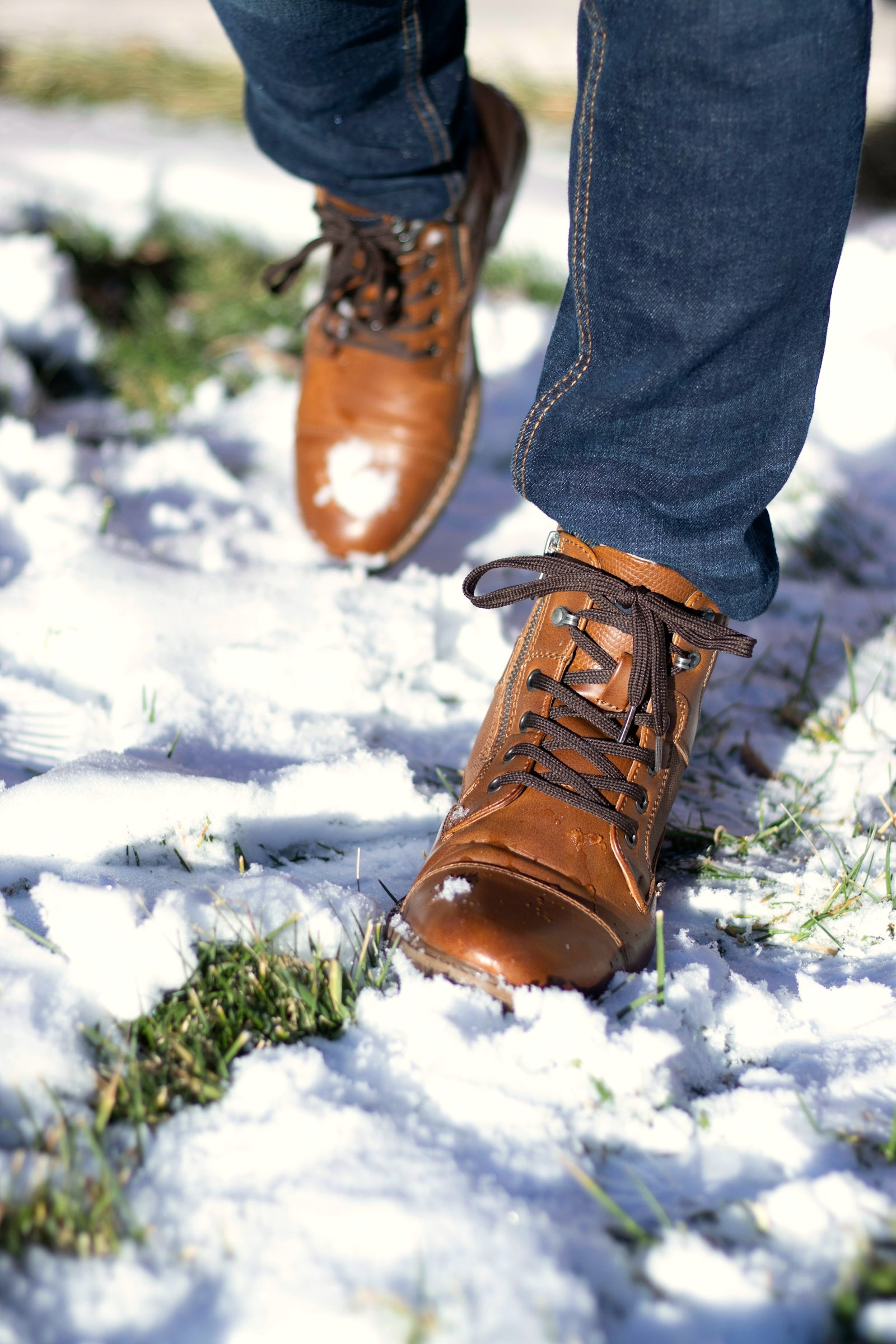
The photography, stated plainly, because this page’s subject is entirely absent from our bank. The bank holds no shearling frame at all: no cropped jacket, no long coat, no fleece at macro range, no skin panel showing the wool grown in, in any register. The hero is therefore the garment’s parent species, the leather jacket of No. 30, carried under the cross-page sharing our credits log and captioned as the substitute it is, and the one figure below is the footwear this brief pairs, in the weather the garment owns. No frame of another coat has been captioned as a shearling, and none will be: the absence is printed rather than dressed. The harvest list this page is waiting for, in order: first, a real shearling worn at street level in dry cold, fleece collar up, the garment’s whole argument in one frame; second, the wool at macro range, a cuff’s turnback showing fleece and flesh side together, the material ruling photographed; third, the long coat over a knit column in falling snow, the deepest week’s assembly. Until those frames land, the leather parent and the booted ground stand at either side of the subject, and the page says so.
Questions, answered
How warm is a shearling jacket, really?
It stands at the top of the wardrobe's warmth, in the class the jackets index reserves for the puffer, and it gets there by the opposite construction. A puffer warms with trapped air in baffles sewn around a fill; a shearling warms with a sheep's own system entire, a dense wool fleece still grown into the hide that carries it, so shell and insulation are one material with no stitching between them and no cold seams for the wind to work on. What the puffer keeps over it is weight and weather: down is lighter on the back and a shell face sheds rain a skin cannot. What the shearling keeps over the puffer is that it is a garment rather than equipment, the warmest civilised jacket a man can wear into a room. This brief places it, as its own ruling, at warmth in the puffer's class and formality in the work family's rung, the widest spread between the two ladders of any jacket the wardrobe holds.
Is faux shearling worth buying?
As a shearling, no, and the site's one scored shearling record prints the reason. Verdict Card No. 28, the slippers Card, grades genuine shearling as shearling and the copy as a copy, and the arithmetic there is the arithmetic here at a larger acreage: genuine shearling is one skin with the wool grown in it, which is why it breathes as it warms and why it is still warm in its second decade, while the faux article is a polyester pile on a synthetic or split backing, warm the first winter by loft alone, matted where it is sat on and leaned on, and on a countdown the genuine article does not run. A faux shearling-styled jacket bought cheaply as a fashion piece is a fashion purchase and is judged as one. Bought at anything approaching the real article's money, as a warm jacket for years, it is the material fraud this brief's mistakes section names: the pile spends like the pelt and performs like a blanket.
Can you wear a shearling jacket in rain or snow?
In falling snow on a cold day, yes; in rain, no, and the distinction is the garment's licence. The wool side was built by its first owner for weather: snow lands on the fleece and shakes off it, and a dry snowfall is the shearling's home ground. The flesh side is the limit. It is a suede-finished skin, and it takes the law this site prints for suede whole, in How to Wear No. 15 and again in No. 58: protected suede survives drizzle, and nothing suede survives a downpour. Rain soaks the skin rather than beading on it, stiffens it as it dries, and carries the road salt that leaves the tide line no brush retires. Shearling is a dry-cold garment: its rows are the bright frozen days, and the wet rows belong to the puffer and the waxed jacket, per Nos. 27 and 28.
How should a shearling jacket fit?
Over the layer it will actually be worn with, and the test is run in the shop, not at the mirror. The jacket must close, zipped or buttoned, over a mid-gauge knit without the front straining and without the wearer holding his breath to do it, because the shearling is the outer layer of the system How to Wear No. 57 builds and the knit is the layer beneath it in earnest cold. This is the opposite purchase from the leather jacket's: No. 30 buys the hide close because hide relaxes where it is worked and moulds to the body by the end of the first season, while a shearling's wool does not relax, it compresses where it is pressed and stays, and the skin over it has no moulding to give. A shearling bought close over a t-shirt is a jacket sized for October; by January, over the knit it was bought for, it is a size small with the receipt gone. Buy the layer inside the size, shoulders on the bone, sleeves to the wrist with the wool's turnback showing.
Cropped or long: which shearling cut should you buy?
The cropped cut for a first shearling, unless the winters are long. The cropped jacket, waist to hip length, cut on the trucker and flight patterns, is the register's working form: it pairs with denim and cords, sits over a knit without swallowing the leg, and reads as a jacket in the wardrobe's grammar. The long cut, mid-thigh and beyond, cut on the coat patterns, is the deeper instrument: more skin, more warmth, more presence, and a narrower licence, worn over knit columns and dark trousers in the coldest weeks and read everywhere as a statement before it is read as a coat. Both cuts obey the same ceiling, the work rung, and neither is a tailoring garment. The reader whose winter is a commute and a weekend buys the crop. The reader whose winter is a season buys the coat, second, after the crop has taught him the material's laws.
What do you wear with a shearling jacket?
The casual wardrobe at its winter weight. Under it, knits in the mid and heavy gauges of the knit briefs, the crew and the chunky sweater, a flannel or denim shirt on the milder days, never a shirt and tie. Below it, denim first, on How to Wear No. 05's laws, dark and straight; cords beside it, on No. 24's record, their ribs in the garment's own register; heavy chinos and fatigues in the work rows. At the ground, boots, on No. 56's allocation: the suede Chelsea on the dry days under the family's suede law, the lugged boot when the ground argues, the clean leather boot between them. The shearling's company is the wardrobe that works outdoors in spirit. It is the least formal thing that costs this much, and its outfits are honest when nothing in them pretends otherwise.
Can you wear a shearling jacket with a suit or tailoring?
No, and the refusal is structural rather than snobbish. Tailoring's rows belong to the overcoat, formality 5 on the jackets index, built with room in its cut for a suit beneath and a shoulder that completes one. The shearling stands at the opposite end of the ladder this brief places it on, the work rung, and its bulk is the reason in visible form: a pelt over a jacket doubles the silhouette's soft mass, erases the tailoring's line at the shoulder and the waist, and reads at twenty paces as two garments arguing about which room they are in. The meeting of warmth and tailoring is the overcoat's whole job, briefed at How to Wear No. 20. The shearling worn over a knit and denim is dressed. The same shearling over a suit is a costume, and the mistakes section prints the line it crosses.
Black or natural brown shearling?
Natural first, for almost every wardrobe, and the material argues it. A natural shearling shows the pelt as it grew: cream to honey wool against a tan flesh side, with the variation from skin to skin left visible across the panels, which is the garment's honesty worn on its surface, and it pairs with the denim, cord and knit palette the jacket lives in without a negotiation. Black shearling is dyed, skin and wool both, and the dye flattens what the natural keeps: the wool's depth goes uniform, the flesh side loses its grain's read, and the jacket joins the monochrome wardrobe entire, where it is genuinely strong, the black denim rows of How to Wear No. 05 run head to ground without a colour decision in them. So the rule is the wardrobe's, as it is for leather in No. 30: the reader who lives in black buys black, deliberately; every other reader buys the natural, and lets the skins disagree with each other in the open.
Next
The family this brief completes stands in the winter outerwear briefs: How to Wear No. 30, the leather jacket, the parent species, whose close fit law this page argues against by name and whose species ceilings are the shearling’s nearest grammar; How to Wear No. 27, the puffer jacket, the warmth class the shearling is placed in, which takes the wet weeks this page surrenders; How to Wear No. 20, the overcoat, the tailored rows and the formality ceiling, the garment that does the job this one refuses; and the jackets index, the twelve types and the two ladders this brief places its thirteenth garment against. The material’s scored record stands at Verdict Card No. 28, where genuine shearling is graded as itself and the copy as a copy, and the system the jacket closes is built at How to Wear No. 57, layering for winter, whose shell this page’s subject is. The full series lives in the How to Wear index, and how every score behind those pages is built stands on our methodology page.