
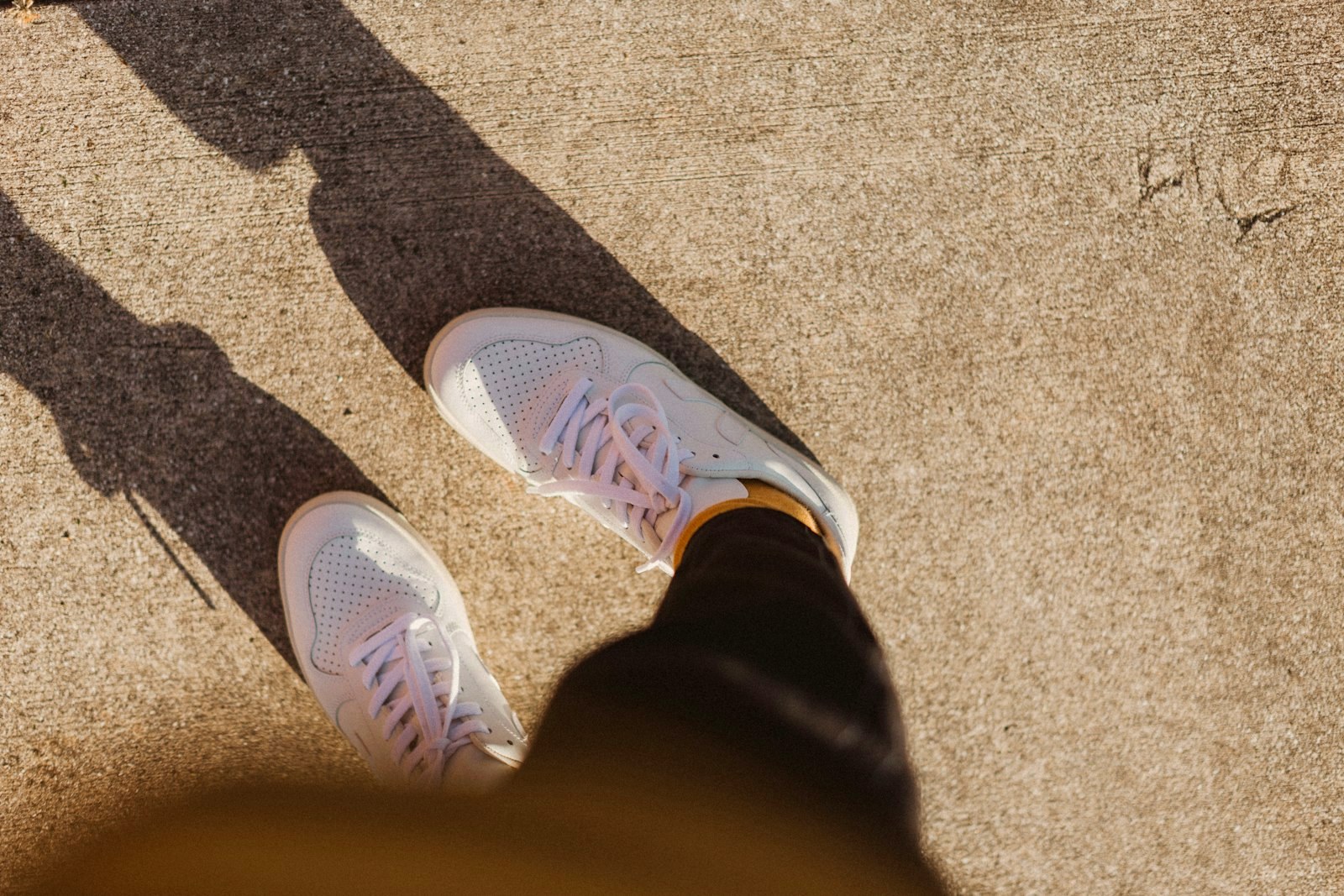
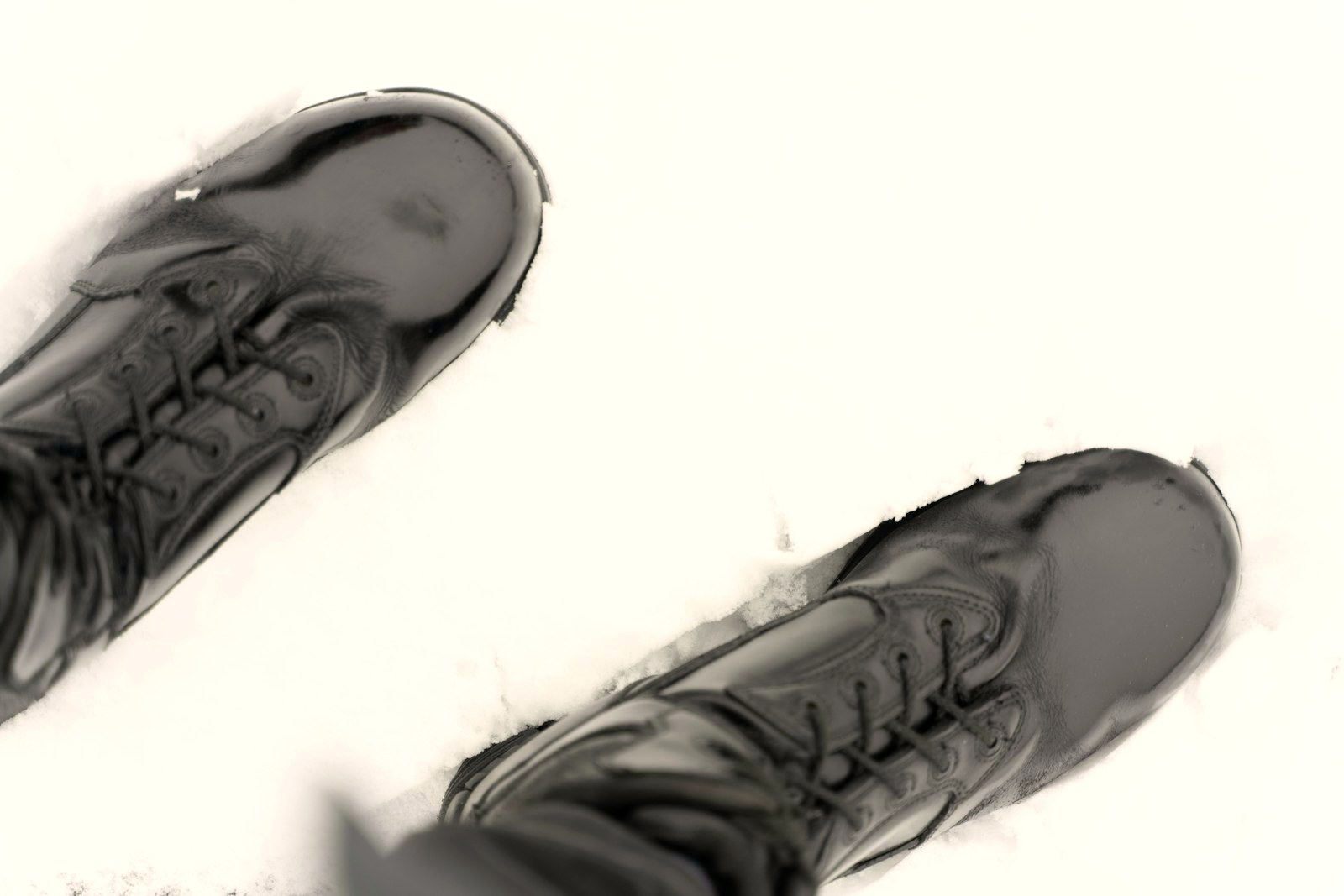
The instrument in its licensed weather, captioned as exactly that: the white sneaker on dry concrete, the frame that opens How to Wear No. 12, carried here under the cross-page sharing precedent logged in our credits. The bank holds no frame of a sneaker in snow or slush, and the absence is not disguised: winter's wet half, where this brief retires the shoe, is shown on this page only from the boot's side of the line.
Checked and updated October 2026
The ruling, up front: winter is a material question before it is a style question. The sneaker survives the season exactly where its upper and its sole agree with the ground: a leather upper on a treaded sole, on dry cold streets, is a winter shoe; a knit or mesh upper, a flat sole, or any sneaker at all in standing wet, is a summer shoe out of its season. Inside that rule this brief separates the uppers one by one, grades the sole’s printed claims as claims, states what the word waterproof can honestly mean on a shoe with an open ankle, darkens the palette to the winter wardrobe’s register, carries the boot brief’s hem law down to a shoe with no shaft, and prints the line the whole family already obeys: the wet half of winter belongs to the boot. On scores: this site publishes no footwear ranking and no sneaker is scored here. The one number quoted is a garment score from the Fall Edit, cited as what it is.
This brief: the decisive rule · the material rulings · the sole question · the weatherproofing register · colour and formality · the trouser agreements · the looks · the mistakes · care and our photography
The decisive rule: winter is decided by the upper
Every brief in this family has a rule that decides its garment, and the sneaker’s winter rule is a material: the upper decides whether the shoe has a winter at all. A sneaker is not one shoe. Under one name the wardrobe holds two opposite constructions, the closed leather shoe, stitched, lined, built on a sole the way shoes have always been built, and the open knit runner, a woven sock on a foam midsole, built to pass air. Summer does not distinguish them, because summer asks nothing of an upper but shape. Winter asks the one question that separates them: what does this material do with cold air and standing water? Leather answers as a barrier, imperfect, finishable, a wall. Knit and mesh answer as a window. Every ruling in this brief is downstream of that answer, and the season’s sneaker failures are almost never failures of taste. They are leather questions answered with knit, or dry-day shoes walked into wet ground, the rotation kept whole from July and the calendar left to do the arguing.
The boundary of the brief is the family’s, already drawn, and it is printed here once so the rulings inside it cannot be mistaken for the whole of winter. How to Wear No. 54 draws the cold-floor line for the loafer, and No. 56 prints the allocation whole: slush and standing meltwater, snow and the downpour belong to the boot, because the low cut admits water at the ankle and the thin sole has no storm welt. The sneaker stands lower than the loafer and is retired by the same line, earlier in the argument and with less ceremony: No. 12 retires it from wet streets outright. What remains, and it is a large remainder, is the dry half of the season: the cold bright weeks, the frozen pavement, the indoor-weighted days, most of a city winter’s actual calendar. This brief rules that half. The sneaker’s winter is real. It is conditional, and the conditions are materials, soles and hems, taken in that order.
One correction belongs to the rule itself, because the commission arrived with a premise the tree corrects, and the correction is printed rather than absorbed. The sneaker in winter is usually discussed as a styling problem, which outfit it completes, which trouser it takes. The tree’s record says the styling is the last of it. No. 12’s solvent rule governs what the sneaker does to an outfit, it only dissolves formality and never adds any, and that rule does not change with the temperature. What changes is whether the shoe is present to dissolve anything: a sneaker soaked at the second crossing, or skating on a flat sole, or worn over a bare ankle in a wind, has left the outfit’s argument and joined the weather’s. This brief therefore rules the shoe’s survival first and its styling second, and a reader who keeps the order will find the styling sections short, because a winter sneaker that is still a shoe by the time it reaches the trouser section has most of its decisions already made for it.
The material rulings: leather, suede, knit
Leather is the winter upper, and it is not close. A full-grain leather upper is the only common sneaker material that behaves like a shoe’s: it closes the foot against wind entire, it sheds the splash and the light shower off a finished surface, it takes a protector and a cream and gives both something to work on, and its construction, stitched to a sole rather than fused to a foam wedge, is the construction that survives a season of salt and flexing. This is why the site’s buy-once exhibit is what it is: the Koio Capri Triple White, the white leather sneaker the quiet-luxury capsule builds its rotation on, a garment scored at 84 in the Fall Edit, full-grain leather on a Margom sole, made the way a shoe is made, at $275. The score is a garment’s, cited as a garment’s, and the point of citing it here is not the number but the pattern: when this site buys one sneaker, it buys the leather one, and winter is the season that explains the preference. The corrected leather of the fashion sneaker, smooth, thin, heavily finished, holds the post at a lower standard: it reads as leather and behaves for a season like plastic, cracking at the flex points where full grain creases. The winter ruling prefers the real article and prints the distinction because the two are sold side by side at similar prices under the same word.
Suede is the dry cold’s luxury, with one enemy and one law. The law is the family’s, printed for the boot and carried here entire: protected suede survives drizzle; nothing suede survives a downpour. In dry cold suede is arguably the winter sneaker’s best-looking form, its nap in the season’s register, its colours, sand, snuff, taupe, charcoal, the palette the winter wardrobe already wears. The enemy is not the weather from above but the ground below: road salt, carried in meltwater, which spots the nap in a single crossing, stiffens it as the shoe dries and leaves the grey tide line that no brush fully retires. Suede’s winter is therefore a forecast discipline: worn on the days the streets are dry, protected before the first wearing and brushed after every one, and rested without argument when the melt is running. A man who loves suede sneakers owns a leather pair beside them. That is not a compromise of the suede position; it is the suede position, stated completely.
The knit upper has a limit, and the limit is the season. The engineered knit and the mesh runner are ventilation instruments, and their virtues are real: light, close, cool, the summer shoe entire. Winter converts each virtue at par. The open weave passes cold air at walking speed and faster, so the foot is dressed in a colder microclimate than the thermometer reports. The weave passes water faster still: a knit upper in slush is not a shoe getting wet but a shoe being filled, and the foam midsole beneath it holds the water against the foot for the rest of the day. Linings and membrane socks improve the figures without changing the species: a lined knit is a warmer window, still a window. The brief’s ruling is a rota ruling rather than a ban. The knit sneaker keeps the dry, indoor-weighted rows of winter, the travel day, the gym run, the office with a carpeted commute, worn as what it is. What it may not do is stand as the winter shoe, the rotation’s answer to the season, because at the material question it has no answer. The summer rotation kept whole is convicted in the mistakes section under its own name; its material count is settled here.
The sole question: tread, compound, and claims graded as claims
Below the upper, the winter question is grip, and it is here that the sneaker’s paperwork is at its most confident and its least checkable. The family’s printed arithmetic first, because it is settled: the lug is the only sole built for snow and slush, the ruling of No. 19 that the winter briefs carry whole, and it belongs to the boot. Slim rubber is the winter default under every low shoe this site styles, costing no formality where leather soles fail on wet stone before they fail as style, per the boot brief’s record. Between those two settled points sits the sneaker’s own sole population, and this brief grades it the way this site grades every printed performance claim: as a claim, with its paperwork read.
The paperwork, read plainly, is thin. Sneaker soles are sold on compound names and tread geometry: a rubber given a trade name, a lug pattern photographed from below, a depth sometimes printed in millimetres. A lug depth is a measurement of shape, and shape is not grip: it says how tall the tread stands, nothing about what the tread does on wet stone, ice film or the polished marble of a station floor, which are the surfaces winter actually presents. A compound name is a name: no sneaker maker prints a wet-grip coefficient, a test method or a comparative result behind one, so the name carries exactly the evidence a name always carries on this site, which is the claim itself and nothing behind it. Even the honest physical fact of the category, that rubber stiffens as the temperature falls and a summer compound hardens out of its working range in deep cold, is printed by almost no maker about his own sole. The desk’s ruling, new here and printed as new: on a sneaker, read every sole claim as geometry and vocabulary, and buy the geometry. Deep, open tread with room between the lugs clears slush and bites frozen ground better than a flat or finely siped sole, as a matter of shape a buyer can inspect with his own eyes in the shop. The flat cupsole of the court sneaker, the winter rotation’s most common sole, is a dry-court instrument: on wet stone it is the category’s skating rink, and its licensed winter rows are the dry ones the materials section already drew.
The lugged sneaker itself, the trail runner and the hiking-shoe hybrid, is priced by the family’s existing arithmetic rather than by enthusiasm. The Chelsea brief prices the lug at 2.5 on the formality scale and moves the lugged shoe out of the dress family into the work register, and the transfer to the sneaker is this brief’s ruling, printed as its own: a lug under a sneaker buys grip with register, and the exchange is real in both directions. Worn in the work rows, with denim, cords, fatigues and the weather coats, the lugged sneaker is a legitimate winter instrument, the closest the category comes to the boot’s ground. Worn under tailoring or with the minimal wardrobe, it spends the outfit’s quiet at the ground, where the eye arrives last and stays longest. What it never becomes is an all-weather pass: its ankle is open, its upper is usually the knit this brief has already limited, and the snow it grips its way through enters at the collar on the same walk. The sole question, answered whole: tread you can inspect, on the rows the tread’s register licenses, under an upper that has passed the material rule, and the snow itself left to the boot, whose sole the family’s ruling was written about.
The weatherproofing register: sprays, membranes, and the honest meaning of waterproof
Two technologies are sold against the winter wet, and they are different species of thing. The spray is a finish. It lays a repellent surface over the upper, and its honest yield is beading: drizzle and splash sit on the material instead of entering it, suede’s nap is defended against the spot damage that is its ruin, and a wiped shoe dries a clean shoe instead of a soaked one. Its limits are its nature: it coats a surface, so it seals no seam, closes no opening, and thins with every wet wearing until the schedule renews it, the same maintenance logic as the wax on a jacket in No. 28. Spray before the first winter wearing, renew after every hard wet day, and grade the product by what it is: the cheapest real protection a sneaker can be given, and a finish, never a construction.
The membrane is a construction. A waterproof-breathable lining built into the shoe is the genuine article of its kind: the upper itself becomes a barrier, rain and splash stay outside the material in earnest, and for the damp commute, the wet pavement that is not yet standing water, it is the strongest answer a low shoe can give. This brief credits it without reservation, and then prints the ruling that bounds it, new here and stated as the page’s own: a low shoe’s waterproofing ends at the waterline of its own height. The membrane defends the shoe’s walls. The shoe’s top is open by design, a collar at ankle height, and winter water is not courteous about arriving only through walls: it stands in crossings deeper than the shoe, it is thrown by the wearer’s own other foot, it runs down the trouser hem and the sock from above. A boot answers those routes with height, which is a measurement, printed in every boot’s shaft and absent from every sneaker’s specification because the sneaker does not have it. So the word waterproof, on a sneaker, has an honest meaning and a sold meaning. The honest meaning: this upper resists water, and on damp streets that is worth having. The sold meaning, that the foot inside stays dry in winter weather, is true of no low shoe ever built, and a reader who prices the word at its honest meaning will never be disappointed by the shoe that carries it.
The register’s practical order follows. For the dry-cold rotation, no weatherproofing is owed: the leather upper and the forecast are the system. For the damp rows, spray the leather and suede, and let the membrane version of a leather sneaker earn its premium if the commute is reliably wet. For standing wet, the register is empty, and its emptiness is the family’s oldest winter sentence: that is the boot’s shift, the Chelsea’s on the tailored rows per No. 15, the lugged boot’s on the ground rows per No. 56, and no product sold for a sneaker fills it. Weatherproofing, graded whole, is a set of answers to rain arriving politely. Winter’s impolite water is answered by height, and height is a different shoe.
Colour and formality: the winter palette and the lowered ceiling
The winter wardrobe darkens, and the shoe darkens with it or argues with it. Above the ankle the season wears charcoal, navy, black, brown and the deep end of every colour it owns, in heavier cloth with more surface and more consequence. A summer-bright sneaker under that column is not a pop of anything; it is a leftover, the one garment in the outfit still dressed for July. The winter palette for the sneaker is therefore the wardrobe’s own: black first, charcoal and dark grey beside it, dark brown in the cord and denim rows, and suede’s neutrals, sand, snuff and taupe, on the dry days their material licenses. Gum soles read as the work register they are and are priced as such in the rows below. White keeps a winter existence, and its terms are the condition terms No. 12 prints for it in every season, sharpened: the white leather sneaker on a dry bright day, kept clean, is the minimal wardrobe’s winter instrument entire, and the same shoe after one salted crossing carries its tide lines into every outfit until it is cleaned. White in winter is not a colour choice. It is a maintenance commitment, renewed daily, and a man who will not sign it should let the dark leathers carry the season.
Formality obeys No. 12’s solvent rule in winter as in summer, the sneaker dissolves one level and adds none, with one seasonal amendment, printed here as this brief’s ruling: the ceiling lowers, because the rows above the sneaker fill with shoes and boots. In summer the sneaker’s licensed rows reach surprisingly high, the casual tailoring rows among them, because the whole wardrobe is lightened. In winter the overcoat rows, the dark suit’s social rows and the evening rows belong to the Oxford, the derby and the sleek Chelsea, whose coverage is part of their formality, and a low shoe under a long coat reads as an outfit that stopped dressing at the ankle. What the winter sneaker keeps is everything from the knit rows down: denim in all its winter weights, cords, chinos in their heavy cloth, the casual trousers, the whole weekend wardrobe, and the commute in its dry form. Inside those rows it is not a compromise. It is the correct shoe, lighter than the boot it would be imitating and honest about the day it is worn in. The failure is never the sneaker in its rows. It is the sneaker carried upward, by habit, into rows the season has reassigned.
The trouser agreements: the hem law, carried down to a shoe with no shaft
The boot brief’s law is the family’s constitution, and this brief sits under it: the hem and the shoe must agree, with the meeting read at twenty paces before either garment is read alone. A boot is met partway up its shaft, in public, and No. 56 prints the two agreements for that meeting. A sneaker is met where every low shoe is met, at the ankle and below it, in what the boot brief calls private, and the agreements simplify without softening. The first agreement: the hem ends above the shoe, or breaks once, cleanly. No break to slight, on the ladder the suit brief prints and the boot brief prices, the leg stopping at the shoe’s collar or resting on it with one fold’s discipline. The refusal, carried down entire: pooling. Over a boot, pooling hides the line the boot exists to draw. Over a sneaker in winter it does that and one thing more, the amendment this brief adds to the law and prints as its own: a pooled hem hangs in the meltwater line, drinks the street at every crossing, and stays wet against the ankle for the rest of the day. Stacking, the concertina above the shoe, is the summer denim habit in winter cloth and reads as a rotation nobody changed. The tuck has no object here; there is no shaft to refuse it into, and a leg long enough to want one is a pooling case wearing an argument.
The cropped and cuffed leg changes the agreement’s price rather than its terms, exactly as No. 56 prices the boot’s crop: the crop’s price is the sock. A leg that ends above the shoe exhibits the join, and the join in winter is the sock, worn visibly, chosen, part of the outfit rather than an accident of laundry. The sock’s standard is the sock Card’s: Verdict Card No. 36, whose winner, the Darn Tough, stands at 88, a merino crew at real height, in the trousers’ colour family or one deliberate step off it. Merino is not a garnish on the ruling: the sock is the winter sneaker’s insulation entire, the only warm layer the low shoe admits, and the cotton ankle sock of the summer rotation fails the post the way cotton fails every winter post on this site, holding the day’s moisture cold against the skin at the body’s furthest point. The bare ankle in January is refused on the same ground the whole brief stands on: it is the summer signature worn into the season that taxes it, and the tax is collected hourly. Wide legs, finally, are legal over a sneaker in a way they never are over a tailored boot, since there is no shaft for the leg to swallow and delete; their one winter condition is length, hemmed clear of the ground, because a wide hem at ground length is a pooling case with more cloth to wet.
The looks: four assemblies the brief licenses
| Setting | The assembly | The shoe | The judgment |
|---|---|---|---|
| The dry cold commute | Charcoal or navy trousers hemmed to one clean break, the overcoat above, a merino crew at the join | Black full-grain leather sneaker on a treaded rubber sole, sprayed at the season’s start | The winter sneaker’s home fixture: the wardrobe’s darkest register carried to the ground, the coat’s rows honoured by staying out of them, the day’s whole weather answer a dry forecast and a defended upper |
| The weekend knit | Dark denim cuffed once to clear the shoe, the heavy knit above, per the knit briefs’ registers | Suede sneaker in snuff or taupe, protected, on a dry day; the grey leather pair when the forecast argues | Suede’s licensed winter: the nap in the season’s palette, the cuff signing the sock agreement in the shape’s casual form, and the leather understudy named in the same breath, because suede’s rows are forecast rows |
| The Scandinavian register | Wide black or charcoal trousers hemmed clear of the ground, the monochrome knit column of the Scandinavian pages | White minimal leather sneaker, kept clean, on dry streets only | The capsule’s shoe in its winter terms: the white instrument of the Fall Edit’s record carried into the season at its condition price, the palette’s one bright surface and the day’s one maintenance debt, both signed knowingly |
| The damp day at the limit | Heavy chinos or cords, hems clear, the waxed or mac coat above per its brief | Dark leather sneaker, membrane-lined if the reader owns it, spray renewed | The brief’s boundary worn honestly: damp pavement is the membrane’s post and the spray’s, and the judgment prints its own exit, if the day turns to standing water the assembly changes shoes, the Chelsea takes the shift per No. 15, and no ruling on this page is embarrassed by the substitution |
The ruling
Wear the sneaker in winter as a leather shoe with a season, not as a summer habit with a coat over it. Pass the upper first: full grain for the rotation, suede for the dry days under its one law, knit and mesh rested to their indoor rows. Buy the sole by its geometry, tread you can inspect, and grade its printed claims as claims, names and millimetres, with no test behind either. Read waterproof at its honest meaning, the upper’s resistance, and let sprays defend and membranes build without asking either for height. Darken the palette to the wardrobe’s, sign the sock like a join, hem clear of the meltwater line, and keep the shoe in the rows the season leaves it, below the coat’s formality and inside the dry half of the calendar. Bought once, as a shoe is bought, the leather sneaker carries those rows for years, and the boot carries the rest, and a winter wardrobe whose two shoes are agreed with its weather has no third problem at the ground.
Where winter sneakers go wrong
White mesh in slush. The summer shoe entire, white, woven, foam-soled, walked into the season’s worst ground in one outfit: the upper fills, the colour greys in a day, the condition the white shoe’s whole value rests on is spent by the second crossing. Every element of the failure is in this brief’s first two sections, which is why it stands first here: it is not an exotic error, it is the default one, the rotation nobody touched.
The summer rotation kept whole. The parent failure of the first: canvas, knit and mesh carried from July to January unchanged, ankle socks and all, on the theory that footwear is a style department and winter a coat department. The season taxes materials, not outfits, and a rotation is a material decision renewed every autumn or defaulted every autumn. This brief is the renewal, printed once.
The waterproof claim believed whole. The membrane sneaker bought as an all-weather pass, then stood in a flooded crossing in its first week: the upper performs exactly as specified and the foot is wet from above, through the opening no specification mentions because no specification can close it. The word was priced at its sold meaning. Its honest meaning was printed on this page and on the boot brief’s line long before the crossing was.
Suede unprotected, suede in the melt. The season’s best-looking casual shoe ruined by its two preventable routes: worn unsprayed, so the first splash spots it, or worn on the running-melt days, so the salt does in one walk what a winter of dry days would not. Suede’s law is short, protected survives drizzle, nothing survives the downpour or the slush line, and the shoe’s beauty is the interest paid on obeying it.
The ankle sock in January. The low shoe’s join signed with a summer signature: a strip of bare or cotton-covered ankle between the hem and the shoe, cold by design, wet by the first splash, reading at twenty paces as the one part of the outfit that did not get the season’s memo. The merino crew costs nothing the outfit was not already spending and closes the column the trousers opened.
The trail runner under tailoring. Grip bought with register and the register not read: the lugged, coloured, technical shoe under the overcoat and the good trousers, spending the outfit’s quiet at the ground. The lug’s price is printed in the family’s arithmetic and it is a fair price in the work rows. Under tailoring it is the most expensive cheap decision in the winter wardrobe, the whole column discounted for the sake of a sole the dry street never asked for.
Care, honestly, and our photography
The winter sneaker’s care is a salt regime before it is anything else. Wipe the day’s salt off the leather the same evening, with a damp cloth, before it dries into the finish; the tide line is a debt that compounds nightly. Dry a wet pair slowly and stuffed, away from radiators and direct heat, which crack leather and warp soles in exchange for an hour’s speed. Rest the pair a day between hard wearings, the cheapest longevity in this family of pages, two leather pairs alternating outlasting three pairs worn daily. Feed the leather on the maker’s schedule, renew the spray after every soaking, and brush suede dry before it is cleaned, never wet. The white shoe’s winter care is its summer care at double frequency, which is the condition commitment the colour section priced: a man who keeps white leather white through a salted February has not bought a colour, he has adopted a routine, and the shoe repays it at the standard No. 12 prints, the clean minimal shoe being the only version of the white sneaker the solvent rule licenses at all.
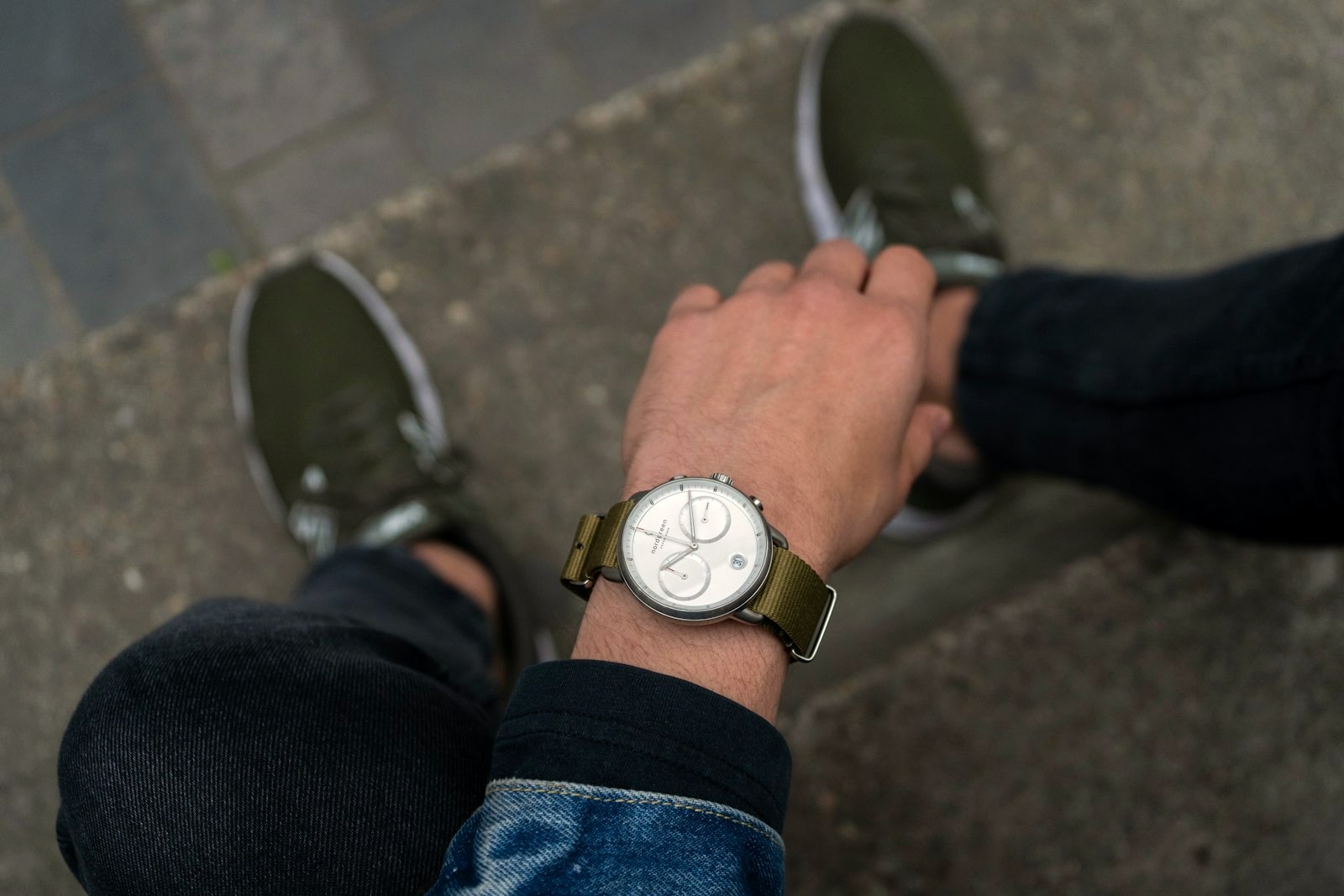
The photography, stated plainly, because this page’s subject is wider than our bank. The bank holds the white sneaker in its own weather and this page uses it, and it holds the boot’s side of the line, black boots in snow, carried as this brief’s second figure. What it does not hold is named rather than disguised: no sneaker in snow or slush, in any upper, the season’s decisive ground unphotographed with this page’s subject on it; no suede in rain or salt, the material section’s central evidence missing with it; no membrane or sole cross-section, the waterproofing register argued from construction because the bank cannot show one; and no knit runner in standing wet, the limit this brief rules on. The overhead frame inside the materials section is a watch-led banked spare whose edges carry a knit runner on damp stone, captioned for the shoes and the stone and nothing else. No frame of another shoe has been captioned as any of the missing ones. The harvest list this page is waiting for, in order: first, a leather sneaker at a slushy crossing at street level, the ruling’s whole argument in one frame; second, a hem breaking once over a dark leather sneaker in winter cloth, the trouser agreement photographed at ankle height; third, protected suede in drizzle, the dry law’s licensed edge. Until those frames land, the bank’s dry shoe and the boot’s snow stand for the season between them, and the page says so.
Questions, answered
Can you wear sneakers in winter?
Yes, on the dry side of the season, and the line is drawn by the ground rather than by the calendar. A leather sneaker on a sole with tread, worn with a real sock, is a sound shoe for cold, dry streets from the first frost to the last. What retires it is water in its standing forms: How to Wear No. 54 draws the cold-floor line this brief inherits, slush and standing meltwater, snow and the downpour belong to the boot, because a low shoe admits water at the ankle however good its upper is. No. 12 retires the sneaker from wet streets outright. Winter does not ban the sneaker; it halves its rota, and the half it keeps is the dry half.
Which sneakers work in winter?
This site publishes no footwear ranking, so the answer is a specification rather than a list. The winter sneaker is a leather shoe in sneaker form: a full-grain leather upper with closed, stitched construction, a sole with real tread rather than a flat cupsole, and a colour that can take salt and splash, black, charcoal or dark brown before white. A membrane lining is a genuine addition for damp commutes, bought with the waterline ruling read: it waterproofs the upper, not the ankle opening. The buy-once exhibit in our records is the Koio Capri Triple White, a garment scored at 84 in the Fall Edit, full-grain leather on a Margom sole, cited here as the pattern of the thing, a sneaker built the way a shoe is built.
Are mesh or knit sneakers ever right in winter?
On dry days, as a shoe; as a winter shoe, no. A knit or mesh upper is a ventilation system, and ventilation is the opposite of the winter post: the same openness that makes the runner cool in July passes cold air and the first splash in January, and no spray or membrane sock closes a woven upper against standing wet. The knit sneaker's honest winter rows are the dry, indoor-weighted days, the travel day and the gym run, worn as what it is. Kept in the rotation whole, as the summer shoe unchanged, it is this brief's central mistake: not a bad shoe, a shoe on the wrong side of the material rule.
What does waterproof mean on a sneaker?
Less than the word promises, and the shortfall is geometric. A membrane or a proofed upper can honestly make the material waterproof: rain landing on the shoe stays outside the shoe. But a sneaker is a low shoe with an open top, and water does not only arrive through materials. It arrives over the collar, from standing water deeper than the shoe is tall, from slush thrown by the other foot, and down the sock from a wet trouser hem. A boot answers those routes with height. A sneaker cannot, at any membrane. Read waterproof on a sneaker as the upper's claim, true as far as it goes, and the ankle's opening as the standing exception the word does not mention.
Do protector sprays make a sneaker winter-proof?
No. A spray is a finish, not a construction. It lays a water-repelling surface on the upper, which buys real things: drizzle beaded instead of soaked, slush wiped off instead of absorbed, and suede's nap protected from the spot damage that ruins it, which is why our Chelsea brief's record rules protected suede survivable in drizzle. What it cannot do is seal seams, close the ankle opening or survive its own wear: the finish thins with every wet day and is renewed on a schedule, like the wax on a jacket. A sprayed shoe is a better-defended shoe. Proofing is a property of how a shoe is built and how tall it stands, and no aerosol issues height.
Can you wear suede sneakers in snow?
In falling snow on a dry cold day, protected suede is defensible; in snow as a surface, no. The distinction this site's record prints for suede boots holds for suede sneakers: protected suede survives drizzle and light weather, and nothing suede survives a downpour or standing wet. Snow's real attack is not the fall but the aftermath: the salted meltwater at every crossing, which spots the nap, stiffens it as it dries and leaves the tide line that marks the shoe for the rest of its life. A suede sneaker worn into slush is a condition expense charged in one walk. The rows suede keeps in winter are the dry ones, where it is the season's best-looking casual shoe.
What trousers and socks go with sneakers in winter?
The trousers follow the hem law of How to Wear No. 56, adapted to a shoe with no shaft: the hem ends above the shoe or breaks once, cleanly, at no break to slight on the family's ladder, and pooling is refused twice over, once for the look and once because a pooled hem drinks the street and stays wet. A cropped or cuffed leg shows the sock, so the sock is signed like a join: a merino crew at real height, the standard of Verdict Card No. 36, whose winner, the Darn Tough, stands at 88, in a colour that belongs to the trousers. The ankle sock and the bare ankle are summer signatures, and in January they read as a rotation that was never changed.
Sneakers or boots when it snows?
Boots, and the record is not close. Our pea coat brief's ruling, carried by the winter briefs whole, is that the lug is the only sole built for snow and slush, and the lug belongs to the boot family: the boot brings the tread, the height that closes the ankle opening and the storm construction the sneaker does not have. A lugged trail sneaker grips better than a flat one and is a legitimate work-register shoe, but its ankle is still open and its formality is priced out of the dress rows, at 2.5 on the family's scale in our Chelsea brief's arithmetic. Snow is the boot's hired shift. The sneaker's winter is the dry cold on either side of it.
Next
The family this brief completes stands in the shoe briefs: How to Wear No. 12, the white sneaker, the solvent rule and the dry-street standard this page winters; How to Wear No. 56, boots, the hem law in its full form and the weather allocation that bounds this brief; How to Wear No. 54, loafers in winter, the cold-floor line in its original drawing; and How to Wear No. 15, the Chelsea boot, the shoe that takes the wet shifts this brief surrenders, whose suede law and lug pricing are carried here. The system the winter shoe stands in is built at How to Wear No. 57, layering for winter, whose floor is this page’s subject, and the sock that signs its joins is graded at Verdict Card No. 36. The full series lives in the How to Wear index, and how every score behind those pages is built stands on our methodology page.