
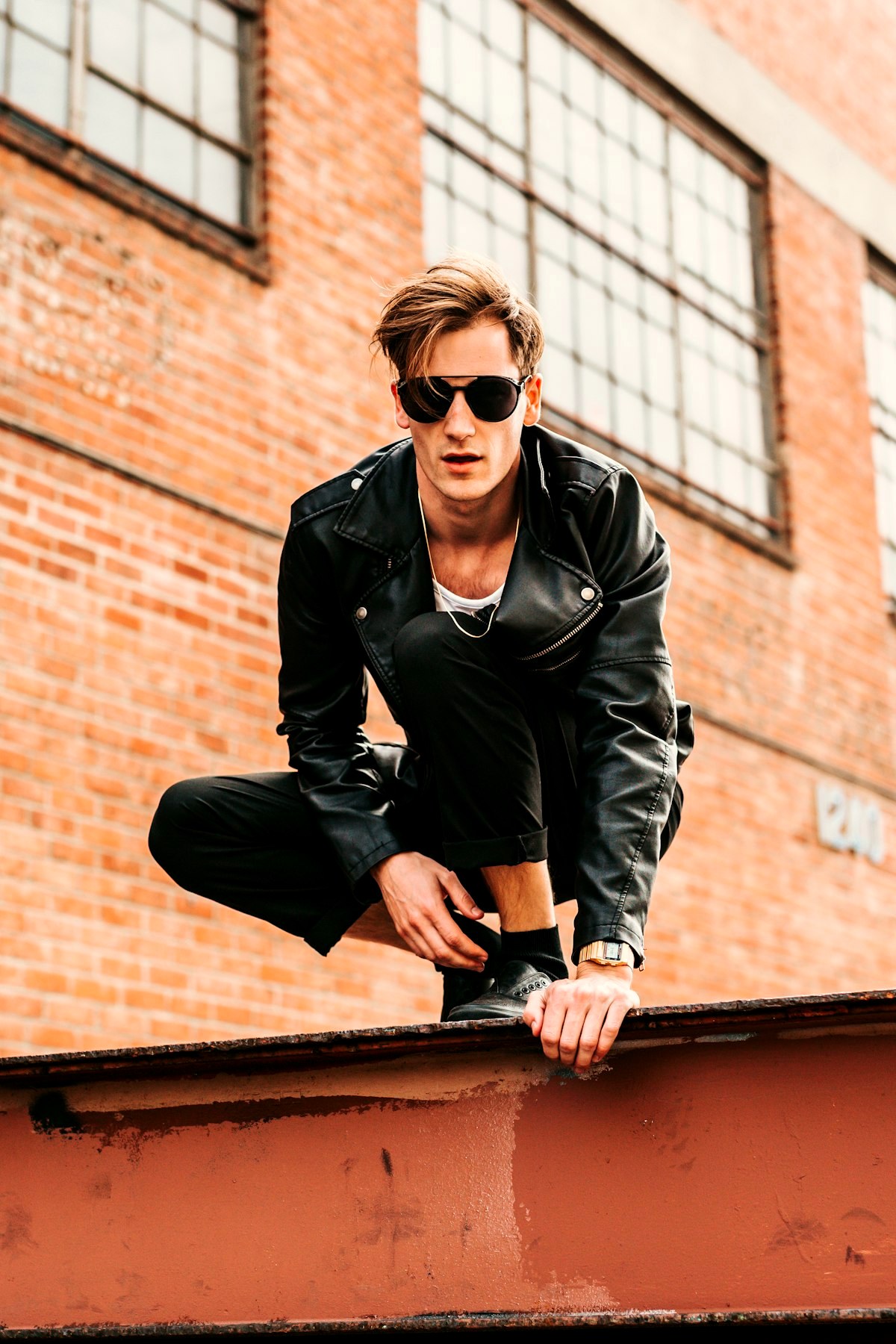
The bank's one true leather frame, captioned as exactly that: a black Perfecto, the double rider species, over a white t-shirt against a brick wall, the street register in one frame. Our bank holds no cafe racer, no A-2 and no suede trucker on a body, and no hide at macro range; the care section prints that gap and the harvest list rather than let this one species stand in for the other three.
Checked and updated October 2026
The ruling, up front: a leather jacket is the permanent garment in a wardrobe of seasons, and wearing it well is mostly the management of three facts the jackets index already prints. The index files the type at formality 3, warmth 3, cloths lambskin and steerhide, season autumn and spring, and its buying rule is the brief in one line: buy the hide and the hardware, in one style, cut close; leather does not forgive. The species: the styles are a closed set, the cafe racer, the double rider and the flight jacket, and each carries a different ceiling inside the rung, set by its hardware, because hardware is jewellery and jewellery sets the volume of everything under it. The fit: the hide relaxes where it is worked and never relaxes back, so the jacket is bought feeling a size tight and moulds itself by the end of the first season; bought comfortable, it is a size too big for a decade. The register: nothing tailored goes over it and no tie goes under it, because the type tops out at 3 and the garments at 4 and 5 answer different rooms. One hide, one style, bought once and worn for a decade, the index's own sentence. This brief is the wearing system that sentence implies.
This brief: the species decide · the break-in contract · what goes under · trousers and shoes · the colour order · the looks · the mistakes · care, and the suede laws
The decisive rule: the species decide the register
Most jackets are one garment with variations. The leather jacket is four garments sharing a cloth, and the index treats them with a discipline it applies nowhere else in the twelve types: the styles are a closed set. The cafe racer, the double rider, the flight jacket, named whole, with the instruction to pick the one your wardrobe already believes and never hedge between two. The reason is printed in the same entry: this is the permanent one, one hide, one style, bought once and worn for a decade, which is why its rule is about materials rather than fashion. A garment bought for ten years cannot be hedged, because the hedge is worn for ten years too. This brief takes the set as given and rules what the index leaves open: where each species stops, and why the stopping places differ. The variable is hardware. A leather jacket's zips, snaps, belts and buckles are metal worn on the body, which is to say jewellery, and jewellery is read at conversational distance before the hide is. The more hardware a species carries, the louder the garment, and the lower its ceiling inside the type's formality 3. The species are ranked below by their metal, quietest first.
The cafe racer: the ceiling species. A band collar standing at the throat, a centre zip, two chest pockets at most, snaps you have to look for. The racer was cut for a rider tucked over a tank, and stripped of everything the wind could catch, which is why it reads as the set's tailoring: a clean front, a close body, no decoration to date it or to argue with what is under it. Inside formality 3 it climbs the highest of the four, nearest the neatness the index gives the Harrington at the same rung, and it is the only species this brief licenses at the ceiling assembly, over an open-collar Oxford and wool trousers, in the pairing section below. Its discipline is subtraction: every added pocket, panel and logo spends the cleanliness that is its whole argument, and the fashion versions with racing stripes and quilted shoulders are the species quoting a sponsor it never had.
The A-2: the flight species, in the middle. The index's flight jacket in its leather form: a shirt collar that snaps down, patch pockets with flaps, and a ribbed knit hem and cuffs, the softest architecture in the set. The A-2's register is military ease: it is the species that was issued over shirts and sweaters to men who worked standing up, and it still reads as equipment with good manners, warmer in spirit than its warmth 3 because the ribbing seals it. Its ceiling is the smart-casual row, over chinos and knits, and its ribbing carries a doctrine this site prints for the bomber in How to Wear No. 17 and transfers here unchanged: the knit is the garment's consumable, the shell outlasts it by years, and a bagged hem is a re-knit, a repair, not a death. The species' failure mode is the souvenir version, patches and painted backs, which belongs to the sukajan's record and its one-statement rule, not to a flight jacket worn as clothing.
The double rider: the loudest, and the ceiling is the floor's neighbour. The Perfecto pattern of 1928: an asymmetric zip worn diagonal across the chest, a wide notched lapel that snaps down, a belted waist, a coin pocket, zipped cuffs, epaulettes. Count the metal: it is the most jewellery a jacket on this index carries, and it is glorious, and it is a ceiling decision. The rider tops out at the dressed-casual row, dark denim and a boot, because every room above that row reads the hardware before it reads the man, and a garment that is read as a reference cannot also be read as an outfit. The hero frame is this species, and its caption names it, because the rider is the species the culture photographs and the species most often bought by men whose wardrobes believed in the racer. The index's sentence is the whole of the law here: pick the one your wardrobe already believes. The rider bought as a costume for a wardrobe of knit polos and loafers will spend its decade in the closet, perfect and unworn, which is the most expensive outcome in this entire category.
The suede trucker: the borrowed pattern. Admitted to this brief as the fourth wearing species, and its papers are printed honestly: it is the trucker pattern, which the index files as its own type at formality 2 in denim and which How to Wear No. 16 briefs, cut in suede instead of denim or smooth hide. The surface does the lifting: suede's nap softens the work pattern the way the index says a suede Harrington climbs toward the blazer, and in its cleanest form the suede trucker stands at the leather type's rung, the quietest species to look at in the whole set, no shine, no hardware beyond its buttons and the trucker's seams. It is also the most fragile garment in this brief, the only one whose weather law is a refusal, and the care section prints its terms in full. Buy it as the second jacket, in the second colour, when the first has broken in and the rotation can carry a dry-weather species. Bought first, it teaches its owner the suede laws at the price of the wardrobe's only leather.
| The species | Its hardware | Its ceiling inside formality 3 | Its native company |
|---|---|---|---|
| Cafe racer | A band collar, a centre zip, snaps you have to look for | The highest: the ceiling assembly, an open Oxford and wool trousers | Fine-gauge knits, derbies, the dressed rows of the set |
| A-2 flight jacket | A snap-down collar, patch pockets, a ribbed knit hem and cuffs | The smart-casual row: chinos, knits, boots | Mid-gauge knits, chinos, suede Chelseas |
| Suede trucker | Buttons and seams, no shine at all | The quiet row: dry weather, daytime, the soft register | Tees, polos, dark denim, suede shoes |
| Double rider | An asymmetric zip, a belt, snaps, a coin pocket, epaulettes | The lowest: the dressed-casual row, dark denim and a boot | The plain tee, dark denim, black boots |
The break-in contract: bought close, moulded by the season
The index's buying rule ends with the warning that governs everything in this section: leather does not forgive. Cotton forgives, it stretches at the waist and shrinks in the wash and a tailor can move its seams. A hide keeps the shape it is given, by the cutter and then by the body, and it keeps both permanently. The mechanism is simple and it is the whole of the fit law: leather relaxes where it is worked, across the chest when the zip is closed, at the shoulders when the arms reach, in long creases at the elbows, and it does not relax anywhere else, and it never tightens back. A leather jacket is therefore the only garment in the wardrobe that is bought for the body it will have in three months rather than the body in the fitting room, and the contract is printed plainly: it should feel a size tight in week one. Not painful, not restrictive at the reach, but close everywhere, the zip a decision, the chest a presence. By the end of the first season of regular wear the hide has taken the body's mould at every worked point, and the jacket that felt a size tight fits like nothing else in the closet can, because nothing else in the closet was shaped by wearing.
The zip test. Closed over a t-shirt, the front pulls faintly across the chest in week one, a tension you can feel and barely see. Over a mid-gauge knit, the knit of the A-2's native layer, closing it is work. Over a heavy-gauge knit it should not close at all, because heavy gauge is refused under leather in the next section, and a jacket roomy enough to swallow it has failed the test that matters: a front that closes easily over bulk on day one is a front that hangs open in folds by year one, the hide relaxed into a size the body never was. The test is run in the shop, over the thickest layer the species is licensed to carry, and a jacket that passes it over a tee and fails it correctly over a chunky knit is the right size.
The shoulder test. The seam sits on the shoulder bone, at the point, never past it. In cloth a dropped shoulder can read as ease, a silhouette chosen. In leather it reads as sag, because the hide's weight pulls the shoulder line down and sets it there, and the set is permanent: the jacket will wear that dropped line for its decade. The shoulder is also where the species divide at the mirror: the racer's shoulder is a clean cap and shows the test plainly, while the A-2's softer shoulder and the rider's padded, epauletted line forgive a fraction more, a fraction being all they forgive.
The sleeve and length tests. The cuff lands at the wrist bone with the arm hanging straight, the elbow's creasing in the first weeks buying the last fraction of length as the hide shortens itself across the bend, which is why a sleeve that starts at the knuckle is correct and a sleeve that starts at the wrist bone's far side will end short. The body lands at the belt line for the racer and the rider, the trucker's length by its pattern, the A-2's ribbing sitting on the belt the way No. 17 rules its own hem: the belt visible below it, the trouser's rise readable. A leather jacket that covers the seat has changed species into a coat it was not cut to be, and no hide relaxes upward.
The hide itself, graded by the ladder this site already prints. Fit is bought at the till, but the decade is bought in the hide, and Verdict Card No. 17 prints the ladder for the belts and it governs jackets unchanged: full-grain keeps the entire surface of the hide, tight fibres and all, and it is the strongest and the best-aging cut, the hide that creases into a map of its owner; top-grain is sanded and finished to hide the marks, smoother, more uniform, and a step down in character and in years; split leather is what remains after the grain is split off, the loose fibrous underside, usually coated to imitate grain, and it is the bottom of the ladder, the hide that cracks at its folds the way the belts Card's skip cracked at its holes. The index names the cloths lambskin and steerhide, and they divide by species and by life: lambskin is the soft, light, close hide of the racer and the fashion rider, bought for drape and worn in the city's weather; steerhide is the heavy, stiff, slow hide of the working rider and the flight jacket, bought for the decade and broken in like equipment. Neither is the other's upgrade. They are the two ends of the contract, softness now or armour eventually, and the break-in tests above are run harder on steerhide, because steerhide is the hide that will still be setting its mould in month three.
What goes under: the layers, the shirt ceiling, and the tie refusal
The tee is the rider's native layer. The hero frame is the whole argument in one photograph: a black Perfecto over a plain white t-shirt, nothing else competing, the hardware carrying the top half and the tee refusing to. It is also the suede trucker's standard layer and a legal one under every species, provided the tee earns its place the way this brief's family always requires of a basic: the class is ranked on this site in Verdict Card No. 02, whose Asket at 88 is the garment evidence, a tee with the weight to sit under a hide without reading as an undershirt. A thin, stretched or logo-printed tee under a decade garment is a layer spending money it does not have: the jacket will outlive a hundred of them, and the outfit is read at its weakest layer.
Knitwear is banded by the species, on No. 09's gauges. How to Wear No. 09 prints the bands this brief grades by: fine gauge at roughly 24 to 30, mid at 12 to 20, heavy at 7 and below. Fine gauge is the racer's knit: the jacket's clean front and close contract tolerate no bulk, and a fine crew or a fine roll neck under a racer is the set's most dressed assembly, the Smedley Lundy at 87 on its Card being the gauge's reference garment. Mid gauge is the A-2's: the flight species was built over layers, its ribbed hem seals over a mid-gauge crew or a henley, and the pairing is the species' weekend register entire. The rider takes the tee or a fine knit and no more, its belted, close body having no room budgeted for bulk. Heavy gauge is refused under every species, on the fit law's arithmetic: a jacket bought to the break-in contract cannot close over a chunky knit without breaking the contract, and worn open over one it stops being a mould and becomes a shell, the decade garment reduced to an over-layer. The chunky knit's partner on this site is the overcoat and the overshirt, garments cut with the room for it. Leather is not.
The shirt ceiling is the open collar, and the tie is refused. A collared shirt under leather is licensed in exactly two assemblies: the open-collar Oxford under the racer, at the ceiling the species section sets, the Kamakura at 93 on the Oxford Card being the shirt this site ranks for the job, its basket weave quiet against the hide; and the same shirt under the A-2, the flight species' soft read, collar open, the snap-down jacket collar and the shirt collar in their old issued company. Under the rider and the trucker the collared shirt is refused: the rider's lapel and the shirt's collar are two architectures for the same inch of neck, and the trucker's shirt is the flannel and work family of No. 13's record, worn as a layer in its own right rather than under a second work pattern. And the tie, under every species, is refused outright, and this brief prints the refusal as one of its rulings rather than as a taste: a tie is tailoring's flag, flown where formality is 4 and 5, and the leather jacket is filed at 3. Knotted under a racer it argues across the zip for the whole day, two closures competing on one chest. Knotted under a rider it is worse than an argument. It is the costume section's subject arriving early, the uniform quoting itself, the tie worn as a reference to offices the outfit has no intention of entering. The shirt and tie have their jacket, and it is briefed in How to Wear No. 03. Under leather the collar stays open, or the layer is knit.
The pairings: trousers, and the matrix at the feet
Denim is the first trouser, on No. 05's laws. How to Wear No. 05 governs the jean under every jacket on this site, and leather is no exception: the wash-break law asks for distance between any two denim surfaces, which under a leather jacket means the jean carries the outfit's only denim, dark or mid, unfaded at the formal end of its range. The signature assembly is the monochrome one: black denim under a black rider or racer, run on the colour logic No. 05 prints for black denim, a colour system rather than a wash, and the one total-black outfit this site licenses without conditions, because the hide's matte surface and the denim's matte cloth are two textures of the same colour and read as a decision. Light-wash and distressed denim under the rider is the costume section's material arriving in the pairings: it completes a reference instead of an outfit. Under the A-2 and the trucker the jean's whole honest range is legal, the field colours included, on the trucker's own pattern law that the colour break is the outfit.
The chino is the second trouser, on No. 29's span. How to Wear No. 29 files the chino's formality as a span, and the span's ends divide by species. The middle and field ends, the washed and middle-rail pairs, go under every species in this brief, most naturally under the A-2, whose smart-casual ceiling they were described in, and under the suede trucker in its dry rows. The tailored end, the high-rise pressed pair, goes under the racer alone: the racer's quiet front is the one leather silhouette that can stand over a tailored trouser without the pairing reading as a negotiation between two garments that each lost an argument. Under the rider, a pressed chino is spent the way No. 29 says a jean in khaki is spent in a formal room: the room reads the pattern above it, and the pattern is hardware.
Wool trousers are the boundary, and the boundary is printed. The dress trouser is ranked in Verdict Card No. 15, the Spier & MacKay tropical wool at 87, a formality 5 garment. Leather meets it in one assembly only: under the cafe racer, at the racer's ceiling, with the open-collar Oxford or a fine-gauge knit above the trouser and a derby or a loafer below it, the outfit that the loafer brief's one-notch rule would recognise, every element one notch from its neighbour and nothing two. Under the rider and the A-2 the wool trouser is refused: the rider's hardware drags the trouser down two rungs and spends its press, and the A-2's ribbed hem meeting a creased wool leg is military softness arguing with civilian tailoring across the belt line. And the boundary's other half is stated in the FAQ and repeated here because it is the most common stacking error this garment attracts: no blazer goes over a leather jacket, and no leather jacket goes over a blazer. The overcoat of How to Wear No. 20 is the weather layer that closes a winter stack, and a leather jacket under it on the commute is outerwear doing transport work; but as an outfit, leather and tailoring meet at the trouser and shake hands. They do not embrace.
At the feet: the boot is the default. Ruled as styling, the way this series rules footwear beside every garment, on the scales the footwear briefs print. How to Wear No. 15's Chelsea scale runs the sleek calf at 4.5, suede at 4, the lug-soled at 2.5, and the boot matrix follows the species: the sleek calf Chelsea under the racer, its clean line answering the jacket's clean front, and under the rider in black, the boot the monochrome assembly is built on; the suede Chelsea under the A-2 and beside the suede trucker, colour kept a clear distance from the jacket's own suede, because two suedes a shade apart is the near miss of No. 29's navy law translated to nap; the lug-soled boot at the field end, under the A-2 in weather and under the trucker on its work rows. The boot is the default because it is the only shoe whose substance answers a hide's substance: leather under leather, the outfit grounded at both ends.
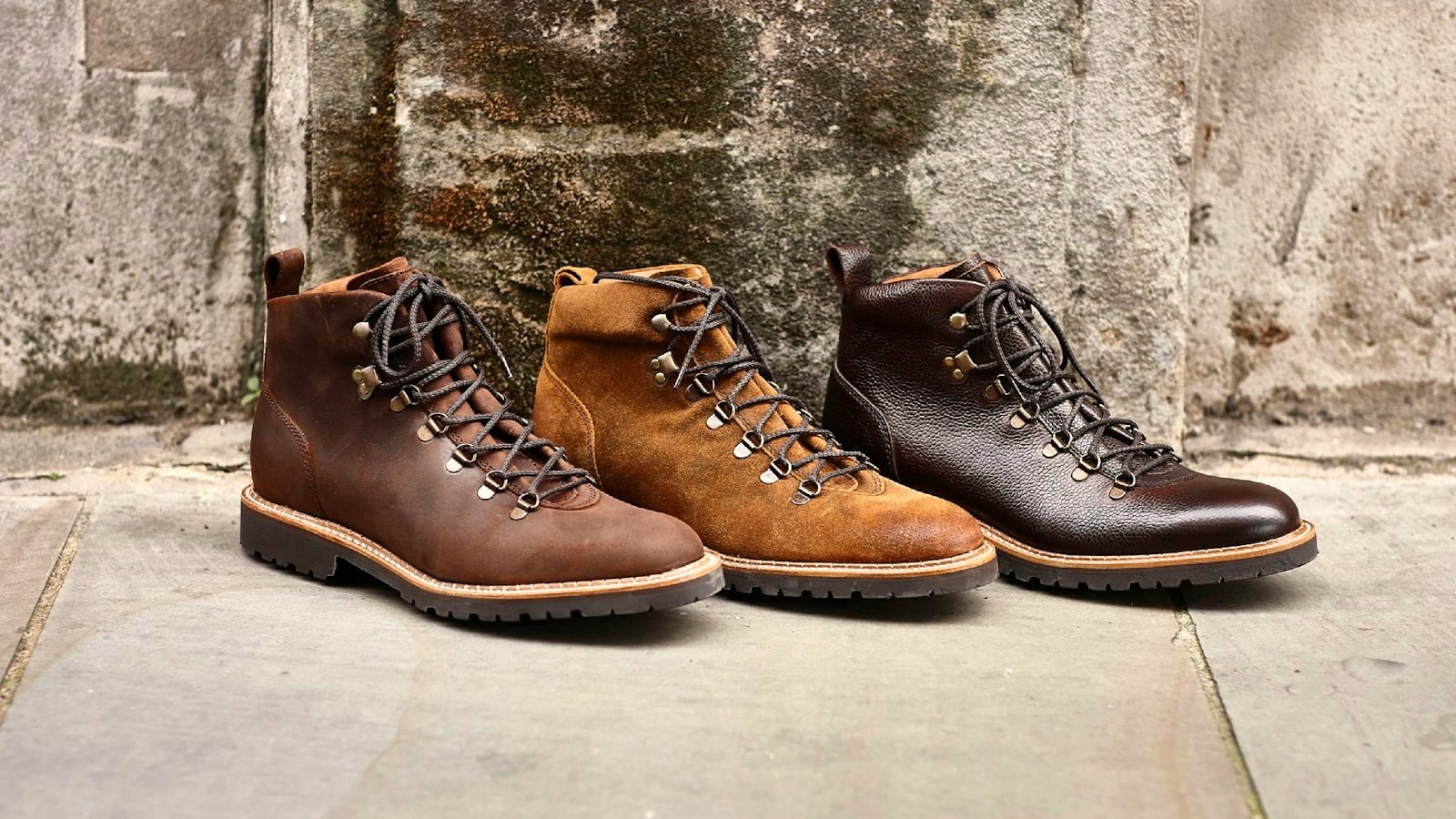
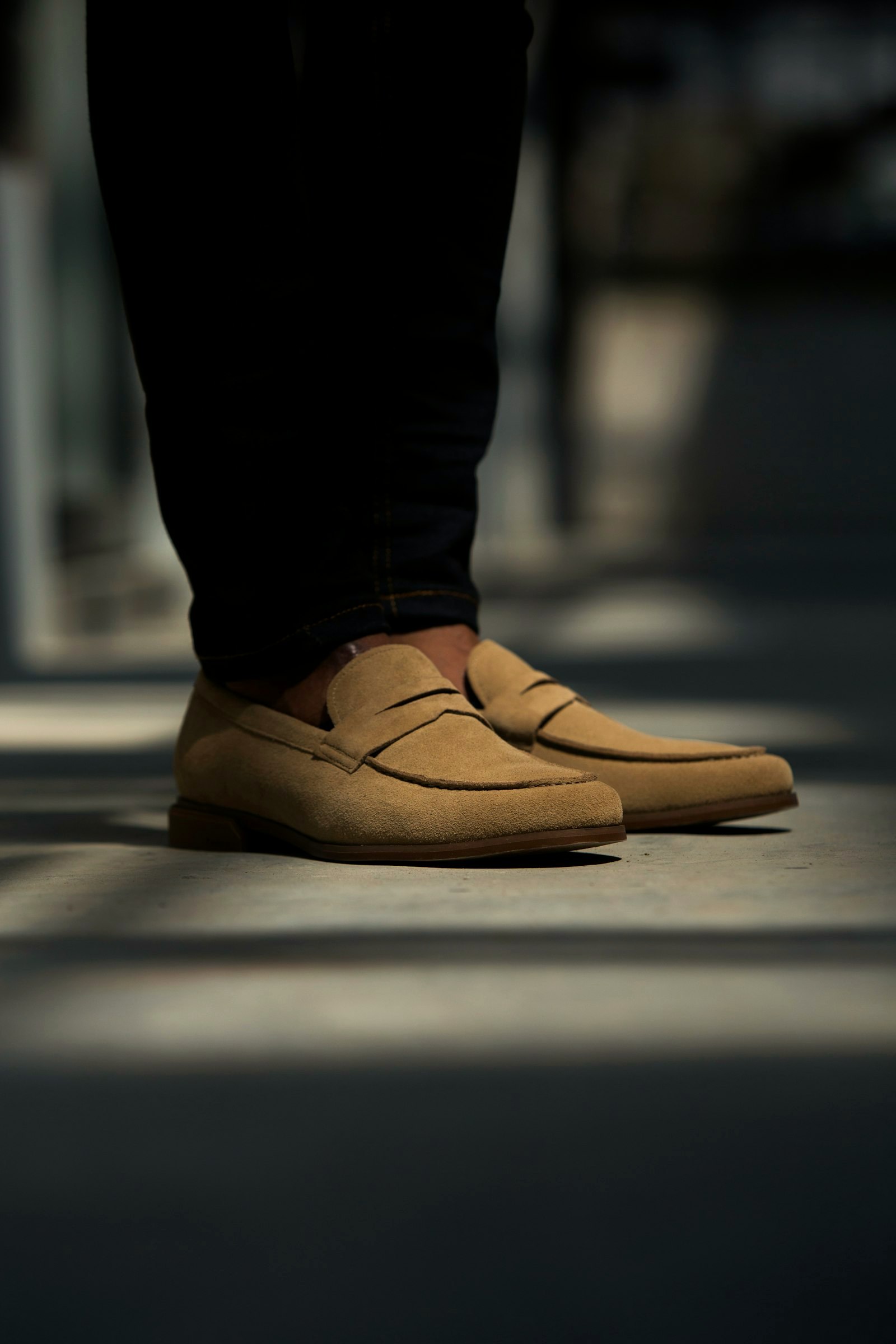
The sneaker is licensed by species, and the dress shoe is answered. How to Wear No. 12's scale grades the minimal leather court shoe at formality 3 when clean, the retro runner at 2, canvas at 1.5. The clean court shoe is licensed under the racer, where it completes the species' modern register, and under the suede trucker in dry weather, suede above and leather below, the soft outfit entire. Under the rider it is licensed only dead clean and minimal: the rider's hardware already spends the outfit's entire volume budget, and a designed sneaker is a second argument started at the ankle. The chunky runner is refused under every species, on the index's decade logic: a shoe that dates to a season, worn under a garment bought for ten years, makes the garment look like the costume and the shoe like the outfit. The polished dress Oxford is refused on the sheen error this series prints beside the chino and prints again here: mirror calf at formality 5 against a matte hide at 3, each finish accusing the other, the shine calling the hide slovenly and the hide calling the shine costume. The derby is the ceiling shoe, under the racer only, matte calf, soft lacing, the one dress shoe that speaks the jacket's language at a lower volume. The loafer of No. 11, one notch in either direction, takes the racer's summer rows in suede, and no other species: under a rider, a loafer is two subcultures introduced at a party neither wanted to attend.
The colour order: the species picks first
Every colour section in this series runs an order, first buy to last, and leather's is the only one where the order is decided before the colour is: the species picks the colour. The riders and the racers read black. Their patterns were cut in a black-hide register, the hardware on both was designed against black, nickel and gunmetal on a dark ground, and the bank's one leather frame, the hero's Perfecto, is the record's exhibit: black is not the rider's safe option, it is the rider's native one, and a tan Perfecto is a species wearing another species' colour. The A-2 and the suede trucker read brown. The flight jacket was issued in seal and russet browns and its knit was dyed to them; suede's nap takes tan, snuff and chocolate the way smooth hide takes polish, and a black suede trucker reads as a garment whose surface and colour are both refusing to shine, a double negative the eye files as grey. So the reader choosing a first leather jacket is really making the index's choice, which species his wardrobe believes in, and the colour arrives with the answer.
What remains is the matching law, and it outranks preference. A jacket's hide is never read alone. It is read against the other leather in the outfit, the boot at the ground and the belt at the waist, and leather arguing with leather is the loudest error this garment permits: two browns a shade apart, close enough to look attempted, or a black jacket over brown boots with a brown belt insisting between them. The wardrobe's existing leather is therefore the first jacket's real colour chart. The belt this site ranks in Verdict Card No. 17 is a brown bridle, its winner the Tanner Goods Standard at 86, and the boot wardrobe in this series' looks runs brown at least as often as black: the reader whose boots and belt run brown buys the A-2 or the suede trucker first and wears a matched column of leather from waist to ground; the reader whose run black buys the rider or the racer. The second jacket, bought years later when the first has moulded and the decade is visibly underway, is the other colour in the other species, and the rotation then covers both registers the index files at this rung. Bought in the wrong order, against the shoes already owned, the first jacket spends its ten years as the one loud fact in every outfit it joins.
The pricing footnote, from the record. Colour and species chosen, the buying itself runs on the one price record this site keeps for the species, in Brands Like No. 14: AllSaints stands at 66 there, and its leather bomber is printed at $569 at list, chained down to $272.80 in the brand's own sale, with that page's law printed as this brief's buying note: in this species, list price is an opening bid. The mall leather houses run a permanent chain of markdowns, and the man who pays the first price printed has skipped the garment's first lesson, the lesson No. 17 also draws from the same record. The heritage benches and the direct makers price differently and hold their prices, which is part of what their money buys. Know which kind of seller is across the counter before the card comes out.
The looks: the set, worn
Four assemblies, one per species, each built from this brief's rulings and the tree's records. The frames are the bank's honest leather and footwear frames, captioned for what they show; the bank holds one jacket frame, and the looks are written so that three of them stand without a photograph rather than borrow a species they are not.
Look one: the rider, worn as clothing. The black double rider, broken in or on its way, over a plain white tee of the Asket's class at 88, black denim run on No. 05's monochrome logic, a black belt, and the black sleek Chelsea at No. 15's 4.5 or a black boot of the same quietness. Nothing else in the outfit refers to anything: no band print, no chain, no distressing bought by the yard, the denim dark and whole. This is the costume section's thesis worn correctly, the jacket as the outfit's single heritage signal and everything else contemporary and quiet, and it is the assembly the hero frame almost shows, one boot away from complete.
Look two: the racer at its ceiling. The cafe racer, black for the city wardrobe or brown where the leather runs brown, over a fine-gauge crew at No. 09's top band, or the open-collar Kamakura Oxford at 93 on the warmer days, above the Spier & MacKay tropical wool trouser at 87, hemmed to the slight break of the suit brief's ladder, and a matte derby or the sleek calf Chelsea below. This is the leather type at the top of its rung, the assembly that walks into the rooms formality 3 is admitted to and is read there as a dressed man rather than as a reference. It is also the ceiling, printed as a ceiling: the same racer over a suit, or with a tie added, is not this look pushed further. It is this look's ruling broken, and the mistakes section names it.
Look three: the flight weekend. The brown A-2 over a mid-gauge knit or a henley, the chino at its middle rail, stone or olive on No. 29's colour order, and the suede Chelsea at No. 15's 4 with its colour kept clear of the jacket's brown. The ribbed hem sits on the belt, the knit seals at the cuffs, and the whole assembly is the flight species doing the job it was issued for: a warm, soft, working layer over the rotation's middle garments, the weekend register at its most considered. In the cold weeks the stack closes under the overcoat on the commute and the A-2 resumes at the door.
Look four: the suede trucker, dry. The tan or snuff suede trucker over a plain tee or an untucked polo on No. 06's hem rule, dark denim or the washed chino below it, and suede loafers or the clean court sneaker at the ground, the suedes kept a clear shade apart. The look carries its weather condition in its name: it is assembled in the morning from a forecast, worn on a dry day, and stood down without regret when the sky changes, because the species' fragility is part of its price and the man who bought it bought the calendar with it. On its day it is the quietest outfit in this brief, no shine anywhere, the nap doing all the talking.
The ruling
Buy one species, the one your wardrobe already believes in, in the colour that species and your existing leather agree on, and buy it close. Run the three tests in the shop, the zip pulling faintly over a tee, the seam on the shoulder bone, the cuff at the wrist bone, and then wear the tightness for a season while the hide takes the mould: that discomfort, brief and specific, is the purchase price of the best-fitting garment in the wardrobe. Wear it inside its ceiling: the racer to the top of the rung over an open Oxford and wool trousers, the A-2 over knits and chinos, the trucker in dry weather over the soft layers, the rider at its dressed-casual row over a tee and dark denim. Keep the tie for the blazer, the blazer off the leather, the chunky knit for the coat, and the polished Oxford for the suit. The record underneath is thin and this brief has cited it exactly: an index filing at 3 and 3 with a closed set of styles, one brand family's leather at 66 with its price chained in public, a waxed motorcycle house at 70 for the pattern's ancestry, and a hide ladder on the belts Card that grades every hide this garment can be cut from. A decade garment does not need a louder record than that. It needs an owner who bought the right species once.
The mistakes
The full uniform. The rider is a uniform with a history, issued by a motorcycle culture that dressed in it completely: the jacket, the engineer boots, the band tee, the chain wallet, the distressed denim, all of it designed to be read together, at a distance, as membership. Worn complete by a man who is not a member, it is not an outfit. It is a costume, a quotation with nothing around it in the wearer's own voice, and the room reads the quotation first and the man second, if at all. The rule is printed in the species section and enforced here: one heritage signal at a time. The jacket is the signal. Everything else in the outfit is from this decade and from the wearer's actual life, quiet enough that the jacket is the only reference being made. The Brando read and the club read are the same trap at different volumes, and both are avoided the same way, by subtraction: the rider over a plain tee and clean dark denim is clothing; the rider over its whole historical supporting cast is a Halloween with a decade-long commitment.
The hedge. The index refuses it in its own words, never hedge between two, and the mistake deserves its name here because it is the most expensive one in the category. It takes two forms: the jacket bought as a compromise between species, the rider with the racer's collar or the cafe racer with a belt, a garment that files under no pattern and carries no species' ceiling, only their average; and the second species bought in year one, before the first has broken in, splitting the wears the break-in contract needs and leaving two jackets at half a mould each. A hide is moulded by wears the way a boot is, in sequence, and the rotation that runs three leather jackets in their first year owns three stiff jackets in their third. One hide, one style, bought once: the sentence is the index's, and the decade is the unit it is measured in.
The comfortable size. The jacket bought roomy because the fitting room rewards comfort: zipped easily over the shop's knit, sleeves past the wrist, the shoulder seam an inch into the arm. It is the fit law read backwards. The hide relaxes where it is worked and nowhere else, so the comfortable jacket's ease becomes drape at the chest, sag at the shoulder and a sleeve that covers the hand, permanently, within the first season, and the garment spends its decade as evidence of one afternoon's preference for ease. No tailor rescues it: taking in a leather jacket means re-cutting panels and re-punching seams in a material that keeps every needle hole it has ever been given, which is the index's warning made literal, leather does not forgive. Buy the tightness. It is temporary. The size is not.
The tie, and the blazer over it. The two stacking errors, named together because they are the same error in opposite directions: tailoring forced into the leather outfit from below and from above. The tie knotted under a rider or a racer imports formality 5's flag into a formality 3 garment and reads as costume or as argument, never as polish. The blazer layered over the jacket, tried every few seasons as a discovered combination, stacks a soft tailored shoulder over a hide that cannot compress, and both garments lose: the blazer rides up on the leather's structure and the leather's collar fights the lapel for the neck. The boundary this brief prints is not a lack of imagination. It is the ladder: leather meets tailoring at the wool trouser, under the racer, once, and everywhere else the two families take turns owning the outfit.
Care, and the suede laws
Smooth hide: fed when it asks, never washed, hung wide. The cadence is already printed on this site for the bomber's leather species in How to Wear No. 17, and it is the belts record's cadence: a smooth leather jacket takes a conditioner when the surface asks, when the creases lighten and the hand feels dry, and not on a calendar, because over-conditioned hide goes soft and dark in the folds and under-conditioned hide cracks at them, and the surface itself reports which side of the line it is on. It is never washed: water immersion stiffens a hide past recovery and no domestic process re-feeds a whole jacket evenly, which is why the rain ruling for smooth leather is tolerance rather than enthusiasm, a shower shed and survived, the jacket then dried slowly at room temperature, away from radiators and direct heat, on its hanger. The hanger is wide, always: a leather jacket is the heaviest garment in the short family, and a thin hanger spends the shoulder the fit section bought, stretching the hide at its two most visible points under the garment's own weight. Stored, it hangs in a breathable cover, never sealed in plastic, rested a day between wears in the season, and its zips and snaps are worked occasionally rather than forced occasionally, hardware being moving parts in a garment with a ten-year service life. None of this is precious. It is the maintenance schedule of a decade asset, and it is shorter than the one a car asks for.
Suede: the laws, printed plainly. The suede trucker inherits How to Wear No. 15's suede law whole, at a jacket's acreage. Spray it with a suede protector before its first wear and after every clean. Brush it after wears, with the nap's own brush, in the nap's direction, because suede is read by its nap the way a knit is read by its gauge and a crushed nap is a crushed register. Keep it out of the rain rows entirely: protected suede survives drizzle, nothing suede survives a downpour, and the tide marks a storm leaves across a jacket's chest do not brush out, the boot brief's sentence applying unchanged at six times the area. A suede jacket that has been rained on once and survived is not thereafter a rain jacket. It is a jacket with a story its owner tells instead of a ruling, and this brief's ruling stands: the suede species has a calendar, and the calendar is part of its price.
The A-2's knit, and the repairs a decade expects. The flight species carries the bomber's consumable: its ribbed hem and cuffs will bag years before its hide tires, and No. 17's doctrine transfers unchanged, that a bagged rib is a re-knit, a scheduled repair at a fraction of the jacket's price, not the jacket's death. The same patience covers the decade's other appointments: a zip replaced by a leather specialist when its teeth begin to skip, a lining renewed when it tears at the shoulders, snaps re-set. A leather jacket is one of the few garments whose repair economics still close, because the hide's decade gives every repair years to pay for itself in. The garment that cannot be repaired is the one that was bought split-grained and coated, the belts ladder's bottom rung, whose surface cracks as a coating rather than creasing as a hide: it cannot be fed, because there is no grain left to feed. The ladder was a care document all along.
A note on our own photography: our photo bank holds exactly one leather-jacket frame, the hero's black Perfecto on a street, and it is a true frame of its species. It holds no cafe racer on a body, no A-2 in any register, no suede trucker worn, and no hide at macro range where the grain ladder could be shown rather than described. The two figures inside this page are footwear, captioned as footwear, because this page will not caption a boot as a jacket to fill a slot. The harvest list names what is missing: a cafe racer worn over knitwear in city light, an A-2 over a mid-gauge crew, a suede trucker in dry daylight with its nap reading, and a full-grain hide at macro range beside a coated split, the ladder in one frame. This page will take those frames the week they exist.
Questions, answered
How should a leather jacket fit?
Close, by the jackets index's own buying rule: buy the hide and the hardware, in one style, cut close, because leather does not forgive. The mechanism is the break-in contract, and it is a property of the hide rather than a preference of this brief: leather relaxes where it is worked, across the chest, the shoulders and the elbows, and it does not relax back. So the jacket is bought a size tight in feeling, on three tests. The zip test: closed over a t-shirt, the front pulls faintly across the chest in week one, and over a mid-gauge knit it is work; a jacket that closes easily over a chunky knit on day one is a jacket that will hang by year one. The shoulder test: the seam sits on the shoulder bone, never past it, because a dropped shoulder in leather does not drape, it sags, permanently. The sleeve test: the cuff lands at the wrist bone with the arm hanging, the hide's creasing at the elbow buying the last fraction as it breaks. Bought right, the jacket is a mould by the end of the first season. Bought comfortable, it is a size too big forever, and no tailor shortens a hide's memory.
Which leather jacket style should you buy first?
The one your wardrobe already believes, in the jackets index's own words: the styles are a closed set, the cafe racer, the double rider and the flight jacket, and the index's advice is to pick the one your wardrobe already believes and never hedge between two. This brief adds the ceilings the species carry inside the type's formality 3. The cafe racer climbs highest: a band collar, a centre zip and almost no hardware, the quietest silhouette in the set, the one species that can sit over an Oxford and wool trousers at the ceiling assembly. The double rider tops out lowest: the asymmetric zip, the belt and the snaps are jewellery, and jewellery sets the volume of the whole outfit, so the rider's ceiling is the dressed-casual row, dark denim and a boot. The flight jacket, the A-2, sits between: military softness, a ribbed hem, the knit-friendly species, its ceiling the smart-casual row over chinos. The suede trucker borrows the trucker pattern the index files at formality 2 in denim and is lifted by its surface toward the leather type's rung in its cleanest form, the quietest species to look at and the most fragile to own. One hide, one style, bought once: the hedging the index refuses is a second species bought before the first has broken in.
What do you wear under a leather jacket?
Layers graded by the species' hardware and No. 09's gauge bands. The plain t-shirt is the rider's native layer and the trucker's, the Asket at 88 in Verdict Card No. 02 being the class's garment evidence. Knitwear is banded: fine gauge, roughly 24 to 30, under the racer, where the jacket's clean front tolerates no bulk; mid gauge, 12 to 20, under the A-2, whose ribbed hem was built over layers; heavy gauge under none of them, because a chunky knit under a cut-close jacket breaks the fit law this page prints, and the knit worn over the jacket's register is a silhouette argument the hide loses. The shirt ceiling is the open-collar Oxford, the Kamakura at 93 on its Card, worn under the racer at its ceiling and under the A-2 as the flight species' soft read. And the tie is refused under every species, printed here as this brief's ruling: a tie is tailoring's flag, flown at formality 4 and 5, and the leather jacket is filed at 3; knotted under a rider it is not formality, it is costume, the uniform quoting itself, and under a racer it argues across the zip for the whole day. The shirt and tie belong to the blazer of How to Wear No. 03. Under leather, the collar stays open or the layer is knit.
What trousers go with a leather jacket?
Denim first, on How to Wear No. 05's laws: dark, with distance between the washes of any two denim surfaces, and black denim under a black rider running on the monochrome logic No. 05 prints for that colour, the one total-black assembly this site licenses outright. The chino follows, on No. 29's span: the middle and field ends under every species, washed and worn as themselves; the tailored, high-rise end under the racer alone, where the jacket's quiet front can carry a pressed trouser without the pairing reading as a negotiation. Wool trousers are the boundary, ranked in Verdict Card No. 15 with the Spier & MacKay tropical wool at 87: they are licensed under the cafe racer at its ceiling assembly and refused under the rider and the A-2, whose hardware and ribbing drag the trouser's formality down two rungs and spend it. That is where leather meets tailoring, and the meeting is at the trouser, never at the jacket: no blazer goes over a leather jacket in any row of this brief, and no leather goes over a blazer. The two garments answer different rooms, and the outfit that stacks them has not mediated between the rooms. It has worn both invitations at once.
What shoes go with a leather jacket?
The boot is the default, on How to Wear No. 15's scale: the sleek calf Chelsea at 4.5 under the racer and the rider, the suede at 4 under the A-2 and the suede trucker in dry weather, the lug-soled at 2.5 at the field end. The sneaker is ruled by species, on No. 12's scale: the clean minimal leather court shoe at its formality 3 is licensed under the racer and the suede trucker, and under the rider only dead clean and minimal, because the rider's hardware already spends the outfit's volume and a loud shoe is a second argument. The chunky runner is refused under every species: it dates the jacket to a season, and the index's whole case for leather is that the garment is bought for a decade. The dress-shoe question is answered the way No. 29 answers it beside the chino: the polished Oxford is refused, a formality 5 shoe under a formality 3 jacket being the sheen error at ground level, mirror calf against a matte hide, each finish making the other look mistaken. The derby is the ceiling shoe, under the racer only, its softer lacing and matte calf the one dress shoe that does not accuse the jacket. Between the boot and the derby, the species are covered.
Can you wear a suede leather jacket in the rain?
No, and the law is inherited whole from the suede this site already rules. How to Wear No. 15 prints it for the suede Chelsea: protected suede survives drizzle, nothing suede survives a downpour, and unprotected suede should not be tried in either. The jacket takes the same terms at a larger acreage. Spray the suede trucker before its first wear and after every clean, brush it after wears with the nap's own brush, and rotate it out of the rain rows entirely: a suede jacket in a storm is not a rugged read, it is a care failure photographed, and the tide marks a downpour leaves on a jacket's chest do not brush out the way they do not brush out of a boot. The weather rows belong to the smooth hides, which shed a shower and ask only to dry away from heat. The suede species is a dry-weather garment the way the linen shirt is a summer garment: by cloth, not by mood, and its calendar is part of its price.
Should your first leather jacket be black or brown?
The species picks the colour before taste does, and the leather already in the wardrobe settles what is left. In this site's record the riders and racers read black: the bank's one leather frame is a black Perfecto, the species were cut for a black-hide register, and black is the colour their hardware was designed against. The A-2 and the suede trucker read brown: the flight species was issued in seal and russet browns, and suede's nap takes tan and snuff the way smooth hide takes polish. So the choice is made when the species is chosen, on the index's closed set. What remains is the matching law: a jacket's hide is read against the other leather in the outfit, the boot and the belt, and leather arguing with leather is the loudest error this garment permits, two browns a shade apart or black against brown at the waist and the ground. Match the jacket to the leather wardrobe already owned, the boots of No. 15 and the belt ranked in Verdict Card No. 17, whose winner is a brown bridle at 86: the reader whose boots and belt run brown buys the A-2 or the trucker first, the reader whose run black buys the rider or the racer, and the second jacket, years later, is the other colour in the other species. Bought in the wrong order, the first jacket spends its decade arguing with the shoes.
Has Young Cotton ranked leather jackets?
Yes, since Verdict Card No. 50 ranked seven leather jackets on their published hide grades, the Taylor Stitch Moto winning at 88. This brief predates the Card; what existed in print when it was written is the garment's record across the site: the jackets index files the leather jacket among the twelve jacket types at formality 3 and warmth 3, cloths lambskin and steerhide, with its buying rule and its closed set of styles; the one leather jacket carrying a price record is a garment inside a brand card, the AllSaints leather bomber in Brands Like No. 14, the house at 66, printed at $569 at list and chained down to $272.80 in the brand's own sale, cited here as the species' pricing behaviour, that list price is an opening bid, and as nothing more; Belstaff stands at 70 in Brands Like No. 30 on its waxed Trialmaster, the motorcycle pattern's other founding house; and the belts Card, Verdict Card No. 17, prints the hide ladder every leather garment on this site is graded by. This brief is the wearing system those records imply, printed so any leather jacket can be judged on the wearing, with the Card now judging the buying.
Next
The index this brief styles from is the types of jackets index, all twelve types scored. The species' siblings are briefed in How to Wear No. 16 for the trucker pattern and No. 17 for the flight family's civilian. The leather price record lives in Brands Like No. 14, the motorcycle pattern's ancestry in No. 30, and the hide ladder in Verdict Card No. 17. The layers are briefed in No. 09 and No. 06, the trousers in No. 05, No. 29 and Verdict Card No. 15, and the shoes in No. 15, No. 12 and No. 11. The layer among the site's winners is mapped in the Body Map, outer layer.