
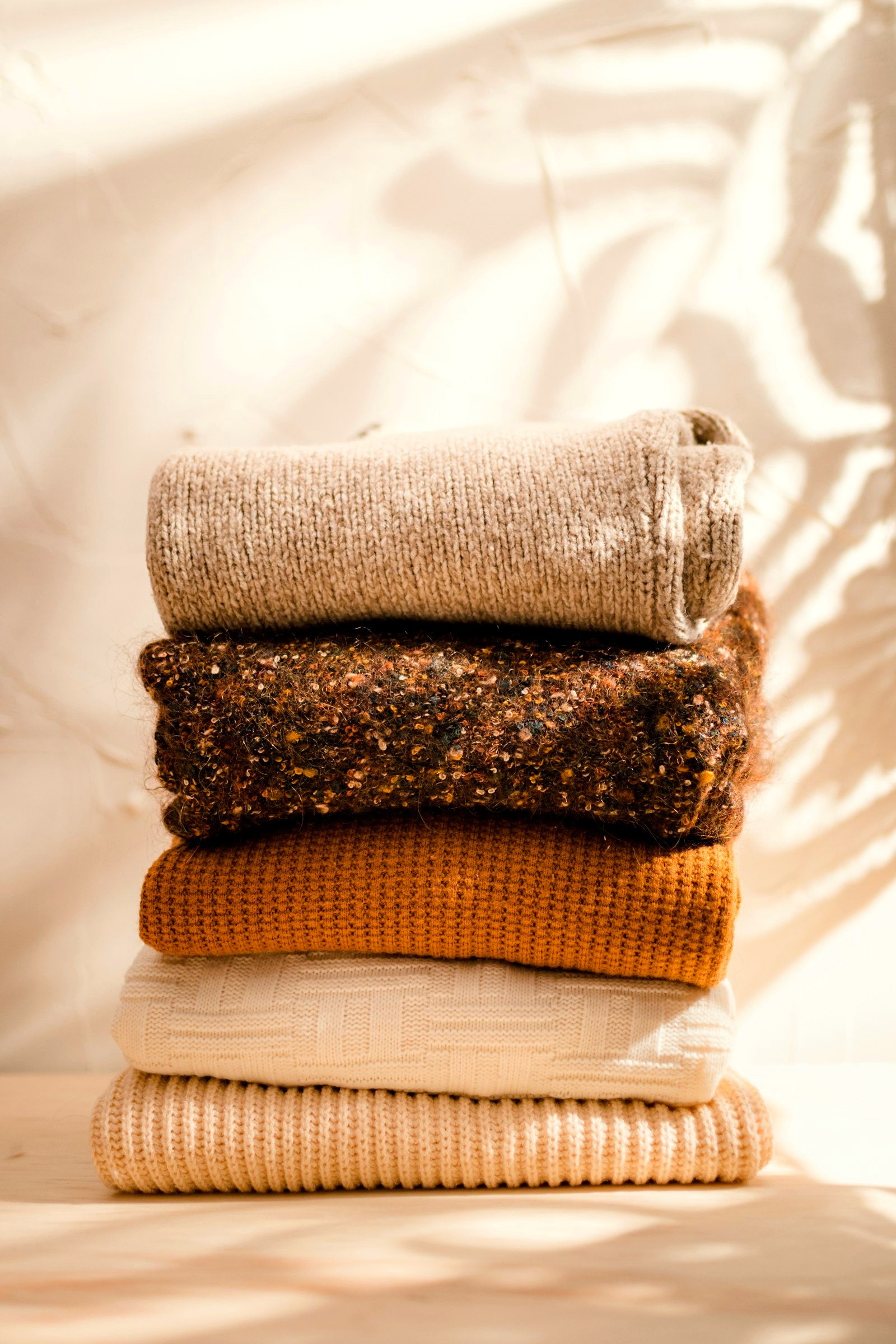
The palette the species wears, tan, olive and tobacco, in folded cloth. Our bank holds no photograph of a barn jacket worn in any species, a gap this page admits rather than covering with a borrowed shot, so the page opens on the colours themselves.
Checked and updated October 2026
The verdict, up front: eight barn jackets scored out of 100 on the house basis for the garment: cloth and weight honesty 30, collar and lining record 20, fit and layering 20, value 15, longevity and service 15. The Carhartt Duck Traditional Coat wins at 87: a 12 ounce firm-hand duck with an arctic-weight insulated lining, a published warmth rating and a corduroy-trimmed collar, at $139.99, the fullest record in the field at the field's working price. The Orvis Classic Barn Coat follows at 75, a 7.8 ounce canvas over yarn-dyed flannel at $169 in its published record, and it ships without a buy link because its maker's US page could not be read at this check. The J.Crew Barn Jacket of 2026 is third at 74, the 1983 icon rebuilt at the waist with its signature intact and its ounces withheld, at $228. And the jacket sent home, at 32, wears a contrast corduroy collar in a matching tone over a cloth described in its entirety as a technical cotton blend. The field's own question runs through every card: of eight coats, three publish a shell weight, none names a mill, six state their collar as corduroy cloth, and one publishes a warmth rating.
First, know which species you are in
The barn jacket is the chore coat's country sibling, and this ranking prints the boundary before it grades anything, because the rail sells four species under the barn name. The barn jacket, as this Card prints it: the chore-derived American country coat. Chore architecture, patch pockets outside and a button or zip front, carried at coat length, below the hip. A contrast collar as the signature, corduroy in the classic form, blanket cloth in the work form, standing against the shell's colour. A lining published as the warmth system, blanket, flannel, plaid or quilted, because a country coat is bought for the cold half of the year. And the barn colours: tan duck, olive, tobacco, brown, the register of the farmyard and the field rather than the workshop floor.
The neighbours, ruled the way this site rules them. Against the chore coat, ranked in Verdict Card No. 47: the chore coat stops at the hip, wears a plain collar, and is unlined or lightly lined by pattern, and its blanket-lined cold-weather form, Carhartt's chore coat at 82 there, is still a chore coat, because lining alone does not change the species; the collar, the length and the lining together do. Against the field jacket, ranked in Verdict Card No. 76: the field pattern was issued by an army, its pockets bellows, its waist drawstrung, its hood folded into its collar; the barn jacket's pockets are flat, its ancestry is agricultural, and no army issued it. Against the waxed jacket, ranked in Verdict Card No. 74: wax is a finish, and a garment whose weather system is wax is graded on that Card's standard, which is why the waxed barn coats the rail sells are cross-referenced there and not graded here. Against the quilted jacket, ranked in Verdict Card No. 53: quilting is a construction, graded on the fill standard there, which is where Burberry's quilted barn jacket already stands, sent home at 35 on a warmth record of one line. Cross-species garments are cross-referenced, never graded twice.
Two honest admissions belong in the boundary. Our jackets index files twelve types and the barn jacket is not one of them: the index folds the country coat into its neighbours, and this Card grades the species the index folds, the way the quilted Card graded a species the index files under other names. And the fashion cut is eroding the length marker the boundary rests on: the species' most famous coat, J.Crew's, returned in 2026 cut at the waist, where its 1983 original dropped well below it. The boundary holds on the whole pattern, collar, lining, architecture and register together, not on any single marker; a waist-length coat that keeps the rest is graded here, with the erosion charged on its card.
How the scores work
Every coat is scored out of 100 on the same five rows, settled from the work-coat Cards' basis, the chore coat Card's shape adapted to this garment. Cloth and weight honesty (30) reads the cloth record first: the shell weight in ounces as published, the fibre or composition stated or withheld, the mill named or silent, and the finish's terms printed or implied. Collar and lining record (20) reads the species' signature as cloth: the corduroy or blanket collar stated as a material or sold as a tone, and the lining published with its cloth named and its warmth rated or merely implied, because on this garment the lining is the warmth claim entire. Fit and layering (20) is scored against the species' own terms: the length against the below-hip line, the cut over layers, the movement built into the back and elbows, and the size library. Value (15) is the score divided by the bill, priced on the transaction where a list price is an opening bid. Longevity and service (15) is the life the construction can hold and the candour of the record behind it. One discipline governs the whole page: the houses behind these coats already stand ranked in this magazine, Carhartt at 77, J.Crew at 73, Banana Republic at 69 and Zara at 48 in their family rankings, with Orvis at 70 and Lands' End at 75 in the tree's brand record, and those brand scores are evidence here, never garment scores. Duck Head and Levi's hold no brand score here and none is created; their garments are graded on their own records. A house can stand high and its garment lower, or the reverse, and where that happens the card prints both numbers and lets the record explain them.
The ranking

Carhartt Duck Traditional Coat (C003)
Price at last check: $139.99 at Tractor Supply, on the maker's verified retail listing; the maker's own store has not been readable to this desk, the door precedent the chore coat Card set for this house.
Buy it on the fullest published record in the field: a weighed duck, a rated warmth system and a counted pocket set, at the price the species was invented at.
The cloth: 12 ounce firm-hand 100 percent ring-spun cotton duck, printed by the maker with its Wind Fighter technology named, over a quilted nylon lining to an arctic-weight 100 percent polyester insulation. That is the field's heaviest published shell and its only complete warmth system, and the cloth row's 26 pays for the completeness: weight, fibre and finish in one published block. The debits are printed rather than buried: no mill is named for the duck, a silence this field shares entire, since none of the eight makers names one, and the current coat is imported, where the species' memory is of an American-made garment.
The collar and the fit: the collar is corduroy-trimmed, the species' signature carried as a trim, with under-collar snaps for an optional hood, and the lining system is published to a warmth rating, Level 3, the field's only one. The collar and lining row's 18 credits the complete publication and charges the form: the warmth is a synthetic quilt, not the flannel the country register expects, and the collar is trimmed in corduroy rather than lined with it. Around it the working record completes itself: a two-way brass zip under a hook-and-loop storm flap, six pockets counted by the maker, two chest with flaps, two large lower-front and two interior, articulated elbows, rib-knit storm cuffs, a pleated bi-swing back and triple-stitched main seams, in a loose fit across sizes S to 6XL, with the garment's measurements, a 30 and three-quarter inch back length at M, published in the maker's spec sheet. The house stands at 77 in Brands Like No. 2; the garment places ten points above its house, because this record is what the house's ranking promises and rarely prints entire.
Orvis Classic Barn Coat
Published price: $169 in the garment's published record. The maker's own US product page could not be read at this check, so no current US price is printed and this card ships without a buy link.
Buy it, where you can read its maker's page, as the country species entire: a published weight, a yarn-dyed flannel lining and five pockets, the archetype the fashion coats are copies of.
The cloth: a 7.8 ounce cotton canvas, garment washed, printed in the garment's published record, which makes this one of three coats in the field whose weight a buyer can read, and the only one under $200 beside the winner. The cloth row's 22 credits the published number and the honest finish, a garment wash sold as softness rather than as a treatment, and charges what the record withholds: no mill, and a record carried by the sporting press and the maker's catalogues rather than by a product page this desk could read at this check, the same terms on which the field jacket Card graded this house's field coat at No. 3 there.
The collar and the fit: a corduroy collar in the species' classic form, and a lining of yarn-dyed, brushed flannel, the country coat's warmth system in its original cloth, which the collar and lining row's 16 credits entire: collar as cloth, lining as cloth, both published. Five pockets are counted in its record, with a double-zip closure, in a classic fit across sizes S to XXL and three colours. The house stands at 70 in this magazine's brand record; the garment places five points above its house. The value row's 12 carries the card's disclosure in a number: the $169 is the published record's price, not a price this desk watched being charged, and the maker's page is owed a fresh read in the next data pass.

J.Crew Barn Jacket in Duck Canvas (2026)
Price at last check: $228 at the maker's store.
Buy it as the icon with its signature intact: a corduroy-lined collar and a wool-blend tartan flannel lining, bought knowing the two charges on its card, the ounces withheld and the waist-length cut.
The cloth: a heavier-weight 100 percent cotton duck canvas, in the maker's launch record, which is one word of weight where the winner prints a number. No ounces stand anywhere behind the word heavier, and the cloth row's 21 charges the silence at the field's second-highest ranked price: the garment this coat descends from, the original the house still sells alongside it at $248 with the longer cut, built the species' reputation, and reputation is not a cloth record. The record this desk graded is the maker's published launch record as carried by the gear press at the coat's debut, labelled as such; the price and the stock were verified on the maker's own page.
The collar and the fit: here the signature is complete. The collar is lined in a soft fine-wale corduroy, the body is lined in a wool-blend tartan flannel, and the collar and lining row's 17 is the ranked field's best signature record, a point under the winner only because the winner publishes a warmth rating beside its lining. The furniture is published with it: a zip under a four-button storm flap, two large flap pockets where the original's overlapping pair stood, the single internal vent pocket kept, tab-and-button cuffs and a bi-swing back. The fit row's 15 carries the erosion this Card's boundary names: the 2026 cut sits at the waistline, boxier, where the 1983 original dropped well below the waist, so the coat now stands at the chore coat's length with the barn coat's collar, and the species' length marker is charged rather than excused. The house stands at 73 in its brand ranking; the garment places a point above its house.

Duck Head Duck Canvas Barn Coat
Price at last check: $348 at the maker's store, sold out in every size and colour at this check, so this card ships without a buy link.
Buy it, when it restocks, for the most precise cloth record in the field, a duck canvas weighed to two decimal places, at the field's highest ranked price.
The cloth: a substantial 10.38 ounce duck canvas, the maker's own figure, the most precise published weight in the field and the second heaviest, over a soft cotton flannel lining, with a water-repellent treatment named. The cloth row's 24 credits the precision and the treatment and charges the two silences beside it: no composition in percentages stands on the product page this desk read, the words duck canvas carrying the fibre by convention rather than by statement, and no mill is named. The maker's design director describes, in the trade press, a functional game pouch and a printed sportsman lining; the product page itself enumerates neither, and this Card grades the page, not the interview.
The collar and the fit: a classic corduroy collar, stated as cloth, and the flannel lining published, which the collar and lining row's 16 credits as the species' signature carried entire at the heritage register. The fit is a classic cut across sizes XS to XXL with a full published size guide. What the record does not publish is the pocket architecture: no count stands on the page, and on a Card that counts furniture, an unenumerated pocket set earns the fit row's 13 rather than the benefit of the doubt. The value row's 8 is the field's plainest arithmetic: $348 is the dearest ranked ticket here, for a coat that cannot currently be bought at all. The house holds no brand score in this magazine and none is created for it; the garment is graded on its own record.

Banana Republic Barn Coat
Price at last check: $189.99 charged at the maker's store against a $270 list, the house's promotions being habitual.
Buy it, on promotion only, as the archive coat with its paperwork in order and its signature missing: every fibre split published, and a plain point collar where the species wears corduroy.
The cloth: a rugged cotton twill, garment washed for lived-in colour and softness, with the fullest fibre accounting in the field after the winner: shell and body lining 100 percent cotton, sleeve lining 100 percent viscose, printed entire. The cloth row's 17 credits the candour and charges the missing number: no weight stands behind the word rugged, and a garment wash is a softening disclosed, not a finish with terms. The coat is an archive reissue, the house recreating a vintage piece from its own archives, the safari years our family ranking of the house prints as its foundation, the years of the barn coats and suede truckers.
The collar and the fit: the body is lined in a soft cotton flannel and the coat is fully lined, which the collar and lining row credits; and then the charge, printed plain. The collar is a point collar in the shell cloth. The archive detail the house chose to keep is the original's clip hardware, a snap-and-clip front closure, where the species' signature is the corduroy collar, and a reissue that keeps the clips and drops the collar has kept the ornament and dropped the definition. The row's 13 is that trade priced. The rest of the record is honest: a relaxed fit with a dropped shoulder, below-hip length, the species' length kept where the icon at No. 3 surrendered it, front pockets, sizes XXS to XXL. The house stands at 69 in Brands Like No. 16; the garment places seven points under its house, and the whole gap is the collar and the unpublished weight. The value row prices the transaction, never the list: at the $270 list this coat would sit lower, and the list is an opening bid this house's own calendar retracts.
Lands' End Canvas Barn Jacket
Price at last check: $129.95 list at the maker's store, cut to $58.47 on clearance at this check.
Buy it while the clearance lasts, as the species' full signature at the field's lowest transaction price: a flannel lining and a convertible corduroy collar on a canvas whose record runs two sentences deep.
The cloth: a canvas with, in the maker's words, the perfect bit of stretch, which is a composition claim with the composition withheld: no split stands in the record this desk could read, no weight, and the cloth row's 14 prices a canvas described by its hand rather than by its facts. Set beside the Orvis at No. 2, the catalogue species' other coat, the difference is the whole lesson of this Card's cloth column: the same register, the same signature, and one maker publishes 7.8 ounces while the other publishes an adjective.
The collar and the fit: and here the catalogue coat surprises. The collar is a convertible corduroy collar, stated as cloth, and the body is lined in a soft flannel for warmth without bulk, the maker's words, which is the species' signature carried entire, collar and lining both published, at the lowest list price in the ranked field. The collar and lining row's 14 is the signature at a catalogue depth of record: no warmth figure, no flannel weight, the lines present and thin. Layered patch pockets are published, the species' furniture in its catalogue form. The longevity row's 7 carries the clearance's meaning: a coat being cleared at 55 percent off is a model at the end of its run, and the garment's own seasons are a catalogue coat's seasons. The house stands at 75 in the tree's brand record; the garment places sixteen points under its house, the widest house gap on the page, because the house's score rests on its guarantee and its library, and this garment's record rests on two sentences.
Levi's Cotton Barn Jacket with Corduroy Collar
Price at last check: $138, the sale price at the maker's store, where the jacket is flagged a best seller.
Buy it as the transitional layer it is: a corduroy collar and an honest fibre line at a fair sale price, bought knowing no lining stands in its record at all.
The cloth: 100 percent cotton, published by the maker, which puts a complete fibre statement behind this jacket that several dearer coats here do not match. No weight is published, and the cloth row's 16 sets the two facts side by side: the fibre is a fact, the weight is an adjective, durable, and the row prices both.
The collar and the charge: the collar is a laydown corduroy collar, stated as cloth, and credited. And then the record stops. No lining appears anywhere in the maker's published record for this jacket: not flannel, not quilt, not an unlined construction stated as a position, simply silence where the species keeps its warmth. The collar and lining row's 8 is that silence priced, the lowest lining mark in the ranked field, because on this species the lining is not a detail, it is the warmth claim entire, and a barn jacket without one is a shell with a collar. The furniture is published and thin in the species' terms: a front zip, one chest pocket with a zip and two side pockets with snaps, three pockets where the winner counts six, in a standard fit. The house's garment evidence in this magazine is its 501, scored 81 in the jeans record; no brand score stands for the house here, and the garment is graded on its own record.
Zara Regular-Fit Jacket with Contrast Collar
Canadian price at last check: $199 at the maker's Canada store. It ships without a buy link, the way this desk sends home the garments it convicts.
Leave it. A contrast corduroy collar in a matching tone, over a technical cotton blend with no split a buyer can read, at a barn jacket's price.
The cloth: a technical cotton-blend fabric, the maker's entire cloth record for this garment on the page this desk read. No composition split stands behind the word blend, no weight, no mill, and the interior is lightly padded with the padding's fill unnamed, a warmth claim with neither a cloth nor a fill attached to it. The cloth row's 7 is what that record scores in a field where the winner prints 12 ounces and the catalogue coat at No. 6 is charged for an adjective: this garment does not reach the adjective, it reaches a category. It is the third Zara garment this desk has sent home, after the waxed-effect jacket at 40 in No. 74 and the utility jacket at 38 in No. 76, and the pattern across the three is the conviction: the house's outerwear records describe silhouettes, and the cloth column is where silhouettes go to be weighed.
The collar and the fit: the collar deserves its own sentence, because the maker wrote it. A contrast corduroy lapel collar, the product copy reads, in a matching tone. A contrast that matches is the species' signature reduced to a styling note: the corduroy is present as a texture and absent as a contrast, sold as a colour decision rather than worn as a cloth one, which is this Card's collar finding in the maker's own words. The furniture is the species' layout, front welt pockets and patch pockets with flaps, a zip concealed by a placket, in a regular fit, and the fit row's 10 credits the layout while the rows around it price the record. The garment is part of the house's Origins collection, its premium line, at $199 Canadian, which is barn jacket money at the icon's end of the field, for a record that would not fill the J.Crew's first paragraph. The house stands at 48 in Brands Like No. 6; the garment places sixteen points under its house.
The cloth, collar and lining table
Every entry below is the maker's own published record for the garment, checked against the maker's pages or their published listings in October 2026. Where the record is silent, the table prints the silence: on a barn jacket, the missing entries are the garment's warmth system, and the warmth system is the datum.
| Coat | Cloth, as published | Collar, as published | Lining, as published |
|---|---|---|---|
| Carhartt Duck Traditional Coat | 12 oz firm-hand 100% ring-spun cotton duck, Wind Fighter technology; mill not named | Corduroy-trimmed, with under-collar snaps for an optional hood | Quilted nylon to arctic-weight 100% polyester insulation; Warmth Rating Level 3 published |
| Orvis Classic Barn Coat | 7.8 oz cotton canvas, garment washed | Corduroy | Yarn-dyed brushed flannel |
| J.Crew Barn Jacket (2026) | 100% cotton duck canvas, heavier-weight; ounces not published | Lined in soft fine-wale corduroy | Wool-blend tartan flannel |
| Duck Head Duck Canvas Barn Coat | 10.38 oz duck canvas, water-repellent treatment; composition split not stated on the page read | Classic corduroy | Soft cotton flannel |
| Banana Republic Barn Coat | Cotton twill, garment washed; weight not published; shell and body lining 100% cotton, sleeve lining 100% viscose | Point collar in shell cloth; no corduroy published | Cotton flannel body lining; fully lined |
| Lands' End Canvas Barn Jacket | Canvas with stretch; split and weight not published in the record read | Convertible corduroy | Soft flannel |
| Levi's Cotton Barn Jacket | 100% cotton; weight not published | Laydown corduroy | None published |
| Zara Jacket with Contrast Collar | Technical cotton-blend fabric; no split readable on the page read | Contrast corduroy lapel collar, in a matching tone | Lightly padded interior; fill not named |
Read the table as the ranking does. The cloth column: a shell weight is printed where a buyer reads it by three of the eight makers, Carhartt at 12 ounces, Duck Head at 10.38 and Orvis at 7.8, and a composition in percentages by five of eight. A mill is named by none of the eight, the field's cleanest silence: the waxed field named two mills in eight garments, this field names none, because the barn jacket's cloth is a commodity duck and canvas the trade buys unnamed, and the makers print the convention. The collar column, this Card's own count: corduroy is stated as a cloth by six of eight, in forms from the winner's trim to the icon's fine-wale lining; one collar is a point collar in shell cloth, the reissue at No. 5, and one is a contrast in a matching tone, the skip. The lining column: a lining is published by seven of eight and its cloth named by six, flannel or a flannel blend in five, an insulated quilt system in one, a padded interior with no fill named in one; a warmth rating is published by one maker and an insulation weight in grams by none, so the species' warmth, the thing the coat is bought for, rests on cloth names everywhere except at the winner, where it rests on a rating. The pocket count, read with them: a countable pocket total is published by four of eight, the Carhartt's six, the Orvis's five, and three each for the J.Crew and the Levi's.
Cost per wear, printed in the open
The assumption, printed before the numbers: a barn jacket in rotation is worn about 45 times a year across the cold half of the year. The life column is the service life our longevity row scores for, counted in years for coats whose construction is published and on the record's own terms where it is not. The Banana Republic figure is the price charged at this check, not its list; the Lands' End figure is its clearance price, and its list price is printed beside it in the reading below.
| Coat | Price | Scored life | Cost per wear |
|---|---|---|---|
| Carhartt Duck Traditional Coat | $139.99 | 15 years | $0.21 |
| Lands' End Canvas Barn Jacket | $58.47 on clearance | 6 years | $0.22 |
| Orvis Classic Barn Coat | $169 | 12 years | $0.31 |
| Levi's Cotton Barn Jacket | $138 | 7 years | $0.44 |
| J.Crew Barn Jacket (2026) | $228 | 10 years | $0.51 |
| Banana Republic Barn Coat | $189.99 charged | 8 years | $0.53 |
| Duck Head Duck Canvas Barn Coat | $348 | 12 years | $0.64 |
| Zara Jacket with Contrast Collar | $199 CAD | 3 years, generous | $1.47 CAD |
The table's shape is the field in miniature. The cheapest wear is the fullest record at the working price, and the second cheapest is a clearance: the catalogue coat at $58.47 nearly ties the winner while its clearance lasts, and at its $129.95 list it would sit at about 48 cents, which is the honest way to read a closing price. The heritage coat at $348 wears at 64 cents because a weighed canvas earns a long denominator. And the skip is the dearest wear on the page at about $1.47 Canadian despite a middling ticket, which is the fashion arithmetic stated plainly: an unpublished cloth has no life a ranking can score for, so the cheap jacket is the expensive one.
Which jacket to buy
If you buy one: the Carhartt, the only complete system in the field, a weighed duck, a rated lining and six counted pockets, at $139.99. If the country archetype is the argument: the Orvis, bought where its maker's page can be read, on the strength of a published weight and a yarn-dyed flannel. If the icon is the point: the J.Crew, bought with its two charges known, the ounces withheld and the waist-length cut. If cloth precision is what you read first: the Duck Head, when it restocks. If the archive is the point: the Banana Republic, on promotion only, its collar known before you pay. If the budget is the point: the Lands' End at its clearance, or the Levi's as the transitional layer it honestly is. Wearing the species' siblings well is briefed in How to Wear a Chore Coat, How to Wear a Waxed Jacket and How to Wear a Field Jacket; the neighbouring species are ranked in Verdict Card No. 47, No. 74 and No. 76, and the quilted form in No. 53.
Questions, answered
What are the best barn jackets for men?
The Carhartt Duck Traditional Coat, scored 87 out of 100: the field's fullest published record, a 12 ounce firm-hand duck with its insulation, lining and warmth rating all printed by its maker, a corduroy-trimmed collar and six counted pockets, at $139.99. The Orvis Classic Barn Coat follows at 75, a 7.8 ounce cotton canvas over a yarn-dyed flannel lining at $169 in its published record, graded without a buy link because its maker's US page could not be read at this check. The J.Crew Barn Jacket of 2026 is third at 74, the icon rebuilt with a corduroy-lined collar and a wool-blend tartan flannel lining at $228, with its cloth's ounces withheld and its cut shortened to the waist. The jacket sent home, at 32, sells a contrast corduroy collar in a matching tone over a cloth its maker calls a technical cotton blend and nothing more.
What counts as a barn jacket?
On this site's printed record, the chore-derived American country coat: chore architecture, patch pockets and a button or zip front, at coat length below the hip, with a contrast corduroy or blanket collar as its signature and a published lining, blanket, flannel, plaid or quilted, as its warmth system, in the barn colours, tan duck, olive, tobacco and brown. It is not the chore coat of Verdict Card No. 47, which stops at the hip with a plain collar and is unlined or lightly lined by pattern; it is not the field jacket of No. 76, whose pockets bellows and whose pattern was issued by an army; and it is not graded by wax or by quilting, a finish and a construction ruled whole in Nos. 74 and 53. Our jackets index does not file the barn jacket among its twelve types; this Card grades the species the index folds into its neighbours, and says so.
Barn jacket or chore coat: what is the difference?
Length, collar and lining, read together. The chore coat ranked in Verdict Card No. 47 is a workshop garment: hip length, a plain collar, three or four patch pockets, and unlined or lightly lined by pattern, with Carhartt's blanket-lined chore coat at 82 there as the cold-weather form of that species. The barn jacket takes the same architecture to the country: below the hip, a collar in corduroy or blanket cloth that contrasts with the shell, and a lining published as the garment's warmth system. A garment that keeps the chore pattern's length and plain collar is graded as a chore coat; a garment that keeps the barn pattern's collar, length and lining is graded here; and a garment another Card owns, the quilted barn jacket Burberry sells, sent home at 35 in the quilted Card, is cross-referenced and never graded twice.
Who publishes the cloth weight, the collar and the lining?
Three of the eight makers here publish a shell weight where a buyer reads it: Carhartt at 12 ounces, Duck Head at 10.38 ounces and Orvis at 7.8 ounces. A composition in percentages is printed by five of eight, and a mill is named by none of the eight. The collar, the species' signature, is stated as corduroy cloth by six of eight; one maker, Banana Republic, fits a point collar in shell cloth instead, and one, Zara, sells a contrast corduroy collar in a matching tone. A lining is published by seven of eight and its cloth named by six, flannel or a flannel blend in five; a warmth rating is published by one maker, Carhartt, and an insulation weight in grams by none.
Is a barn jacket warm?
Only as warm as its lining, and the lining is the line to read. Five of the eight coats here line the body in flannel or a flannel blend, one lines it in an insulated quilt system with a published warmth rating, Carhartt's Level 3, one pads its interior without naming the fill, and one, the Levi's, publishes no lining at all and is a transitional layer whatever its name says. No maker in the field publishes an insulation weight in grams, so every warmth claim beyond Carhartt's rating is a cloth claim: flannel over a duck or canvas shell is a three-season coat, and this ranking scores the lining record, never the adjective.
How much should a good barn jacket cost?
The ranked field runs from $58.47, a catalogue coat on clearance at this check, to $348 for the heritage coat, which was sold out in every size. The honest middle is $139.99 to $228, where the three fullest records stand: the Carhartt at $139.99, the Orvis at $169 in its published record and the J.Crew at $228. Cost per wear rearranges the top less than the bottom: at forty-five wears a year the Carhartt costs about 21 cents a wear across fifteen years and the clearance catalogue coat about 22 cents across six, while the $199 Canadian skip, given a generous three years, costs about $1.47 a wear, the dearest wear on the page.
How this ranking stays honest
Rests, boundaries and door notes, printed. The Burberry Haddington, sold as a quilted barn jacket, was not graded here: it stands in the quilted Card, No. 53, sent home at 35 on its fill record, and this Card cross-references it rather than grading a garment twice. L.L.Bean sells no distinct men's barn coat this desk could find: the coat its reviewers call a barn coat is its Original Field Coat, ranked at 84 in the field jacket Card, and it is cross-referenced there. Dickies' current barn-adjacent coat is a waxed canvas chore coat, two other species' garment at once, and Berne's is chore-named; both were rested by the boundary. Duluth Trading's Best Made barn coat is a waxed canvas garment whose current record this desk could not verify, and it waits for one. H&M sells barn jackets and was rested deliberately, and no H&M garment is engaged or scored on this page. On doors: five cards carry a buy link. The J.Crew, the Banana Republic, the Lands' End and the Levi's link their makers' own product pages; the Carhartt links its verified Tractor Supply listing, the maker's own store having not been readable to this desk, the precedent the chore coat Card set for this house. The Duck Head card ships without a buy link because the coat was sold out in every size and colour at this check; the Orvis card ships without one because its grade rests on the garment's published record and its maker's US page could not be read; the skip ships without a link, as convicted garments do. On photography: this page uses cloth, rail and ground studies from the magazine's own bank, no product photography, and the bank holds no barn-jacket-on-body frame in any species, a gap this page repeats rather than covering with a mislabelled picture. Prices and records were checked against the makers' own listings in October 2026; where a figure rests on the published record rather than the maker's page, the card says so, and the next data pass owes the Orvis a current price and the Duck Head a restock check. The full method is written out on the methodology page.