

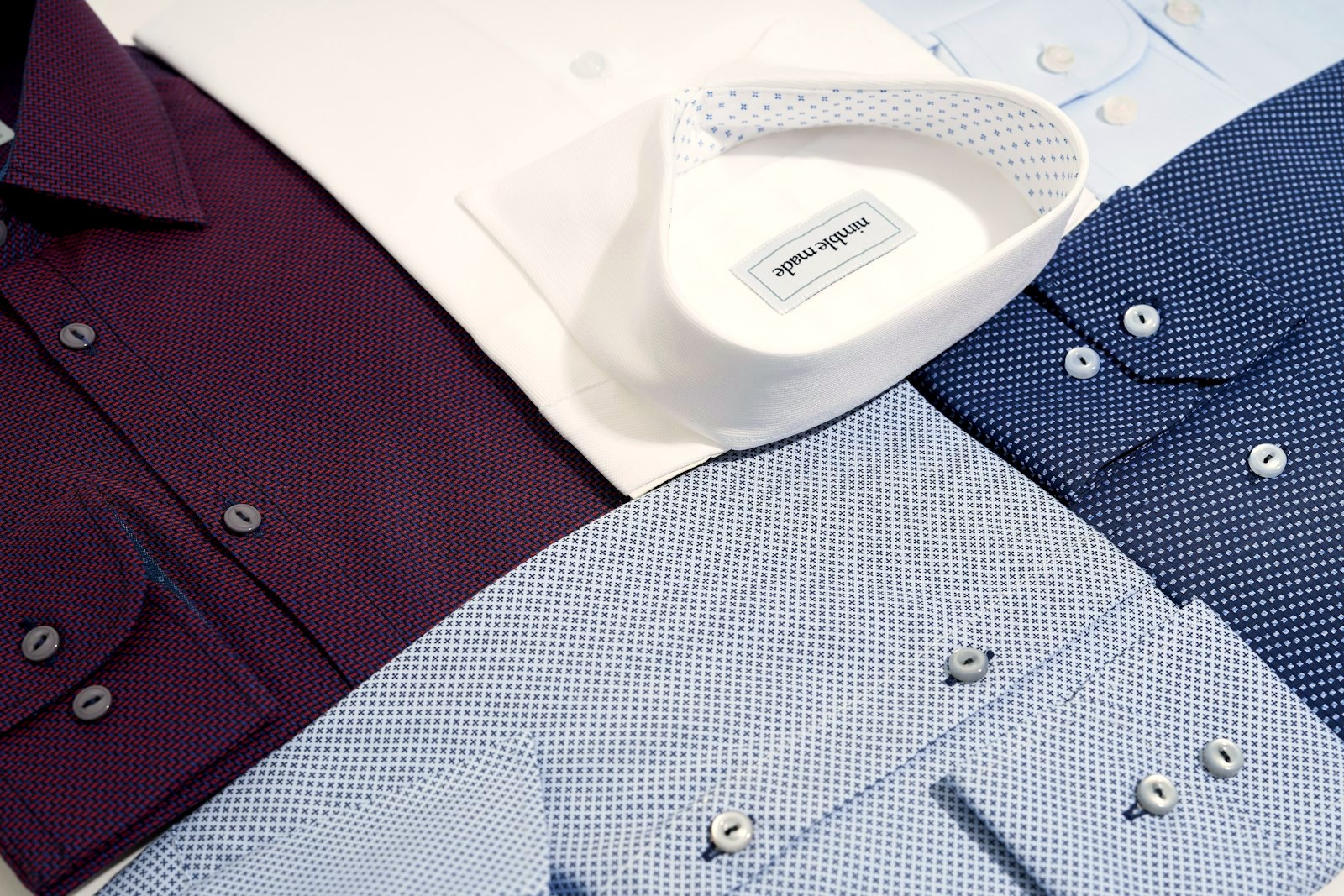
The stripe, in its flat form: a blue and white striped shirt, CREDITS-logged, captioned as exactly that. The bank holds no seersucker frame of any kind, no puckered stripe, no suit in the cloth, and this page prints that absence rather than dressing a flat weave as its subject; the care section prints the gap and the harvest list entire.
Checked and updated October 2026
The ruling, up front: seersucker is a heat instrument before it is a pattern. Its stripe is not decoration. The cloth is woven with its warp threads at two tensions, tight and slack in alternating bands, so the slack bands pucker and the finished cloth carries raised stripes that hold it off the skin: only the flat bands between the stripes rest on the body, air moves in the channels the pucker makes, and the garment does not cling as it takes up moisture. That mechanism is the whole licence. Seersucker is worn where the heat is real and the room allows a summer cloth, and its register is capped: it is a daytime summer suit, standing in the summer row of the tailored wardrobe beside linen and fresco, and it does not cross into the evening, into ceremony, or into any room where the heat that justifies it is absent. The classic form is the blue stripe on white; the tonal forms, white on white and the dark grounds, run the same instrument at a quieter volume. The failures are priced from the rule: worn as a costume of Southern nostalgia it is fancy dress, and worn where no heat licenses it, the stripe reads as sleepwear. This brief prints the cloth’s record first, the weave and its published history; then the pairing law; then the rooms and hours; and the looks, the ruling, the mistakes and the keeping after all of it. On scores: no Card grades this cloth, and none is invented here; the records cited are the family’s standing law, named where they stand.
This brief: the decisive rule · the cloth’s record · the pairing law · the rooms and hours · the looks · the ruling · the mistakes · care, the cloth’s keeping, and our photography
The decisive rule: a heat instrument before it is a pattern
Most cloths in this family are governed by their register, and the briefs argue about where a garment stands: the monk strap between the loafer and the Oxford, the double-breasted suit one step dressed above the foundation. Seersucker is governed by something prior to register, and this brief’s spine is the fact of it. Seersucker is a heat instrument before it is a pattern. The puckered stripe, the thing every eye reads first and the thing the cloth is bought for in the imagination, is not a design applied to a summer cotton. It is the working surface of a cooling device. In the loom the warp is held at two tensions, thread bands pulled tight and thread bands left slack, side by side, the length of the cloth. The tight bands weave flat. The slack bands have more thread than the space they are given, and cloth with too much thread in it has nowhere to go but out: it rises, permanently, in soft lengthwise ridges. The finished garment therefore touches its wearer only along the flat bands. The ridges hold the rest of the cloth away from the skin, the air occupies the channels between ridge and body, and the two failures of summer clothing, the cling of a damp flat cloth and the sealed layer of a cloth resting everywhere at once, are both engineered out of the garment before it is cut. The stripe is what the mechanism looks like. The mechanism is what the cloth is.
The rule’s working half is that the licence is earned by temperature and not by charm. A linen suit cools by its fibre’s hand and its open hand-loomed slub; a fresco cools by its porous weave; seersucker cools by its geometry, and geometry does not care what month the calendar shows, only what the air is doing. Worn in genuine heat, the cloth is the most rational suiting in the wardrobe, a suit that keeps its tailored line while standing off the body it covers, which is why its published record, printed in the next section, is a record of professional men in hot cities wearing it as working dress rather than as leisure’s fancy. Worn where the heat is absent, the same garment loses its argument and keeps only its stripe, and a stripe without its argument reads as the two things this brief’s mistakes section prices: a costume, when the wearer leans into the cloth’s nostalgia, and sleepwear, when he does not, the puckered stripe in a cool room sitting closer to the pyjama’s family than to the suit’s. The comparison that prices the rule is the cloth’s own stablemate. Our tweed brief rules a cloth whose texture is its substance and whose failure is the costume; seersucker is the summer term of the same law, a cloth whose surface is a function, judged first by whether the day calls for the function at all.
What the instrument buys, at that price, is the only suit in the wardrobe whose comfort improves as the room gets worse, and the register it stands at is fixed by the bargain. Seersucker’s formality is a range with a lid. Inside the summer rows it is a complete suit, worn closed, furnished under the suit’s ordinary law, and this family’s standing record seats it there without apology: No. 63, printing the outfit matrix of No. 04, seats linen, fresco, seersucker and the open weaves together in the matrix’s summer row, the tailored wardrobe’s warm-weather register. Above that row the cloth does not travel. It is not an evening cloth, not a ceremony cloth, and not a cold-weather answer to anything, and the rooms section below is simply the list of places where heat and register coincide. The wearer who understands the instrument owns the most comfortable suit in summer and the most misunderstood one in every other season, and the difference between the two is not the suit. It is whether the day licensed it.
The cloth’s record: the weave, the name, and the washable suit
The weave first, because in this cloth the construction is the biography. Seersucker is a slack-tension weave: the lengthwise threads, the warp, are fed to the loom in alternating bands under different tensions, one band drawn tight, the next left slack, and the weft beaten in across both. The tight bands lie flat and smooth. The slack bands, carrying more length than the cloth’s plane allows, buckle outward into the puckered stripes that give the cloth its handle and its name in the trade. Nothing is added and nothing is applied: no embossing, no chemical crimp, no finish that washing could strip. The pucker is the cloth’s structure, which is why a seersucker garment a generation old puckers exactly as it did when it was cut, and why the care section’s one prohibition, the full flat press, is a structural matter rather than a fastidious one. The ground is cotton, in the classic cloth entirely, and the stripe’s colour rides on the raised bands in the form the next section prices, blue on white standing first in the record.
The name is the published record’s, and it is printed the way this family prints a shoe’s name, as the record stands. Seersucker comes from the Persian shir o shekar, milk and sugar, carried through Hindustani into English trade language, the milk for the smooth bands and the sugar for the rough ones, a name that describes the cloth’s two surfaces before it describes anything else. The cloth’s working life begins in India and the hot stations of the colonial world, where a cotton that stood off the skin was a practical technology before it was a style, and it crosses to America in the humblest registers first: workwear, uniforms, the clothing of men whose summers were spent outdoors or in uncooled rooms. Its tailoring career is a New Orleans story. Joseph Haspel, from 1909, built a house on the proposition that the cloth could be a suit and the suit could be washed: the seersucker suit as he sold it was laundered like a shirt and worn again the next day, a claim so foreign to the tailoring of its period that the house’s own legend has him demonstrating the wash in public. The American South, whose professional summers no wool suit was built for, adopted the garment wholesale: the seersucker suit became the region’s summer professional dress, courtrooms and capitols included, and its institutional afterlife stands in the record as the Senate’s Seersucker Thursday, a summer tradition from 1996, the cloth worn in the chamber as a deliberate quotation of the working summers it was built for. That is the whole history this brief needs, and it is the rule’s evidence: at every station of the record, the cloth was chosen by men who were hot, for the mechanism, and the nostalgia that now surrounds it is the residue of a century of use, not the use itself.
The cloth’s record on this site is shorter, and it is printed entire because this brief rules inside it and adds nothing to its numbers. The suit matrix seats the cloth in the summer row, as the rule section prints, and No. 63 writes its shoe licence in the cloth’s own name: suede’s licence, in that brief’s sentence, is written in cloth, fresco, linen, seersucker and the open weaves, the unstructured jacket, the lighter colours, the suede shoe licensed by the summer cloths as a class. The shirt record files the cloth one register down and at a different station: the camp collar brief files the shirt at formality 2, in rayon, linen and seersucker, the heat’s cloths, under Verdict Card No. 14, whose winner, the Todd Snyder camp collar, stands at 84: the cloth worn as a shirt is the wardrobe’s hot-day instrument at its most relaxed, which is the same cloth at a different formality, the difference being the garment and not the weave. And the underwear shelf closes the record with the family’s typical honesty: the boxers Card’s weave ladder names the cloth and seats none of it, seersucker: the puckered summer weave, named here because the ladder should be complete; no seersucker pair made this field on verifiable evidence. No Card grades the cloth as a suit, no blazer ranking seats it, and this brief, ruling the wearing, invents no score to fill the space: the cloth’s standing on this site is a summer-row seat, a shoe licence, a shirt at formality 2, and a ladder’s honest blank, and that is record enough to rule from.
The pairing law: one pattern at scale, and the summer row’s shoes
The pairing law’s first principle is scale. The stripe is a pattern, and it is priced the way our tweed brief prices a check: what reads as pattern from across the room is pattern, and a chest carries one pattern at scale at a time. The classic blue and white stripe reads as pattern at any distance past a handshake; it is therefore the outfit’s single loud element, and everything worn with it is chosen at the volume of texture or of plain. The shirt is plain: white first, the palest blue behind it, in a flat Oxford or a plain poplin, its collar a proper shirt collar with a stand. A striped shirt under a seersucker jacket is the standing error, two stripe scales arguing at the chest, and a checked shirt is the same error in the other axis. The one licensed exception stands in the site’s own record and is a change of garment, not a doubling: the seersucker camp collar shirt, the cloth worn as the shirt itself at formality 2, over plain trousers or shorts, where the stripe is the whole outfit’s pattern because there is no jacket above it to argue with. The tie, where the room asks for one, is matte and quiet. A knit tie in a sober colour, or a grenadine, whose texture answers the cloth’s texture without competing with its pattern; the tie shelf’s winner stands at 91 on Verdict Card No. 40 and its law is No. 64’s entire. A glossy silk tie is refused on the cloth’s own logic: shine is a second surface statement on a garment whose surface is already the statement, and the pairing reads as two finishes bidding.
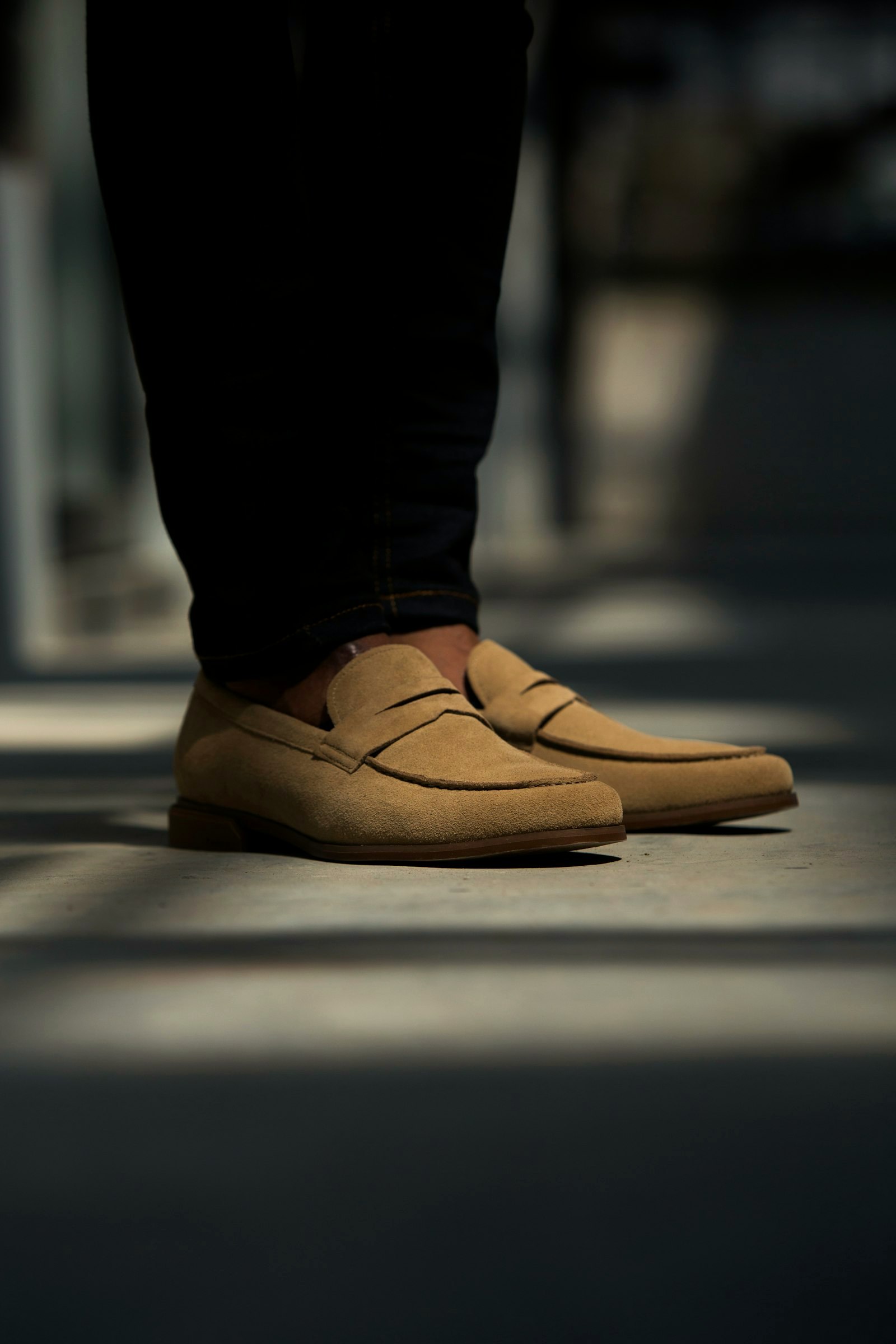
The shoe rows are inherited, not re-argued, and they are No. 63’s, printed for the summer row this cloth stands in. That brief seats the species by number on the row: the suede penny at 3, the suede tassel at 3.5, the suede horsebit at 4, with the polished horsebit at 4.5 the species’ ceiling on the row, and its sock law for the summer rows is unqualified, the no-show, always. Suede is the row’s standing material for the reason No. 63 prints in this cloth’s name: the summer cloths license it, its matte nap sitting at the same volume as the pucker’s texture, where a polished calf Oxford would import the boardroom’s finish into a summer register and read dressed past the cloth. The tradition’s own shoe stands beside the record as a tradition: white bucks, the dirty-white suede derby of the cloth’s American century, worn with the classic blue and white form by men quoting the record knowingly. This brief licenses them as quotation, priced as quotation: they are the costume line’s near side, correct in the cloth’s home rooms and in high summer, and a half-step toward fancy dress anywhere the wearer is not prepared to own the reference entire. The trousers, where the jacket is worn as a separate, are plain and pale: cream, stone, white, the flat cottons and linens of the summer wardrobe, never a second stripe and never a dark winter trouser, whose weight of colour argues with the cloth’s whole premise. The jacket worn as a separate is this brief’s recommended dose for most wardrobes, and the looks below seat it so.
The forms close the section, because the cloth is sold in more than its classic stripe and the forms are registers, not colours. The classic form, blue stripe on white, is the full statement: the pucker and the pattern at once, the form of the record and of the cloth’s home rooms, and the form whose ceiling is lowest, since a pattern this legible cannot pretend to be anything but a summer suit enjoying itself. The tonal forms weave the pucker in a single colour, white on white above all, or carry it on dark grounds, navy and grey: the mechanism entire, the stripe read as texture rather than pattern, the instrument at a quieter volume. The tonal suit is the form for the wearer who wants the cooling without the quotation, and it stands a half-step nearer the cloth’s ceiling, texture being priced below pattern in every room this family grades; it does not cross the ceiling, because the pucker’s texture still announces a summer cloth at conversational distance, and no form of seersucker has ever been an evening garment. The checked forms, gingham seersucker the standing example, lay the pucker over a check and are the cloth at its most casual: shirts, shorts and holiday jackets, the formality 2 territory of the shirt record, refused as suiting in this brief’s rows. The choice among the forms is the wardrobe’s one real decision in this cloth, and it is a decision about volume: the classic for the rooms that ask for the full record, the tonal for everything else the licence covers.
The rooms and hours: licensed by heat, capped at the evening
The cloth’s rooms are the places where its two conditions coincide, real heat and a register the summer row covers, and the list is shorter than the cloth’s admirers suppose. The outdoor summer wedding is its founding room: the garden ceremony, the afternoon reception, the marquee in July, rooms where the invitation asks for a suit and the weather forbids the wardrobe’s ordinary ones, and where seersucker, worn closed and furnished plainly, is not the relaxed reading of the dress code but its correct execution. The summer’s social day rooms stand beside it: the races, the garden party, the christening, the long lunch outdoors, the whole calendar of occasions that happen in heat and ask for tailoring. The working licence is regional and historical and still real: in the hot-climate city, the cloth remains what its record made it, professional summer dress, the suit of the courtroom and the office where the summer is a season of genuine temperature; the same suit in a cool-climate boardroom is a quotation without a referent, and it reads as one. The hours follow the rooms: this is a daylight cloth, its stripe and its texture both drawn for sun, and its register falls with the light even inside its season.
The refusals are three, and each is a confusion the rule predicts. The first is upward: seersucker does not enter the evening’s formal rooms at any form’s volume. Black tie is a fixed uniform under No. 67, its grammar closed, and a seersucker dinner jacket is the ladder’s half-sentence in a summer cloth; the formal summer evening that is not black tie still asks for the dark plain suit, and the pucker’s texture is a daytime surface whatever its colour. The second refusal is ceremonial: the funeral, the formal ceremony, the rooms where dress is a discipline of not being noticed, refuse a cloth whose stripe is noticeable by construction; the summer row’s plain members, the light grey fresco, the pale linen worn soberly, carry those rooms, and seersucker’s absence from them is its register’s price, not its failure. The third refusal is the calendar’s: out of heat, the cloth has no licence at all. Not in winter under any layering argument, not in a cool spring room because the date is near summer, not indoors in January because the heating is fierce: the licence is the weather’s, and a licensing condition that can be argued around was never the rule. The Senate wears its seersucker on a Thursday in June. It does not wear it in December, and neither does this brief.
The looks: three assemblies the brief licenses
| Setting | The assembly | The details | The judgment |
|---|---|---|---|
| The classic suit, in its home room | A blue and white seersucker suit, worn closed, over a plain white shirt | A matte knit tie where the room asks for one, suede loafers from the summer row’s seating, no-show socks, the hem at No. 04’s slight break | The cloth at its founding register: the full record, stripe and mechanism together, correct because the heat is real and the room is the one the suit was built for |
| The tonal form, at the ceiling’s near side | A white-on-white or navy tonal seersucker suit, the pucker read as texture, over a plain pale shirt worn open at the collar | Suede horsebit loafers at the summer row’s upper seats, no tie, the square at white linen’s discipline if one is carried at all | The instrument at its quietest: the cooling entire, the quotation withdrawn, the form for the wearer who wants the cloth’s function without its folklore |
| The jacket as a separate | A classic stripe seersucker jacket over plain cream or stone trousers in a flat cotton or linen | A plain white or pale blue shirt, suede penny loafers, no-show socks, nothing else patterned anywhere in the assembly | The recommended dose for most wardrobes: the stripe at jacket scale over a plain field, the suit’s commitment halved and its licence kept entire |
| The cloth as a shirt | A seersucker camp collar shirt, the shirt record’s formality 2, over plain shorts or trousers | No jacket, no tie, the summer row’s relaxed shoes; the stripe is the assembly’s only pattern because nothing stands above it | The heat’s cloth at its most relaxed station: the instrument worn as a shirt, licensed by the same heat and capped far below the suit’s rows |
The ruling
Wear seersucker as the instrument it is. Buy it for heat you actually live in: the classic blue and white if your summers hold the rooms the cloth was built for, the tonal form if you want the cooling without the quotation, the jacket as a separate if your wardrobe wants the dose at half commitment. Wear the suit closed and furnished plainly, a flat white or pale shirt under it, matte at the tie, suede at the shoe under the summer row’s seating, and nothing else patterned at scale anywhere on the body. Keep it in its hours, the summer day, and in its rooms, the outdoor wedding, the social day, the hot city’s working summer. Keep it out of the evening, out of ceremony, and out of every month whose weather does not sign its licence. Ruled so, seersucker is what its record says it has always been: the professional answer to a hot day, a suit whose comfort is engineered into its surface, worn by a man who chose it for the mechanism and lets the stripe be what the mechanism looks like.
Where the wearing goes wrong
The costume. The failure this cloth shares with tweed, in its summer form: seersucker worn as a character, the full quotation assembled at once, the bow tie and the straw hat and the white bucks and the manner to match, the wearer playing the Southern gentleman of the cloth’s folklore rather than wearing its suit. It fails on the record’s own evidence. The men who made the cloth’s reputation wore it as the plainest working dress their climate allowed, one garment chosen for its mechanism; the costume takes the garment and adds every accessory the folklore supplies, converting a suit into a fancy-dress entry whose subject is the past. The repair is subtraction: the suit, the plain shirt, the summer row’s shoes, and nothing that winks. A wearer who wants the reference owns it by wearing the cloth straight, the way its record wore it.
The stripe doubled. The pattern failure: a second pattern at scale worn with the suit, the striped shirt under the striped jacket, the checked tie over the blue and white, the patterned square in the breast pocket. It fails on the pairing law’s arithmetic. The stripe is a pattern that reads across a room, and two patterns at competing scales do not average into richness; they read as static, the eye unable to settle on either, the cloth’s clean mechanism muddied by noise at its own station. The tonal forms relax the rule by exactly their volume, texture permitting a quiet pattern elsewhere; the classic form permits none. The repair is the law’s: one pattern at scale to a chest, and on this cloth the chest’s pattern is woven in before the wearer makes a single choice.
The licence argued around. The calendar failure: seersucker worn where the heat is not, the cool spring day, the air-conditioned formality, the winter wedding abroad argued as somebody’s summer. It fails because the licence is the garment’s whole argument, and a garment worn past its argument keeps only its surface: the puckered stripe in a cold room reads as pyjamas, the cloth’s stripes sitting in the sleepwear family’s register when nothing in the weather explains them. It is the mistake with no repair at the mirror, because the suit is correctly assembled and correctly worn and wrong only in the one fact the wearer cannot change at the door, the temperature. The repair is the wardrobe’s: the fresco and the linen stand in the same summer row for the season’s cooler half, and seersucker waits for the days that sign for it.
The formality push. The ceiling failure: the cloth asked to do an evening’s or a ceremony’s work, the seersucker suit at the formal dinner, the striped jacket standing in for the dark suit, on the reasoning that a suit is a suit. It fails on the register the cloth cannot shed. The pucker is a texture, the stripe is a pattern, and both announce a summer day at conversational distance whatever the hour on the invitation; the wearer has not dressed down an acceptable suit but dressed a daytime instrument in a formal room, and the room reads the difference even when he does not. No. 67’s sentence covers the black tie end of it, and the plain end needs no authority beyond the matrix’s: the summer row is a row, with rows above it, and the rows above it are where the evening lives.
The pucker pressed out. The keeping failure, committed by a cleaner rather than a wearer: the suit returned from a full flat press with its ridges ironed down, the jacket’s surface smooth, its mechanism flattened at every stripe the iron crossed. It fails structurally. The pucker is the cloth’s working surface, the raised bands are what hold it off the skin, and a pressed-flat seersucker is a cotton suit with a stripe and no instrument left, the one garment in the wardrobe that a standard service can ruin by doing its standard job well. The repair is instruction, printed in the care section: steam, hang, press only where the cloth is flat, and tell the cleaner the garment’s name before he tells you his price.
Care, the cloth’s keeping, and our photography
Seersucker is kept as the cotton it is, with one prohibition that follows from its weave. The wash is the cloth’s founding economy: the suit Haspel built his house on was washed and worn again, and the modern garment keeps the terms, the trousers washed as cotton trousers, the jacket washed gently or cleaned on the suit’s ordinary economy according to its construction, canvassed jackets to the cleaner and unstructured ones to the wash as their makers direct. The pucker needs no keeping at all, being structure rather than finish: it does not wash out, wear out or relax out, and a decade-old seersucker stands off the skin exactly as a new one does. The prohibition is pressure. A hot iron laid flat across the stripes, or a cleaner’s full press taken without instruction, flattens the raised bands and with them the channels the whole garment exists to make. The refresh is steam, the distinction the garment-care shelf grades at Verdict Card No. 126, where the Jiffy J-2000 stands at 88 on the strength of its printed record: hang the suit, steam the day’s creases out of it, press nothing but the trouser’s crease line and the shirt. Storage is the suit’s ordinary law, a wide hanger and rest between wearings, with one addition the cloth’s lightness argues for: it is hung away at the season’s end clean, cotton being a fibre that rewards being stored washed, and brought out when the weather signs for it, which is the wardrobe’s calendar keeping itself.
The rulings this brief prints beyond the tree’s standing record are gathered here once, the way the family gathers its extensions. The seats and laws are the family’s, cited as theirs: No. 04’s summer row and its break ladder, by way of No. 63’s printing of the matrix; No. 63’s summer-row shoe numbers, suede penny 3, suede tassel 3.5, suede horsebit 4 and the polished horsebit’s 4.5 ceiling, its cloth-written suede licence and its no-show law; the camp collar brief’s formality 2 filing of the seersucker shirt and Verdict Card No. 14’s winner at 84; the boxers Card’s weave ladder and its honest blank; No. 67’s fixed uniform; No. 64’s tie law and Verdict Card No. 40’s winner at 91; No. 68’s pattern scale law, transposed; and Verdict Card No. 126’s steam-over-pressure distinction, at 88. This brief’s own are: the heat instrument stated as the cloth’s decisive rule, with the pucker’s mechanism made load-bearing; the licence priced by temperature rather than by season’s name; the formality stated as a range with a lid, the summer row beneath an evening it cannot enter; the forms priced as registers, classic, tonal and checked, by the volume at which the stripe reads; the jacket-as-separate dose; white bucks licensed as knowing quotation; and the flat press graded as the cloth’s one destructive service. Nothing scored stands behind any of them: the numbers quoted here are other pages’, cited as what they are, and the cloth carries no number of its own because none has been graded.
The photography, stated plainly, because this page’s subject is another of the bank’s empty shelves. The bank holds no frame of seersucker in any form: no puckered stripe in close view, no blue and white suit on a street, no tonal jacket, no camp collar in the cloth, nothing. The hero is the bank’s CREDITS-logged striped shirt frame, a blue and white stripe woven flat, carried on other shirt pages, printed here for the stripe the cloth shares and captioned as the flat weave it is. The figures in the record are the summer wardrobe’s flat cottons folded, and No. 63’s suede loafers on a street, both captioned for what they show. No frame has been captioned as seersucker, as a pucker or as a summer suit in the cloth, and the frames that stand in are captioned for the register they actually show. The harvest list this page is waiting for, in order: first, a blue and white seersucker suit worn in real heat on a street, full length, the stripe reading at distance as this page says it does; second, the puckered cloth in close view, the raised bands and the flat channels readable in one frame, the mechanism photographed; third, a tonal white-on-white jacket worn open-collared, the form this brief seats nearest the ceiling.
Questions, answered
What is seersucker, exactly?
A cotton cloth woven so that it puckers. In the loom, the warp threads are held at two tensions, some tight and some slack, in alternating bands; the slack bands cannot lie flat, so the finished cloth carries permanent raised stripes running its length, with flat bands between them. The pucker is in the weave itself, not pressed in and not printed on, which is why it survives washing and why no finish has to be renewed. The classic form is a blue stripe on white, the stripe the puckered bands make visible. The name comes from the Persian shir o shekar, milk and sugar, by way of Hindustani, and the cloth reached American tailoring through workwear and summer uniforms before Joseph Haspel of New Orleans built the washable seersucker suit from 1909 and the American South made it professional summer dress.
Why is seersucker cool to wear in heat?
Because of where the cloth touches. A flat cotton rests on the skin across its whole surface, and a damp flat cotton clings across it. Seersucker's raised stripes hold the cloth off the body, so only the flat bands between the stripes rest on the skin and the rest of the garment stands away from it, with air able to move in the channels the pucker makes. The cooling is mechanical rather than chemical: less contact, more air, and a cloth that does not plaster itself to the wearer as it takes up moisture. That is why this page rules the cloth a heat instrument before it is a pattern. The stripe is the visible part of the mechanism, and the licence the cloth carries, into summer rooms and summer hours, is earned by the mechanism and not by the stripe's charm.
How formal is a seersucker suit?
It is a summer suit with a ceiling, and the ceiling is the ruling. Seersucker stands in the tailored wardrobe's summer rows: our suit brief's matrix, cited in our loafers-with-a-suit brief, seats it in the summer row beside linen, fresco and the open weaves, which is the wardrobe's warm-weather register, daytime and social. Within those rows it is a real suit, worn closed and furnished like one. It does not cross upward: it is not evening dress, it is not black tie, where our black tie brief rules a fixed uniform this cloth does not enter, and it is not the suit for a formal room in a cool climate, where its licence, the heat, is absent. Its formality is therefore best stated as a range with a lid: everything a summer daytime room asks, and nothing an evening or a ceremony asks.
What shirt and shoes go with a seersucker suit?
A plain shirt and the summer row's shoes, under the records this site already prints. The shirt is plain white or the palest blue, in a flat weave: the stripe is the outfit's one pattern at scale, and a second pattern beside it at a competing scale is this cloth's standing mistake. The shoe law is inherited from our loafers-with-a-suit brief, which seats seersucker in the summer row and writes suede's licence in the cloth's name: the suede penny at 3, the suede tassel at 3.5 and the suede horsebit at 4 are the summer row's species numbers, the polished horsebit at 4.5 the species ceiling, and the summer rows' sock law is the no-show, always. White bucks are the cloth's traditional shoe in its American record and are worn as that tradition, knowingly. A tie, where the room asks for one, is matte: a knit or a grenadine, never a shiny silk competing with the stripe's texture.
Can seersucker be worn to a summer wedding?
Yes, in the rows the cloth is licensed for, and it is one of the garment's founding rooms: the outdoor summer wedding, the garden ceremony, the afternoon reception in real heat, where a flat wool suit is a punishment the invitation never intended. The conditions are the brief's own. The heat must be real, because the licence is the mechanism; the suit is worn as a suit, closed, with the plain shirt and the summer row's shoes; and the invitation's register governs, so a wedding that specifies evening formality or black tie is outside the licence entire, under our black tie brief's ruling that the uniform is fixed. Worn inside its rows, seersucker at a summer wedding is not the relaxed option. It is the correct cloth for the weather, which is a different and better thing to be.
Does seersucker only come in blue and white stripes?
No, and the other forms move the cloth's register, which is why this brief prints them as forms rather than as colours. The classic form is the blue stripe on white, the loudest and the most traditional, reading as pattern from across a room. The tonal forms weave the stripe in one colour, white on white, or in dark grounds, navy and grey, where the pucker still works entire and the stripe reads as texture rather than pattern: the same instrument at a quieter volume, and the form that stands nearest the cloth's formality ceiling. Checked forms exist, gingham seersucker among them, the pucker laid over a check, and they are the cloth at its most casual, shirt and short territory rather than suiting. The ruling across the forms is the scale law of our tweed brief transposed: what reads as texture behaves as texture's register, and what reads as pattern is priced as pattern, wherever it is worn.
How do you wash seersucker, and can you iron it?
It is cotton, and it is washed as cotton, which was the cloth's founding claim: the suit Joseph Haspel built his house on was a washable suit, laundered and worn again in Southern heat where a wool suit could not be. The care that is specific to the cloth follows from the weave. The pucker is woven in, so washing does not remove it and no treatment renews it; it is simply there, permanently, which is the cloth's whole economy. What can damage it is pressure: a hot iron pressed flat across the stripes can flatten the raised bands locally, pressing the instrument out of the cloth at the crease. The refresh is steam rather than pressure, which is the garment-care shelf's standing distinction, graded at Verdict Card No. 126: hang the suit, steam the wrinkles out, and let the pucker stand. A tailor's light press on the flat bands and the trouser crease is ordinary; a full flat press of the jacket is the one service to refuse.
Has Young Cotton ranked seersucker suits?
No, and the absence is printed rather than papered over. No Verdict Card grades seersucker as a subject: no summer suit or blazer ranking seats the cloth for grading, and the records that mention it are the family's standing law, cited on this page as what they are. Our loafers-with-a-suit brief seats seersucker in the suit matrix's summer row and writes suede's licence in its name; our camp collar brief files the seersucker shirt among the heat's cloths at formality 2, under Verdict Card No. 14, whose winner stands at 84; and our boxers ranking's weave ladder names the cloth and seats no seersucker pair on verifiable evidence, a sentence this page quotes rather than improves. This brief therefore invents no score for the cloth. It rules the wearing inside the standing record, and when the desk grades a seersucker shelf on its makers' published records, this page's rulings will be re-argued from that Card.
Next
The family this brief stands in: No. 63, loafers with a suit, which seats this cloth in the suit matrix’s summer row, writes suede’s licence in its name, and prints the shoe numbers this brief’s pairings inherit entire; the camp collar brief, which files the seersucker shirt among the heat’s cloths at formality 2, the cloth’s other station in the wardrobe; No. 68, tweed, the winter term of this brief’s law, a cloth whose texture is its substance, whose pattern scale law this page transposes and whose costume failure this page’s first mistake repeats in summer dress; No. 71, the double-breasted suit, the brief before this one, whose wardrobe order, the statement species bought after the foundation, this cloth’s place in the summer wardrobe repeats; and the ceiling this licence stops below, No. 67, black tie, where the uniform is fixed and no summer cloth enters. The brief before this one stands at No. 71; the series began with the cardigan and the full run lives in the How to Wear index. How every score behind those pages is built stands on our methodology page.