

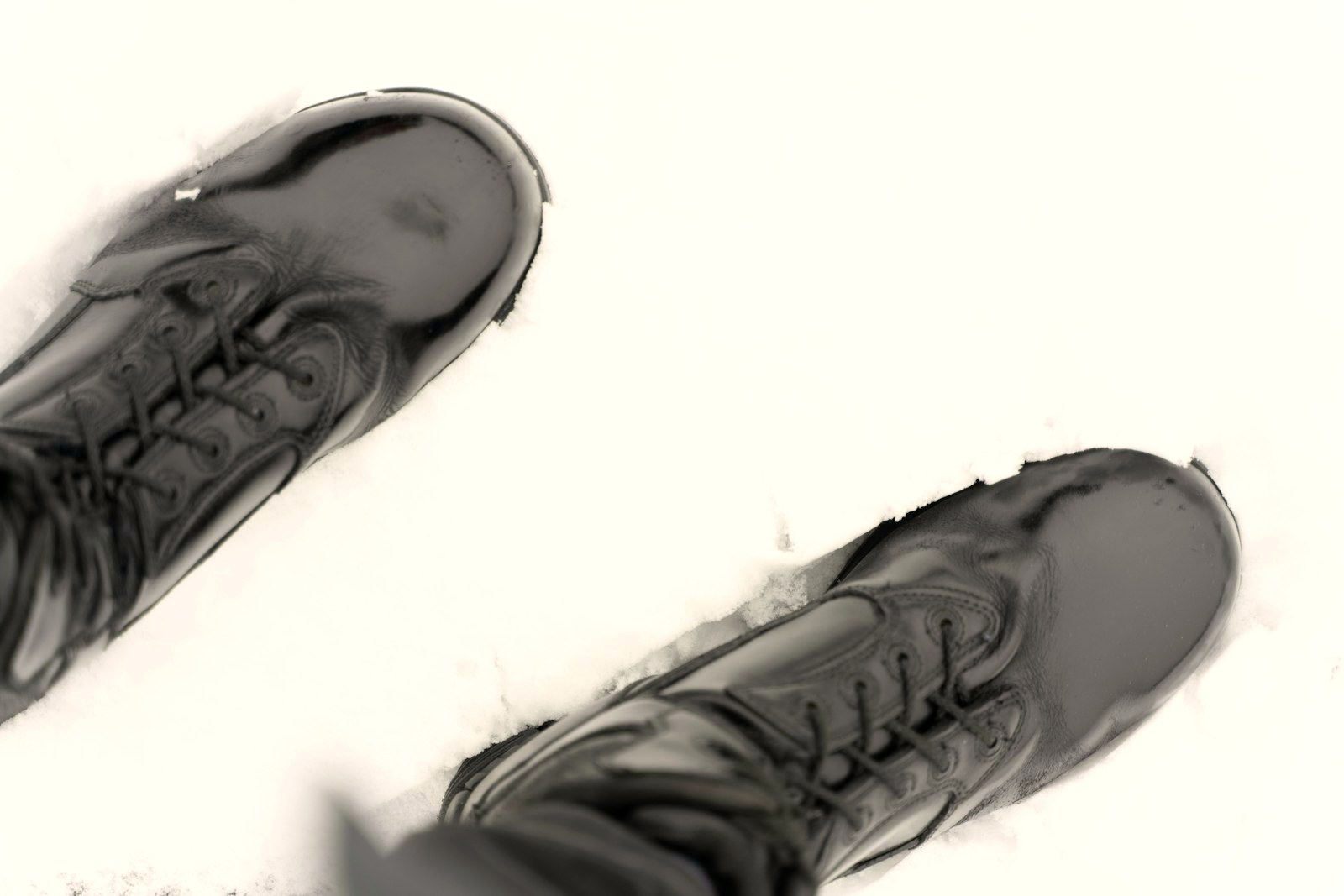
The equipment register, honestly come by: a boot that has been somewhere, the same frame the hub prints for this decode. A note on photography, printed because this page believes in saying so: our photo bank holds no shell-in-rain frame and no taped-seam macro yet, so no ranked garment is pictured as itself on this page rather than borrow one. The gear below is graded on its paperwork, which is the point of the page.
Checked and updated October 2026
The short version: gorpcore is decode No. 7 on the Aesthetic Decoder hub, ruled the gear survives, the suffix is a costume, and this page is that ruling at full length. It is also the decode this desk handles differently from the other six, because the hub prints a policy beside it: the term is decoded here, once, and not adopted. There is no trend file, no seasonal update, no look to assemble. What exists instead is the fullest grading record on this site: five equipment Cards and a run of technical-brand audits, because this is the one aesthetic whose home category already grades the way this site grades, by specification. The fashion version therefore needs no standard invented against it. It is convicted by the gear's own published numbers, and the numbers are below.
In this guide
The word, and the ruling it arrives with
The hub's definition, kept whole: as a term, a portmanteau built on a trail snack's nickname, applied to technical outdoor clothing worn as everyday fashion: shells, fleeces, trail shoes and cargo pockets, in the city, nowhere near weather. As garments, it names real equipment with real specifications, and the two halves of that sentence grade completely differently. The hub prints what the term is not in the same breath: on this desk, it is not an adopted category. The page decodes the term because the term is searched and argued about; the desk does not chase trend names, because a name invented to sell a season cannot be graded the way a garment can. That policy is restated here in this page's own voice, because a spoke that quietly behaved like trend content would break it: this decode is the term's full hearing, and it is also its file being closed. The equipment stays in coverage, graded as equipment, season after season. The word goes back to the internet that coined it.
The hub applied the same three questions it applies to every aesthetic. Can it be stated without using its own name? The garments can: a waterproof shell, an insulation layer, a fleece, specified in grams and deniers. The term cannot: remove the gear's job from the description and what remains is a posture toward weather that never arrives. Do the garments survive their own composition lines? Emphatically, and the next section is the counts. Does the record name an entry piece? It does, and the entry piece arrives with a condition no other decode carries: the Torrentshell at 86, bought as a rain jacket, worn as one, and allowed to be seen in the city precisely because it was not bought for the city. The ruling, kept exactly: the gear survives, the suffix is a costume. Of the seven terms on the hub, this is the only one whose garments pass more completely than the word that collects them, and the only one the desk refuses to adopt while grading everything it points at. Both halves of that sentence are the decode.
The category that was always sold by specification
Start with why the gear passes this site's tests without the tests bending. Every other category this desk grades has to be dragged toward disclosure. Fashion prints a fibre split when it feels like it and a weight almost never. Technical equipment was never given the choice: a shell is sold against rain, a parka against cold, a fleece as a weight class, and a buyer comparing two of them needs numbers or has nothing. So the category's native paperwork is the paperwork the Cards grade: fill powers and fill weights, face deniers, membrane chemistries, fabric weights, certifications with the certifier named. The desk did not teach this category to publish. It arrived publishing, and the Cards mostly record how completely.
The counts, Card by Card, because counts are the argument. On the fleece Card, seven of eight makers publish a fabric weight; the category is sold in weight classes and the figure survives onto the page. On the parka Card, seven of eight publish a fill power. On the rain Card, the winner publishes the only membrane chemistry in its field, a polycarbonate polyurethane membrane with 13 percent biobased content, over a 50-denier face whose feedstock is named. And the brand audits found the same habit at house level: one maker's down programme, the Down Codex, has audited its own supply chain farm to factory since 2009; another prints both down numbers, power and weight, as a house habit across its ladder. No other cluster on this site, not tailoring, not knitwear, not denim, walks in with a record this formatted.
The counts cut the other way too, and printing that is what separates grading the gear from cheerleading for it. The same parka Card that counts seven of eight fill powers counts two of eight verifiable fill weights at expedition prices, the same rate the puffer Card found, and a warmth figure on one of eight, that one a house scale no competitor can be measured against. The vest Card counts a temperature figure for the vest itself on zero of eight: every vest warmth claim in that field is an adjective or an inheritance from the parent jacket. On the rain Card, a hydrostatic figure a buyer can find is published by two systems in the field, and one of those two keeps its 28,000 mm in a customer-service answer rather than the spec block. The category publishes more than fashion and less than its reputation. The desk grades both halves of that sentence on every equipment Card it runs, which is exactly why the gear's convictions, when they come, are worth more than its medals.
The evidence, Card by Card
Rain. The rain Card is the decode's home fixture. The Patagonia Torrentshell 3L wins at 86, not because its membrane is magic but because its maker publishes the fullest paperwork in the field: the chemistry above, the denier, the feedstock, the certifications, fabric bluesign approved and factory Fair Trade Certified, then pit zips and storm flaps, at $189. The Arc'teryx Beta follows at 79, the named-membrane standard, charged in the open for having no pit zips at $400 and for keeping its waterproof figure in an answer thread. And the same Card carries the costume conviction in its purest form, held for the next section: a water-repellent designer windbreaker sent home at 36.
Fleece. On the fleece Card, the Patagonia R1 Air wins at 89 on a published 5.7-ounce recycled jacquard with its structure named, in the field where seven of eight publish a weight. The fleece is the gear's quiet proof of concept: a midlayer with no fashion ambitions at all, graded top of its Card on paperwork alone. Its maker's sibling record runs through this whole page, and it is worth naming why: the house that wins the rain Card and the fleece Card is the same house the brand audits seat at 83, second in the technical cluster, because the disclosure habit is a house habit, not a product accident.
Insulation. Three Cards grade the warm layers, and their findings interlock. The puffer Card: Feathered Friends' Eos at 88, Rab's Microlight Alpine at 84, and the field's law printed in its finding, warmth is fill power times fill weight, with only two of eight publishing the weight. The vest Card: the Rab Microlight Down Vest at 88, its 111 grams of fill published beside Montbell's 45 grams at a higher power, the complete warmth equation printed where the field mostly prints half of it. The parka Card: the Feathered Friends Khumbu and the Fjällräven Expedition tied at 85, ruled on the cloth row, the Expedition carrying 680 published grams of down in a design in production since 1974. Read together, the three Cards are one argument at three thicknesses: the gear that publishes both numbers wins, at every weight of garment, and the gear that publishes neither is sent home, at every price.
The brand audits. The garment Cards are backed by a run of audits in Brands Like Arc'teryx and its successors, where the technical cluster is ranked as houses: Patagonia 83, Rab 77, the anchor Arc'teryx itself 73 audited, Montbell 73 on a record that publishes a 1000 fill power and a 96-gram fill weight on its flagship parka, and Moncler last at its standing 55. The audits then did what audits do. Houdini's confirmation at 84 found the circular house winning the cluster outright, its key piece a fleece in production, on its maker's own line, virtually unchanged since 2003. Rab's audit confirmed 77 and retired the derivation behind it, printing the one number that moved underneath the score, a list price up from $295 to $325, rather than smoothing it. Fjällräven's audit moved its number, 72 to 73, on a longevity record: a lifetime repair assessment, more than 10,000 repairs in 2025 on the maker's own count, and a resale platform running since 2024. That is what a living record looks like. The gear's houses get re-graded, their prices re-read, their numbers moved in both directions, in the open.
The suffix: where the costume fails
Against that record, the fashion version's file is short, and every entry in it was convicted by the gear's own numbers rather than by a standard invented for the occasion. Exhibit one is the rain Card's skip: the Moncler Grimpeurs, a $995 water-repellent nylon windbreaker, sent home at 36. Read its record beside the winner's. No membrane. No seam claim. No figure. A ribbon on the hood, at five times the price of the jacket whose maker publishes its membrane's chemistry. The Grimpeurs is not bad gear that failed a test. It is the costume with the gear removed, a shell silhouette sold into weather it makes no published claim about, and the rain Card's arithmetic needs no help from this page: 36 is what a claim with no paperwork scores.
The pattern repeats at every thickness, which is how a pattern is known. The puffer Card sent home the same house's Maya garment at 52, near $1,900 with no fill power and no fill weight published, the well-made jacket underneath the silence, in that Card's phrase. The vest Card sent home the Tibb at 33, $1,130 for a composition ratio and nothing else, no power, no weight. The fleece Card's skip is the instructive one, because it comes from the sportswear end rather than the luxury end: a fashion spacer sold as fleece at 42, around $150, publishing no fabric weight anywhere in a category where seven of eight publish one. And the brand ladder closes the file: the house behind the first three exhibits stands last in the technical cluster at 55, holding this site's Logo Tax anti-award on the Awards page. The hub's sentence for all of it stands as printed: equipment worn as a signal, with the spec sheet unread, is the logo tax in a waterproof membrane.
The suffix's second failure is quieter and, for the gear, worse: the cycle. Technical equipment's longevity record is the strongest on this site, and it is printed above in the gear's own documents. A flagship fleece virtually unchanged since 2003. A parka design in production since 1974. A repair bench that took in five figures of garments in a single year, a down programme auditing its chain since 2009, lifetime guarantees and workmanship promises scored in the longevity rows. The fashion version runs the opposite clock: colourway drops, seasonal shells, last year's palette marked down to make room for this year's identical jacket in a new bright. Nothing in that cycle is a garment failure. Each piece may be honestly made. The failure is the replacement rhythm applied to the one category whose entire published record argues for buying once, on specification, and keeping the thing. A term that teaches the cycle against the gear that refutes it is not the gear's aesthetic. It is its churn.
The boundary the desk keeps
None of this rules the city out of the gear's life, and the hub's entry piece is precise about where the line sits. The Torrentshell at 86 is allowed to be seen in the city, in the hub's sentence, precisely because it was not bought for the city. The boundary is the order of the decisions. Bought for the job, the specification comes first and the appearance is whatever the tool looks like: the membrane is named because rain was the question, the fill weight is known because warmth was, and the garment then goes wherever its owner goes, commute included, with the desk's blessing printed on the rain Card itself, whose winner's call is to buy it as the one shell in the bag and on the commute. Bought for the city, the order inverts: silhouette and colourway first, specification as decoration, and the garment's paperwork, where it exists at all, is a smaller, quieter, more expensive version of the real thing's, as the exhibits in the section above show at 36, 52 and 33.
What follows is the gear's record compiled as equipment, which is the only form in which this page will present a collection. Not a look. Not a starter kit for a term. A set of graded tools, each with the number its maker published and the Card that graded it, for the jobs the category exists to do.
| The job | The equipment | The published record |
|---|---|---|
| Rain | Patagonia Torrentshell 3L, 86 (rain Card) | Membrane chemistry, face denier and feedstock published; $189 |
| The active layer | Patagonia R1 Air, 89 (fleece Card) | 5.7 oz cloth weight published; seven of eight in its field publish one |
| Warmth, portable | Rab Microlight Down Vest, 88 (vest Card) | 700 fill power and 111 g fill weight, both published |
| Warmth, jacket weight | Feathered Friends Eos, 88 (puffer Card) | Fill weight published in the maker's spec table, one of two in its field |
| Warmth, expedition | Fjällräven Expedition Down, 85 (parka Card) | 700 fill power and 680 g fill weight published; design in production since 1974 |
| The house to buy the system from | Houdini, 84 (Brands Like audit) | Key piece in production, virtually unchanged on the maker's line, since 2003 |
Read the right-hand column as the whole decode in miniature. Every line in it is a number a maker chose to publish and a buyer can check. Assemble the left-hand column for the weather it names and the result is a working kit that will also, incidentally, be seen in the city, which is the only version of that sight this desk grades as anything but a costume. Assemble it for the sight and the numbers stop mattering, the cycle starts, and the record of what happens next is already printed: it is in the skips, at the bottom of every equipment Card on this site.
The Decoder Rule
An aesthetic that cannot survive its garments' composition lines is a costume. Gorpcore is the inversion of that test, the one case on this hub where the garments print their lines in grams and deniers and pass easily, and the aesthetic itself has no composition line at all: no fibre, no weight, no standard, only a suffix. The gear survives its paperwork. The term never had any. Read the spec sheet, buy the entry piece for its job, and let the name come last. In this decode, it does not come at all.
What this page does not claim
Five limits, printed in the open, in the hub's manner. First: no gorpcore ranking exists on this site, and none is invented here. The equipment Cards grade garments, the audits grade houses; this spoke decodes from those records and revises none of them. Second: the policy is the page's own: the term is decoded, not adopted. This page will not be updated as trend coverage, no seasonal version of it is planned, and where this page and the hub could be read differently, the hub's sentence governs: the gear survives, the suffix is a costume. Third: the disclosure counts are the Cards' counts as published at their last check, quoted with their fields attached; a maker who publishes a missing figure tomorrow improves its own record on its own Card's cadence, not retroactively here. One capture gap is carried openly from the parka Card: the Khumbu's own fill-weight figure was not captured in that pass, and the gap is printed on its card rather than filled from the house's format. Fourth: the longevity exhibits are makers' published records and the Cards' grades of them: a production run since 1974, a design virtually unchanged since 2003 on the maker's own line, a repair count the maker prints itself. They are cited as the published record they are, not as this desk's laboratory findings. Fifth: the photographs are bank frames, captioned for exactly what they show. The bank holds no shell-in-rain frame and no ranked garment is pictured as itself; the frames are the equipment register the text describes, boots that have been somewhere and a rail of working garments, and the captions say so.
FAQ
What is gorpcore?
As a term, in the Aesthetic Decoder hub's definition, a portmanteau built on a trail snack's nickname, applied to technical outdoor clothing worn as everyday fashion: shells, fleeces, trail shoes and cargo pockets, in the city, nowhere near weather. As garments, it names real equipment with real specifications, and the two halves of that sentence grade completely differently. The hub rules that the gear survives and the suffix is a costume, and this page is that ruling at full length.
Does Young Cotton cover gorpcore?
No, and the absence is policy, printed on the hub so it cannot be mistaken for a gap, and repeated here. This desk decodes trend terms; it does not adopt them, because a term invented to sell a season cannot be graded the way a garment can. The garments the term points at are graded on this site as what they are: equipment, on the rain, fleece, puffer, vest and parka Cards and in the technical-brand audits. This page decodes the word once, at full length, and then goes back to grading the gear. Nothing on it is a trend report and nothing on it will be updated as one.
Why does the gear survive the record?
Because technical equipment is the one category that was always sold by specification, which is the paperwork this site grades. On the fleece Card, seven of eight makers publish a fabric weight. On the rain Card, the winner publishes its membrane's chemistry, its face denier and its feedstock. On the parka Card, seven of eight publish a fill power. The category's native language is grams, deniers and certified fills, so its honest records arrive pre-formatted for grading, and its winners win on documents any buyer can check before money moves.
Why is the term itself a costume?
Because the term adds a signal and subtracts the specification. Equipment worn as a signal, with the spec sheet unread, is the logo tax in a waterproof membrane, in the hub's sentence. The fashion version is convicted by the gear's own numbers, not by a standard invented for the occasion: on the rain Card, a $995 water-repellent designer windbreaker with no membrane, no seam claim and no figure was sent home at 36, and on the fleece Card a fashion spacer sold as fleece, publishing no fabric weight anywhere, was sent home at 42. The gear's real houses publish the numbers those records withhold.
What is the entry piece?
The Patagonia Torrentshell 3L at 86 on the rain Card, and the condition attached to it is the decode: bought as a rain jacket, worn as one, and allowed to be seen in the city precisely because it was not bought for the city. Its maker publishes the fullest paperwork in its field, membrane chemistry, face denier, feedstock and certifications, and charges $189. Every other piece of equipment named on this page is compiled as equipment, with its Card score and its published numbers, labelled as what it is. There is no look to assemble. There is a job to equip for, and the records for that are already graded.
What separates wearing outdoor gear from the costume version?
The order of the decisions. Gear bought for its job carries its specification with it: the fill weight is known because warmth was the question, the membrane is named because rain was. Gear bought for the city starts from the silhouette and the colourway, and its specification, if it has one, is decoration. The gear's own longevity record draws the same line: the technical cluster's leading house prints its key fleece as in production, virtually unchanged, since 2003, and the leading parka design in this record dates to 1974. A drop cycle that replaces a shell every season is not a faster version of that record. It is the opposite of it.
Next
The hub this spoke hangs from is the Aesthetic Decoder, where all seven decodes stand and the rule is printed once for all of them; this spoke completes the set, the other six being Old Money, Decoded, Soft Boy, Decoded, Clean Boy, Decoded, Scandinavian Minimalism, Decoded and Ametora, Decoded, with quiet luxury standing as its own Index and capsule. The records this page rules from: the rain ranking, the fleece ranking, the puffer ranking, the vest ranking, the parka ranking, and the technical audits at Brands Like Arc'teryx, Brands Like Houdini, Brands Like Rab, Brands Like Mountain Equipment and Brands Like Fjällräven. The scoring basis for every number quoted here is the Methodology page. Read the spec sheet first. The weather does not care what the jacket is called, and neither, in the end, does the record.