

The pattern on a body, in its founding cloth: a denim trucker worn outdoors. The frame is Verdict Card No. 81's own hero and the jackets index's trucker frame, reused here deliberately and captioned as that reuse, because the bank holds no suede, corduroy or canvas trucker on a body, the gap the Card prints about its own page. Denim truckers are graded on Verdict Card No. 51 and briefed in How to Wear No. 16; this brief styles the pattern across its cloths.
Checked and updated October 2026
The ruling, up front: the trucker is a pattern before it is a cloth, and it is bought and worn in that order. Verdict Card No. 81 has ranked the pattern across its cloths: the Taylor Stitch Long Haul winning at 85, the Schott 121 at 81, the Patagonia Pile-Lined at 80, and a jacket sent home at 34 for keeping the silhouette entire over a cloth described in two words. So this brief begins where the Card ends: buy the record, the cloth weighed and the hardware named, because the silhouette will sell you an undisclosed material if you let it, and wear the hem, the cropped body ending at the trouser's waistband, because the rise is the other half of the garment. The cloth changes the register, corduroy across, suede and leather up, inside a formality the pattern does not leave. This page prints the pattern and its cloths, the record test that separates a specification from a silhouette, the fit at the joint the garment is built around, the outfit matrix, and the five ways the garment is ruined.
This brief: the decisive rule · the pattern and its cloths · the record test · the fit rules · what goes under it, what goes over it · the front discipline · the season line · the looks · the mistakes · care and our photography
The decisive rule: buy the record, wear the hem
Every brief in this family has a rule that decides the garment, and the trucker's has two halves that are one rule read at two tills, the shop's and the mirror's. The trucker is the Type III pattern: twin chest pockets on a panelled front, a buttoned placket, a waistband, a cropped body at hip length, cut close enough to work as a layer. It is the most trusted silhouette in workwear, and that trust is exactly its hazard, because a silhouette this famous can sell anything cut in its shape, including, at the bottom of the Card's field, a cloth its seller never describes beyond the two words faux suede. A garment whose fame precedes its facts is bought on the facts, and worn on the one measurement the pattern is built around. That is this brief's decisive rule, printed as new: a trucker is bought on its record, the cloth weighed and the hardware named, and worn on its hem, the body ending at the waistband, with the trouser's rise as the other half of the garment.
The buying half is the Card's arithmetic. Of the eight jackets No. 81 graded, a cloth weight in numbers is published by two, a composition in percentages stands on four, and a metal is named for the front closure on five. The record test below is those counts in shopping form: three checks at the rail, each one a line the Card has already counted across its field, and a jacket that fails them is not a bad trucker. It is a silhouette with a price attached, graded as exactly that.
The wearing half is the pattern's own geometry. The trucker is the shortest jacket in the short-jacket drawer, and its hem is not a detail of the fit, it is the fit: the waistband exists to end the jacket where the trouser begins, so the outfit is built at that joint or it is not built at all. Every styling error in the mistakes section below is a failure at one of the rule's two tills, a record never read, or a hem left to land where it likes.
Know which trucker you are holding: the pattern and its cloths
The rail sells one pattern in many cloths, and No. 81 separates them in print before it grades any of them, because the wearing rules differ by cloth while the pattern's law does not. One agreement stands over the whole table, printed on the Card and adopted here: our jackets index files the type at formality 2 and warmth 2, spring through autumn, inside its work-and-field family, under the family law this brief adopts as its order of questions, cloth first, hardware second, silhouette third, and its three-jacket answer names the trucker as the personality layer of a working wardrobe. The Card's own FAQ prints the cloth doctrine this table is built on: the pattern holds, and the cloth moves a jacket inside that band rather than out of it.
| Cloth | Build | Its seat on the Card |
|---|---|---|
| Cotton weaves | The pattern in a weighed work cotton, the everyday reading | The Taylor Stitch Long Haul at 85, an 8.5 ounce organic cotton waffle with its copper hardware named, its weave boundary printed on the Card: a waffle is not a denim twill, and denim belongs to No. 51 |
| Corduroy | The pattern with a pile surface, the texture reading; lined, the field's warm end | The Patagonia Pile-Lined at 80, its 14-wale count the field's only one; the Levi's Relaxed Corduroy Sherpa at 65, its blend printed and its count withheld |
| Suede | The pattern with a dressed surface, the most fragile reading, a specialist-clean cloth whose makers say so | The Thursday Suede Trucker at 75, its brass snaps and finish named; the FRAME at 49, a fibre and almost nothing else at the field's dearest price. The species' other seat is cross-referenced: the Todd Snyder suede Dylan at 74, graded as a leather jacket on No. 50 |
| Leather | The pattern in hide, the heaviest and longest-lived reading, priced like it | The Schott 121 at 81, the pattern kept entire with its hide weight published; the Schott 582 at 67, the same house trading the buttoned front for a zip |
| Denim | The founding cloth, the pattern's first century | Not graded on No. 81 and not styled here: the Iron Heart Type III stands at 86 and the Levi's Trucker at 66 on Verdict Card No. 51, and the denim species is briefed entire in How to Wear No. 16 |
| Waxed cotton | The pattern as weather equipment, proofed | Cross-referenced only: the Flint and Tinder Flannel-Lined Waxed Trucker at 72 on Verdict Card No. 74, briefed with its species in How to Wear No. 28 |
| The name only | The silhouette over an undisclosed cloth | The skip at 34, its whole cloth record the two words faux suede, no composition, lining or care published anywhere in its record |
Read the table as a ladder of registers, not of formalities. Cotton is the pattern at its plainest, the weekday reading. Corduroy moves it across, texture doing the work colour does elsewhere, and its pile lining makes it the field's cold-end garment. Suede moves it up, the surface a room reads before it reads the cut, at the price of fragility its makers print themselves. Leather moves it across and up at once, weight and years in the same garment. None of them moves it out of formality 2, which is why the office ruling below is a ruling about rooms and not about cloths: the dearest suede in the field is a formality-2 jacket with a $1,698 ticket, and the Card grades its record accordingly.

The record test: three checks at the rail
The Card grades the record; the wearer meets it as a product page. These are the same facts in shopping form, and each check is a count No. 81 has already run across its field of eight.
The cloth check. Find the weight and the composition, and grade their grammar. A specification is a number: 8.5 ounces and 100 percent organic cotton on the winner's page, a leather weight of 3 to 3.5 ounces on the heritage hide, a 14-wale count on the field's one honest corduroy. An adjective is not: lightweight carries the Schott 582's whole cloth substance, one word standing where its own brother prints a figure, and the FRAME's materials line, 100 percent lamb leather, is a fact entire that still leaves a buyer nothing to grade a $1,698 hide by, no weight, no thickness, no tannage, no lining. The counts set the expectation: a weight stands on two of eight pages, a composition on four, a lining or its stated absence on five. A maker who has weighed the cloth prints it, because it costs money to weave to a number. A maker who has not prints the silhouette instead.
The hardware check. The trucker's buttons are its signature hardware, the part of the pattern a stranger reads first, and the Card's second row is named for it. A metal is named for the front closure on five of the eight: antique copper tacks on the winner, metal shank buttons front and cuff on the Schott 121, brass snaps with their finish stated on the Thursday, branded metal on the Levi's. The construction, shank, tack, snap or button, is named on all eight, and that completeness is what makes the field's one deviation legible as a deviation: the Schott 582 names its brass and its shank cuffs and still closes its trucker front with a zip, at ten dollars under its buttoned brother's price. At the rail, the check takes ten seconds: name the metal, name the construction, and if the front is a zip or a snap, know that you are buying a stated trade, priced on the Card, and not the pattern's term.
The pattern check. Count what the page counts. A pocket record beyond the chest pair is stated by five of the eight, five pockets across three zones on the winner, flap and lower pockets on the 121, hand-warmers with their twill tape trim on the Patagonia. A panel or stitch construction is stated in words by three, a zig-zag reinforcement, a tapered V, a twill tape trim. Waist adjusters are stated by two, and a garment length is published in numbers by two, 26 inches and 25.5, which is why the fit section below rules the hem by a joint and not by a chart. The absences convict in the other direction too: the Thursday's record omits the Type III's twin chest pockets entire, and the skip's page offers thousands of words of generic size tables and one sentence about the garment. A pattern this published can be checked. A page that declines to publish it has told you what it is selling.
Worn, the test's results become the wardrobe's map of the rail. The fullest records are the jackets that can be bought by number and worn for a decade, the weighed cotton at $208 and the counted corduroy at $199 wearing at 58 and 66 cents on the Card's costing. The thin records are not all cheap and the dear ones are not all deep: the field's dearest wear, $3.77, belongs to its thinnest premium record, and its cheapest ticket belongs to a record of two words. The test exists so that neither fact is discovered at the till.
The fit rules: the hem, the rise, and the knit underneath
The jackets index describes the settled form in four words, waist length, close cut, and No. 16 prints the default fit's terms for the denim species: the Type III bought first, sized over the thickest knit it has to cover, the shop test mechanical, buttoned closed over a mid-gauge crew without pulling at the chest, because a jacket that cannot close is a jacket that has resigned from weather. Those terms carry across to the pattern entire, and this brief says so rather than reprinting them as new. What the pattern across its cloths adds is the joint, and the joint is this brief's central fit problem, so it gets the section.
The hem and the rise are one joint. A trucker's body ends at the waistband by design, which means the jacket is only ever half the measurement: the other half is the rise of the trouser under it. Over a mid or high rise, hem and waistband meet, the break is clean and deliberate, and the proportions read as the pattern intends, a short jacket over a long leg. Over a low rise the same jacket strands a band of tee or skin at the waist and reads as a garment that shrank in the wash. No. 16 rules this for the cropped fit, the fashion end of the denim rail, and the ruling generalises: the whole pattern is a cropped fit by the standards of every other jacket in the drawer, and it asks the trouser to rise to the meeting. Buy the jacket and the rise together, or expect the joint to argue in public.
Buy the joint, not a number, because the field barely publishes one. A garment length in numbers stands on two of the Card's eight records, the Schott 121's 26 inch back length and the FRAME's 25.5 inches from the shoulder, with a third stated in words, the Patagonia's hip length, longer than the classic crop and printed as such. The two numbered jackets sit at opposite ends of the field's prices, which tells the buyer the honest thing: length is not a premium feature, it is a publishing habit, and its absence is not a sizing answer. Where no number exists, the rail test is the joint itself, the jacket tried over the knit it must close over, hem checked against the waistband of the trousers it will actually be worn with, stride and sit checked with the front buttoned. A hem that swallows the waistband has failed the pattern whatever the size chart called it, and a hem that clears the belt line by inches has failed it the other way.
The three fits, placed as No. 16 places them. The close Type III is the default and the first buy, in every cloth on the table. The oversized fit is the second jacket, a street register that works when it is the outfit's only oversized piece, legs and tee kept plain beneath it; in the trucker's case it is also the one fit that changes the joint, its longer body covering the waistband deliberately rather than meeting it, which is a decision and not a default. The cropped fit is the third, the least forgiving and the fastest to date, licensed over high-rise trousers at full commitment. No. 16 prints the full reasoning for the denim species and it is not repeated here; what this brief adds is that the cloth does not rescue a fit: a suede trucker in the wrong fit is a fragile garment worn wrong, at a specialist-clean price.

What goes under it, what goes over it
The trucker sits in the middle of the stack as often as at its top, and its layering follows the index's filing, warmth 2, spring through autumn: a shoulder-season outside and a cold-season middle. The rungs beneath it are No. 16's, carried across and named, because the pattern's body does not change with its cloth.
Beneath it: the tee and the shirt. The plain tee under an open trucker is the base assembly the whole garment family was standardised around, judged as the tee ranking judges it, cloth with a published weight and a collar that recovers its line at the jacket's open front. The Oxford is the shirt rung, the ceiling assembly's partner, its collar inside the jacket's collar. One hem rule governs both, and it is this brief's addition to the family's law: nothing worn under a trucker hangs below the trucker's hem. A long tee or an untucked shirt falling past the waistband inverts the layers at the exact joint the garment is built around, and the outfit reads as two hems arguing. Tuck the layer, or choose one that ends at the joint.
Beneath it: the knit rungs. The gauge bands are How to Wear No. 09's, applied to this pattern by No. 16 and carried across whole: fine gauge, roughly 24 to 30, is the only knit that closes under the close cut; mid gauge, roughly 12 to 20, wears the jacket open over it, or takes the oversized fit; heavy gauge, 7 and below, is a top layer that stands alone, and no trucker in any cloth is sized up to swallow it. The roll neck keeps its evening row from No. 16: a black or navy roll neck under the darkest reading of the pattern, the knit doing the dressing and the jacket standing down, works in the leather and suede cloths exactly as it works in denim, because the assembly's logic is colour and surface, not cloth.
The hoodie: refused in the default, licensed in one place. No. 16 refuses the pairing under the Type III on mechanical grounds and this brief adopts the refusal for the pattern entire: the hood bunches against the trucker's collar and pushes it out of line, the hoodie's body fills the close cut until the front pulls at its fastenings, and two garments with strong casual signatures compete at the one place the eye lands first. In the oversized fit, and only there, it is licensed as a street outfit, a plain hoodie with its hood outside the jacket's collar. The hoodie is a top layer by design on this site, scored in Verdict Card No. 26, and it does not need to be smuggled under another garment to earn its place.
Above it: the trench, and the cold stack. In the wet and cold shoulder seasons the trucker changes jobs the way No. 16 prints for the denim species: buttoned closed, it becomes the middle layer, and the coat that closes the system is the trench of How to Wear No. 02, whose brief licenses whatever the day already required beneath it. The division of labour is exact: the coat is the weather skin, because none of this pattern's cloths is rain cloth, and a soaked suede or corduroy is a worse outcome than a soaked denim; the trucker underneath does the texture and insulation work; and the collar order stays clean, trucker collar inside trench collar, one collar visible to the weather. In dry cold the same stack runs under an overcoat. The cloths differ in what the stack costs them, leather indifferent, corduroy content, suede kept out of the wet entirely, which the season line rules on below.

The front discipline: buttoned, open, and read at the hardware
The mac brief gives its garment's signature a section of law, and the trucker's signature is its front: a panelled chest, a fastened placket and the hardware that does the fastening, worn at the body's most-read point. Its states are two. Closed is the working state: the front fastened, the panels reading as one constructed surface, the state the pattern was graded in and the state weather is worn in. Open is the mild-weather state: the front framing the layer beneath, the chest pockets and the placket's hardware doing the outfit's detail work at a distance. There is no third state worth printing. A trucker fastened at one middle button against a waist it is straining over is a fit failure arranged as a styling choice, and the fit section has already ruled it.
The hardware is read before the cloth is. This is the wearing consequence of the Card's second row. At conversational distance nobody can weigh a cotton or count a wale; what the eye actually receives is the front: copper tacks with their finish named, shank buttons in metal, brass snaps in a matte finish, or the plain statement of a zip where the pattern's signature should be. The Card grades those records from the maker's page; the street grades them from three feet away, and the two grades agree more often than the industry would like. It is why the 582's trade matters beyond its ten-dollar saving against its brother: worn, the zip is the first thing the jacket says, and what it says is that the silhouette was kept and the signature was negotiable.
The chest pair is furniture with a job. The twin chest pockets are the pattern's face, and the field's records treat them with varying respect, flap and button closures stated on the Patagonia and the 121, a pen sleeve worked into the winner's left pocket, and the pair absent entire from the Thursday's record, charged on the Card. Worn, they are for almost nothing, a card, a pair of gloves' worth of room at most, because a loaded chest pocket breaks the panel line the front exists to present. The waist adjusters, stated by two makers in eight, do their quiet work at the joint: a tab taken in one notch is the difference between a hem that sits on the waistband and one that floats over it, and it is fitting equipment, not decoration.
The season line: spring through autumn, warmth 2
The index files the type in the spring through autumn window, and the season follows the filing: the trucker is a shoulder-season garment, the jacket of the months when a layer is the day's main clothing decision. The Card's costing runs on the same line, its field priced at thirty wears a year across those seasons. The cloths arrange themselves inside the window rather than widening it. The plain cotton readings hold the window's middle. The pile-lined corduroy holds its cold end, the one garment on the Card built to be worn over a mid-gauge knit into the first cold snaps. The leather readings hold the whole window with weight to spare and step into the middle-layer stack when it closes. And the suedes hold the window's dry days only, at every point on the calendar: both suede makers on the Card print specialist cleaning as the cloth's own terms, professional leather clean only on the Thursday's page, specialist clean only on the FRAME's, and a cloth that cannot be washed at home is not a cloth to be rained on. Suede in the rain is not a season error. It is a care error committed outdoors, and the mistakes section prices it.
In winter the trucker does not fail, it is simply out of its filing, and its honest winter life is the one the layers section prints: the middle of the stack, under the trench in the wet and the overcoat in the dry, where its cropped body is an advantage, no hem of jacket bunching below the coat's own line. The winter outside belongs to the coats, whose rankings and briefs stand in the family beside this one. A wardrobe that files the trucker correctly owns it for three seasons as an outside and one as an inside, which is a longer working year than most garments in the drawer are given.
The looks: the Card's field, worn in its order
Six assemblies from this brief's rulings, each built on the published records around the garment. The jackets are No. 81's, in the Card's order and at the Card's scores; the layers under them are the family's ranked partners; nothing in the judgments is scored here.
| Setting | The jacket | With | The judgment |
|---|---|---|---|
| The fullest record | The Taylor Stitch Long Haul, 85, open or closed at the day's temperature | A plain white tee, dark jeans or chinos below, the copper hardware doing the detail work | The pattern's everyday reading at its most published: a weighed organic cotton, five pockets, its stitching stated, at $208 and the Card's cheapest wear at $0.58. Bought knowing its weave boundary, a waffle and not a twill, which the Card prints and the wearing honours: it is the cotton trucker, and it never has to pretend to the denim Card's ground |
| The heritage leather | The Schott 121, 81, closed over the day | A fine-gauge crew or a tee under it, dark tailored trousers, boots with a real sole | The pattern kept entire in naked cowhide: shank buttons front and cuff, the hide's weight published, a 26 inch back length a buyer can plan a rise around, made in the United States. The $1,130 ticket is the row's known price, and the Card's $1.88 a wear across twenty years is its defence. Formality stays 2, per the Card's doctrine; the register is the register, and the room ruling is unchanged |
| The cold shoulder season | The Patagonia Pile-Lined, 80, over a mid-gauge knit worn open or closed | Straight trousers or dark denim below, the pile lining carrying the warmth the knit starts | The field's warmest reading and its only counted corduroy: 14 wales, a full organic composition, Fair Trade sewing, at $199 and $0.66 a wear. Its hip length, stated by its maker as longer than the classic crop, is worn as the fact it is: the joint sits lower, and the rise beneath it is chosen accordingly |
| The dressed surface | The Thursday Suede Trucker, 75, on a dry day | An Oxford or a fine crew under it, wool trousers of the class the trouser ranking scores at 87, leather shoes | Suede at an honest price: a waxed goat hide, brass snaps with their finish stated, a maker who holds one price all year, at $360. Worn knowing the two trades the Card charges, snaps for the pattern's button and the chest pair absent from the record, and knowing the cloth's terms entire: dry days, specialist cleaning, the dressed end of a formality-2 pattern |
| The attainable corduroy | The Levi's Relaxed Corduroy Sherpa, 65, at $130 | A tee or a light knit under it, ecru or dark trousers below, the colour break kept clear | The pattern owner's own corduroy at the field's cheapest ranked ticket: a percentage split printed entire, branded metal buttons, the tapered V stitches named. Bought with its withholding known, no wale count on the cloth whose count is its specification, and its maker's stray denim sentence forgiven as what the Card calls it, a record fault, not a garment one |
| The premium, weighed | The FRAME Suede Trucker, 49, worn open over a plain layer | Dark trousers, nothing competing at the front | The form at its most polished and its record at its thinnest: 100 percent lamb leather and nearly nothing else published at $1,698, the Card's dearest wear at $3.77. The matrix prints it last because it is the seat the record supports least at the price the field asks most. Bought for the eye with the paperwork known, or not bought |
The ruling
Buy the trucker on the record test: a cloth weighed or counted, a hardware metal named, a pattern published past its chest pockets, which in the Card's field means the Taylor Stitch at $208 for the working wardrobe and the Patagonia at $199 for the cold end, with the Schott 121 at 81 waiting for the buyer who wants the pattern kept entire in hide and accepts its price. Wear it on its hem: the body ending at the waistband, the rise rising to meet it, the layers beneath ending at the same joint, the front buttoned in weather and open in the mild. Keep it in its band, formality 2 and proud of the rung, the personality layer the index names it, and let the cloth choose the day, corduroy for texture, leather for years, suede for dry days and dressed rooms. The trucker is workwear's most trusted silhouette reduced to its two honesties, a cloth that can be weighed and a front that signs itself in metal. Worn on its record, it is the jacket that pairs with every trouser in the drawer, and it earns the pairing at the joint.
The mistakes
The trucker worn long. The fit error the pattern cannot absorb: a trucker bought or worn with its body falling past the waistband, the hem swallowing the belt line and the rise with it. The crop is not a styling option on this garment, it is the pattern's definition, the thing the waistband exists to draw. A long trucker is a field jacket's length wearing a trucker's face, and it reads as neither. The record makes the error easy to commit and easier to avoid: only two of the Card's eight makers publish a length at all, so the length is checked at the joint, in the shop, against the trousers it will be worn with, and a jacket that fails there is left on the rail whatever its cloth promised.
Double trucker over matching denim, without the break. The denim species' oldest failure, carried across from No. 16 because the pattern invites it in every cloth: jacket and leg reading as one surface from shoulder to shoe, the matched set that No. 16's two conditions exist to prevent and the chore coat brief bans from its own rail. In denim the conditions are arithmetic and No. 16 prints them entire, two stops or a family break, and two surfaces. In the other cloths the same read is refused in colour's terms: a corduroy trucker over corduroy trousers in the same dye lot, a black leather trucker disappearing into black denim with no break of texture or tone, each a uniform where an outfit was intended. The escape costs nothing, as it does in No. 16: the jacket changes trousers, and the trouser rail is the one rail this jacket has never failed on.
The faux cloth bought as suede. The buying error the Card exists to catch, and its skip is the portrait: a trucker silhouette entire, chest pockets, snap closures, over a cloth whose whole published record is two words, faux suede, with no composition, no weight, no lining and no care printed anywhere by its seller. The word suede does the selling and the material is never named. Costed on its regular price across a generous two years it wears at about $1.17, dearer than the weighed cotton winner, the counted corduroy, the split-printed Levi's and the real suede it imitates. Cheap is not the charge. The charge is a famous silhouette asked to sell an undisclosed cloth, and the defence is the record test, thirty seconds on a product page: if the cloth cannot be read, it cannot be bought as the cloth it is named for.
The traded front. The silhouette bought with its signature exchanged: the Schott 582, a stated lightweight cowhide and named brass hardware, its trucker front closed with a zip at $1,120, ten dollars under the brother that keeps the pattern entire. The Card charges it on the hardware row and this brief charges it at the mirror: the buttoned placket is the garment's signature, the fastening the pattern is recognised by, and a zip front is a different jacket wearing the trucker's panels. Bought knowingly, as a leather jacket with a trucker's cut, it is a legitimate garment. Bought as a trucker, it is the pattern with its defining fact surrendered, discovered the first time the front is looked at.
The care error. The ownership error, and the costliest, because it is committed at home and cannot be undone. The suede trucker washed, soaked or weatherproofed against its maker's printed terms: professional leather clean only on the Thursday's page, specialist clean only on the FRAME's, the two most expensive cloths in the field carrying the strictest care lines in it. Beside it stands the same error in the field: the suede worn as rain cloth because the day looked merely grey, the pile lining left damp in a closed wardrobe, the naked cowhide fed nothing across its decades. Each cloth on the Card keeps its promise a different way, and the maker's care record is part of its specification. A trucker is maintained the way its cloth says, or it becomes the silhouette its owner mistook it for.
Care, and a note on our photography
A trucker's care follows from its cloth, and the records print the terms class by class. The cottons are the field's washable class, the waffle and the corduroys carrying ordinary cotton care, with the corduroy's pile brushed rather than pressed and the Levi's sherpa lining given the airing a lined garment asks for; the Patagonia's own record adds its sewing certification rather than a care novelty, Fair Trade Certified sewn, printed on the Card. The leathers run on the hide's clock: the Schott 121's naked cowhide is uncoated and full aniline, a surface that marks, darkens and records its wear the way the denim brief's raw cloth does, by being lived in rather than protected from living; it is brushed, aired and conditioned on evidence, and its twenty-year costing on the Card assumes exactly that ownership. The suedes carry the strictest lines in the field, printed above: specialist cleaning only, a brush and an eraser for the day's marks, storage aired and out of plastic. And across all three classes the storage rule is the short jacket's own: hung on a shaped hanger that fills the shoulder, never folded at the waistband, because the pattern's line is its shoulders and its hem, and a wardrobe can spend both in a season of bad hanging.
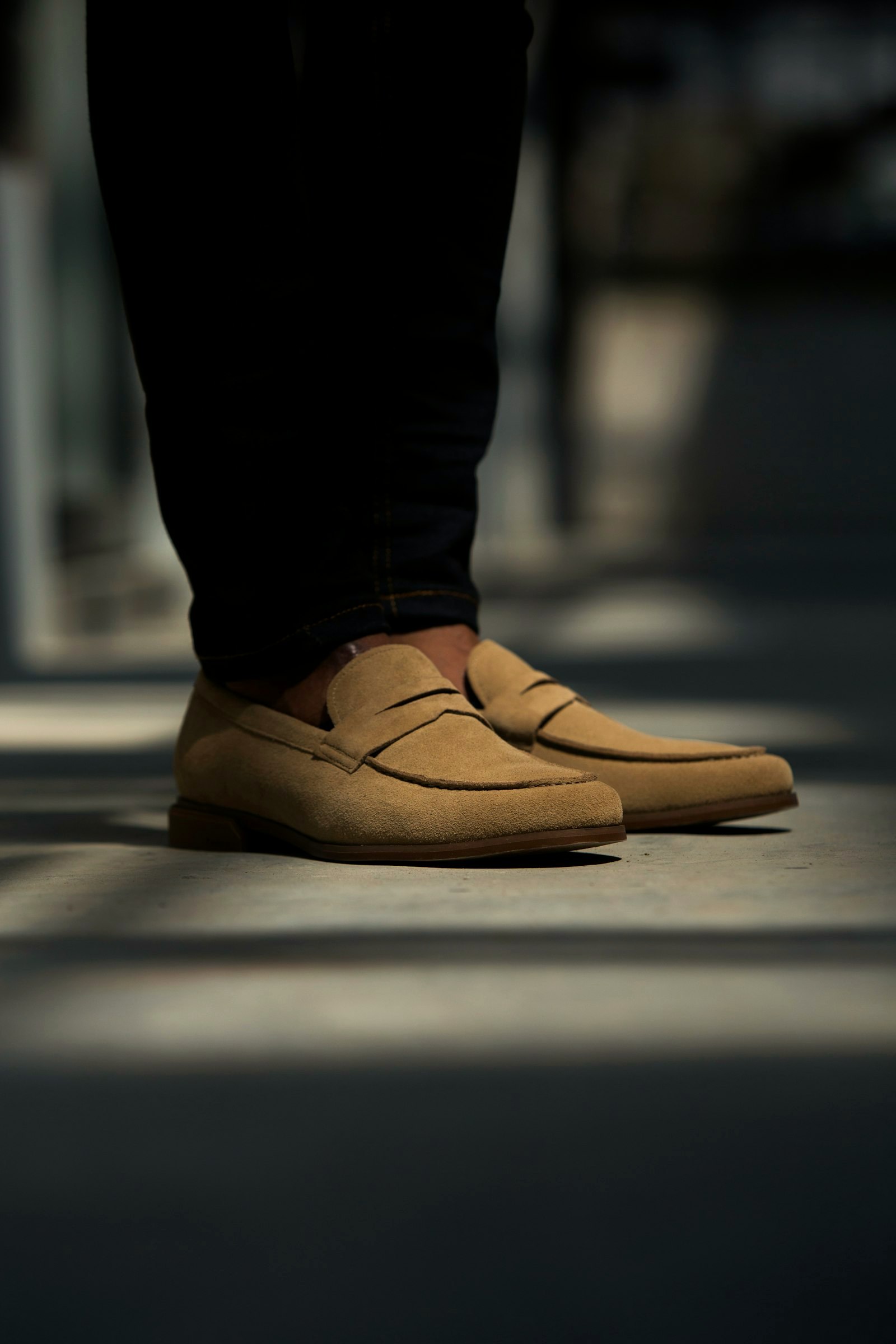
A note on our own photography: our photo bank holds no frame of a suede trucker worn on a body, no corduroy trucker in daylight, no canvas trucker, and no shank button in close-up, the gap Verdict Card No. 81 prints about its own page as well. The harvest list names what is missing, in the Card's order: a suede trucker worn on a body, a corduroy trucker in daylight, a shank button in close-up. Until those frames exist, the bank's denim frames carry the pattern, its leather frame carries the register and its suede frame carries the surface, each captioned for exactly what it shows, and no frame on this page is captioned as a jacket it does not picture.
Questions, answered
How do you wear a trucker jacket?
On its hem. The trucker is a pattern, the Type III silhouette, twin chest pockets on a panelled front, a buttoned placket, a waistband closing a cropped body, and every cloth it is cut in is worn the same way at the joint that defines it: the jacket's hem ends at the trouser's waistband, and the trouser's rise is the other half of the garment. Closed, it is the working state, the front fastened and the column clean; open, it is the mild-weather state, the front framing the layer beneath. Our jackets index files the type at formality 2 and warmth 2, spring through autumn, the personality layer of a working wardrobe, and the cloth moves the jacket inside that band, corduroy across, suede and leather up, never out of it.
Trucker jacket or denim jacket: what is the difference?
The trucker is the pattern and the denim jacket is the pattern in its founding cloth, and this site keeps the two in separate documents on purpose. Verdict Card No. 51 ranks the pattern in denim, the Iron Heart Type III at 86 and the original Levi's Trucker at 66, and How to Wear No. 16 briefs the denim species entire, its wash ladder, its two conditions for denim on denim and its fade. Verdict Card No. 81 ranks the same pattern across its other cloths, suede, corduroy, cotton weaves and leather, and this brief styles that field. A denim trucker is governed by both documents and graded once, on No. 51; a suede or corduroy trucker lives here.
How should a trucker jacket fit?
Waist length and close, the settled form the jackets index prints in four words, sized over the thickest knit it has to close over. The governing joint is the hem and the rise: the jacket's hem lands at the trouser's waistband, over a mid or high rise that rises to meet it, because over a low rise the cropped body strands a band of tee or skin and reads as a jacket that shrank. Only two of the eight makers Verdict Card No. 81 graded publish a garment length in numbers, 26 inches and 25.5, so the shop test is the joint itself rather than a chart: hem against waistband, front buttoned over the knit, no pull at the chest. A trucker that cannot close has resigned from weather, and a trucker whose hem swallows the waistband is a different garment wearing the pattern's name.
Can you wear a trucker jacket with jeans?
Yes, under the law the denim brief prints and this brief carries across. In the denim species, How to Wear No. 16's two conditions govern entire: the washes sit at opposite ends of the wash ladder or break by colour family, and the surfaces differ, one worn and textured, the other smooth and even; fail either and the jacket changes trousers, which costs it nothing, since the index calls it the one jacket that pairs with every trouser a man owns. In the pattern's other cloths the same prudence applies in colour's terms rather than wash's: the corduroy, suede, leather and cotton truckers are worn over jeans with a clear break between the jacket's surface and the leg's, and the matched set, jacket and jean reading as one surface from shoulder to shoe, is refused in every cloth.
What do you wear under a trucker jacket?
The tee first, plain and with a collar that holds its line at the open front, the assembly the garment family was standardised around. Then the shirt rung, an Oxford under the darker cloths, its collar inside the jacket's. Then the knits, by the gauge bands How to Wear No. 09 prints and No. 16 applies to this pattern: fine gauge, roughly 24 to 30, is the only knit that closes under the close cut; mid gauge, roughly 12 to 20, wears the jacket open over it; heavy gauge stands alone as a top layer. The hoodie is refused under the close cut for mechanical reasons No. 16 prints, the hood bunches against the collar and two casual signatures compete at the neck, and licensed only in the oversized fit as a street outfit. One hem rule governs every layer: nothing worn under the jacket hangs below the jacket's hem, or the layers invert at the joint the whole garment is built around.
Can you wear a trucker jacket to the office?
In the rooms whose code is formality 2, yes, at one ceiling assembly, and How to Wear No. 16's ruling carries across to the pattern entire: the darkest, plainest reading of the garment, closed, over an Oxford or a fine-gauge crew, with tailored wool trousers and leather shoes. The cloth can help at the margin, a suede or leather reading is the dressed end of the pattern, but Verdict Card No. 81 prints the limit plainly: the cloth moves a trucker inside its formality band rather than out of it, and formality 2 is the band. In a room with a tailoring expectation the jacket's office life is the commute, over the office clothes and off at the desk. And never over a tie, in any cloth: a tie is a formality claim a formality-2 jacket cannot cash.
Can you wear a trucker jacket in winter?
At its edges, dressed underneath, and past them it changes jobs. The jackets index files the type at warmth 2, spring through autumn, which makes the trucker a shoulder-season outside and a cold-season middle. The field Verdict Card No. 81 graded holds the season's two extensions: the pile-lined corduroy, the warmest reading on the Card, worn over a mid-gauge knit into the cold snaps; and the trucker buttoned closed as the middle layer under a trench or an overcoat, the stack How to Wear No. 16 prints for the denim species, collar order jacket inside coat. The suedes sit the winter out in the rain regardless of the month: both suede makers on the Card print specialist cleaning as the cloth's terms, and a fragile, specialist-clean surface is a dry-day garment. In deep winter the honest outside is a coat, and the trucker waits at its filing.
Has Young Cotton ranked trucker jackets?
Yes. Verdict Card No. 81 ranked seven trucker jackets on their published records and sent one home: the Taylor Stitch Long Haul Jacket in Rinsed Indigo Waffle winning at 85 on an 8.5 ounce organic cotton with its weight printed and its copper hardware named, at $208; the Schott 121 Type 3 second at 81, the pattern kept entire in naked cowhide with its hide weight published; the Patagonia Pile-Lined Trucker third at 80 on the field's only published wale count; and the jacket sent home at 34, a trucker silhouette over a cloth its seller describes in two words, faux suede, with no composition, lining or care published anywhere. The denim species is ranked separately on Verdict Card No. 51. This brief is the wearing system that ranking implies: it styles the Card's field in the Card's order, carries the denim brief's law across where it governs, and scores nothing of its own.
Next
The family this brief belongs to: the ranking it styles is Verdict Card No. 81, and the pattern's founding cloth is ranked in Verdict Card No. 51 and briefed entire in How to Wear No. 16, whose wash law, fits and layering this brief carries across and names. The pattern's other species are ranked in Verdict Card No. 50, where the suede Dylan stands at 74, and in Verdict Card No. 74, briefed in How to Wear No. 28. The type's place among all twelve, with its formality and warmth in the table, is filed in the jackets index, the knit gauges beneath it are How to Wear No. 09, and the season's assemblies are scored in the Fall Edit.