

The classic seat, captioned as exactly that: a plain white tee worn alone in hard sunlight, the light the opacity test is run in, because a cloth that passes in a fitting room can fail at noon. No ranked tee is identified in this frame, and our bank holds no frame of a ranked tee in a ranked outfit; this page repeats the admission rather than covering it with a borrowed shot.
Checked and updated October 2026
The ruling, up front: a white t-shirt is not a default. It is a fit and opacity garment, and it is worn on four facts: the cloth in the opaque band, a collar that recovers its ring after washing, a sleeve that ends at mid-bicep, and a hem whose tuck is decided by the outfit's other half. Our shirt index files the tee at formality 1, the foundation garment, and prints its laws in one line, cloth weight and a neckband that recovers. Verdict Card No. 02 has graded the garment entire: the Asket winning at 88 on a published 180 grams, the Merz loopwheel at 82 on 245, and a $225 fine-gauge tee sent home at 61 for the shortest expected life on the page. The undershirt ranking prints the boundary this brief enforces, that a tee is a garment built to be seen and its virtues are an undershirt's vices. This page prints the opacity test that shops for the garment, the collar rule, the classic seat with denim, the layer rows under an overshirt and a blazer, the tuck line, the undershirt line drawn plain, the outfit matrix that assembles the whole thing, and the five ways the garment is ruined.
This brief: the decisive rule · know which white tee you are holding · the opacity test · alone, with denim · under layers · the tuck line · the undershirt line · the season line · the looks · the mistakes · care and our photography
The decisive rule: a fit and opacity garment, worn as the foundation
Every brief in this family has a rule that decides the garment, and the white tee's is a law of evidence. The white tee is the most graded garment on this site and the least examined garment in most wardrobes, because it looks like nothing: a white tube with a ring at the neck, identical on every hanger from $12 to $225. It is not identical. The difference between the tee that carries an outfit and the tee that apologises for one lives in four facts, and none of them is visible until the garment is worn, washed or held to the light. That is this brief's decisive rule, printed as new: a white t-shirt is bought on its opacity and worn as the outfit's foundation, the cloth inside the published band of 180 to 220 grams, the collar recovering its ring after washing rather than relaxing into a scoop, the sleeve ending at mid-bicep and sitting close without gripping, and the hem's tuck decided by the bottom half it stands over; and a white garment that fails the opacity test is not a lighter tee, it is an undershirt, whatever its label, its price or its maker's story says, and it is worn under something or it is not worn.
The rule's first corollary is about rank, and the index prints it: the tee stands at formality 1, the floor of the shirt ladder, below the henley and the polo, and the number is not an insult but a job description. The foundation garment is the one every other garment in the outfit is measured against, because it is the layer the eye reads first and the layer the layers assume. A foundation that sags at the collar, shows the chest through its cloth or hangs past the fly does not fail quietly at the bottom of the outfit. It spends every garment above it, the overshirt framed around a waved collar, the blazer seated over underwear. That is why this brief grades the plainest garment in the wardrobe with the family's full apparatus: the plainer the garment, the more of the outfit it is carrying.
The second corollary is about buying, and No. 02 prints its evidence: the decisive fact, the cloth weight, is published by five of the ranking's eight makers, and the three silences are three of the four dearest shirts in the field. The Card counts the silence as data, and this brief adopts the count as the buying rule's second half: a maker who publishes a weight is selling a garment; a maker who publishes only a hand feel is selling a layer at a garment's price. The test below is the shopping form of the whole rule: three checks, two of them run by hand in the shop, each one a fact the Card grades as a record.
Know which white tee you are holding: the species and their seats
The rail sells several garments under the white tee's name, and No. 02 separates them by cloth and construction before it grades any of them, because the wearing rules differ by seat. The seats come first.
| Form | Build | Its seat on the Card |
|---|---|---|
| The complete record | Published weight, published cost breakdown, bound collar, a size system with lengths | The Asket T-Shirt at 88 in Verdict Card No. 02, 180 gsm at $70 |
| The heavy garment | Loopwheel cloth at garment weight, tubular body, no side seams to twist | The Merz B. Schwanen 215 at 82, 245 gsm, the field's cloth crown |
| The roomy blank | Heavy open-end cotton, garment-dyed, one spacious cut | The Los Angeles Apparel 1801GD at 79, 220 gsm at $26 |
| The attainable garment | A real cut and a bound collar at a rotation price, its weight unpublished | The Uniqlo U Crew Neck at 75, $19.90 |
| The fine layer | Fine-gauge jersey or a fluid blend, made to drape under other garments | The Sunspel Classic at 76 and the CDLP Midweight at 74, the layer's seats |
| The workhorse floor | Ringspun cotton, taped shoulders, a pattern unchanged for decades | The Hanes Beefy-T at 67, about $12, the floor that holds |
| The name-only form | A dress-shirt cloth wearing a tee's name at a shirtmaker's price | The skip at 61 in No. 02, the Eton Filo di Scozia at $225 |
| The undershirt | Built to be hidden: a flat collar, no sleeve line, a hem engineered to stay tucked | Not this species: graded in Verdict Card No. 31, won by the Tommy John Stay-Tucked at 85 |
One word on the rail causes most of the confusion in this family, and both Cards rule on it: weight. As a number, a published gsm is the garment's whole argument in one figure, because it predicts the opacity, the drape and half the longevity before the shirt is touched. As an adjective, heavyweight, midweight, premium lightweight, it is a claim with no number behind it, and the field prices the two differently: the shirts that publish place at 88, 82 and 79, and the dearest silence in the field, a fine lisle jersey at $225 with no weight anywhere on its record, is sent home. The species table is therefore also a reading lesson. The tee you are holding is the row its record matches, not the row its name asks for.
The opacity test: three checks at the rail
The Card grades the tee as a record; the wearer meets it as a garment on a rail, in a family where the decisive fact is the one least often printed on a swing ticket. These checks are No. 02's published band and first-wash reads in shopping form.
The show-through check. Put your hand inside the body of the shirt and hold it to the shop's light, fingers spread. If the hand reads clearly through the cloth, its outline and its colour, the garment is in the undershirt class whatever the rail calls it: No. 02 prints the threshold in numbers, that under about 160 grams a white tee shows everything under it, and the check is that number in the hand. Inside the band, 180 to 220 grams, the hand is a shadow at most and the chest stays the wearer's own business in daylight. Run the check in the brightest light available, because the garment will be: a cloth that passes under shop spots and fails at noon has not passed. This is the test the whole brief hangs on, and it takes five seconds.
The collar check. Stretch the neckband gently sideways and let it go. A collar built to the index's law, a neckband that recovers after washing, returns to its ring at once, the rib's memory intact. A collar that stays where the stretch left it, or ripples at its edge, is printing its first wash in advance: No. 02's first-wash read names collar wave as the fine gauges' whole game and the bound collar as the construction that holds, the Asket's, the Uniqlo U's and the Los Angeles Apparel's all spec'd with one. The collar is the tee's only tailored part, the ring the face is framed by, and it is judged the way the shirt index judges every collar in the family: standing, or rather sitting in its ring, at 4pm as at 9am.
The record check. What the hand cannot settle, the maker's page sometimes can: a published weight stands on five of No. 02's eight records, a published cost breakdown on one, and the pattern across the field is the pattern every Card on this site prints, that the garments which publish are the garments that place. The two remaining first-wash reads belong to the record check's family: seam twist, which the tubular loopwheel body cannot suffer because it has no side seam to walk, and which compacted, pre-shrunk jersey is finished to resist; and length loss, which garment-dyed cloth has already surrendered before purchase and fine untreated cotton has not. None of it proves a fit, and the brief does not pretend otherwise. What it proves is which class of garment you are buying, and on a white tee the class is the whole purchase.
Alone, with denim: the classic seat
The white tee worn alone with jeans is the garment's classic seat, the assembly the whole species is photographed in and the one it is most often ruined in, because a two-garment outfit has nowhere to hide a failure. The seat is an agreement between two graded garments. The leg is the denim ranking's reference: the Levi's 501 Original at 81 in Verdict Card No. 11, rigid cotton, a button fly, a mid rise of 11.25 inches, straight enough to give the tee a line to end against. How to Wear No. 05 prints the wash break that dresses the leg; this brief prints the tee's half of the contract.
The tee's half is the decisive rule worn at full size. The cloth is in the opaque band, because worn alone the tee is not a layer, it is the outfit's entire top half, and a cloth that shows the chest through it has demoted the outfit to underwear in public. The collar sits in its ring, because at this distance the collar is the outfit's only detail above the waist and a waved one is read before the face is. The sleeve ends at mid-bicep and sits close without gripping: a sleeve that ends at the elbow reads as a borrowed shirt, a band that grips reads as a size too small worn as an argument, and the family's fit lines from the polo brief carry across entire. The hem ends at the belt line, worn out over the 501's rise or tucked where the day asks for a waist, and never past the fly, where a tee stops being a shirt and becomes a tunic. The field's classic seats, in the Card's order: the Asket at 88, the complete record worn as the reference; the Merz at 82, the heavy garment whose 245 grams make the seat a cloth event; the Los Angeles Apparel at 79, the roomy blank the seat was standardised on; and the Hanes at 67, the floor that holds, coarse in the hand and honest on the body. The fine layer does not take this seat at any score: the Sunspel's 76 is a layer's grade, and worn alone its whisper of a cloth is the undershirt mistake wearing a famous name.
Under layers: the open overshirt and the blazer conditions
The tee's second life is as the base other garments are built on, and the layers divide by how much of the tee they show. The open overshirt shows all of it. How to Wear No. 10 rules the overshirt's two states, open as the jacket or closed as the shirt, and open, the overshirt is a frame and the tee is the picture it hangs: the outfit's whole front is the tee's cloth, collar and hem. The tee that earns the seat is therefore the garment class entire, opaque in daylight, its collar ring sitting flat against the overshirt's open placket, its hem ending where the overshirt's hem lets it end. The seat's ranked shirt is the L.L.Bean Chamois Cloth Shirt at 83 in Verdict Card No. 06, and the pairing is the shoulder season's standard on this site's records. What fails under an open overshirt is never the overshirt: it is the logo, the graphic or the waved collar spending a frame on a picture that was not worth hanging.
Under a blazer the tee shows a triangle of itself, and the conditions are already printed in How to Wear No. 03's outfit matrix, which seats the t-shirt under a blazer in exactly one row: the Weekend row. The jacket is unstructured, hopsack or cotton twill, born alone, never a smooth suit jacket. Below it, dark denim or chinos. On the feet, clean minimal trainers or suede. And the tee is the garment class, the Asket's or the Merz's cloth, because the triangle the jacket frames is read at the distance a collar is read, and a fine-gauge tee inside it is the blazer row's convicted failure: at layer weight the cloth reads as an undershirt that has escaped, and the whole outfit reads as a man caught between dressing and undressing. The same matrix draws the ceiling in the open: its office row leans on the Oxford deliberately, and no tee stands in it. The tee under tailoring is a weekend instrument, and inside its conditions it is a complete one: one knitted element under one tailored element, the polo brief's arithmetic, with the tee taking the polo's seat at one less rung of formality and twice the ease.
Between the two rows stands the closed layer, the tee under a crew knit or a cardigan, where only the collar ring and the hem's sliver show. The conditions invert the open row's: the tee here is a layer by design, and the fine cloths take the seat the garment class cannot, because bulk under a fine knit is its own failure. The Sunspel at 76 and the CDLP at 74 are the row's ranked seats, bought for exactly this, their longevity rows printing the price of the fineness. The collar law does not invert with them: the ring that shows at the neckline sits in its ring or the layer is changed, because the sliver of a waved collar at a crew's neck is the same confession at a smaller size.
The tuck line: the bottom half decides
The tuck law is the polo family's, printed in How to Wear No. 06 and carried across to the tee without amendment: the tuck is a property of what the tee is worn over. Tailored trousers, a belt, leather shoes: tuck, because the outfit has asked for a clean waist at every other point and the untucked hem is the one untidy fact left standing. Denim, chinos worn open, shorts: the hem may stay out, provided it ends around the belt line, a sliver below at most, and never past the fly. The half-tuck is not a third option on this brief either: it reads as an accident that has been photographed too often, and the matrix below contains no row for it.
The tee adds one fact to the law, and it is the fact the wide-leg brief prints from the other side as the counterweight rule. Over a pleated or wide leg, in How to Wear No. 47's system, the top half is fitted or tucked so the outfit keeps the waist the width spends, and the tucked tee is that system's second seat by name: a plain tee of real cloth, the Asket at 88 its standing example, tucked with the belt line showing, the outfit's hinge made visible. Untucked over width, the tee deletes the hinge entirely, and each half, defensible alone, ruins the other. The reverse holds at the slim end: over a tapered jean or a tailored trouser worn deliberately casual, the untucked hem at the belt line is the classic seat's own length, and tucking it dresses the outfit one rung past its intention. The bottom half decides, entire, and the tee's hem is long enough to obey either ruling, which is a buying fact as well as a wearing one: a tee cut too short to tuck is a tee that has resigned from half its rows before it is worn.
The undershirt line: drawn plain
No boundary in the wardrobe is crossed more often or confessed more plainly than this one, and this site has already graded both sides of it, so the brief prints the line from the records rather than inventing one. Verdict Card No. 31 states it in its own text, adopted here entire: our white t-shirt ranking grades a garment built to be seen, cloth weight for opacity, a collar that holds a ring in public, the Asket tee winning at 88 as outerwear; and a tee's virtues are an undershirt's vices, because weight becomes bulk under a shirt, a proud collar becomes a visible one, and a boxy body becomes a tail by 3pm. The undershirt is graded on the opposite virtues and won by the Tommy John Second Skin Crew Neck Stay-Tucked at 85: a memory collar engineered to stay flat and hidden, a tapered body with no sleeve line under a shirt, and a patented extra length that is still tucked at the end of a workday. The $116 fashion undershirt sent home at 47 on the same Card is the line's price marker from the hidden side: even invisibility is not worth any price.
The line's working form is the show-through test from the rail checks above, and it cuts both ways. A garment you can read your hand through is an undershirt, and worn alone it confesses itself at noon. A garment in the opaque band worn under a dress shirt is the equal and opposite error, its collar ring printing through the woven cloth, its sleeve ending in a visible band on the arm, its hem adding a second shirt's bulk to the first: the undershirt exists because the tee is too much garment for the job. Below the tee the drawer continues in the same order, the underwear ranking, No. 24, won by the Organic Basics Core Boxer Brief at 87 on a GOTS licence verified against the certifier's own record, and the tank ranking, No. 30, won by the Sunspel Superfine Cotton Vest at 84, which is where the line ends in summer: the tank is the undershirt class worn as the shirt by design, its armholes cut to the depth its ruling asks, and the tee yields its hottest rows to it rather than competing with a garment built for them. Each layer has its own Card, its own basis and its own winner, and the wardrobe works when each is bought for its own side of the line.
The season line: formality 1, four seasons by cloth
The tee files at formality 1 and keeps the filing in every month; what changes by season is the cloth's weight and the layer it stands under. The warm half is the tee's native season and the classic seat's: the garment class worn alone, the band's lighter end doing the work, and at the heat's peak the tee yields the seat to the tank of No. 30, the one garment in the drawer built to be less. The shoulder seasons are the layer rows': the tee under the open overshirt of No. 10, under the chore coat and the denim jacket on their briefs' rulings, the base frame every cropped jacket in the family is standardised around. The cold half demotes the tee to the closed layer, under the crew knit and the cardigan, where the fine cloths take their seat and the garment class's weight is spent as warmth rather than wasted as bulk. The rotation is the point of the species table: the heavy garment and the roomy blank are summer's shirts and winter's bases in one purchase, the fine layer is the twelve-month layer, and a rotation of three tees across the Card's seats covers the calendar the way the trouser brief's four cloths cover its silhouette.
The looks: the Card's field, worn in its order
Six assemblies from this brief's rulings, each built on the published records around the garment. The tees are No. 02's, in the Card's order and at the Card's scores; the garments around them are the rankings named in the sections above; nothing in the judgments is scored here.
| Setting | The tee | With | The judgment |
|---|---|---|---|
| The classic seat | The Asket T-Shirt, 88, hem at the belt line | The Levi's 501 at 81, straight dark denim, clean minimal sneakers or suede boots | The reference assembly executed on the ranking's winner: 180 grams published, the collar bound, the size bought in its exact length, at $70 and about 23 cents a wear across three years. This is the outfit the species is judged by, and on the complete record it is also the easiest one in the matrix to get right, because every fact in it has been published by its maker |
| The heavy garment alone | The Merz B. Schwanen 215, 82, sized up | Dark denim or tailored trousers, nothing over it | The cloth event: 245 grams of loopwheel cotton with no side seam to twist, worn where its weight is the outfit's whole texture. The judgment carries the Card's charges with it, that the cut runs small and the price needs the four-year arithmetic to defend it, at about 28 cents a wear defended. Bought as the hobbyist's tee, worn as the wardrobe's heaviest plain fact |
| The open overshirt | The Los Angeles Apparel 1801GD, 79 | The Bean Chamois overshirt at 83, worn open; chinos or denim below | The shoulder season's standard on this site's records: the roomy garment-dyed blank, already shrunk and holding a high ribbed collar, framed by the open chamois. At $26 it is the attainable version of the frame row, and its one spacious cut is a virtue here, the overshirt supplying the structure the tee declines |
| The blazer weekend | The Asket, 88, or the Merz, 82 | An unstructured hopsack blazer, dark denim or chinos, suede shoes | How to Wear No. 03's Weekend row dressed in full: the only row in the blazer matrix a tee is seated in, executed on the two cloths heavy enough to hold the triangle the jacket frames. The judgment carries the ceiling with it: the same tee in the office row is refused, the matrix leaning on the Oxford there deliberately, and no score on this page argues otherwise |
| The closed layer | The Sunspel Classic, 76 | A fine crew knit or a cardigan over it, tailored trousers below | The fine layer in its designed seat: long-staple cloth that drapes instead of standing, invisible under knitwear except at the collar ring and the hem. The judgment carries its record entire, that the weight is unpublished and the longevity row is 11, bought for the hand feel and the fall knowingly, at $98 |
| The attainable rotation | The Uniqlo U Crew Neck, 75, bought in threes | Denim, chinos and shorts across the warm half, the overshirt over it in the shoulder months | The rotation's honest door: a bound collar and a real cut at $19.90 and about 10 cents a wear, the cheapest tee on the Card that behaves like a garment. Its weight is unpublished and the matrix prints the fact rather than hiding it; at this price, in a rotation of three, the record is honest about what it is |
The Hanes Beefy-T at 67 stands behind the matrix as its floor rather than in it: the workhorse for the days the outfit is labour, at about 6 cents a wear across two years, outliving shirts in the field that cost ten times more. The CDLP at 74 takes the closed-layer row beside the Sunspel for the man who runs warm, its lyocell drape the alternative fall. And the skip is worn nowhere: a $225 fine-gauge tee at $1.50 a wear, with the shortest expected life on its page, is not the luxury seat in any row of this matrix, because the luxury it sells is a shirtmaker's name on a garment whose whole virtue is having nothing to say. The complete record at $70 says less and lasts three times as long.
The ruling
Buy the garment on the opacity test: a hand unreadable through the cloth in bright light, a collar that returns to its ring when stretched and released, from a maker whose page prints a weight, which in the Card's field means the Asket at $70 for the complete record, the Merz at about $110 for the cloth, the Los Angeles Apparel at $26 for the roomy blank, and the Uniqlo U at $19.90 for the attainable rotation, with the Sunspel and the CDLP bought as layers knowingly and the Hanes as the floor without apology. Wear it as the foundation it is filed as: alone only in the garment class, its collar in its ring and its sleeve at mid-bicep; under the open overshirt as the picture in that frame; under a blazer only on the Weekend row's conditions; tucked by the bottom half, and over width tucked always, the belt line showing. Keep it on its own side of the undershirt line, and let the Stay-Tucked and the tank do the hidden and the sleeveless work they were graded for. The white tee is the wardrobe's most public garment wearing its plainest face, and worn on its facts it is the hardest-working square of cloth in the drawer: the foundation every other garment in the outfit is quietly measured against.
The mistakes
The undershirt worn as the shirt. The class error, and the one this brief exists to catch: the layer-weight garment worn alone, its cloth reading the chest through it at noon, its collar relaxing into a scoop by lunch. It is convicted at every price, in the multipack undershirt bought as a tee and in the fine designer tee whose cloth was always a layer's, because the test is not the label or the ticket but the light through the cloth. The show-through check takes five seconds at the rail and there is no styling rule downstream that can repay a class bought wrong: the garment is worn under something, where its class is a virtue, or it is not worn.
The waved collar. The finishing error: the tee worn past its collar's life, the ring rippled and sagging, the face framed by a neckline that has given up. The collar is the garment's only tailored part and its first retirement notice, and No. 02's first-wash read is the diagnostic: a bound collar with proper coverstitching holds, a thin self-fabric collar ripples early, and no outfit above the tee, not the overshirt's frame and not the blazer's triangle, can spend a collar that has already spent itself. A tee whose collar has waved is not demoted to casual. It is retired, because casual is a register, not a condition.
The fine tee under tailoring. The layer error, the blazer row's convicted failure: a layer-weight tee, the Sunspel worn as a whisper or any cloth under the band, seated in the Weekend row's triangle as if the row graded cloth by name rather than by class. Inside the jacket's frame the thin cloth reads as underwear at the exact distance the outfit is inspected, and the assembly reads as dressing interrupted. The conditions are printed and they are not negotiable by score: the row takes the garment class, the Asket's or the Merz's cloth, and the fine tees take the closed-layer row under knitwear, where their fineness is the design rather than the confession.
The hem past the fly. The length error: the tee worn long, its hem below the fly and approaching the thigh, the foundation garment reading as a tunic over every bottom half it meets. It is usually a sizing error wearing a styling costume, the size up bought for room through the body and paid for in length, and it breaks the tuck line in both directions, too long to wear out and too sloppy to tuck. The Card's winner sells its lengths as a sizing fact for this reason. Buy the body by the collar and the shoulder, the length by the belt line, and let a hem that cannot end at the waist end the purchase instead.
The logo doing the talking. The family's standing mistake, carried across from the polo and knit briefs because the plainest garment is not exempt from it: the chest mark scaled from a signature into signage, or the graphic printed across the garment the whole wardrobe uses as its blank. A white tee's entire argument is that it says nothing, in a cloth that proves it, and a billboard across the chest reverses the polarity the foundation exists for: every layer above it, the open overshirt first, is framed around an advertisement. A small mark at handshake distance is a maker's signature. Anything larger is the wearer paying to be carried by the garment that was supposed to carry everything else.
Care, and a note on our photography
A white tee's care is aimed at the two places the garment is judged: the collar and the colour. No. 02 prints the colour doctrine entire, and this brief adopts it: wash cold, inside out, and only with other whites; skip chlorine bleach, which yellows cotton over time, and let an oxygen-based soak handle collar and cuff marks; treat sweat stains early, before they set; dry out of direct midday sun. Five minutes a wash is the real price of the look, the Card's sentence, and the collar is where the bill arrives first, its ring holding or waving on exactly this discipline. The wash is also where the rail test is re-run: collar wave, seam twist and length loss are No. 02's three first-wash reads, and they are this brief's standing inspection, run after the first wash and at each season's turn. A tee is measured against them the way the wide leg's waistband is measured against its rise, standing where it was bought to stand, or retired before it confesses in public. The fine layers are washed as their records direct and kept out of the alone rows when they thin; the heavy garments ask only to be kept white, which is the whole of their vanity and the whole of their maintenance.
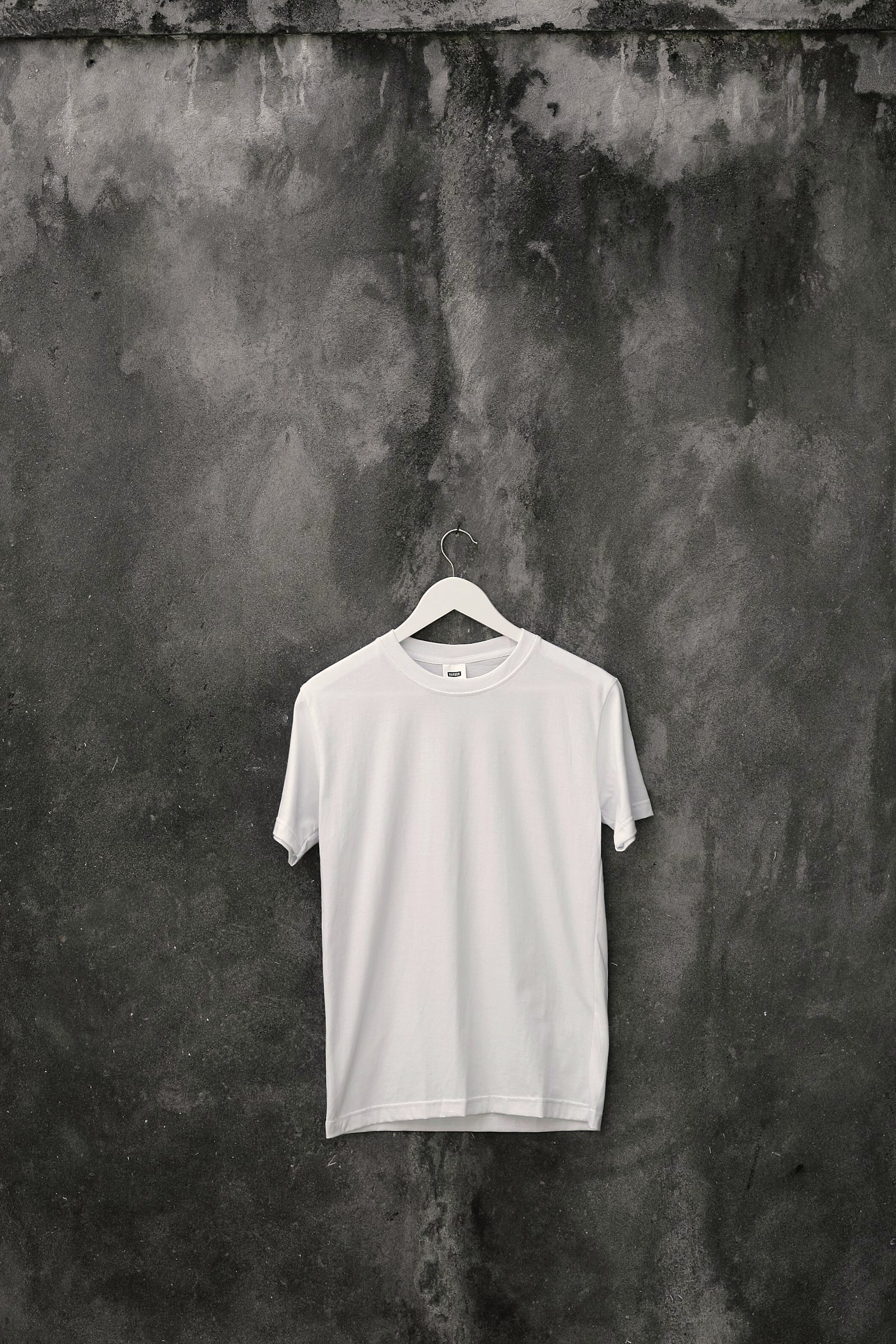
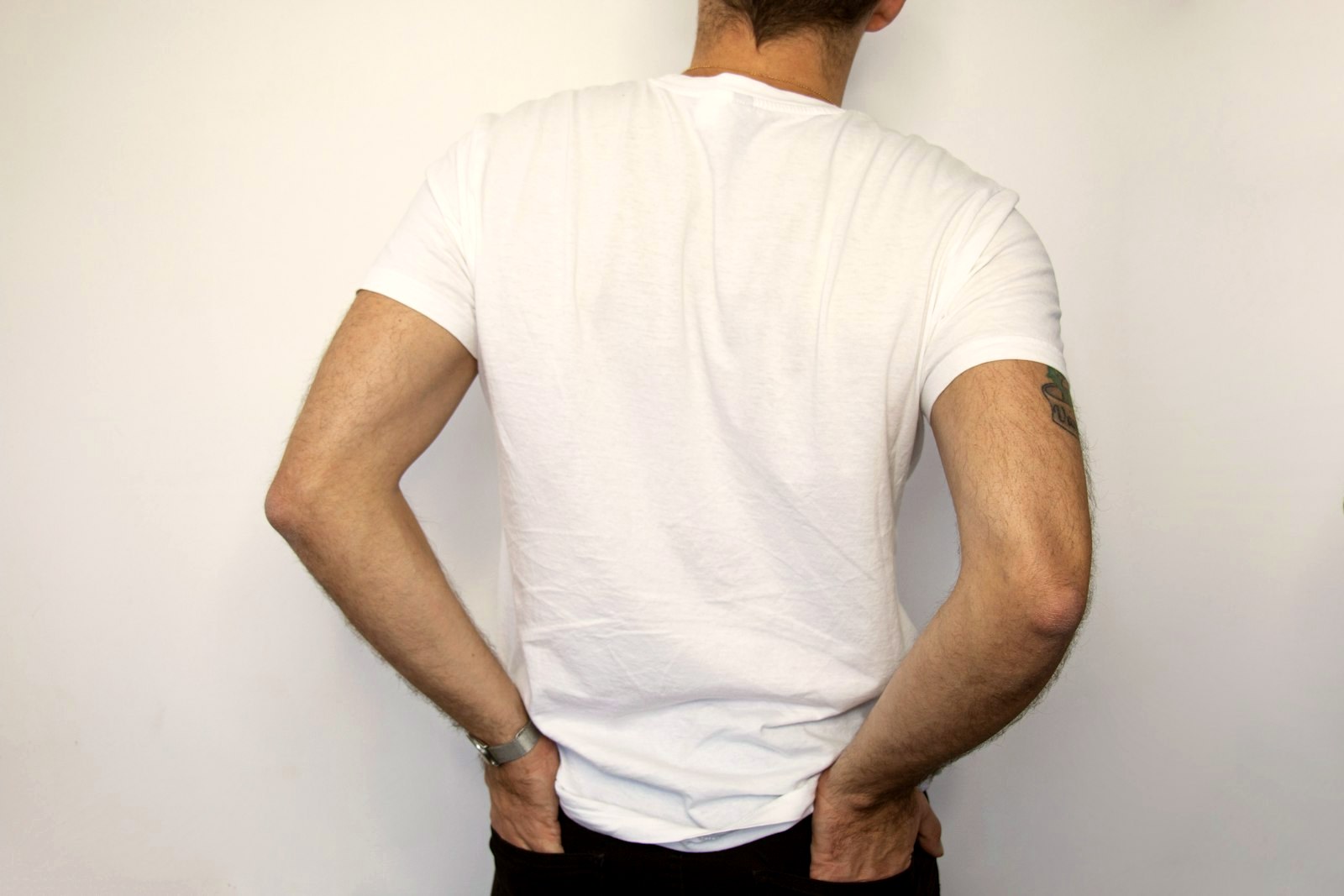
A note on our own photography: our photo bank holds strong white tee frames, the sunlit wall, the garment on its hanger, the cloth's fall from behind, and they carry this page, captioned for exactly what they show. What it does not hold is a ranked tee identified in a ranked outfit, the Asket worn in the classic seat, the Merz's weight read on a body, a collar ring photographed at 4pm beside the same collar at 9am, the two frames this brief's argument most wants. This page will take those frames the week they exist, in the tee family's own harvest order: the winner worn alone with denim in hard light, the collar at the end of a day, the hand test photographed against a window. Until then, no frame here is labelled as a garment it does not show.
Questions, answered
How do you wear a white t-shirt?
As the outfit's foundation, on four facts: the cloth in the opaque band, a collar that holds its ring, a sleeve that ends at mid-bicep, and a hem whose tuck is decided by the bottom half. Our shirt index files the t-shirt at formality 1, the foundation garment, and prints its laws, cloth weight and a neckband that recovers after washing. Worn, that means the tee is bought on its published weight, 180 to 220 grams in Verdict Card No. 02's working band, worn alone only when it passes the opacity test, and treated everywhere else as the layer the rest of the outfit is built on. The Asket tee at 88 is the ranking's reference for the garment worn as a shirt.
Should you tuck in a white t-shirt?
By the bottom half, the polo family's standing law carried across to the tee entire. With tailored trousers, a belt and leather shoes, tuck: the outfit has asked for a clean waist at every other point, and the untucked hem is the one untidy fact left. With denim, chinos worn open or shorts, the hem may stay out, provided it ends around the belt line and never past the fly. The wide-leg brief prints the same arithmetic from the other side as the counterweight rule: over a pleated or wide leg the tee is tucked with the belt line showing, because the untucked tee over width deletes the waist the whole silhouette hangs from. The half-tuck is not a third option here either.
Can you wear a white t-shirt under a blazer?
Yes, on the blazer brief's printed conditions, and only on them. In How to Wear No. 03's outfit matrix the t-shirt under a blazer is the Weekend row: the jacket unstructured, hopsack or cotton twill, born alone and never a smooth suit jacket; dark denim or chinos below; clean minimal trainers or suede shoes. The tee itself must be the garment class, cloth in the opaque band with a collar that holds its ring, the Asket at 88 or the Merz loopwheel at 82 in Verdict Card No. 02. The failure is a fine, light tee under tailoring: at layer weight it reads as an undershirt that has escaped, and the outfit reads as a man caught between dressing and undressing. The office row in the same matrix leans on the Oxford deliberately, and no tee stands in it.
What makes a white t-shirt and jeans work?
The classic seat is an agreement between two graded garments, not an accident of two defaults. The leg is the denim ranking's reference, the Levi's 501 Original at 81 in Verdict Card No. 11, rigid cotton with a mid rise of 11.25 inches, straight enough to give the tee a line to end against. The tee answers with the four facts: cloth opaque enough to be the outfit's only top layer, a collar sitting in its ring rather than sagging into a scoop, a sleeve ending at mid-bicep and sitting close without gripping, and a hem that ends at the belt line, out over the jean or tucked where the rise invites it. What ruins the seat is never the pairing, it is the tee's class: an undershirt-weight cloth, a waved collar, or a hem past the fly, each one a foundation garment asked to do a shirt's work.
What is the difference between a t-shirt and an undershirt?
The undershirt ranking prints the line entire: our white t-shirt ranking grades a garment built to be seen, cloth weight for opacity and a collar that holds a ring in public, and a tee's virtues are an undershirt's vices, because weight becomes bulk, a proud collar becomes a visible one, and a boxy body becomes a tail by 3pm. The undershirt, Verdict Card No. 31, is graded on the opposite virtues and won by the Tommy John Second Skin Stay-Tucked at 85: a collar engineered to stay flat and hidden, no sleeve line under a shirt, and a hem still tucked at the end of the day. The shopping form of the line is the show-through test: a white garment you can read your hand through, held inside its body against the light, is an undershirt whatever its label calls it, and it is worn under something or not at all.
How heavy should a white t-shirt be?
In the band the white tee ranking prints: 180 to 220 grams is the working band, opaque against skin, structured enough to hold a shape, light enough for summer. Under about 160 grams a white tee reads as an undershirt and shows everything under it; the Sunspel Classic at 76 in Verdict Card No. 02 is the fine end worn knowingly, a layer's cloth, elegant under tailoring and a whisper worn alone. Over 240 grams the tee becomes a garment in its own right, the Merz loopwheel at 245 grams and 82 the standing example, and wears warm. Five of the ranking's eight makers publish a weight; the three that do not are three of the four dearest shirts in the field, and the ranking counts the silence as data.
What do you wear under an open overshirt?
A white tee of the garment class, because the open overshirt is a frame and the tee is the picture it shows. How to Wear No. 10 rules the overshirt's two states, open as the jacket or closed as the shirt, and open, the layer beneath carries the outfit's whole front. The tee that earns the seat is opaque, collared in a ring that sits flat against the overshirt's open placket, and plain: the Asket at 88 is Verdict Card No. 02's reference, and the overshirt it stands under is graded in Verdict Card No. 06, won by the L.L.Bean Chamois Cloth Shirt at 83. A logo, a graphic or a waved collar under an open overshirt is a frame spent on a picture that was not worth hanging.
Has Young Cotton ranked white t-shirts?
Yes. Verdict Card No. 02 ranked eight white t-shirts on cloth, construction, fit, value and longevity and sent one home: the Asket T-Shirt winning at 88 on a published 180 grams and a published cost breakdown at $70, the Merz B. Schwanen 215 loopwheel second at 82 on the field's heaviest cloth at 245 grams, the Los Angeles Apparel 1801GD at 79, the Sunspel Classic at 76, the Uniqlo U Crew Neck at 75, the CDLP Midweight at 74, the Hanes Beefy-T at 67, and the one sent home at 61, a $225 fine-gauge tee whose expected life is the shortest on the page. This brief is the wearing system that ranking implies: it styles the Card's field in the Card's order, draws the undershirt line from No. 31, and scores nothing of its own.
Next
The family this brief belongs to: the ranking it styles is Verdict Card No. 02, and the type itself is filed in the shirt index, whose formality ladder and collar laws this page is built on. The boundary beneath it is graded in the undershirt Card, No. 31, the drawer below it in the underwear Card, No. 24, and its summer seat in the tank Card, No. 30. The layers above it are styled in How to Wear No. 10, No. 03 and No. 45; the classic seat's leg is ranked in the jeans Card, No. 11 and styled in No. 05; the tucked row over width stands in No. 47; the polo family's tuck law this brief carries stands in No. 06; and where the torso hangs among this site's winners is mapped in the Body Map.