
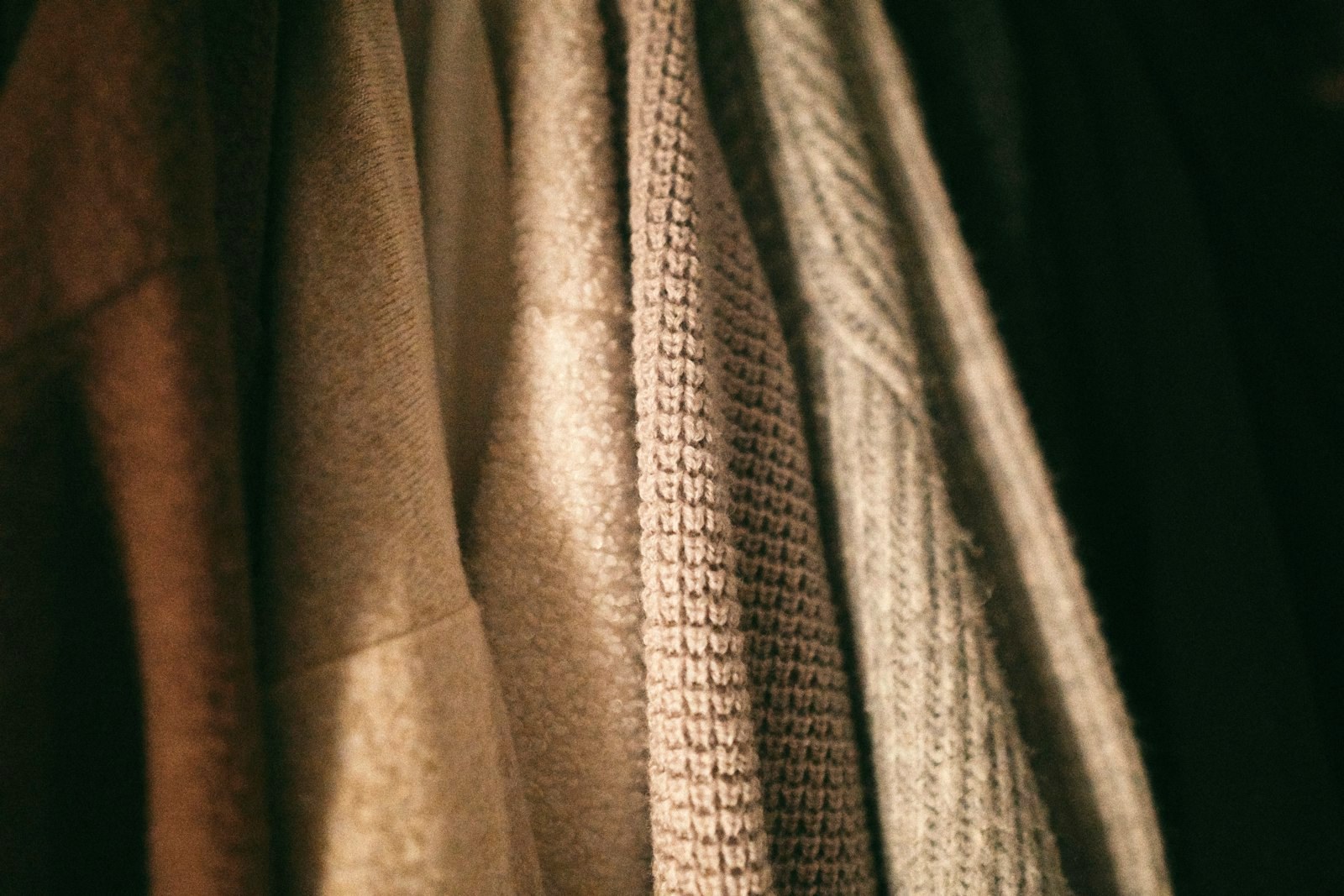
The species' rail, captioned as exactly that: heavy knitwear hanging in a row. No garment on this rail is a ranked cardigan, and our bank holds exactly one worn shawl-collar frame, already the hero of How to Wear No. 01 and a figure on Verdict Card No. 78; it stands as a figure below, captioned as that reuse, rather than being passed off as this page's own discovery.
Checked and updated October 2026
The ruling, up front: a shawl-collar cardigan is not a cardigan with a bigger collar. It is a different storey of the outfit. Our sweater index files it as its own type, formality 3 and warmth 4, a jacket substitute that goes over and never under, and Verdict Card No. 78 has now ranked the species entire: the Colhay's Superfine Lambswool winning at 89, the Permanent Style Indulgent Shawl at 88, the Dehen sweater coat at 84, and a cardigan sent home at 32 for wearing the shawl name over a knit with no wool in it. So this brief begins where the Card ends: the shawl collar is the garment, a roll of cloth that is roughly a third of the knit, worn at the neck, and it is worn as the last thing on. Over it goes nothing. Under it goes a cleaner surface than its own, the cardigan family's standing law from How to Wear No. 01, carried across whole. The buttons fasten at the middle and stay open at the bottom. This page prints the species and its seats, the collar test that separates a roll from a trim, the fit as the Card's field actually cuts it, the outfit matrix that assembles the whole thing, and the five ways the garment is ruined.
This brief: the decisive rule · know which shawl you are holding · the collar test · the fit rules · what goes under the roll · the button discipline · the season line · the looks · the mistakes · care and our photography
The decisive rule: the collar is the garment, and the garment is the top layer
Every brief in this family has a rule that decides the garment, and the shawl collar's is a law of storeys. The cardigan proper is the layer in the middle, the only knit that opens, filed at warmth 3 and worn over a shirt and under a coat in the same outfit. The shawl-collar cardigan is filed one rung warmer and one job higher: warmth 4, the warmest of the open knits, a jacket substitute. The two garments share a rail, a name and a button stance, and they are not interchangeable, because the shawl version's whole reason to exist is the thing the middle layer cannot have: a collar built like a lapel, a roll of knitting that rises from the button line, widens over the chest and folds back on itself, with no separate collar piece and no notch. That is this brief's decisive rule, printed as new: the collar is the garment, roughly a third of its yarn worn at the neck, so the shawl-collar cardigan is bought on its collar's construction and worn as the outfit's outer surface, over a cleaner layer, with nothing over it.
The rule's first corollary is about buying, and the Card has already done the counting. A roll that size is cloth, not styling: it is knitted at the garment's own tension out of the garment's own yarn, and a species whose signature is a third of its substance stands or falls on its cloth record in a way a V-neck never has to. That is why No. 78 grades cloth first, out of 30, and the collar and button record second, out of 20, and why its field sorts the way it does: the winner publishes six plies, a micron count, a named mill and 1.2 kilos, and the garment sent home publishes a collar that is a trim on a different neckline over a fully synthetic knit. The collar test below is the buying form of the rule: three checks at the rail, each one a count the Card has already run.
The second corollary is about wearing, and the index prints it in four words: over, never under. A shawl collar under a blazer is a roll crushed flat against the chest, its volume spent making the jacket sit badly; a shawl collar under a coat is the same waste at a heavier price. The garment's warmth, its collar and its cut are all spent on being the surface. Where the cardigan proper disappears into an outfit on purpose, the shawl is the outfit's visible argument, and the matrix below seats it exactly where No. 01 first put it: the dark shawl as the jacket of a smart evening, over a fine knit, with dark trousers and nothing over it at all.
Know which shawl you are holding: the species and its seats
The rail sells several garments under the shawl name, and No. 78 separates them in print before it grades any of them. The wearing rules differ by seat, so the seats come first.
| Form | Build | Its seat on the Card |
|---|---|---|
| The true shawl cardigan | Button front, the collar one continuous roll from the button line | The species entire: the Colhay's at 89, the Paul James at 83, the Inverallan at 81, the Drake's at 79 |
| The engineered shawl | A collar built to close: a chest button and a hidden loop | The Permanent Style Indulgent at 88, the ceiling of the species and the one legal exception to the open-collar rule |
| The sweater coat | The shawl built as a coat's collar, a longer body, workwear weight | The Dehen 1920 Shawl Sweater Coat at 84, the heavy end of the species |
| The robe-cardigan | The shawl over a belted waist; the belt is the closure | The RRL Belted Ranch Cardigan at 74, read on its belt's record, not the button column |
| The visiting shawls | Shawl collars entered in the cardigan ranking before the species had its own | Scored in Verdict Card No. 16: the William Lockie at 82, the J.Crew Rugged Merino at 62, cross-referenced here and never re-graded |
| The closed cousin | The same collar on a pullover body, no opening, no buttons | The Bean Ragg Wool Fisherman Shawl Collar at 75 in Verdict Card No. 59, a different garment with a different brief |
Two garments on the rail are not in the table because they are not the species. The zip-front sweater-jacket wears a shawl-shaped collar as outerwear trim and is graded as itself where it appears; No. 78 rested its standing example on the bench with its record printed. And the name-only form, a stand collar with a corduroy detail sold under the shawl name in one of its maker's own markets, is the skip at 32: the collar test below is the instrument that catches it in a shop, before the name is believed.

The collar test: three checks at the rail
The Card grades the collar as a record; the wearer meets it as a garment on a hanger. These are the same facts in shopping form, and each check is a count No. 78 has already run across its field of eight.
The roll test. Run a hand from the lowest button upward: a true shawl is one continuous roll of knitting, rising from the button line, widening over the chest and folding back on itself, the collar and the front the same cloth at the same tension. There is no separate collar piece, no notch, no seam where a collar was attached. If the collar stands up instead of rolling, if it is a band, a stand or a trim sewn onto a different neckline, the garment is another species wearing the name, whatever the product title says. The field's convicted form fails this test in both of its maker's markets: a high neck and a zip in one, a contrast collar in the other, a shawl in neither.
The cloth test. The roll is about a third of the garment's yarn, so the collar is only ever as honest as the cloth record under it, and the record is checkable on the maker's own page. A garment weight in grams or kilos is published by two of the eight makers on the Card, the winner at 1.2 kilos and the Paul James at 825 grams, with a third, Dehen, publishing its line's sweaters at three to four pounds. A ply or a gauge is published by five of eight, a composition in percentages by five of eight, and a mill or a yarn origin is named by two, Todd and Duncan for the winner and Donegal for the hand-knit's yarn. The hand test agrees with the paper more often than not: a real shawl has a weight in the hand that a silhouette cannot fake, which is the index's warning in physical form, that the thin fashion copy of this type deletes the very thing its warmth score is measuring.
The button test. Read the buttons, because on this species they are a published fact with a pattern behind it. Six of the seven button-front cardigans on the Card name their button material: horn on the Colhay's, the Indulgent and the RRL, corozo on the Dehen, knotted leather on the Drake's, Italian-made buttons on the Paul James. The one ranked silence is the hand-knit's, charged on its card. The belted robe carries no buttons at all, which is its species, and is read on its belt instead. And the Card prints the correlation that makes this a test rather than a trivia question: every maker on its page who names the button also publishes the cloth. A maker who will tell you what the smallest part is made of will usually tell you what the garment is made of. The reverse has held on every ranking this desk has run.
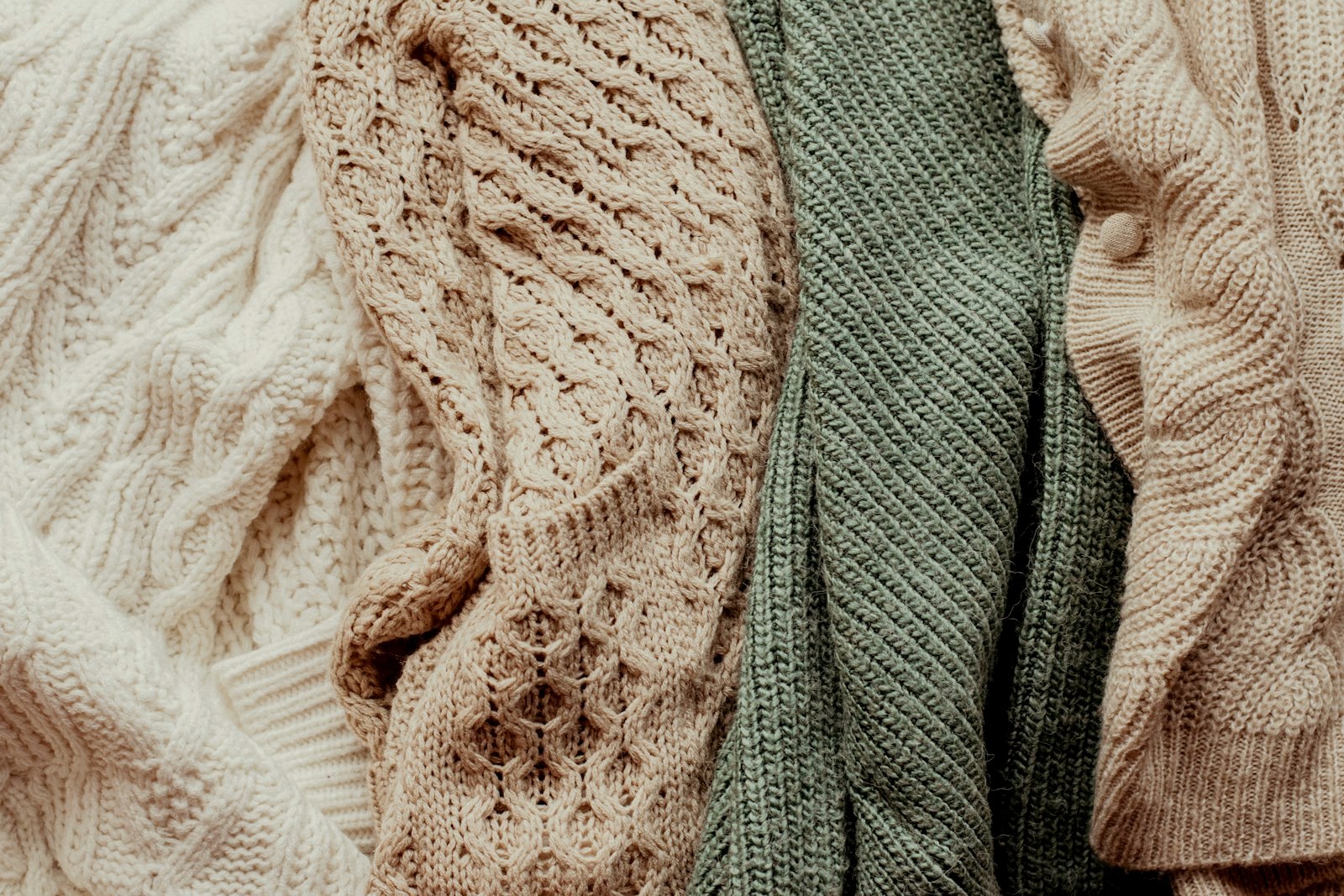
Worn, the collar has one job beyond warmth: it frames the opening. Open, the roll should lie on the chest and hold its shape without being held, widening where the Card's two stated constructions put it, on the winner's tailored lapel line and on the hand-knit's deep hand-built roll. A collar that collapses flat against the chest when the buttons are open is a construction fact about the knit, and it will not improve with wearing. The fit rules below begin from there.
The fit rules: generous by design, exact where it counts
No. 01 prints the cardigan family's fit lines, and three of them carry across to the species unchanged: the shoulder seam on the shoulder point, because knitwear forgives more than tailoring does but a dropped shoulder still reads as borrowed; sleeves to the wrist bone, with the under-layer's cuff showing a sliver beneath on the dressed forms; and no strain at the button stance, the placket discipline the cardigan ranking judges its whole category on, because a shawl buttoned over a gaping front has failed at the joint the garment exists around. Two of the family's lines change on this species, and the Card's fit records are the reason for both.
Through the body: room is the design, not a sizing error. The cardigan proper fits close, a middle layer drawn for a shirt underneath and a coat above. The shawl's field is cut the other way at its top: the Colhay's is generous by design, the Indulgent generous and roomy by intent, the Dehen built as a coat. The body has to carry the layer it is worn over without the stance straining, and it has to keep the roll's volume in proportion: a shawl sized down to a middle layer's fit is the species bought against its own pattern, and it reads as exactly that, a jacket substitute squeezed into a layer's job. Size it as the outer garment it is.
Length: past the belt line, to where a jacket ends. The family's length rule for the cardigan proper, to the belt line and a touch past, is the floor here, not the line. The species runs longer: the winner carries the longest body in the specialist guides, the sweater coat's current version adds a longer, coat-minded body on purpose, and the robe form is longest of all because its belt has to sit at a waist. What the longer body must not become is the fine cardigan's failure at the other gauge, a dressing gown that escaped: the hem ends where a jacket's ends, at the seat, and the belted form is the only seat in the table licensed to run past it.
Buy on published measurements where they exist. The Indulgent publishes chest, length and sleeve across five sizes; the Paul James publishes a full measurement table behind the field's widest library, eight sizes from XS to 4XL; the Drake's runs XXS to XXXL on the ranked field's shortest record. A generous cut is a stated intention only when the numbers are printed beside it. Where a maker publishes nothing, the rail test is the under-layer you actually wear: try the shawl over a fine knit, button the middle, and let the stance answer.
What goes under the roll: the cleaner-surface law, carried across
No. 01's under-layer law governs the whole cardigan family, and this brief carries it across whole, because the shawl's deeper opening makes it stricter, not looser: the layer under the cardigan must have a cleaner surface than the cardigan itself. The shawl frames more of the under-layer than a V-neck does, from the chest to the waist, so whatever sits under the roll is on display inside the garment's own architecture. The ranked partners, in the order the matrix uses them:
The fine crew neck is the standard. A smooth fine knit under a rolling collar is the assembly No. 01's matrix builds its smart evening on, and its ranking's reference stands at the top of the crew Card: the Smedley Lundy at 87 in Verdict Card No. 10. Fine against chunky, quiet against loud, the under-layer doing nothing but being clean.
The roll neck is the cold form. A turtleneck under a shawl collar is two collars in sequence, and it works because they are different instruments: the roll neck closes the throat, the shawl frames it. Its ranking's winner is the Smedley Cherwell at 85 in Verdict Card No. 05, and the wearing system for that layer is briefed in How to Wear No. 08. This is the assembly for the shawl's coldest honest work, warmth 4 over warmth 4, and the season line below rules on where it stops.
The collared shirt is the dressed form. Under the dressed shawls, the Drake's class that its maker sells as a tailored jacket alternative, a collared shirt keeps the register the garment claims: the shirt's collar sits inside the shawl's roll, the cuff shows at the wrist, and the reference for the layer is the Oxford Card's winner, the Kamakura at 93. The flannel shirt is the working form of the same law, and it comes with the species' own precedent: the closed cousin on No. 59, the Bean shawl-collar fisherman at 75, is sold on its card as a shawl worn over a flannel, and the flannel ranking's winner, the Bean Scotch Plaid at 85 in Verdict Card No. 09, is the layer the Dehen's coat form was built over.
The plain t-shirt and the henley belong to the working shawls only. No. 01 licenses the t-shirt under the chunky cardigan and nowhere else in the family; the licence extends here to the species' working seats, the Paul James at the rail and the Dehen over it, where the under-layer is a base, not a statement. The henley is the same seat with a placket of its own, its ranking's Filson Waffle Knit at 84 in Verdict Card No. 34. Under the dressed and ceiling shawls, both read as the layer that gave up.

The prohibitions are the law's other half, and the brief names the brief's own third mistake from among them below: a competing texture under the roll, a chunky knit under a chunky shawl, a cable under a cable, two knits arguing at the same volume; a graphic print framed by the opening, shouting through the one part of the outfit designed to be looked at; and a hooded layer, whose second collar has nowhere to go under a roll that is itself a collar. The under-layer is the quiet surface. Everything else in the outfit is built on its quietness.
The season line: warmth 4, the cold half of the year
The index files the type at warmth 4, one rung under the fisherman's 5 and one above the cardigan proper's 3, and the season follows the filing: the shawl-collar cardigan is a cold-half garment, autumn through winter into spring's cold edge, the months when a top layer has to be a warm one. The Card's costing runs on the same line, its field priced across winters at forty wears a year in the cold half. In the warm months the species has no honest work: the index's warm-weather knits sit at warmth 2 by design, and a 1.2-kilo roll of lambswool worn in July is not a commitment to the garment, it is a refusal to read its label.
The line's cold end is the one that needs ruling, because warmth 4 tempts its owner upward. The shawl over a knit is, in No. 78's own FAQ, the coldest this garment should ever be asked to go alone: below that weather the answer is not a coat dragged over the shawl, which the storey rule forbids, and it is not the shawl buttoned to the neck, which the button discipline forbids on every collar but the engineered one. The answer is the outfit changing storeys, a coat over a different knit, with the shawl kept for the weather it was filed for. The seasonal assemblies that seat the species are the site's own: the Fall Edit and the Winter Edit, where the knit drawer is assembled whole.
The looks: the Card's field, worn in its order
Six assemblies from this brief's rulings, each built on the published records around the garment. The cardigans are No. 78's, in the Card's order and at the Card's scores; the layers under them are the rankings named in the under-layer section; nothing in the judgments is scored here.
| Setting | The cardigan | With | The judgment |
|---|---|---|---|
| The smart evening | The Colhay's in navy, 89, worn open over the layer | A fine crew neck, the Lundy class at 87, or a roll neck in real cold, dark trousers, nothing over it | No. 01's smart-evening row executed on the Card's winner: the shawl as the jacket, seated by a collar designed on a tailored lapel's line, which is why this garment, alone in the knit drawer, can hold a jacket's seat without apology. The £695 ticket is the row's known price, and the Card's £1.45 a wear is its defence |
| The dressed shawl | The Drake's, 79, half-buttoned | A collared Oxford, the Kamakura class at 93, tailored trousers | The house sells this cardigan as an alternative to a tailored jacket, and the assembly takes it at its word: knotted leather buttons, a shirt's collar inside the roll, the register dressed. The judgment carries the Card's charge with it, that its page is the ranked field's shortest record, bought for the eye with the paperwork known |
| The attainable working shawl | The Paul James, 83, at £245 | A plain t-shirt or a henley, the Filson class at 84, denim or cords below | The species at its honest working price: 825 grams and a 5 gauge published on the product page, Italian-made buttons named, the cheapest full record on the Card. This is the row the brief recommends first, because it is the shawl a rotation can actually start with, and its cost per wear, £0.77 on the Card, is the field's second cheapest |
| The heavy cold | The Dehen Shawl Sweater Coat, 84 | A flannel shirt beneath it, the Scotch Plaid class at 85, work trousers, the coat form worn as the coat | The Bean pullover's own printed assembly, a shawl over a flannel, translated to the opening form at three times the weight class: the species' top end in warmth, worn where warmth 4 is the outfit's whole weather plan. The Card ships this garment without a buy link, its doors at its stockists, and the row keeps that honesty |
| The long evening in | The Inverallan 6A, long form, 81 | A fine crew neck under it, the hand-knit worn open at home and out locally | The slowest make in the field, graded on a record that publishes its hand and its Donegal yarn and withholds its numbers, charged on its card for the field's one unnamed button. Worn, none of that shows and all of it is the point: this is the shawl bought for the knitting itself |
| The robe form | The RRL Belted Ranch Cardigan, 74, the belt fastened | A t-shirt or henley under it, at home, the shawl falling open above and below the belt | The species' belted seat, read on its belt's record as the Card reads it: a hand-knit in a published wool, linen and silk split, at a collector's $1,199 on its verified listing. Bought as the robe form's exemplar or not at all; the matrix prints it last because it is the seat a wardrobe grows into, not the one it starts with |
The ruling
Buy the species on the collar test: a true roll from the button line, a cloth record with a weight or a ply on it, a button with a material's name, which in the Card's field means the Paul James at £245 for the working wardrobe and the Colhay's at £695 for the complete record, with the Lockie at 82 waiting in No. 16 for the buyer who finds it first. Wear it as the top layer or not at all: over a cleaner surface than its own, the fine crew for the standard, the roll neck for the cold, the collared shirt for the dressed form, the plain base layers under the working seats only. Fasten the middle, leave the bottom open, and close the collar to the chin only where a maker engineered it to close. Keep it in its season, the cold half of the year, and let the coat take the weather below it. The shawl collar is the oldest argument in the knit drawer, that a collar can be a garment's whole architecture. Worn on its record, it still wins the argument every evening it is put on.
The mistakes
The silhouette shawl. The buying error the Card exists to catch: the name believed before the collar is checked. The convicted form is sold under the shawl name in one of its maker's own markets and is, in the hand, a high neck with a zip and a corduroy trim over a knit with no wool in it, sent home at 32. The roll test takes five seconds at the rail: one continuous roll from the button line, or it is not this garment. A collar that exists only in the product name will not appear later in the wearing.
The undisclosed knit. The quiet version of the same error: a true roll, honestly shaped, over a cloth record that publishes nothing, no weight, no ply, no split, no mill. The collar is a third of the garment's yarn; a shawl bought on an unpublished cloth is a third of a garment bought blind, and the Card's counts are the shopping list of what should be printed, weight by two of eight, ply or gauge by five, the button's material by six of seven. The makers who publish are named on the Card at every price from £245 up. There is no budget at which the silence is the only option.
The wrong layer under the roll. The wearing error the under-layer section exists to prevent, in its three forms: the competing texture, a chunky knit under a chunky shawl, arguing at the same volume through an opening built to frame it; the print in the frame, a graphic shouting out of the one part of the outfit designed to be looked at; and the buried shawl, this garment worn under a coat or a blazer as if it were the middle layer, its roll crushed, its warmth and volume spent making another garment sit badly. The first two break the cleaner-surface law. The third breaks the storey rule. All three are the same mistake at different depths: the shawl treated as a layer among layers, when the index files it as the surface.
Buttoned to the neck. The stance error: every button fastened, the roll dragged up to the chin and held there by force, on a collar that was built to fold back on itself. No. 78's FAQ prints the sentence and this brief adopts it: a shawl buttoned to the neck is a cardigan pretending to be a coat, and coats do it better. The exception is engineered, not improvised: the one collar on the Card with a chest button and a hidden loop closes because it was built to, and it is the exception that proves the construction is the rule.
The shawl as weatherproofing. The season error: warmth 4 read as a coat rating. The shawl is the warmest of the open knits, and an open knit is what it remains, a knitted front with a button stance, no shell, no closure that seals. In real cold and weather it is the outfit's warm layer under nothing, which is why the season line gives it the cold half of the year and takes it out of the storm: the man who needs a coat wears a coat, over a knit that was filed for the middle, and the shawl waits for its own weather, in which nothing beats it.
Care, and a note on our photography
A shawl-collar cardigan's care follows from its construction, and the records print the terms. The garment is heavy by design, the field's published weights running from 825 grams to 1.2 kilos, so it is stored folded, never hung: a knit that weight on a hanger is a garment slowly re-cutting its own shoulders. It is rested between wears, the discipline the cardigan ranking prints for its cashmere and the heritage houses build into their costings, the Lockie costed at twelve winters on the strength of a make that expects repair across decades rather than replacement. And its watch points are the family's, printed in No. 16: a cardigan fails at the front first, the placket, the buttonholes, the pockets, so the stance is checked the way the collar is, as a record. Buttons of horn, corozo and knotted leather are furniture with names; a lost one is replaced like for like or the card's smallest published fact goes missing from the garment.
A note on our own photography: our photo bank holds exactly one frame of a shawl-collar knit worn, the portrait that fronts How to Wear No. 01 and figures on Verdict Card No. 78, and it stands as a figure on this page too, captioned as that reuse. There is no second worn shawl frame to choose, no photograph of a ranked cardigan, and no macro of a shawl roll at the button line, the exact frame the collar test describes. This page will take those frames the week they exist: the roll rising from the button stance in raking light, the Indulgent's loop closed, a 1.2-kilo knit folded on a shelf. Until then the bank's rail, its cloth macro and its one honest portrait carry the page, captioned for exactly what they show.
Questions, answered
How do you wear a shawl-collar cardigan?
As the top layer, and as nothing else. Our sweater index files the shawl-collar cardigan as its own type, formality 3 and warmth 4, a jacket substitute that goes over and never under, and How to Wear No. 01 seats the dark shawl as the jacket of a smart evening. Over it goes nothing; under it goes a cleaner surface than its own, a fine crew neck, a roll neck or a collared shirt. Button the middle and leave the bottom button open. Worn that way it is the warmest of the open knits doing the job a jacket does; worn as a middle layer it is a cardigan buried in the wrong storey of its own outfit.
What do you wear under a shawl-collar cardigan?
A cleaner surface than the shawl's own, the cardigan family's standing law in How to Wear No. 01, carried across to the species whole. The fine crew neck is the standard, and its ranking's reference is the Smedley Lundy at 87; the roll neck is the cold form, the Smedley Cherwell at 85 in its ranking; the collared shirt is the dressed form, the Oxford Card's Kamakura at 93 under the dressed shawls. A plain t-shirt belongs under the chunky working shawls and nowhere else in the family. What never works is a competing texture: two knits arguing at the same volume, a cable under a cable, a pattern shouting through the opening.
Which buttons do you fasten on a shawl-collar cardigan?
Button the middle, and leave the bottom button open, always: the cardigan family's rule, and on this species the makers print it themselves. The Permanent Style Indulgent Shawl, second in Verdict Card No. 78 at 88, omits the bottom button of its placket entirely, because, in its maker's words, no one does that one up. Fully open works over a clean under-layer. Closed to the chin works only on a collar engineered to close, a chest button and a hidden loop built for it; a shawl forced shut at the neck is a cardigan pretending to be a coat, and coats do it better.
How should a shawl-collar cardigan fit?
More generously than the cardigan proper, by design. The top of Verdict Card No. 78's field is cut that way on purpose: the winning Colhay's is generous, with the longest body in the specialist guides, and the Indulgent is generous and roomy by intent. The body needs room for the layer it is worn over, with no strain at the button stance, the placket discipline the cardigan ranking prints. The length runs past the belt line, to where a jacket ends; the shoulder seam stays on the shoulder point and the sleeves end at the wrist bone, the fit lines How to Wear No. 01 prints for the whole family. Buy on published measurements where a maker prints them, as the Indulgent and the Paul James both do.
Can you wear a shawl-collar cardigan under a coat or a blazer?
No, and the index prints the rule before this brief does: the shawl-collar cardigan goes over, never under. It is filed as a jacket substitute at formality 3, and a coat or blazer over it crushes the roll the garment exists for and demotes it to a middle layer it was never built to be; the middle layer is the cardigan proper's job, ranked in Verdict Card No. 16. In weather colder than the shawl's, the outfit changes around it, a coat over a different knit. The shawl itself is the outer surface, or it stays home.
How warm is a shawl-collar cardigan?
Warmth 4 on our sweater index, the warmest of the open knits, one rung under the fisherman's 5. The warmth is the cloth, and the cloth is checkable: Verdict Card No. 78's field runs from the Colhay's at 1.2 kilos of six-ply lambswool and the Indulgent's 12 plies of cashmere to the Dehen line's sweaters published at three to four pounds. The index prints the warning beside the score: the thin fashion copy of the type deletes the very thing the warmth score is measuring. A shawl collar over a thin knit is a collar drawn on a layer, and it will be exactly as warm as the yarn that is not there.
Shawl-collar cardigan or ordinary cardigan: which should you buy?
They are different storeys of the same outfit, and our index files them as different types. The cardigan proper, ranked in Verdict Card No. 16, is the layer in the middle: fine under tailoring, over a shirt and tie, under a coat, the Smedley Bryn its winner at 84. The shawl collar is the top layer, the jacket substitute, ranked in No. 78. Buy the storey the wardrobe is missing. Two garments stand on the boundary and are scored once each, in No. 16, because that is where they were entered: the William Lockie lambswool cardigan at 82 and the J.Crew Rugged Merino at 62, both shawl-collared, both cross-referenced by No. 78 and never re-graded.
Has Young Cotton ranked shawl-collar cardigans?
Yes. Verdict Card No. 78 ranked seven shawl-collar cardigans on their published records and sent one home: the Colhay's Superfine Lambswool winning at 89 on six-ply lambswool from a named mill at a published 1.2 kilos, the Permanent Style Indulgent Shawl second at 88, the Dehen 1920 Shawl Sweater Coat third at 84, and the cardigan sent home at 32, sold under a shawl name in one of its maker's own markets over a knit with no wool in it. This brief is the wearing system that ranking implies: it styles the Card's field in the Card's order, cites the cardigan ranking's two visiting shawls from No. 16 where the boundary puts them, and scores nothing of its own.
Next
The family this brief belongs to: the ranking it styles is Verdict Card No. 78, and the storey beneath it is ranked in Verdict Card No. 16, whose brief, How to Wear No. 01, prints the cardigan law this page carries across. The closed cousin is ranked in Verdict Card No. 59 and briefed in No. 39. The knit siblings stand around it: the sweater vest in No. 36, the V-neck in No. 37, the mock neck in No. 38, the crew neck in No. 09 and the turtleneck in No. 08, and the drawer whole is filed in the sweater index. Where the collar lands on the body is drawn in the Body Map.