
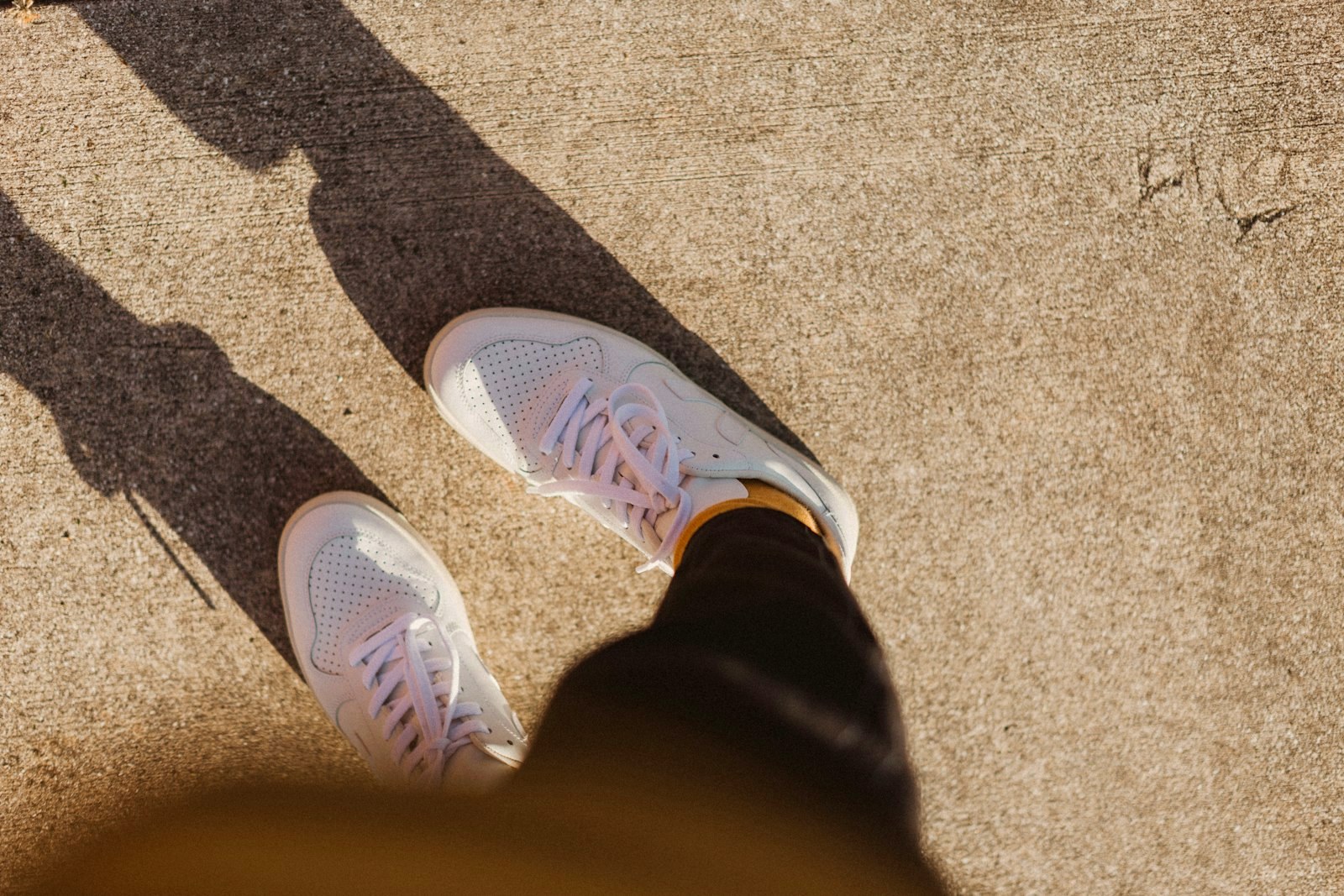
The summer ground, captioned as exactly that: white sneakers on sunlit concrete, the shoe this brief's matrix starts from. It is not a pair of shorts. Our bank holds no photograph of a short worn on a body in any cloth, and the closing section prints that gap and the harvest list rather than let a trouser or a swim short stand in for the garment.
Checked and updated October 2026
The ruling, up front: a short is a trouser with one decision left in it, and the decision is the inseam. Verdict Card No. 07 prints the decoder and this brief wears it: the inseam is the formality dial. The 5 inch class lands mid-thigh and corrects short legs; the 7 inch is the default, landing two to three inches above the knee; the 9 inch is the tall leg's class and the formal end. The check that settles every argument is the landing zone the Card prints: one to three inches above the knee. At the knee the garment shortens the leg it was bought to free, and below it the garment has changed species. The field underneath is ranked and this brief touches no number in it: the Spier & MacKay linen short at 86, the only pair cut like a trouser; the Patagonia Baggies at 84 in both this ranking and the swim ranking, the bridge between the street and the water; the H&M slim short sent home at 46, named in this brief as a warning and styled nowhere. And the boundary is printed before anything else is argued: this brief styles the street short. The swim short belongs to Verdict Card No. 43, whose record is cited here and re-ruled nowhere.
This brief: the inseam is the dial · the cloth species · the tailored short · what goes on top · feet and socks · colour and pattern · the looks · the mistakes · the water boundary, care, and our photography
The decisive rule: the inseam is the formality dial
Every other garment in this series spends its formality across several variables at once: cloth, cut, construction, company. The short spends almost all of it on one number. The cloth matters and the waistband matters, and both are argued below, but the room reads a short first at the hem, and the hem is set by the inseam, which is why Verdict Card No. 07 decodes the number before it ranks a single pair: an inseam class is not a style, it is a landing zone. The Card's decoder is reproduced here whole, because this brief's first ruling is that the decoder is not buying advice. It is the garment's formality system, and it is worn, not just purchased.
| Class | Where the hem lands | Who it suits | The register it sets |
|---|---|---|---|
| 5 inch | Mid-thigh | Heights under about 5'8"; longer legs at any height; athletic builds | The proportion corrector: it returns the length long shorts steal. The dressed-casual ceiling of the garment, provided the leg opening does not grip. |
| 7 inch | Two to three inches above the knee | Heights from about 5'8" to 6'1"; most legs, most settings | The default. The travel, evening and family-photograph answer, and the class the tailored assembly is built in. |
| 9 inch | At or just above the knee | Heights over about 6'1"; long torsos; conservative settings | The tall leg's class and the formal end of the category. On a shorter leg it is the one unforgivable read: a short that shortens. |
The hem law, printed as law. The landing zone is one to three inches above the knee, and the two failures are failures of landing, not of taste. At the knee is refused: a hem that lands on the kneecap cuts the leg at its joint, reads as a trouser that stopped rather than a short that was cut, and on any leg under tall it steals the length the garment exists to return. Below the knee is refused outright, and the refusal has a taxonomy behind it: past the knee the garment is in the territory Verdict Card No. 43 draws for its own species, where the long cut is surf equipment built against board rash. A street short below the knee has borrowed the boardshort's silhouette without its workplace, and it reads as exactly that borrowing. The chino brief spends a ladder on where a trouser's hem breaks over a shoe; a short has no shoe to break over, so it spends the same discipline on the knee instead. The hem is the short's break, and it is judged the way No. 29 judges a break: by where it lands, every time, in the mirror before the door.
The two corrections the table cannot hold. First, rise: the Card prints that a higher rise makes the same inseam look longer-legged, which is part of why its tailored winner photographs a class above its number. A 7 inch inseam on a high-rise, tailored pattern and a 7 inch inseam on a low, elastic pattern are different garments wearing one number, and the dial reads the pattern, not just the tape. Second, the leg opening: the pants index prints for trousers that the opening is read against what stands under it, and the short's opening is read against the thigh itself. An opening that grips turns any class into costume, which is the Card's warning about the 5 inch worn tight on a long leg, and the skip's conviction in miniature: the H&M pair at 46 is sent home partly on a slim cut that grips the thigh the decoder warns about. Short and relaxed is a proportion. Short and tight is a photograph of somebody else's legs.
The cloth species, and the ceilings they carry
Chino twill is the tailored register. The cotton twill short is the chino cut at the knee line, and it inherits the chino's whole position: the middle of the rotation, the type most men actually live in. In the ranked field it is the J.Crew stretch chino short at 75, the range answer, one product line carrying 5, 7 and 9 inch inseams across slim and classic fits, which means the decoder can actually be followed inside a single rail; and it is the Uniqlo chino short at 68, the honest budget pair in an 8.5 inch class, the value row's perfect score, the rotation's spare and travel pair. Twill's terms are the chino's terms from No. 29: it takes a press, holds a crease for a day rather than owning one, and its polished end is the tailored short's cloth in the next section.
Linen is the heat register, and it is the winner's cloth. The Spier & MacKay short at 86 is cut in linen and cotton-linen, and the cloth is half its case: in real heat and humidity the short in linen does the cooling work no twill matches, and How to Wear No. 07 prints the cloth's terms for the shirt and they transfer to the leg unchanged: the creases that follow joints are the cloth being itself, the creases everywhere with the architecture gone are neglect, and linen on linen is worn as two decisions, the tones broken, never as a matched set that reads as sleepwear. The linen short under a linen shirt in a broken tone is the heatwave assembly of No. 07's own matrix: shirt above, shorts with the hem above the knee, loafers or canvas trainers below.
Seersucker is the stripe that breathes. The puckered cotton weave is the tailored short's warmest-climate cloth, the stripe doing the ventilation the pucker builds in, and its register is the garden-party end of the tailored row: a seersucker short with a tucked shirt and loafers is a complete regional uniform in the American South and a considered one anywhere else. The honesty this brief prints beside it: this site's seersucker record lives in its shirt files, and no short in the ranked field is cut from it, so it is ruled here as a cloth, not as a card. Buy it on the tailored pattern, high rise and a proper waistband, or the stripe's formality is spent by the cut before the cloth can argue.
The technical short has a ceiling, and the Card prints where it is. Two of the field's seven are engineered synthetics, the Bonobos Anywhere at 71 and the lululemon ABC at 70, and the Card's verdict on the species is the same sentence in two dialects: the Bonobos' synthetic knit is comfortable the way athletic wear is comfortable and reads that way too, a short for motion, not for dinner; the lululemon's Warpstreme cloth reads as performance wear under any light, excellent in a suitcase and a compromise at a table. This brief takes the ceiling as the Card set it. The technical short owns the active rows outright, travel days, cycling to lunch, the short that is worn all day on foot, and its fit ranges are the field's best argument (the Bonobos menu is the widest here). It does not enter the tailored row at any price, because its cloth announces its workplace before its cut can argue, and no pocket layout changes that.
Denim shorts are refused above the field row, and the refusal's provenance is printed. How to Wear No. 05 prints no ruling on the denim short; this is this brief's ruling, drawn from No. 05's laws and labelled as such. A denim short is a jean with its length removed, and the length was most of the jean's argument: what remains is the five-pocket pattern at its most casual rung, judged, as No. 29 judges the jean in khaki, by the pattern the room reads first. Cut-offs add a second charge, a hem that was a decision somebody else made with scissors, fraying being the one finish no other tailored garment is allowed to wear unfinished. The wash break, No. 05's law for two denim surfaces, has almost nowhere to go on a garment this small. So the denim short is legal where the jean's own field rows are legal, the water's edge, the garden, the festival field, worn with a tee and canvas shoes as work clothes for leisure, and it is refused at every row where the outfit is trying to be read as dressed. The man who wants a blue short for the evening rows owns the navy chino short, which is the same colour with the pattern changed, and the pattern was the whole problem.
The tailored short: pleats, a crease, and the two readings
The tailored short is the category's argument with itself, and Verdict Card No. 07 settles the factual half of it: shorts can look smart when they are built like trousers. A tailored waistband, a proper rise, a hem one to three inches above the knee and cloth with some structure reads deliberate with loafers and a tucked shirt, the summer-evening uniform from Milan to the Lower East Side. The winner is the proof worn at full strength: the Spier & MacKay linen short at 86 is the only pair in the field cut like the trousers its maker wins other rankings with, and it holds an evening in a way nothing else in the seven does. This brief's job is the conditional half: the same tailored features, pleats and a crease, read two opposite ways depending on the system around them, and the system is the ruling.
The Riviera read is a system, not a feature. A pleat in a short is a fold of cloth that needs somewhere to live, which is the pants index's law for trousers and is doubled on a garment half the length: the pleat is licensed only on the high-rise pattern, where the waistband sits at the natural waist and the fold has the rise to live in. Add the crease, pressed down the front of each leg; the loafer at the ground; the shirt tucked or the camp collar open above it; and the belt at the waist, the class ranked in Verdict Card No. 17, whose Tanner Goods Standard at 86 is the waist's reference. Every element is the same decision, a trouser worn in summer, and the assembly reads Riviera because nothing in it apologises for the garment's formality. Remove any two elements and the reading collapses.
The school uniform is the same features with the system missing. Pleats on a low rise, where the fold has nowhere to live and reads as bunching. A crease pressed into a long, baggy leg, where it reads as an iron applied to a garment that did not ask for one. A polo and trainers below, a hem at the knee: the parts are a tailored short's parts list and the whole is a boy sent somewhere in his best clothes. The failure is never the pleat. It is the pleat asked to carry formality the pattern, the hem and the shoes have already declined. This is the chino span's law from No. 29 at half length: never leave the garment hovering, pressed at one end and washed at the other. The tailored short is dressed toward its end completely or it is not worn tailored at all.
The office honesty, kept. The Card prints it and this brief repeats it without softening: most offices remain a no. The tailored short's rooms are the evening, the resort, the summer city, the garden and the terrace, rooms that read a bare leg as a season rather than as a dress code under negotiation. In a room that measures formality, the answer is the linen trouser, which does the same cooling job with the formality left in: the Card's own thermometer ruling, and the quiet luxury capsule's warm-weather split, shorts outdoors and in heat, linen trousers at anything with a dress code and under hard air conditioning. A brief that sold the short into the boardroom would be selling the garment past its record, and this series does not sell garments past their records.
What goes on top: the tuck, the camp collar, and the knit ceiling
The tuck is ruled by the bottom half, and the bottom half here is a short. How to Wear No. 06 prints the rule as a property of what a shirt is worn over, and it names this garment in its own text: with shorts, denim or anything worn open and casual, leave it out, provided the hem earns it, ending around the belt line, a sliver below at most, and never past the fly, where an untucked shirt stops being a shirt and becomes a tunic. No. 29 supplies the mechanism: the rise decides, because a rise at the natural waist keeps a tucked shirt tucked and a low rise spends the day ejecting it in small instalments. Applied to the short, the two rules produce one exception and one default. The default is untucked, for every elastic waist, every low rise, every field and technical pair. The exception is the tailored short of the previous section, high rise, constructed waistband, belt and loafers, where the assembly has asked for a clean waist at every other point and the tucked shirt is the waist completed. That is the Card's own smart assembly, loafers and a tucked shirt, and it is the only tuck this brief licenses. The half-tuck is refused, here as on both briefs it descends from: not a third option, an accident that has been photographed too often.
The camp collar is the short's shirt. How to Wear No. 11 prints the licensing sentence whole: shorts take the camp collar shirt, the knit polo and the overshirt. The camp collar leads the three because its open, soft collar is the shirt family's summer register, worn untucked by construction and finished at the hem to be worn that way. The class is ranked on this site in the camp collar Verdict Card, whose winner is the Todd Snyder camp shirt at 84, honest drape cloth with its fibre line printed and its prints edited down to tonal botanicals and geometrics, which is the pattern discipline the colour section below applies to the whole outfit. Worn over the tailored linen short with loafers, it is look one of this brief and the garment's most complete evening assembly. The knit polo follows on No. 06's terms, untucked over shorts by that brief's own rule, its collar standing; and the overshirt takes the cooler evenings, worn open as the layer.

The tee, and the knit ceiling. The plain tee is the field rows' standard layer and the Baggies' native one, and it earns its place the way this series always requires of a basic: the class is ranked in Verdict Card No. 02, whose Asket at 88 is the garment evidence, a tee with the weight to be read as a layer rather than as an undershirt worn outside. Knitwear over shorts is banded by No. 09's gauges and capped hard: fine gauge, roughly 24 to 30, is the ceiling, a fine knit polo or a featherweight crew on the evening rows, because a short is a declaration about temperature and the top half is not licensed to contradict it. Mid gauge is the borderline, legal only as the evening layer over the tailored short. Heavy gauge over shorts is refused outright: a chunky knit above a bare leg is two seasons in one outfit, each calling the other a mistake, and the man is dressed for neither.
And no blazer goes over the top. The refusal is inherited and printed in the loafer brief's own record: the blazer over shorts is a runway proposition, not a wardrobe one. The blazer's rows with the summer leg belong to the linen trouser, briefed in How to Wear No. 03. The short's tailored ceiling is reached without a jacket, at the waistband, the tuck and the shoe, which is the whole argument of the tailored section: this garment dresses from the pattern up, not from a layer down.
Feet and socks: the notch, the shoe scale, and the no-show law
The loafer is the ceiling shoe, and it spends exactly one notch. How to Wear No. 11 prints the rule the whole matrix hangs on: a loafer moves an outfit exactly one notch and never two. Under a trouser it dresses the outfit down one notch, toward ease; over a short it does the same work from the other side, lending the bare leg its polish while keeping the register summer. The species run on No. 11's own scale: the penny at formality 3.5 in polished calf, the tassel at 4, the horsebit at 4.5 in dark polished calf, the highest a slip-on reaches and still half a rung below the Oxford shoe. Suede is the tailored short's summer form, its nap answering linen and twill the way calf answers the evening rows, and the loafer's hem request transfers from the trouser: the shoe asks for the leg shown clean above it, which in a short is the landing zone itself, one to three inches above the knee, the dial and the shoe agreeing on the same measurement for once.
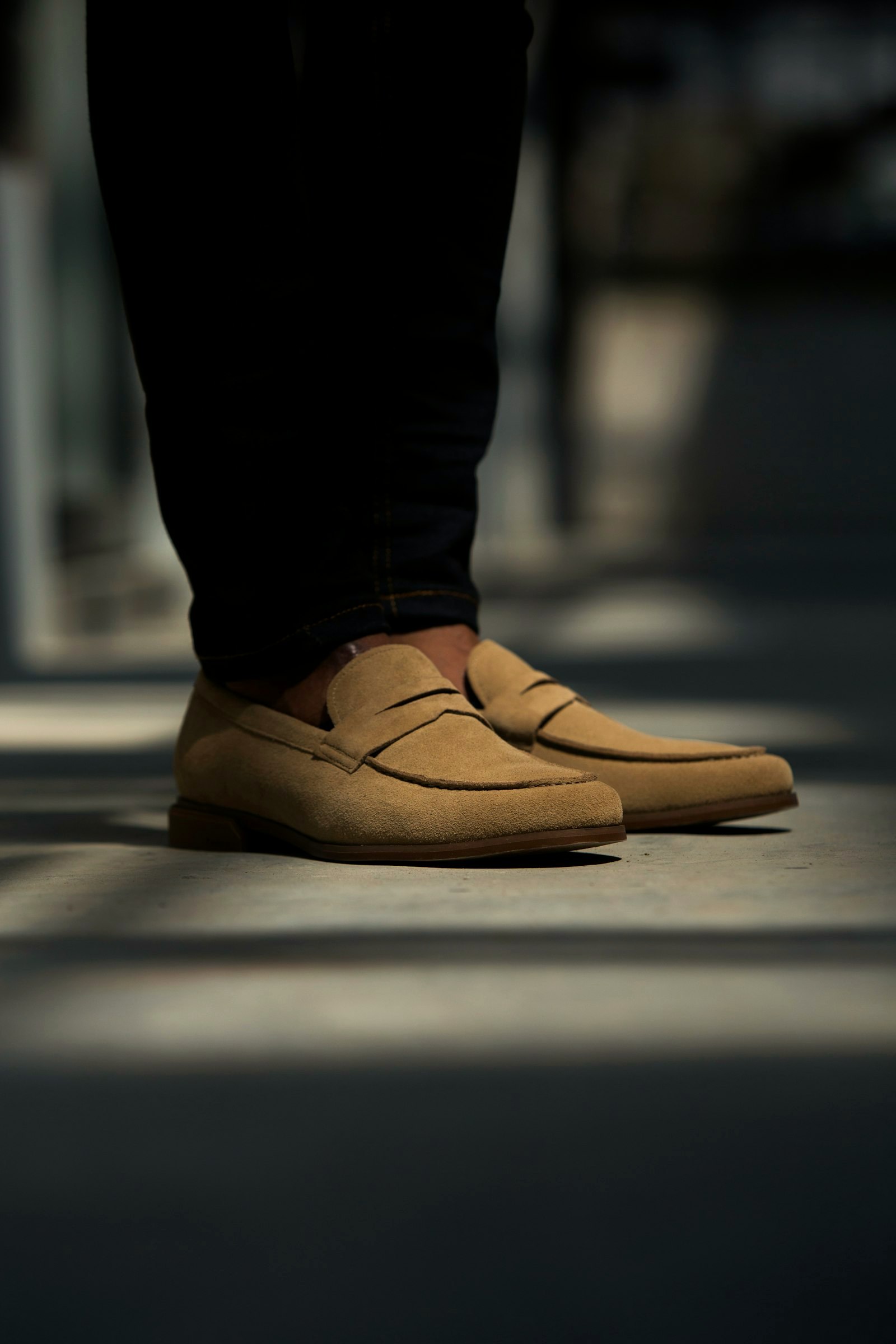
The sneaker follows on No. 12's scale, and the sandal is answered honestly. How to Wear No. 12 grades the clean minimal leather court shoe at formality 3 when clean, the retro runner at 2 and canvas at 1.5, and it files the canvas low-top in its own words as summer's shoe, for shorts and light cloth. The court shoe is the tailored short's second shoe and the chino short's standard; the canvas shoe owns the field rows and the water's edge. The sandal ruling is printed with its evidence status beside it: there is no sandal Verdict Card on this site, so the sandal is ruled here as styling only, the way this series rules any unranked class. A leather sandal, plain, dark, unadorned, is licensed at the resort and water rows, where it is the honest shoe for the ground; it is refused at the tailored row, where it spends in one step the assembly the winner's waistband built; and the flip-flop is refused everywhere except the sand and the pool deck, being footwear for a workplace, the water, and not for a street. The polished dress Oxford is refused on the series' standing ground: a formality 5 shoe under a bare leg is the sheen error at ground level, the shine accusing the leg and the leg accusing the shine.
The sock is a no-show, and the law has one argued exception. No. 11's ruling for the loafer is quoted in substance because it is the whole law in two sentences: you wear a sock the room cannot see, or a sock the outfit chose on purpose, and you almost never wear the bare foot the photographs suggest; with shorts, the sock is a no-show, always, because a visible sock with shorts and loafers is the sandals error. The hygiene truth is printed with it, as No. 11 prints it: the invisible sock is also the honest one, because a bare foot gives a day's sweat nowhere to go but the shoe's lining, which cannot be washed, so the photograph's bare ankle is bought with the shoe's interior, a season at a time. The socks ranked on this site take the same position for summer, the no-show as the heat's default. The exception is argued, not assumed, and it belongs to No. 12: a white crew sock worn with the canvas sneaker as a deliberate period note, licensed there in its own text under denim, chinos and shorts. It is legal because it is legible, a reference worn on purpose at the field rows, with the shoe it was period with. It is not a default, it does not transfer to the loafer at any length, and a quarter sock that is neither invisible nor deliberate is the one true sock error with this garment: the accident between the law and the exception.
The colour order, and the pattern cap
The colour order transfers from No. 29's rail with the Card's buying answer as its first line. Stone first: the Card's own instruction is the winner in stone or navy, worn with loafers, and stone is the summer leg's neutral, the colour that takes every top in this brief without negotiation. Navy second, carrying No. 29's prohibition unchanged: never near-match navy against navy, a navy short under a navy top a shade apart is the near miss, the tones broken by a clear distance or by a belt and a shoe between them. Olive third, the field colour, at home with the tee and canvas rows. Charcoal fourth, the evening end of the twill rail. Black last, as it stands last on the chino rail: a black short reads technical or uniform in most cloths, and the one assembly that licenses it outright is the swim species' monochrome, which is the other ranking's garment and the other ranking's law.
Pattern is capped at the stripe and the check. A short is a small field of cloth and it carries pattern at a higher concentration than a trouser does, so the discipline is stricter than the trouser's: the seersucker stripe, the tonal check, the faint madras in broken tones are the ceiling, patterns that read as texture at conversational distance. The loud print is refused on the street, and its refusal has an address: the print belongs to the swim species, where Verdict Card No. 43 grades it as a claim and sent its loudest example home at 44, a $535 print over a drawstring waist. A printed street short borrows that garment's register without its workplace, resort language worn on a pavement, and it spends the tailored pattern's whole argument on a joke the leg has to carry all day. One patterned surface per outfit is the cap's second half: the camp shirt's tonal botanical over a plain short, or the seersucker short under a plain top, never both halves printed at once.
The looks: the field, worn
Four assemblies from the ranked field of Verdict Card No. 07, each built from this brief's rulings. The skip is in none of them. The frames are the bank's honest summer frames, captioned for what they show; the bank holds no shorts on a body, and the looks are written to stand without borrowing a photograph of a different garment.
Look one: the tailored evening. The Spier & MacKay linen short at 86, in stone, at its tailored length above the knee, the camp collar shirt above it, the Todd Snyder at 84, worn open at the collar and untucked by its construction, a suede loafer below on the no-show law, colour kept clear of the short's tone. This is the garment at the top of its dial: the winner's waistband doing the dressing, the hem in the landing zone, the whole assembly reading deliberate at a dinner table outdoors, which is the room the tailored short was built for and the room the gym short is refused in.
Look two: the bridge, all day. The Patagonia Baggies at 84, in the 5 inch class, a plain tee of the Asket's class at 88 above it, canvas low-tops below on No. 12's filing of that shoe as summer's own. The assembly is the bridge garment worn across its whole range: the morning's swim, the bicycle, the lunch in the same pair, the only look in this brief licensed to get wet. Its ceiling is printed with it, in both of its rankings: it does not go to dinner. It is the second short in the rotation, behind the winner, and as that it has no rival in the field.
Look three: the chino default. The J.Crew stretch chino short at 75, in the 7 inch class, navy, under a knit polo left out on No. 06's hem rule, the clean leather court sneaker at the ground, or a penny loafer where the evening asks one notch more. Bought at its real-world price rather than its fictional list, this is the rotation's working pair: the decoder followed inside one product line, the twill taking the day in stride, the assembly landing at the dressed end of casual as a decision rather than as a default.
Look four: the honest budget, travelling. The Uniqlo chino short at 68, in stone or olive, a linen shirt above it in a broken tone on No. 07's two-decision rule, loafers or canvas trainers below. At $29.90 this is the pair that travels without anxiety, the spare that becomes the favourite in hot cities, and its cost per wear ties the winner's in the Card's own table when it sees its expected summers. The look's discipline is the brief's: the budget bought the pattern honestly, twill and a numbered waist, and spends nothing pretending to be the tailored pair.
The ruling
Buy the short by its landing and wear it by its dial. Choose the inseam class by your leg, not by a photograph: the 5 for the shorter and athletic leg, the 7 as the default, the 9 for the tall leg only, and check the hem in the mirror against the one measurement that settles it, one to three inches above the knee. Buy the tailored pattern for the evening rows, high rise, constructed waistband, real cloth, and wear it as a system or not at all; buy the twill default for the working week of summer; keep the technical pair for motion and travel, inside its ceiling; and let the Baggies be the bridge they are, the one pair scored 84 on both sides of the water. Leave the shirt out unless the tailored assembly has asked for the tuck at every other point. Show no sock, except the one period note worn on purpose with canvas. Cap the pattern at the stripe. The record underneath is one ranking of seven, a decoder, and a bridge to a second ranking across the water, and it is enough: the short is the smallest garment in the wardrobe with a formality system of its own, and the system is one number, landed honestly.
The mistakes
The knee-length short on the short leg. The Card names it in its first paragraphs: the knee-length board short on a short leg reads as a boy in his father's clothes, the hem at or below the knee stealing the length the garment exists to return. It is the decoder ignored at the rail, a class bought by copying a photograph of a taller leg, and it is unfixable by anything worn above it, because the error is the leg's proportion itself. The fix is one class down and the landing zone checked: the mirror, not the tag, is the authority the Card prints.
The gym short at dinner. The Card's sentence, kept whole: what cannot look smart is the gym short at dinner, however expensive it was. The elastic waist and the performance cloth announce a workplace, and the room reads the announcement before it reads the price. The technical species' ceiling in this brief is the same ruling from the wearing side: the suitcase is not the table, and a short bought for motion has been dressed for a room it cannot enter by the simple act of its owner sitting down in it.
Tight and short together. The costume the decoder warns about by name: the 5 inch class worn gripping on a long leg, proportion turned into a reference to athletes and lifeguards, other men's workplaces worn as an outfit. Short is a landing and relaxed is its condition; the leg opening that grips fails the inseam section's second check at any class, and at the shortest class it fails loudest.
The visible sock with the loafer. The sandals error, named by No. 11 and convicted here without appeal: a quarter or crew sock showing above a loafer, under a bare leg, is the one sock state that is neither the law nor the exception, the no-show not worn and the period note not intended. With it goes its cousin, the bare foot in the loafer all day in heat, the photograph's ankle bought with the shoe's unwashed lining. The no-show costs almost nothing. It is the cheapest ruling in this brief to obey and the most expensive to be photographed breaking.
The water boundary, care, and our photography
The boundary, one more time, because the rail will not draw it for you. This brief styles the street short, ranked in Verdict Card No. 07. The swim short is a different garment with its own ranking, Verdict Card No. 43, where the Orlebar Brown Bulldog wins at 85 on a tailored waist, side fasteners instead of elastic, a cloth woven in France and a five-year guarantee: the swim short that has to work on land is built like the tailored street short, and the two rankings agree on the standard from opposite sides of the water. What neither ranking licenses is the traffic between them worn wrong: the street short in the sea, twill and linen drowned and drying for a day, and the swim short worn as the evening's tailored pair on the strength of its price. The Baggies cross legally because they were built to, and both files print their ceiling. Everything else stays on its own side of the waterline.
Care is the season's arithmetic. The Card costs the field per wear on expected summers, and the wearing decides which estimate a pair collects. The tailored linen pair is hung, not folded, rested a day between wears in the rotation, and pressed at the crease it was bought with; the twill pair takes the same press discipline No. 29 prints for its long form, the crease rented by the day and renewed by the iron. The nylon pair is rinsed after salt and chlorine wherever it has been, on the swim file's audit that elastic is what fails first, and a waistband rinsed is a waistband with summers left in it. The skip's arithmetic is the cautionary tale kept in the record: about $25, one summer, about 63 cents a wear, dearer per day than the $48 winner and more than double the $69 pair that outlasts six summers. Cheap shorts are a subscription. The rotation this brief styles, tailored, twill, bridge, spare, is four pairs bought once a decade between them.
A note on our own photography: our photo bank holds no photograph of a short worn on a body in any cloth, no tailored hem landing above a knee, and no sandal worn, and this page will not caption a trouser as a short, a swim short as a street short, or a shoe as a garment to fill the slot. The hero is the summer ground in the Card's own hero frame, white sneakers on sunlit concrete; the figures inside are a suede loafer at street level and a plain tee in hard sun, captioned as footwear and as a top half respectively, because those are the halves of the outfit the bank can honestly show. The harvest list names what is missing: a tailored short worn on a street in stone and in navy, a hem landing at macro range in the zone one to three inches above the knee, a linen short beside its twill counterpart in the same light, and a plain leather sandal worn at a resort rail. This page will take those frames the week they exist.
Questions, answered
What inseam should shorts be?
The one whose hem lands one to three inches above your knee, which is the landing zone Verdict Card No. 07's decoder prints and the check that settles every class argument. Start from your height, then adjust for your leg. Under about 5 foot 8, start with a 5 inch inseam. From 5 foot 8 to about 6 foot 1, start with 7 inches, the class that suits the most men and the default of this brief. Over 6 foot 1, start with 9 inches. Then correct for proportion: long legs take one class up, short legs one class down. Rise changes the read as well: a higher rise makes the same inseam look longer-legged, which is part of why the Card's tailored winner photographs a class above its number.
Are 5 inch shorts too short?
On the right legs, no, and the Card's answer stands: a 5 inch inseam lands mid-thigh, it lengthens the read of shorter legs, suits athletic builds, and is the default in the rooms that set warm-weather style. It reads too short when the leg is long and the short is also tight, which turns proportion into costume. The two checks are the landing and the opening: if the hem lands in the middle third of your thigh and the leg opening does not grip, the length is right. Short is a landing, not a number, and a relaxed 5 on a shorter leg is a more conservative garment than a gripping 7 on any leg.
Can shorts look smart?
Yes, when they are built like trousers, which is Verdict Card No. 07's answer and its winner's whole case. A tailored waistband, a proper rise, a hem one to three inches above the knee and cloth with some structure reads deliberate with loafers and a tucked shirt: the summer-evening uniform from Milan to the Lower East Side, and the Spier & MacKay linen short at 86 is the field's proof, the only pair in the ranking cut like a trouser. Pleats and a crease join that assembly only as a system, high rise, crease, loafer and a tucked or camp collar shirt, the Riviera read; the same pleats on a low rise and a long hem are a school uniform. What cannot look smart is the gym short at dinner, however expensive it was, and most offices remain a no. The ranking says so, and so does this brief.
Should you tuck a shirt into shorts?
By the bottom half, on How to Wear No. 06's rule, which names shorts in its own text: with shorts, denim or anything worn open and casual, leave it out, provided the hem ends where it should, around the belt line and never past the fly. How to Wear No. 29 adds the mechanism and the one exception. The rise decides: a rise at the natural waist keeps a tucked shirt tucked, and a low rise spends the day ejecting it. So the tailored short, high rise, constructed waistband, worn with a belt and loafers, is the one shorts assembly that takes a tuck, because its whole construction has asked for a clean waist; every other pair is worn untucked or not with a shirt at all. The half-tuck is refused here as it is refused on No. 06 and No. 29: not a third option, an accident that has been photographed too often.
What shoes go with shorts?
The loafer is the ceiling shoe, on How to Wear No. 11's one-notch rule: a loafer moves an outfit exactly one notch and never two, and over a short it spends that notch on ease with its polish intact, the penny at formality 3.5, the tassel at 4, the horsebit at 4.5. The sneaker follows on No. 12's scale: the clean minimal leather court shoe at 3 is the tailored short's second shoe, and the canvas low-top at 1.5 is filed by No. 12 itself as summer's shoe, for shorts and light cloth, the field end of the matrix. The sandal is answered honestly: there is no sandal Verdict Card on this site, so it is ruled here as styling only, a leather sandal licensed at the resort and water rows and refused at the tailored row, where it spends the assembly the winner built. The polished dress Oxford is refused the way the chino and leather briefs refuse it: a formality 5 shoe under a bare leg is the sheen error at ground level.
Should you wear socks with shorts?
A sock the room cannot see, or a sock the outfit chose on purpose, and almost never the bare foot the photographs suggest, which is How to Wear No. 11's ruling for loafers and this brief's law for the whole garment. With loafers the sock is a no-show, always: No. 11 prints that a visible sock with shorts and loafers is the sandals error, and the invisible sock is also the honest one, because a bare foot gives a day's sweat nowhere to go but the shoe's lining, which cannot be washed. The one argued exception is No. 12's: a white crew sock worn as a deliberate period note, licensed there under denim, chinos and shorts with the canvas sneaker. It is period dress, worn on purpose and read as a reference, legal at the field rows and never with a loafer, where the no-show law has no exceptions.
Are swim shorts the same as shorts?
No, and the site keeps the two in separate rankings on purpose. This brief styles the street short, the field ranked in Verdict Card No. 07. The swim short is Verdict Card No. 43's garment: the Orlebar Brown Bulldog wins there at 85 on a tailored waist with side fasteners and a five-year guarantee, and its record is cited here, never re-ruled. One garment stands in both rankings and it is the honest bridge between them: the Patagonia Baggies, scored 84 as a street short and 84 as a swim short, the pair that swims, hikes and travels and carries a ceiling on where it can go after dark in both files. Past a 9 inch inseam either ranking leaves its garment behind: that is boardshort territory, surf equipment, a third species with its own rules.
Has Young Cotton ranked shorts?
Yes, since Verdict Card No. 07 ranked seven street shorts on cloth, cut, construction, value and longevity, the Spier & MacKay linen short winning at 86 as the only pair cut like a trouser, the Patagonia Baggies second at 84 and the cheapest pair per wear in the field, and the H&M slim short sent home at 46 on one summer of service at about 63 cents a wear. The swim species is ranked separately in Verdict Card No. 43, the Orlebar Brown Bulldog at 85. This brief is the wearing system those records imply: the inseam decoder worn as a formality dial, the hem landing as law, the cloth species and their ceilings, the tailored assembly and its conditions, and the footwear and sock rulings, printed so any short can be judged on the wearing, with the Cards now judging the buying.
Next
The ranking this brief styles from is Verdict Card No. 07, and the species across the water is Verdict Card No. 43. The long form of the same cloth is briefed in How to Wear No. 29, the linen system in No. 07, and the leg's whole family is indexed in the types of pants index, whose figure wears the chino by default and switches to shorts for summer. The tops are briefed in No. 06 and the camp collar Verdict Card, the shoes in No. 11 and No. 12, the waist in Verdict Card No. 17, and the layer among the site's winners is mapped in the Body Map, legs layer, summer switch.